Unit 5 · General and Physical Chemistry · 9 teaching hours · 23 min read
Chemical Bonding and Shapes of Molecules
What the syllabus asks for 12
- Valence shell, valence electron and octet theory
- Ionic bond and its properties
- Covalent bond and coordinate covalent bond; properties of covalent compounds
- Lewis dot structure of common compounds of s and p block elements
- Resonance
- VSEPR theory and shapes of simple molecules (BeF2, BF3, CH4, CH3Cl, PCl5, SF6, H2O, NH3, CO2, H2S, PH3)
- Elementary idea of Valence Bond Theory
- Hybridization involving s and p orbitals only
- Bond characteristics: bond length, ionic character, dipole moment
- Van der Waals' force and molecular solids
- Hydrogen bonding and its application
- Metallic bonding and properties of metallic solids
Almost nothing in nature exists as free atoms. Atoms join because the combination has lower energy than the separate atoms, and how they join — by transferring electrons, sharing them, or pooling them — decides everything about the substance: whether it melts at 801 °C like NaCl or boils at −161 °C like CH₄, whether it conducts, and what it dissolves in.
(i) Why does this bond form — in terms of electrons and octets? (ii) What shape is the molecule — from VSEPR and hybridisation, with the bond angle? (iii) What property follows — melting point, conductivity, solubility, dipole moment. Learn to answer all three for any formula you are given.
5.1 Valence shell, valence electron and octet theory
The valence shell is the outermost shell of an atom; the electrons in it are the valence electrons, and only these take part in bonding. Sodium (2, 8, 1) has one; chlorine (2, 8, 7) has seven.
In 1916 Kössel and Lewis noted that the noble gases — with ns²np⁶ — are almost completely unreactive, which gives the octet rule.
Atoms combine by losing, gaining or sharing electrons so as to acquire eight electrons in their valence shell, the configuration of the nearest noble gas. H, He, Li and Be aim for a duplet (two electrons) instead.
The rule is a good first guess, not a law. It fails in four ways:
| Failure | Examples |
|---|---|
| Incomplete octet | BeCl₂ (4 e⁻ on Be), BF₃ (6 e⁻ on B), AlCl₃ |
| Expanded octet (elements of period 3 onwards, which have vacant d orbitals) | PCl₅ (10 e⁻), SF₆ (12 e⁻), IF₇ |
| Odd-electron molecules | NO (11 e⁻), NO₂, ClO₂ |
| Noble gases do react | XeF₂, XeF₄, XeO₃ |
It also says nothing about the shape or the strength of a bond — which is why the rest of this unit exists.
5.2 Ionic bond and its properties
The electrostatic force of attraction that holds together the oppositely charged ions produced by the complete transfer of one or more electrons from a metal atom to a non-metal atom.
Na (2, 8, 1) − e⁻ → Na⁺ (2, 8) and Cl (2, 8, 7) + e⁻ → Cl⁻ (2, 8, 8), so
2Na + Cl₂ → 2Na⁺Cl⁻
Three conditions favour it: low ionization energy of the metal, high electron affinity of the non-metal, and a high lattice energy — the energy released when one mole of the crystal forms from its gaseous ions. As a working rule ΔEN must exceed about 1.7 (Na–Cl is 3.0 − 0.9 = 2.1). Lattice energy is 788 kJ mol⁻¹ for NaCl but 3791 kJ mol⁻¹ for MgO, whose ions carry double charges — hence melting points of 801 °C and 2852 °C.
The electrostatic field of an ion is the same in every direction, so the ionic bond is non-directional: there is no "molecule" of NaCl, only a giant lattice in which every Na⁺ touches six Cl⁻.
5.3 Covalent bond and coordinate covalent bond; properties of covalent compounds
A covalent bond is formed by the mutual sharing of one or more electron pairs between two atoms, each contributing an equal number of electrons. Sharing one pair gives a single bond (H–H), two pairs a double bond (O=O), three pairs a triple bond (N≡N).
A covalent bond in which both the shared electrons come from the same atom. The atom supplying the lone pair is the donor, the atom with the empty orbital is the acceptor, and the bond is written as an arrow from donor to acceptor.
Two standard examples: NH₃ + H⁺ → NH₄⁺ (the lone pair on N is donated to a bare proton) and NH₃ + BF₃ → H₃N→BF₃ (the same lone pair completes boron's octet). Once formed, a coordinate bond is indistinguishable from an ordinary covalent bond — all four N–H bonds in NH₄⁺ are identical.
| Property | Ionic compounds | Covalent compounds |
|---|---|---|
| Physical state | hard, brittle crystalline solids | gases, liquids or soft solids |
| Melting / boiling point | very high (NaCl 801 °C) | low (CCl₄ 77 °C) |
| Electrical conduction | conduct when molten or in water, not when solid | do not conduct (no free ions) |
| Solubility | soluble in polar solvents (water) | soluble in non-polar solvents (benzene, ether) |
| Nature of bond | non-directional | strongly directional |
| Isomerism | not shown | shown |
| Rate of reaction | fast (ionic reactions) | slow (bonds must break) |
5.4 Lewis dot structure of common compounds of s and p block elements
A Lewis (electron-dot) structure shows every valence electron as a dot — shared pairs between the symbols, lone pairs around them. To draw one:
- Add up the valence electrons of all atoms; add one for each negative charge and subtract one for each positive charge. Call this A.
- Work out the electrons needed to give every atom a full shell (8 each, 2 for hydrogen). Call this N.
- The number of shared electrons is S = N - A, i.e. S/2 bond pairs.
- The remaining (A - S)/2 pairs are placed as lone pairs, oxygen and the halogens first.
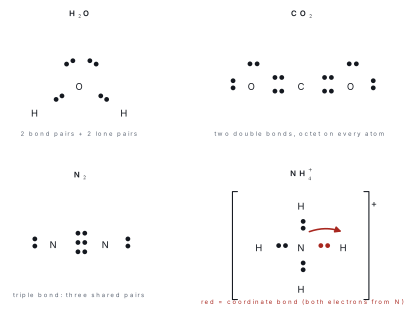
Problem. Draw the Lewis structure of sulphur dioxide and assign formal charges.
Solution. Step 1: A = 6 + 2(6) = 18 valence electrons.
Step 2: N = 3 \times 8 = 24 electrons for three complete octets.
Step 3: shared electrons S = N - A = 24 - 18 = 6, i.e. 3 bond pairs. With only two S–O links, one must be a double bond and the other a single bond.
Step 4: lone pairs = (A - S)/2 = (18-6)/2 = 6 pairs — one on S, two on the doubly bonded O, three on the singly bonded O.
Formal charge = (valence electrons) − (lone-pair electrons) − ½(bonding electrons):
So the structure is O=S⁺–O⁻. Since the double bond could equally be on the other oxygen, SO₂ is a resonance hybrid of two such forms, and both S–O bonds are found to be the same length (143 pm) with an O–S–O angle of 119.5°.
5.5 Resonance
When a single Lewis structure cannot account for all the observed properties of a molecule, several structures are written that differ only in the positions of electrons, never of atoms.
The actual structure of such a molecule is a resonance hybrid — a single structure intermediate between all the contributing (canonical) forms, and more stable than any of them. The extra stability is the resonance energy.
Conditions: the canonical forms must have the same arrangement of atoms, the same number of paired electrons, and roughly comparable energies.
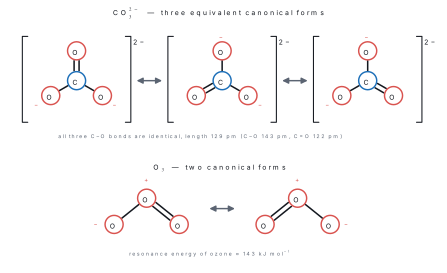
The carbonate ion does not flip between the three structures. It has one structure — the hybrid — at all times. The canonical forms are imaginary pictures we draw because our dot notation cannot show a delocalised pair, just as a mule is not a horse on Sundays and a donkey on Mondays.
5.6 VSEPR theory and shapes of simple molecules
The Valence Shell Electron Pair Repulsion theory (Sidgwick and Powell, developed by Gillespie and Nyholm) predicts shape from electron-pair counting alone. Its postulates:
- The shape of a molecule depends on the total number of electron pairs (bonding + lone) in the valence shell of the central atom.
- These pairs repel one another and arrange themselves as far apart as possible.
- Repulsion falls in the order lone pair–lone pair > lone pair–bond pair > bond pair–bond pair, so lone pairs squeeze the bond angles.
- A multiple bond is treated as a single "super pair" for counting shape, but it repels more strongly than a single bond.
The number of electron pairs X around the central atom is
where V is the number of valence electrons of the central atom, M the number of monovalent atoms attached, c the positive charge and a the negative charge on the ion.
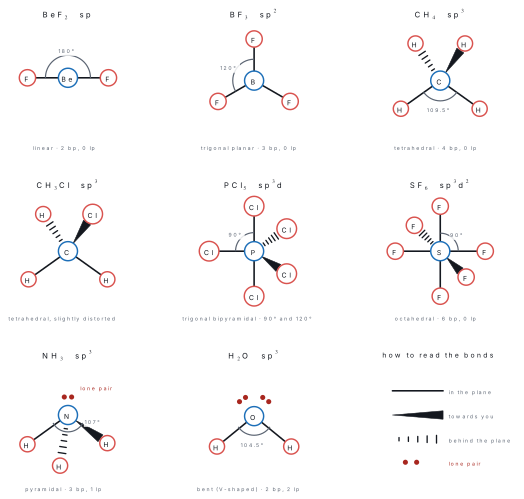
| Molecule | Bond pairs | Lone pairs | X | Hybridisation | Arrangement of pairs | Shape | Bond angle |
|---|---|---|---|---|---|---|---|
| BeF₂ | 2 | 0 | 2 | sp | linear | linear | 180° |
| CO₂ | 2 | 0 | 2 | sp | linear | linear | 180° |
| BF₃ | 3 | 0 | 3 | sp² | trigonal planar | trigonal planar | 120° |
| CH₄ | 4 | 0 | 4 | sp³ | tetrahedral | tetrahedral | 109.5° |
| CH₃Cl | 4 | 0 | 4 | sp³ | tetrahedral | tetrahedral (distorted) | ≈110° |
| NH₃ | 3 | 1 | 4 | sp³ | tetrahedral | trigonal pyramidal | 107° |
| PH₃ | 3 | 1 | 4 | sp³ | tetrahedral | trigonal pyramidal | 93.5° |
| H₂O | 2 | 2 | 4 | sp³ | tetrahedral | bent (V-shaped) | 104.5° |
| H₂S | 2 | 2 | 4 | sp³ | tetrahedral | bent (V-shaped) | 92° |
| PCl₅ | 5 | 0 | 5 | sp³d | trigonal bipyramidal | trigonal bipyramidal | 120° and 90° |
| SF₆ | 6 | 0 | 6 | sp³d² | octahedral | octahedral | 90° |
Problem. Predict the shape and bond angle of (a) H₂S, (b) PH₃, (c) CO₂.
Solution. (a) H₂S: V = 6 (sulphur), M = 2, c = a = 0.
Four pairs → tetrahedral arrangement; two are bonding, two are lone pairs, so the shape is bent. The two lone pairs push the bonds together, giving 92° — smaller than in H₂O because sulphur is bigger and less electronegative, so its bond pairs sit further from the central atom.
(b) PH₃: X = \frac{1}{2}(5+3) = 4; 3 bond pairs + 1 lone pair → trigonal pyramidal, angle 93.5°.
(c) CO₂: oxygen is divalent, so M = 0 and X = \frac{1}{2}(4+0) = 2. Two electron regions → linear, 180°. Note that although each C=O bond is polar, the molecule is not.
5.7 Elementary idea of Valence Bond Theory
Valence Bond Theory (Heitler, London and Pauling) treats a covalent bond as the overlap of two half-filled atomic orbitals holding electrons of opposite spin. As two H atoms approach, the attraction of each nucleus for the other's electron lowers the potential energy; at 74 pm it reaches a minimum 436 kJ mol⁻¹ below the free atoms, and any closer the nuclei repel. That minimum is the bond: 74 pm is the bond length and 436 kJ mol⁻¹ the bond dissociation energy of H₂.
The greater the overlap, the stronger the bond. Two kinds occur:
| Bond | Overlap | Strength | Rotation | Example |
|---|---|---|---|---|
| σ (sigma) | head-on, along the internuclear axis (s–s, s–p, p–p) | strong | free | H–H, C–H |
| π (pi) | sideways, above and below the axis (p–p) | weaker | not free | second bond of C=C |
A double bond is therefore σ + π and a triple bond σ + 2π. Simple VBT cannot explain why CH₄ has four identical bonds at 109.5°, or why O₂ is paramagnetic; the first difficulty is removed by hybridisation.
5.8 Hybridization involving s and p orbitals only
The intermixing of atomic orbitals of an atom that are close in energy to produce a set of new orbitals of equal energy and identical shape, called hybrid orbitals, which are oriented so as to be as far apart as possible.
The number of hybrids always equals the number of orbitals mixed, and hybrids overlap better than pure orbitals, so their bonds are stronger.
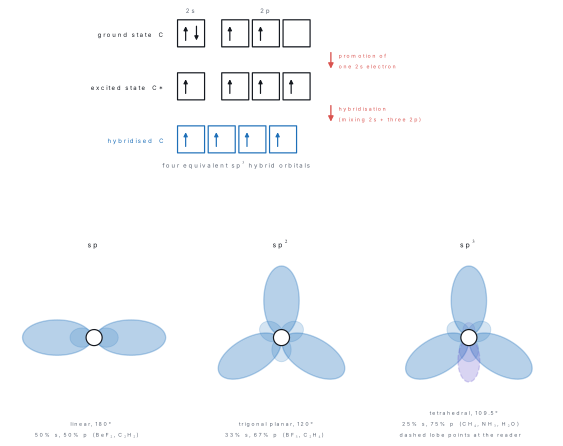
| Hybridisation | Orbitals mixed | Hybrids formed | Geometry | Angle | Examples |
|---|---|---|---|---|---|
| sp | one s + one p | 2 | linear | 180° | BeF₂, BeCl₂, C₂H₂, CO₂ |
| sp² | one s + two p | 3 | trigonal planar | 120° | BF₃, C₂H₄, SO₂ |
| sp³ | one s + three p | 4 | tetrahedral | 109.5° | CH₄, NH₃, H₂O, NH₄⁺ |
In NH₃ and H₂O the central atom is still sp³, but one and two of the four hybrids respectively hold lone pairs, which is exactly why the observed angles (107° and 104.5°) fall short of 109.5°.
5.9 Bond characteristics: bond length, ionic character, dipole moment
Bond length is the equilibrium internuclear distance. It decreases as bond order rises, as the atoms get smaller, and as the s character of the hybrid increases (sp > sp² > sp³).
| Bond | C–C | C=C | C≡C | H–H | O–H | C–Cl |
|---|---|---|---|---|---|---|
| Length / pm | 154 | 134 | 120 | 74 | 96 | 177 |
| Bond energy / kJ mol⁻¹ | 348 | 614 | 839 | 436 | 463 | 328 |
Ionic character. No bond is purely covalent unless the two atoms are identical. When they differ in electronegativity the shared pair is pulled to the more electronegative atom, giving partial charges δ⁺ and δ⁻ — a polar covalent bond. The bigger the ΔEN, the more ionic the bond; at ΔEN ≈ 1.7 it is half ionic.
Dipole moment measures that polarity:
where q is the separated charge and d the distance between the centres of positive and negative charge. The unit is the debye, 1 D = 3.336 × 10⁻³⁰ C m. Dipole moment is a vector drawn from δ⁺ to δ⁻, so the molecular dipole is the vector sum of the bond dipoles.
| Molecule | μ / D | Why |
|---|---|---|
| HF, HCl, HBr, HI | 1.91, 1.03, 0.79, 0.38 | falls as ΔEN falls |
| H₂O | 1.85 | bent, so bond dipoles do not cancel |
| NH₃ | 1.47 | pyramidal; lone pair adds to the resultant |
| CO₂, BF₃, CCl₄ | 0 | symmetrical, bond dipoles cancel exactly |
| CHCl₃ | 1.04 | symmetry broken by replacing one Cl with H |
CO₂ has two strongly polar C=O bonds yet μ = 0, because the molecule is linear and the two equal dipoles point in opposite directions. Always check the shape before deciding whether a molecule is polar.
Problem. The observed dipole moment of HCl is 1.03 D and the H–Cl bond length is 1.27 Å. Calculate the percentage ionic character of the bond.
Solution. If the bond were 100% ionic, a full electronic charge e = 1.602\times10^{-19} C would sit at each end, separated by d = 1.27\times10^{-10} m:
Converting to debye,
So the H–Cl bond is about 17% ionic and 83% covalent — consistent with ΔEN = 3.0 − 2.1 = 0.9.
Problem. Each O–H bond moment in water is 1.5 D and the H–O–H angle is 104.5°. Calculate the dipole moment of the molecule.
Solution. The two bond dipoles are equal in magnitude and inclined at \theta = 104.5^{\circ}, so by the parallelogram law
The measured value is 1.85 D, so the bent shape is confirmed. Had the molecule been linear, \theta = 180^{\circ} would give \mu = 0.
5.10 Van der Waals' force and molecular solids
Even molecules with no net charge attract one another weakly. These van der Waals forces are worth 1–40 kJ mol⁻¹ against ≈400 for a covalent bond.
| Type | Acts between | Example |
|---|---|---|
| Dipole–dipole | two polar molecules | HCl, CH₃Cl |
| Dipole–induced dipole | a polar and a non-polar molecule | HCl and Ar |
| London dispersion | any two molecules; an instantaneous dipole induces one in its neighbour | Cl₂, I₂, noble gases |
Dispersion forces grow with the number of electrons, so the halogens turn from gas to solid down the group: F₂ boils at −188 °C, Cl₂ at −34 °C, Br₂ at 59 °C, and I₂ melts at 114 °C. Molecular solids (I₂, dry ice, naphthalene, ice) are held by these forces alone, so they are soft, volatile, low-melting and non-conducting.
5.11 Hydrogen bonding and its application
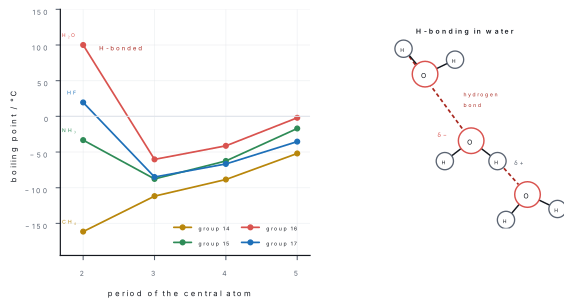
The weak electrostatic attraction between a hydrogen atom covalently bonded to a small, highly electronegative atom (F, O or N) and a lone pair on another such atom. Its strength is 10–40 kJ mol⁻¹, about one twentieth of a covalent bond.
It is intermolecular when it joins separate molecules (water, HF, alcohols, carboxylic acids) and intramolecular when it closes a ring inside one molecule. The difference is measurable: o-nitrophenol, bonded to itself, melts at 45 °C, while p-nitrophenol, which can only bond to its neighbours, melts at 114 °C.
Applications and consequences:
- High boiling points: water boils at 100 °C when H₂S, with a heavier molecule, boils at −60 °C.
- Ice floats. In ice every molecule is hydrogen-bonded tetrahedrally to four others, making an open cage. Ice has a density of 0.92 g cm⁻³ against 1.00 for water, so lakes freeze from the top and fish survive the Himalayan winter.
- Solubility: ethanol, sugar, glucose and ammonia dissolve freely in water because they can hydrogen-bond to it; hydrocarbons cannot and do not.
- Association: ethanoic acid exists as a dimer in benzene, so its measured molecular mass is 120 instead of 60.
- Biology: the two strands of DNA are held together by hydrogen bonds between base pairs, and proteins owe their α-helix to them.
- High surface tension and viscosity of water, and the stiffness of cellulose and nylon fibres.
5.12 Metallic bonding and properties of metallic solids
In a metal the valence electrons are so loosely held that they leave their parent atoms and move freely through the whole crystal.
The force of attraction between the positively charged metal ions fixed at the lattice points and the "sea" of delocalised valence electrons moving among them.
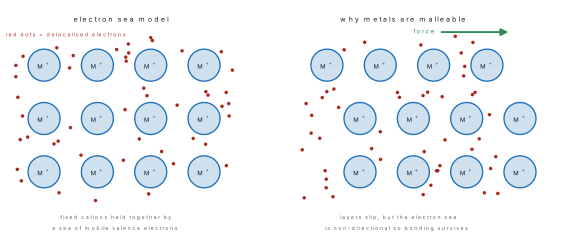
Its strength rises with the number of valence electrons contributed and falls with cation size: Na (1 e⁻, m.p. 98 °C) < Mg (2 e⁻, 650 °C) < Al (3 e⁻, 660 °C and far harder).
| Property of metallic solids | Explanation |
|---|---|
| Electrical conductivity | delocalised electrons drift under an applied field |
| Thermal conductivity | mobile electrons carry kinetic energy quickly |
| Metallic lustre | free electrons absorb and re-emit light of all frequencies |
| Malleability and ductility | layers slip without breaking a directional bond |
| High density, high m.p. and b.p. | close packing and strong non-directional attraction |
| Alloy formation | similar-sized cations substitute freely in the lattice |
Chapter summary
- Atoms bond to reach a noble-gas octet (duplet for H). The octet rule fails for incomplete octets (BF₃), expanded octets (SF₆), odd-electron molecules (NO) and noble-gas compounds.
- Ionic bond = complete transfer (ΔEN > 1.7), giving a non-directional giant lattice: high melting point, conducts only when molten or aqueous.
- Covalent bond = shared pairs; a coordinate bond is a shared pair donated entirely by one atom (NH₄⁺, H₃N→BF₃).
- Lewis structures: shared pairs S = N - A; lone pairs = (A-S)/2; formal charge = valence − lone-pair electrons − ½(bonding electrons).
- Resonance: one hybrid structure, not a mixture; it equalises bond lengths and lowers the energy by the resonance energy.
- VSEPR: X = \frac{1}{2}(V + M - c + a) pairs; repulsion lp–lp > lp–bp > bp–bp, so CH₄ 109.5° > NH₃ 107° > H₂O 104.5°.
- sp, sp² and sp³ hybrids give linear (180°), trigonal planar (120°) and tetrahedral (109.5°) geometries; a double bond is σ + π, a triple bond σ + 2π.
- \mu = q \times d in debye; a symmetrical molecule has \mu = 0 even with polar bonds; % ionic character = (\mu_{obs}/\mu_{ionic}) \times 100.
- Van der Waals forces (weak, grow with size) < hydrogen bonds (10–40 kJ mol⁻¹, need F, O or N) < covalent/ionic/metallic bonds.
Practice questions
Group A — Multiple choice (1 mark each)
- The shape of the PH₃ molecule is [1]atrigonal planarbtrigonal pyramidalctetrahedraldbent
- Which of the following has zero dipole moment? [1]aH₂ObNH₃cBF₃dCHCl₃
- The number of coordinate covalent bonds in the ammonium ion is [1]a0b1c2d4
- The correct order of bond angle is [1]aH₂O > NH₃ > CH₄bCH₄ > NH₃ > H₂OcNH₃ > CH₄ > H₂OdCH₄ > H₂O > NH₃
- Which property is not a consequence of hydrogen bonding? [1]aice floats on waterbHF is a liquid near room temperaturecmethane has a very low boiling pointdethanol mixes with water in all proportions
Answers to Group A
1. (b) — X = \frac{1}{2}(5+3) = 4: three bond pairs and one lone pair.
2. (c) — BF₃ is trigonal planar and symmetrical, so the three bond dipoles cancel.
3. (b) — one, formed when N donates its lone pair to H⁺; all four bonds then become identical.
4. (b) — lone pairs repel more strongly, so each lone pair closes the angle: 109.5°, 107°, 104.5°.
5. (c) — CH₄ has no F, O or N, so there is no hydrogen bonding at all; its low boiling point is due to weak dispersion forces.
Group B — Short answer (5 marks each)
- What is a coordinate covalent bond? Explain its formation in NH₄⁺ and in the addition compound H₃N→BF₃. [5]
- State the postulates of VSEPR theory and use them to account for the fall in bond angle from CH₄ (109.5°) to NH₃ (107°) to H₂O (104.5°). [5]
- Define dipole moment. The observed dipole moment of HBr is 0.79 D and the H–Br bond length is 1.41 Å. Calculate the percentage ionic character of the bond. [5]
- What is hydrogen bonding? Explain why water boils at 100 °C while H₂S boils at −60 °C, and why ice floats on water. [5]
- Give any five points of difference between ionic and covalent compounds. [5]
Answers to Group B
2. All three have four electron pairs and sp³ hybridisation, so the ideal angle is 109.5°. CH₄ has no lone pair and keeps it. NH₃ has one lone pair; since lp–bp repulsion exceeds bp–bp repulsion, the three bonds are pushed closer to 107°. H₂O has two lone pairs, and the additional lp–lp repulsion closes the angle further to 104.5°.
3. \mu = q \times d is the product of the separated charge and its separation, measured in debye. For a fully ionic H–Br bond, \mu_{ionic} = (1.602\times10^{-19})(1.41\times10^{-10}) = 2.259\times10^{-29} C m = 2.259\times10^{-29}/3.336\times10^{-30} = 6.77 D. Hence
% ionic character = (0.79/6.77)\times100 = 11.7\%.
4. A hydrogen bond is the attraction between an H atom bonded to F, O or N and a lone pair on another such atom. Water molecules are extensively hydrogen-bonded, so a great deal of extra energy is needed to separate them; sulphur is too large and too weakly electronegative to hydrogen-bond, so H₂S is held only by weak van der Waals forces and boils 160 °C lower. In ice each molecule is hydrogen-bonded to four neighbours in an open tetrahedral cage containing empty space; this makes ice (0.92 g cm⁻³) less dense than liquid water (1.00 g cm⁻³), so it floats.
Group C — Long answer (8 marks each)
- (a) State the postulates of VSEPR theory. Predict, with reasons, the shape, hybridisation and bond angle of BF₃, PCl₅, SF₆ and H₂O. [5](b) Both BeF₂ and H₂O are triatomic, yet BeF₂ is linear and H₂O is bent. Explain. [3]
- (a) What is hybridisation? Describe sp, sp² and sp³ hybridisation with one example of each, stating the geometry and bond angle. [5](b) The dipole moment of H₂O is 1.85 D but that of CO₂ is zero, although both contain polar bonds. Explain, and calculate the resultant for water from an O–H bond moment of 1.5 D and a bond angle of 104.5°. [3]
Answers to Group C
1.(b) In BeF₂, X = \frac{1}{2}(2+2) = 2: beryllium has two bond pairs and no lone pair, so the pairs get as far apart as possible at 180° and the molecule is linear (sp). In H₂O, X = \frac{1}{2}(6+2) = 4: oxygen has two bond pairs and two lone pairs, arranged tetrahedrally (sp³). Only the atoms are seen, so the shape is bent, and the lone pairs squeeze the angle to 104.5°.
2.(b) CO₂ is linear, so its two equal C=O bond dipoles point in exactly opposite directions and cancel: \mu = 0. Water is bent, so its bond dipoles add vectorially to a non-zero resultant: \mu = 2(1.5)\cos(104.5^{\circ}/2) = 3.0 \times 0.6122 = 1.84 D, in agreement with the measured 1.85 D.
Practise more: Chemistry question bank