Unit 1 · General and Physical Chemistry · 2 teaching hours · 13 min read
Foundation and Fundamentals
What the syllabus asks for 4
- General introduction of chemistry
- Importance and scope of chemistry
- Basic concepts: atoms, molecules, relative masses of atoms and molecules, amu, radicals, molecular formula, empirical formula
- Percentage composition from molecular formula
Everything you can touch, breathe or drink is matter, and chemistry is the science of what matter is made of and how it changes. This short opening unit fixes the vocabulary and the counting rules that the other sixteen units will use without further comment: atom, molecule, radical, atomic mass unit, empirical formula, molecular formula. Get these exactly right now and the stoichiometry in Unit 2 becomes arithmetic instead of guesswork.
Two things, almost every year: a definition (atom vs molecule, empirical vs molecular formula, atomic mass unit) and a percentage composition numerical. Both are full-mark questions if you show the molar mass working.
1.1 General introduction of chemistry
Chemistry is the branch of science that deals with the composition, structure, properties and transformations of matter, and with the energy changes that accompany those transformations.
Matter is anything that has mass and occupies space. Chemistry studies matter at the level of its particles — atoms, molecules and ions — and explains bulk behaviour (why iron rusts, why ice floats, why a lemon tastes sour) in terms of what those particles do.
The subject grew out of alchemy, the medieval search for a way to turn base metals into gold. It became a quantitative science when Antoine Lavoisier (1743–1794) began weighing his reactants and products and stated the law of conservation of mass; he is called the father of modern chemistry. John Dalton's atomic theory (1808) then gave the weighings a particle explanation, and the modern subject follows from there.
| Branch | Deals with |
|---|---|
| Physical chemistry | Principles and laws governing chemical change — energy, rates, equilibrium, structure |
| Inorganic chemistry | Elements and their compounds other than hydrocarbons and their derivatives |
| Organic chemistry | Compounds of carbon: hydrocarbons and their derivatives |
| Analytical chemistry | Detection (qualitative) and estimation (quantitative) of substances |
| Biochemistry | Chemical processes inside living organisms |
| Industrial / applied chemistry | Manufacture of chemicals on a commercial scale |
| Nuclear chemistry | Changes in the nucleus: radioactivity, fission, fusion |
| Environmental chemistry | Chemical species in air, water and soil, and pollution |
1.2 Importance and scope of chemistry
Chemistry is called the central science because physics, biology, geology, agriculture, medicine and engineering all borrow from it.
| Field | What chemistry contributes |
|---|---|
| Agriculture | Fertilizers (urea, DAP, potash), pesticides, soil-pH correction with lime |
| Medicine | Drug synthesis — antibiotics, analgesics, vaccines, anaesthetics |
| Industry | Cement, glass, paper, soap and detergents, paints, plastics, textiles |
| Energy | Petroleum refining, LPG, biogas, batteries, solar-cell materials |
| Food | Preservatives, iodisation of salt, vitamins, food testing for adulteration |
| Environment | Water purification, monitoring of SO₂ and CO₂, ozone-layer studies |
| Materials | Alloys, semiconductors, ceramics, nano-materials, polymers |
In Nepal the scope is very concrete. Cement plants at Udayapur and Hetauda convert limestone (CaCO₃) into clinker; iodised salt distributed by the Salt Trading Corporation has removed goitre from most hill districts; arsenic test kits in the Terai screen tube-well water; and the country imports several hundred thousand tonnes of urea and DAP every year, so knowing the nitrogen content of a fertilizer bag is a genuinely useful piece of chemistry.
1.3 Basic concepts
Atoms and molecules
An atom is the smallest particle of an element that takes part in a chemical reaction. It may or may not be able to exist independently. A molecule is the smallest particle of an element or compound that can exist independently and shows all the properties of that substance.
The number of atoms present in one molecule of a substance is its atomicity.
| Atomicity | Meaning | Examples |
|---|---|---|
| Monoatomic | 1 atom per molecule | He, Ne, Ar, Na (vapour) |
| Diatomic | 2 atoms | H₂, O₂, N₂, Cl₂, HCl, CO |
| Triatomic | 3 atoms | O₃, H₂O, CO₂ |
| Tetra-atomic | 4 atoms | NH₃, P₄ |
| Polyatomic | many atoms | S₈, C₆H₁₂O₆ |
Relative masses and the atomic mass unit
An atom of oxygen weighs about 2.66 × 10⁻²³ g. Numbers like this are useless in the laboratory, so chemists compare masses instead of quoting them. The agreed standard is the carbon-12 atom.
One atomic mass unit is one-twelfth of the mass of one atom of carbon-12. 1 u = 1.66054 × 10⁻²⁴ g = 1.66054 × 10⁻²⁷ kg.
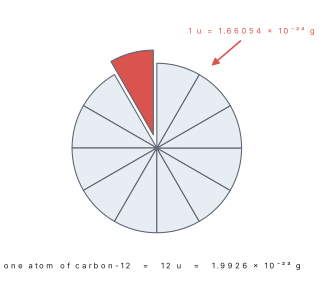
Relative atomic mass of an element is the number of times one atom of that element is heavier than one-twelfth of a carbon-12 atom. It is a pure ratio, so it has no unit. Expressed in u it is called the atomic mass.
Relative molecular mass is defined in the same way for a molecule, and is obtained simply by adding the atomic masses of all the atoms in the formula. For ionic compounds, which have no discrete molecules, the same sum is called the formula mass.
Problem. Calculate the relative molecular mass of H₂SO₄ and the actual mass of one molecule of it in grams. (H = 1, S = 32, O = 16)
Solution. Adding the atomic masses,
So the relative molecular mass is 98 (no unit); the molecular mass is 98 u. Since 1 u = 1.66054 × 10⁻²⁴ g,
Radicals
A radical is an atom or a group of atoms carrying a net electrical charge which behaves as a single unit in a chemical reaction. Positively charged radicals are basic radicals (cations); negatively charged ones are acid radicals (anions).
| Valency | Basic radicals (cations) | Acid radicals (anions) |
|---|---|---|
| 1 | Na⁺, K⁺, NH₄⁺, Ag⁺ | Cl⁻, NO₃⁻, OH⁻, HCO₃⁻ |
| 2 | Mg²⁺, Ca²⁺, Fe²⁺, Cu²⁺, Zn²⁺ | SO₄²⁻, CO₃²⁻, O²⁻, S²⁻ |
| 3 | Al³⁺, Fe³⁺ | PO₄³⁻, N³⁻ |
A formula is written by criss-crossing the valencies and reducing: Al³⁺ with SO₄²⁻ gives Al₂(SO₄)₃; Ca²⁺ with PO₄³⁻ gives Ca₃(PO₄)₂.
Molecular formula and empirical formula
The molecular formula shows the actual number of atoms of each element in one molecule. The empirical formula shows the simplest whole-number ratio of the atoms present.
They are connected by one integer n:
| Compound | Molecular formula | Empirical formula | n |
|---|---|---|---|
| Water | H₂O | H₂O | 1 |
| Hydrogen peroxide | H₂O₂ | HO | 2 |
| Benzene | C₆H₆ | CH | 6 |
| Ethyne | C₂H₂ | CH | 2 |
| Glucose | C₆H₁₂O₆ | CH₂O | 6 |
| Acetic acid | C₂H₄O₂ | CH₂O | 2 |
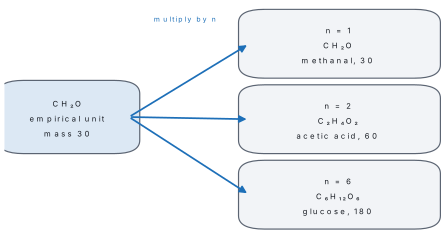
The empirical formula of ethane (C₂H₆) is CH₃, not CH — you divide by the HCF of the subscripts, which is 2, not by whatever makes the numbers smallest. And for many compounds (water, ammonia, methane) the two formulae are identical.
1.4 Percentage composition from molecular formula
The percentage composition of a compound is the mass of each element present in 100 g of the compound. From the molecular formula:
The percentages of all elements must add up to 100 (allow ±0.1 for rounding) — that is your free check on the arithmetic.
Problem. Find the percentage composition of urea, CO(NH₂)₂. (C = 12, O = 16, N = 14, H = 1)
Solution. Molecular mass:
| Element | Mass in 1 mol | Percentage |
|---|---|---|
| C | 12 | (12/60) × 100 = 20.00 % |
| O | 16 | (16/60) × 100 = 26.67 % |
| N | 28 | (28/60) × 100 = 46.67 % |
| H | 4 | (4/60) × 100 = 6.66 % |
Total = 100.00 %. Urea is the richest solid nitrogen fertilizer in common use.
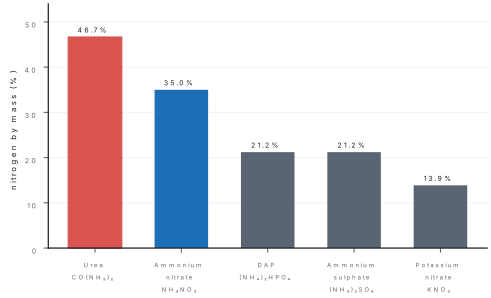
Problem. A 50 kg bag of ammonium sulphate, (NH₄)₂SO₄, is spread on a paddy field in Chitwan. What mass of nitrogen does it supply?
Solution. Formula mass:
Nitrogen present in one formula unit = 2 × 14 = 28.
The same 50 kg as urea would supply 0.4667 × 50 = 23.3 kg of nitrogen.
Problem. Calculate the percentage of water of crystallisation in blue vitriol, CuSO₄·5H₂O. (Cu = 63.5, S = 32, O = 16, H = 1)
Solution. Mass of the anhydrous part: 63.5 + 32 + 4(16) = 159.5. Mass of five water molecules: 5 × 18 = 90. Total M = 249.5.
So heating 100 g of blue vitriol to dryness leaves 63.93 g of white anhydrous CuSO₄ and drives off 36.07 g of water.
Write the molar-mass sum as one line of arithmetic and then divide. Students who compute each percentage from scratch make four chances for an error instead of one. Always finish by adding the percentages to check they give 100.
Chapter summary
- Chemistry studies the composition, structure, properties and transformations of matter; its main branches are physical, inorganic, organic, analytical, biochemistry, industrial, nuclear and environmental.
- An atom is the smallest particle of an element taking part in a reaction; a molecule is the smallest particle able to exist independently.
- 1 atomic mass unit = 1/12 of the mass of one ¹²C atom = 1.66054 × 10⁻²⁴ g.
- Relative atomic and molecular masses are ratios and carry no unit; molecular mass is the sum of the atomic masses in the formula.
- A radical is a charged atom or group of atoms that acts as one unit; formulae are built by criss-crossing valencies.
- Molecular formula = n × empirical formula, with n = \text{molecular mass} / \text{empirical formula mass}.
- Percentage of X = (atomic mass of X × number of X atoms) / molecular mass × 100; all percentages must total 100.
Practice questions
Group A — Multiple choice (1 mark each)
- One atomic mass unit is equal to [1]amass of one ¹²C atomb1/12 of the mass of one ¹²C atomcmass of one hydrogen atomd1/16 of the mass of one oxygen atom
- The empirical formula of hydrogen peroxide (H₂O₂) is [1]aH₂O₂bHOcH₂OdHO₂
- The percentage of nitrogen in ammonium nitrate, NH₄NO₃, is [1]a17.5 %b21.2 %c35.0 %d46.7 %
- Which of the following is a triatomic molecule? [1]aHebCl₂cO₃dP₄
- Relative atomic mass has the unit [1]agrambamuckg mol⁻¹dno unit
Answers to Group A
1. (b) — that is the definition of the amu on the carbon-12 scale.
2. (b) — divide both subscripts by the HCF 2.
3. (c) — M = 80 and 2 N atoms give 28, so 28/80 × 100 = 35.0 %.
4. (c) — ozone has three atoms per molecule.
5. (d) — it is a ratio of two masses, so the units cancel.
Group B — Short answer (5 marks each)
- Define atom, molecule and radical, giving one example of each. Why can an atom of oxygen not exist freely while a molecule of oxygen can? [5]
- What is meant by atomic mass unit? Calculate the mass in grams of one molecule of carbon dioxide. [5]
- Distinguish between empirical formula and molecular formula with two examples each. A compound has the empirical formula CH₂ and molecular mass 56; find its molecular formula. [5]
- Calculate the percentage composition of calcium carbonate, CaCO₃, and hence the mass of calcium oxide obtainable from 1 tonne of pure limestone. (Ca = 40, C = 12, O = 16) [5]
Answers to Group B
2. 1 u = 1/12 of the mass of a ¹²C atom = 1.66054 × 10⁻²⁴ g. For CO₂, M = 12 + 32 = 44, so one molecule has mass 44 × 1.66054 × 10⁻²⁴ g = 7.31 × 10⁻²³ g.
3. Empirical formula mass of CH₂ = 12 + 2 = 14, so n = 56/14 = 4 and the molecular formula is C₄H₈.
4. M(CaCO₃) = 40 + 12 + 48 = 100. %Ca = 40 %, %C = 12 %, %O = 48 %. On heating, CaCO₃ → CaO + CO₂. Every 100 g of CaCO₃ gives 56 g of CaO, so 1 tonne (1000 kg) gives 560 kg of CaO.
Group C — Long answer (8 marks each)
- (a) Explain why chemistry is called the central science, listing four fields in which it is applied with one concrete example from Nepal in each. [4](b) State the relation between empirical formula, molecular formula and molecular mass, and use it to show that acetic acid and glucose share an empirical formula. [4]
- A farmer can buy either urea, CO(NH₂)₂, at Rs 1,000 per 50 kg bag or ammonium sulphate, (NH₄)₂SO₄, at Rs 600 per 50 kg bag. [8]aCalculate the percentage of nitrogen in each.bCalculate the mass of nitrogen in one bag of each.cFind the cost per kilogram of nitrogen for each and say which is cheaper.
Answer to Group C question 2
(a) Urea: M = 60, N = 28, so %N = 28/60 × 100 = 46.67 %. Ammonium sulphate: M = 132, N = 28, so %N = 28/132 × 100 = 21.21 %.
(b) Urea bag: 0.4667 × 50 = 23.33 kg of N. Ammonium sulphate bag: 0.2121 × 50 = 10.61 kg of N.
(c) Urea: Rs 1000 / 23.33 kg = Rs 42.9 per kg of N. Ammonium sulphate: Rs 600 / 10.61 kg = Rs 56.6 per kg of N. Urea is the cheaper source of nitrogen, even though the bag costs more.
Practise more: Chemistry question bank