Unit 16 · Applied Chemistry · 4 teaching hours · 19 min read
Fundamentals of Applied Chemistry
What the syllabus asks for 6
- Chemical industry and its importance
- Stages in producing a new product
- Economics of production; cash flow in the production cycle
- Running a chemical plant; designing a chemical plant
- Continuous and batch processing
- Environmental impact of the chemical industry
Everything in the first fifteen units happened in a test tube. This unit asks a different question: how do you take a reaction that works on 5 g in a laboratory and make it work on 500 tonnes a day, profitably, safely, and without poisoning the river next door? Applied chemistry — also called chemical technology or chemical engineering science — is the study of that scale-up. It is the bridge between the balanced equation and the bag of urea a farmer in Chitwan actually buys.
This is a descriptive unit with no derivations, so marks are won on organised lists. Learn: the stages of new-product development in order; the difference between fixed and variable cost and the shape of the cash-flow curve; the batch-versus-continuous comparison table; and four or five named environmental impacts with the chemistry behind each. Unit 17 then applies all of it.
16.1 Chemical industry and its importance
The chemical industry is the branch of manufacturing that converts raw materials — minerals, air, water, petroleum, biomass — into chemical products by deliberately changing their chemical composition on a commercial scale.
Chemical manufacture is divided by scale and value:
| Class | Tonnage | Value | Examples |
|---|---|---|---|
| Heavy (bulk) chemicals | millions of tonnes/year | low per kg | H₂SO₄, NH₃, NaOH, Na₂CO₃, cement, urea |
| Fine chemicals | hundreds to thousands of tonnes/year | high per kg | dyes, flavours, pesticide actives, reagents |
| Speciality chemicals | small, made to a specification | sold on performance | paints, adhesives, catalysts, detergents |
| Pharmaceuticals | kg to tonnes | very high per kg | paracetamol, antibiotics, vaccines |
Why the industry matters:
- Food. Nitrogen fertilizers made from atmospheric nitrogen feed roughly half the world's population. Nepal has no fertilizer factory of its own and imports 100% of its chemical fertilizer, at a cost of more than Rs 40 billion a year.
- Health. Medicines, disinfectants, chlorine for drinking water, oxygen for hospitals, and the plastics that syringes and IV sets are made from.
- Infrastructure. Cement, steel, glass, paints and bitumen. Nepal has 13 integrated and 16 grinding cement plants with a combined capacity of about 12.3 million tonnes a year, including the state-owned Hetauda Cement (using limestone from Bhaise, Majhuwa and Jogmara in Makawanpur) and Udayapur Cement.
- Energy. Refining, battery chemicals, and the electrolysis of water for hydrogen.
- Economy. The output of one chemical plant is the raw material of the next, so a single plant creates a chain of downstream industry and employment.
The industry's signature is that a single cheap raw material tree feeds everything. Air gives N₂ and O₂; brine gives Cl₂, NaOH and Na₂CO₃; sulphur or pyrites give H₂SO₄; hydrocarbons and water give H₂ and synthesis gas. Almost every product in Unit 17 grows from one of these four roots.
16.2 Stages in producing a new product
A new chemical product is not invented and then built. It passes through a fixed sequence of stages, each of which can kill the project. The later a project is abandoned, the more money is lost — so each stage is designed to answer one question as cheaply as possible.
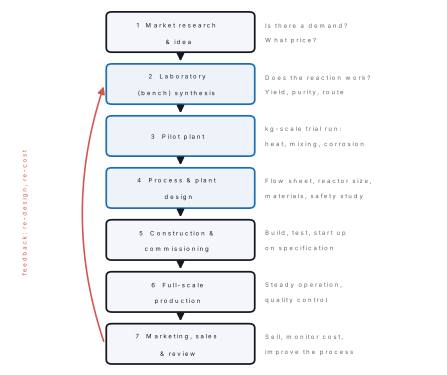
Two stages deserve extra attention.
- The pilot plant (stage 3) exists because chemistry does not scale linearly. Doubling the size of a reactor multiplies its volume by 8 but its surface area only by 4, so a reaction that was easy to cool in a 250 cm³ flask can run away in a 25 m³ vessel. Mixing, heat transfer, corrosion, catalyst life and the handling of solids can only be measured, not predicted.
- Process design (stage 4) fixes the flow sheet: which units, in what order, at what temperature and pressure, with what recycle streams. Every later cost is locked in here.
16.3 Economics of production; cash flow in the production cycle
A plant is built only if it will make money. The money involved falls into two capital sums and two running costs.
| Term | Meaning | Examples |
|---|---|---|
| Fixed capital | one-off spending to build the plant | land, reactors, pipework, instruments |
| Working capital | money tied up to keep it running | stock of raw material, product in store, unpaid bills |
| Fixed costs | paid whether or not anything is produced | depreciation, interest on loans, salaries, insurance, rates |
| Variable costs | proportional to output | raw materials, catalyst, electricity, steam, packaging |
For a selling price S per kilogram, a variable cost V per kilogram and fixed costs F per year, the profit on n kilograms a year is
The quantity (S-V) is the contribution per kilogram. Setting P=0 gives the break-even point — the output at which the plant stops losing money:
Because F is spread over every kilogram, the cost per kilogram falls as output rises. This is the economy of scale, and it is the single strongest reason that bulk chemical plants are enormous.
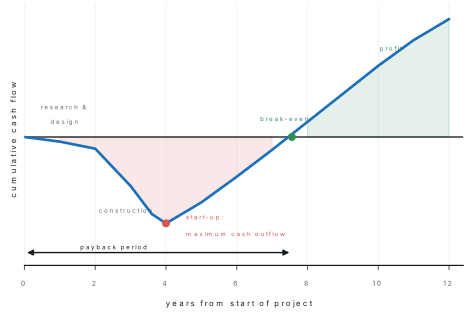
The curve above is the cash-flow diagram of the production cycle. Read it left to right: money flows out during research, design and construction; the outflow is worst at commissioning, when the plant is complete but selling nothing; then sales begin and the curve climbs. Where it crosses zero, the project has returned exactly what was spent — that time is the payback period. Nothing after that point is profit until the plant is shut down and its working capital recovered.
Problem. A plant making a solvent has fixed costs of Rs 120 million per year. The variable cost is Rs 45 per kg and the product sells for Rs 75 per kg. (a) Find the break-even output. (b) Find the annual profit at an output of 7,000 tonnes. (c) If the plant cost Rs 900 million to build, find the payback period at that output, ignoring interest.
Solution.
(a) Contribution = S - V = 75 - 45 = Rs 30 per kg.
(b) At n = 7000\ \text{t} = 7.0\times10^{6} kg,
(c) Payback = 900/90 = \mathbf{10} years. A payback longer than about eight years would normally make the project unattractive, so the company would look for a cheaper design or a higher output.
16.4 Running a chemical plant; designing a chemical plant
Designing a plant
Design begins with the flow sheet — a block diagram naming every unit and every stream. Once the flow sheet is fixed, the designer works through:
- Choice of route. Of the reactions that give the product, pick the one with the cheapest raw materials, the highest atom economy and the fewest steps.
- Reaction conditions. Temperature, pressure and catalyst are chosen by balancing equilibrium yield against rate and cost — the compromise that dominates Unit 17.
- Plant location. Near the raw material if the raw material is bulky (cement near limestone); near the market if the product is bulky or dangerous (sulphuric acid); always near water, power, transport and labour, and away from dense settlement.
- Materials of construction. Stainless steel, lead lining, glass lining or titanium, chosen against corrosion at the operating temperature.
- Energy integration. Exothermic reactions raise steam that drives the next stage. In a contact-process plant almost all the process heat comes from the reaction itself.
- Safety and effluent. Pressure-relief systems, interlocks, and treatment for every waste stream, decided at the design stage — not afterwards.
Running a plant
| Task | What it involves |
|---|---|
| Raw-material supply | continuous, of guaranteed purity; catalyst poisons excluded |
| Process control | automatic control of temperature, pressure, flow, pH, level |
| Quality control | sampling and analysis of product against a written specification |
| Maintenance | planned shutdowns; corrosion and catalyst-activity monitoring |
| Safety | training, protective equipment, leak detection, emergency plans |
| Waste management | scrubbing of gases, effluent treatment, solid-waste disposal |
Why catalysts get "poisoned" in exam answers
A catalyst is expensive and must last for years. Impurities that adsorb on its surface and block the active sites are called poisons — arsenic oxide for the V₂O₅ of the contact process, sulphur compounds and CO for the iron of the Haber process. This is why every flow sheet in Unit 17 has a purification stage before the catalyst chamber. Naming the poison earns the mark.
16.5 Continuous and batch processing
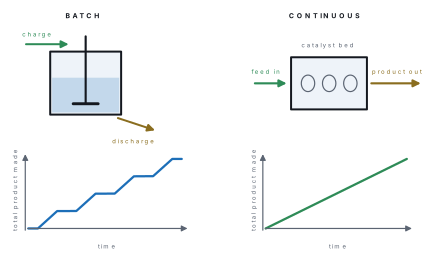
In a batch process a measured charge of reactants is put into a vessel, made to react, and the whole product is removed before the next charge is loaded. In a continuous process reactants flow into the reactor and products flow out without interruption, so the plant runs at a steady state for months at a time.
| Feature | Batch | Continuous |
|---|---|---|
| Scale suited to | small, up to a few thousand t/yr | very large, bulk chemicals |
| Equipment | one general-purpose vessel, many products | dedicated plant, one product |
| Capital cost | low | high |
| Labour per tonne | high | low |
| Product uniformity | varies from batch to batch | very uniform at steady state |
| Traceability | excellent — each batch numbered | harder; needs continuous sampling |
| Down-time | large (charge, clean, discharge) | small; runs months between shutdowns |
| Control | manual or semi-automatic | fully automatic |
| Typical products | medicines, dyes, paints, cosmetics | H₂SO₄, NH₃, urea, NaOH, cement, petrol |
Problem. A batch reactor makes 2.5 tonnes of product per batch. Each cycle is 6 hours of reaction plus 2 hours for charging, discharging and cleaning. A continuous plant for the same product makes 0.40 tonnes per hour. Both operate 330 days a year. Compare the annual outputs.
Solution. Operating time per year = 330 \times 24 = 7920 h.
Batch: cycle time = 6 + 2 = 8 h, so the number of batches is 7920/8 = 990 batches, and
Continuous: \ 0.40 \times 7920 = 3168 tonnes per year.
The continuous plant makes 693 tonnes (28%) more from the same operating time, because it loses no time to charging and cleaning. Note also that the batch plant is idle for 990 \times 2 = 1980 h, a quarter of the year.
Continuous plant is only cheaper per tonne at high output. Its high fixed capital means a low break-even point is impossible, and it can make only one product. A pharmaceutical company making 40 different drugs in small quantities, each needing a traceable batch number, uses batch reactors for very good reasons.
16.6 Environmental impact of the chemical industry
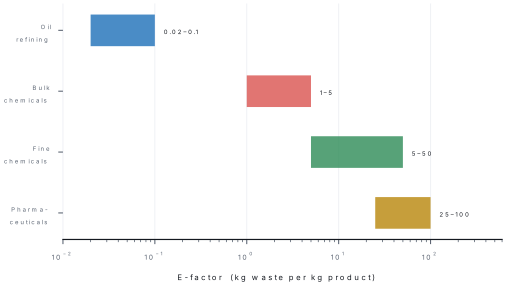
Every kilogram of product leaves the plant with some mass of waste attached to it. The standard measure is the E-factor: kilograms of waste per kilogram of product. It rises steeply as tonnage falls and chemistry gets more complicated.
The main impacts, with the chemistry behind each
| Impact | Chemistry | Control measure |
|---|---|---|
| Acid rain | SO₂ and NOₓ escaping to air: SO₂ + H₂O → H₂SO₃; 2SO₂ + O₂ → 2SO₃ → H₂SO₄ | scrubbing flue gas with lime slurry; double absorption in the contact process |
| Global warming | CO₂ from fuel, from reforming and from CaCO₃ → CaO + CO₂ in cement kilns | energy integration, alternative fuels, carbon capture |
| Ozone depletion | CFCs release Cl atoms: Cl + O₃ → ClO + O₂ | Montreal Protocol; replacement by HFCs and hydrocarbons |
| Water pollution | acidic or alkaline effluent, heavy-metal ions (Hg²⁺, Cr⁶⁺, Pb²⁺), organic load | neutralisation, precipitation as hydroxide or sulphide, biological treatment |
| Solid waste | CaCl₂ from the Solvay process, phosphogypsum, spent catalyst, fly ash | re-use in road building and cement; metal recovery from spent catalyst |
| Air-borne dust | cement, lime and fertilizer dust causing respiratory disease | bag filters, electrostatic precipitators, wet spraying |
| Thermal pollution | warm cooling water lowers the dissolved oxygen of a river | cooling towers before discharge |
| Major accidents | the Bhopal disaster of December 1984, in which methyl isocyanate leaked from a pesticide plant and killed thousands | inventory reduction, containment, interlocks, emergency planning |
The modern answer to all of this is green chemistry: design the waste out rather than treat it afterwards. The most useful single number is the atom economy, which measures how much of the mass of the reactants ends up in the wanted product:
Unlike percentage yield, atom economy is fixed by the equation — a reaction with a poor atom economy is wasteful even at 100% yield.
Problem. Ethanol can be made by two routes:
Route A: C₂H₄ + H₂O → C₂H₅OH Route B: C₆H₁₂O₆ → 2C₂H₅OH + 2CO₂
Calculate the atom economy of each and comment. (M: C₂H₄ = 28, H₂O = 18, C₂H₅OH = 46, C₆H₁₂O₆ = 180.)
Solution.
Route A. Total reactant mass = 28 + 18 = 46; desired product = 46.
Route B. Total reactant mass = 180; desired product = 2\times46 = 92.
Route A is an addition reaction, so nothing is wasted — every addition reaction has 100% atom economy. Route B throws away 88 g of CO₂ for every 92 g of ethanol. Route B is still used because its raw material (molasses, a sugar-mill by-product) is renewable and cheap, while route A needs ethene from petroleum. Atom economy is one factor in the choice of route, not the only one.
Percentage yield compares the mass you actually got with the mass the equation promised. Atom economy compares the mass the equation promises with the mass you put in. A reaction can have 95% yield and 40% atom economy, or 100% atom economy and 5% yield. Examiners set this distinction almost every year.
Chapter summary
- The chemical industry converts cheap raw materials — air, brine, water, sulphur, limestone, hydrocarbons — into heavy, fine, speciality and pharmaceutical chemicals. Nepal imports 100% of its chemical fertilizer.
- New products pass through seven stages: market research → laboratory synthesis → pilot plant → process and plant design → construction and commissioning → full production → marketing and review, with a go/no-go decision at each.
- Costs are fixed capital and working capital, fixed costs and variable costs. Profit P = n(S-V) - F and the break-even output is n_{\text{BE}} = F/(S-V).
- The cash-flow curve is negative through research and construction, reaches its minimum at start-up, and crosses zero at the end of the payback period.
- Plant design fixes the route, the conditions, the location, the materials of construction, energy integration and effluent treatment. Purification comes before every catalyst bed because catalysts are poisoned.
- Batch = one charge at a time, cheap, flexible, traceable, small scale. Continuous = steady state, high capital, low labour, uniform product, bulk scale.
- Environmental damage includes acid rain (SO₂, NOₓ), CO₂ emission, ozone depletion, effluent and heavy metals, dust and solid waste.
- Atom economy = (M_{\text{product}}/\sum M_{\text{reactants}})\times 100\% is a property of the equation, not of the operator; percentage yield is not.
Practice questions
Group A — Multiple choice (1 mark each)
- Which of the following is a fixed cost of a chemical plant? [1]araw materialsbpackagingcdepreciationdelectricity
- The stage at which a reaction is first tested on the kilogram scale is the [1]abench synthesisbpilot plantccommissioningdmarket survey
- Which process would normally be operated batchwise? [1]amanufacture of sulphuric acidbmanufacture of ammoniacmanufacture of a tablet coatingdmanufacture of cement
- The atom economy of the addition reaction C₂H₄ + Br₂ → C₂H₄Br₂ is [1]a50%b75%c100%dimpossible to calculate
- The lowest point of the cumulative cash-flow curve of a project occurs at [1]athe end of researchbstart-up of the plantcthe break-even pointdthe end of the plant's life
Answers to Group A
1. (c) — depreciation is paid whether or not the plant produces anything.
2. (b) — the pilot plant is the kg-scale trial between bench and full plant.
3. (c) — small tonnage, many different specifications, batch traceability needed.
4. (c) — in an addition reaction all reactant atoms appear in the product.
5. (b) — the plant is fully paid for but has not yet sold anything.
Group B — Short answer (5 marks each)
- Define the chemical industry. Classify chemical products into four groups with one example of each. [5]
- List, in order, the stages in producing a new chemical product, and state why a pilot plant is needed even when the bench reaction works perfectly. [5]
- Distinguish between batch and continuous processing under any five headings. [5]
- A plant has fixed costs of Rs 60 million per year. The variable cost is Rs 28 per kg and the selling price is Rs 40 per kg. Find(a) the break-even output in tonnes and(b) the profit at an output of 8,000 tonnes per year. [5]
- State four environmental impacts of the chemical industry, giving one chemical equation or species responsible for each and one method of control. [5]
Answers to Group B
2. Market research → bench synthesis → pilot plant → process and plant design → construction and commissioning → full production → marketing and review. The pilot plant is needed because heat transfer, mixing, corrosion, catalyst life and solids handling do not scale with volume: the surface-to-volume ratio falls as size rises, so a reaction that is easy to cool in a flask can run away in a large reactor.
4. Contribution = 40 - 28 = Rs 12 per kg. (a) n_{\text{BE}} = 60\times10^{6}/12 = 5.0\times10^{6} kg = 5000 tonnes per year. (b) P = 8.0\times10^{6}(12) - 60\times10^{6} = 96\times10^{6} - 60\times10^{6} = Rs 36 million per year.
5. Any four from the impact table — e.g. acid rain (SO₂ + H₂O → H₂SO₃; controlled by lime scrubbing), global warming (CaCO₃ → CaO + CO₂ in cement kilns; controlled by energy integration), water pollution (Cr⁶⁺, Pb²⁺ in effluent; controlled by precipitation and neutralisation), dust (cement dust; controlled by electrostatic precipitators).
Group C — Long answer (8 marks each)
- (a) Draw and explain the cash-flow diagram for the production cycle of a new chemical product, marking the research, construction, start-up, break-even and profit regions. [4](b) Explain the factors that must be considered when choosing the site and designing a new chemical plant. [4]
- (a) Define atom economy and percentage yield and distinguish between them. [3](b) Ethanoic acid can be made by CH₃OH + CO → CH₃COOH or by CH₃CH₂OH + O₂ → CH₃COOH + H₂O. Calculate the atom economy of each route. (M: CH₃OH = 32, CO = 28, CH₃COOH = 60, CH₃CH₂OH = 46, O₂ = 32, H₂O = 18.) [3](c) State which route a manufacturer would prefer on environmental grounds and why. [2]
Answer to Group C question 2
(a) Atom economy is the fraction of the total mass of the reactants that appears in the desired product, (M_{\text{product}}/\sum M_{\text{reactants}})\times100\%; it is fixed by the balanced equation. Percentage yield is (actual mass obtained / theoretical mass from the equation) \times 100\%; it depends on how well the reaction and the separation are carried out. A reaction can have a high yield and a poor atom economy, or the reverse.
(b) Route 1: reactants 32 + 28 = 60; product 60; atom economy = (60/60)\times100\% = 100\%. Route 2: reactants 46 + 32 = 78; product 60; atom economy = (60/78)\times100\% = 76.9\%.
(c) Route 1 — the carbonylation of methanol — is preferred: every atom of the reactants ends up in the product, so there is no by-product to separate, treat or dispose of, and no raw material is bought only to be thrown away. Route 2 wastes 18 g of water per 60 g of acid, and the dilute water must be removed by distillation, which costs energy.
Practise more: Chemistry question bank