Unit 15 · Organic Chemistry · 6 teaching hours · 29 min read
Aromatic Hydrocarbons
What the syllabus asks for 7
- Introduction and characteristics of aromatic compounds
- Huckel's rule of aromaticity
- Kekule structure of benzene
- Resonance and isomerism
- Preparation of benzene from decarboxylation of sodium benzoate, phenol, and ethyne
- Physical properties of benzene
- Chemical properties: addition (hydrogen, halogen); electrophilic substitution and orientation of benzene derivatives (o, m, p); nitration; sulphonation; halogenation; Friedel-Crafts reaction (alkylation and acylation); combustion; uses
The hydrocarbons of Unit 14 behaved exactly as their bonds predicted: a double bond added, a triple bond added twice, a single bond was hard to touch. Benzene, C₆H₆, breaks that pattern completely. On paper it looks like a ring with three double bonds, so it should decolourise bromine water instantly and burn through its unsaturation in every test. It does neither. It refuses to add, it prefers to substitute, and it releases far less energy on hydrogenation than three double bonds ought to. That stubbornness has a name — aromaticity — and this unit is about where it comes from and what it does to the chemistry.
Four things come up almost every year: Hückel's rule applied to a given ring, the evidence for and against the Kekulé structure, the mechanism of one electrophilic substitution (usually nitration), and the o/p versus m orientation rules with a reason. Learn the four Friedel–Crafts-type reactions as a block — reagent, catalyst, electrophile, product — because they are usually asked as a single five-mark question.
15.1 Introduction and characteristics of aromatic compounds
The word aromatic is a historical accident. The first members of the class — benzaldehyde from almonds, vanillin from vanilla pods, oil of wintergreen — were isolated because they smelled pleasant, and the name stuck long before anyone understood the bonding. Today the smell is irrelevant; the word means a ring system with a closed loop of delocalised π electrons and the unusual stability that comes with it.
Organic compounds are therefore sorted into three families:
| Class | Description | Example |
|---|---|---|
| Aliphatic | Open chain, or a ring without a delocalised π loop | hexane, cyclohexane |
| Alicyclic | Cyclic but behaving like the corresponding aliphatic compound | cyclohexene |
| Aromatic | Contains a benzene ring or another Hückel π system | benzene, toluene, naphthalene, pyridine |
Aromatic compounds that contain a benzene ring are called benzenoid (benzene, naphthalene, anthracene); those that are aromatic without one are non-benzenoid (tropylium ion, azulene, furan).
The characteristics that define the class
- Cyclic, planar and fully conjugated. Every ring atom is sp² hybridised and carries one unhybridised p orbital perpendicular to the ring plane, so the loop of overlap is unbroken.
- (4n + 2) π electrons in that loop — Hückel's rule, the subject of the next section.
- Unusually stable. Benzene's measured heat of hydrogenation is about 152 kJ mol⁻¹ less than the calculation for three isolated double bonds. That deficit is the resonance energy (delocalisation energy).
- Substitution, not addition, is the normal reaction. Addition would destroy the delocalised loop, so an aromatic ring gives up a hydrogen instead of opening a double bond. Addition happens only under forcing conditions.
- Equal carbon–carbon bond lengths. All six C—C bonds in benzene are 139 pm — between a single bond (154 pm) and a double bond (134 pm).
- High carbon content, so aromatic compounds burn with a sooty, luminous flame — a quick laboratory clue.
- Resistant to oxidation. The ring survives hot KMnO₄; in an alkylbenzene the side chain is oxidised instead, leaving the ring intact.
A cyclic, planar, fully conjugated system containing (4n + 2) delocalised π electrons, where n = 0, 1, 2, 3, …, is aromatic. It is more stable than the corresponding open-chain conjugated system by its resonance energy.
15.2 Huckel's rule of aromaticity
Erich Hückel showed in 1931 that the stability of a monocyclic conjugated ring depends on how many π electrons it holds. The rule has three conditions and a count, and all four must be satisfied.
- The molecule must be cyclic.
- It must be planar, so the p orbitals are parallel.
- Every atom of the ring must be able to contribute a p orbital, i.e. the conjugation must be complete and uninterrupted.
- The number of delocalised π electrons must equal 4n + 2 where n = 0, 1, 2, 3, … — that is 2, 6, 10, 14, …
A ring that meets the first three conditions but holds 4n π electrons (4, 8, 12, …) is antiaromatic — it is less stable than the open chain, and molecules usually escape that fate by buckling out of the plane. A ring that fails a structural condition is simply non-aromatic.
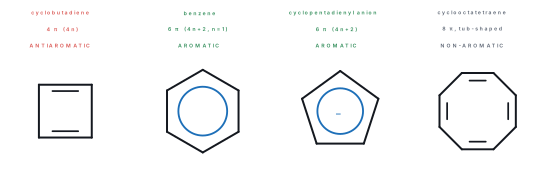
Classify each species as aromatic, antiaromatic or non-aromatic. (i) cyclopropenyl cation C₃H₃⁺ (ii) cyclopentadienyl cation C₅H₅⁺ (iii) tropylium (cycloheptatrienyl) cation C₇H₇⁺ (iv) cyclohexane (v) naphthalene C₁₀H₈
Method. Check planar + cyclic + full conjugation first, then count only the electrons in the ring π system. A positive carbon contributes an empty p orbital (0 electrons); a negative carbon contributes a lone pair (2 electrons); each C=C contributes 2.
(i) Three-membered ring, one C=C (2 π) and one C⁺ (empty p orbital) — cyclic, planar, conjugated. π electrons = 2 = 4n + 2 with n = 0 → aromatic. This is why the cyclopropenyl cation is surprisingly easy to make.
(ii) Five-membered ring, two C=C (4 π) and one C⁺ (0) — π electrons = 4 = 4n with n = 1 → antiaromatic, and indeed it is extremely unstable. Contrast this with the anion in the figure, which has 6 π and is aromatic.
(iii) Seven-membered ring, three C=C (6 π) and one C⁺ (0) — π electrons = 6 → aromatic. Tropylium bromide is an ionic, water-soluble solid, which is remarkable for a hydrocarbon salt.
(iv) Cyclohexane has no p orbitals at all — condition 3 fails, so it is non-aromatic (not antiaromatic).
(v) Naphthalene, two fused rings, five C=C → 10 π = 4n + 2 with n = 2 → aromatic. Hückel's rule was derived for monocyclic rings, so for fused systems it is applied as a useful approximation rather than a proof.
A lone pair counts only if it sits in a p orbital that is part of the loop. In pyridine the nitrogen lone pair lies in an sp² orbital in the ring plane, so it is not counted — pyridine has 6 π electrons from its three C=C/C=N bonds and is aromatic. In pyrrole the nitrogen lone pair is in the p orbital, so it joins the loop: 4 (from two C=C) + 2 = 6 π, again aromatic.
15.3 Kekule structure of benzene
Benzene was isolated by Faraday in 1825 from compressed illuminating gas, and its formula C₆H₆ was quickly established. That formula implies four degrees of unsaturation, which for years nobody could draw. In 1865 August Kekulé proposed a planar hexagonal ring of six carbons, each carrying one hydrogen, with three alternating single and double bonds.
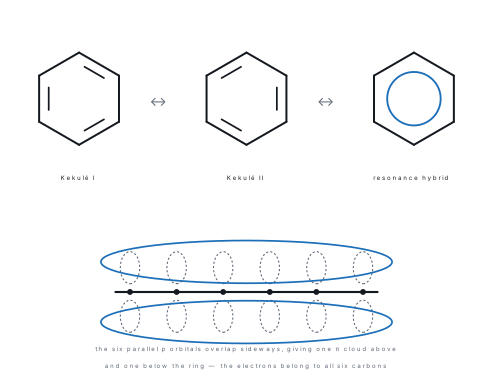
What the Kekulé structure explains
- The formula C₆H₆ and the fact that benzene adds exactly three molecules of hydrogen to give cyclohexane.
- Only one monosubstituted product, C₆H₅X, is ever obtained — all six hydrogens are equivalent, which a symmetrical ring accounts for.
- Complete ozonolysis of benzene gives three molecules of glyoxal, exactly as three C=C bonds require:
C₆H₆ + 3O₃ → benzene triozonide, then triozonide + 3H₂O --Zn--> 3 OHC—CHO
What it fails to explain
- Benzene does not decolourise bromine water or Baeyer's reagent, although it is drawn with three double bonds.
- Its heat of hydrogenation is far too small (see §15.4).
- The C—C bond lengths are all 139 pm, not alternating 134 and 154 pm.
- Kekulé's own structure predicts two different ortho-disubstituted products (one with a double bond between the substituted carbons and one without). Only one is ever isolated.
Kekulé tried to rescue the theory with his oscillation hypothesis — the two arrangements interconvert so fast that no experiment can catch them apart. The modern answer is better and simpler: benzene is not either structure. It is a single substance, the resonance hybrid, in which the six π electrons are delocalised over the whole ring.
Hexagon + inner circle = six carbons, six hydrogens (understood), and six π electrons belonging to nobody in particular. Use the Kekulé form when you need to push arrows in a mechanism, and the circle form everywhere else.
15.4 Resonance and isomerism
Resonance and resonance energy
Benzene is a resonance hybrid of the two Kekulé structures. Resonance lowers the energy, and the size of that lowering can be measured by hydrogenation.
| Compound | C=C bonds | ΔH of hydrogenation (kJ mol⁻¹) |
|---|---|---|
| Cyclohexene | 1 | −120 |
| Cyclohexa-1,3-diene | 2 | −232 (expected −240) |
| Hypothetical "cyclohexatriene" | 3 | −360 (calculated, 3 × −120) |
| Benzene (measured) | — | −208 |
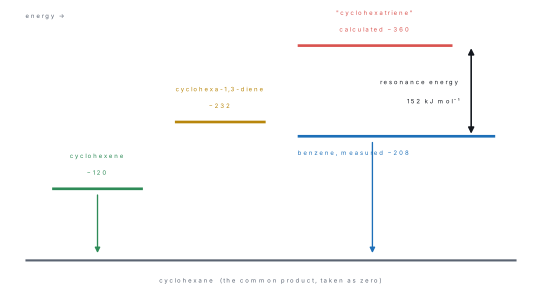
The gap of 152 kJ mol⁻¹ between the calculated and measured values is the resonance energy of benzene. It is a stability credit: to make benzene react by addition you must first pay that credit back, which is why benzene is so reluctant to add and so willing to substitute.
The contributing structures differ only in the position of electrons — the nuclei never move. Each must have the same number of unpaired electrons and the same overall charge. The real molecule is the hybrid, and it is more stable than the most stable single contributor. A resonance hybrid is not a mixture and not an equilibrium.
Isomerism in benzene derivatives
Because all six positions are equivalent, benzene gives exactly one monosubstituted product C₆H₅X. Put a second substituent on and the picture changes: three positional isomers become possible.
| Isomer | Positions | Prefix | Example, C₆H₄Cl₂ |
|---|---|---|---|
| ortho (o-) | 1, 2 — adjacent | o- | 1,2-dichlorobenzene |
| meta (m-) | 1, 3 — one carbon apart | m- | 1,3-dichlorobenzene |
| para (p-) | 1, 4 — opposite | p- | 1,4-dichlorobenzene |
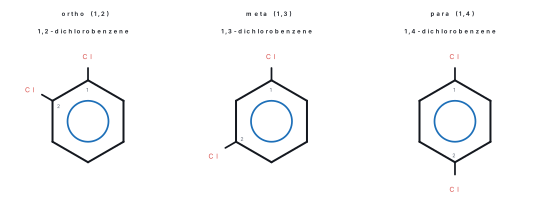
Counting quickly: for trisubstituted benzene C₆H₃X₃ there are again three isomers — 1,2,3 (vicinal), 1,2,4 (asymmetrical) and 1,3,5 (symmetrical). For C₆H₄XY, with two different groups, there are still three (o, m, p).
15.5 Preparation of benzene from decarboxylation of sodium benzoate, phenol, and ethyne
| Method | Reagents and conditions | Equation |
|---|---|---|
| Decarboxylation of sodium benzoate | Soda lime (NaOH + CaO), heat | C₆H₅COONa + NaOH --CaO, Δ--> C₆H₆ + Na₂CO₃ |
| Reduction of phenol | Zinc dust, distil | C₆H₅OH + Zn --Δ--> C₆H₆ + ZnO |
| Cyclic polymerisation of ethyne | Red-hot iron or quartz tube, 873 K | 3C₂H₂ --Fe tube, 873 K--> C₆H₆ |
| Hydrolysis of benzenesulphonic acid | Superheated steam, 423 K | C₆H₅SO₃H + H₂O --Δ--> C₆H₆ + H₂SO₄ |
| Industrial source | Fractional distillation of coal tar (353–443 K cut) | — |
Decarboxylation. Heating the sodium salt of any carboxylic acid with soda lime removes the —COONa group as carbonate and puts a hydrogen in its place. Soda lime is used rather than NaOH alone because it is a free-flowing solid that does not attack glass at the temperature needed.
Reduction of phenol. Zinc dust strips the oxygen out of phenol; the zinc is oxidised to ZnO. This is the standard laboratory route when phenol is on hand.
From ethyne. Three molecules of ethyne polymerise on the surface of a red-hot iron tube. This is the reaction that first showed benzene could be built from a two-carbon unit, and it is a favourite examination question because it links Units 14 and 15.
Students commonly write C₆H₅COONa + NaOH → C₆H₆ + CO₂. Count the sodiums: the left has two, the right has none. The carbon leaves as sodium carbonate, Na₂CO₃, not as carbon dioxide.
15.6 Physical properties of benzene
| Property | Value or description |
|---|---|
| State and appearance | Colourless, mobile liquid |
| Odour | Characteristic sweet aromatic smell |
| Boiling point | 353 K (80 °C) |
| Melting point | 278.5 K (5.5 °C) — freezes on a cold day |
| Density | 0.879 g cm⁻³ at 293 K, so it floats on water |
| Solubility | Insoluble in water; miscible with ether, alcohol, CCl₄, and itself an excellent solvent for fats, resins, rubber and iodine |
| Combustion | Burns with a sooty, luminous flame (92.3 % carbon by mass) |
| Toxicity | Highly toxic; prolonged exposure to the vapour causes leukaemia — benzene is a proven carcinogen and is no longer used as a school solvent |
| Other | Non-polar (zero dipole moment, from its symmetry); forms a low-boiling azeotrope with water at 342 K |
The zero dipole moment is itself evidence for the regular hexagonal structure: the six identical C—H bond moments cancel exactly in pairs only if the ring is a regular planar hexagon.
15.7 Chemical properties: addition (hydrogen, halogen); electrophilic substitution and orientation of benzene derivatives (o, m, p); nitration; sulphonation; halogenation; Friedel-Crafts reaction (alkylation and acylation); combustion; uses
Addition reactions
Addition destroys the aromatic sextet, so it needs forcing conditions — high pressure with a catalyst, or ultraviolet light.
Hydrogenation. C₆H₆ + 3H₂ --Ni, 473–573 K--> C₆H₁₂ (cyclohexane)
Halogenation (addition). In bright sunlight, and with no halogen carrier present, chlorine adds by a free-radical route:
C₆H₆ + 3Cl₂ --UV light--> C₆H₆Cl₆
The product, benzene hexachloride (BHC, gammexane or lindane), was once a widely used insecticide and is now banned in most countries for its persistence. Note the contrast that examiners love: sunlight gives addition, a Lewis-acid catalyst in the dark gives substitution.
The mechanism of electrophilic substitution
Every ring substitution of benzene — nitration, sulphonation, halogenation, alkylation, acylation — follows the same three steps.
- Generate the electrophile. A reagent plus a catalyst produces a strongly electron-poor species, E⁺.
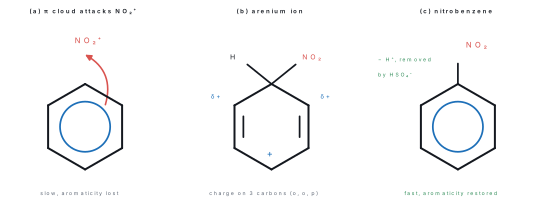
- Attack by the π cloud. Two of the six delocalised electrons attack E⁺, giving a positively charged, non-aromatic intermediate called the arenium ion (or σ-complex, or carbocation intermediate). This step is slow — it is the rate-determining step, because aromaticity is temporarily lost.
- Lose a proton. A base removes H⁺ from the sp³ carbon, the electron pair falls back into the ring, and aromaticity is restored. This step is fast and it is the reason substitution beats addition: the alternative, adding a nucleophile to the arenium ion, would leave the ring permanently non-aromatic.
Nitration
C₆H₆ + HNO₃ (conc.) --conc. H₂SO₄, 330 K--> C₆H₅NO₂ + H₂O
The mixture of concentrated nitric and sulphuric acids is the nitrating mixture. Sulphuric acid, being the stronger acid, protonates nitric acid and strips water from it to release the electrophile, the nitronium ion:
HNO₃ + 2H₂SO₄ ⇌ NO₂⁺ + H₃O⁺ + 2HSO₄⁻
Above about 330 K a second nitro group enters, and because —NO₂ is meta-directing the product is 1,3-dinitrobenzene.
Sulphonation
C₆H₆ + H₂SO₄ (fuming) --Δ--> C₆H₅SO₃H + H₂O
Fuming sulphuric acid (oleum) is used because the electrophile is sulphur trioxide, SO₃, whose sulphur carries a large partial positive charge:
2H₂SO₄ ⇌ SO₃ + H₃O⁺ + HSO₄⁻
Sulphonation is the one electrophilic substitution that is readily reversible — boiling benzenesulphonic acid with superheated steam gives benzene back, which is the preparation listed in §15.5.
Halogenation (substitution)
C₆H₆ + Cl₂ --anhydrous AlCl₃, dark--> C₆H₅Cl + HCl
C₆H₆ + Br₂ --anhydrous FeBr₃, dark--> C₆H₅Br + HBr
The Lewis acid is called a halogen carrier. It polarises the halogen molecule and pulls one atom off as the electrophile:
Cl₂ + AlCl₃ → Cl⁺ + AlCl₄⁻
Iodination needs an oxidising agent (HIO₃ or HNO₃) to remove the HI as it forms, because the reaction is reversible; fluorination is far too violent to control.
Friedel–Crafts reactions
Both are run in the dark with anhydrous aluminium chloride; the smallest trace of moisture destroys the catalyst.
Alkylation puts an alkyl group on the ring:
C₆H₆ + CH₃Cl --anhyd. AlCl₃--> C₆H₅CH₃ + HCl (toluene)
CH₃Cl + AlCl₃ → CH₃⁺ + AlCl₄⁻
Acylation puts an acyl group on the ring:
C₆H₆ + CH₃COCl --anhyd. AlCl₃--> C₆H₅COCH₃ + HCl (acetophenone)
CH₃COCl + AlCl₃ → CH₃CO⁺ + AlCl₄⁻
| Reaction | Reagent | Catalyst | Electrophile | Product |
|---|---|---|---|---|
| Nitration | conc. HNO₃ | conc. H₂SO₄, 330 K | NO₂⁺ | nitrobenzene |
| Sulphonation | fuming H₂SO₄ | — (SO₃ in oleum) | SO₃ | benzenesulphonic acid |
| Chlorination | Cl₂ | anhyd. AlCl₃, dark | Cl⁺ | chlorobenzene |
| Bromination | Br₂ | anhyd. FeBr₃, dark | Br⁺ | bromobenzene |
| Alkylation | CH₃Cl | anhyd. AlCl₃ | CH₃⁺ | toluene |
| Acylation | CH₃COCl | anhyd. AlCl₃ | CH₃CO⁺ | acetophenone |
The alkyl group it installs is electron-releasing, so the product is more reactive than benzene and polyalkylation is hard to avoid. Worse, the carbocation can rearrange: benzene with 1-chloropropane gives mostly isopropylbenzene (cumene), not propylbenzene, because CH₃CH₂CH₂⁺ shifts a hydride to become the more stable (CH₃)₂CH⁺. Acylation has neither problem — the acylium ion is resonance-stabilised and does not rearrange, and the ketone product is deactivated. This is why the standard way to make an alkylbenzene is to acylate first and then reduce.
Combustion
2C₆H₆ + 15O₂ → 12CO₂ + 6H₂O ΔH = −3268 kJ mol⁻¹ per mole of benzene
In a limited supply of air the high carbon content shows itself as the characteristic sooty flame. Controlled catalytic oxidation gives a useful industrial product:
2C₆H₆ + 9O₂ --V₂O₅, 723 K--> 2C₄H₂O₃ + 4CO₂ + 4H₂O (maleic anhydride)
Orientation of benzene derivatives
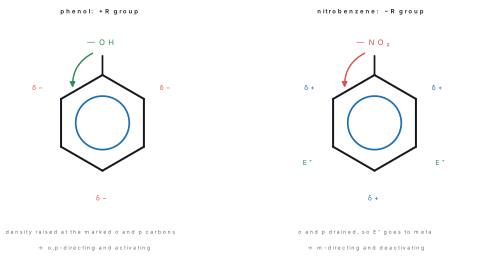
Once one group is on the ring it decides where the next one goes and how fast the reaction runs. The group changes the electron density at the ortho, meta and para positions through its inductive and resonance effects (Unit 13), and the incoming electrophile goes wherever the electron density — and the stability of the resulting arenium ion — is greatest.
| Type | Groups | Effect on rate | Directs to |
|---|---|---|---|
| Activating, o,p-directing | —OH, —O⁻, —OR, —NH₂, —NHR, —NR₂, —NHCOCH₃, —R (alkyl), —C₆H₅ | faster than benzene | ortho + para |
| Deactivating, o,p-directing | —F, —Cl, —Br, —I | slower than benzene | ortho + para |
| Deactivating, m-directing | —NO₂, —CN, —CHO, —COR, —COOH, —COOR, —SO₃H, —CCl₃, —N⁺R₃ | slower than benzene | meta |
The halogens are the exception that always appears in the examination. A halogen has a strong −I effect, which drains the whole ring and makes the reaction slow; but it also has a weak +R effect through its lone pairs, which feeds density back specifically to the ortho and para positions. Rate is governed by the stronger effect (−I, so deactivating); orientation is governed by the position-selective effect (+R, so o,p-directing).
If the atom joined to the ring carries a lone pair (O, N, halogen) the group is o,p-directing. If that atom carries a double or triple bond to a more electronegative atom, or a full positive charge (—NO₂, —CHO, —COOH, —CN, —SO₃H, —N⁺R₃), the group is m-directing. Alkyl and aryl groups are o,p-directing by +I and hyperconjugation.
Ortho and para products are formed together, and they are separated by their physical properties — the para isomer is usually the more symmetrical, higher melting solid, while the ortho isomer, which can hydrogen bond internally, is often a lower boiling liquid. Bulky groups push the mixture towards para.
Uses of benzene and its derivatives
- Solvent for fats, waxes, resins, rubber and iodine (now heavily restricted on health grounds).
- Feedstock for styrene (→ polystyrene), phenol via cumene, aniline via nitrobenzene, and cyclohexane (→ nylon-6,6).
- Manufacture of dyes, drugs (aspirin, paracetamol), explosives (TNT from toluene) and detergents (alkylbenzenesulphonates).
- Formerly added to petrol as an anti-knock agent; replaced because of its toxicity.
Predict the major monosubstitution product, and say whether the reaction is faster or slower than for benzene. (i) nitration of toluene (ii) nitration of nitrobenzene (iii) bromination of chlorobenzene (iv) nitration of benzoic acid
Method. Identify the group already on the ring, classify it from the table, then apply the direction and the rate separately.
(i) —CH₃ is an activating, o,p-director (+I and hyperconjugation). Nitration is therefore faster than for benzene and gives a mixture of 2-nitrotoluene (o) and 4-nitrotoluene (p), with only a trace of the meta isomer. Conditions: conc. HNO₃ + conc. H₂SO₄ at 303–313 K — deliberately cooler than for benzene, because toluene reacts more readily.
(ii) —NO₂ is a strongly deactivating m-director. Nitration is much slower and needs fuming HNO₃ with conc. H₂SO₄ at about 373 K. The product is 1,3-dinitrobenzene.
(iii) —Cl deactivates by −I but directs by +R, so the reaction is slower than for benzene yet still gives 1-chloro-2-bromobenzene and 1-chloro-4-bromobenzene.
(iv) —COOH has a carbon doubly bonded to oxygen, so it is deactivating and m-directing: the product is 3-nitrobenzoic acid, formed slowly.
The heat of hydrogenation of cyclohexene is −119.6 kJ mol⁻¹ and that of benzene is −208.4 kJ mol⁻¹. Calculate the resonance energy of benzene. What would the resonance energy be if benzene's measured value were −240 kJ mol⁻¹ instead?
Step 1 — the model compound. Every hydrogenation ends at the same product, cyclohexane, so the heats can be compared directly. One isolated C=C releases 119.6 kJ mol⁻¹ on hydrogenation.
Step 2 — the calculated value for three isolated double bonds.
ΔH(calculated) = 3 × (−119.6) = −358.8 kJ mol⁻¹
Step 3 — compare with experiment.
Resonance energy = ΔH(calculated) − ΔH(measured) = (−358.8) − (−208.4) = −150.4, i.e. a stabilisation of 150.4 kJ mol⁻¹
Benzene lies 150.4 kJ mol⁻¹ below where three separate double bonds would put it, and that is the energy penalty any reaction must pay before it can break the ring's delocalisation.
Step 4 — the hypothetical case. If benzene released 240 kJ mol⁻¹ the resonance energy would be 358.8 − 240 = 118.8 kJ mol⁻¹: still aromatic, but noticeably less stabilised. The general point is that the smaller the measured heat of hydrogenation, the larger the resonance energy — the molecule has already "spent" some of its unsaturation on delocalisation.
(a) Starting from benzene, prepare 1,3-dinitrobenzene, giving reagents and conditions. (b) 39 g of benzene is nitrated and 49.2 g of nitrobenzene is isolated. Calculate the percentage yield.
(a) The first nitro group must go on before the second, because —NO₂ is the group that directs the second one to the meta position.
Step 1: C₆H₆ + HNO₃ --conc. H₂SO₄, 330 K--> C₆H₅NO₂ + H₂O
Step 2: C₆H₅NO₂ + HNO₃ --fuming H₂SO₄, 373 K--> 1,3-C₆H₄(NO₂)₂ + H₂O
The harsher conditions in step 2 are needed because the ring has been deactivated by the first nitro group. Note that the route cannot be reversed: you cannot make 1,2- or 1,4-dinitrobenzene this way at all.
(b) Molar mass of benzene = (6 × 12) + (6 × 1) = 78 g mol⁻¹ Molar mass of nitrobenzene C₆H₅NO₂ = 72 + 5 + 14 + 32 = 123 g mol⁻¹
Moles of benzene = 39 / 78 = 0.50 mol
The equation is 1 : 1, so the theoretical yield of nitrobenzene is 0.50 mol = 0.50 × 123 = 61.5 g.
Percentage yield = (49.2 / 61.5) × 100 = 80 %
Chapter summary
- Aromatic means cyclic, planar, fully conjugated and holding (4n + 2) delocalised π electrons. 4n electrons in the same geometry means antiaromatic; a broken conjugation or a non-planar ring means non-aromatic.
- Kekulé's alternating-bond hexagon explains the formula, the single monosubstituted product and the three molecules of glyoxal from ozonolysis, but not the equal 139 pm bond lengths, the refusal to add bromine, or the low heat of hydrogenation.
- Benzene is a resonance hybrid of the two Kekulé forms, stabilised by a resonance energy of about 150 kJ mol⁻¹.
- Benzene is made by decarboxylating sodium benzoate with soda lime, reducing phenol with zinc dust, or passing ethyne through a red-hot tube.
- The typical reaction is electrophilic substitution in three steps: generate E⁺, slow attack by the π cloud to give the arenium ion, fast loss of H⁺ to restore aromaticity.
- Nitration (NO₂⁺), sulphonation (SO₃), halogenation (X⁺ with a halogen carrier), Friedel–Crafts alkylation (R⁺) and acylation (RCO⁺) all share that mechanism.
- Addition needs forcing conditions: 3H₂/Ni gives cyclohexane, 3Cl₂ in sunlight gives benzene hexachloride.
- Groups with a lone pair on the attached atom are o,p-directing; groups with a multiple bond to an electronegative atom or a positive charge are m-directing. Halogens deactivate but still direct o,p.
Practice questions
Group A — Multiple choice (1 mark each)
- Benzene does not decolourise bromine water because [1]ait is a liquidbits π electrons are delocalised and the ring is stabilisedcbromine is insoluble in itdit has no hydrogen
- Which species is antiaromatic? [1]abenzenebcyclopentadienyl anionccyclobutadienedtropylium cation
- The electrophile in the nitration of benzene is [1]aHNO₃bNO₂⁻cNO₂⁺dNO⁺
- All six carbon–carbon bond lengths in benzene are [1]a154 pmb139 pmc134 pmd120 pm
- Benzene is obtained when ethyne is passed through [1]acold dilute KMnO₄ba red-hot iron tube at 873 Kcammoniacal AgNO₃dconc. H₂SO₄
- Which group is meta-directing? [1]a—OHb—CH₃c—Cld—COOH
- Friedel–Crafts reactions cannot be carried out in the presence of [1]aanhydrous AlCl₃bmoisturecan acyl chloridedbenzene
- The number of isomers of dichlorobenzene, C₆H₄Cl₂, is [1]a2b3c4d6
- Chlorine reacts with benzene in bright sunlight to give [1]achlorobenzenebbenzene hexachlorideco-dichlorobenzenedno reaction
Answers to Group A
1. (b) — addition would destroy the aromatic sextet, and the resonance energy makes that unfavourable.
2. (c) — 4 π electrons, i.e. 4n with n = 1.
3. (c) — the nitronium ion, generated by H₂SO₄ acting on HNO₃.
4. (b) — intermediate between a single and a double bond, as delocalisation requires.
5. (b) — cyclic polymerisation, 3C₂H₂ → C₆H₆.
6. (d) — the carbon of —COOH is doubly bonded to oxygen, so the group is −R and deactivating.
7. (b) — water destroys the anhydrous AlCl₃ catalyst.
8. (b) — ortho, meta and para only.
9. (b) — sunlight with no halogen carrier gives free-radical addition, C₆H₆Cl₆.
Group B — Short answer (5 marks each)
- State Hückel's rule and its conditions. Apply it to cyclobutadiene, benzene, the cyclopentadienyl anion and cyclooctatetraene. [5]
- Give three pieces of evidence that support the Kekulé structure of benzene and three that contradict it. [5]
- What is resonance energy? How is the resonance energy of benzene obtained from heats of hydrogenation, and what does it explain about benzene's chemistry? [5]
- How is benzene prepared from (i) sodium benzoate, (ii) phenol and (iii) ethyne? Give equations with conditions. [5]
- Describe the mechanism of the nitration of benzene, naming the electrophile, the intermediate and the rate-determining step. [5]
- What are Friedel–Crafts reactions? Write the alkylation and acylation of benzene with equations, and give two limitations of alkylation. [5]
- Why is —NO₂ meta-directing while —OH is ortho–para directing? Explain in terms of the resonance effect. [5]
- Chlorine is deactivating yet ortho–para directing. Explain this apparent contradiction. [5]
Answers to Group B
1. A cyclic, planar, fully conjugated ring with (4n + 2) delocalised π electrons is aromatic. Cyclobutadiene 4 π = 4n, antiaromatic; benzene 6 π, aromatic (n = 1); cyclopentadienyl anion 4 π from two C=C plus the lone pair = 6 π, aromatic; cyclooctatetraene 8 π = 4n and tub-shaped, therefore non-aromatic.
2. For: it accounts for C₆H₆; benzene adds exactly 3H₂ to give cyclohexane; ozonolysis gives three molecules of glyoxal; only one monosubstituted product C₆H₅X exists. Against: benzene does not decolourise bromine water or Baeyer's reagent; its heat of hydrogenation is 152 kJ mol⁻¹ too small; all six C—C bonds are 139 pm, not alternating; the structure predicts two different ortho isomers but only one is found.
3. Resonance energy is the extra stability of the delocalised hybrid over the most stable single contributing structure. ΔH for three isolated double bonds = 3 × (−120) = −360 kJ mol⁻¹, while benzene measures −208 kJ mol⁻¹; the difference, 152 kJ mol⁻¹, is the resonance energy. It explains why benzene resists addition and prefers substitution, which restores the delocalised system.
5. Step 1: HNO₃ + 2H₂SO₄ ⇌ NO₂⁺ + H₃O⁺ + 2HSO₄⁻. Step 2 (slow, rate determining): the π cloud attacks NO₂⁺ to give the arenium ion (σ-complex), a non-aromatic carbocation whose positive charge is delocalised over three carbons. Step 3 (fast): HSO₄⁻ removes H⁺ from the sp³ carbon and aromaticity is restored, giving C₆H₅NO₂.
7. In phenol the oxygen lone pair is delocalised into the ring (+R), and the resonance structures put the negative charge specifically on the ortho and para carbons, so the electrophile attacks there. In nitrobenzene the −NO₂ group withdraws density (−R), and the resonance structures put the positive charge on the ortho and para carbons; the meta positions are least depleted, so attack occurs there.
8. Chlorine exerts a strong −I effect, which withdraws density from the whole ring and slows every electrophilic substitution — hence deactivating. It also exerts a weak +R effect through its lone pairs, and that effect delivers density only to the ortho and para positions. Rate is decided by the stronger −I effect, orientation by the position-selective +R effect.
Group C — Long answer (8 marks each)
- (a) State Hückel's rule and explain, with reasons, why cyclobutadiene is antiaromatic, benzene is aromatic and cyclooctatetraene is non-aromatic. [4](b) Discuss the Kekulé structure of benzene: what it explains, what it fails to explain, and how resonance resolves the difficulty. [4]
- (a) Describe the general mechanism of electrophilic aromatic substitution, using nitration as the example. [4](b) Write equations with reagents and conditions for the sulphonation, bromination, alkylation and acylation of benzene, naming the electrophile in each case. [4]
- (a) Explain the terms activating, deactivating, o,p-directing and m-directing, giving two examples of each class. [3](b) Predict the major product of (i) nitration of toluene, (ii) nitration of nitrobenzene, (iii) bromination of phenol. [3](c) 7.8 g of benzene is completely burnt in oxygen. Calculate the volume of carbon dioxide produced at STP. [2]
Answers to Group C
1. (a) Cyclobutadiene is planar, cyclic and conjugated but holds 4 π electrons (4n), so it is destabilised relative to the open chain — antiaromatic. Benzene holds 6 π (4n + 2 with n = 1) in a regular planar hexagon — aromatic. Cyclooctatetraene has 8 π (4n) and escapes antiaromaticity by folding into a tub shape; since it is no longer planar, its p orbitals cannot overlap all round the ring and it behaves as an ordinary polyene — non-aromatic.
2. (b) Sulphonation: C₆H₆ + H₂SO₄ (fuming) --Δ--> C₆H₅SO₃H + H₂O, electrophile SO₃. Bromination: C₆H₆ + Br₂ --anhyd. FeBr₃, dark--> C₆H₅Br + HBr, electrophile Br⁺. Alkylation: C₆H₆ + CH₃Cl --anhyd. AlCl₃--> C₆H₅CH₃ + HCl, electrophile CH₃⁺. Acylation: C₆H₆ + CH₃COCl --anhyd. AlCl₃--> C₆H₅COCH₃ + HCl, electrophile CH₃CO⁺.
3. (b) (i) 2-nitrotoluene and 4-nitrotoluene — —CH₃ is activating and o,p-directing. (ii) 1,3-dinitrobenzene — —NO₂ is deactivating and m-directing. (iii) 2-bromophenol and 4-bromophenol with bromine in CS₂ at low temperature; with bromine water the ring is so activated that 2,4,6-tribromophenol precipitates as a white solid.
3. (c) The balanced equation is 2C₆H₆ + 15O₂ → 12CO₂ + 6H₂O. Molar mass of benzene = 78 g mol⁻¹, so moles of benzene = 7.8 / 78 = 0.10 mol. From the equation 2 mol of benzene gives 12 mol of CO₂, i.e. 1 mol gives 6 mol, so moles of CO₂ = 6 × 0.10 = 0.60 mol. Volume at STP = 0.60 × 22.4 = 13.44 dm³.
Practise more: Chemistry question bank