Unit 13 · Organic Chemistry · 10 teaching hours · 34 min read
Fundamental Principles of Organic Chemistry
What the syllabus asks for 8
- IUPAC Nomenclature of Organic Compounds (up to chain having 6 carbon atoms)
- Qualitative analysis: detection of N, S and halogens by Lassaigne's test
- Isomerism: definition and classification
- Structural isomerism: chain, position, functional, metamerism and tautomerism
- Geometrical isomerism (cis and trans) and optical isomerism (d and l form)
- Reaction Mechanism: homolytic and heterolytic fission
- Electrophiles, nucleophiles and free radicals
- Inductive effect (+I and -I); Resonance effect (+R and -R)
Unit 12 taught you what organic compounds are. This unit teaches you the working grammar of the subject: how to give every compound a name that no two chemists can disagree about, how to prove by experiment which elements a compound contains, how the same set of atoms can build several different substances, and why some bonds break one way and some the other. Ten hours of the syllabus are spent here because everything in Units 14 and 15 — and the whole of the Grade 12 organic course — is written in this language.
Four skills carry almost every mark: (1) name any compound of up to six carbons and go back from the name to the structure; (2) write the Lassaigne equations with the colour of each product; (3) draw and classify isomers, including cis / trans and d / l; and (4) use the inductive and resonance effects to explain an order of acid strength or carbocation stability. Notice that the last one is always "explain", never "state".
13.1 IUPAC Nomenclature of Organic Compounds (up to chain having 6 carbon atoms)
Before 1892 every compound had a trivial name — acetic acid, glycerol, urea — which told you nothing about its structure. The IUPAC system (International Union of Pure and Applied Chemistry) builds a name out of pieces, so that the name and the structure can always be converted into each other.
An IUPAC name has up to four parts:
secondary prefix + word root + primary suffix + secondary suffix
| Part | What it gives | Examples |
|---|---|---|
| Secondary prefix | substituents that are not the principal group | methyl-, ethyl-, chloro-, nitro-, hydroxy-, amino- |
| Word root | number of carbons in the principal chain | meth (1), eth (2), prop (3), but (4), pent (5), hex (6) |
| Primary suffix | saturation of the chain | -ane, -ene, -yne |
| Secondary suffix | the principal functional group | -ol, -al, -one, -oic acid, -amine |
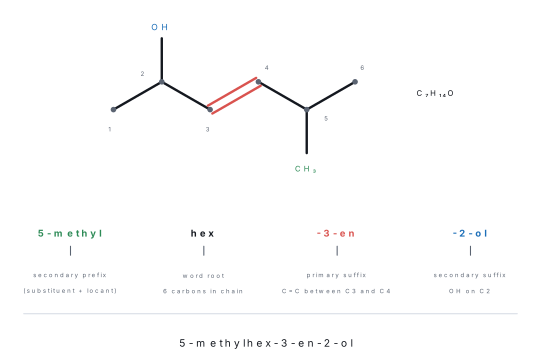
The naming rules, in the order you apply them
- Find the principal chain. It is the longest continuous chain of carbon atoms that contains the principal functional group, and then the greatest number of multiple bonds. If two chains are equally long, take the one with more substituents.
- Find the principal functional group. If a molecule has more than one, only the senior one gets a suffix; the rest become prefixes. The seniority order is
—COOH > —COOR (ester) > —COCl > —CONH₂ > —CN > —CHO > >C=O > —OH > —NH₂ > C=C > C≡C
- Number the chain from the end that gives the lowest locant to the principal functional group. If there is no functional group, number to give the lowest locant to the multiple bond; if there is neither, number to give the lowest set of locants to the substituents (first point of difference rule).
- Name the substituents and put them in alphabetical order, each with its locant. The multiplying prefixes di-, tri-, tetra- are not counted when alphabetising, so 4-ethyl-2-methylhexane has ethyl before methyl, and 2,3-dimethylpentane files under "m".
- Assemble and elide. Drop the final "e" of -ane/-ene/-yne when the next letter is a vowel: hexan-2-ol (not hexane-2-ol), but hexane-1,2-diol (the "e" survives before a consonant).
| Class | Group | Prefix | Suffix | Example (IUPAC name) |
|---|---|---|---|---|
| Carboxylic acid | —COOH | carboxy- | -oic acid | CH₃COOH ethanoic acid |
| Ester | —COOR | alkoxycarbonyl- | alkyl …oate | CH₃COOC₂H₅ ethyl ethanoate |
| Acid chloride | —COCl | chlorocarbonyl- | -oyl chloride | CH₃COCl ethanoyl chloride |
| Amide | —CONH₂ | carbamoyl- | -amide | CH₃CONH₂ ethanamide |
| Nitrile | —C≡N | cyano- | -nitrile | CH₃CN ethanenitrile |
| Aldehyde | —CHO | oxo- / formyl- | -al | CH₃CH₂CHO propanal |
| Ketone | >C=O | oxo- | -one | CH₃COCH₃ propanone |
| Alcohol | —OH | hydroxy- | -ol | C₂H₅OH ethanol |
| Amine | —NH₂ | amino- | -amine | CH₃NH₂ methanamine |
| Ether | —OR | alkoxy- | — | CH₃OC₂H₅ methoxyethane |
| Halide | —X | fluoro-, chloro-, bromo-, iodo- | — | CH₃Cl chloromethane |
| Nitro | —NO₂ | nitro- | — | CH₃NO₂ nitromethane |
The common alkyl groups up to C4 are worth memorising, because NEB questions still quote the trivial names:
| Structure | IUPAC name | Trivial name |
|---|---|---|
| CH₃— | methyl | methyl |
| CH₃CH₂— | ethyl | ethyl |
| CH₃CH₂CH₂— | propyl | n-propyl |
| (CH₃)₂CH— | propan-2-yl | isopropyl |
| CH₃CH₂CH₂CH₂— | butyl | n-butyl |
| CH₃CH₂CH(CH₃)— | butan-2-yl | sec-butyl |
| (CH₃)₂CHCH₂— | 2-methylpropyl | isobutyl |
| (CH₃)₃C— | 2-methylpropan-2-yl | tert-butyl |
Problem. Give the IUPAC name of (a) CH₃CH₂CH(CH₃)CH₂CH₂CH₃, (b) (CH₃)₂C=CHCH₂CH₃, (c) CH₃CH(OH)CH₂CHO, (d) (CH₃)₂CHCH₂CH(CH₃)COOH.
Solution.
(a) The longest chain is six carbons, so the root is hex and there is no functional group, so the suffix is -ane. One methyl branch. Numbering from the left puts it on C3; from the right, on C4. Lowest locant wins: 3-methylhexane.
(b) The principal chain must contain the C=C. The longest such chain is CH₃—C(CH₃)=CH—CH₂—CH₃, five carbons, so the root is pent and the suffix -ene. Numbering from the left gives the double bond the locant 2 (it starts at C2); from the right it would be 3. So the chain is pent-2-ene with a methyl on C2: 2-methylpent-2-ene.
(c) Two groups are present, —CHO and —OH. The aldehyde is senior, so it takes the suffix and must be C1. The chain is four carbons: butanal. The OH sits on C3 and becomes the prefix hydroxy-: 3-hydroxybutanal.
(d) The —COOH carbon is C1. Reading back: C1 = COOH, C2 = CH(CH₃), C3 = CH₂, C4 = CH(CH₃), C5 = CH₃. The chain is five carbons with methyls on C2 and C4: 2,4-dimethylpentanoic acid (C₇H₁₄O₂).
- The longest chain is not always the one drawn horizontally — count every branch as a possible continuation.
- The carbon of —COOH, —CHO, —CN and —COCl is part of the chain and is always C1. Ethanoic acid is "eth", not "meth".
- Once the principal functional group has fixed the numbering, you may not renumber to give a substituent a lower locant. 3-hydroxybutanal can never be called 2-hydroxybutanal.
13.2 Qualitative analysis: detection of N, S and halogens by Lassaigne's test
In an organic compound nitrogen, sulphur and the halogens are joined by covalent bonds, so the ordinary inorganic tests — which need free ions — give nothing. Lassaigne's test solves this by first converting the covalent element into an ionic sodium salt.
A small piece of clean, dry sodium is heated in an ignition tube until it melts, the organic compound is added, and the tube is heated to redness and then plunged while hot into about 20 cm³ of distilled water in a china dish. The tube shatters; the mixture is boiled and filtered. The clear, alkaline filtrate is the sodium fusion extract or Lassaigne's extract.
During the fusion sodium reduces the elements into ionic salts:
Na + C + N --fuse--> NaCN
2Na + S --fuse--> Na₂S
Na + X --fuse--> NaX (X = Cl, Br, I)
If nitrogen and sulphur are both present and sodium is not in excess, they combine instead as sodium thiocyanate:
Na + C + N + S --fuse--> NaSCN
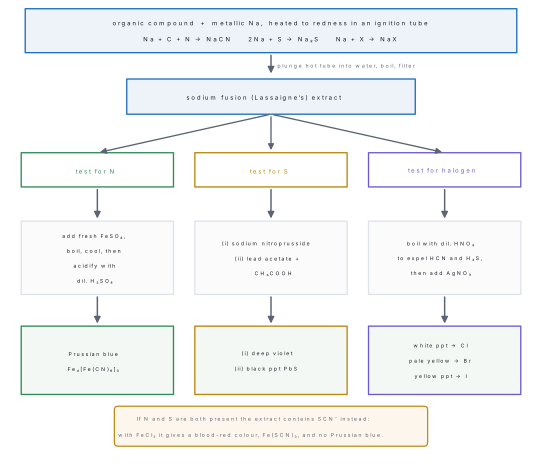
Detection of nitrogen
The extract is boiled with freshly prepared iron(II) sulphate solution and then acidified with dilute sulphuric acid. A Prussian blue colour or precipitate confirms nitrogen.
6NaCN + FeSO₄ → Na₄[Fe(CN)₆] + Na₂SO₄
3Na₄[Fe(CN)₆] + 2Fe₂(SO₄)₃ → Fe₄[Fe(CN)₆]₃↓ + 6Na₂SO₄ (Prussian blue)
Some of the Fe²⁺ is oxidised to Fe³⁺ by air during the boiling; the acid then dissolves the greenish iron hydroxides so that the blue colour can be seen.
Detection of sulphur
Two independent tests are used.
- Sodium nitroprusside test. A few drops of sodium nitroprusside give a deep violet or purple colour:
Na₂S + Na₂[Fe(CN)₅NO] → Na₄[Fe(CN)₅NOS] (violet)
- Lead acetate test. Acidify with acetic acid and add lead acetate; a black precipitate of lead sulphide appears:
Na₂S + (CH₃COO)₂Pb → PbS↓ + 2CH₃COONa (black)
Detection of nitrogen and sulphur together
If both are present as SCN⁻, adding iron(III) chloride gives a blood-red colour:
FeCl₃ + 3NaSCN → Fe(SCN)₃ + 3NaCl (blood red)
Fusing with excess sodium destroys the thiocyanate (NaSCN + 2Na → NaCN + Na₂S), after which the ordinary nitrogen and sulphur tests both work.
Detection of halogens
The extract is first boiled with dilute nitric acid. This is essential: any cyanide or sulphide left in solution would precipitate AgCN and Ag₂S and give a false positive.
NaCN + HNO₃ → NaNO₃ + HCN↑
Na₂S + 2HNO₃ → 2NaNO₃ + H₂S↑
Silver nitrate solution is then added:
NaX + AgNO₃ → AgX↓ + NaNO₃
| Halogen | Precipitate | Colour | In excess NH₄OH |
|---|---|---|---|
| Chlorine | AgCl | white, curdy | completely soluble |
| Bromine | AgBr | pale yellow | sparingly soluble |
| Iodine | AgI | bright yellow | insoluble |
The test does not work for diazonium salts, because they lose their nitrogen as N₂ gas before the sodium can react with it. Also, the sodium must be dry and freshly cut, the tube must be red hot, and the fusion mixture must be plunged in while still hot — otherwise unreacted sodium survives and the extract is unsafe.
For completeness: carbon and hydrogen are detected by heating the compound with dry copper(II) oxide. The carbon dioxide turns lime water milky and the water condensing on the cool part of the tube turns anhydrous copper sulphate from white to blue.
13.3 Isomerism: definition and classification
Isomers are two or more different compounds that have the same molecular formula but different arrangements of atoms, and therefore different physical and/or chemical properties. The phenomenon is called isomerism (Greek isos, equal; meros, part).
Isomerism exists because carbon is tetravalent and catenates: for a given formula there is usually more than one way to join the atoms up. The number of possibilities rises very fast — C₄H₁₀ has 2 isomers, C₅H₁₂ has 3, C₆H₁₄ has 5, C₁₀H₂₂ has 75 and C₂₀H₄₂ has 366 319.
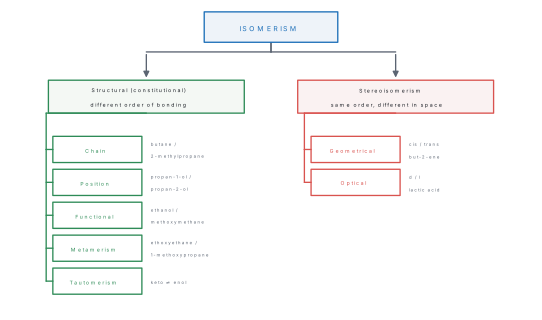
13.4 Structural isomerism: chain, position, functional, metamerism and tautomerism
Structural isomers have the same molecular formula but a different connectivity — the atoms are bonded to different partners. Five types are examined.
Chain isomerism
The isomers differ in the length or branching of the carbon skeleton. It begins at C₄.
- C₄H₁₀: CH₃CH₂CH₂CH₃ (butane) and (CH₃)₃CH (2-methylpropane)
- C₅H₁₂: pentane, 2-methylbutane, 2,2-dimethylpropane
- C₆H₁₄: hexane, 2-methylpentane, 3-methylpentane, 2,2-dimethylbutane, 2,3-dimethylbutane — five in all
Position isomerism
The skeleton is the same; the functional group or multiple bond sits on a different carbon.
- C₃H₈O: CH₃CH₂CH₂OH (propan-1-ol) and CH₃CH(OH)CH₃ (propan-2-ol)
- C₄H₈: CH₂=CHCH₂CH₃ (but-1-ene) and CH₃CH=CHCH₃ (but-2-ene)
- C₆H₄Cl₂: 1,2-, 1,3- and 1,4-dichlorobenzene
Functional isomerism
The isomers contain different functional groups altogether, so they belong to different families and behave completely differently.
| Formula | Isomer 1 | Isomer 2 |
|---|---|---|
| C₂H₆O | ethanol CH₃CH₂OH (liquid, b.p. 78 °C) | methoxymethane CH₃OCH₃ (gas, b.p. −24 °C) |
| C₃H₆O | propanal CH₃CH₂CHO | propanone CH₃COCH₃ |
| C₂H₄O₂ | ethanoic acid CH₃COOH | methyl methanoate HCOOCH₃ |
| C₃H₉N | propan-1-amine (1°) | N-methylethanamine (2°) |
Metamerism
Metamers are isomers that contain the same functional group but different alkyl groups on either side of a polyvalent atom or group such as —O—, —S—, —CO— or —NH—.
- C₄H₁₀O ethers: C₂H₅—O—C₂H₅ (ethoxyethane) and CH₃—O—C₃H₇ (1-methoxypropane)
- C₅H₁₀O ketones: CH₃—CO—C₃H₇ (pentan-2-one) and C₂H₅—CO—C₂H₅ (pentan-3-one)
Metamerism is really a special case of chain/position isomerism, but NEB lists it separately, so learn the definition word for word.
Tautomerism
Tautomers are structural isomers that exist together in dynamic equilibrium and interconvert by the migration of a hydrogen atom from one atom to another, with a shift of the double bond.
The common type is keto–enol tautomerism, which needs at least one hydrogen on the carbon next to the carbonyl (an α-hydrogen):
CH₃—CO—CH₃ ⇌ CH₃—C(OH)=CH₂
(keto form) ⇌ (enol form)
At room temperature propanone is 99.99 % keto; ethyl acetoacetate, CH₃COCH₂COOC₂H₅, is about 93 % keto and 7 % enol, because its enol is stabilised by conjugation and an internal hydrogen bond. The keto form normally dominates because the C=O bond (≈ 749 kJ mol⁻¹) is much stronger than the C=C bond (≈ 614 kJ mol⁻¹).
Resonance structures are imaginary forms of one substance and differ only in where the electrons are drawn. Tautomers are two real, separable substances and differ in where an atom (the hydrogen) actually is. Never join tautomers with a double-headed resonance arrow — use the equilibrium arrows ⇌.
Problem. Write all the structural isomers of C₄H₁₀O and state the type of isomerism relating each pair you name.
Solution. C₄H₁₀O is saturated (degree of unsaturation zero) with one oxygen, so it is either an alcohol or an ether.
Alcohols — put —OH on each distinct position of the two C₄ skeletons:
- CH₃CH₂CH₂CH₂OH — butan-1-ol
- CH₃CH₂CH(OH)CH₃ — butan-2-ol
- (CH₃)₂CHCH₂OH — 2-methylpropan-1-ol
- (CH₃)₃COH — 2-methylpropan-2-ol
Ethers — split the four carbons across the oxygen as 1 + 3 or 2 + 2:
- CH₃—O—CH₂CH₂CH₃ — 1-methoxypropane
- CH₃—O—CH(CH₃)₂ — 2-methoxypropane
- CH₃CH₂—O—CH₂CH₃ — ethoxyethane
Seven isomers. Relationships: 1 and 2 are position isomers; 1 and 3 are chain isomers; any alcohol and any ether are functional isomers; 5 and 7 are metamers; 5 and 6 are chain isomers.
13.5 Geometrical isomerism (cis and trans) and optical isomerism (d and l form)
Stereoisomers have the same connectivity. They differ only in the three-dimensional arrangement of the atoms.
Geometrical (cis–trans) isomerism
A C=C double bond cannot rotate: rotating it would mean breaking the π bond, which costs about 250 kJ mol⁻¹. The groups on the two carbons are therefore locked in place.
There must be restricted rotation (a C=C bond or a ring), and each of the two doubly bonded carbons must carry two different groups. If either carbon carries two identical groups, the two "arrangements" are the same molecule and there is no geometrical isomerism.
- but-2-ene CH₃CH=CHCH₃ — each carbon carries CH₃ and H → yes, cis and trans
- but-1-ene CH₂=CHCH₂CH₃ — C1 carries two H → no
- 2-methylbut-2-ene (CH₃)₂C=CHCH₃ — C2 carries two CH₃ → no
In the cis isomer the two like groups are on the same side of the double bond; in the trans isomer they are on opposite sides.
| Property | cis isomer | trans isomer |
|---|---|---|
| Position of like groups | same side | opposite sides |
| Dipole moment | bond dipoles add — polar | dipoles cancel — zero or small |
| Boiling point | higher (stronger dipole–dipole forces) | lower |
| Melting point | lower (packs badly, less symmetric) | higher (packs well) |
| Stability | lower (the two groups crowd each other) | higher |
| Solubility in water | greater | smaller |
The standard NEB illustration is the pair of butenedioic acids. Maleic acid (cis) melts at 130 °C, is very soluble in water and loses water on heating to give maleic anhydride. Fumaric acid (trans) melts at 287 °C, is much less soluble and forms no anhydride, because its two —COOH groups are too far apart to reach each other.
Optical isomerism
A substance is optically active if it rotates the plane of plane-polarised light. Two isomers that are non-superimposable mirror images of each other are called enantiomers or optical isomers; one rotates the plane to the right (dextrorotatory, d or +) and the other by exactly the same angle to the left (laevorotatory, l or −).
The usual cause is a chiral (asymmetric) carbon — a carbon atom joined to four different groups. Such a molecule has no plane of symmetry, so its mirror image cannot be laid on top of it, just as a left hand cannot be laid on a right hand.
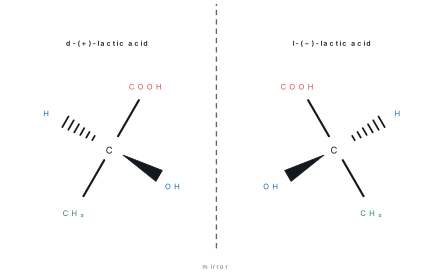
Key facts about enantiomers:
- They have identical melting point, boiling point, density, solubility and ordinary chemical reactivity. They differ only in the direction in which they rotate polarised light, and in how they react with other chiral things (enzymes, other enantiomers, polarised light).
- A racemic mixture is an equimolar (50:50) mixture of the d and l forms. It is written (±) or dl and is optically inactive by external compensation — the rotation of one half exactly cancels the other.
- A meso compound has chiral carbons but also an internal plane of symmetry, so it is optically inactive by internal compensation. Tartaric acid therefore exists in three forms: d, l and meso.
- A molecule with n different chiral carbons has at most 2^{n} optical isomers (van't Hoff's rule).
The rotation is measured in a polarimeter and reported as the specific rotation
where \alpha is the observed rotation in degrees, l the length of the tube in decimetres and c the concentration in g cm⁻³.
The lower-case d and l used by NEB describe only the observed direction of rotation (+ and −), which must be measured. The capital D and L used in biology describe the configuration drawn in a Fischer projection. A compound can be D and laevorotatory at the same time — L-(+)-arabinose is the classic example. Do not mix the two notations.
Problem. (a) Which of these show geometrical isomerism: pent-2-ene, 2-methylbut-1-ene, 1,2-dichloroethene, 1,1-dichloroethene? (b) How many optical isomers does 2,3-dihydroxybutanoic acid, CH₃CH(OH)CH(OH)COOH, have?
Solution.
(a) Apply the test carbon by carbon.
- pent-2-ene, CH₃CH=CHCH₂CH₃: C2 carries CH₃ and H, C3 carries C₂H₅ and H — both different, so yes (cis and trans).
- 2-methylbut-1-ene, CH₂=C(CH₃)CH₂CH₃: C1 carries two H — no.
- 1,2-dichloroethene, ClCH=CHCl: each carbon carries Cl and H — yes.
- 1,1-dichloroethene, Cl₂C=CH₂: C1 carries two Cl and C2 two H — no.
(b) Number the carbons: C1 = COOH, C2 = CH(OH), C3 = CH(OH), C4 = CH₃.
- C2 is bonded to —COOH, —OH, —H and —CH(OH)CH₃: four different groups → chiral.
- C3 is bonded to —CH₃, —OH, —H and —CH(OH)COOH: four different groups → chiral.
So n = 2 and the number of optical isomers is 2^{2} = 4 — two pairs of enantiomers. (There is no meso form here, because the two chiral carbons do not carry the same set of groups.)
13.6 Reaction Mechanism: homolytic and heterolytic fission
A reaction mechanism is the detailed, step-by-step description of how reactants become products: which bonds break, which form, in what order, and what short-lived intermediates appear on the way.
Every organic reaction starts by breaking a covalent bond, and a shared pair can be split in only two ways.
Homolytic fission (homolysis)
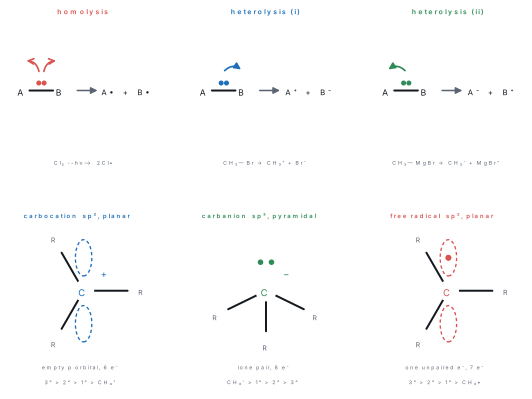
The two bonded atoms take one electron each. Each fragment keeps an unpaired electron and is a free radical. The movement of a single electron is shown by a half-headed "fish-hook" arrow.
Cl—Cl --hν--> Cl• + Cl•
CH₃—CH₃ --Δ, 500 °C--> CH₃• + CH₃•
Homolysis is favoured by high temperature, ultraviolet light, peroxide initiators, non-polar bonds and non-polar solvents such as CCl₄. The reactions it starts are called free-radical reactions; substitution in alkanes (Section 14.2) is the standard example.
Heterolytic fission (heterolysis)
Both electrons go to one atom — the more electronegative one. Two oppositely charged ions result, and the movement of the electron pair is shown by a full curved arrow.
CH₃—Br → CH₃⁺ + Br⁻ (carbocation)
CH₃—MgBr → CH₃⁻ + MgBr⁺ (carbanion)
Heterolysis is favoured by polar bonds, polar solvents (which solvate and stabilise the ions) and the presence of a catalyst such as AlCl₃ that can pull the leaving group away. It gives ionic (polar) reactions.
| Homolytic fission | Heterolytic fission | |
|---|---|---|
| Sharing of the pair | one electron to each atom | both electrons to one atom |
| Arrow | half-headed (fish-hook) | full curved arrow |
| Products | two free radicals | a cation and an anion |
| Favoured by | UV light, heat, peroxides, non-polar solvent | polar bond, polar solvent, catalyst |
| Energy needed | bond dissociation energy | usually less, if the ions are solvated |
| Reaction type produced | free-radical reactions | ionic (electrophilic / nucleophilic) reactions |
13.7 Electrophiles, nucleophiles and free radicals
The species produced by fission are the reaction intermediates; the species that attack them are the reagents. Organic reagents are sorted by what they do with electrons.
An electrophile ("electron loving") is an electron-deficient species that accepts a pair of electrons — a Lewis acid. A nucleophile ("nucleus loving") is an electron-rich species that donates a pair of electrons — a Lewis base.
| Electrophile (E⁺ or E) | Nucleophile (Nu⁻ or Nu) | |
|---|---|---|
| Electron demand | deficient — accepts a pair | rich — donates a pair |
| Lewis character | acid | base |
| Attacks | the electron-rich site (π bond, benzene ring, C of C=O) | the electron-poor site (C of C—X, C of C=O) |
| Charged examples | H⁺, Cl⁺, Br⁺, NO₂⁺, NO⁺, R⁺, R—C≡O⁺ | OH⁻, CN⁻, Cl⁻, Br⁻, RO⁻, CH₃COO⁻, HSO₃⁻, R⁻ |
| Neutral examples | BF₃, AlCl₃, FeCl₃, ZnCl₂, SO₃, carbene :CCl₂ | H₂O, NH₃, ROH, RNH₂, R₃P, alkenes, benzene |
Two points examiners like:
- Every carbocation is an electrophile and every carbanion is a nucleophile, but the reverse is not true — BF₃ is an electrophile with no charge at all.
- Ambident nucleophiles such as CN⁻ and NO₂⁻ have two donor atoms and can attack through either, which is why KCN gives nitriles while AgCN gives isocyanides.
A free radical is the third kind of reactive species: an atom or group with an unpaired electron, electrically neutral, paramagnetic and extremely reactive. It is neither an electrophile nor a nucleophile, although it is electron deficient.
| Intermediate | Electrons on C | Hybridisation | Shape | Stability order |
|---|---|---|---|---|
| Carbocation R₃C⁺ | 6 | sp² | trigonal planar, 120° | 3° > 2° > 1° > CH₃⁺ |
| Carbanion R₃C⁻ | 8 (incl. lone pair) | sp³ | pyramidal, ≈107° | CH₃⁻ > 1° > 2° > 3° |
| Free radical R₃C• | 7 | sp² | planar (shallow pyramid) | 3° > 2° > 1° > CH₃• |
The reason for the carbocation order is that alkyl groups release electrons (+I effect) and also share the C—H electrons of the neighbouring carbon with the empty p orbital (hyperconjugation); the more alkyl groups, the more the positive charge is spread out and the more stable the ion. For a carbanion the charge is negative, so electron-releasing alkyl groups make it worse, and the order reverses.
13.8 Inductive effect (+I and −I); Resonance effect (+R and −R)
Substituents change how a molecule reacts by pushing or pulling electron density. Two permanent electronic effects are on the syllabus.
Inductive effect
The inductive effect is the permanent displacement of the electrons of a σ bond towards the more electronegative of the two atoms, and its relay along the chain of σ bonds with rapidly decreasing intensity.
Hydrogen is taken as the reference, so an effect is measured relative to a C—H bond.
- −I groups (electron-withdrawing) pull electrons away from the chain. In decreasing order of strength:
—NO₂ > —CN > —SO₃H > —CHO > —COOH > —F > —Cl > —Br > —I > —OR > —OH > —C₆H₅
- +I groups (electron-releasing) push electrons towards the chain:
—O⁻ > —COO⁻ > —C(CH₃)₃ > —CH(CH₃)₂ > —CH₂CH₃ > —CH₃ > —H
The effect dies away quickly: its strength falls to roughly one-third at each successive carbon, so it is negligible beyond the third carbon from the substituent. That is why 4-chlorobutanoic acid is barely stronger than butanoic acid, while 2-chlorobutanoic acid is much stronger.
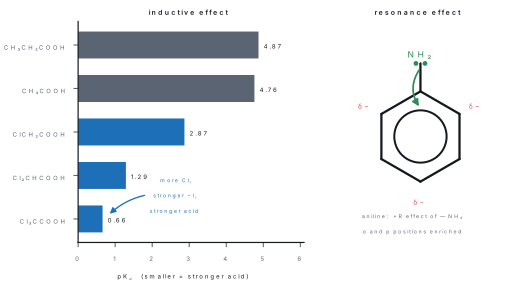
Application 1 — strength of carboxylic acids. An acid is strong when its conjugate base is stable. A −I group drains negative charge away from the carboxylate ion and stabilises it, so the acid is stronger:
| Acid | CH₃CH₂COOH | CH₃COOH | HCOOH | ClCH₂COOH | Cl₂CHCOOH | Cl₃CCOOH |
|---|---|---|---|---|---|---|
| pKa | 4.87 | 4.76 | 3.75 | 2.87 | 1.29 | 0.66 |
Formic acid beats acetic acid because it has no +I methyl group at all. Among the monohalo acids, the more electronegative halogen wins: FCH₂COOH (2.59) > ClCH₂COOH (2.87) > BrCH₂COOH (2.90) > ICH₂COOH (3.17).
Application 2 — carbocation stability. Alkyl groups are +I, so they feed electron density into the electron-poor carbon: (CH₃)₃C⁺ > (CH₃)₂CH⁺ > CH₃CH₂⁺ > CH₃⁺. This single fact explains Markovnikov's rule in Unit 14.
Resonance (mesomeric) effect
The resonance or mesomeric effect is the permanent polarisation produced in a conjugated system by the delocalisation of π electrons or a lone pair through the system. It is written +R (or +M) when the group donates electrons to the system and −R (or −M) when it withdraws them.
- +R groups carry a lone pair on the atom attached to the conjugated system and push it in: —OH, —OR, —NH₂, —NHR, —NR₂, —NHCOR, —OCOR, —F, —Cl, —Br, —I.
- −R groups have a multiply bonded electronegative atom and pull electron density out: —NO₂, —CN, —CHO, —COR, —COOH, —COOR, —CONH₂, —SO₃H.
Two properties distinguish resonance from induction and are worth a mark each:
| Inductive effect | Resonance effect | |
|---|---|---|
| Electrons involved | σ electrons | π electrons or a lone pair |
| Needs conjugation? | no | yes — a planar, conjugated system |
| Range | dies out after 2–3 σ bonds | transmitted right along the conjugated chain |
| Charge produced | partial (δ+, δ−) | full formal charges in the contributing structures |
| Magnitude | weaker | stronger |
For resonance to be possible the contributing structures must have the same positions for all nuclei, the same number of unpaired electrons, and the system must be planar and conjugated. The real molecule is a single resonance hybrid — never one structure "changing into" another — and it is always more stable than the most stable contributing structure. That extra stability is the resonance energy (152 kJ mol⁻¹ for benzene, Unit 15).
Application — acidity of phenol versus ethanol. Phenol (pKa 10.0) is far more acidic than ethanol (pKa 15.9), because the phenoxide ion C₆H₅O⁻ spreads its negative charge over the ortho and para carbons of the ring by resonance, while the ethoxide ion has nowhere to put it.
Application — basicity of aniline versus ammonia. In aniline the nitrogen lone pair is delocalised into the ring (+R). It is therefore less available for protonation, which is why aniline (pKb 9.4) is a much weaker base than ammonia (pKb 4.75) or methylamine (pKb 3.4).
Problem. (a) Arrange in increasing order of acid strength: CH₃COOH, CH₃CH₂COOH, ClCH₂COOH, FCH₂COOH, Cl₃CCOOH. (b) Which carbocation is more stable, CH₃CH₂CH₂⁺ or (CH₃)₂CH⁺, and why? (c) 4-nitrophenol is a stronger acid than phenol. Explain.
Solution.
(a) Start from ethanoic acid. Adding a +I ethyl group in place of a methyl weakens the acid; adding −I halogens strengthens it, more halogens and more electronegative halogens giving more strengthening. So, weakest first:
CH₃CH₂COOH < CH₃COOH < ClCH₂COOH < FCH₂COOH < Cl₃CCOOH
(pKa 4.87, 4.76, 2.87, 2.59, 0.66 — the pKa values confirm the order.)
(b) (CH₃)₂CH⁺ is a secondary carbocation with two +I methyl groups feeding electron density into the empty p orbital, plus six α C—H bonds available for hyperconjugation. CH₃CH₂CH₂⁺ is primary, with only one alkyl group and two α C—H bonds. The secondary cation is therefore more stable.
(c) Acidity depends on the stability of the anion. In the 4-nitrophenoxide ion the —NO₂ group is both strongly −I and strongly −R; because it sits at the para position it is conjugated with the oxygen, so the negative charge can be delocalised right onto the nitro oxygens. The anion is much more stable than plain phenoxide, so the acid is stronger (pKa 7.15 against 10.0).
- Root words: meth, eth, prop, but, pent, hex.
- Seniority: acid > ester > amide > nitrile > aldehyde > ketone > alcohol > amine > ene > yne.
- Lassaigne colours: Prussian blue (N), violet and black (S), blood red (N+S), white / pale yellow / yellow (Cl, Br, I).
- Five structural isomerisms: Chain, Position, Functional, Metamerism, Tautomerism — "Can Piyush Find My Tiffin?"
- Carbocation and radical stability: 3° > 2° > 1° > methyl. Carbanion: reverse.
- −I strongest: NO₂; +I strongest among alkyls: tert-butyl.
Chapter summary
- An IUPAC name is secondary prefix + word root + primary suffix + secondary suffix. Choose the longest chain containing the senior functional group, number for the lowest locant to that group, list substituents alphabetically, and elide the final "e" before a vowel.
- Lassaigne's test fuses the compound with sodium to make NaCN, Na₂S and NaX. Nitrogen gives Prussian blue Fe₄[Fe(CN)₆]₃; sulphur gives a violet nitroprusside colour and a black PbS precipitate; halogens give AgCl (white), AgBr (pale yellow) or AgI (yellow) after the extract is boiled with dilute HNO₃.
- Isomers share a molecular formula. Structural isomerism = chain, position, functional, metamerism, tautomerism. Stereoisomerism = geometrical and optical.
- Geometrical isomerism needs restricted rotation and two different groups on each doubly bonded carbon. Trans is the more stable and higher-melting; cis is the more polar and higher-boiling.
- Optical isomerism needs a chiral carbon (four different groups). Enantiomers rotate polarised light equally and oppositely; a 50:50 racemic mixture and a meso form are both optically inactive; n chiral centres give up to 2^{n} isomers.
- Homolysis splits the pair one electron each and gives free radicals; heterolysis gives both electrons to one atom and produces a carbocation or a carbanion. Carbocations and radicals are sp² and planar, 3° > 2° > 1°; carbanions are sp³ and pyramidal, with the order reversed.
- Electrophiles accept an electron pair (Lewis acids); nucleophiles donate one (Lewis bases); free radicals have one unpaired electron.
- The inductive effect works through σ bonds, is short-range and gives partial charges; the resonance effect works through a conjugated π system, is long-range and gives full charges. Both are permanent, and together they explain acid strength, base strength and carbocation stability.
Practice questions
Group A — Multiple choice (1 mark each)
- The IUPAC name of (CH₃)₂CHCH₂CH₂OH is [1]a2-methylbutan-1-olb3-methylbutan-1-olc2-methylbutan-4-oldpentan-1-ol
- Prussian blue in Lassaigne's test confirms the presence of [1]asulphurbnitrogencchlorinedphosphorus
- Before testing for halogens the sodium extract is boiled with dilute HNO₃ in order to [1]aoxidise the halidebremove cyanide and sulphide ionscneutralise the sodiumdincrease the solubility of AgX
- Ethoxyethane and 1-methoxypropane are [1]achain isomersbtautomerscmetamersdfunctional isomers
- Which compound shows geometrical isomerism? [1]a1,1-dichloroetheneb2-methylprop-1-enecpent-2-enedpropene
- A racemic mixture is optically inactive because of [1]ainternal compensationbexternal compensationcthe absence of a chiral carbonda plane of symmetry in each molecule
- Heterolytic fission of a covalent bond gives [1]atwo free radicalsba cation and an anionctwo cationsdtwo atoms
- Which of the following is the strongest −I group? [1]a—CH₃b—OHc—Id—NO₂
- The number of optical isomers of a compound with three different chiral carbons is [1]a3b4c6d8
Answers to Group A
1. (b) — the longest chain is four carbons with OH on C1 and a methyl on C3.
2. (b) — the CN⁻ from fused nitrogen ends up as Fe₄[Fe(CN)₆]₃.
3. (b) — otherwise AgCN and Ag₂S precipitate and give a false positive.
4. (c) — same functional group (ether) but different alkyl groups on the oxygen.
5. (c) — in CH₃CH=CHC₂H₅ each doubly bonded carbon carries two different groups.
6. (b) — the d and l halves rotate the plane equally and oppositely and cancel.
7. (b) — both electrons go to the more electronegative atom.
8. (d) — the nitro group heads the −I series.
9. (d) — 2^{n} with n = 3 gives 8.
Group B — Short answer (5 marks each)
- State the rules of IUPAC nomenclature and use them to name (i) CH₃CH₂CH(CH₃)CH₂CH₃ (ii) (CH₃)₂C=CHCH₃ (iii) CH₃CH(OH)CH₂CH₂CHO (iv) CH₃CH₂COOCH₃ [5]
- How is Lassaigne's extract prepared? Describe with equations how nitrogen and sulphur are detected in it. [5]
- Define isomerism and classify it with one example of each type. [5]
- What are the necessary conditions for geometrical isomerism? Draw the cis and trans forms of but-2-ene and give three ways in which their properties differ. [5]
- What is a chiral carbon? Explain optical isomerism with lactic acid as an example, and distinguish between a racemic mixture and a meso compound. [5]
- Distinguish between homolytic and heterolytic fission. Give the shape, hybridisation and stability order of a carbocation and a carbanion. [5]
- Define the inductive effect. Explain why trichloroacetic acid is a much stronger acid than acetic acid, and why the effect of the chlorine in 4-chlorobutanoic acid is almost negligible. [5]
- Write the seven structural isomers of C₄H₁₀O, name them, and state the type of isomerism between (i) isomers 1 and 2 and (ii) an alcohol and an ether. [5]
Answers to Group B
1. (i) 3-methylpentane (ii) 2-methylbut-2-ene (iii) 4-hydroxypentanal (iv) methyl propanoate. In (iii) the —CHO carbon is C1, the chain is five carbons, and the OH becomes the prefix hydroxy-.
2. Extract: fuse the compound with clean sodium to redness, plunge the hot tube into distilled water, boil and filter. Nitrogen — boil with FeSO₄, acidify with dilute H₂SO₄: 6NaCN + FeSO₄ → Na₄[Fe(CN)₆] + Na₂SO₄, then 3Na₄[Fe(CN)₆] + 2Fe₂(SO₄)₃ → Fe₄[Fe(CN)₆]₃↓ + 6Na₂SO₄, Prussian blue. Sulphur — Na₂S + Na₂[Fe(CN)₅NO] → Na₄[Fe(CN)₅NOS], violet; and Na₂S + (CH₃COO)₂Pb → PbS↓ + 2CH₃COONa, black.
4. Conditions: restricted rotation about a C=C (or a ring) and two different groups on each of the doubly bonded carbons. cis-but-2-ene has both methyls on the same side (b.p. 3.7 °C, m.p. −139 °C, dipole moment 0.33 D); trans-but-2-ene has them on opposite sides (b.p. 0.9 °C, m.p. −106 °C, dipole moment 0). The trans form is more stable and melts higher; the cis form is more polar and boils higher.
7. Definition as in Section 13.8. In Cl₃CCOOH three strongly −I chlorines drain electron density from the carboxylate oxygen, spreading the negative charge and stabilising the anion, so the acid ionises far more completely (pKa 0.66 against 4.76). In 4-chlorobutanoic acid the chlorine is three carbons away; the inductive effect falls to roughly one-third of its strength at each carbon, so almost nothing reaches the —COOH group.
8. butan-1-ol, butan-2-ol, 2-methylpropan-1-ol, 2-methylpropan-2-ol, 1-methoxypropane, 2-methoxypropane, ethoxyethane. (i) butan-1-ol and butan-2-ol are position isomers; (ii) any alcohol and any ether are functional isomers.
Group C — Long answer (8 marks each)
- (a) State the rules used to select and number the principal chain in IUPAC nomenclature, and give the seniority order of the common functional groups. [4](b) Name: (i) CH₃CH(CH₃)CH₂CH(OH)CH₃ (ii) HOOC—CH₂—CH(CH₃)—COOH (iii) CH₃CH₂CH₂CHO (iv) (CH₃)₃CCl. [4]
- (a) Define isomerism and classify it fully, giving one example of each of the seven types. [4](b) What is optical isomerism? State the conditions for a compound to be optically active, define enantiomer, racemic mixture and meso compound, and work out how many optical isomers tartaric acid, HOOC—CH(OH)—CH(OH)—COOH, actually has. [4]
- (a) Define the inductive effect and the resonance effect and give three points of difference between them. [4](b) Using these effects, explain: (i) the order HCOOH > CH₃COOH > CH₃CH₂COOH in acid strength; (ii) why phenol is more acidic than ethanol; (iii) why aniline is a weaker base than ammonia. [4]
Answers to Group C
1. (b) (i) 4-methylpentan-2-ol — the chain is five carbons, the OH takes the lower locant 2, so the methyl lands on C4. (ii) 2-methylbutanedioic acid — both —COOH carbons are in the chain, giving a four-carbon diacid with a methyl on C2. (iii) butanal. (iv) 2-chloro-2-methylpropane.
2. (b) A compound is optically active if it is chiral, i.e. its mirror image is not superimposable on it; the usual cause is a carbon carrying four different groups, and the molecule must have no plane or centre of symmetry. Enantiomers are the two non-superimposable mirror images; a racemic mixture is a 50:50 blend of them, inactive by external compensation; a meso compound contains chiral carbons but has an internal plane of symmetry and is inactive by internal compensation. Tartaric acid has two chiral carbons, so 2^{2} = 4 is the maximum — but the two chiral carbons carry the same four groups, so one of the four is a meso form and its mirror image is identical to it. Tartaric acid therefore has only three forms: d, l and meso.
3. (b) (i) The methyl group in CH₃COOH is +I and pushes electron density onto the carboxylate, destabilising the anion; the ethyl group in CH₃CH₂COOH is a still stronger +I group. Formic acid has no alkyl group at all, so its anion is the most stable and it is the strongest of the three. (ii) In the phenoxide ion the negative charge is delocalised over the ortho and para carbons of the ring by the −R effect of the ring, so the anion is strongly resonance stabilised. The ethoxide ion has no such delocalisation, so ethanol is a far weaker acid (pKa 10.0 against 15.9). (iii) In aniline the nitrogen lone pair is conjugated with the ring (+R effect of —NH₂) and is delocalised into it, so it is much less available to accept a proton. In ammonia the lone pair is entirely localised on nitrogen. Hence aniline (pKb 9.4) is a much weaker base than ammonia (pKb 4.75).
Practise more: Chemistry question bank