Unit 17 · Applied Chemistry · 11 teaching hours · 37 min read
Modern Chemical Manufactures
What the syllabus asks for 6
- Ammonia by Haber's process (principle and flow-sheet diagram)
- Nitric acid by Ostwald's process
- Sulphuric acid by contact process
- Sodium hydroxide by Diaphragm Cell
- Sodium carbonate by ammonia soda (Solvay) process
- Fertilizers: chemical fertilizers, types, production of urea with flow-sheet diagram
Unit 16 gave you the grammar of industrial chemistry — stages, costs, batch versus continuous, pollution. This unit gives you the sentences. Six manufactures are named in the syllabus, and between them they make the four "heavy chemicals" on which every other industry rests: ammonia, nitric acid, sulphuric acid and alkali. A country's sulphuric acid output was once used as a one-number index of how industrialised it was. Nepal makes none of these at scale, which is exactly why the bag of urea a farmer in Bardiya buys has crossed a border to get there.
For every process: (i) the raw materials, (ii) the balanced equations, (iii) the catalyst, temperature and pressure with a reason for each, (iv) a labelled flow sheet, (v) the by-products and uses. The reasons are where the marks hide. "450 °C" alone earns nothing; "450 °C — a compromise, because the forward reaction is exothermic so a low temperature gives a better yield but too slow a rate" earns the mark. Expect one 8-mark question from this unit in almost every paper, plus stoichiometry numericals.
17.1 Ammonia by Haber's process
Nitrogen is 78% of the air and utterly useless to most living things, because the N≡N triple bond (945 kJ mol⁻¹) is one of the strongest in chemistry. Fritz Haber's achievement in 1909, scaled up by Carl Bosch, was to break it with a catalyst and so make fixed nitrogen — nitrogen in a combinable form — available by the million tonnes. Roughly half the nitrogen atoms in your body passed through a Haber plant.
Raw materials
- Nitrogen — from the fractional distillation of liquid air.
- Hydrogen — from the steam reforming of natural gas: CH₄ + H₂O --Ni, 750 °C--> CO + 3H₂, followed by the water–gas shift CO + H₂O --Fe₂O₃--> CO₂ + H₂. The CO₂ is scrubbed out with a base and, in a fertilizer complex, sent next door to the urea plant.
The two gases are mixed in the stoichiometric ratio N₂ : H₂ = 1 : 3 by volume, which is the ratio that gives the highest equilibrium conversion.
The principle
Three features of this equation dictate the whole plant:
- It is reversible, so ammonia can never be made in 100% yield in one pass.
- It is exothermic, so by Le Chatelier's principle a low temperature shifts the equilibrium to the right.
- It goes from 4 moles of gas to 2, so a high pressure shifts the equilibrium to the right.
Start with 1 mol N₂ and 3 mol H₂ and let x mol of N₂ react. At equilibrium:
| Species | Moles | Mole fraction |
|---|---|---|
| N₂ | 1-x | (1-x)/(4-2x) |
| H₂ | 3(1-x) | 3(1-x)/(4-2x) |
| NH₃ | 2x | 2x/(4-2x) |
| total | 4-2x | 1 |
With partial pressure p_i = y_i P,
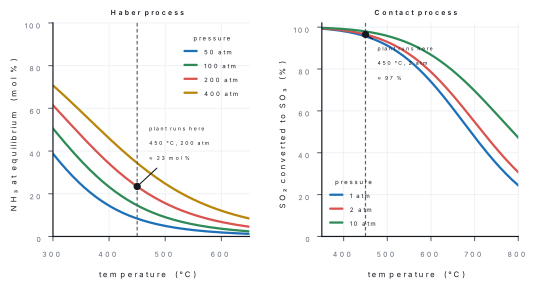
so K_p P^{2} fixes x, and the ammonia content of the exit gas is y_{NH_3} = x/(2-x). Because K_p falls steeply as T rises (exothermic) and the left-hand side carries P^2, yield improves with pressure and worsens with temperature — the two curves you must be able to sketch.
Choosing the conditions
| Variable | Equilibrium wants | Rate wants | Plant uses | Why |
|---|---|---|---|---|
| Temperature | low | high | 450–500 °C | a compromise: below ~400 °C the catalyst is too slow to be economic |
| Pressure | high | high | 200 atm | both want high; the limit is the cost and safety of thick-walled vessels |
| Catalyst | no effect | high | finely divided Fe with Mo or K₂O/Al₂O₃ promoters | speeds both directions equally, so equilibrium is reached sooner, not shifted |
| Removal of NH₃ | shifts right | — | condensed out at −30 °C | Le Chatelier: removing a product pulls the equilibrium forward |
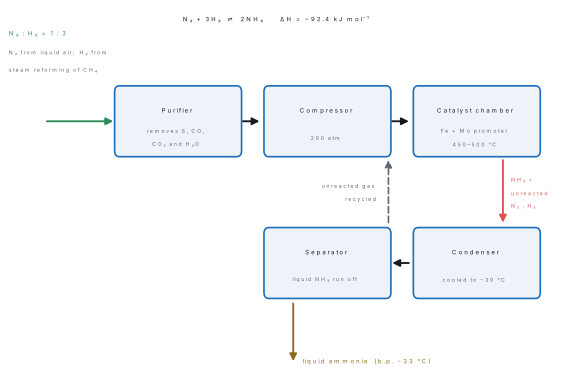
A single pass converts only about 15%. What makes the process economic is the recycle loop: unreacted N₂ and H₂ are returned to the converter, so the overall conversion of feed to ammonia exceeds 97%.
It does not. A catalyst lowers the activation energy of the forward and the reverse reaction by the same amount, so K_p is unchanged. Iron lets the converter reach equilibrium in seconds instead of years — it changes how fast you get the yield, never how much. Write "the catalyst allows an acceptable rate at a lower temperature, and the lower temperature is what improves the yield."
| Haber process at a glance | |
|---|---|
| Raw materials | air (N₂), natural gas + steam (H₂) |
| Conditions | 450–500 °C, 200 atm, 1 : 3 N₂ : H₂ |
| Catalyst | finely divided iron, promoted with molybdenum (or K₂O + Al₂O₃) |
| Key reaction | N₂ + 3H₂ ⇌ 2NH₃, ΔH = −92.4 kJ mol⁻¹ |
| By-products | CO₂ from the reforming step (used to make urea); purge gas burnt as fuel |
| Uses | urea and other fertilizers, nitric acid, explosives, nylon, refrigerant, cleaning agents |
Problem. A converter is charged with 1400 kg of N₂ and 240 kg of H₂. The plant recovers 1088 kg of ammonia. Find the limiting reactant, the theoretical yield and the percentage yield. (N = 14, H = 1)
Solution. Moles of N₂ = 1400 kg ÷ 28 kg kmol⁻¹ = 50 kmol. Moles of H₂ = 240 kg ÷ 2 kg kmol⁻¹ = 120 kmol.
The equation needs 3 mol H₂ per mol N₂, so 50 kmol of N₂ would need 3 × 50 = 150 kmol of H₂. Only 120 kmol is available, so hydrogen is the limiting reactant (and 40 kmol of N₂ is in excess).
From 2NH₃ per 3H₂: n(NH₃) = 120 × 2/3 = 80 kmol. Theoretical yield = 80 kmol × 17 kg kmol⁻¹ = 1360 kg.
17.2 Nitric acid by Ostwald's process
Before 1900 the world's nitric acid came from Chilean saltpetre. Wilhelm Ostwald's process (1902) makes it from ammonia and air instead, so a Haber plant and an Ostwald plant together turn atmospheric nitrogen into nitrate. The two are almost always built on the same site.
The manufacture is three oxidations in series.
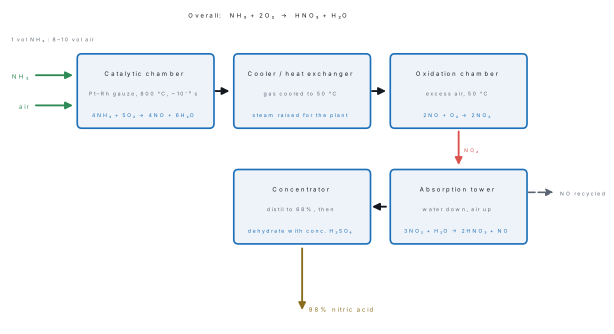
Step 1 — catalytic oxidation of ammonia. One volume of ammonia to 8–10 volumes of air is passed through a glowing platinum–rhodium (90 : 10) gauze at 800 °C. The contact time is about 10⁻³ s:
4NH₃ + 5O₂ --Pt/Rh, 800 °C--> 4NO + 6H₂O, ΔH = −905 kJ mol⁻¹
The reaction is so exothermic that once lit the gauze stays red hot without external heating. The contact time must be very short, because if the gases linger the nitric oxide decomposes back to nitrogen and oxygen.
Step 2 — oxidation of nitric oxide. The gas is cooled in a heat exchanger (raising steam for the rest of the plant) to about 50 °C and mixed with more air:
2NO + O₂ ⇌ 2NO₂, ΔH = −114 kJ mol⁻¹
This is an unusual reaction — it goes faster at lower temperature — so cooling helps both the rate and the equilibrium.
Step 3 — absorption in water. The nitrogen dioxide is passed up an absorption tower packed with quartz, against a downward spray of warm water, in the presence of excess air:
3NO₂ + H₂O → 2HNO₃ + NO and 4NO₂ + O₂ + 2H₂O → 4HNO₃
The NO released in the first of these is swept back into the oxidation chamber, so with enough air the overall equation is simply
NH₃ + 2O₂ → HNO₃ + H₂O
The tower produces about 68% nitric acid, which is the constant-boiling (azeotropic) mixture and cannot be concentrated further by distillation alone. To reach 98% "fuming" acid the 68% acid is distilled with a dehydrating agent — concentrated sulphuric acid or magnesium nitrate.
| Ostwald process at a glance | |
|---|---|
| Raw materials | ammonia, air, water |
| Conditions | 800 °C and 4–10 atm at the gauze; ~50 °C in the oxidiser and absorber |
| Catalyst | platinum–rhodium (90 : 10) gauze |
| Key reactions | 4NH₃ + 5O₂ → 4NO + 6H₂O; 2NO + O₂ ⇌ 2NO₂; 3NO₂ + H₂O → 2HNO₃ + NO |
| By-products | high-pressure steam (sold or used); tail gas containing NOₓ, which must be abated |
| Uses | ammonium nitrate and NPK fertilizers, explosives (TNT, nitroglycerine), dyes, nitration in organic synthesis, metal pickling |
Problem. An Ostwald unit is fed 170 kg of ammonia per hour. The overall conversion of NH₃ to HNO₃ is 90%. Calculate (a) the mass of pure HNO₃ made per hour, and (b) the mass of 68% (by mass) acid this corresponds to. (H = 1, N = 14, O = 16)
Solution. (a) Overall: NH₃ + 2O₂ → HNO₃ + H₂O, a 1 : 1 mole ratio.
n(NH₃) = 170 kg ÷ 17 kg kmol⁻¹ = 10 kmol. Theoretical n(HNO₃) = 10 kmol, so theoretical mass = 10 × 63 = 630 kg. At 90%: mass of pure HNO₃ = 0.90 × 630 = 567 kg per hour.
(b) If 100 kg of product acid contains 68 kg of HNO₃,
17.3 Sulphuric acid by contact process
Sulphuric acid is the most-produced chemical in the world by mass. It is cheap, a strong acid, a dehydrating agent, an oxidising agent at high concentration and a high-boiling liquid — so it turns up in fertilizer manufacture (its largest single use), detergents, dyes, paints, batteries and metal processing. The contact process is named for the contact between the gases and the solid catalyst.
Stage 1 — making sulphur dioxide
Either by burning sulphur in dry air,
S + O₂ → SO₂, ΔH = −297 kJ mol⁻¹
or by roasting iron pyrites,
4FeS₂ + 11O₂ --Δ--> 2Fe₂O₃ + 8SO₂
Stage 2 — purifying the gas
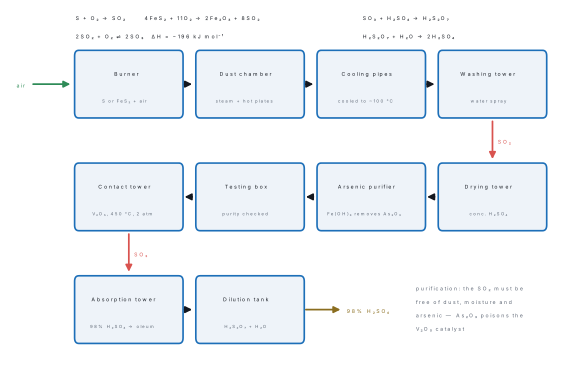
This is the stage students forget, and it carries marks. The V₂O₅ catalyst is poisoned by arsenic oxide and fouled by dust and moisture, so the burner gas is put through, in order: a dust chamber (steam, and electrostatic precipitation, to settle solid particles), cooling pipes, a washing tower (water spray removes soluble impurities), an arsenic purifier (ferric hydroxide adsorbs As₂O₃), a testing box, and finally a drying tower where concentrated sulphuric acid removes water vapour.
Stage 3 — the catalytic oxidation
Exothermic, and 3 mol of gas become 2 — the same shape of problem as the Haber process, so the same reasoning applies. But look again at the right-hand panel of the yield figure: at 450 °C and only 2 atm the equilibrium conversion is already about 97%. There is almost nothing left to gain from high pressure, so the plant runs at a little above atmospheric pressure and saves the cost of compressors and pressure vessels. This contrast with the Haber process is a favourite examination question.
Vanadium(V) oxide is used rather than the faster platinum because it is far cheaper and is not poisoned by traces of arsenic.
Stage 4 — absorption
SO₃ is not absorbed directly in water. Doing so produces a dense, persistent acid mist that neither settles nor dissolves, and most of the SO₃ escapes up the stack. Instead it is absorbed in 98% sulphuric acid to give oleum (fuming sulphuric acid, pyrosulphuric acid), which is then diluted:
SO₃ + H₂SO₄ → H₂S₂O₇ then H₂S₂O₇ + H₂O → 2H₂SO₄
That reaction is thermodynamically fine and completely useless industrially, because it produces an uncondensable mist. The mark scheme wants the two-step oleum route and the reason for it. The same mistake in reverse: do not add water to concentrated acid in the laboratory — always acid to water.
| Contact process at a glance | |
|---|---|
| Raw materials | sulphur (or iron pyrites), dry air, water |
| Conditions | 450 °C, 2 atm, purified and dried gas |
| Catalyst | vanadium(V) oxide, V₂O₅, on a silica support |
| Key reaction | 2SO₂ + O₂ ⇌ 2SO₃, ΔH = −196 kJ mol⁻¹ |
| By-products | Fe₂O₃ (cinder, to the steel industry) when pyrites is used; waste heat recovered as steam; unabsorbed SO₂ in the tail gas |
| Uses | fertilizers (superphosphate, ammonium sulphate), detergents, dyes, paints, lead–acid batteries, pickling of steel, petroleum refining |
Problem. 1.20 tonnes of iron pyrites, FeS₂, is roasted. Every sulphur atom is eventually converted to sulphuric acid with an overall efficiency of 95%. Calculate the mass of H₂SO₄ obtained. (Fe = 56, S = 32, O = 16, H = 1)
Solution. Molar mass of FeS₂ = 56 + 2(32) = 120 g mol⁻¹. n(FeS₂) = 1200 kg ÷ 120 kg kmol⁻¹ = 10 kmol.
From 4FeS₂ + 11O₂ → 2Fe₂O₃ + 8SO₂, each FeS₂ gives 2 SO₂: n(SO₂) = 20 kmol. Then 2SO₂ + O₂ → 2SO₃ and SO₃ → H₂SO₄ are both 1 : 1, so theoretical n(H₂SO₄) = 20 kmol.
Theoretical mass = 20 kmol × 98 kg kmol⁻¹ = 1960 kg. Actual mass = 0.95 × 1960 = 1862 kg = 1.862 tonnes.
17.4 Sodium hydroxide by Diaphragm Cell
Sodium hydroxide (caustic soda) and chlorine are made together by electrolysing brine — the chlor-alkali industry. The awkward part is not the electrolysis but keeping the two products apart: if hydroxide ions reach the chlorine, they react at once to give bleach and then chlorate,
Cl₂ + 2NaOH → NaCl + NaOCl + H₂O
so the cell must be designed to prevent mixing. The diaphragm cell does this with a porous barrier and a difference in liquid level.
Construction and action
The cell is a steel tank divided by a diaphragm of asbestos (now usually a polymer-modified asbestos or a synthetic fibre) deposited on a perforated steel cathode. The anode is titanium coated with a ruthenium oxide (graphite in older plants). Saturated purified brine (about 25% NaCl) is fed continuously into the anode compartment and kept at a higher level than the liquid in the cathode compartment, so the flow of liquid through the diaphragm is always from anode to cathode.
At the anode (oxidation): 2Cl⁻ → Cl₂ + 2e⁻
At the cathode (reduction): 2H₂O + 2e⁻ → H₂ + 2OH⁻
Overall: 2NaCl + 2H₂O --electrolysis--> 2NaOH + H₂ + Cl₂
Sodium ions migrate through the diaphragm to the cathode compartment to balance the charge; hydroxide ions try to migrate the opposite way, but the bulk flow of brine through the diaphragm sweeps them back. That is the whole trick.
Na⁺ has a far more negative discharge potential than water, so in aqueous solution water is reduced instead and hydrogen comes off. Sodium metal is made by electrolysing molten NaCl (Down's cell), not brine. Cells are also never run hot and never allowed to leak gas between compartments, because a hydrogen–chlorine mixture explodes in light.
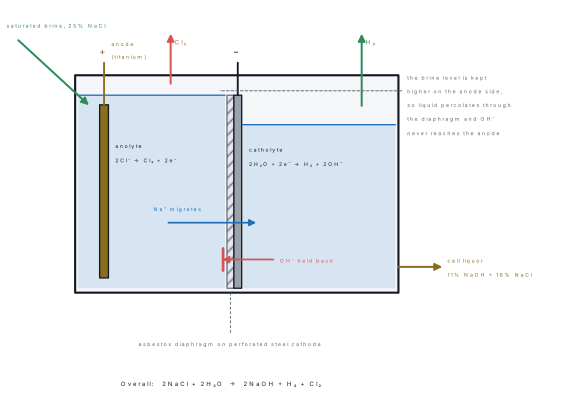
The liquid drawn from the cathode compartment is called cell liquor and is only about 11% NaOH contaminated with 16% NaCl. It is evaporated in multiple effect evaporators; sodium chloride is much less soluble in strong alkali and crystallises out, and is returned to the brine feed. The product is 50% caustic soda liquor, from which solid flakes can be obtained.
| Diaphragm cell at a glance | |
|---|---|
| Raw materials | saturated purified brine (25% NaCl), electricity |
| Conditions | 60–70 °C, 3.5–4 V per cell, current densities of a few kA m⁻² |
| Catalyst | none — an electrolytic process; the anode coating (RuO₂ on Ti) is an electrocatalyst |
| Key reactions | anode 2Cl⁻ → Cl₂ + 2e⁻; cathode 2H₂O + 2e⁻ → H₂ + 2OH⁻ |
| By-products | chlorine and hydrogen (both sold; often burnt together to make HCl) |
| Uses | soap and detergents, paper pulping, alumina from bauxite, rayon, petroleum refining, drain cleaner, laboratory reagent |
Problem. A diaphragm cell carries a current of 30 000 A for 24 hours with a current efficiency of 96%. Calculate (a) the mass of NaOH produced and (b) the volume of chlorine at STP. (Na = 23, O = 16, H = 1; F = 96 500 C mol⁻¹; molar volume at STP = 22.4 L mol⁻¹)
Solution. Charge passed, Q = I t = 30 000 A × (24 × 3600) s = 2.592 × 10⁹ C.
Useful electrons = 0.96 × 2.686 × 10⁴ = 2.579 × 10⁴ mol.
(a) The cathode reaction 2H₂O + 2e⁻ → H₂ + 2OH⁻ gives one OH⁻ per electron, and each OH⁻ pairs with an Na⁺, so n(NaOH) = 2.579 × 10⁴ mol.
mass = 2.579 × 10⁴ mol × 40 g mol⁻¹ = 1.031 × 10⁶ g = 1031 kg
(b) The anode reaction 2Cl⁻ → Cl₂ + 2e⁻ needs two electrons per Cl₂:
n(Cl₂) = ½ × 2.579 × 10⁴ = 1.289 × 10⁴ mol V = 1.289 × 10⁴ × 22.4 = 2.888 × 10⁵ L = 288.8 m³
17.5 Sodium carbonate by ammonia soda (Solvay) process
Sodium carbonate (soda ash, washing soda as the decahydrate Na₂CO₃·10H₂O) is needed by the glass industry above all — roughly half of world output goes into glass — and also for soaps, paper, water softening and detergent builders. Ernest Solvay's 1861 process makes it from two of the cheapest raw materials on Earth, common salt and limestone, using ammonia that is recovered and used over and over again. The overall equation is deceptively simple:
2NaCl + CaCO₃ → Na₂CO₃ + CaCl₂
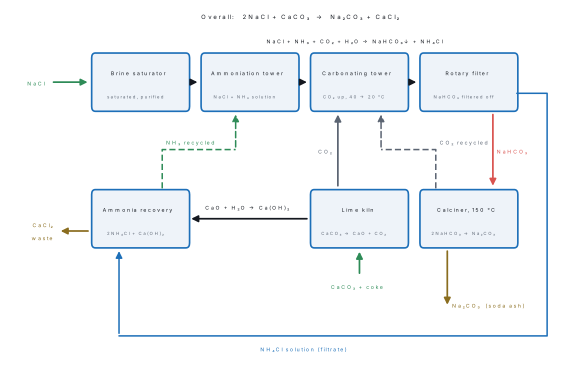
This reaction will not happen if you simply mix the two solids — it is the wrong way round thermodynamically in solution. Solvay's insight was to reach the same result through four steps that each do work.
1. Ammoniation. Purified, saturated brine is run down an ammoniation tower against a rising stream of ammonia gas. Any Ca²⁺ and Mg²⁺ in the brine is precipitated here and filtered off, which also purifies the feed.
2. Carbonation. The ammoniated brine is run down a carbonating (Solvay) tower fitted with perforated mushroom-shaped baffles, against carbon dioxide rising from below. The tower is warm at the top (about 40 °C) and cooled to about 20 °C at the bottom:
NH₃ + H₂O + CO₂ → NH₄HCO₃
NH₄HCO₃ + NaCl → NaHCO₃↓ + NH₄Cl
Sodium hydrogencarbonate is the least soluble substance present, so it crystallises out. Everything turns on that one solubility fact.
3. Filtration and calcination. The NaHCO₃ is filtered on a rotary vacuum filter and heated to about 150–200 °C in a calciner:
2NaHCO₃ --Δ--> Na₂CO₃ + H₂O + CO₂↑
Half the carbon dioxide needed by the tower comes back from this step.
4. Ammonia recovery. The filtrate is ammonium chloride solution. It is warmed with milk of lime:
2NH₄Cl + Ca(OH)₂ → CaCl₂ + 2NH₃↑ + 2H₂O
The ammonia goes straight back to the ammoniation tower, which is why the process consumes almost no ammonia — only make-up for losses.
The lime and the remaining CO₂ come from a lime kiln burning limestone with coke:
CaCO₃ --1000 °C--> CaO + CO₂↑ and CaO + H₂O → Ca(OH)₂
| Solvay process at a glance | |
|---|---|
| Raw materials | brine (NaCl), limestone (CaCO₃), coke; ammonia is recycled, not consumed |
| Conditions | carbonating tower 40 °C falling to 20 °C; calciner 150–200 °C; lime kiln ~1000 °C |
| Catalyst | none |
| Key reactions | NaCl + NH₃ + CO₂ + H₂O → NaHCO₃↓ + NH₄Cl; 2NaHCO₃ → Na₂CO₃ + H₂O + CO₂ |
| By-products | calcium chloride solution (the only large waste — de-icing salt, dust suppressant, but mostly discharged) |
| Uses | glass manufacture, soaps and detergents, paper, water softening, sodium salts, textile processing |
Problem. A Solvay plant processes 1170 kg of sodium chloride. If the overall yield of sodium carbonate is 90%, what mass of Na₂CO₃ is obtained? (Na = 23, Cl = 35.5, C = 12, O = 16)
Solution. Molar mass of NaCl = 58.5 g mol⁻¹; n(NaCl) = 1170 ÷ 58.5 = 20 kmol.
From the overall equation 2NaCl + CaCO₃ → Na₂CO₃ + CaCl₂, two moles of NaCl give one mole of Na₂CO₃, so theoretical n(Na₂CO₃) = 10 kmol.
Molar mass of Na₂CO₃ = 2(23) + 12 + 3(16) = 106 g mol⁻¹. Theoretical mass = 10 × 106 = 1060 kg. Actual mass = 0.90 × 1060 = 954 kg.
17.6 Fertilizers: chemical fertilizers, types, production of urea
A fertilizer is a substance, natural or manufactured, added to soil to supply one or more of the elements that plants need for growth in a form the roots can absorb.
Plants need sixteen elements. Carbon, hydrogen and oxygen come free from air and water. Of the rest, three are needed in bulk and are almost always the limiting ones, so they are called the primary nutrients:
| Nutrient | Symbol | What it does | Deficiency sign |
|---|---|---|---|
| Nitrogen | N | proteins, chlorophyll, vegetative growth | older leaves yellow (chlorosis), stunting |
| Phosphorus | P | ATP, nucleic acids, root and seed development | dark green to purple leaves, poor rooting |
| Potassium | K | enzyme activation, stomatal control, disease resistance | scorched leaf margins, weak stems, lodging |
Secondary nutrients are Ca, Mg and S; micronutrients (Fe, Mn, Zn, Cu, B, Mo, Cl) are needed in traces.
Types of chemical fertilizer
| Type | Examples | N–P₂O₅–K₂O grade | Notes |
|---|---|---|---|
| Nitrogenous | urea NH₂CONH₂ | 46–0–0 | highest N content of any solid fertilizer; hygroscopic |
| ammonium sulphate (NH₄)₂SO₄ | 21–0–0 | also supplies S; acidifies the soil | |
| ammonium nitrate NH₄NO₃ | 35–0–0 | quick-acting; an explosive hazard in bulk | |
| calcium ammonium nitrate | 26–0–0 | safer, non-acidifying version of the above | |
| Phosphatic | single superphosphate | 0–16–0 | Ca(H₂PO₄)₂ + CaSO₄, made with H₂SO₄ |
| triple superphosphate | 0–46–0 | made with H₃PO₄, no gypsum diluent | |
| Potassic | muriate of potash, KCl | 0–0–60 | cheapest K source; avoid on chloride-sensitive crops |
| sulphate of potash, K₂SO₄ | 0–0–50 | for tobacco, potato, fruit | |
| Mixed / complex | DAP (NH₄)₂HPO₄ | 18–46–0 | one compound supplying two nutrients |
| NPK blends | e.g. 20–20–0 | physically blended or chemically granulated |
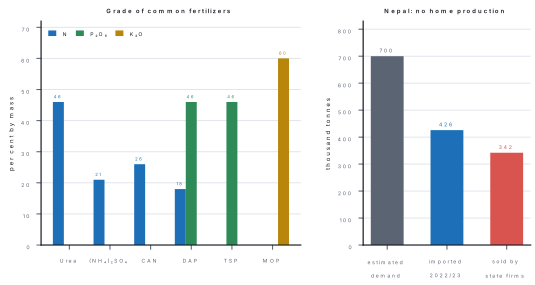
The three numbers printed on every bag — the grade — are the percentages by mass of N, of P as P₂O₅, and of K as K₂O. They are a trade convention, not a statement that the bag contains P₂O₅ molecules.
Straight fertilizers supply one primary nutrient; complex (or mixed) fertilizers supply two or three. Fertilizers are also classed as quick-acting (nitrate salts, which are freely soluble and leach fast) or slow-acting (urea, which must first be hydrolysed by soil urease to ammonium carbonate).
Nitrate is very soluble, so whatever the crop does not take up is washed into streams, where it feeds algae. The algae die, bacteria decompose them and use up the dissolved oxygen, and fish suffocate — eutrophication. Ammonium fertilizers also acidify soil over years, and nitrogenous fertilizer beds emit N₂O, a greenhouse gas about 270 times more potent than CO₂ per molecule. The correct exam answer to "why is fertilizer a problem?" is always eutrophication plus soil acidification, never "it is a chemical".
Fertilizer in Nepal
Nepal has no chemical fertilizer factory. Every kilogram is imported, mostly from India and the Gulf, by two state undertakings — Agriculture Inputs Company Limited and Salt Trading Corporation — and sold at a subsidised price. In the fiscal year 2022/23 Nepal imported 426,007 tonnes of chemical fertilizer worth about Rs 40.65 billion, against a government estimate of annual demand of roughly 700,000 tonnes; the two state firms sold 342,462 tonnes of it. The shortfall is the reason for the queues outside depots before the paddy planting season. This is the applied-chemistry argument for building an urea plant at home, and the reason this section matters more in Nepal than the syllabus line suggests.
Production of urea
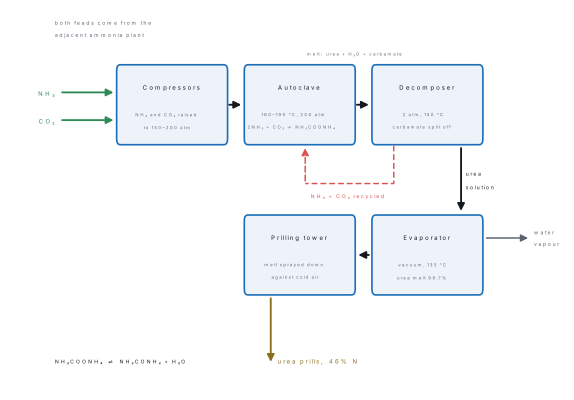
Urea, NH₂CONH₂, is made by the Bosch–Meiser process directly from the two products of an ammonia plant — ammonia itself, and the carbon dioxide stripped out of the reformer gas. That is why urea plants are always built beside ammonia plants.
Step 1 (fast, exothermic). Liquid ammonia and carbon dioxide are compressed to 150–200 atm and fed to an autoclave at 180–190 °C, where they combine to ammonium carbamate:
2NH₃ + CO₂ → NH₂COONH₄, ΔH = −117 kJ mol⁻¹
Step 2 (slow, endothermic, reversible). The carbamate loses water:
NH₂COONH₄ ⇌ NH₂CONH₂ + H₂O, ΔH = +15.5 kJ mol⁻¹
The high pressure is needed to keep the carbamate in the liquid phase; the high temperature drives the second, endothermic step. Conversion per pass is about 50–70%.
Step 3. The melt leaving the autoclave is let down to about 2 atm in a decomposer (stripper), where the unconverted carbamate splits back into NH₃ and CO₂. These gases are compressed and recycled to the autoclave, so the overall conversion is nearly complete.
Step 4. The urea solution is concentrated in a vacuum evaporator at about 135 °C to a melt containing 99.7% urea.
Step 5. The melt is sprayed from the top of a prilling tower through a rotating perforated bucket. The droplets solidify as they fall against an up-draught of cold air, forming the near-spherical prills sold in bags. Modern plants granulate instead, giving harder, larger particles.
Combining steps 1 and 2:
2NH₃ + CO₂ → NH₂CONH₂ + H₂O
| Urea manufacture at a glance | |
|---|---|
| Raw materials | ammonia and carbon dioxide (both from the ammonia plant) |
| Conditions | autoclave 180–190 °C and 150–200 atm; decomposer 2 atm; evaporator 135 °C under vacuum |
| Catalyst | none — high pressure and temperature only |
| Key reactions | 2NH₃ + CO₂ → NH₂COONH₄; NH₂COONH₄ ⇌ NH₂CONH₂ + H₂O |
| By-products | water; biuret (NH₂CONHCONH₂), an impurity that must be kept below ~1% because it damages leaves |
| Uses | fertilizer (about 90% of output), cattle feed supplement, urea–formaldehyde resins, melamine, medical creams, NOₓ abatement in diesel exhaust |
Problem. A urea unit receives 1.00 tonne of ammonia per hour, all of which reacts. Calculate (a) the mass of CO₂ required per hour, (b) the maximum mass of urea produced per hour, and (c) the mass of nitrogen delivered to the field in that urea. (H = 1, C = 12, N = 14, O = 16)
Solution. The overall equation is 2NH₃ + CO₂ → NH₂CONH₂ + H₂O.
n(NH₃) = 1000 kg ÷ 17 kg kmol⁻¹ = 58.82 kmol.
(a) n(CO₂) = ½ × 58.82 = 29.41 kmol; mass = 29.41 × 44 = 1294 kg.
(b) n(urea) = ½ × 58.82 = 29.41 kmol; molar mass of NH₂CONH₂ = 60 g mol⁻¹, so mass = 29.41 × 60 = 1765 kg.
(c) Each mole of urea carries 2 mol of N (28 g):
mass of N = 0.467 × 1765 = 824 kg per hour.
Chapter summary
- Haber: N₂ + 3H₂ ⇌ 2NH₃, ΔH = −92.4 kJ mol⁻¹; Fe + Mo promoter, 450–500 °C, 200 atm, 1 : 3 feed; ammonia condensed out at −30 °C and unreacted gas recycled. Temperature is a compromise between yield and rate.
- Ostwald: 4NH₃ + 5O₂ → 4NO + 6H₂O over Pt–Rh gauze at 800 °C in ~10⁻³ s; 2NO + O₂ ⇌ 2NO₂ on cooling; 3NO₂ + H₂O → 2HNO₃ + NO in the absorber. Overall NH₃ + 2O₂ → HNO₃ + H₂O, giving 68% acid, concentrated with conc. H₂SO₄.
- Contact: S + O₂ → SO₂ (or 4FeS₂ + 11O₂ → 2Fe₂O₃ + 8SO₂); purify and dry; 2SO₂ + O₂ ⇌ 2SO₃ over V₂O₅ at 450 °C and 2 atm, ΔH = −196 kJ mol⁻¹; absorb in 98% H₂SO₄ to oleum (SO₃ + H₂SO₄ → H₂S₂O₇) and dilute. Low pressure suffices because conversion is already ~97%.
- Diaphragm cell: anode 2Cl⁻ → Cl₂ + 2e⁻, cathode 2H₂O + 2e⁻ → H₂ + 2OH⁻, overall 2NaCl + 2H₂O → 2NaOH + H₂ + Cl₂. The asbestos diaphragm plus a higher anolyte level keeps OH⁻ away from Cl₂. Cell liquor is 11% NaOH + 16% NaCl.
- Solvay: NaCl + NH₃ + CO₂ + H₂O → NaHCO₃↓ + NH₄Cl, then 2NaHCO₃ → Na₂CO₃ + H₂O + CO₂, with 2NH₄Cl + Ca(OH)₂ → CaCl₂ + 2NH₃ + 2H₂O recovering the ammonia. Overall 2NaCl + CaCO₃ → Na₂CO₃ + CaCl₂; CaCl₂ is the only waste.
- Fertilizers: graded N–P₂O₅–K₂O. Urea 46–0–0, (NH₄)₂SO₄ 21–0–0, DAP 18–46–0, TSP 0–46–0, MOP 0–0–60. Excess causes eutrophication and soil acidification.
- Urea: 2NH₃ + CO₂ → NH₂COONH₄ ⇌ NH₂CONH₂ + H₂O at 180–190 °C and 200 atm; carbamate recycled from the decomposer; melt prilled. Nitrogen content 28/60 = 46.7%.
- A catalyst never changes K_p; it changes the time taken to reach equilibrium, which is what lets a plant use a lower, yield-friendly temperature.
Practice questions
Group A — Multiple choice (1 mark each)
- The catalyst used in the contact process is [1]afinely divided ironbplatinum–rhodium gauzecvanadium(V) oxidednickel
- In the Haber process, increasing the pressure increases the yield of ammonia because [1]athe reaction is exothermicbthe number of gas molecules decreasescthe catalyst works betterdammonia is a liquid
- Sulphur trioxide is absorbed in concentrated sulphuric acid rather than water because [1]awater does not react with SO₃bthe reaction with water is endothermicca persistent acid mist is formed with waterdSO₃ is insoluble in water
- In the diaphragm cell the product formed at the cathode is [1]asodium metalbchlorinechydrogendoxygen
- The least soluble substance formed in the carbonating tower of the Solvay process is [1]aNaHCO₃bNH₄ClcNa₂CO₃dNH₄HCO₃
- The percentage of nitrogen in urea is closest to [1]a21%b35%c46%d60%
Answers to Group A
1. (c) — V₂O₅ is cheap and, unlike platinum, is not poisoned by traces of arsenic.
2. (b) — 4 mol of gas become 2, so by Le Chatelier's principle higher pressure shifts the equilibrium right.
3. (c) — direct absorption in water gives a fine mist of H₂SO₄ that will not condense and escapes up the stack.
4. (c) — water is reduced in preference to Na⁺, so hydrogen is evolved; sodium metal needs molten NaCl.
5. (a) — sodium hydrogencarbonate crystallises out, which is what drives the whole process.
6. (c) — 28/60 × 100 = 46.7%.
Group B — Short answer (5 marks each)
- State Le Chatelier's principle and use it to explain the choice of temperature and pressure in the Haber process. Why is a catalyst used even though it cannot change the yield? [5]
- Describe, with equations, the purification of the gas in the contact process, and state why each impurity must be removed. [5]
- Explain the function of the diaphragm and of the difference in brine level in a diaphragm cell. Write the electrode reactions and name the by-products. [5]
- 2.8 tonnes of nitrogen is passed through a Haber converter with excess hydrogen. If the percentage yield is 85%, calculate the mass of ammonia produced. [5]
- A farmer needs to apply 140 kg of nitrogen to one hectare. Calculate the mass of urea required, and state two reasons why applying twice this amount would be harmful. [5]
- Why is ammonia not consumed in the Solvay process? Write the equations for the two steps in which it is used and recovered, and name the only large waste product. [5]
Answers to Group B
1. Le Chatelier: if a system at equilibrium is disturbed, the equilibrium shifts in the direction that opposes the disturbance. The forward reaction N₂ + 3H₂ ⇌ 2NH₃ is exothermic, so a low temperature would give the highest equilibrium yield; but at low temperature the rate is uneconomically slow, so 450–500 °C is chosen as a compromise. Four moles of gas become two, so a high pressure shifts the equilibrium right and speeds the reaction — 200 atm is used, limited only by the cost and safety of the vessels. The iron catalyst lowers the activation energy of forward and reverse reactions equally, so K_p is unchanged; its value is that equilibrium is reached quickly at a temperature low enough to give a useful yield.
2. Burner gas is passed through: a dust chamber (steam and electrostatic precipitation) to settle dust, which would coat and deactivate the catalyst; cooling pipes, to drop the temperature to about 100 °C and recover heat; a washing tower (water spray) to dissolve out soluble impurities; an arsenic purifier where Fe(OH)₃ adsorbs As₂O₃, because arsenic is a permanent catalyst poison; a testing box to confirm purity; and a drying tower where concentrated H₂SO₄ removes water vapour, which would otherwise form acid mist and dilute the product. The reaction to be protected is 2SO₂ + O₂ ⇌ 2SO₃ over V₂O₅.
3. The diaphragm is a porous asbestos layer on the perforated steel cathode. It lets ions and liquid through but prevents bulk mixing of the anolyte and catholyte, which is essential because Cl₂ + 2NaOH → NaCl + NaOCl + H₂O would destroy both products. The anode compartment is kept at a higher liquid level, so brine percolates continuously from anode side to cathode side; this bulk flow opposes the electrical migration of OH⁻ towards the anode and sweeps hydroxide away from the chlorine. Electrode reactions: anode 2Cl⁻ → Cl₂ + 2e⁻; cathode 2H₂O + 2e⁻ → H₂ + 2OH⁻. By-products: chlorine and hydrogen.
4. n(N₂) = 2800 kg ÷ 28 kg kmol⁻¹ = 100 kmol. From N₂ + 3H₂ → 2NH₃ (hydrogen in excess, so N₂ is limiting), theoretical n(NH₃) = 200 kmol. Theoretical mass = 200 × 17 = 3400 kg. Actual mass = 0.85 × 3400 = 2890 kg = 2.89 tonnes.
5. Urea is NH₂CONH₂, molar mass 60 g mol⁻¹, containing 2 N (28 g) per mole. mass of urea = 140 × 60/28 = 300 kg. Harm from over-application: (i) the excess nitrate is leached into streams and causes eutrophication — algal bloom, oxygen depletion, fish kill; (ii) repeated ammonium application acidifies the soil, and high salt concentration can scorch roots ("fertilizer burn"); emission of N₂O, a potent greenhouse gas, is also increased.
6. Ammonia is used in the ammoniation/carbonation step, NaCl + NH₃ + CO₂ + H₂O → NaHCO₃↓ + NH₄Cl, and is recovered from the filtrate by warming with milk of lime, 2NH₄Cl + Ca(OH)₂ → CaCl₂ + 2NH₃↑ + 2H₂O. The recovered ammonia is returned to the ammoniation tower, so only make-up ammonia for mechanical losses is bought. The only large waste is calcium chloride solution.
Group C — Long answer (8 marks each)
- Describe the manufacture of sulphuric acid by the contact process. Include a labelled flow sheet, all balanced equations, the conditions with reasons, and explain why a much lower pressure is used than in the Haber process. [8]
- (a) With a labelled diagram, describe the manufacture of sodium hydroxide by the diaphragm cell, giving the electrode reactions and the composition of the cell liquor.(b) A cell carries 50 kA for 10 hours at 95% current efficiency. Calculate the mass of NaOH produced and the volume of chlorine at STP. [8]
- (a) What is a chemical fertilizer? Classify chemical fertilizers with one example and the N–P₂O₅–K₂O grade of each class.(b) Describe the manufacture of urea from ammonia and carbon dioxide with a flow-sheet diagram and balanced equations.(c) Calculate the mass of urea that can be made from 340 kg of ammonia if the conversion is 75%. [8]
Answers to Group C
1. Outline. Stage 1: S + O₂ → SO₂ (or 4FeS₂ + 11O₂ → 2Fe₂O₃ + 8SO₂) in the burner. Stage 2 — purification: dust chamber → cooling pipes → washing tower → arsenic purifier (Fe(OH)₃ removes As₂O₃, a catalyst poison) → testing box → drying tower (conc. H₂SO₄). Stage 3: 2SO₂ + O₂ ⇌ 2SO₃, ΔH = −196 kJ mol⁻¹, over V₂O₅ at 450 °C and 2 atm. Temperature is a compromise: the reaction is exothermic so a low temperature favours SO₃, but below ~400 °C the catalyst is too slow. Stage 4: SO₃ + H₂SO₄ → H₂S₂O₇ (oleum), then H₂S₂O₇ + H₂O → 2H₂SO₄; direct absorption in water is avoided because it forms an uncondensable acid mist. Pressure: both reactions reduce the number of gas moles, so both are helped by pressure — but at 450 °C and only 2 atm the SO₂ conversion is already about 97%, so higher pressure would buy at most 2–3% more product and could not pay for compressors and pressure vessels. In the Haber process the equilibrium at the operating temperature is so unfavourable that 200 atm is worth paying for. Credit a flow sheet matching the figure in the text.
2. (a) Steel tank; titanium (RuO₂-coated) anode; perforated steel cathode carrying an asbestos diaphragm; saturated 25% brine fed to the anode compartment and held at a higher level. Anode: 2Cl⁻ → Cl₂ + 2e⁻. Cathode: 2H₂O + 2e⁻ → H₂ + 2OH⁻. Overall: 2NaCl + 2H₂O → 2NaOH + H₂ + Cl₂. The diaphragm and the level difference keep OH⁻ away from Cl₂. Cell liquor drawn off contains about 11% NaOH and 16% NaCl; it is evaporated, the less soluble NaCl crystallises and is recycled, and 50% caustic liquor is obtained. (b) Q = 50 000 A × 36 000 s = 1.8 × 10⁹ C. n(e⁻) = 1.8 × 10⁹ ÷ 96 500 = 1.865 × 10⁴ mol; useful = 0.95 × 1.865 × 10⁴ = 1.772 × 10⁴ mol. NaOH: 1 mol per electron → 1.772 × 10⁴ × 40 = 7.088 × 10⁵ g = 708.8 kg. Cl₂: 1 mol per 2 electrons → 8.860 × 10³ mol; V = 8.860 × 10³ × 22.4 = 1.985 × 10⁵ L = 198.5 m³.
3. (a) A fertilizer is a substance added to soil to supply one or more elements needed for plant growth in an absorbable form. Classes: nitrogenous — urea, 46–0–0; phosphatic — triple superphosphate, 0–46–0; potassic — muriate of potash (KCl), 0–0–60; mixed/complex — DAP, 18–46–0. (Straight versus complex, and quick- versus slow-acting, are acceptable alternative classifications.) (b) NH₃ and CO₂ from the adjacent ammonia plant are compressed to 150–200 atm and fed to an autoclave at 180–190 °C: 2NH₃ + CO₂ → NH₂COONH₄ (fast, exothermic), then NH₂COONH₄ ⇌ NH₂CONH₂ + H₂O (slow, endothermic). The melt is let down to 2 atm in a decomposer where unconverted carbamate splits back to NH₃ + CO₂, which are recycled; the urea solution is concentrated to a 99.7% melt in a vacuum evaporator at 135 °C and sprayed down a prilling tower against cold air to give prills. Credit a flow sheet matching the figure in the text. (c) n(NH₃) = 340 ÷ 17 = 20 kmol. From 2NH₃ + CO₂ → NH₂CONH₂ + H₂O, theoretical n(urea) = 10 kmol = 10 × 60 = 600 kg. At 75%: mass = 450 kg.
Practise more: Chemistry question bank