Unit 9 · Inorganic Chemistry · 22 teaching hours · 40 min read
Chemistry of Non-metals
What the syllabus asks for 8
- Hydrogen: atomic and nascent hydrogen; isotopes and uses; hydrogen as fuel; heavy water [with 9.2, 9.3 = 4 hrs]
- Allotropes of Oxygen: allotropy; types of oxides (acidic, basic, neutral, amphoteric, peroxide, mixed); applications of H2O2; medical and industrial application of oxygen
- Ozone: occurrence; preparation from oxygen; structure; test; ozone layer depletion; uses
- Nitrogen [5 hrs]: inertness and active nitrogen; chemical properties of ammonia and applications; harmful effects; oxy-acids of nitrogen (name and formula); chemical properties of nitric acid; ring test for nitrate ion
- Halogens [5 hrs]: general characteristics; comparative preparation, chemical properties and uses of Cl2, Br2, I2; tests; haloacids HCl, HBr, HI
- Carbon [with phosphorus = 3 hrs]: allotropes including fullerenes; properties and uses of carbon monoxide
- Phosphorus: allotropes (name only); phosphine
- Sulphur [5 hrs]: allotropes and uses; hydrogen sulphide including Kipp's apparatus; sulphur dioxide; sulphuric acid; sodium thiosulphate
This is the longest unit in the course and the one that rewards organised revision most. For eight different non-metals it asks the same four things: how the element or its compound is prepared, what its properties are, how it reacts, and what it is used for. Once you see that pattern, twenty-two hours of syllabus collapses into a set of tables you can rebuild from memory.
Expect one laboratory preparation with a labelled diagram, two or three "give reasons" questions (why quicklime and not conc. H₂SO₄; why conc. H₂SO₄ cannot make HI), a test for a gas or an ion, and one numerical on gas volumes at STP. A balanced equation earns marks that a paragraph of description never will.
9.1 Hydrogen
Hydrogen has the simplest possible atom — one proton, one electron, 1s¹. It sits awkwardly in the periodic table because it resembles both group 1 (one valence electron, forms H⁺) and group 17 (one short of a duplet, forms H⁻ in NaH).
Atomic and nascent hydrogen
Ordinary hydrogen is molecular, H₂, and is unreactive at room temperature because the H–H bond enthalpy is a large 436 kJ mol⁻¹.
- Atomic hydrogen is free H atoms, made by passing H₂ through an electric arc between tungsten electrodes at about 4000 °C. It lasts a fraction of a second and recombines, releasing enough heat for the atomic hydrogen torch.
- Nascent hydrogen is hydrogen released inside a reacting mixture, for example by adding zinc to dilute sulphuric acid in the presence of the substance to be reduced. It turns acidified KMnO₄ colourless and reduces FeCl₃ to FeCl₂, whereas bubbling H₂ through the same solutions does nothing.
The difference is energy: nascent hydrogen carries the energy released by the generating reaction and never has to pay the 436 kJ mol⁻¹ to split H₂.
Isotopes of hydrogen
| Isotope | Symbol | Protons | Neutrons | Mass number | Abundance | Note |
|---|---|---|---|---|---|---|
| Protium | ¹₁H | 1 | 0 | 1 | 99.985 % | ordinary hydrogen |
| Deuterium | ²₁H or D | 1 | 1 | 2 | 0.015 % | stable, heavy water |
| Tritium | ³₁H or T | 1 | 2 | 3 | trace | radioactive, β-emitter, half-life 12.3 yr |
Uses. Deuterium is a tracer for reaction mechanisms and, as D₂O, a reactor moderator; tritium is a radioactive tracer in hydrology and is used in luminous signs.
Preparation of hydrogen
| Method | Equation |
|---|---|
| Active metal + dilute acid (the lab method, Kipp's apparatus) | Zn + H₂SO₄(dil) → ZnSO₄ + H₂↑ |
| Very active metal + cold water (violent) | 2Na + 2H₂O → 2NaOH + H₂↑ |
| Amphoteric metal + alkali | Zn + 2NaOH → Na₂ZnO₂ + H₂↑ |
| Steam over red-hot coke (water gas) | C + H₂O --1273 K--> CO + H₂ |
| Steam reforming of methane (main industrial route) | CH₄ + H₂O --Ni, 1100 K--> CO + 3H₂ |
| Electrolysis of acidified water (purest H₂) | 2H₂O --electricity--> 2H₂↑ + O₂↑ |
Properties of hydrogen
| Physical | Chemical |
|---|---|
| Colourless, odourless, tasteless, neutral to litmus | Burns in air: 2H₂ + O₂ → 2H₂O, ΔH = −286 kJ per mol H₂O |
| Lightest known gas, 0.09 g L⁻¹ at STP | With halogens: H₂ + Cl₂ --sunlight--> 2HCl (explosive) |
| Very slightly soluble; b.p. −252.8 °C | With N₂: N₂ + 3H₂ ⇌ 2NH₃ (Haber process); with Na: 2Na + H₂ → 2NaH |
| Diffuses faster than any other gas | Reduces hot metal oxides: CuO + H₂ → Cu + H₂O |
Hydrogen as a fuel
Hydrogen has the highest energy content per gram of any chemical fuel — about 143 kJ g⁻¹, against 48 kJ g⁻¹ for petrol — and its only combustion product is water. A hydrogen fuel cell runs the same reaction electrochemically and delivers electricity far more efficiently than a petrol engine.
| Advantages | Problems |
|---|---|
| Highest calorific value per unit mass; product is only water — no CO₂, no SO₂, no soot | Very low density, so storage needs compression, liquefaction at −253 °C or metal hydrides |
| Renewable if electrolysed using hydropower; fuel cells are silent and efficient | Wide explosive range in air (4–75 %); most hydrogen today still comes from fossil methane |
For Nepal the attraction is clear: surplus monsoon hydro-electricity could electrolyse water and be stored as hydrogen instead of being spilled.
Heavy water, D₂O
Heavy water is deuterium oxide, D₂O, present to about 1 part in 6000 in ordinary water. It is obtained by prolonged electrolysis of alkaline water: H₂O is electrolysed faster than D₂O, so D₂O concentrates in the residue — about 30 litres of water leaves roughly 1 mL of nearly pure D₂O.
| Property | H₂O | D₂O |
|---|---|---|
| Molar mass (g mol⁻¹) | 18 | 20 |
| Melting point | 0 °C | 3.8 °C |
| Boiling point | 100 °C | 101.4 °C |
| Density at 25 °C | 0.997 g cm⁻³ | 1.104 g cm⁻³ |
Uses. As a moderator in nuclear reactors — it slows fast neutrons without absorbing them; as a source of deuterium compounds (Ca₃N₂ + 6D₂O → 3Ca(OD)₂ + 2ND₃); and as a tracer. It is not hard water or water containing heavy metals — only the hydrogen is the heavier isotope.
Problem. 6.5 g of granulated zinc is completely dissolved in excess dilute sulphuric acid. Calculate the volume of hydrogen liberated at STP. (Zn = 65, molar volume at STP = 22.4 L mol⁻¹.)
Solution. Equation: Zn + H₂SO₄ → ZnSO₄ + H₂↑
Moles of zinc:
From the equation, 1 mol Zn gives 1 mol H₂, so n(\mathrm{H_2}) = 0.10 mol.
Answer: 2.24 L (2240 cm³) of hydrogen at STP.
9.2 Allotropes of Oxygen
Allotropy
Allotropy is the existence of an element in two or more forms in the same physical state, differing in physical properties but giving the same chemical products. Oxygen has two allotropes: colourless, odourless, stable dioxygen O₂ (b.p. −183 °C) and pale blue, pungent, unstable ozone O₃ (b.p. −112 °C), which is a far stronger oxidising agent. They differ in the number of atoms per molecule, so this is molecular allotropy; diamond and graphite show crystalline allotropy.
Types of oxides
An oxide is a binary compound of oxygen with another element. Oxides are classified by how they behave towards acids and alkalis.
| Type | Behaviour | Examples |
|---|---|---|
| Acidic | dissolve in water to give acids; react with alkalis | CO₂, SO₂, SO₃, N₂O₅, P₄O₁₀; SO₂ + 2NaOH → Na₂SO₃ + H₂O |
| Basic | metal oxides; react with acids to give salt and water | Na₂O, CaO, MgO, FeO; CaO + 2HCl → CaCl₂ + H₂O |
| Amphoteric | react with both acids and alkalis | ZnO, Al₂O₃, PbO, SnO; ZnO + 2HCl → ZnCl₂ + H₂O and ZnO + 2NaOH → Na₂ZnO₂ + H₂O |
| Neutral | neither acidic nor basic; no salt with acid or base | CO, NO, N₂O, H₂O |
| Peroxide | contain the O–O linkage (O₂²⁻); give H₂O₂ with dilute acid | Na₂O₂, BaO₂, H₂O₂; BaO₂ + H₂SO₄ → BaSO₄↓ + H₂O₂ |
| Mixed | behave as a mixture of two simpler oxides | Fe₃O₄ (FeO·Fe₂O₃), Pb₃O₄ (2PbO·PbO₂), Mn₃O₄ |
Metal on the left → basic; non-metal on the right → acidic; the diagonal strip Be, Al, Zn, Sn, Pb → amphoteric; an O–O bond → peroxide; an odd ratio like M₃O₄ → mixed.
Applications of hydrogen peroxide
Hydrogen peroxide, H₂O₂, is a pale blue syrupy liquid sold as a 3 % or 6 % solution or labelled by volume strength. Its only reduction product is water, which makes it an environmentally clean oxidant.
| Application | Basis |
|---|---|
| Antiseptic for wounds (3 %) | liberates nascent oxygen, kills anaerobic bacteria |
| Bleaching silk, wool, hair, ivory | mild oxidant, does not damage delicate fibre |
| Restoring old oil paintings | black PbS + 4H₂O₂ → white PbSO₄ + 4H₂O |
| Rocket propellant; effluent treatment; lab oxidant | decomposes to hot O₂; oxidises cyanides; 2KI + H₂O₂ → 2KOH + I₂ |
Problem. A sample of hydrogen peroxide is labelled "10 volume". Express its strength in grams per litre and in mol L⁻¹. (H₂O₂ = 34, molar volume at STP = 22.4 L mol⁻¹.)
Solution. "10 volume" means 1 volume of the solution gives 10 volumes of oxygen at STP on complete decomposition, so 1 L of solution gives 10 L of O₂ at STP.
From 2H₂O₂ → 2H₂O + O₂, one mole of O₂ comes from two moles of H₂O₂:
Mass per litre = 0.8929 × 34 = 30.4 g L⁻¹, and the concentration is 0.893 mol L⁻¹.
Useful shortcut: strength in g L⁻¹ = volume strength × 3.04.
Medical and industrial applications of oxygen
| Medical | Industrial |
|---|---|
| Oxygen therapy for pneumonia, asthma, COVID-19 patients | Oxy-acetylene flame for welding and cutting (≈3200 °C) |
| Oxygen cylinders for high-altitude climbing — above 8000 m on Everest, supplementary oxygen is standard | Oxy-hydrogen flame (≈2800 °C) for melting quartz and platinum |
| Artificial respiration, anaesthesia, hyperbaric chambers for CO poisoning | Steel making — oxygen blown through molten pig iron burns off carbon; LOX as rocket oxidiser |
9.3 Ozone
Occurrence
Ozone occurs only in traces near the ground but forms a layer in the stratosphere between about 15 km and 35 km, densest near 25 km, where ultraviolet light splits O₂ into atoms that attach to further O₂ molecules. Brought to sea-level pressure all of it would form a layer only 3 mm thick — and that 3 mm absorbs the ultraviolet that would otherwise sterilise the land.
Preparation from oxygen
In the laboratory ozone is made by passing cold, dry oxygen through a silent electric discharge in a Siemens' ozoniser. A spark is deliberately avoided: the heat of a spark would decompose the ozone as fast as it formed.
3O₂ ⇌ 2O₃, ΔH = +284 kJ
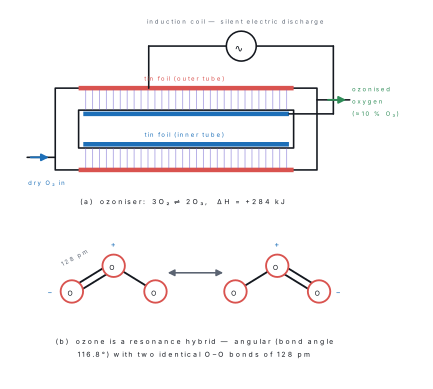
Three features of the equation control the yield: the reaction is endothermic, so a low temperature favours ozone; the number of molecules falls (3 → 2), so higher pressure favours ozone; and the discharge must be silent so the product is not destroyed as it forms. Even so the product is only about 10 % ozone by volume — ozonised oxygen — from which pure ozone is separated by liquefaction (b.p. −112 °C against −183 °C for O₂).
Structure of ozone
The molecule is angular with a bond angle of 116.8°; the central oxygen is sp² hybridised and carries a positive formal charge. Experimentally both O–O bonds are identical at 128 pm, between a single bond (148 pm) and a double bond (121 pm). No single Lewis structure explains this, so ozone is a resonance hybrid of the two structures shown above.
Test for ozone
| Test | Observation | Equation |
|---|---|---|
| Moist starch–iodide paper | turns blue-black | 2KI + H₂O + O₃ → 2KOH + I₂ + O₂ |
| Shaken with mercury | mercury loses its meniscus and sticks to glass ("tailing") | a surface film of Hg₂O forms |
Chlorine and nitrogen dioxide also liberate iodine from KI and turn the paper blue. To distinguish, add the gas to starch–iodide paper moistened with dilute alkali: only ozone still gives the colour, because Cl₂ is absorbed by the alkali. NEB answers should mention this qualification.
Ozone layer depletion
Chlorofluorocarbons (CFCs, e.g. CF₂Cl₂ used as refrigerants and aerosol propellants) are inert in the troposphere and drift into the stratosphere. There ultraviolet light breaks a C–Cl bond and releases chlorine free radicals:
CF₂Cl₂ --UV--> •CF₂Cl + •Cl
The chlorine radical then destroys ozone in a chain reaction in which it is regenerated, so one Cl radical can destroy of the order of 10⁵ ozone molecules:
•Cl + O₃ → •ClO + O₂ •ClO + O → •Cl + O₂
Nitric oxide from high-flying aircraft acts in the same way. The thinning is worst over Antarctica each spring — the "ozone hole" — and lets through UV-B that causes skin cancer, cataracts, weakened immunity and reduced crop yields. The Montreal Protocol (1987), which Nepal has ratified, phased out CFCs, and the layer is slowly recovering.
Uses of ozone
| Use | Why ozone is chosen |
|---|---|
| Sterilising drinking water | powerful germicide; unlike chlorine it leaves no taste or smell |
| Bleaching flour, ivory, wax, delicate fabrics | strong but leaves only O₂ behind |
| Purifying air in cinemas, tunnels and cold stores | oxidises odours and kills microbes |
| Ozonolysis; manufacture of KMnO₄, artificial silk, camphor | locates C=C double bonds; general oxidising agent |
Problem. 100 cm³ of ozonised oxygen, when heated so that all the ozone decomposes, expands to 110 cm³ at the same temperature and pressure. Find the percentage by volume of ozone in the original sample.
Solution. Let the volume of ozone be x cm³; the rest, (100 − x) cm³, is oxygen.
2O₃ → 3O₂
By Avogadro's law, volumes react in the ratio of the coefficients, so x cm³ of ozone gives \frac{3x}{2} cm³ of oxygen.
Final volume = (100 − x) + \frac{3x}{2} = 100 + \frac{x}{2}
Increase in volume = \frac{x}{2} = 110 − 100 = 10 cm³
Answer: the sample contains 20 cm³ of ozone, i.e. 20 % ozone by volume.
Check: 20 cm³ O₃ → 30 cm³ O₂; total = 80 + 30 = 110 cm³.
9.4 Nitrogen
Inertness and active nitrogen
Nitrogen is 78 % of the air by volume, yet almost nothing reacts with it. The reason is the triple bond N≡N, dissociation enthalpy 941 kJ mol⁻¹ — the strongest bond between two like atoms. Nitrogen therefore reacts only under forcing conditions: with Mg at red heat, with H₂ at 450 °C over a catalyst, with O₂ in a lightning flash.
Active nitrogen is made by passing nitrogen at about 1 mm Hg through a high-voltage discharge; a golden-yellow afterglow persists for minutes after the discharge stops. It contains free N atoms and combines directly with S, P, Hg, Na and I₂ at room temperature to give nitrides such as Hg₃N₂ and Na₃N, which ordinary nitrogen never forms.
Ammonia
Laboratory preparation. Ammonia is prepared by heating any ammonium salt with a strong, non-volatile base — usually slaked lime:
2NH₄Cl + Ca(OH)₂ --Δ--> CaCl₂ + 2NH₃↑ + 2H₂O
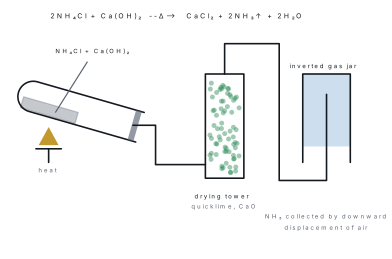
The tube slopes down at the mouth so that condensed water cannot run back and crack the hot glass. Ammonia is dried over quicklime, CaO and collected by downward displacement of air, being lighter than air and very soluble.
All three are the "obvious" drying agents and all three are wrong. The first two are acidic and neutralise ammonia (2NH₃ + H₂SO₄ → (NH₄)₂SO₄); calcium chloride forms the addition compound CaCl₂·8NH₃. Only quicklime, a basic drying agent, leaves ammonia untouched — a favourite "give reasons" question.
Manufacture: the Haber process. N₂ + 3H₂ ⇌ 2NH₃, ΔH = −92 kJ, run at about 200 atm and 450–500 °C over finely divided iron promoted with molybdenum or K₂O/Al₂O₃.
Chemical properties of ammonia.
| Reaction | Equation | Observation / use |
|---|---|---|
| Basic character | NH₃ + H₂O ⇌ NH₄⁺ + OH⁻ | turns red litmus blue; weak base, Kb = 1.8 × 10⁻⁵ |
| With hydrogen chloride | NH₃ + HCl → NH₄Cl | dense white fumes — the standard test |
| Combustion in oxygen | 4NH₃ + 3O₂ → 2N₂ + 6H₂O | burns with a pale yellow flame; will not burn in air |
| Catalytic oxidation (Ostwald) | 4NH₃ + 5O₂ --Pt, 1073 K--> 4NO + 6H₂O | first step in nitric acid manufacture |
| With copper(II) sulphate solution | CuSO₄ + 4NH₃ → [Cu(NH₃)₄]SO₄ | deep blue solution |
| With Nessler's reagent | 2K₂[HgI₄] + NH₃ + 3KOH → HgO·Hg(NH₂)I↓ + 7KI + 2H₂O | brown precipitate — test for NH₄⁺ |
| Reducing action | 3CuO + 2NH₃ → 3Cu + N₂ + 3H₂O | black CuO turns reddish-brown |
Applications. Nitrogenous fertilisers — urea, ammonium sulphate and DAP, used across the Terai; nitric acid by the Ostwald process; refrigerant in ice plants (high latent heat of vaporisation); the Solvay process; cleaning agents; explosives and rayon.
Harmful effects. The gas is intensely pungent and corrosive, inflaming eyes, nose and lungs, and is fatal above about 2500 ppm; liquid-ammonia leaks in cold stores are a recognised hazard. Excess ammonium fertiliser washed into rivers causes eutrophication — algal blooms, oxygen depletion and fish kills — and ammonia is directly toxic to fish below 1 mg L⁻¹.
Oxy-acids of nitrogen
| Name | Formula | Oxidation state of N | Anhydride | Salt |
|---|---|---|---|---|
| Hyponitrous acid | H₂N₂O₂ | +1 | N₂O | Na₂N₂O₂ |
| Nitrous acid | HNO₂ | +3 | N₂O₃ | NaNO₂ |
| Nitric acid | HNO₃ | +5 | N₂O₅ | NaNO₃ |
Only nitric acid can be isolated pure; nitrous acid exists only in cold dilute solution and disproportionates on warming, 3HNO₂ → HNO₃ + 2NO + H₂O.
Chemical properties of nitric acid
Nitric acid is a colourless fuming liquid (b.p. 83 °C) that turns yellow on standing through dissolved NO₂ from its own decomposition, 4HNO₃ → 4NO₂ + O₂ + 2H₂O.
| Behaviour | Equation and note |
|---|---|
| Strong monobasic acid | NaOH + HNO₃ → NaNO₃ + H₂O |
| With copper, dilute | 3Cu + 8HNO₃ → 3Cu(NO₃)₂ + 2NO↑ + 4H₂O (colourless NO, browns in air) |
| With copper, concentrated | Cu + 4HNO₃ → Cu(NO₃)₂ + 2NO₂↑ + 2H₂O (brown NO₂) |
| With magnesium, very dilute (1 %) | Mg + 2HNO₃ → Mg(NO₃)₂ + H₂↑ — the only case giving hydrogen |
| Passivity | Fe, Al and Cr are coated with an impervious oxide film by conc. HNO₃ |
| With non-metals | C + 4HNO₃ → CO₂↑ + 4NO₂↑ + 2H₂O; S + 6HNO₃ → H₂SO₄ + 6NO₂↑ + 2H₂O; P₄ + 20HNO₃ → 4H₃PO₄ + 20NO₂↑ + 4H₂O |
| Aqua regia (3 conc. HCl : 1 conc. HNO₃) | HNO₃ + 3HCl → NOCl + 2H₂O + 2[Cl]; the nascent chlorine dissolves Au and Pt |
Writing "Cu + 2HNO₃ → Cu(NO₃)₂ + H₂" loses the whole mark. The nitrate ion is a better oxidising agent than H⁺, so any hydrogen formed is at once oxidised to water while NO₃⁻ is reduced to NO₂ (conc.) or NO (dil.). The only exception is very dilute HNO₃ with Mg or Mn.
Ring test for the nitrate ion
Add freshly prepared iron(II) sulphate solution to the unknown, then pour concentrated sulphuric acid slowly down the side of the inclined tube so that it forms a separate lower layer. A dark brown ring at the junction of the two liquids confirms a nitrate.
6FeSO₄ + 3H₂SO₄ + 2HNO₃ → 3Fe₂(SO₄)₃ + 4H₂O + 2NO FeSO₄ + NO → [Fe(NO)]SO₄ (brown ring, a nitrosyl complex)
The ring disappears on shaking or warming, as the loosely bound NO escapes.
9.5 Halogens
General characteristics
The halogens are group 17: fluorine, chlorine, bromine, iodine and astatine. Each has the valence configuration ns²np⁵, one electron short of the noble-gas octet, so all are strong oxidising agents and all are diatomic.
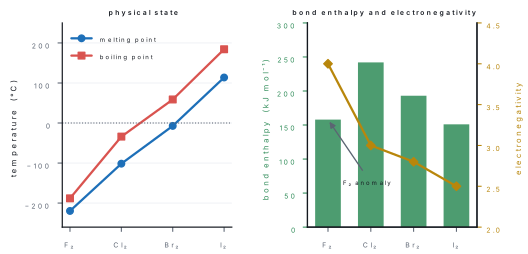
| Property | F₂ | Cl₂ | Br₂ | I₂ |
|---|---|---|---|---|
| State at 25 °C | pale yellow gas | greenish-yellow gas | red-brown liquid | violet-black solid |
| m.p. / b.p. (°C) | −219.6 / −188.1 | −101.5 / −34.0 | −7.2 / 58.8 | 113.7 / 184.3 |
| Atomic radius (pm) | 64 | 99 | 114 | 133 |
| Electronegativity | 4.0 | 3.0 | 2.8 | 2.5 |
| Bond enthalpy X–X (kJ mol⁻¹) | 158 | 242 | 193 | 151 |
| Oxidising power | strongest | weakest |
Melting and boiling points increase down the group as the molecules become larger and more polarisable, strengthening the van der Waals forces. Electronegativity and oxidising power decrease down the group as the atom grows and the incoming electron sits further from the nucleus.
(i) The F–F bond enthalpy (158 kJ mol⁻¹) is lower than Cl–Cl (242 kJ mol⁻¹): the F atom is so small that the lone pairs repel across the very short bond and weaken it. (ii) Fluorine also has a lower electron affinity than chlorine, yet is still the strongest oxidising agent, because of that weak bond and the very high hydration energy of F⁻.
Comparative preparation of Cl₂, Br₂ and I₂
All three are made by oxidising the halide ion, and the oxidising agent needed gets milder down the group as the halide becomes easier to oxidise.
| Chlorine | Bromine | Iodine | |
|---|---|---|---|
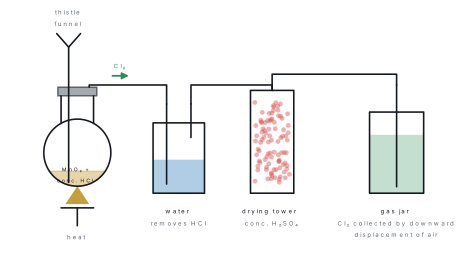
| Laboratory method | MnO₂ + 4HCl(conc) --Δ--> MnCl₂ + Cl₂↑ + 2H₂O | MnO₂ + 2NaBr + 2H₂SO₄ → MnSO₄ + Na₂SO₄ + Br₂ + 2H₂O | MnO₂ + 2KI + 2H₂SO₄ → MnSO₄ + K₂SO₄ + I₂ + 2H₂O |
| Milder alternative | 2KMnO₄ + 16HCl → 2KCl + 2MnCl₂ + 5Cl₂↑ + 8H₂O (no heat) | KBr + conc. H₂SO₄ (H₂SO₄ itself oxidises Br⁻) | KI + conc. H₂SO₄ (even H₂SO₄ suffices) |
| Industrial source | electrolysis of brine; Deacon's process 4HCl + O₂ --CuCl₂, 723 K--> 2Cl₂ + 2H₂O | sea bittern: 2NaBr + Cl₂ → 2NaCl + Br₂ | Chile saltpetre: 2NaIO₃ + 5NaHSO₃ → 2Na₂SO₄ + 3NaHSO₄ + H₂O + I₂ |
| Collection | downward displacement of air, dried over conc. H₂SO₄ | condensed as a liquid, distilled | sublimed and condensed as violet crystals |
Comparative chemical properties
| Reaction | Chlorine | Bromine | Iodine |
|---|---|---|---|
| With hydrogen | explosive in sunlight: H₂ + Cl₂ → 2HCl | needs 200 °C and a catalyst | reversible and incomplete: H₂ + I₂ ⇌ 2HI |
| With water | Cl₂ + H₂O → HCl + HOCl (bleaching) | slow, similar | almost insoluble; no reaction |
| With cold dilute NaOH | Cl₂ + 2NaOH → NaCl + NaOCl + H₂O | Br₂ + 2NaOH → NaBr + NaOBr + H₂O | I₂ + 2NaOH → NaI + NaOI + H₂O |
| With hot concentrated NaOH | 3Cl₂ + 6NaOH → 5NaCl + NaClO₃ + 3H₂O | 3Br₂ + 6NaOH → 5NaBr + NaBrO₃ + 3H₂O | 3I₂ + 6NaOH → 5NaI + NaIO₃ + 3H₂O |
| Displacement | displaces Br₂ and I₂ (and gives bleaching powder with slaked lime, 2Cl₂ + 2Ca(OH)₂ → Ca(OCl)₂ + CaCl₂ + 2H₂O) | displaces I₂ only | displaces none |
| Bleaching action | strong, permanent (oxidation by HOCl) | weaker | negligible |
All three reactions with alkali are disproportionations: the halogen is simultaneously reduced (to −1) and oxidised (to +1 or +5).
Tests and uses
| Substance | Test | Observation |
|---|---|---|
| Cl₂ gas | moist blue litmus | turns red, then bleached white |
| Br₂ vapour | colour and smell | reddish-brown, choking |
| I₂ | starch solution | deep blue-black |
| Cl⁻ / Br⁻ / I⁻ | AgNO₃ solution, then NH₄OH | curdy white AgCl, soluble in NH₄OH; pale yellow AgBr, sparingly soluble; deep yellow AgI, insoluble |
Uses. Chlorine: disinfecting drinking water, bleaching paper and textiles, manufacture of HCl, PVC and bleaching powder. Bromine: AgBr for photographic film, dyes, 1,2-dibromoethane. Iodine: tincture of iodine as an antiseptic, iodised salt to prevent goitre — the programme that has almost eliminated iodine deficiency in the Nepali hills — AgI emulsions and iodoform.
Haloacids: HCl, HBr, HI
| Property | HCl | HBr | HI |
|---|---|---|---|
| Bond enthalpy (kJ mol⁻¹) | 431 | 366 | 299 |
| Boiling point (°C) | −85 | −67 | −35 |
| Thermal stability | high | moderate | low, decomposes to I₂ |
| Acid strength / reducing power | least | intermediate | greatest |
Down the group the H–X bond lengthens and weakens, so the acid ionises more readily, is more easily oxidised and is thermally less stable. HCl is made by warming a chloride with concentrated sulphuric acid: NaCl + H₂SO₄ --Δ--> NaHSO₄ + HCl↑.
Concentrated sulphuric acid is an oxidising agent, and HBr and HI are good reducing agents, so the product is oxidised the moment it forms: 2HBr + H₂SO₄ → Br₂ + SO₂ + 2H₂O and 8HI + H₂SO₄ → 4I₂ + H₂S + 4H₂O. Use non-volatile, non-oxidising phosphoric acid instead: NaBr + H₃PO₄ → NaH₂PO₄ + HBr↑.
Problem. Calculate the mass of manganese dioxide and the volume of 11.6 M concentrated hydrochloric acid required to prepare 5.6 litres of chlorine at STP. (Mn = 55, O = 16.)
Solution. MnO₂ + 4HCl → MnCl₂ + Cl₂↑ + 2H₂O
From the equation, 1 mol Cl₂ needs 1 mol MnO₂ and 4 mol HCl.
Molar mass of MnO₂ = 55 + 2(16) = 87 g mol⁻¹
Answer: 21.75 g of MnO₂ and about 86 cm³ of the concentrated acid.
9.6 Carbon
Allotropes of carbon
Carbon has more allotropes than any other element, because a carbon atom can hybridise as sp³, sp² or sp and so build completely different frameworks.
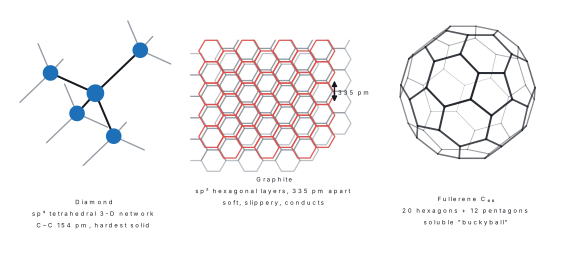
| Diamond | Graphite | Fullerene C₆₀ | |
|---|---|---|---|
| Hybridisation | sp³ | sp² | sp² (slightly pyramidal) |
| Structure | 3-D tetrahedral network | flat hexagonal layers 335 pm apart | closed cage, 20 hexagons + 12 pentagons |
| C–C distance | 154 pm | 142 pm in the layer | 140 and 145 pm |
| Hardness / density | hardest known; 3.51 g cm⁻³ | soft, slippery; 2.25 g cm⁻³ | soft molecular solid; 1.65 g cm⁻³ |
| Conduction | insulator | good conductor along the layers | semiconductor; K₃C₆₀ superconducts |
| Uses | cutting tools, abrasives, gem stones | pencil lead, electrodes, lubricant, reactor moderator | drug-delivery cages, lubricants, nanotechnology |
Graphite layers are held together only by weak van der Waals forces, so they slide over one another — hence the lubricating action and the mark a pencil leaves. Within a layer each carbon uses three of its four valence electrons for σ bonds; the fourth is delocalised and carries current. Fullerenes were discovered in 1985; C₆₀ is football-shaped and is the only allotrope of carbon that dissolves in ordinary solvents such as benzene, giving a magenta solution. Coal, coke, charcoal and lamp black are called amorphous carbon, but X-ray study shows them to be microcrystalline graphite.
Carbon monoxide
| Detail | |
|---|---|
| Preparation (lab) | HCOOH --conc. H₂SO₄, 373 K--> CO↑ + H₂O (dehydration of formic acid) |
| Preparation (industrial) | C + H₂O --1273 K--> CO + H₂ (water gas); 2C + O₂ + 4N₂ → 2CO + 4N₂ (producer gas) |
| Physical properties | colourless, odourless, almost insoluble, slightly lighter than air, b.p. −192 °C |
| Neutral oxide | no reaction with acids or alkalis; does not turn litmus |
| Combustion | 2CO + O₂ → 2CO₂, blue flame, ΔH = −566 kJ — a useful fuel |
| Reducing agent | Fe₂O₃ + 3CO → 2Fe + 3CO₂ (blast furnace); CuO + CO → Cu + CO₂ |
| Carbonyl formation | Ni + 4CO --330 K--> Ni(CO)₄; heating to 450 K reverses it — the Mond process for pure nickel |
| Toxicity | binds haemoglobin about 300 times more strongly than O₂ as carboxyhaemoglobin, so the blood can no longer carry oxygen; with Cl₂ it gives phosgene, COCl₂ |
| Uses | fuel gas; reducing agent in metallurgy; Mond process; manufacture of methanol, CO + 2H₂ --ZnO/Cr₂O₃--> CH₃OH |
CO has no colour and no smell, so a charcoal sigdi or a gas geyser burning in a closed room gives no warning; deaths from unventilated heating are reported in Kathmandu every winter, and the victim feels only headache and drowsiness. Treatment is pure oxygen, which drives Hb·CO + O₂ ⇌ Hb·O₂ + CO to the right.
9.7 Phosphorus
Allotropes of phosphorus
| Allotrope | Appearance | Note |
|---|---|---|
| White (yellow) phosphorus | waxy white solid, P₄ tetrahedra | most reactive, glows in the dark, stored under water |
| Red phosphorus | dull red powder, polymeric chains | stable, used on the striking surface of matchboxes |
| Scarlet and violet phosphorus | scarlet powder; violet crystals | from white P in PBr₃; by heating red P with sodium |
| Black phosphorus (α and β) | grey-black flakes, layered like graphite | the thermodynamically most stable form; conducts |
(The syllabus asks for the names only.)
Phosphine, PH₃
Preparation. White phosphorus is boiled with concentrated sodium hydroxide in an atmosphere of coal gas or CO₂, to keep out air:
P₄ + 3NaOH + 3H₂O --boil--> PH₃↑ + 3NaH₂PO₂
Pure phosphine is obtained from a metal phosphide: Ca₃P₂ + 6H₂O → 3Ca(OH)₂ + 2PH₃↑
| Property | Detail |
|---|---|
| Physical | colourless gas, smell of rotten fish, very poisonous, sparingly soluble |
| Basic character | PH₃ + HI → PH₄I; weaker base than NH₃, because the P–H bond is longer and the lone pair is in a larger, more diffuse orbital |
| Inflammability | pure PH₃ is not spontaneously inflammable, but traces of P₂H₄ make it catch fire in air, giving vortex smoke rings of P₄O₁₀ |
| Reactions | 3CuSO₄ + 2PH₃ → Cu₃P₂↓ + 3H₂SO₄ (black ppt — the test); PH₃ + 4Cl₂ → PCl₅ + 3HCl |
| Uses | Holme's signals — calcium phosphide and carbide thrown into the sea release PH₃, which ignites and marks the position; smoke screens; grain fumigant |
9.8 Sulphur
Allotropes of sulphur and uses
| Allotrope | Crystal form | Stable range | Density (g cm⁻³) | Made by |
|---|---|---|---|---|
| Rhombic (α) | octahedral, yellow | below 95.6 °C | 2.06 | slow evaporation of a solution of S in CS₂ |
| Monoclinic (β) | long needles, pale yellow | 95.6 °C to 119 °C | 1.98 | slow cooling of molten sulphur, pouring off the liquid |
| Plastic (γ) | amorphous, rubbery | unstable | 1.95 | pouring boiling sulphur into cold water |
95.6 °C is the transition temperature: below it monoclinic sulphur changes to rhombic, above it the change reverses. Both crystalline forms are built from the same puckered S₈ crown ring and differ only in packing, which is why their chemistry is identical.
Uses. Manufacture of sulphuric acid (by far the largest use); vulcanisation of rubber; gunpowder and matches; fungicides and insecticides; sulphur ointments for skin disease; bleaching.
Hydrogen sulphide and Kipp's apparatus
H₂S is prepared by the action of dilute sulphuric acid on iron(II) sulphide:
FeS + H₂SO₄(dil) → FeSO₄ + H₂S↑
Because qualitative analysis needs a steady, controllable stream, the gas is generated in Kipp's apparatus, a three-bulb vessel in which the acid is pushed away from the solid the moment the stopcock is closed.
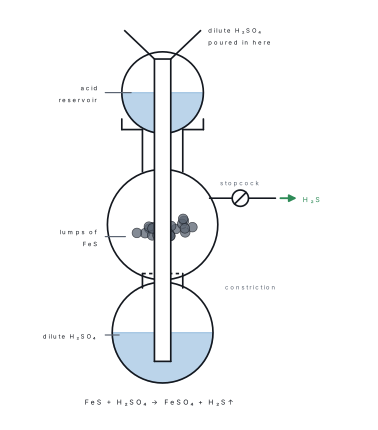
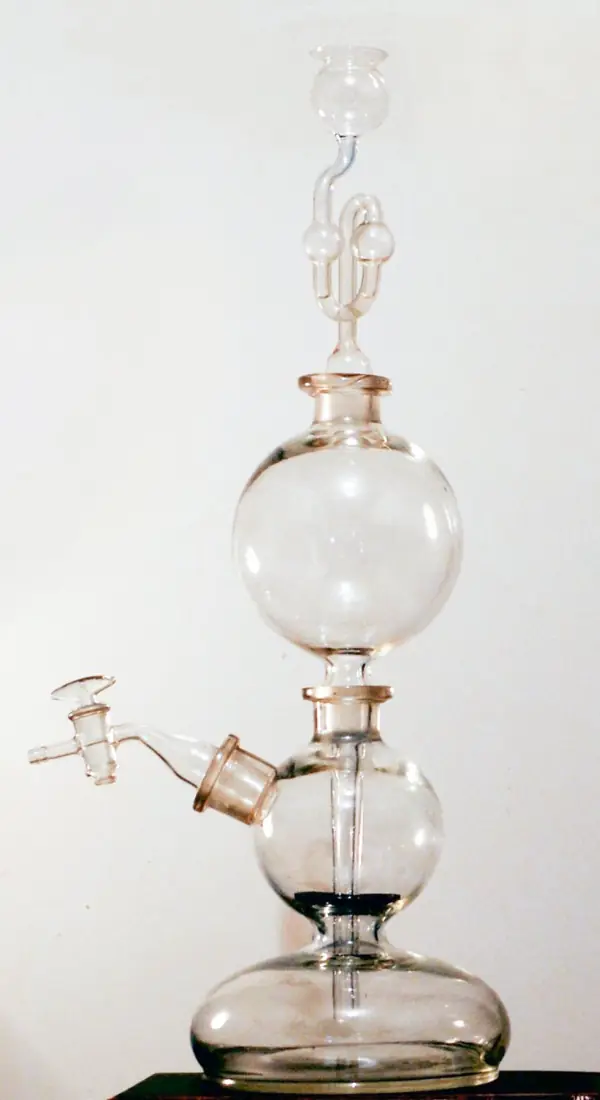
With the stopcock open, acid from the reservoir rises into the middle bulb and attacks the FeS. With it closed, the gas pressure forces the acid back down into the bottom bulb and up the stem, contact with the solid is broken and the reaction stops by itself, so no reagent is wasted.
| Property | Detail |
|---|---|
| Physical | colourless gas, rotten-egg smell, highly poisonous, heavier than air, fairly soluble |
| Acidic | weak dibasic acid, H₂S ⇌ H⁺ + HS⁻ ⇌ 2H⁺ + S²⁻; turns blue litmus faintly red |
| Combustion | 2H₂S + 3O₂ → 2SO₂ + 2H₂O (excess air); 2H₂S + O₂ → 2S + 2H₂O (limited air) |
| Reducing agent | Cl₂ + H₂S → 2HCl + S↓; 2FeCl₃ + H₂S → 2FeCl₂ + 2HCl + S↓; decolourises acidified KMnO₄ |
| Group reagent (its main use) | precipitates coloured sulphides — CuS and PbS black, CdS yellow, ZnS white, MnS buff |
| Test | blackens lead-acetate paper: Pb(CH₃COO)₂ + H₂S → PbS↓ + 2CH₃COOH |
Sulphur dioxide
| Detail | |
|---|---|
| Preparation (lab) | Na₂SO₃ + H₂SO₄(dil) → Na₂SO₄ + SO₂↑ + H₂O |
| Cu + 2H₂SO₄(conc) --Δ--> CuSO₄ + SO₂↑ + 2H₂O | |
| Preparation (industrial) | S + O₂ → SO₂; 4FeS₂ + 11O₂ → 2Fe₂O₃ + 8SO₂ (roasting of pyrites) |
| Physical | colourless, suffocating smell of a burning matchstick, 2.2 times heavier than air, very soluble, easily liquefied (b.p. −10 °C) |
| Acidic oxide | SO₂ + H₂O → H₂SO₃; SO₂ + 2NaOH → Na₂SO₃ + H₂O |
| Reducing agent | decolourises acidified KMnO₄; turns acidified K₂Cr₂O₇ paper green (the standard test); 2FeCl₃ + SO₂ + 2H₂O → 2FeCl₂ + H₂SO₄ + 2HCl |
| Oxidising agent / bleach | SO₂ + 2H₂S → 3S↓ + 2H₂O; bleaches by reduction, so the colour slowly returns in air — a temporary bleach, unlike chlorine |
| Uses | manufacture of H₂SO₄; bleaching wool, silk and straw; preservative; disinfectant; refrigerant |
Sulphuric acid — the Contact process
- SO₂ is produced by burning sulphur or roasting iron pyrites.
- Purification in a dust chamber, washing tower, drying tower and arsenic purifier — arsenic compounds would poison the catalyst.
- Catalytic oxidation: 2SO₂ + O₂ ⇌ 2SO₃, ΔH = −196 kJ, over V₂O₅ at 450 °C and about 2 atm. The reaction is exothermic and 3 molecules become 2, so a low temperature and a raised pressure both favour SO₃; 450 °C is the compromise with rate.
- Absorption in 98 % H₂SO₄ to give oleum, SO₃ + H₂SO₄ → H₂S₂O₇; direct absorption in water gives an unmanageable acid mist.
- Dilution: H₂S₂O₇ + H₂O → 2H₂SO₄.
| Property of H₂SO₄ | Illustration |
|---|---|
| Strong dibasic acid | H₂SO₄ + 2NaOH → Na₂SO₄ + 2H₂O |
| High boiling point (338 °C), non-volatile | displaces volatile acids: NaCl + H₂SO₄ → NaHSO₄ + HCl↑ |
| Powerful dehydrating agent | C₁₂H₂₂O₁₁ --H₂SO₄--> 12C + 11H₂O (sugar chars to a black column); CuSO₄·5H₂O → CuSO₄ |
| Oxidising agent when hot and concentrated | Cu + 2H₂SO₄ → CuSO₄ + SO₂↑ + 2H₂O; C + 2H₂SO₄ → CO₂ + 2SO₂ + 2H₂O |
| Uses | fertilisers (superphosphate, ammonium sulphate), lead–acid batteries, petroleum refining, dyes, detergents, pickling of steel — its consumption is taken as a measure of a country's industrial development, hence "king of chemicals" |
Sodium thiosulphate, Na₂S₂O₃·5H₂O
Commonly called hypo, it is made by boiling sodium sulphite solution with flowers of sulphur: Na₂SO₃ + S --boil--> Na₂S₂O₃
| Reaction | Equation | Use |
|---|---|---|
| With dilute acid | Na₂S₂O₃ + 2HCl → 2NaCl + S↓ + SO₂↑ + H₂O | milky turbidity; a kinetics experiment |
| With iodine | 2Na₂S₂O₃ + I₂ → 2NaI + Na₂S₄O₆ | iodometric titration; the blue starch colour vanishes at the end point |
| With silver bromide | AgBr + 2Na₂S₂O₃ → Na₃[Ag(S₂O₃)₂] + NaBr | fixing a photographic film — unexposed AgBr is dissolved away |
| With chlorine | Na₂S₂O₃ + 4Cl₂ + 5H₂O → 2NaHSO₄ + 8HCl | antichlor — removes excess chlorine after bleaching |
It is also a cyanide antidote in medicine and is used to extract silver from its ores.
Chapter summary
- Hydrogen: nascent hydrogen is more reactive than H₂ because the 436 kJ mol⁻¹ H–H bond need not be broken. Isotopes protium, deuterium (D₂O, reactor moderator) and tritium. As a fuel: 143 kJ g⁻¹, only water, but hard to store.
- Oxides: acidic (CO₂, SO₂), basic (Na₂O, CaO), amphoteric (ZnO, Al₂O₃), neutral (CO, NO), peroxide (Na₂O₂, BaO₂), mixed (Fe₃O₄, Pb₃O₄). H₂O₂ strength in g L⁻¹ = volume strength × 3.04.
- Ozone: 3O₂ ⇌ 2O₃, ΔH = +284 kJ, made by silent electric discharge; angular, 116.8°, both O–O bonds 128 pm, a resonance hybrid; turns starch–iodide paper blue; destroyed catalytically by Cl radicals from CFCs.
- Nitrogen is inert because of the 941 kJ mol⁻¹ N≡N bond; active nitrogen is atomic and very reactive. Ammonia: 2NH₄Cl + Ca(OH)₂ → CaCl₂ + 2NH₃↑ + 2H₂O, dried over quicklime only, tested with HCl (white fumes) and Nessler's reagent (brown ppt).
- Nitric acid gives NO₂ (conc.) or NO (dil.) with metals, never H₂. Nitrate is confirmed by the brown ring [Fe(NO)]SO₄. Oxy-acids: H₂N₂O₂, HNO₂, HNO₃.
- Halogens: oxidising power and electronegativity fall down the group; the F–F bond is anomalously weak (158 kJ mol⁻¹). MnO₂ + 4HCl → MnCl₂ + Cl₂ + 2H₂O. Cold dilute alkali gives X⁻ + XO⁻, hot concentrated alkali X⁻ + XO₃⁻. Acid strength and reducing power HCl < HBr < HI, so conc. H₂SO₄ cannot make HBr/HI.
- Carbon: diamond sp³ network, graphite sp² layers 335 pm apart, C₆₀ cage of 20 hexagons and 12 pentagons. CO is neutral, a strong reducing agent (Fe₂O₃ + 3CO → 2Fe + 3CO₂) and a poison through carboxyhaemoglobin.
- Phosphorus: white, red, scarlet, violet and black allotropes. PH₃ from P₄ + 3NaOH + 3H₂O → PH₃ + 3NaH₂PO₂; weaker base than NH₃; Holme's signals.
- Sulphur: rhombic ⇌ monoclinic at 95.6 °C, both S₈ rings. H₂S from Kipp's apparatus blackens lead-acetate paper; SO₂ is a temporary bleach and turns acidified K₂Cr₂O₇ green; Contact process 2SO₂ + O₂ ⇌ 2SO₃ over V₂O₅ at 450 °C, then oleum; hypo is the photographic fixer and the iodometric titrant.
Practice questions
Group A — Multiple choice (1 mark each)
- Which of the following is used to dry ammonia gas? [1]aconc. H₂SO₄banhydrous CaCl₂cquicklimedP₄O₁₀
- The bond angle in the ozone molecule is [1]a104.5°b109.5°c116.8°d120°
- The bond dissociation enthalpy of F₂ is less than that of Cl₂ because [1]afluorine is more electronegativeblone-pair repulsion is large in the small F₂ moleculecfluorine has a higher electron affinitydF₂ is a gas
- The transition temperature of rhombic and monoclinic sulphur is [1]a95.6 °Cb113.7 °Cc119 °Cd444.6 °C
- Sulphur dioxide is passed over a paper moistened with acidified potassium dichromate. The paper turns [1]abluebblackcgreendpink
Answers to Group A
1. (c) — quicklime is basic, so it does not react with the basic gas; the other three form ammonium salts or CaCl₂·8NH₃.
2. (c) — ozone is angular with a bond angle of 116.8°.
3. (b) — the F atom is very small, so the three lone pairs on each atom repel across the short bond and weaken it.
4. (a) — below 95.6 °C rhombic is stable, above it monoclinic.
5. (c) — SO₂ reduces orange Cr(VI) to green Cr(III).
Group B — Short answer (5 marks each)
- Distinguish between atomic hydrogen and nascent hydrogen. Why is nascent hydrogen a better reducing agent than ordinary hydrogen gas? [5]
- How is ozone prepared from oxygen in the laboratory? Draw the essential features of the apparatus and explain why a silent electric discharge and a low temperature are used. [5]
- Give reasons: (i) ammonia cannot be dried over concentrated sulphuric acid; (ii) concentrated sulphuric acid cannot be used to prepare HI; (iii) nitric acid does not liberate hydrogen with most metals. [5]
- Classify the following oxides and justify each answer with one equation: CO, ZnO, N₂O₅, Na₂O₂, Pb₃O₄. [5]
- Describe the working of Kipp's apparatus for the preparation of hydrogen sulphide, with the equation, and give the test for the gas. [5]
Answers to Group B
1. Atomic hydrogen is free H atoms from passing H₂ through an electric arc at about 4000 °C; it lasts a fraction of a second and recombines with great heat (atomic hydrogen torch). Nascent hydrogen is hydrogen at the moment of generation inside a reacting mixture, e.g. Zn + dil. H₂SO₄. It reduces acidified KMnO₄ and FeCl₃, which H₂ gas will not, because it need not first supply the 436 kJ mol⁻¹ H–H bond enthalpy and retains the energy of the generating reaction.
2. Cold dry oxygen is passed through a Siemens' ozoniser — a silent electric discharge between tin-foil electrodes on concentric glass tubes: 3O₂ ⇌ 2O₃, ΔH = +284 kJ. A spark would heat the gas and destroy the ozone as fast as it formed, so the discharge must be silent; and since the reaction is endothermic, a low temperature shifts the equilibrium right (Le Chatelier). The product is about 10 % ozonised oxygen.
3. (i) Conc. H₂SO₄ is acidic and ammonia basic: 2NH₃ + H₂SO₄ → (NH₄)₂SO₄; quicklime is used instead. (ii) Conc. H₂SO₄ oxidises the HI as it forms: 8HI + H₂SO₄ → 4I₂ + H₂S + 4H₂O; non-oxidising phosphoric acid is used instead. (iii) NO₃⁻ is a better oxidising agent than H⁺, so hydrogen is oxidised to water while NO₃⁻ is reduced to NO₂ (conc.) or NO (dil.).
4. CO — neutral. ZnO — amphoteric: ZnO + 2HCl → ZnCl₂ + H₂O and ZnO + 2NaOH → Na₂ZnO₂ + H₂O. N₂O₅ — acidic: N₂O₅ + H₂O → 2HNO₃. Na₂O₂ — peroxide: Na₂O₂ + H₂SO₄ → Na₂SO₄ + H₂O₂. Pb₃O₄ — mixed, 2PbO·PbO₂.
5. Lumps of FeS rest on the constriction in the middle bulb; dilute H₂SO₄ poured into the top funnel collects in the bottom bulb. Opening the stopcock lets acid rise into the middle bulb: FeS + H₂SO₄ → FeSO₄ + H₂S↑. Closing it lets the gas pressure force the acid back down out of contact with the solid, so the reaction stops automatically. Test: the gas blackens lead-acetate paper, Pb(CH₃COO)₂ + H₂S → PbS↓ + 2CH₃COOH.
Group C — Long answer (8 marks each)
- (a) Describe with equations the laboratory preparation of chlorine, bromine and iodine from a suitable halide, and explain why a weaker oxidising agent suffices as the group is descended.(b) Write the equations for the action of chlorine on cold dilute and on hot concentrated sodium hydroxide, and state the type of reaction involved.(c) How would you distinguish between solutions of NaCl, NaBr and NaI in the laboratory? [8]
- (a) Describe the manufacture of sulphuric acid by the Contact process, giving the conditions used in the catalytic converter and explaining the choice of each condition.(b) Why is sulphur trioxide absorbed in concentrated sulphuric acid rather than in water?(c) Calculate the mass of sulphuric acid that can be obtained from 1.00 tonne of sulphur if the overall yield is 90 %. (S = 32, H = 1, O = 16) [8]
- (a) Give the names and formulae of three oxy-acids of nitrogen with the oxidation state of nitrogen in each.(b) Write balanced equations for the action of nitric acid on copper (dilute and concentrated), on carbon and on sulphur.(c) Describe the ring test for the nitrate ion, with equations. [8]
Answers to Group C
1. (a) MnO₂ + 4HCl(conc) --Δ--> MnCl₂ + Cl₂↑ + 2H₂O; MnO₂ + 2NaBr + 2H₂SO₄ → MnSO₄ + Na₂SO₄ + Br₂ + 2H₂O; MnO₂ + 2KI + 2H₂SO₄ → MnSO₄ + K₂SO₄ + I₂ + 2H₂O (conc. H₂SO₄ alone oxidises I⁻). Down the group the halide ion is larger and holds its outer electron less firmly, so it is oxidised more easily and a milder oxidant suffices. (b) Cold dilute: Cl₂ + 2NaOH → NaCl + NaOCl + H₂O. Hot concentrated: 3Cl₂ + 6NaOH → 5NaCl + NaClO₃ + 3H₂O. Both are disproportionations — chlorine goes from 0 to −1 and simultaneously to +1 (or +5). (c) Add AgNO₃ solution: NaCl gives curdy white AgCl, readily soluble in NH₄OH; NaBr pale yellow AgBr, sparingly soluble; NaI deep yellow AgI, insoluble.
2. (a) Burn sulphur or roast pyrites, 4FeS₂ + 11O₂ → 2Fe₂O₃ + 8SO₂; purify the gas of dust, moisture and arsenic (a catalyst poison); then in the contact tower 2SO₂ + O₂ ⇌ 2SO₃, ΔH = −196 kJ, over V₂O₅ at 450 °C and about 2 atm. Exothermic, so a low temperature favours SO₃ but the rate would be too slow — 450 °C is the compromise; 3 molecules become 2, so pressure helps, but only a modest pressure is needed since the yield is already about 97 %. Finally SO₃ + H₂SO₄ → H₂S₂O₇ and H₂S₂O₇ + H₂O → 2H₂SO₄. (b) Water absorption is strongly exothermic and gives a dense acid mist that is neither condensed nor absorbed, so most of the product would be lost. (c) 1 mol S gives 1 mol H₂SO₄, i.e. 32 g S gives 98 g acid. Theoretical mass = 1.00 × 10⁶ × 98/32 = 3.0625 × 10⁶ g = 3062.5 kg; actual = 0.90 × 3062.5 = 2756 kg ≈ 2.76 tonne.
3. (a) Hyponitrous acid H₂N₂O₂ (N = +1); nitrous acid HNO₂ (+3); nitric acid HNO₃ (+5). (b) 3Cu + 8HNO₃(dil) → 3Cu(NO₃)₂ + 2NO↑ + 4H₂O; Cu + 4HNO₃(conc) → Cu(NO₃)₂ + 2NO₂↑ + 2H₂O; C + 4HNO₃ → CO₂↑ + 4NO₂↑ + 2H₂O; S + 6HNO₃ → H₂SO₄ + 6NO₂↑ + 2H₂O. (c) Add fresh FeSO₄ solution, then pour conc. H₂SO₄ gently down the side of the inclined tube so that it forms a separate lower layer; a dark brown ring appears at the junction: 6FeSO₄ + 3H₂SO₄ + 2HNO₃ → 3Fe₂(SO₄)₃ + 4H₂O + 2NO, then FeSO₄ + NO → [Fe(NO)]SO₄.
Practise more: Chemistry question bank