Unit 13 · Units · 12 min read
Nepal is the First Country to Double its Tiger Population / Drama: A Mousetrap
What the syllabus asks for 5
- Reading and interpreting charts, graphs and tables
- Drama: plot, characters and stage directions
- Grammar: much/many, some/any; expressing quantity
- Writing: writing a description of data; presenting data in a graph
- Pronunciation: words used to interpret charts and graphs
Unit 13 is about reading and presenting information and about helping others. Reading I is a report from the National Trust for Nature Conservation (NTNC) on how Nepal became the first country to double its wild tiger population. Reading II is a short play, A Mousetrap, in which farm animals refuse to help a frightened mouse — and pay for it. The grammar is quantifiers (much, many, some, any, a few, a little…) and a review of present tenses. In writing you interpret a chart and describe a process from a flowchart.
(1) Read numbers and trends from a report or chart. (2) Use quantifiers with countable and uncountable nouns, some in positive sentences and any in questions and negatives. (3) Choose present simple, present continuous, present perfect or present perfect continuous. (4) Describe a chart (overview → main figures → comparison) and a process (passive voice, sequence words).
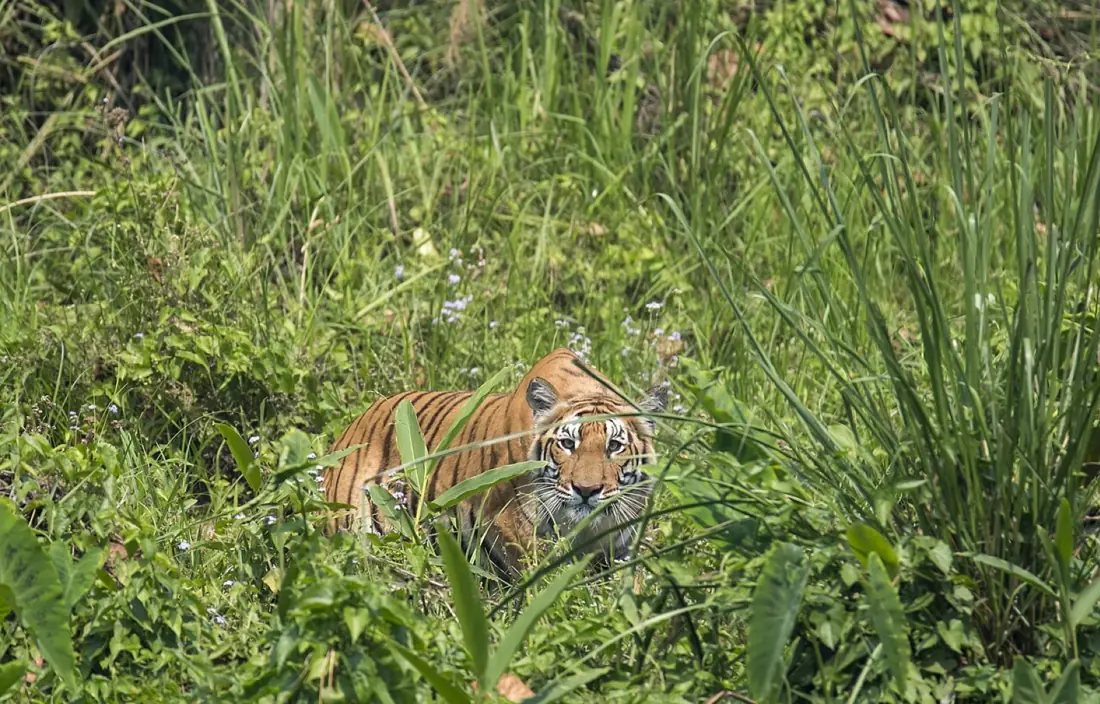
13.1 Reading I: Nepal is the first country to double its tiger population
Summary
- Nepal's fourth tiger and prey survey began in December (2021), led by the DNPWC and the Department of Forests and Soil Conservation. Surveys are held every four years.
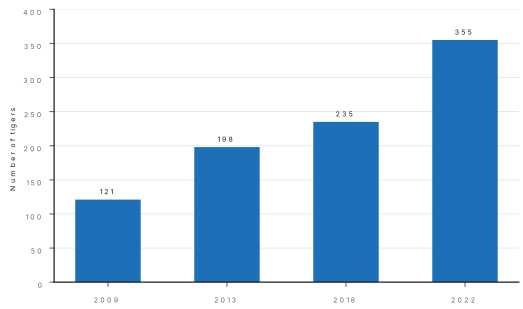
- Earlier counts: 121 (2009), 198 (2013), 235 (2018). The 2022 count (announced on 29 July 2022, Global Tiger Day) was 355 — nearly three times the 2009 figure.
- Dr. Chiranjibi P. Pokharel of NTNC calls this "historical": tigers are apex predators at the top of the food chain, so their numbers show the health of forests and ecosystems.
- A century ago about 100,000 tigers lived in Asia; by 2010 they had fallen by 97% to about 3,200, mainly because of habitat loss and poaching. In 2010 the 13 tiger-range countries signed the St. Petersburg Declaration (Russia), pledging to double tigers by 2022 (TX2).
- Nepal's steps: new habitat (Banke National Park, extension of Parsa National Park); the National Tiger Conservation Committee chaired by the Prime Minister; Wildlife Crime Control Bureau units from centre to district; over 450 community-based anti-poaching units; partnerships and investment from national and international stakeholders.
- Future threats: poaching, illegal wildlife trade, climate change, human–tiger conflict. Needed: protect prey (gaur, swamp deer, sambar, nilgai, wild buffalo), involve communities, use good science, make development wildlife-friendly, and manage corridors linking habitats.
(The textbook misprints NTNC as the "National Trust for Nature Conversation"; it is Conservation.)
Vocabulary (Exercise A)
a–iv (nationwide), b–vi (intricately), c–ii (poaching), d–i (enforcement), e–iii (coexistence), f–v (dispersal)
Gap filling (Exercise B)
a. 235 b. food c. the Prime Minister d. stakeholders e. wildlife-friendly
Comprehension (Exercise C) — model answers
a. How many tiger surveys have been conducted? Four — in 2009, 2013, 2018 and the fourth begun in December 2021.
b. What was the percentage of tigers in 2010 in Asia? The population had fallen by 97%, so only about 3% of the tigers of a century earlier were left — about 3,200.
c. When was the St. Petersburg Declaration made? In 2010.
d. Mention one initiative Nepal adopted. It established Banke National Park and extended Parsa National Park to give tigers more habitat. (Also: the committee chaired by the Prime Minister, WCCB units, over 450 community anti-poaching units.)
e. What are the threats to tiger conservation? Poaching, illegal wildlife trade and the impacts of climate change (also human–tiger conflict and loss of habitat).
13.2 Writing I: Interpreting charts, graphs and tables
Plan: (1) Introduction — what the chart shows, where and when. (2) Overview — the main trend in one sentence. (3) Details — highest, lowest, key numbers, comparisons. (4) Conclusion (optional). Use the trend vocabulary below and do not give opinions not supported by the data.
| Trend | Verbs / nouns | Adverbs |
|---|---|---|
| up | rise, increase, climb, grow, shoot up, a rise | sharply, rapidly, steadily, gradually |
| down | fall, decrease, drop, decline, a fall | slightly, considerably, dramatically |
| no change | remain stable / steady / constant | — |
Model answer — Tiger numbers in Nepal (the bar graph above)
The bar graph shows the number of wild tigers in Nepal in the four national surveys from 2009 to 2022. Overall, the number rose steadily and almost tripled over the period.
In 2009 there were only 121 tigers. The number increased sharply to 198 in 2013, and then rose slightly to 235 in 2018. The largest jump came between 2018 and 2022, when it shot up by 120 to 355. Thus Nepal more than doubled its tiger population and achieved its TX2 target.
The textbook's Writing I chart (men and women studying engineering) appears as a picture; use the same plan — e.g. "The chart shows the number of male and female engineering students… Men outnumber women in every year, but the number of women is rising gradually…"
13.3 Grammar I: Quantifiers — much/many, some/any
| With countable nouns (eggs, tomatoes) | With uncountable nouns (milk, work, time) | With both |
|---|---|---|
| many, a few, few, several, each, either, neither, both, fewer | much, a little, little, a bit of, less | some, any, a lot of, lots of, enough, all, most, no, more |
- some in positive sentences and in offers/requests: Would you like some tea? any in negatives and questions: Did you see any friends?
- much mostly in negatives/questions: Do we have much time? In positive sentences prefer a lot of: I used to drink a lot of milk.
- no = not any: There's no milk. (not There's not no milk).
- a few / a little = some (positive); few / little = almost none (negative feeling).
Textbook answers (Grammar I B)
a. no b. less c. some d. enough e. a lot of f. a lot of g. some (much cannot go with countable eggs; any would be the most natural) h. some
- many milk / much books ✗ → much milk, many books ✓
- less people → fewer people (countable) ✓
- I have some money? / I don't have some money ✗ → Do you have any money? / I don't have any money ✓
13.4 Reading II: Drama — A Mousetrap
Characters and plot
Characters: Man, Woman, Doctor, Mouse, Chicken, Lamb, Buffalo.
- A mouse peeps through the wall as a man and a woman open a package — it is a mousetrap. The horrified mouse runs to warn the others.
- The chicken: "it is a big problem for you, but I don't care."
- The lamb: "the mousetrap is not for me… I can only pray."
- The buffalo: "That won't hurt me. Am I in danger? I don't think so."
- That night the trap catches the tail of a deadly snake; in the dark the woman goes to look and the snake bites her. She faints; the doctor advises chicken soup for her fever — the chicken is cooked.
- Friends and neighbours visit; to feed them the man cooks the lamb.
- When she recovers, the couple hold a party for well-wishers and the buffalo becomes "the main dish".
- Only the mouse is saved. Moral: help others when they ask, because we never know when we will be in the same situation; a problem for one member of a community is a problem for all.
Features of drama: a list of characters; dialogue with the speaker's name in capitals; stage directions in brackets and italics, describing actions and setting (The woman fainted. The man called the doctor.).
Vocabulary (Exercise A)
a. package – a parcel; something wrapped for sending or carrying b. worried – anxious, unhappy about a problem c. ingredient – one of the things used to make a dish d. delicious – very tasty e. celebrate – mark a happy event with a party or ceremony
Order of events (Exercise B)
c → g → a → b → e → f → d
Comprehension (Exercise C) — model answers
a. Why was the mouse shocked? Because the package was a mousetrap, and he was afraid he would be trapped and killed.
b. Who did the mouse tell about the mousetrap? The chicken, the lamb and the buffalo.
c. What did the lamb reply? That the mousetrap was not for him, there was nothing he could do, but he would pray for the mouse.
d. What happened to the woman in the dark? A deadly snake caught in the trap bit her, and she fainted.
e. Why did the couple kill the buffalo? To feed their friends and neighbours at the party they gave to celebrate the woman's recovery.
13.5 Grammar II: Present tenses (review)
| Tense | Form | Use | Signal words |
|---|---|---|---|
| Present simple | V / V-s | habits, facts, states | always, every day, usually |
| Present continuous | am/is/are + V-ing | happening now; temporary | now, Look!, Listen!, at the moment |
| Present perfect | has/have + V3 | result now; experience | just, already, yet, ever |
| Present perfect continuous | has/have been + V-ing | started in the past and still continuing | for, since, all day |
Stative verbs (know, belong, remember, like, want) are not normally used in continuous forms: We know him well (not are knowing).
Textbook answers
Grammar II A: a. is – present simple b. shows – present simple c. Look – imperative; is running – present continuous d. 've found – present perfect e. 'd been studying – past perfect continuous; were born – past simple
Grammar II B: a. i give b. i are c. i get up d. ii is raining e. iii has cleaned f. ii is playing g. iv have been living (iii have lived also acceptable) h. i reads i. i know j. i remembers
Grammar II C: a. belongs b. is calling c. play d. is taking e. is carrying f. have lost g. has been dancing h. Have … heard i. am living j. has been teaching (or has taught)
13.6 Writing II: Describing a process from a flowchart
Use the passive voice (the doer is not important) and sequence words (first, then, next, after that, finally).
Model answer — Making orange juice (textbook Writing I)
The flowchart shows how orange juice is made. First, the oranges are received from the farms or the market. Then the best oranges are selected and the bad ones are thrown away. After that, the selected oranges are cleaned thoroughly. Next, the juice is extracted from the oranges, and it is filtered to remove the seeds and pulp. Finally, the fresh juice is served in a glass.
The tea process (Speaking B) can be described the same way: First, the tea leaves are picked. Then they are withered, fermented and dried. After that, they are sorted, and finally the tea is stored and packed.
13.7 Speaking, pronunciation and project work
Reading a table (Speaking A): Which is the largest state? — Texas (695,621 km²). Which state has the most people? — California (34 million). Which became a state first? — New York (1788).
Words for charts: 'constant, 'rising, trend, a'scend, de'scend, de'crease (verb) / 'decrease (noun), de'cline, 'steadily, 'rapidly, pro'portion.
Project work: count the boys and girls in classes 6–8 and draw a bar graph.
Chapter summary
- Nepal's tigers: 121 (2009) → 198 (2013) → 235 (2018) → 355 (2022); TX2 target from the 2010 St. Petersburg Declaration; Banke NP, Parsa extension, PM-chaired committee, WCCB, 450+ anti-poaching units.
- Drama A Mousetrap: chicken, lamb and buffalo refuse to help and are all eaten; moral — help others in need.
- Countable: many, a few, fewer; uncountable: much, a little, less; both: some, any, a lot of, enough, no.
- some in positives and offers; any in negatives and questions.
- Describing a chart: introduction, overview, details with numbers, trend words.
- Process description: passive + first, then, next, finally.
Practice questions
Reading
- Answer from the texts. [5]aWho led the fourth tiger survey?bWhat does TX2 mean?cHow many tiger-range countries signed the 2010 declaration?dWhat did the doctor suggest for the woman?eWhich animal was saved at the end?
Answers — Reading
1. (a) The DNPWC and the Department of Forests and Soil Conservation. (b) Doubling the wild tiger population by 2022. (c) Thirteen. (d) Chicken soup. (e) The mouse.
Grammar
- Fill in with much, many, some, any, a few or a little. [5]aHow ___ students are there?bThere isn't ___ sugar left.cWould you like ___ tea?dI have ___ friends in Pokhara.eAdd ___ salt to the soup.
- Use the correct present tense. [3]aListen! Someone (knock) at the door.bShe (live) here since 2075.cWater (boil) at 100 °C.
Answers — Grammar
2. (a) many (b) much/any (c) some (d) a few (e) a little
3. (a) is knocking (b) has lived / has been living (c) boils
Writing
- The table shows SEE pass rates of a school: 2078 – 62%, 2079 – 70%, 2080 – 68%, 2081 – 85%. Write a description. [5]
Answer — Writing
4. Model: The table shows the SEE pass rate of the school from 2078 to 2081. Overall, the rate improved by 23 percentage points. It rose from 62% in 2078 to 70% in 2079, fell slightly to 68% in 2080, and then jumped sharply to 85% in 2081, the highest in the period.
Practise more: English question bank