Unit 2 · Units · 16 min read
A Father's Letter to his Son / Poem: Changing
What the syllabus asks for 5
- A letter of advice: tone, point of view and structure
- Poetry: theme, speaker and the idea of personal change
- Grammar: yes/no questions
- Writing: completing a skeleton story; writing an e-mail
- Project work: composing a poem; pronunciation: /t/, /d/, /ɪd/
Unit 2 is about asking for permission and about changing yourself. Reading I is a short story, A Father's Letter to his Son: a boy travels alone by train to his grandparents' house, and a short note from his father removes his fear. Reading II is a poem, Changing World, in which an old man realises that the only thing he can really change is himself. The grammar is yes/no questions. In writing you complete a skeleton story and write an e-mail.
(1) Understand the plot of the story and say who said what and why. (2) Explain the message of the poem in your own words. (3) Turn statements into yes/no questions with the right helping verb (do/does/did, is/are, can, have…). (4) Use polite expressions for asking, giving and refusing permission. (5) Develop a story from an outline, with a title, in the past tense.
2.1 Reading I: A Father's Letter to his Son
Summary of the story
A boy lives in a city with his parents. Every summer holiday they take him to his grandparents' house in another city, where they stay for fifteen to twenty days. When the boy grows up, he asks to go alone. His parents refuse at first, but he insists, so they agree and teach him everything he needs to know about travelling alone, because they are worried about his safety.
He politely asks his mother if he may take his swimming goggles and suit (she agrees, but tells him always to swim with his grandparents), and whether he may take sunglasses and mufflers as gifts for his grandparents (she smiles and says it is a good idea).
On the day of the journey his parents see him off at the station. Through the train window his father hands him an envelope and says that if he feels afraid on the way, he should open it. As the train travels, the boy notices that everyone has someone with them and begins to feel lonely. At one station a big man enters his compartment; the boy is scared and cannot sleep. He then opens the envelope. The note says that his father is on the same train, in the adjacent compartment. At once the boy's face lights up and his fear vanishes.
Message: parents' love and care are always with their children, even when the children think they are independent.
Vocabulary (crossword answers)
| Clue | Answer |
|---|---|
| Across 2: next to something | adjacent |
| Across 7: gave something to somebody | handed |
| Across 9: glasses that protect eyes from the Sun | sunglasses |
| Down 1: a place to sleep on a train or ship | berth |
| Down 3: to leave a place | depart |
| Down 4: a section on a train | compartment |
| Down 5: thick cloth to keep your neck warm | muffler |
| Down 6: disappeared suddenly | vanished |
| Down 8: to demand something forcefully | insist |
| Down 9: a group of objects | stuff |
Who said it, and why (Exercise B)
| Sentence | Speaker | Purpose |
|---|---|---|
| a. Is it okay if I go on my own? | the boy (to his parents) | asking permission to travel alone |
| b. Please let me go by myself. | the boy | asking/insisting for permission |
| c. May I take them, please? | the boy (to his mother) | asking permission to take his goggles and swimming suit |
| d. Okay but always go swimming with your grandparents. | the mother | giving permission with a condition |
| e. Would it be alright if I took sunglasses and mufflers for them? | the boy | asking permission to take gifts |
Comprehension (Exercise C) — model answers
a. Where did the boy want to visit? He wanted to visit his grandparents' house in another city, alone.
b. How long would the boy live with his grandparents? For fifteen to twenty days during the summer holidays.
c. Why did the parents not want to let him go alone at first? Because they were worried about his safety on such a long journey alone.
d. Do you think the boy was loving and caring? Why? Yes. He loved his grandparents a lot and wanted to take sunglasses and mufflers for them as gifts. He also told his parents not to worry about him.
e. What did the boy tell his father before the announcement? He smiled and said, "I remember everything. Don't worry." (Strictly, the text puts this just after the departure announcement.)
f. Why do you think the boy felt relaxed at last? Because his father's note told him that his father was travelling in the next compartment, so he was not alone and had nothing to fear.
2.2 Reading II: Poem — Changing World
What the poem says
The poem is printed in the textbook as Changing World and credited to Edward de Bono. (The same lines are also widely quoted as an old anonymous inscription; in the exam, simply call the writer "the poet".) The speaker looks back over his life:
- As a young man he wanted to change the world, but found it too difficult.
- So he tried to change his nation; he could not.
- Then he focused on his town; he could not change it either.
- As an older man he tried to change his family.
- Now, as an old man, he realises that the only thing he can change is himself.
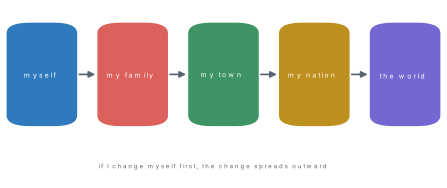
- He sees that if he had changed himself long ago, he could have influenced his family; together they could have changed the town, the town the nation, and so he "could, indeed, have changed the world".
Theme: real change starts with yourself. Self-improvement spreads outward, like a chain: self → family → town → nation → world.
Structure: the first half moves from the biggest circle (world) to the smallest (himself); the second half moves back out again. The poem is in free verse (no regular rhyme), told in the first person, in the past tense with could have + past participle for regret.
Vocabulary (Exercise A)
a. Great people always realize their mistake. b. The meal was very delicious indeed. c. Excessive use of electronic devices has negative impacts on our mental health. d. … I cannot change my mind. e. … I cannot focus on my studies. (suddenly is not needed.)
Comprehension (Exercise B) — model answers
a. Why do you think the poet wants to change himself? Because he has learnt that he cannot change others by force; the only thing fully in his control is himself, and his good example can then change others.
b. Why does the poet feel sorry in the poem? He is sorry that he wasted his life trying to change the world, the nation, the town and his family, and realised too late that he should have started with himself.
c. What does the poet realise when he grew old? He realises that the only thing he can change is himself.
d. If the poet had changed himself, what could have happened? He could have made an impact on his family; his family and he could have changed their town; the town could have changed the nation, and he could have changed the world.
e. Is changing the world easy or tough? Give your opinion. It is tough if we try to change it directly, because we cannot control other people. It becomes possible when each person changes his or her own habits — for example, if every student stops throwing plastic, the whole town becomes cleaner.
2.3 Grammar: Yes/no questions
A yes/no question expects the answer yes or no. It begins with a helping verb (auxiliary), followed by the subject.
| If the statement has… | Move it to the front | Example |
|---|---|---|
| am/is/are/was/were | the be verb | She is sleeping. → Is she sleeping? |
| can/could/should/will… | the modal | They should rewrite it. → Should they rewrite it? |
| have/has/had + past participle | have/has/had | We have met before. → Have we met before? |
| no helping verb, present (I/you/we/they) | add Do | You work at home. → Do you work at home? |
| no helping verb, present (he/she/it) | add Does + base verb | He loves this town. → Does he love this town? |
| no helping verb, past | add Did + base verb | She went home. → Did she go home? |
Short answers repeat the helping verb: Do you study in Grade VII? — Yes, I do. / No, I don't. Can you draw a dragon? — Yes, I can.
some → any in questions: There are some smart students. → Are there any smart students?
Textbook answers
Exercise A (matching): a–iv, b–vi, c–v, d–vii, e–i, f–ii, g–viii, h–iii.
Exercise B: a. Does he love this town? b. Do they always play football? c. Can she fly an aeroplane? d. Are there any smart students in the school? e. Did they go to the river yesterday? f. Does she spend her money on books? g. Did he decide to leave the town? h. Does she go to bed early? i. Should they rewrite their homework? j. Was he born in India?
Exercise C (honest answers): short answers such as No, I don't (you are in grade 8, not VII), Yes, I do, Yes, I have / No, I haven't, Yes, he does, No, I didn't, Yes, I can, No, we don't, Yes, she does.
- Does he loves this town? ✗ → Does he love…? ✓ (after does/did, base verb)
- Did they went to the river? ✗ → Did they go…? ✓
- Do she go to bed early? ✗ → Does she go…? ✓
- Are there some students? — in a normal question use any.
- Short answer Yes, I like. ✗ → Yes, I do. ✓
2.4 Speaking: asking for, giving and denying permission
| Asking (more polite as you go down) | Giving | Denying |
|---|---|---|
| Can I…? | Yes, you can. / Sure. | Sorry, you can't. |
| May I…? | Of course. / Go ahead. | I'm sorry, I'm using it. |
| Is it okay/alright if I…? | No problem. | I'm afraid not. |
| Do you mind if I… (present)? / Would you mind if I… (past)? | Not at all. (= I don't mind, so yes) | Sorry, I'd rather you didn't. |
Note: after Would you mind if I and Would it be alright if I the verb goes in the past: Would you mind if I used your telephone? And "Not at all" gives permission, because the question asks whether you mind.
Speaking A (matching): a–c (Yes, you can), b–e (I'm sorry, I am doing my classwork), c–a (No problem. You can use it), d–f (Yes. No one is sitting here), e–b (Not at all. I like loud reading), f–d (Yes, it's hot in here).
2.5 Writing I: Completing a skeleton story
A skeleton story gives the main events in note form. Turn each note into full sentences in the past simple, add connectives (one day, the next morning, soon, finally) and feelings, and give a title and a moral if suitable.
Model answer — The Shoemaker and the Elves (Writing I A)
The Shoemaker and the Elves
Once upon a time, a poor shoemaker and his wife lived in a small house. He worked hard but had tough days earning his daily bread, and they always dreamed of living happily. One day he ran out of money. He had only one piece of leather left, so he cut it out for a pair of shoes and went to bed.
The next morning, when he got up, he found a fine pair of shoes on his table. He was surprised and sold them in the market at a good price. With the money he bought more leather, cut it out to make more pairs and left it on his work-table. Again, in the morning he found many finished pairs there. He sold them and slowly became rich. This continued for some weeks, and he bought a beautiful house.
One night the couple hid and watched. They saw two tiny elves sewing the shoes in ragged clothes. To thank them, the shoemaker and his wife made beautiful little clothes and pairs of shoes and left them for the elves. The elves put them on happily and danced away, and they never came back again. But the shoemaker never forgot their kindness.
Moral: Kindness should be repaid with kindness.
For Writing I B (a story that ends "She finally realised her mistake"), plan: a girl makes a wrong choice (e.g. ignores advice, lies, laughs at someone) → trouble follows → someone helps her → last line: She finally realised her mistake.
2.6 Writing II: Writing an e-mail
In the textbook e-mail, Kabir Jha, coordinator of a cultural programme for the school's Platinum Jubilee, asks the headteacher whether participants may use the auditorium hall during lunch break for a couple of days to rehearse. He uses polite permission questions: Is it okay if they use the hall? Would it be alright if they practised there…?
E-mail format: To / Subject → greeting (Dear Kabir,) → body (short paragraphs) → closing (Best regards,) → name.
To: kabir.jha@example.com Subject: Re: Asking for permission to use the hall
Dear Kabir,
Thank you for your e-mail. I am glad to know that you have planned the cultural programme for our Platinum Jubilee so well.
You may certainly use the auditorium hall for rehearsal during the lunch break from Sunday to Tuesday. Please make sure that the participants keep the hall clean, switch off the lights and fans, and return the keys to the office after each practice.
I wish you all the best for the programme.
Best regards, Headteacher
2.7 Pronunciation and project work
The -ed ending has three sounds.
| Sound | Rule | Words from the story |
|---|---|---|
| /t/ | after voiceless sounds /p, k, s, ʃ, tʃ, f/ | asked, stopped |
| /d/ | after voiced sounds and vowels | loved, agreed, lived, worried, smiled, scared (and said /sed/) |
| /ɪd/ | after /t/ or /d/ — adds a syllable | insisted, wanted, handed |
Project work: compose a short poem on any topic and share it in class.
Chapter summary
- Story: the boy travels alone; his father's note says he is in the adjacent compartment, and the boy's fear vanishes — a parent's love protects quietly.
- Poem: the speaker failed to change the world, nation, town and family; he learns that change begins with himself and spreads outward.
- Yes/no question = helping verb + subject + …; use do/does/did when there is no helping verb, then the base verb.
- some becomes any in questions; short answers use the helping verb.
- Permission: Can/May I…?, Is it okay if I…?, Would you mind if I + past?; "Not at all" means yes.
- -ed endings: /t/, /d/, /ɪd/ (/ɪd/ only after t or d).
Practice questions
Reading
- Answer briefly from A Father's Letter to his Son. [5]aWhat did the boy pack as gifts?bWhere did the father give the envelope?cWhy did the boy feel lonely?dWho frightened him?eWhat was written in the letter?
- Write True or False. [3]aThe parents agreed at once.bThe mother allowed him to swim alone.cThe boy read the letter before the train started.
- What lesson does the poem Changing World teach? Answer in about 50 words. [4]
Answers — Reading
1. (a) Sunglasses and mufflers. (b) Through the train window at the station. (c) He saw that everyone was with someone. (d) A big man who entered the compartment. (e) "Don't be afraid. I am here with you on this train, in the adjacent compartment."
2. (a) False — they refused at first. (b) False — always with his grandparents. (c) False — he read it when he got scared on the way.
3. The poem teaches that we should begin by changing ourselves. We cannot easily change the world, the nation or even our family by force, but if we improve our own habits, our example influences our family, then our town and nation, and finally the world.
Grammar
- Change into yes/no questions. [5]aShe plays the madal.bThey were at home.cHe has finished his work.dRam bought a bicycle.eThere is some milk in the jug.
- Give short answers. [2](a) Does your sister sing? (Yes)(b) Can you swim? (No)
Answers — Grammar
4. (a) Does she play the madal? (b) Were they at home? (c) Has he finished his work? (d) Did Ram buy a bicycle? (e) Is there any milk in the jug?
5. (a) Yes, she does. (b) No, I can't.
Writing
- Develop a story with a title from these outlines: a thirsty crow … searches for water … finds a pot with little water … cannot reach it … drops pebbles … water rises … drinks and flies away. [5]
- Write an e-mail to your class teacher asking permission to leave school early tomorrow. [5]
Answers — Writing
6. Title The Clever Crow; past tense; all outline points in order; a moral such as Where there is a will, there is a way.
7. Subject line (Request to leave school early), polite greeting, reason (e.g. a family function or a doctor's appointment), the exact time, a polite permission question (Would it be alright if I left at 1 p.m.?), thanks, closing and name.
Practise more: English question bank