Unit 3 · Units · 14 min read
Public Announcements / How to Wash Clothes in a Washing Machine
What the syllabus asks for 5
- Announcements: the language of notice-giving
- Instructions and the sequence of steps
- Grammar: reported speech — yes/no questions
- Writing: writing an announcement; preparing a set of instructions
- Pronunciation: /r/
Unit 3 is about giving information to many people at once and giving instructions. Reading I has two announcements: a pre-flight announcement by Nepal Airlines and a Parents Day announcement by Dibya Jyoti Secondary School. Reading II is a set of seven steps on how to wash clothes in a washing machine. The grammar is reported speech of yes/no questions (She asked if…). In writing you prepare an announcement and a set of instructions.
(1) Find facts in an announcement: what, when, where, who. (2) Report yes/no questions with if/whether, changing tense, pronouns and time words. (3) Write an announcement that answers what, when, where, who, how and invites people. (4) Write numbered instructions with imperative verbs.
3.1 Reading I: Public Announcements
An announcement is a short public message, spoken or written, that tells people about an event, a change or a rule. It is made at airports, bus parks, schools, offices and on radio and TV.
Text 1: Pre-flight announcement (Nepal Airlines)
The crew welcome passengers to Flight RA-402 from Kathmandu to New Delhi. The plane is third in line for take-off and should be in the air in about five minutes. Passengers are asked to:
- fasten their seatbelts;
- keep their baggage under the seat or in the overhead compartments;
- put their seats in the upright position for take-off;
- turn off personal gadgets such as laptops and mobile phones.
Smoking is strictly prohibited. The announcement ends by thanking passengers for choosing Nepal Airlines.
Text 2: Parents Day announcement (Dibya Jyoti Secondary School)
| Question | Answer from the text |
|---|---|
| What? | Parents Day, on the school's 42nd anniversary |
| When? | 22nd of March, at 11:00 a.m. |
| Where? | the Assembly Hall |
| Who is the chief guest? | the Mayor of Bardaghat Municipality, an ex-student of the school |
| What will happen? | the mayor confers prizes for academic, extra-curricular and co-curricular activities; a cultural performance by the school's talented students; a short photo session with the chief guest at the end |
Vocabulary (Exercise A)
a. baggage b. gadgets c. anniversary d. confer e. upright f. auspicious
True or False (Exercise B)
a. False — it is about take-off, not landing. b. True. c. False — it is on the 22nd of March. d. False — the school's own talented students perform. e. False — the photo session is at the end.
Comprehension (Exercise C) — model answers
a. What are the first and second announcements about? The first tells passengers of flight RA-402 what to do before take-off; the second announces the celebration of Parents Day at Dibya Jyoti Secondary School.
b. State the travel route of flight RA-402. It flies from Kathmandu to New Delhi.
c. Why should the seats be upright during take-off? For safety: an upright seat holds the passenger firmly and keeps the way clear, so people can get out quickly in an emergency.
d. Who is the chief guest on Parents Day? The Mayor of Bardaghat Municipality, who is an ex-student of the school.
e. When and where is the programme to be held? On the 22nd of March at 11:00 a.m. in the school's Assembly Hall.
3.2 Writing I: Writing an announcement
Format
- Heading — the name of the organisation and/or Announcement.
- Opening — We are pleased to announce that… / Attention, please!
- What, when, where, who, how — the event, date, time, place, chief guest or organiser, and the programme.
- Request — All are requested to attend / to be on time.
- Closing — Thank you! and the name of the person or office announcing.
Model answer — Children's Day announcement (Writing I)
Problem. As class captain, write an announcement about celebrating an event at your school.
Solution.
Shree Janata Secondary School, Butwal — Announcement
Dear friends and teachers, I am pleased to announce that our school is going to celebrate Children's Day on Bhadra 29 (14 September). The programme will be held in the school ground from 10:30 a.m. The ward chairperson will be the chief guest. There will be a quiz contest, a drawing competition, songs, dances and a short speech on children's rights by grade 8 students. Prizes will be given to the winners, and snacks will be served at the end. All students, teachers and parents are kindly requested to attend the programme on time and make it a success. Thank you!
Ramesh Thapa Class Captain, Grade 8
- Missing the date, time or place — these carry the marks.
- Writing it like a story in the past tense. Use will / is going to for the event and the present for requests.
- No request to attend at the end.
3.3 Speaking and pronunciation: requests and /r/
| Making a request | Responding |
|---|---|
| Can I ask you to…? | Yes, what do you need? |
| I was wondering if you could… | I'll see what I can do. |
| Do you think you could…? | Let me check and get back to you. |
| Could you please…? | Sure, no problem. / I'm sorry, I've injured my arm. |
| Would you mind if I…? | Of course not. Go ahead. |
Example from the clues: Could you please help push my wheelchair across the road? — Sure, no problem. / I was wondering if you could lend me your bicycle for a few days. — I'm sorry, I need it myself.
Pronunciation of r. In standard British English, r is pronounced only before a vowel: in compartment, turn off, your, confer, winner the r at the end of a syllable is silent and the vowel is lengthened (turn /tɜːn/). In overhead, anniversary, entertainment, guardian — check whether a vowel follows. American English pronounces every r.
3.4 Grammar: Reported speech — yes/no questions
When we report a yes/no question:
- Use asked / wanted to know / inquired / wondered as the reporting verb.
- Join with if or whether.
- Change the question into statement word order (subject + verb) and drop the question mark.
- Remove do/does/did and change the tense one step back (if the reporting verb is past).
- Change pronouns and time/place words.
| Direct | Reported (past reporting verb) |
|---|---|
| is/are | was/were |
| do/does + verb | past simple (likes → liked) |
| did + verb / past simple | had + past participle |
| has/have + pp | had + pp |
| can / will / may | could / would / might |
| today, tomorrow, this | that day, the next day, that |
"Does he like singing?" → She asked if he liked singing.
If the reporting verb is present (says, asks), do not change the tense: "Is your sister coming?" says Pallawi. → Pallawi asks if my sister is coming.
Textbook answers — Grammar I
A (matching): a–iii, b–v, c–vi, d–ii, e–i, f–iv.
B: a. My father asked if she spent her money on books. b. They asked if the farmer had decided to sell her old oxen. c. She asked if she could borrow my pen. d. Rajani asked whether the students should concentrate on their studies. (should does not change.) e. Milan asked if I would come to his housewarming party the next day. f. My friend wanted to know whether Srijana had been born in that hospital. g. The waiter questioned whether he had put the spoon on the table. h. My father asked if his mother was a professor of History. i. Rachana inquired whether his sister had gone to market. j. She asked if I was a foreigner.
Textbook answers — Grammar II
a. Pawan asked if I was going to the store. b. Pallawi asks if my sister is coming to the party. c. Sophie asked me if I liked pizza. d. Siddhartha asked Rani if her cat liked to chase mice. e. The guest inquired if it was raining outside. f. The teacher asked if I had finished my homework. g. My mom asked if I was feeling well. h. My friend asked if my boss expected me to work overtime that day. i. Smita wanted to know if my favourite colour was purple. j. The boss asked if I had seen the news that morning.
- She asked did I finish my homework. ✗ → She asked if I had finished… ✓
- He asked if was I ready? ✗ → He asked if I was ready. ✓ (no question order, no ?)
- She said me if… ✗ → She asked me if… ✓
- Forgetting pronoun change: "Are you a foreigner?" she asked → She asked if I was…
3.5 Reading II: How to Wash Clothes in a Washing Machine
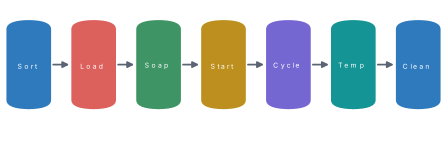
A washing machine is a home appliance that washes clothes automatically. The text gives seven steps:
| Step | What to do | Why |
|---|---|---|
| 1. Separate your laundry | sort by fabric and colour; read the care label; wash delicate items by hand or on the delicate cycle in a mesh bag | to avoid damaging fabrics |
| 2. Load the machine | put the clothes in; do not overload | an overloaded machine does not wash properly |
| 3. Add detergent and fabric softener | read the manual to see which goes where; check the amount on the detergent box | the amount depends on load size and machine type |
| 4. Turn on the washer | close the door and press start | some machines warn if the door is open, some do not |
| 5. Choose the washing cycle | follow the care label; cycles: normal, permanent press, delicate, quick | to clean well and protect clothes |
| 6. Set the water temperature | hot for towels, bedding, sturdy and very dirty items; warm for moderately dirty loads, dark colours, permanent press; cold is gentlest and saves energy | hot water kills germs but can shrink and fade clothes and uses more energy |
| 7. Clean the machine | use a washing machine cleaner; leave the door open after use | to air it out and prevent mould |
Vocabulary (Exercise A)
a–v (appliance: a device for a specific task), b–i (agitate: make something move around by shaking), c–ii (shrink), d–vi (detergent: a water-soluble cleaning substance), e–iv (dump: put down carelessly), f–iii (mould: a fungus).
Comprehension (Exercise B) — model answers
a. What is a washing machine? It is a home appliance that does the laundry automatically, without anyone having to supervise it.
b. Why is it necessary to separate the laundry? Different fabrics and colours need different cycles and temperatures; sorting stops colours running and protects delicate clothes from damage.
c. How can the user maximise the cleanliness of clothes? By choosing the correct washing cycle and water temperature according to the fabric care label.
d. Mention the effects of overloading. The clothes are not washed as well as they should be.
e. Why should we clean a washing machine regularly? To keep it fresh and to prevent mould from growing inside it.
f. Is the text useful for you? How? Yes. It teaches me to use a washing machine safely and correctly, so that clothes get clean without shrinking or fading and energy is saved.
3.6 Writing II: Preparing a set of instructions
- Give a title (How to…) and, if needed, a list of things required.
- Number the steps in the right order.
- Begin each step with an imperative verb: Pour, Add, Stir, Press.
- Keep each step short; add warnings with Make sure… / Do not….
Model answer — How to prepare sel roti (project work)
Things needed: 2 cups of rice soaked overnight, ½ cup sugar, 2 tablespoons ghee, a little water or milk, oil for frying.
- Drain the soaked rice and grind it into a smooth, thick paste.
- Add the sugar and ghee and mix well; add a little water so that the batter flows slowly.
- Leave the batter to rest for about half an hour.
- Heat the oil in a deep pan on a medium flame.
- Pour the batter into the oil in a ring shape, by hand or from a cone.
- Turn the roti with a stick when the lower side is golden brown.
- Take it out, let the extra oil drain, and serve warm.
Make sure the oil is hot enough before you pour; otherwise the roti will soak up oil.
3.7 Punctuation (Extra bit): comma, semicolon, colon
| Mark | Use | Example |
|---|---|---|
| comma (,) | items in a list; after linking phrases; before quoted speech; after yes/no | On the other hand, phones have some disadvantages. |
| semicolon (;) | joins two closely related complete sentences; separates list items that already have commas | I am going abroad this year; I will study there. |
| colon (:) | introduces a list or an explanation | I need to buy: milk, bread and vegetables. |
Chapter summary
- Announcements give what, when, where, who and end with a request and thanks.
- Flight RA-402, Kathmandu → New Delhi: seatbelts, baggage under seat or overhead, seat upright, gadgets off, no smoking.
- Parents Day: 22nd March, 11 a.m., Assembly Hall, 42nd anniversary, chief guest the Mayor of Bardaghat (an ex-student).
- Reported yes/no question: asked + if/whether + subject + verb, tense one step back, no question mark.
- Present reporting verb (says/asks) → no tense change.
- Instructions: title, numbered steps, imperative verbs, warnings.
- Washing: separate → load → detergent → turn on → cycle → temperature → clean.
Practice questions
Reading
- Read the practice announcement and answer. [5]
Attention, please! The Kathmandu–Pokhara bus No. 3, scheduled to leave at 7:00 a.m., will now leave at 8:30 a.m. because of a landslide at Mugling. Passengers are requested to wait in the waiting hall and keep their tickets with them. We are sorry for the inconvenience.
(a) Where is the bus going? (b) What was its original time? (c) How late will it leave? (d) Why is it late? (e) Where should passengers wait?
Answers — Reading
1. (a) From Kathmandu to Pokhara. (b) 7:00 a.m. (c) One and a half hours late, at 8:30 a.m. (d) Because of a landslide at Mugling. (e) In the waiting hall.
Grammar
- Change into reported speech. [5]a"Are you hungry?" Mother asked me.b"Did Hari pass the exam?" the teacher asked.c"Can you help me?" she said to him.d"Have you seen my bag?" Sita asked Ram.e"Will it rain today?" he asked.
Answers — Grammar
2. (a) Mother asked me if I was hungry. (b) The teacher asked if Hari had passed the exam. (c) She asked him if he could help her. (d) Sita asked Ram if he had seen her bag. (e) He asked if it would rain that day.
Writing
- Write an announcement about a blood donation programme in your school. [5]
- Write instructions on how to make a cup of tea. [5]
Answers — Writing
3. Heading; We are pleased to announce…; organiser (e.g. Junior Red Cross Circle with Nepal Red Cross Society); date, time, place; who can donate (healthy people aged 18–60 — teachers, parents); request to take part; thanks and name.
4. Title, things needed (water, tea leaves, milk, sugar), 5–7 numbered steps starting with verbs (Boil… Add… Simmer… Pour… Strain… Serve), one safety warning.
Practise more: English question bank