Unit 15 · Units · 12 min read
Conservation of Earth / An Official Notice
What the syllabus asks for 5
- Argumentative writing on conservation
- Notices: purpose, audience and format
- Grammar: connectives of reason, purpose and contrast
- Writing: an argumentative essay; an official notice
- Project work: preparing a bulletin board; English consonants
Unit 15 is about giving reasons and explanations. Reading I, Conservation of Earth, explains why every creature needs its natural habitat, why saving single species is not enough, and why we must look after the biosphere. Reading II is a real official notice from Nepal's Ministry of Education, Science and Technology about closing schools during the COVID-19 spread in 2078 BS. The grammar is connectives of reason, purpose and contrast (because, so that, although, however…). In writing you write an argumentative (opinion) essay and a notice.
(1) Explain cause and effect from an expository text. (2) Pick out the key facts of a notice: who, what, when, why, what to do. (3) Join sentences with the correct connective and correct grammar after it (because + clause, because of + noun). (4) Write an argumentative essay with a clear opinion and reasons. (5) Write a notice in the proper format.
15.1 Reading I: Conservation of Earth
Summary, paragraph by paragraph
- Natural habitat. Every creature has a place where it feels at home — polar bears in the Arctic (protected by thick layers of fat), lions in hot African grasslands (thinner coats). This place is its natural habitat, where it and its ancestors have lived for perhaps millions of years. Habitats differ in temperature and vegetation; wild creatures are used to one kind and cannot survive long in a different one.
- Early conservation. Several decades ago, conservationists began saving specific endangered species by banning some hunting, poaching and overfishing.
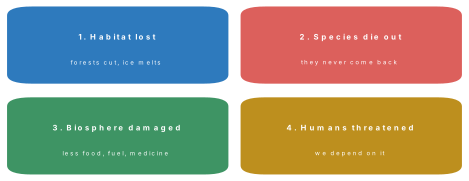
- Saving habitats. Saving one species was not enough; its home had to be saved too. Habitats are in danger because people cut forests for firewood and timber, and global warming is melting the ice caps.
- Extinction. Thousands of species are in danger of becoming extinct, and once gone they never come back. Thousands more are still undiscovered, in hard-to-reach places — isolated rainforests, deep oceans, the Arctic and Antarctic.
- The biosphere. Other creatures give us food, building materials, fuel and medicine. If we destroy the biosphere through greed or foolishness, we will die out ourselves. Conserving it means looking after ourselves.
- Looking ahead. Some scientists are searching for other habitable planets; the James Webb Space Telescope looks for signs of oxygen and water vapour. This will take hundreds of years, so we must look after the Earth now.
Main idea: protect habitats and the whole biosphere, not just single species, because human survival depends on it.
Vocabulary (Exercise A)
a. extinct b. poaching c. decade (text: decades) d. ancestors e. sort f. conservationists g. biosphere h. habitable
True or False (Exercise B)
a. True. b. False — they began several decades ago. c. True — "there are probably thousands more species … we have not discovered". d. True. e. False — they are still searching.
Comprehension (Exercise C) — model answers
a. How can polar bears live in the Arctic? Their thick layers of fat protect them from the freezing temperatures.
b. Why can't wild creatures survive long in a different habitat? They are adapted to the climate, vegetation and other species of their own habitat, where they and their ancestors have lived for millions of years.
c. What have conservationists done to save specific species? They banned some hunting, poaching and overfishing.
d. What is the impact of cutting down trees? The creatures living in the forest lose their home and may have nowhere else to go.
e. Where are many undiscovered species found? In places that are difficult to reach, such as isolated rainforests, deep oceans, the Arctic and the Antarctic.
f. What do other creatures contribute to humans? Food, building materials, fuel and medicine.
g. Why are scientists looking for oxygen and water vapour on other planets? Because living things need them; their presence would suggest that a planet might be habitable.
15.2 Grammar: Connectives of reason, purpose and contrast
| Function | Connective | Followed by | Example |
|---|---|---|---|
| Reason | because, as, since | a clause | They survive because they have thick fat. |
| because of, due to | a noun / noun phrase | He couldn't join the army because of his visual impairment. | |
| Result | so, therefore | a clause | It rained; therefore, we stayed in. |
| Purpose | so that | clause (often with can/could) | I went to the bank so that I could withdraw money. |
| to, in order to | base verb | She spoke clearly in order to impress the headteacher. | |
| Contrast | but | clause (joins two) | I work a lot, but I don't get good grades. |
| although, even though | clause | Although she was sick, she came to school. | |
| in spite of, despite | noun / -ing | In spite of being ill, he wants to meet me. | |
| however | new sentence, comma after | It was a great start; however, it was not enough. |
Rule to remember: although and but are not used together: ~~Although~~ she was rich, ~~but~~ she lived simply — use only one.
Textbook answers
Grammar I A: a. because b. Although c. because d. however e. to f. so that
Grammar I B: a. because b. because of c. because d. Although e. so that f. Because of g. Although h. in order to i. but
Grammar II: a. Although she is very rich, she lives a simple life. b. In spite of being ill (his illness), he wants to meet me. c. Although she works carefully, she makes many mistakes. d. I went to the grocery so that I could buy some rice. e. She has got good grades; however, she has not passed the entrance test. f. He ran away because he was afraid. g. We did not go out because of the heavy rain. h. Although it was hot, we went to play football. i. She bought a book and a pencil. j. He likes dancing, but he doesn't like singing.
- because of it was raining ✗ → because it was raining / because of the rain ✓
- in spite of he was ill ✗ → in spite of being ill / although he was ill ✓
- in order to buying ✗ → in order to buy** ✓
- Although … but … ✗ — use one connective only.
15.3 Writing I: An argumentative (opinion) essay
Structure: title → introduction with your opinion → 2–3 body paragraphs, each with one reason and an example → a paragraph answering the other side → conclusion restating your view. Use connectives: firstly, moreover, because, however, on the other hand, therefore, in conclusion.
Model answer — Radio and Television: Good or Bad for Students?
Radio and Television: Good or Bad for Students?
Some people think that radio and television waste students' time, while others believe they are an important source of learning. In my opinion, radio and television are useful for students if they are used wisely.
Firstly, they give knowledge. News programmes keep students informed about events in Nepal and the world, and educational channels and radio lessons teach science, history and languages in an interesting way. During the COVID-19 school closures, many Nepali students continued learning through radio and TV lessons.
Secondly, they improve language skills. Listening to English news or documentaries helps students learn new words and correct pronunciation. Moreover, quiz shows and debates encourage them to think.
On the other hand, it is true that too much television harms students. Some students watch films and serials for hours, neglect their homework and damage their eyes, and some programmes show violence. However, this is a problem of overuse, not of the media themselves.
In conclusion, radio and television are good teachers if students choose useful programmes and limit their viewing time. Parents should guide them so that these media help, not harm, their studies.
15.4 Reading II: An Official Notice
The notice in brief
| Part | Content |
|---|---|
| Issuing office | Government of Nepal, Ministry of Education, Science and Technology, Singhadurbar, Kathmandu |
| Date | 26th Poush 2078 |
| Title | Notice about School Closure |
| What and why | all schools across the country closed because of the rapid spread of COVID-19 |
| When | from 27th Poush to 15th Magh |
| Other decisions | children aged 12–17 to be vaccinated at local health posts during the vacation; parents to take their children on the specified dates; schools to continue learning through alternative methods; universities may hold pre-scheduled exams following health and safety standards |
Format of a notice: name of the organisation → date → the word Notice and a title → the message (what, when, where, why, who) → request/instructions → name and post of the person issuing it (signature).
Vocabulary (Exercise A)
a–iii (rapid), b–v (infection), c–iv (vaccination), d–i (arrangement), e–ii (alternative)
Comprehension (Exercise B) — model answers
a. What is the notice about? The closure of all schools in Nepal. b. Why did the government close all schools? Because of the rapid spread of COVID-19 infection. c. How long will schools remain closed? From 27th Poush to 15th Magh, about three weeks. d. What are parents asked to do? To contact schools and take their children aged 12–17 for vaccination on the specified dates. e. What are universities told about exams? They can hold their pre-scheduled examinations following public health and safety standards.
Exercise C (message to an absent friend): Hi Suman, the Ministry of Education has closed all schools from 27th Poush to 15th Magh because COVID-19 is spreading fast. Children aged 12 to 17 will get vaccines at the local health post during the holiday, so ask your parents to contact the school for the date. Our teachers will send lessons online. Take care! — Bibek
15.5 Writing II: A notice
Model answer — one-day school closure
Shree Saraswati Secondary School Pokhara-8, Kaski
Date: 5 Bhadra 2082
NOTICE
School Closed on Thursday
This is to inform all students, teachers and parents that the school will remain closed on Thursday, 7 Bhadra 2082, because the school building will be used as a polling centre for the by-election. Regular classes will resume on Friday, 8 Bhadra, at the usual time.
All students are requested to complete the homework given for the day.
Principal
The organisation's name, the date, the heading NOTICE and a title, the exact day/date of the closure, the reason, what happens next, and the issuer's post. Keep it short, formal and impersonal (no Dear…, no Yours…).
15.6 Speaking, pronunciation and project work
Giving explanations (speaking): Why are bicycles popular these days? — Because they are cheap and eco-friendly. / Why did you go to the bank? — I went there in order to withdraw some money.
English consonant sounds in the word list: /k/ creature, /t/ temperature, /l/ layer, /h/ habitat, /s/ ancestors, /w/ warming, /f/ freezing, /ʃ/ bush, /ʒ/ treasure and decision, /dʒ/ danger, /v/ living, /ɡ/ great, /θ/ thousands, /ð/ another, /j/ you. English has 24 consonant sounds.
Listening (zoos): the speaker is against keeping animals in zoos; he says they look sad, children can learn from television and the internet, and most zoo animals are not endangered.
Project work: make a class bulletin board from local materials and pin notices on it.
Chapter summary
- Natural habitat = where a creature and its ancestors have always lived; wild creatures cannot survive long elsewhere.
- Conservation moved from banning hunting/poaching/overfishing to saving whole habitats; threats: deforestation, global warming; extinction is permanent.
- The biosphere gives food, building materials, fuel, medicine; destroying it threatens humans.
- Notice (26 Poush 2078): schools closed 27 Poush–15 Magh due to COVID-19; vaccination for 12–17-year-olds.
- because + clause / because of + noun; so that + clause / (in order) to + verb; although + clause / in spite of + noun or -ing; however starts a new sentence.
- Opinion essay: opinion → reasons with examples → other side → conclusion.
Practice questions
Reading
- Answer from the texts. [5]aWhy can lions live in hot grasslands?bName two things that are destroying habitats.cWhat will the James Webb Space Telescope look for?dWho issued the notice?eWhich age group was to be vaccinated?
Answers — Reading
1. (a) They have thinner coats. (b) Cutting forests for firewood and timber; global warming melting the ice caps. (c) Signs of oxygen and water vapour on other planets. (d) The Ministry of Education, Science and Technology. (e) Children between 12 and 17 years.
Grammar
- Join using the word in brackets. [5]aHe was tired. He kept working. (although)bShe studies hard. She wants to become a doctor. (because)cWe stayed home. There was a strike. (because of)dI saved money. I could buy a bicycle. (so that)eIt was cold. He went swimming. (in spite of)
Answers — Grammar
2. (a) Although he was tired, he kept working. (b) She studies hard because she wants to become a doctor. (c) We stayed home because of the strike. (d) I saved money so that I could buy a bicycle. (e) In spite of the cold, he went swimming.
Writing
- Write a notice on behalf of your school's Eco Club about a cleanliness campaign. [5]
- Write an opinion essay: "Should mobile phones be allowed in school?" [5]
Answers — Writing
3. School name, date, NOTICE, title, what (cleanliness campaign), when, where, who should take part, what to bring (gloves, sacks), the issuer (Coordinator, Eco Club).
4. Clear opinion in the introduction; two or three reasons with examples; the opposing view and your reply; conclusion; connectives of reason and contrast.
Practise more: English question bank