Unit 9 · Units · 11 min read
The Leap between High School and College / Smartphones in our Life
What the syllabus asks for 5
- Making comparison and contrast in writing
- Advantages and disadvantages of technology
- Grammar: comparative and superlative forms of adjectives and adverbs
- Writing: a paragraph comparing places; an essay on technology
- Project work: making a survey; pronunciation: college-related words
Unit 9 is about comparing and contrasting. Reading I, The Leap between High School and College, is a comparison essay: college costs more, demands more and offers more social activities than high school. Reading II, Smartphones in our Life, shows how smartphones have changed the way we find information, communicate and behave. The grammar is the comparative and superlative forms of adjectives and adverbs. In writing you compare two villages and write an essay comparing life before and after the internet.
(1) Find the three points of comparison in an essay and the evidence for each. (2) Form comparatives and superlatives correctly (-er/-est, more/most, irregular forms). (3) Use than, as … as, not as … as, the … of all. (4) Write comparison paragraphs and essays with contrast connectives (whereas, while, in contrast, similarly, both).
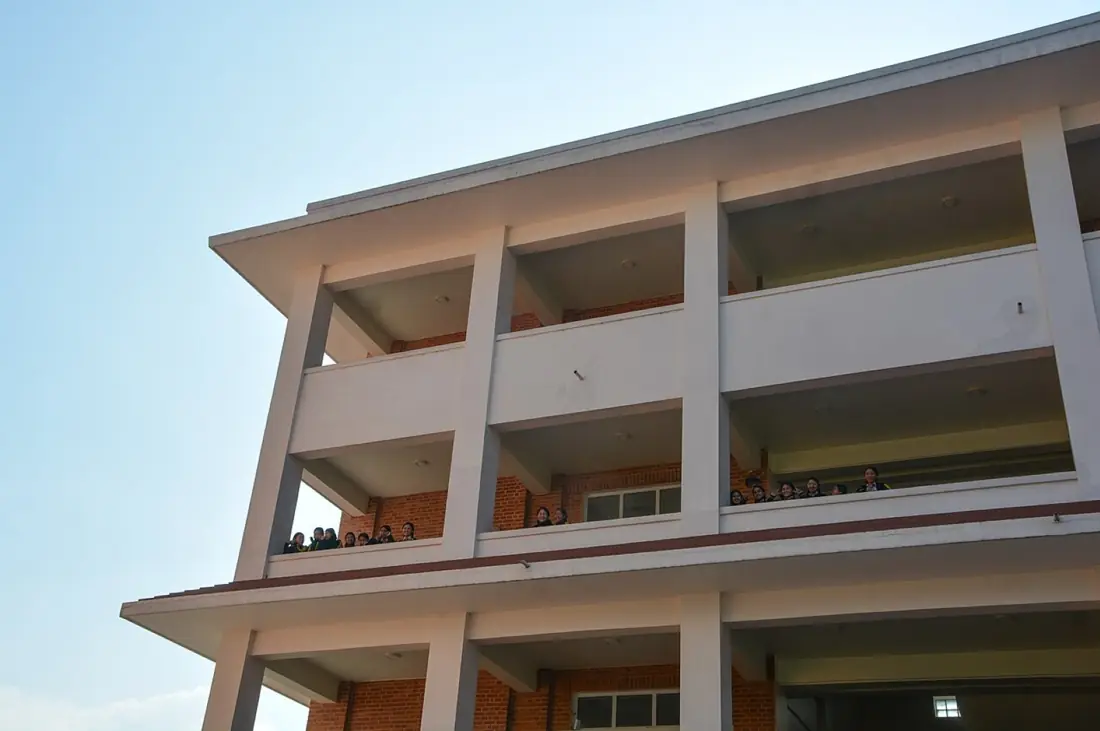
9.1 Reading I: The Leap between High School and College
Structure and summary
| Paragraph | Point | Evidence |
|---|---|---|
| Introduction | The move to college is a big transition; students wrongly assume it will be like school. Thesis: college costs more, is more challenging and offers more freedom. | — |
| 1. Cost | College is more expensive. | tuition; residence or rent near college (school students mostly live at home); textbooks for every course |
| 2. Workload | College work is more challenging. | more assignments; harder ones that take hours; extra pressure because final grades depend on each assignment |
| 3. Activities | College is more social. | more sports and clubs; college teams and athletic facilities; few high schools have such facilities; smaller schools have a limited variety of clubs |
| Conclusion | College is more costly, more academically challenging and more socially stimulating; students who know this will be better prepared. | — |
Language of contrast used in the essay: In contrast, Furthermore, In addition, First / Second / Third, Overall.
Vocabulary (Exercise A)
a–v assumption b–iii expense c–iv residence d–i assignment e–vii stimulating f–vi challenging g–ii adequately (viii boast is extra).
Comprehension (Exercise B) — model answers
a. What do students expect when they enter post-secondary education? They expect college to be the same as their experience at secondary school.
b. How is college more expensive? Students pay tuition, they must pay for a residence or rent near the college, and they must buy textbooks for each course.
c. Write three reasons why the college workload is more challenging. (i) There are more assignments. (ii) The assignments are harder and can take hours. (iii) There is extra pressure because the final grade is based on each assignment.
d. What athletic opportunities/challenges do college students face? They are expected to take part more in sports and clubs; they can join college sports teams and use the college's athletic facilities.
e. What should students consider while entering college? The differences in cost, workload and social life, so that they are prepared for the challenges.
9.2 Grammar I: Comparative and superlative adjectives
| Type of adjective | Comparative | Superlative |
|---|---|---|
| one syllable: large, high, hard | larger, higher, harder | the largest, highest, hardest |
| one vowel + one consonant: slim, big | slimmer, bigger | the slimmest |
| consonant + -y: heavy, easy | heavier, easier | the heaviest |
| two or more syllables: expensive, important | more expensive | the most expensive |
| irregular | good → better, bad → worse, far → farther/further, little → less, many/much → more | best, worst, farthest/furthest, least, most |
Patterns: X is heavier than Y. / X is as slim as Y. / X is not as expensive as Y. / the highest peak in the world / the best of all.
Textbook answers
Grammar I A (adjectives in the text):
| Adjective | Comparative | Superlative |
|---|---|---|
| large | larger | largest |
| small | smaller | smallest |
| few | fewer | fewest |
| expensive | more expensive | most expensive |
| challenging | more challenging | most challenging |
| costly | more costly / costlier | most costly / costliest |
| social | more social | most social |
| stimulating | more stimulating | most stimulating |
| significant | more significant | most significant |
Grammar I B: a. more important b. heavier c. most expensive d. slimmer e. more crowded f. highest g. most exciting h. worse i. harder j. most challenging
- more better / most cheapest ✗ → better / cheapest ✓ (never double)
- She is taller then me. ✗ → taller than** ✓
- Everest is the highest peak of the world. → in the world is preferred
- the most expensive car of town → in town
- as slim than ✗ → as slim as** ✓
9.3 Reading II: Smartphones in our Life
Summary
- Many of us feel scared or lost without our phone; smartphones have become a vital part of life.
- One device lets us surf the internet and social media, check e-mail, listen to music, play games, watch videos, take photos, read news, text — and make calls. Twenty-five years ago some of this was impossible; life has changed drastically.
- Information and communication: we can find any information anytime, anywhere, and communicate by calls, messages, e-mail and social media.
- Effect on thinking: we tend to forget information we know we can find again, and we search the internet instead of thinking — we are getting lazier.
- Effect on behaviour: from the morning alarm to bedtime we use the phone everywhere; we are constantly connected and expected to be available, which is convenient but tiring.
- Sales of landlines, desktop computers and digital cameras have dropped; the smartphone has taken their place and become our personal assistant.
Vocabulary (Exercise A)
a. smartphone b. constantly c. device d. scared e. retrieve f. surf g. convenient h. impact i. vital j. drastically
Comprehension (Exercise B) — model answers
a. How do people feel when they miss their mobile phones? Some feel scared and others feel completely lost or incomplete.
b. Write any three ways of using smartphones. To surf the internet and social media, to take photos and watch videos, and to make phone calls.
c. Why are we getting lazier? Because we know we can find any information anytime, so we search the internet instead of thinking or remembering.
d. What is the impact of being connected all the time? It is convenient, but being available all the time is tiring.
e. Why is the smartphone called a personal assistant? Because it does the work of many devices — alarm clock, camera, computer, telephone — and helps us manage our everyday lives.
9.4 Grammar II: Adverbs and their comparison
An adverb tells how, when, how often or to what degree: completely, importantly, drastically, constantly (Grammar II A — all four are adverbs).
| Adverb | Comparative | Superlative |
|---|---|---|
| hard, fast, early, late (same form as adjective) | harder, faster, earlier, later | hardest, fastest, earliest, latest |
| -ly adverbs: carefully, clearly, fluently | more carefully | most carefully |
| well / badly | better / worse | best / worst |
Textbook answers (Grammar II B)
a. more carefully b. harder … hardest c. most beautifully d. more clearly e. earlier f. fastest g. better … best h. more fluently i. later j. more seriously
9.5 Writing I: A paragraph comparing two places
Organise by points (location, size, people, attractions), comparing both villages in each sentence. Use both, while, whereas, similarly, unlike, larger than.
Model answer — Bhujung and Bhada
Problem. Write a description of Bhujung and Bhada villages, comparing them.
Solution. Bhujung and Bhada are both popular village tourist destinations of Nepal, but they are different in many ways. Bhujung is a typical Gurung village in the hills of Lamjung at an altitude of about 1,700 metres, whereas Bhada is a typical Tharu settlement in the plains of Kailali, about 12 kilometres from the district headquarters. Bhujung is larger, with around 500 households, while Bhada has around 200 houses.
Both villages offer homestay services and warm hospitality. In Bhujung, tourists enjoy Gurung culture, clean streets, traditional mud-and-stone houses with tile roofs, terraced fields, green forests and stunning mountain views. In Bhada, on the other hand, visitors experience the Tharu way of life, taste Tharu dishes such as dhikri, ghonghi and crab, and watch dances like Lathwa, Jhumra and Sakhiya. Bhada also has Joginya and Sahadeva lakes and the Rameshwar Temple, and the best time to visit it is from mid-September to mid-December. In short, Bhujung is ideal for mountain scenery, while Bhada is perfect for culture and food of the plains.
9.6 Writing II: Essay — life before and after the internet
Model answer — Life Before and After the Internet
The internet is one of the greatest inventions of modern times. It has changed the way we communicate, learn, work and enjoy ourselves.
Communication. Before the internet, people wrote letters that took weeks to arrive, or made expensive telephone calls. Today, we can send messages, e-mails and video calls to any part of the world in seconds, almost free of cost.
Learning and information. In the past, students depended on textbooks, teachers and libraries. Now, information on almost any topic is available online, and students can join online classes. However, much online information is not reliable, so we must check it carefully.
Work, shopping and banking. Earlier, people had to stand in long queues to pay bills or transfer money. Now, online banking and digital wallets make these tasks faster and easier, and many people work from home.
Social life. People used to meet friends face to face more often. Today, social media keeps us connected, but many people spend less time with their families and suffer from screen addiction.
In conclusion, the internet has made life faster and more convenient than before, but it must be used wisely and in moderation.
9.7 Speaking, pronunciation and project work
Comparing (speaking): An elephant is bigger than a tiger. A bicycle isn't as expensive as a motorcycle. An aeroplane is faster than a train. A crocodile isn't as slow as a snail.
College words — stress: a'cademy, 'campus, 'faculty, 'lecture, 'library, gradu'ation, a'lumni, 'scholarship, 'dormitory, se'mester, 'freshman, tu'ition.
Project work: survey your classmates on what they use mobile phones for (calls, study, games, social media, videos) and show the results in a bar graph or pie chart.
Chapter summary
- College vs high school: more cost (tuition, residence, books), more workload (more and harder assignments, grade pressure), more social life (sports, clubs, facilities).
- Smartphones: one device for everything; easy information makes us lazier; constant connection is tiring; they replaced landlines, desktops and cameras.
- Comparatives: -er / more; superlatives: the -est / the most; irregular good–better–best, bad–worse–worst.
- than; as … as; not as … as; never more better.
- Adverbs: hard–harder, carefully–more carefully, well–better–best.
- Comparison writing: point by point, with whereas, while, both, unlike.
Practice questions
Reading
- Answer from the texts. [5]aName the three ways in which college differs from high school.bWhy do high school students have no living expenses?cWhat is the first thing we do in the morning with our phones?dWhich devices have lost sales because of smartphones?eWhat did the writer say about life 25 years ago?
Answers — Reading
1. (a) Cost, workload and social activities. (b) Most of them live at home with their parents. (c) Turn off the alarm clock. (d) Landline phones, desktop computers and digital cameras. (e) Some of today's smartphone activities were not even possible then.
Grammar
- Use the correct form. [5]aMount Everest is (high) mountain in the world.bThis book is (good) than that one.cRam runs (fast) than Hari.dShe is (intelligent) student in the class.eToday is (bad) day of my life.
Answers — Grammar
2. (a) the highest (b) better (c) faster (d) the most intelligent (e) the worst
Writing
- Write a paragraph comparing village life and city life. [5]
Answer — Writing
3. Topic sentence; at least three points (environment, facilities, cost of living, people's relations), each compared using whereas / while / than; a concluding sentence with your preference.
Practise more: English question bank