Question bank · 18 min read
Optional Mathematics: Unit-wise Objective Question Bank
Optional Mathematics in grade 8 is examined by your own school, in a written paper of 50 marks and two hours. Group A of that paper is ten one-mark objective items. They are the cheapest marks in the paper and the easiest to throw away: a sign slipped in a rotation rule, a degree confused with a grade, a median found before the data were put in order. This chapter drills those items unit by unit for all ten units of the Optional Mathematics 8 book, in the same order as the book.
Each section opens with a facts line, the few results that the items of that unit actually use. Then come twelve items, and then a key that gives the answer with a one-line reason. Work an item in under a minute, check it in ten seconds, and move on. The reasons matter more than the letters: a reason you can repeat is a mark you will not lose next time.
| Group | Items | Marks each | Total | What it tests |
|---|---|---|---|---|
| A | 10 | 1 | 10 | one-step recall or a single substitution |
| B | 10 | 2 | 20 | one short method |
| C | 5 | 4 | 20 | a full method, a figure or a proof |
| Total | 25 | 50 | 2 hours |
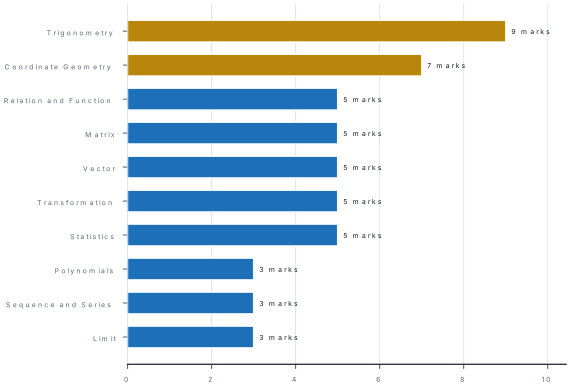
There is no national specification grid for this school paper. The weights in the chart below are the ones this bank uses for its model papers (chapter 22): every unit gets one Group A item, and the longer questions follow the size of each unit.
Every item below is an original practice item written to the pattern above and to the chapters of the Optional Mathematics 8 book. None is claimed to come from any school's paper. Every numerical answer was worked out independently before it was written down.
20.1 Relation and Function
Facts. (a,b)=(c,d) exactly when a=c and b=d. A\times B=\{(a,b): a\in A, b\in B\} and n(A\times B)=n(A)\times n(B). A relation from A to B is a subset of A\times B, so there are 2^{n(A)\times n(B)} relations. The domain is the set of first components and the range the set of second components; R^{-1} swaps every pair. A function gives every member of the domain exactly one image; a graph is a function if no vertical line meets it twice.
- If (a+3,\ 2b-1)=(5,\ 7), then a+b is [1]a6b2c4d8
- If (x,\ y)=(y,\ 4), then x is [1]a0b4c2d-4
- If A=\{1,2,3\} and B=\{4,5\}, the number of members of A\times B is [1]a5b6c8d9
- If n(A\times B)=12 and n(A)=4, then n(B) is [1]a3b8c16d48
- For A=\{p,q\} and B=\{1,2\}, which pair belongs to A\times B? [1]a(1,p)b(q,2)c(2,q)d(p,q)
- If n(A)=2 and n(B)=2, the number of relations from A to B is [1]a4b8c16d2
- The range of R=\{(1,2),(2,4),(3,6)\} is [1]a\{1,2,3\}b\{2,4,6\}c\{1,2,3,4,6\}d\{2\}
- On A=\{1,2,3,4\}, the relation R=\{(x,y): y=x+1\} is [1]a\{(1,2),(2,3),(3,4)\}b\{(1,2),(2,3),(3,4),(4,5)\}c\{(2,1),(3,2),(4,3)\}d\{(1,1),(2,2)\}
- The inverse of R=\{(a,1),(b,2)\} is [1]a\{(1,a),(2,b)\}b\{(a,2),(b,1)\}c\{(1,b),(2,a)\}d\{(a,b),(1,2)\}
- Which kind of arrow diagram is not a function? [1]aone-to-onebmany-to-onecone-to-manydconstant
- If f(x)=5-2x, then f(-3) is [1]a-1b11c-11d1
- If f(x)=x^2 with domain \{-2,-1,0,1,2\}, the range is [1]a\{-4,-1,0,1,4\}b\{0,1,4\}c\{0,1,2,4\}d\{1,4\}
Answers to 20.1
1. (a) — a+3=5 gives a=2; 2b-1=7 gives b=4; 2+4=6.
2. (b) — the second components give y=4, and the first give x=y=4.
3. (b) — 3\times2=6.
4. (a) — 4\times n(B)=12.
5. (b) — the first component must come from A and the second from B.
6. (c) — A\times B has 4 pairs, and a set of 4 has 2^4=16 subsets.
7. (b) — the range is the set of second components.
8. (a) — (4,5) is not allowed because 5\notin A.
9. (a) — swap the components of each pair.
10. (c) — one member with two images breaks the rule of a function.
11. (b) — 5-2(-3)=5+6=11.
12. (b) — squares are never negative, and repeated images are listed once.
20.2 Polynomials
Facts. A polynomial has only whole-number powers of the variable. The degree is the highest power (for a term in several variables, the sum of the powers). By degree: constant 0, linear 1, quadratic 2, cubic 3, biquadratic 4; by terms: monomial, binomial, trinomial. Standard form lists the powers in descending order; the first coefficient is the leading coefficient. Equal polynomials have equal coefficients of like powers. The degree of a product is the sum of the degrees.
- Which of these is not a polynomial? [1]a3x^2+2b\sqrt{3}\,x+1c\frac{2}{x}+1d7
- The degree of 3x^2y^2-5x^3+y is [1]a2b3c4d5
- The polynomial 4x^3-2x+1 is a [1]acubic trinomialbcubic binomialcquadratic trinomialdbiquadratic
- The leading coefficient of 2-7x+3x^2-x^3 is [1]a2b-7c3d-1
- A polynomial of degree 1 is called [1]aconstantblinearcquadraticdcubic
- If f(x)=x^3-2x+1, then f(2) is [1]a5b3c13d1
- If (p-2)x^2+5x=3x^2+qx, then (p,q) is [1]a(5,5)b(1,5)c(5,3)d(3,5)
- (2x^2-3x+1)+(x^2+3x-4) equals [1]a3x^2-3b3x^2+6x-3cx^2-3d3x^2-6x-3
- (x^2+2x)-(3x^2-x) equals [1]a-2x^2+3xb-2x^2+xc4x^2+xd-2x^2-3x
- (x-3)^2 equals [1]ax^2-9bx^2-6x+9cx^2+9dx^2-3x+9
- (2x+1)(x-4) equals [1]a2x^2-7x-4b2x^2-9x-4c2x^2+7x-4d2x^2-8x-4
- If f(x) has degree 4 and g(x) has degree 3, then f(x)\cdot g(x) has degree [1]a1b7c12d4
Answers to 20.2
1. (c) — \frac{2}{x}=2x^{-1} has a negative power; a surd coefficient such as \sqrt{3} is allowed.
2. (c) — the term 3x^2y^2 has degree 2+2=4, more than 3 or 1.
3. (a) — highest power 3 and three terms.
4. (d) — in standard form -x^3+3x^2-7x+2, the first coefficient is -1.
5. (b) — degree 1 is linear.
6. (a) — 8-4+1=5.
7. (a) — p-2=3 gives p=5, and q=5.
8. (a) — the x terms cancel: -3x+3x=0.
9. (a) — x^2-3x^2=-2x^2 and 2x-(-x)=3x.
10. (b) — (a-b)^2=a^2-2ab+b^2; the middle term -6x is not optional.
11. (a) — 2x^2-8x+x-4=2x^2-7x-4.
12. (b) — degrees add: 4+3=7.
20.3 Sequence and Series
Facts. The general term t_n gives the term in position n. Equal first differences d: t_n=a+(n-1)d; equal ratios: t_n=ar^{n-1}; equal second differences: the rule contains n^2. A number is a term only if solving t_n= number gives a natural number n. \sum_{k=1}^{n}t_k adds t_k for k=1 to n; the number of terms is upper limit - lower limit +1. 1+2+\cdots+n=\frac{n(n+1)}{2}; 1+3+\cdots+(2n-1)=n^2; t_n=S_n-S_{n-1}.
- The 6th term of the sequence with t_n=n^2-1 is [1]a35b36c11d25
- The general term of 5, 8, 11, 14, \ldots is [1]a3n+2b5ncn+3d3n+5
- The next term of 1, 3, 6, 10, 15, \ldots is [1]a20b21c25d18
- The next term of 64, 32, 16, 8, \ldots is [1]a0b2c4d6
- Which term of 3, 7, 11, \ldots is 43? [1]a9thb10thc11thd12th
- The general term of 1, -1, 1, -1, \ldots is [1]a(-1)^nb(-1)^{n+1}c-1dn
- \sum_{k=1}^{3}k^2 equals [1]a6b9c14d36
- \sum_{k=1}^{4}3 equals [1]a3b7c12d81
- 1+3+5+7+9 in sigma notation is [1]a\sum_{k=1}^{5}(2k-1)b\sum_{k=1}^{9}kc\sum_{k=1}^{5}2kd\sum_{k=0}^{5}(2k+1)
- The sum of the first 20 natural numbers is [1]a200b210c400d420
- The number of terms in \sum_{k=5}^{12}t_k is [1]a7b8c12d17
- If S_n=n^2 for every n, then t_3 is [1]a9b5c3d4
Answers to 20.3
1. (a) — 6^2-1=35.
2. (a) — the difference is 3 and each term is 2 more than 3n.
3. (b) — the differences are 2, 3, 4, 5, so the next is 15+6=21.
4. (c) — each term is half the one before.
5. (c) — t_n=4n-1=43 gives n=11.
6. (b) — it must be +1 when n=1; (-1)^{n+1} does that.
7. (c) — 1+4+9=14.
8. (c) — the constant 3 is added 4 times.
9. (a) — the kth odd number is 2k-1; option (d) starts at k=0 and has six terms, ending with 11.
10. (b) — \frac{20\times21}{2}=210.
11. (b) — 12-5+1=8.
12. (b) — t_3=S_3-S_2=9-4=5.
Item 11 is lost by writing 12-5=7. The terms are t_5, t_6, \ldots, t_{12}: list the first two and the last if in doubt, and the "+1" will not be forgotten. The same slip appears in item 9, where starting at k=0 adds an extra term.
20.4 Limit
Facts. A sequence has limit l if its terms come as close to l as we wish and stay that close; the limit need not be a term. \lim_{n\to\infty}\frac{1}{n}=0; \frac{1}{2}+\frac{1}{4}+\frac{1}{8}+\cdots approaches 1. x\rightarrow a means x approaches a but never equals it. For a polynomial, substitute; for a \frac{0}{0} form, factorise and cancel first. The limit exists only if the left-hand and right-hand values agree.
- The sequence 2, 1.5, 1.25, 1.125, \ldots tends to [1]a0b1c2d1.1
- \lim_{n\to\infty}\frac{5}{n} is [1]a5b0c\inftyd1
- \lim_{n\to\infty}\frac{n+1}{n} is [1]a0b1c2d\infty
- The sum \frac{1}{2}+\frac{1}{4}+\frac{1}{8}+\cdots approaches [1]a\frac{1}{2}b1c2d\infty
- \lim_{x\to3}(2x-1) is [1]a5b6c7d3
- \lim_{x\to0}(x^2+4) is [1]a0b2c4dnot defined
- \lim_{x\to2}\frac{x^2-4}{x-2} is [1]a0b2c4dnot defined
- \lim_{x\to1}\frac{x^2-1}{x-1} is [1]a0b1c2dnot defined
- For f(x)=\frac{x^2-9}{x-3}, the value f(3) is [1]a6b0c9dnot defined
- "x\rightarrow5^-" means that x approaches 5 [1]athrough values greater than 5bthrough values less than 5cand becomes 5dfrom both sides
- If \lim_{x\to a^-}f(x)=2 and \lim_{x\to a^+}f(x)=3, then \lim_{x\to a}f(x) [1]ais 2bis 3cis 2.5ddoes not exist
- As the number of sides increases, the perimeter of a regular polygon inscribed in a circle of radius 7 cm approaches (take \pi=\frac{22}{7}) [1]a44 cmb154 cmc42 cmd49 cm
Answers to 20.4
1. (b) — the terms are 1+1, 1+0.5, 1+0.25, …; the extra part halves towards 0.
2. (b) — \frac{5}{n} shrinks without end.
3. (b) — \frac{n+1}{n}=1+\frac{1}{n}\rightarrow1.
4. (b) — the part still missing after n terms is \frac{1}{2^n}\rightarrow0.
5. (a) — substitute: 6-1=5.
6. (c) — substitute: 0+4=4.
7. (c) — \frac{(x-2)(x+2)}{x-2}=x+2\rightarrow4.
8. (c) — \frac{(x-1)(x+1)}{x-1}=x+1\rightarrow2.
9. (d) — \frac{0}{0} has no value, although the limit is 6.
10. (b) — the minus sign means "from the left", through smaller values.
11. (d) — the two sides disagree, so there is no single limit.
12. (a) — the polygons tend to the circle: 2\pi r=2\times\frac{22}{7}\times7=44 cm.
20.5 Matrix
Facts. A matrix with m rows and n columns has order m\times n and mn elements; a_{ij} is in row i, column j. In this bank a matrix written [(a,b),(c,d)] has first row a, b and second row c, d. Row, column, zero, rectangular and square matrices are named by shape; diagonal, scalar, unit, symmetric (a_{ij}=a_{ji}) and triangular matrices are square. Equal matrices have the same order and equal corresponding elements. Only matrices of the same order can be added or subtracted; kA multiplies every element by k.
- A matrix of order 2\times3 has [1]a2 columnsb3 rowsc6 elementsd5 elements
- In the matrix [(5,2,7),(1,9,4)], the element a_{21} is [1]a2b1c9d7
- A matrix with only one column is a [1]arow matrixbcolumn matrixcsquare matrixdunit matrix
- The matrix [(3,0),(0,3)] is a [1]aunit matrixbscalar matrixcrow matrixdzero matrix
- A square matrix with a_{ij}=a_{ji} for all i and j is [1]adiagonalbsymmetricctriangulardzero
- The unit matrix of order 2 is [1]a[(1,1),(1,1)]b[(1,0),(0,1)]c[(0,1),(1,0)]d[(0,0),(0,0)]
- If [(x,3),(4,y)]=[(2,3),(4,5)], then x+y is [1]a5b7c9d10
- Two matrices can be added only when they have [1]athe same number of rowsbthe same ordercthe same first elementda zero element
- [(1,2),(3,4)]+[(4,3),(2,1)] equals [1]a[(5,5),(5,5)]b[(4,6),(6,4)]c[(3,1),(-1,-3)]d[(5,5),(5,6)]
- [(5,6),(7,8)]-[(1,2),(3,4)] equals [1]a[(4,4),(4,4)]b[(6,8),(10,12)]c[(4,3),(2,1)]d[(5,4),(4,4)]
- If A=[(2,-1),(3,0)], then -2A is [1]a[(-4,2),(-6,0)]b[(4,-2),(6,0)]c[(-4,-2),(-6,0)]d[(0,-3),(1,-2)]
- For matrices of the same order, A+B=B+A is the [1]aassociative propertybcommutative propertycidentity propertydinverse property
Answers to 20.5
1. (c) — 2 rows and 3 columns make 2\times3=6 elements.
2. (b) — row 2, column 1.
3. (b) — by definition.
4. (b) — diagonal with equal diagonal elements; it would be the unit matrix only if they were 1.
5. (b) — the leading diagonal acts as a mirror.
6. (b) — 1s on the leading diagonal, 0s elsewhere.
7. (b) — x=2 and y=5.
8. (b) — only then do the elements have matching positions.
9. (a) — every pair of matching elements adds to 5.
10. (a) — every difference is 4.
11. (a) — multiply every element by -2; -2\times-1=2.
12. (b) — the order of adding does not matter.
20.6 Coordinate Geometry
Facts. Distance =\sqrt{(x_2-x_1)^2+(y_2-y_1)^2}; from the origin \sqrt{x^2+y^2}. Internal division in the ratio m_1:m_2: \left(\frac{m_1x_2+m_2x_1}{m_1+m_2},\frac{m_1y_2+m_2y_1}{m_1+m_2}\right); mid-point \left(\frac{x_1+x_2}{2},\frac{y_1+y_2}{2}\right). Slope m=\frac{y_2-y_1}{x_2-x_1}; horizontal lines have slope 0 and vertical lines no slope; y=mx+c has slope m and y-intercept c. Area of a triangle =\frac{1}{2}\left|x_1(y_2-y_3)+x_2(y_3-y_1)+x_3(y_1-y_2)\right|; zero area means collinear.
- The distance between (1,2) and (4,6) is [1]a5b7c25d\sqrt{7}
- The distance of (-5,12) from the origin is [1]a7b13c17d169
- The mid-point of (-2,5) and (6,-1) is [1]a(2,2)b(4,4)c(-4,3)d(2,3)
- The point dividing the join of (2,1) and (8,4) internally in the ratio 2:1 is [1]a(6,3)b(4,2)c(5,2.5)d(10,5)
- If (3,4) is the mid-point of (1,2) and (x,y), then (x,y) is [1]a(5,6)b(2,3)c(4,6)d(7,8)
- The slope of the line joining (-1,3) and (2,9) is [1]a2b3c\frac{1}{2}d6
- The slope of a line parallel to the y-axis is [1]a0b1cnot definedd-1
- The equation of the x-axis is [1]ax=0by=0cy=xdx+y=0
- The line y=3x-2 cuts the y-axis at [1]a(0,3)b(0,-2)c(-2,0)d(3,0)
- The slope of the line 4x-2y=5 is [1]a4b-2c2d-4
- The area of the triangle with vertices (0,0), (6,0) and (0,4) is [1]a24b12c10d6
- The "triangle" with vertices (1,1), (2,2) and (3,3) has area [1]a0b1c3d6
Answers to 20.6
1. (a) — \sqrt{9+16}=5.
2. (b) — \sqrt{25+144}=13.
3. (a) — \left(\frac{-2+6}{2},\frac{5-1}{2}\right).
4. (a) — \left(\frac{2(8)+1(2)}{3},\frac{2(4)+1(1)}{3}\right)=(6,3).
5. (a) — x=2(3)-1=5 and y=2(4)-2=6.
6. (a) — \frac{9-3}{2+1}=2.
7. (c) — its run is 0, and division by 0 is not defined.
8. (b) — every point on the x-axis has y=0.
9. (b) — put x=0: y=-2.
10. (c) — y=2x-\frac{5}{2}.
11. (b) — a right triangle with legs 6 and 4: \frac{1}{2}\times6\times4.
12. (a) — the points lie on the line y=x, so they are collinear.
20.7 Trigonometry
Facts. Right angle =90^\circ=100^g=\left(\frac{\pi}{2}\right)^c; 1^g=100^c; \pi^c=180^\circ; \frac{D}{90}=\frac{G}{100}=\frac{2R}{\pi}. \sin\theta=\frac{p}{h}, \cos\theta=\frac{b}{h}, \tan\theta=\frac{p}{b}, with reciprocals cosec, sec, cot. \sin^2\theta+\cos^2\theta=1, 1+\tan^2\theta=\sec^2\theta, 1+\cot^2\theta=\mathrm{cosec}^2\theta. \sin30^\circ=\cos60^\circ=\frac{1}{2}, \tan45^\circ=1, \tan60^\circ=\sqrt{3}. Signs: All, Sin, Tan, Cos. \sin(-\theta)=-\sin\theta, \cos(-\theta)=\cos\theta; 90^\circ\pm\theta changes the ratio to its partner, 180^\circ\pm\theta keeps it.
- 60^\circ in grades is [1]a54^gb66\frac{2}{3}^gc60^gd75^g
- 90^g in degrees is [1]a81^\circb100^\circc90^\circd99^\circ
- \left(\frac{\pi}{6}\right)^c in degrees is [1]a60^\circb30^\circc45^\circd15^\circ
- 1^g is equal to [1]a60^cb100^cc90'd100'
- If \sin\theta=\frac{3}{5} and \theta is acute, then \cos\theta is [1]a\frac{4}{5}b\frac{3}{4}c\frac{5}{4}d\frac{5}{3}
- \sec\theta is equal to [1]a\frac{1}{\sin\theta}b\frac{1}{\cos\theta}c\frac{1}{\tan\theta}d\frac{\sin\theta}{\cos\theta}
- 1+\tan^2\theta is equal to [1]a\sec^2\thetab\mathrm{cosec}^2\thetac\cos^2\thetad\cot^2\theta
- \cos60^\circ+\sin30^\circ is equal to [1]a0b\frac{1}{2}c1d\sqrt{3}
- \tan30^\circ\times\tan60^\circ is equal to [1]a1b\sqrt{3}c\frac{1}{\sqrt{3}}d3
- \sin150^\circ is equal to [1]a-\frac{1}{2}b\frac{1}{2}c\frac{\sqrt{3}}{2}d-\frac{\sqrt{3}}{2}
- \cos(-\theta) is equal to [1]a-\cos\thetab\cos\thetac\sin\thetad-\sin\theta
- From a point 20\sqrt{3} m from the foot of a 20 m pole, the angle of elevation of the top is [1]a30^\circb45^\circc60^\circd90^\circ
Answers to 20.7
1. (b) — 60\times\frac{10}{9}=66\frac{2}{3} grades.
2. (a) — 90\times\frac{9}{10}=81^\circ.
3. (b) — \frac{180^\circ}{6}=30^\circ.
4. (b) — a grade has 100 centesimal minutes.
5. (a) — p=3, h=5, so b=4.
6. (b) — secant is the reciprocal of cosine.
7. (a) — divide p^2+b^2=h^2 by b^2.
8. (c) — \frac{1}{2}+\frac{1}{2}=1.
9. (a) — \frac{1}{\sqrt{3}}\times\sqrt{3}=1.
10. (b) — \sin(180^\circ-30^\circ)=\sin30^\circ, positive in quadrant II.
11. (b) — reflecting in the x-axis does not change x.
12. (a) — \tan\theta=\frac{20}{20\sqrt{3}}=\frac{1}{\sqrt{3}}.
60^\circ is not 60^g: a grade is smaller than a degree, so the same angle has more grades (66\frac{2}{3}^g). Check the direction of every conversion this way: grades are always the bigger number, radians the smallest.
20.8 Vector
Facts. A scalar has magnitude only; a vector has magnitude and direction. \overrightarrow{AB}=\binom{x_2-x_1}{y_2-y_1} (head minus tail); |\vec{a}|=\sqrt{x^2+y^2}; direction \tan\theta=\frac{y}{x}. Unit vector \hat{a}=\frac{\vec{a}}{|\vec{a}|}; null vector \binom{0}{0}; \overrightarrow{BA}=-\overrightarrow{AB}. k\vec{a}=\binom{kx}{ky}; \vec{a}\parallel\vec{b} when x_1y_2-x_2y_1=0 (like if \vec{a}=k\vec{b} with k>0, unlike if k<0). \vec{a}\pm\vec{b} by components; \overrightarrow{AB}+\overrightarrow{BC}=\overrightarrow{AC}.
- Which of these is a scalar quantity? [1]aweightbdisplacementcmassdvelocity
- If A is (2,-1) and B is (5,3), then \overrightarrow{AB} is [1]a\binom{3}{4}b\binom{7}{2}c\binom{-3}{-4}d\binom{3}{2}
- The magnitude of \binom{-6}{8} is [1]a2b10c14d100
- The vector \binom{1}{1} makes with the positive x-axis an angle of [1]a30^\circb45^\circc60^\circd90^\circ
- The unit vector in the direction of \binom{0}{-5} is [1]a\binom{0}{-1}b\binom{0}{1}c\binom{0}{-5}d\binom{1}{0}
- The magnitude of the null vector is [1]a1b0cnot defineddany number
- \overrightarrow{BA} is equal to [1]a\overrightarrow{AB}b-\overrightarrow{AB}c2\overrightarrow{AB}d\vec{0}
- The vectors \binom{2}{6} and \binom{1}{3} are [1]aunlike vectorsblike vectorscunit vectorsdnull vectors
- If \vec{a}=\binom{4}{-2}, then \frac{1}{2}\vec{a} is [1]a\binom{2}{-1}b\binom{8}{-4}c\binom{4}{-1}d\binom{2}{-2}
- \binom{k}{2} is parallel to \binom{6}{4} when k is [1]a2b3c4d12
- \binom{3}{-1}-\binom{1}{2} is equal to [1]a\binom{2}{-3}b\binom{4}{1}c\binom{2}{1}d\binom{-2}{3}
- By the triangle law, \overrightarrow{PQ}+\overrightarrow{QR} is equal to [1]a\overrightarrow{PR}b\overrightarrow{RP}c\overrightarrow{QP}d\vec{0}
Answers to 20.8
1. (c) — mass has no direction; weight is a force and acts downwards.
2. (a) — \binom{5-2}{3+1}.
3. (b) — \sqrt{36+64}=10.
4. (b) — \tan\theta=1 in quadrant I.
5. (a) — divide by the magnitude 5.
6. (b) — both components are 0.
7. (b) — same length, opposite direction.
8. (b) — \binom{2}{6}=2\binom{1}{3} with a positive scalar.
9. (a) — halve each component.
10. (b) — 4k-6\times2=0 gives k=3.
11. (a) — \binom{3-1}{-1-2}.
12. (a) — from the first tail to the last head.
20.9 Transformation
Facts. Reflection, rotation and translation are isometric (congruent image); enlargement is not. Reflection in the x-axis: (x,y)\rightarrow(x,-y); in the y-axis: (x,y)\rightarrow(-x,y). Rotation about O: +90^\circ\rightarrow(-y,x), 180^\circ\rightarrow(-x,-y), +270^\circ=-90^\circ\rightarrow(y,-x), 360^\circ\rightarrow(x,y). Translation by \binom{a}{b}: (x,y)\rightarrow(x+a,y+b); its inverse is the translation by \binom{-a}{-b}. Points on the mirror line do not move.
- Which transformation changes the size of a figure? [1]areflectionbtranslationcrotationdenlargement
- The image of (-4,-1) after reflection in the x-axis is [1]a(-4,1)b(4,-1)c(4,1)d(-1,-4)
- The image of (6,-2) after reflection in the y-axis is [1]a(-6,-2)b(6,2)c(-6,2)d(-2,6)
- Under reflection in the y-axis, the point (0,5) goes to [1]a(0,-5)b(0,5)c(5,0)d(-5,0)
- Rotation through +90^\circ about O sends (3,1) to [1]a(-1,3)b(1,-3)c(-3,-1)d(1,3)
- Rotation through -90^\circ about O sends (3,1) to [1]a(-1,3)b(1,-3)c(-3,-1)d(3,-1)
- Rotation through 180^\circ about O sends (-2,7) to [1]a(2,-7)b(-7,2)c(2,7)d(-2,-7)
- A rotation about O sends (2,3) to (-3,2). The rotation is [1]a+90^\circb-90^\circc180^\circd360^\circ
- Translation by \binom{-3}{4} sends (5,-1) to [1]a(2,3)b(8,-5)c(2,-5)d(-15,-4)
- The translation vector that sends (1,1) to (4,-2) is [1]a\binom{3}{-3}b\binom{5}{-1}c\binom{-3}{3}d\binom{3}{3}
- Rotation through 270^\circ anticlockwise about O sends (x,y) to [1]a(-y,x)b(y,-x)c(-x,-y)d(y,x)
- The translation that undoes the translation by \binom{2}{-5} is the translation by [1]a\binom{-2}{5}b\binom{2}{5}c\binom{5}{-2}d\binom{-2}{-5}
Answers to 20.9
1. (d) — the others keep every length.
2. (a) — the sign of y changes.
3. (a) — the sign of x changes.
4. (b) — the point lies on the mirror line.
5. (a) — (-y,x)=(-1,3), into quadrant II.
6. (b) — (y,-x)=(1,-3), into quadrant IV.
7. (a) — both signs change.
8. (a) — (-y,x) for (2,3) is (-3,2).
9. (a) — (5-3,\ -1+4).
10. (a) — \binom{4-1}{-2-1}.
11. (b) — the same as a quarter turn clockwise.
12. (a) — the negative vector brings every point back.
Items 5 and 6 differ only in direction, and their answers differ only in where the minus sign goes. Before choosing, say which quadrant the image must be in: an anticlockwise quarter turn from quadrant I lands in quadrant II (x negative), a clockwise one in quadrant IV (y negative).
20.10 Statistics
Facts. Mean: \frac{\sum x}{n}, \frac{\sum fx}{N}, or \frac{\sum fm}{N} with mid-values m for grouped data. Median: the \left(\frac{n+1}{2}\right)th item of the ordered data; Q_1 the \left(\frac{n+1}{4}\right)th and Q_3 the \left(\frac{3(n+1)}{4}\right)th item. Mode: the most frequent value; for grouped data M_o=L+\frac{f_1-f_0}{2f_1-f_0-f_2}\times i in the modal class. Range =L-S; coefficient of range =\frac{L-S}{L+S}.
- The mean of 7, 9, 11, 13 is [1]a9b10c11d40
- If the mean of 6 numbers is 15, their sum is [1]a21b90c2.5d9
- The mean of the distribution x: 1, 2, 3 with f: 2, 3, 5 is [1]a2b2.3c2.5d3
- The mid-value of the class 30–40 is [1]a30b35c40d70
- The median of 8, 3, 6, 1, 9 is [1]a3b6c5.4d9
- The median of 4, 6, 9, 13, 15, 20 is [1]a9b13c11d11.17
- For 15 values in ascending order, Q_1 is the [1]a3rd valueb4th valuec8th valued12th value
- For 15 values in ascending order, Q_3 is the [1]a10th valueb11th valuec12th valued13th value
- The mode of 3, 5, 5, 6, 8, 8, 8, 10 is [1]a5b6c8d10
- For the classes 0–10: 5, 10–20: 9, 20–30: 6, the modal class is [1]a0–10b10–20c20–30d0–30
- The range of 34, 12, 56, 23, 45 is [1]a44b22c56d33
- If the largest value is 60 and the smallest is 20, the coefficient of range is [1]a40b0.5c2d0.33
Answers to 20.10
1. (b) — \frac{40}{4}=10.
2. (b) — 6\times15=90.
3. (b) — \sum fx=2+6+15=23 and N=10.
4. (b) — \frac{30+40}{2}.
5. (b) — in order 1, 3, 6, 8, 9; the 3rd value is 6.
6. (c) — \frac{9+13}{2}=11.
7. (b) — \frac{15+1}{4}=4.
8. (c) — \frac{3(15+1)}{4}=12.
9. (c) — 8 occurs three times.
10. (b) — it has the highest frequency, 9.
11. (a) — 56-12=44.
12. (b) — \frac{40}{80}=0.5.
One hundred and twenty items, ten facts lines. Copy the ten facts lines onto one sheet: the rules for transformations, the standard trigonometric values, the conversion between degrees, grades and radians, the distance and section formulas, and the averages. In the last week before the paper that sheet replaces this chapter.
Chapter summary
- Relations and functions: n(A\times B)=n(A)n(B); a function gives each member of the domain exactly one image; R^{-1} swaps every pair.
- Polynomials and sequences: whole-number powers only; degree of a product = sum of degrees; t_n=a+(n-1)d; number of terms in \sum_{k=p}^{q} is q-p+1.
- Limit: substitute for polynomials; factorise and cancel a \frac{0}{0} form; no limit when the two sides disagree.
- Matrix: order is rows \times columns; add and subtract only the same order; kA multiplies every element.
- Coordinate geometry: distance, section and mid-point formulas; slope \frac{y_2-y_1}{x_2-x_1}; y=mx+c; area \frac{1}{2}|x_1(y_2-y_3)+x_2(y_3-y_1)+x_3(y_1-y_2)|.
- Trigonometry: 90^\circ=100^g=\frac{\pi}{2} rad; the three identities; standard values; ASTC; allied-angle rules.
- Vector and transformation: head minus tail; parallel when x_1y_2-x_2y_1=0; (x,-y), (-x,y), (-y,x), (-x,-y), (y,-x), (x+a,y+b).
- Statistics: order the data before finding a median or quartile; divide by N=\sum f; range L-S and coefficient \frac{L-S}{L+S}.