Question bank · 21 min read
Optional Mathematics: Unit-wise Subjective Question Bank
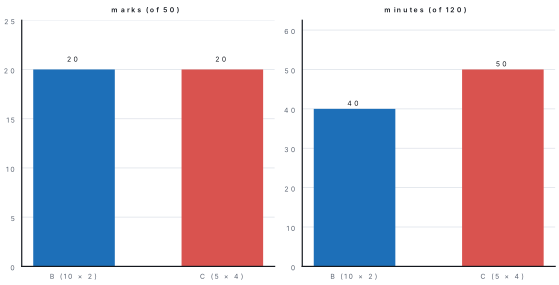
Group A is ten single marks. The other 40 marks of the Optional Mathematics paper come from Group B (ten 2-mark questions) and Group C (five 4-mark questions), and here marks are won by method, not by recall. A 2-mark answer needs two visible steps; a 4-mark answer needs a figure or a table where one helps, the formula, the substitution, the working and a checked answer. This chapter takes the ten units of the Optional Mathematics 8 book in order. Each unit opens with a model question worked the way a marker wants to see it, followed by four 2-mark and three 4-mark questions with complete solutions.
Read the model question first. Then cover the solutions and write the seven questions out in full, on paper, against the clock: about 4 minutes for a 2-mark question and 10 minutes for a 4-mark question. Mark yourself step by step, not just by the final answer. In the real paper a correct method with one arithmetic slip still earns most of the marks, while a bare answer with no working may earn none.
Every question below is an original practice item written for the 50-mark school paper and the chapters of the Optional Mathematics 8 book. None is claimed to have appeared in any school's paper. All numerical answers were worked out independently, and most solutions end with the check that proves them.
21.1 Relation and Function
Problem. Let A=\{1,2,3,4\}, B=\{2,4,6,8,10\} and f: A\rightarrow B be defined by f(x)=2x. (i) Write f as a set of ordered pairs and show it in an arrow diagram. (ii) Write its domain, co-domain and range. (iii) Write the inverse relation f^{-1}. Is f^{-1} a function from B to A? Give a reason.
Solution. (i) f(1)=2, f(2)=4, f(3)=6, f(4)=8, so f=\{(1,2),(2,4),(3,6),(4,8)\}. In the arrow diagram, 1, 2, 3, 4 in the first oval send one arrow each to 2, 4, 6, 8; the member 10 of B receives no arrow.
(ii) Domain =A=\{1,2,3,4\}; co-domain =B=\{2,4,6,8,10\}; range =\{2,4,6,8\}.
(iii) f^{-1}=\{(2,1),(4,2),(6,3),(8,4)\}. As a relation from B to A it is not a function, because the member 10 of B has no image. (It would be a function from the range \{2,4,6,8\} to A.)
Check. Every member of A has exactly one image, so f itself is a function ✓.
- Find x and y if \left(\frac{x}{2}+1,\ y-2\right)=(3,\ x). [2]
- If P=\{a,b,c\} and Q=\{0,1\}, find Q\times P and n(P\times Q). [2]
- On A=\{1,2,3,6\}, list the relation R=\{(x,y): x \text{ is a factor of } y \text{ and } x\neq y\} and write its domain and range. [2]
- If f(x)=x^2-4x+3, find the pre-images of 0 and of 3. [2]
- A function f from A=\{-1,0,1,2\} to B=\{0,1,2,3,4,5\} is defined by f(x)=x^2+1. (i) Write f as ordered pairs. (ii) Find the range. (iii) Draw the arrow diagram. (iv) Is f one-to-one? Give a reason. [4]
- A function is defined by f(x)=ax+b. If f(2)=7 and f(-1)=-2, find a and b, then find f(5) and the pre-image of 19. [4]
- State, with reasons, which of these are functions: R_1=\{(1,1),(2,4),(3,9)\}; R_2=\{(4,2),(4,-2),(9,3)\}; R_3=\{(x,y): y=3\} on \{1,2,3\}; the circle x^2+y^2=4. Use the vertical line test where it helps. [4]
Solutions to 21.1
1. First components: \frac{x}{2}+1=3, so x=4. Second components: y-2=x=4, so y=6.
2. Q\times P=\{(0,a),(0,b),(0,c),(1,a),(1,b),(1,c)\} and n(P\times Q)=3\times2=6.
3. R=\{(1,2),(1,3),(1,6),(2,6),(3,6)\}. Domain =\{1,2,3\}; range =\{2,3,6\}.
4. Pre-images of 0: x^2-4x+3=0, (x-1)(x-3)=0, so x=1 or 3. Pre-images of 3: x^2-4x=0, x(x-4)=0, so x=0 or 4.
5. (i) f=\{(-1,2),(0,1),(1,2),(2,5)\}. (ii) Range =\{1,2,5\}. (iii) Arrows -1\rightarrow2, 0\rightarrow1, 1\rightarrow2, 2\rightarrow5; the members 0, 3 and 4 of B receive none. (iv) It is not one-to-one, because -1 and 1 have the same image 2. It is still a function (many-to-one).
6. 2a+b=7 and -a+b=-2. Subtracting, 3a=9, so a=3 and b=1: f(x)=3x+1. Then f(5)=16, and 3x+1=19 gives the pre-image x=6. Check: f(2)=7 ✓, f(-1)=-2 ✓.
7. R_1: a function, each first component appears once. R_2: not a function, 4 has two images, 2 and -2. R_3=\{(1,3),(2,3),(3,3)\}: a function (constant), each input has the one image 3. The circle: not a function, the vertical line x=0 meets it at (0,2) and (0,-2).
21.2 Polynomials
Problem. If f(x)=2x^3-x+3 and g(x)=x^2-2x+1, find f(x)+g(x), f(x)-g(x) and f(x)\cdot g(x). State the degree of each result and check the product at x=2.
Solution.
For the product, multiply each term of f by each term of g:
Check at x=2. f(2)=16-2+3=17 and g(2)=4-4+1=1, so f(2)g(2)=17. The product gives 64-64+8+20-14+3=17 ✓.
- Write the degree, the leading coefficient and the constant term of 3x^2-5+2x^4-x. [2]
- Find a and b if (a-1)x^2+2x+3=4x^2+(b+1)x+3. [2]
- Subtract 2x^3-3x^2+4 from x^3+x^2-2x+1. [2]
- Multiply (x+2)(x^2-3x+1). [2]
- If p(x)=x^3+2x^2-x, q(x)=2x^2-3x+4 and r(x)=x^3-5, find p(x)-q(x)+r(x) and its value at x=-1. [4]
- Find the product (2x^2-x+3)(x^2+2x-1), state its degree, and check it at x=1. [4]
- A rectangle is (3x-1) cm long and (x+4) cm wide. (i) Find its area. (ii) Find its perimeter. (iii) Find both when x=5, and check with the actual sides. [4]
Solutions to 21.2
1. In standard form 2x^4+3x^2-x-5: degree 4, leading coefficient 2, constant term -5.
2. x^2: a-1=4, so a=5. x: 2=b+1, so b=1.
3. (x^3+x^2-2x+1)-(2x^3-3x^2+4)=-x^3+4x^2-2x-3.
4. x^3-3x^2+x+2x^2-6x+2=x^3-x^2-5x+2.
5. x^3+2x^2-x-2x^2+3x-4+x^3-5=2x^3+2x-9. At x=-1: -2-2-9=-13. Check: p(-1)=2, q(-1)=9, r(-1)=-6, and 2-9-6=-13 ✓.
6. 2x^4+4x^3-2x^2-x^3-2x^2+x+3x^2+6x-3=2x^4+3x^3-x^2+7x-3; degree 4. At x=1: (2-1+3)(1+2-1)=4\times2=8, and 2+3-1+7-3=8 ✓.
7. (i) (3x-1)(x+4)=3x^2+11x-4 cm². (ii) 2[(3x-1)+(x+4)]=8x+6 cm. (iii) At x=5: area =75+55-4=126 cm², perimeter =46 cm. The sides are 14 cm and 9 cm: 14\times9=126 ✓ and 2(14+9)=46 ✓.
21.3 Sequence and Series
Problem. The first four terms of a sequence are 4, 9, 16, 25. (i) Find the general term. (ii) Find the 12th term. (iii) Is 225 a term? If so, which one? (iv) Write the sum of the first five terms in sigma notation and find it.
Solution. (i) The terms are 2^2, 3^2, 4^2, 5^2, so t_n=(n+1)^2.
(ii) t_{12}=13^2=169.
(iii) (n+1)^2=225=15^2 gives n+1=15, so n=14: 225 is the 14th term.
(iv) \sum_{k=1}^{5}(k+1)^2=4+9+16+25+36=90.
Check. t_1=(1+1)^2=4 ✓ and t_4=25 ✓.
- Write the first four terms of the sequence with t_n=\frac{2n-1}{n+1}. [2]
- Find the general term and the 15th term of 2, 6, 10, 14, \ldots. [2]
- Is 101 a term of 5, 9, 13, \ldots? If so, which term? [2]
- Find the value of \sum_{r=1}^{5}(r^2+1). [2]
- Triangles in a row are made of matchsticks: 1 triangle needs 3 sticks, 2 triangles 5 sticks, 3 triangles 7 sticks. (i) Find the general term. (ii) How many sticks make 20 triangles? (iii) How many triangles can be made with 61 sticks? (iv) Write the total sticks for the first five patterns in sigma notation and find it. [4]
- Find the general term of 0, 3, 8, 15, 24, \ldots by the method of differences, find the 10th term, and evaluate the sum of the first four terms written in sigma notation. [4]
- Using \sum_{k=1}^{n}k=\frac{n(n+1)}{2}, find (i) \sum_{k=1}^{30}k (ii) \sum_{k=1}^{12}(2k+3) (iii) the sum of all the multiples of 4 from 4 to 100. [4]
Solutions to 21.3
1. t_1=\frac{1}{2}, t_2=\frac{3}{3}=1, t_3=\frac{5}{4}, t_4=\frac{7}{5}.
2. The difference is 4 and each term is 2 less than 4n: t_n=4n-2, so t_{15}=58.
3. t_n=4n+1. Setting 4n+1=101 gives n=25, a natural number, so 101 is the 25th term.
4. 2+5+10+17+26=60.
5. (i) The difference is 2 and each term is 1 more than 2n: t_n=2n+1. (ii) t_{20}=41 sticks. (iii) 2n+1=61 gives n=30 triangles. (iv) \sum_{k=1}^{5}(2k+1)=3+5+7+9+11=35 sticks.
6. First differences 3, 5, 7, 9; second differences 2, so compare with n^2: the terms are each 1 less, so t_n=n^2-1. Then t_{10}=99, and \sum_{k=1}^{4}(k^2-1)=0+3+8+15=26.
7. (i) \frac{30\times31}{2}=465. (ii) 2\sum_{k=1}^{12}k+\sum_{k=1}^{12}3=2\times78+36=192. (iii) 4+8+\cdots+100=4(1+2+\cdots+25)=4\times\frac{25\times26}{2}=4\times325=1300.
21.4 Limit
Problem. Let f(x)=\frac{x^2+x-6}{x-2}. (i) Show that f(2) is not defined. (ii) Find f(x) for x=1.9, 1.99, 2.01 and 2.1. (iii) Find \lim_{x\to2}f(x) by factorising. (iv) Describe the graph of f.
Solution. (i) f(2)=\frac{4+2-6}{0}=\frac{0}{0}, which has no value.
(ii) f(1.9)=4.9, f(1.99)=4.99, f(2.01)=5.01, f(2.1)=5.1.
(iii) x^2+x-6=(x+3)(x-2), so for x\neq2, f(x)=x+3 and \lim_{x\to2}f(x)=2+3=5.
(iv) The graph is the straight line y=x+3 with a hole at the point (2,5).
Check. The table approaches 5 from both sides, as the algebra says ✓.
- Write the next three terms of \frac{1}{3}, \frac{2}{4}, \frac{3}{5}, \frac{4}{6}, \ldots and state the limit of the sequence. [2]
- Evaluate \lim_{x\to-2}(3x^2-x+1). [2]
- Evaluate \lim_{x\to5}\frac{x^2-25}{x-5}. [2]
- Evaluate \lim_{n\to\infty}\frac{4n-1}{n}. [2]
- Evaluate (i) \lim_{x\to3}\frac{x^2-5x+6}{x-3} (ii) \lim_{x\to-1}\frac{x^2-1}{x+1} (iii) \lim_{x\to4}\frac{x^2-3x-4}{x-4}. [4]
- After n steps of "shade half of what is left", the shaded fraction of a square is 1-\frac{1}{2^n}. (i) Write the first five values. (ii) State the limit. (iii) Find the least n for which the unshaded part is less than 0.001. [4]
- A function is defined by f(x)=2x+1 for x<2 and f(x)=7-x for x\geq2. (i) Find f(2). (ii) Find what f(x) approaches as x\rightarrow2^- and as x\rightarrow2^+. (iii) Does \lim_{x\to2}f(x) exist, and does it equal f(2)? [4]
Solutions to 21.4
1. The nth term is \frac{n}{n+2}, so the next terms are \frac{5}{7}, \frac{6}{8}=\frac{3}{4}, \frac{7}{9}. Since \frac{n}{n+2}=1-\frac{2}{n+2} and \frac{2}{n+2}\rightarrow0, the limit is 1.
2. Substitute: 3(4)+2+1=15.
3. \frac{(x-5)(x+5)}{x-5}=x+5\rightarrow10.
4. \frac{4n-1}{n}=4-\frac{1}{n}\rightarrow4.
5. (i) \frac{(x-2)(x-3)}{x-3}=x-2\rightarrow1. (ii) \frac{(x-1)(x+1)}{x+1}=x-1\rightarrow-2. (iii) \frac{(x-4)(x+1)}{x-4}=x+1\rightarrow5.
6. (i) \frac{1}{2}, \frac{3}{4}, \frac{7}{8}, \frac{15}{16}, \frac{31}{32}. (ii) The unshaded part \frac{1}{2^n}\rightarrow0, so the limit is 1. (iii) \frac{1}{2^n}<\frac{1}{1000} needs 2^n>1000; 2^9=512 is too small and 2^{10}=1024 works, so n=10.
7. (i) x=2 uses the second rule: f(2)=7-2=5. (ii) From the left, 2x+1\rightarrow2(2)+1=5; from the right, 7-x\rightarrow5. (iii) Both sides approach 5, so the limit exists and equals 5, which is also f(2): the graph has no break at x=2.
21.5 Matrix
Problem. Let A=[(2,-1),(0,3)], B=[(1,4),(-2,5)] and C=[(3,0),(1,-1)]. Find (i) A+B-C (ii) 2A-3B (iii) the matrix X such that A+X=2B.
Solution. (i) A+B=[(3,3),(-2,8)], so A+B-C=[(3-3,\ 3-0),(-2-1,\ 8+1)]=[(0,3),(-3,9)].
(ii) 2A=[(4,-2),(0,6)] and 3B=[(3,12),(-6,15)], so 2A-3B=[(1,-14),(6,-9)].
(iii) X=2B-A=[(2,8),(-4,10)]-[(2,-1),(0,3)]=[(0,9),(-4,7)].
Check (iii). A+X=[(2+0,\ -1+9),(0-4,\ 3+7)]=[(2,8),(-4,10)]=2B ✓.
- Construct the 3\times2 matrix A=[a_{ij}] with a_{ij}=i-2j. [2]
- Find x, y and z if [(x+y,\ 2),(z,\ x-y)]=[(6,\ 2),(5,\ 2)]. [2]
- If [(a,\ 2b),(4,\ 1)] is symmetric and a+b=5, find a and b. [2]
- If A=[(3,-2),(1,4)], find 3A-2I, where I is the unit matrix of order 2. [2]
- If A=[(1,-2),(3,0)] and B=[(2,1),(-1,4)], verify that 3(A+B)=3A+3B. [4]
- Find the matrices X and Y if X+Y=[(5,2),(0,9)] and X-Y=[(3,6),(4,-1)]. [4]
- The marks of two students in three subjects are F=[(65,72,80),(58,66,75)] in the first term and S=[(70,68,85),(64,70,79)] in the second term (rows: students; columns: subjects). Find (i) the total marks F+S (ii) the change S-F, explaining any negative entry (iii) the average marks \frac{1}{2}(F+S). [4]
Solutions to 21.5
1. a_{11}=-1, a_{12}=-3, a_{21}=0, a_{22}=-2, a_{31}=1, a_{32}=-1, so A=[(-1,-3),(0,-2),(1,-1)].
2. z=5; x+y=6 and x-y=2 give x=4, y=2.
3. Symmetric means a_{12}=a_{21}: 2b=4, so b=2 and a=3.
4. 3A=[(9,-6),(3,12)] and 2I=[(2,0),(0,2)], so 3A-2I=[(7,-6),(3,10)].
5. A+B=[(3,-1),(2,4)], so 3(A+B)=[(9,-3),(6,12)]. 3A=[(3,-6),(9,0)] and 3B=[(6,3),(-3,12)], so 3A+3B=[(9,-3),(6,12)]. The two are equal.
6. Adding the equations, 2X=[(8,8),(4,8)], so X=[(4,4),(2,4)]. Then Y=[(5,2),(0,9)]-X=[(1,-2),(-2,5)]. Check: X-Y=[(3,6),(4,-1)] ✓.
7. (i) F+S=[(135,140,165),(122,136,154)]. (ii) S-F=[(5,-4,5),(6,4,4)]: the first student scored 4 marks fewer in the second subject; every other mark rose. (iii) \frac{1}{2}(F+S)=[(67.5,70,82.5),(61,68,77)].
21.6 Coordinate Geometry
Problem. The vertices of a triangle are A(1,1), B(5,4) and C(-2,5). (i) Show that it is an isosceles right-angled triangle. (ii) Find its area. (iii) Find the mid-point of its hypotenuse.
Solution. (i) AB^2=4^2+3^2=25, AC^2=(-3)^2+4^2=25, BC^2=(-7)^2+1^2=50. So AB=AC=5 (isosceles) and AB^2+AC^2=50=BC^2, so the angle at A is a right angle.
(ii) Area =\frac{1}{2}\times AB\times AC=\frac{1}{2}\times5\times5=12.5 square units.
(iii) The hypotenuse is BC; its mid-point is \left(\frac{5-2}{2},\frac{4+5}{2}\right)=(1.5,\ 4.5).
Check (ii). \frac{1}{2}\left|1(4-5)+5(5-1)+(-2)(1-4)\right|=\frac{1}{2}\left|-1+20+6\right|=12.5 ✓.
- Find the distance between (-3,-2) and (3,6). [2]
- Find the point that divides the join of (-4,6) and (8,-3) internally in the ratio 1:2. [2]
- Find the slope and the y-intercept of 3x+5y=15. [2]
- Find the equation of the line of slope -1 through (2,5). [2]
- Find k if (1,2), (3,k) and (6,12) are collinear, (i) using slopes (ii) using area. [4]
- Find the points that divide the join of A(-3,-1) and B(9,7) into four equal parts. [4]
- Show that P(-2,1), Q(3,-1), R(5,4) and S(0,6) are the vertices of a square, and find its area in two ways. [4]
Solutions to 21.6
1. \sqrt{6^2+8^2}=\sqrt{100}=10 units.
2. \left(\frac{1(8)+2(-4)}{3},\ \frac{1(-3)+2(6)}{3}\right)=(0,3).
3. 5y=-3x+15, so y=-\frac{3}{5}x+3: slope -\frac{3}{5}, y-intercept 3.
4. y=-x+c through (2,5): 5=-2+c, so c=7 and the line is y=-x+7.
5. (i) The slope from (1,2) to (6,12) is \frac{10}{5}=2, so the slope from (1,2) to (3,k) must be 2: \frac{k-2}{2}=2, k=6. (ii) \frac{1}{2}\left|1(k-12)+3(12-2)+6(2-k)\right|=\frac{1}{2}\left|30-5k\right|=0 gives k=6 ✓.
6. The quarter points divide AB in the ratios 1:3, 1:1 and 3:1: \left(\frac{9-9}{4},\frac{7-3}{4}\right)=(0,1); the mid-point (3,3); \left(\frac{27-3}{4},\frac{21-1}{4}\right)=(6,5).
7. PQ^2=25+4=29, QR^2=4+25=29, RS^2=25+4=29, SP^2=4+25=29: all sides equal. Diagonals: PR^2=49+9=58 and QS^2=9+49=58: equal. Four equal sides and equal diagonals make a square. Area (i) = side^2=29 square units. (ii) Arrow method: (-2)(-1)-3(1)=-1; 3(4)-5(-1)=17; 5(6)-0(4)=30; 0(1)-(-2)(6)=12; total 58, so the area is \frac{58}{2}=29 ✓.
21.7 Trigonometry
Problem. A tree is broken by a storm at a point 6 m above the ground. Its top touches the ground, and the broken part makes an angle of 30^\circ with the ground. Draw a figure and find (i) the length of the broken part (ii) the original height of the tree (iii) the distance from the foot of the tree to the point where the top touches the ground.
Solution. Figure. A vertical segment AB=6 m (the standing part), the broken part BC reaching the ground at C, and the right angle at A; the angle at C is 30^\circ.
(i) \sin30^\circ=\frac{AB}{BC}=\frac{6}{BC}, so BC=\frac{6}{\frac{1}{2}}=12 m.
(ii) Original height =AB+BC=6+12=18 m.
(iii) \tan30^\circ=\frac{6}{AC}, so AC=6\sqrt{3}\approx10.39 m.
Check. AC^2+AB^2=108+36=144=12^2=BC^2 ✓.
- Convert 48^\circ36' into grades. [2]
- Express \left(\frac{7\pi}{10}\right)^c in degrees and in grades. [2]
- If \cos\theta=\frac{12}{13} and \theta is acute, find \tan\theta and \mathrm{cosec}\,\theta. [2]
- Find the value of \sin^245^\circ+\cos^230^\circ-\tan^260^\circ. [2]
- Prove that (i) (1+\tan^2\theta)(1-\sin^2\theta)=1 (ii) \sec\theta-\cos\theta=\sin\theta\tan\theta. [4]
- Find the values of (i) \sin240^\circ (ii) \cos150^\circ (iii) \tan(-45^\circ) (iv) \sin(90^\circ+30^\circ)+\cos(180^\circ-60^\circ). [4]
- From the top of a tower 30 m high, the angle of depression of a car on the road is 60^\circ. Draw a figure and find (i) the distance of the car from the foot of the tower (ii) the distance from the top of the tower to the car. [4]
Solutions to 21.7
1. 36'=\frac{36}{60}=0.6^\circ, so the angle is 48.6^\circ, and 48.6\times\frac{10}{9}=54^g.
2. \frac{7\times180^\circ}{10}=126^\circ and \frac{7\times200^g}{10}=140^g.
3. b=12, h=13, so p=\sqrt{169-144}=5. \tan\theta=\frac{5}{12} and \mathrm{cosec}\,\theta=\frac{13}{5}.
4. \frac{1}{2}+\frac{3}{4}-3=\frac{2+3-12}{4}=-\frac{7}{4}.
5. (i) LHS =\sec^2\theta\cdot\cos^2\theta=\frac{1}{\cos^2\theta}\cdot\cos^2\theta=1= RHS. (ii) LHS =\frac{1}{\cos\theta}-\cos\theta=\frac{1-\cos^2\theta}{\cos\theta}=\frac{\sin^2\theta}{\cos\theta}=\sin\theta\cdot\frac{\sin\theta}{\cos\theta}=\sin\theta\tan\theta= RHS.
6. (i) \sin(180^\circ+60^\circ)=-\sin60^\circ=-\frac{\sqrt{3}}{2}. (ii) \cos(180^\circ-30^\circ)=-\cos30^\circ=-\frac{\sqrt{3}}{2}. (iii) -\tan45^\circ=-1. (iv) \cos30^\circ-\cos60^\circ=\frac{\sqrt{3}}{2}-\frac{1}{2}=\frac{\sqrt{3}-1}{2}.
7. Figure: the tower AB=30 m with the horizontal through the top A, the car C on the ground, and the 60^\circ depression at A equal to the elevation at C. (i) \tan60^\circ=\frac{30}{BC}, so BC=\frac{30}{\sqrt{3}}=10\sqrt{3}\approx17.32 m. (ii) \sin60^\circ=\frac{30}{AC}, so AC=\frac{60}{\sqrt{3}}=20\sqrt{3}\approx34.64 m.
21.8 Vector
Problem. The points are P(1,2), Q(4,6) and R(8,3). (i) Find \overrightarrow{PQ} and \overrightarrow{QR} and their magnitudes. (ii) What kind of triangle is PQR? (iii) Verify that \overrightarrow{PQ}+\overrightarrow{QR}=\overrightarrow{PR} and find |\overrightarrow{PR}|.
Solution. (i) \overrightarrow{PQ}=\binom{3}{4} with |\overrightarrow{PQ}|=5; \overrightarrow{QR}=\binom{4}{-3} with |\overrightarrow{QR}|=5.
(ii) Two sides are equal, so the triangle is isosceles.
(iii) \overrightarrow{PR}=\binom{8-1}{3-2}=\binom{7}{1} and \overrightarrow{PQ}+\overrightarrow{QR}=\binom{3+4}{4-3}=\binom{7}{1} ✓. |\overrightarrow{PR}|=\sqrt{49+1}=\sqrt{50}=5\sqrt{2}.
Check. 5^2+5^2=50=|\overrightarrow{PR}|^2, so the triangle is also right-angled at Q.
- Find the magnitude and direction of \binom{-3}{3}. [2]
- If \vec{a}=\binom{2}{-3} and \vec{b}=\binom{-1}{4}, find 3\vec{a}+2\vec{b}. [2]
- Find m if \binom{m}{-6} and \binom{2}{-3} are parallel. Are they like or unlike? [2]
- Find the unit vector in the direction of \binom{5}{12}. [2]
- If \vec{a}=\binom{3}{4} and \vec{b}=\binom{-2}{1}, find |\vec{a}|, |\vec{b}|, \vec{a}+\vec{b} and |\vec{a}+\vec{b}|, and show that |\vec{a}+\vec{b}|<|\vec{a}|+|\vec{b}|. [4]
- A boat is rowed straight across a river at 4 km/h while the water flows downstream at 3 km/h. Taking downstream as the x-direction and across as the y-direction, write both velocities as vectors and find the resultant velocity, its magnitude and its direction with the bank. [4]
- Show that A(1,1), B(5,3), C(7,7) and D(3,5) form a parallelogram, and verify that \overrightarrow{AB}+\overrightarrow{AD}=\overrightarrow{AC}. Is it also a rhombus? [4]
Solutions to 21.8
1. Magnitude \sqrt{9+9}=3\sqrt{2}. x<0, y>0: quadrant II, with acute angle 45^\circ, so the direction is 180^\circ-45^\circ=135^\circ.
2. \binom{6}{-9}+\binom{-2}{8}=\binom{4}{-1}.
3. \binom{m}{-6}=k\binom{2}{-3} needs k=2, so m=4. The scalar is positive, so they are like vectors.
4. |\vec{a}|=13, so \hat{a}=\binom{\frac{5}{13}}{\frac{12}{13}}.
5. |\vec{a}|=5, |\vec{b}|=\sqrt{5}\approx2.24, \vec{a}+\vec{b}=\binom{1}{5}, |\vec{a}+\vec{b}|=\sqrt{26}\approx5.10. Since 5.10<5+2.24=7.24, the inequality holds: two sides of a triangle are together longer than the third.
6. Water \binom{3}{0}, rowing \binom{0}{4}; resultant \binom{3}{4} km/h, magnitude 5 km/h, at an angle with \tan\theta=\frac{4}{3} to the bank, \theta\approx53.13^\circ.
7. \overrightarrow{AB}=\binom{4}{2}=\overrightarrow{DC} and \overrightarrow{AD}=\binom{2}{4}=\overrightarrow{BC}, so both pairs of opposite sides are equal and parallel: a parallelogram. \overrightarrow{AB}+\overrightarrow{AD}=\binom{6}{6}=\overrightarrow{AC} ✓. Also |\overrightarrow{AB}|=|\overrightarrow{AD}|=\sqrt{20}, so all four sides are equal: it is a rhombus.
21.9 Transformation
Problem. The triangle A(1,2), B(3,1), C(2,4) is reflected in the x-axis to A'B'C', and A'B'C' is rotated through +90^\circ about the origin to A''B''C''. Find both images and describe what happens to the coordinates of a general point.
Solution. Reflection in the x-axis, (x,y)\rightarrow(x,-y): A'(1,-2), B'(3,-1), C'(2,-4).
Rotation +90^\circ, (x,y)\rightarrow(-y,x): A''(2,1), B''(1,3), C''(4,2).
A general point goes (x,y)\rightarrow(x,-y)\rightarrow(y,x): the two transformations together simply swap the coordinates. (This single transformation is the reflection in the line y=x, which you will meet in grade 9.)
Check. AB=\sqrt{4+1}=\sqrt{5} and A''B''=\sqrt{1+4}=\sqrt{5}: lengths are kept, as two isometric steps must keep them ✓.
- Find the images of P(-2,5) after reflection in the x-axis and after reflection in the y-axis. [2]
- Find the images of (5,-3) under rotation about the origin through +90^\circ and through 180^\circ. [2]
- A translation sends (3,-2) to (-1,4). Find the translation vector and the image of the origin. [2]
- For the point (4,7), show that rotation through 180^\circ about O gives the same image as reflection in the x-axis followed by reflection in the y-axis. [2]
- The triangle A(2,1), B(4,1), C(4,3) is rotated through -90^\circ about the origin and the image is then translated by \binom{-1}{2}. Find the final image. [4]
- Reflect the rectangle P(1,1), Q(4,1), R(4,3), S(1,3) in the y-axis. Plot both figures and compare their areas. [4]
- A point P is rotated through +90^\circ about the origin to P'(-3,5). (i) Find P. (ii) Find the image of P under reflection in the x-axis. (iii) Find the translation vector that would send P to P'. [4]
Solutions to 21.9
1. In the x-axis: (-2,-5). In the y-axis: (2,5).
2. +90^\circ: (-y,x)=(3,5). 180^\circ: (-5,3).
3. \binom{-1-3}{4+2}=\binom{-4}{6}; the origin goes to (-4,6).
4. 180^\circ: (-4,-7). Reflections: (4,7)\rightarrow(4,-7)\rightarrow(-4,-7). The same image.
5. -90^\circ, (x,y)\rightarrow(y,-x): A'(1,-2), B'(1,-4), C'(3,-4). Translating by \binom{-1}{2}: A''(0,0), B''(0,-2), C''(2,-2).
6. Images: P'(-1,1), Q'(-4,1), R'(-4,3), S'(-1,3). Both are rectangles 3 units by 2 units, so both areas are 6 square units, as an isometric transformation requires.
7. (i) Undo the rotation with -90^\circ, (x,y)\rightarrow(y,-x): P=(5,3). Check: (-3,5) is (-y,x) for (5,3) ✓. (ii) (5,-3). (iii) \overrightarrow{PP'}=\binom{-3-5}{5-3}=\binom{-8}{2}.
21.10 Statistics
Problem. The ages of 50 people at a health camp are given below. Find the mean age and the modal age.
| Age (years) | 0–20 | 20–40 | 40–60 | 60–80 | 80–100 |
|---|---|---|---|---|---|
| People | 8 | 14 | 18 | 7 | 3 |
Solution. Mid-values 10, 30, 50, 70, 90.
| Age | f | m | fm |
|---|---|---|---|
| 0–20 | 8 | 10 | 80 |
| 20–40 | 14 | 30 | 420 |
| 40–60 | 18 | 50 | 900 |
| 60–80 | 7 | 70 | 490 |
| 80–100 | 3 | 90 | 270 |
| Total | 50 | 2160 |
Mean =\frac{2160}{50}=43.2 years.
Modal class 40–60: L=40, f_1=18, f_0=14, f_2=7, i=20:
Check. The mode lies inside the modal class 40–60 and nearer to 40, the side of the larger neighbour (14 against 7) ✓.
- Find the mean of 18, 22, 25, 30 and 35. [2]
- The mean of 8 numbers is 20. If the number 34 is removed, find the mean of the remaining numbers. [2]
- Find the median of 41, 28, 35, 50, 33, 46, 38, 29. [2]
- Find the range and the coefficient of range for the classes 20–30, 30–40, 40–50, 50–60. [2]
- Find the first quartile, the median and the third quartile of 12, 15, 9, 20, 18, 25, 30, 14, 22, 27. [4]
- For the distribution x: 2, 4, 6, 8, 10 with f: 3, 7, 12, 5, 3, find the mean, the median and the mode. [4]
- The mean of the distribution x: 5, 10, 15, 20, 25 with f: 2, 4, p, 6, 3 is 16. Find p and check your answer. [4]
Solutions to 21.10
1. \frac{18+22+25+30+35}{5}=\frac{130}{5}=26.
2. The total was 8\times20=160; without 34 it is 126, shared by 7 numbers: \frac{126}{7}=18.
3. In order: 28, 29, 33, 35, 38, 41, 46, 50 (n=8). Median =4.5th item =\frac{35+38}{2}=36.5.
4. L=60, S=20: range =40, coefficient =\frac{40}{80}=0.5.
5. In order: 9, 12, 14, 15, 18, 20, 22, 25, 27, 30 (n=10). Q_1: 2.75th item =12+0.75(14-12)=13.5. Median: 5.5th item =\frac{18+20}{2}=19. Q_3: 8.25th item =25+0.25(27-25)=25.5.
6. N=30, \sum fx=6+28+72+40+30=176, mean =\frac{176}{30}\approx5.87. Cumulative frequencies 3, 10, 22, 27, 30: the 15.5th item lies where cf first reaches 22, so the median is 6. The highest frequency is 12, so the mode is 6.
7. N=15+p and \sum fx=10+40+15p+120+75=245+15p. Then 16(15+p)=245+15p, so 240+16p=245+15p and p=5. Check: N=20, \sum fx=320, and \frac{320}{20}=16 ✓.
Write the formula before the numbers. Show the table in statistics and the figure in height and distance, because those are where method marks live. And finish with a check, by substitution, by a second method, or by asking whether the answer is sensible: a tree 18 m tall is believable; one 180 m tall is not.
Chapter summary
- A 2-mark answer is two visible steps; a 4-mark answer is figure or table, formula, substitution, working and a checked answer.
- Relations and functions: list ordered pairs, then read domain, range and inverse; a function needs exactly one image for every member of the domain.
- Polynomials and sequences: collect like terms; check products by substituting a number; find t_n by differences, then test it on every given term.
- Limit: substitute, or factorise and cancel a \frac{0}{0} form; compare the left-hand and right-hand values.
- Matrix: same order to add or subtract; solve X+A=B as X=B-A; add two matrix equations to find X and Y.
- Coordinate geometry: compare squared lengths; use the section formula for trisection and quarter points; area by formula or the arrow method.
- Trigonometry: draw the right triangle, name p, b, h, choose the ratio; prove identities from one side.
- Vector and transformation: head minus tail; parallel by x_1y_2=x_2y_1; undo a transformation with its inverse.
- Statistics: tables for \sum fx and \sum fm; order the data for medians and quartiles; use the modal-class formula for grouped data.