Question bank · 12 min read
Compulsory English: Unit-wise Objective Question Bank
The English paper does not reward memorised answers. Its one-mark items test vocabulary in context, grammar in use and comprehension of a passage you have not seen before. That sounds harder than recall, and it is also fairer: the skill transfers. This chapter trains the three in turn — words from the nineteen textbook units, the grammar points of the Grade 8 course, and short unseen passages with objective items.
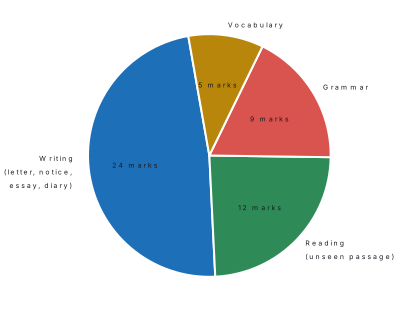
Roughly: three or four from a reading passage, three or four from grammar (tense, voice, question tags, prepositions, articles, conditionals, reported speech), and two or three from vocabulary — synonyms, antonyms, words in context. None of them can be prepared by learning the textbook answers by heart.
8.1 Vocabulary from the textbook units
Facts. The words below are the ones the units keep using: itinerary, hospitality, altitude, endangered, habitat, migration, invention, anecdote, vegan, conservation, inaugurate, vacancy, applicant, deadline, memoir, forecast, humidity, custom, ritual, poacher.
- An itinerary is [1]aa ticketba plan of a journeyca passportda guide
- An animal in danger of dying out completely is [1]aextinctbendangeredcdomesticdnocturnal
- The place where a plant or animal naturally lives is its [1]ahabitatbhabitchamletdharvest
- A person who hunts animals illegally is a [1]arangerbpoachercporterdpeasant
- The word closest in meaning to hospitality is [1]ahospital treatmentbfriendly welcome of guestschostilitydhesitation
- A short, interesting story about a real incident is an [1]aepicbanecdotecessaydeditorial
- The opposite of ancient is [1]aoldbantiquecmoderndhistoric
- To inaugurate an airport means to [1]aclose itbformally open itcrepair itdexpand it
- The seasonal movement of birds from one region to another is [1]amigrationbhibernationcemigrationdrotation
- A vacancy announcement invites [1]acomplaintsbapplications for a postctenders for goodsddonations
Answers
1. (b) — an itinerary is the plan of a journey, not the ticket for it.
2. (b) — extinct means already gone; endangered means still alive but at risk.
3. (a) — a habitat is the place where a species naturally lives.
4. (b) — a poacher hunts illegally; a ranger protects.
5. (b) — hospitality is the friendly welcome of guests; hostility is its near-opposite.
6. (b) — an anecdote is a short true story about a real incident.
7. (c) — ancient and modern are the opposites; old and antique are near-synonyms.
8. (b) — to inaugurate is to open formally.
9. (a) — hibernation is winter sleep; emigration is of people leaving a country.
10. (b) — a vacancy announcement invites applications for a post.
8.2 Tense
Facts. Simple present for habits and facts (she walks); present continuous for now (she is walking); present perfect for a finished action with present relevance (she has walked), used with just, already, yet, ever, never, since, for. Simple past with a finished past time (yesterday, last year, in 2019, ago). Past continuous for an action in progress when another interrupted it. Since takes a point of time, for a length of time.
- He ______ in Pokhara since 2019. [1]alivesbis livingchas liveddlived
- While I ______ my homework, the lights went out. [1]adobwas doingchave doneddid
- The sun ______ in the east. [1]arisebrisescis risingdrose
- She ______ her grandmother last Dashain. [1]avisitsbhas visitedcvisiteddis visiting
- I have known him ______ five years. [1]asincebforcfromdby
- Listen! Somebody ______ at the door. [1]aknocksbis knockingcknockeddhas knocked
- They ______ their project yet. [1]ahaven't finishedbdidn't finishcdon't finishdweren't finishing
- By the time we reached the station, the train ______. [1]aleftbhas leftchad leftdwas leaving
Answers
1. (c) — since + present perfect.
2. (b) — an action in progress, interrupted.
3. (b) — a general fact.
4. (c) — finished past time.
5. (b) — for + length of time.
6. (b) — happening at this moment.
7. (a) — yet with the present perfect.
8. (c) — the earlier of two past actions.
8.3 Voice
Facts. In the passive, the object becomes the subject and the verb becomes be + past participle: They built the bridge → The bridge was built (by them). Keep the tense. Intransitive verbs (sleep, arrive) have no passive.
- The passive of They are repairing the road is [1]aThe road is repairingbThe road is being repairedcThe road has repaireddThe road was repaired
- The passive of Someone has stolen my bag is [1]aMy bag has stolenbMy bag was stolencMy bag has been stolendMy bag is stolen
- The active of The letter was written by Sita is [1]aSita writes the letterbSita wrote the lettercSita has written the letterdSita was writing the letter
- The passive of We must obey the rules is [1]aThe rules must obeybThe rules must be obeyedcThe rules must been obeyeddThe rules are obeyed
- Which sentence cannot be made passive? [1]aShe sang a song.bHe arrived late.cThey cleaned the room.dI read the notice.
- The passive of People speak Nepali in Sikkim too is [1]aNepali speaks in Sikkim toobNepali is spoken in Sikkim toocNepali has spoken in Sikkim toodNepali was speaking in Sikkim too
- The passive of Did the teacher punish him? is [1]aWas he punished by the teacher?bIs he punished by the teacher?cHas he punished by the teacher?dWas he punish by the teacher?
- In a passive sentence, the doer of the action is introduced by [1]aofbwithcbydfrom
Answers
1. (b) — present continuous passive: is being repaired.
2. (c) — present perfect passive: has been stolen.
3. (b) — the past simple active of was written is wrote.
4. (b) — a modal passive keeps the modal: must be obeyed.
5. (b) — arrive is intransitive, so it has no object to become a subject.
6. (b) — present simple passive of a general fact.
7. (a) — a past simple question becomes Was … by …?
8. (c) — the doer takes by; with introduces the instrument.
8.4 Question tags, articles and prepositions
Facts. A positive statement takes a negative tag and the reverse: She is a nurse, isn't she? / He didn't come, did he? Let's → shall we; imperative → will you; I am → aren't I. Use a before a consonant sound, an before a vowel sound (an hour, a university), the for something already known or unique. Fixed pairs: afraid of, good at, interested in, depend on, listen to, arrive at (a place), congratulate on, married to.
- She has finished her work, ______? [1]ahas shebhasn't shecisn't sheddidn't she
- Let's go for a walk, ______? [1]awill webshall wecdon't wedcan we
- Open the window, ______? [1]ado youbwill youcshall wedaren't you
- He is ______ honest officer. [1]aabancthedno article
- Mount Everest is ______ highest peak in the world. [1]aabancthedno article
- She is good ______ Mathematics. [1]ainbatcondwith
- The success of the plan depends ______ your support. [1]ainbatcondof
- We arrived ______ the airport at six. [1]ainbatctodon
Answers
1. (b) — a positive statement takes a negative tag, and the auxiliary is repeated: hasn't she.
2. (b) — Let's always takes shall we.
3. (b) — an imperative takes will you.
4. (b) — honest begins with a vowel sound, so an.
5. (c) — a unique superlative takes the.
6. (b) — the fixed pair is good at.
7. (c) — the fixed pair is depend on.
8. (b) — arrive at a point, arrive in a country or city.
8.5 Reported speech and conditionals
Facts. In reported speech, move the tense back one step, change pronouns and time words (today → that day, tomorrow → the next day, here → there), and use said that / asked / told. For questions use asked if/whether or the question word, in statement order. Conditionals: type 1 If + present, will + verb; type 2 If + past, would + verb; type 0 If + present, present for general truths.
- He said, "I am tired." → He said that he ______ tired. [1]aisbwaschas beendwere
- She asked, "Where do you live?" → She asked where I ______. [1]aliveblivedcdo livedam living
- "Don't touch the wires," the teacher said. → The teacher ______ us not to touch the wires. [1]asaidbtoldcasked thatdsays
- If it rains tomorrow, we ______ the match. [1]apostponebwill postponecwould postponedpostponed
- If I ______ a bird, I would fly over the Himalaya. [1]aambwascweredwill be
- Water ______ if you heat it to 100 °C. [1]aboilsbwill boilcwould boildboiled
- He said, "I will come tomorrow." → He said that he would come ______. [1]atomorrowbthe next daycyesterdaydthat day
- "Have you finished?" she asked. → She asked ______ I had finished. [1]athatbwhatcifdwhich
Answers
1. (b) — the tense moves back one step: am becomes was.
2. (b) — a reported question takes statement order and the tense moves back.
3. (b) — told takes an object (told us); said does not.
4. (b) — type 1: if + present, will + verb.
5. (c) — type 2 uses were for every person.
6. (a) — a general truth keeps the present simple in both clauses.
7. (b) — tomorrow becomes the next day in reported speech.
8. (c) — a yes/no question is reported with if or whether.
8.6 Unseen passage 1
Khaptad National Park, in the far west of Nepal, is a plateau of rolling meadows at about 3,000 metres, broken by patches of fir and oak. Twenty-two patans, or grassland clearings, open out among the trees, and in the monsoon they fill with wild flowers. The park was gazetted in 1984, partly to protect the forest and partly because the plateau had been the home of Khaptad Baba, a hermit whose ashram still stands beside the Triveni, where three streams meet. Pilgrims walk up for the full-moon festival in late summer; the rest of the year the park is almost empty, and the only sounds are the wind and the Himalayan monal calling from the ridge.
- Khaptad National Park lies in [1]aeastern Nepalbcentral Nepalcthe far westdthe Tarai
- The word patans in the passage means [1]apondsbgrassland clearingscforest trailsdtemples
- The park was established in [1]a1974b1984c1994d2004
- Triveni is a place where [1]athree streams meetbthree paths crosscthree temples standdthree districts meet
- The passage suggests that the park is crowded [1]aall yearbin wintercaround the late-summer full moondnever
- The Himalayan monal in the passage is [1]aa flowerba birdca streamda ridge
Answers
1. (c) — in the far west of Nepal.
2. (b) — the passage defines it.
3. (b) — gazetted in 1984.
4. (a).
5. (c) — pilgrims walk up for the full-moon festival.
6. (b) — it calls from the ridge.
8.7 Unseen passage 2
In 2010 the governments of thirteen countries where tigers still live agreed on a single target: to double the number of wild tigers by 2022. Nepal was the first country to reach it. The national count rose from 121 animals in 2009 to 355 in 2022, and most of the increase came from the parks of the Tarai — Chitwan, Bardiya, Parsa, Banke and Shuklaphanta. Three things made the difference: soldiers and rangers patrolling the parks, community forests that joined the parks into corridors so that young tigers could move and find territory, and village programmes that paid for losses to livestock so that farmers reported a tiger instead of poisoning it. Success has brought its own problem. More tigers in a crowded landscape means more encounters, and the number of people killed has risen with the number of tigers. The next ten years will be judged less by the count than by whether the two populations can share the same corridor.
- The target agreed in 2010 was to double the tiger population by [1]a2018b2020c2022d2030
- Nepal's tiger count in 2022 was [1]a121b198c235d355
- According to the passage, community forests helped because they [1]asupplied firewoodblinked parks into corridorscprovided tourist incomedfenced the parks
- Farmers reported tigers rather than poisoning them mainly because [1]athey were afraid of the lawblosses to livestock were compensatedctigers were raredrangers asked them to
- The word encounters in the passage means [1]acountsbmeetingscescapesdcaptures
- The last sentence suggests that the writer is [1]acertain of failurebsatisfied that the problem is solvedccautious about coexistencedopposed to conservation
Answers
1. (c) — to double the number of wild tigers by 2022.
2. (d) — 355, up from 121 in 2009.
3. (b) — they joined the parks into corridors so young tigers could find territory.
4. (b) — village programmes paid for livestock losses, so reporting was worth more than poisoning.
5. (b) — an encounter here is a meeting between people and tigers.
6. (c) — the writer says success has brought its own problem and the next decade will be judged by coexistence.
8.8 Word formation and spelling
Facts. Noun from verb: inform → information, decide → decision, arrive → arrival, conserve → conservation. Adjective from noun: danger → dangerous, beauty → beautiful, nature → natural. Opposites with prefixes: un-, in-, im-, dis-, ir- (unhappy, incorrect, impossible, disagree, irregular). Commonly misspelled in examinations: necessary, government, occurred, environment, separate, received, immediately, beginning.
- The noun form of decide is [1]adecidingbdecisioncdecisiveddecided
- The adjective form of nature is [1]anaturallybnaturalisecnaturaldnature's
- The correct opposite of regular is [1]aunregularbinregularcirregularddisregular
- Which word is spelt correctly? [1]agovermentbgovernmentcgovermantdgovenment
- The noun form of conserve is [1]aconservativebconservationcconservingdconserved
- Which word is spelt correctly? [1]aenviornmentbenvironmentcenviromentdenvirenment
- The opposite of possible is [1]aunpossiblebdispossiblecimpossibledirpossible
- The adjective form of danger is [1]adangerlybdangerouscendangerddangered
Answers
1. (b) — decide → decision; decisive is the adjective.
2. (c) — nature → natural; naturally is the adverb.
3. (c) — regular takes the prefix ir-.
4. (b) — government keeps the n of govern.
5. (b) — conserve → conservation.
6. (b) — environment keeps iron inside it, which is the easiest way to remember the spelling.
7. (c) — possible takes im- before p.
8. (b) — danger → dangerous.
Grammar items are decided by the signal word: since, for, yet, already, ago, while, if, by the time. Before you answer, find that word and underline it. The grammar you need is the grammar that word demands.