Unit 1 · Units · 22 min read
Sequence and Series
What the syllabus asks for 7
- Arithmetic sequence and the nth term
- Arithmetic mean
- Sum of an arithmetic series
- Geometric sequence and the nth term
- Geometric mean
- Sum of a geometric series
- Exercises of the SEE type
A bank adds the same interest to a deposit every month. A bacterium divides into two, then four, then eight. A staircase has steps that rise by equal amounts. All three situations produce a list of numbers that follows a pattern. A list that follows a rule is a sequence; when its terms are added, we get a series. This chapter studies the two most important patterns, the arithmetic pattern (add the same number each time) and the geometric pattern (multiply by the same number each time). You will learn to find any term, to insert means between two numbers, and to add up many terms without writing them all out.
Expect a 3- or 4-mark question on this chapter almost every year. The common types are: (i) find a term or the number of terms of an AP or GP; (ii) find a term from two given terms; (iii) insert arithmetic or geometric means; (iv) three numbers in AP or GP with a given sum and product; (v) the sum of n terms; (vi) a real-life problem on savings, salary or growth. Write the formula first, then substitute. Marks are given for the formula, the substitution and the answer.
1.1 Arithmetic sequence and the nth term
A sequence is a list of numbers written in a definite order, each number being called a term. We write the terms t_1, t_2, t_3, \ldots, t_n, \ldots (the symbol t_n is read "the nth term").
A sequence in which the difference between any term and the term before it is always the same is called an arithmetic sequence or arithmetic progression (AP). This constant difference is the common difference d.
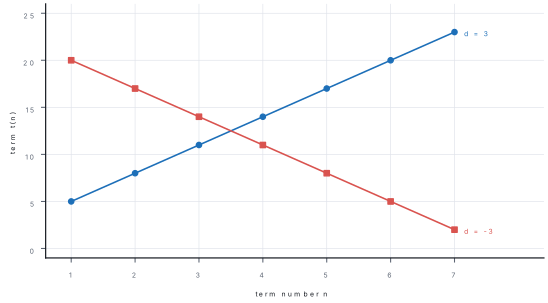
For example, 5, 8, 11, 14, \ldots is an AP with first term a=5 and d=8-5=3. The sequence 20, 17, 14, 11, \ldots is an AP with d=-3 (decreasing). A sequence such as 1, 4, 9, 16, \ldots is not an AP because the differences 3, 5, 7 are not equal.
The general term
Let the first term be a and the common difference d. Then
The coefficient of d is always one less than the term number. So the nth term is a+(n-1)d.
where a is the first term, d the common difference and n the number of the term. If l is the last term of an AP with n terms, then l=a+(n-1)d, so the number of terms is n=\frac{l-a}{d}+1.
Problem. For the AP 5, 8, 11, \ldots find (i) the 20th term, (ii) which term is 101.
Solution. Here a=5 and d=8-5=3.
(i) t_{20}=a+19d=5+19\times 3=5+57=62.
(ii) Let t_n=101. Then 5+(n-1)\times 3=101, so (n-1)\times 3=96, n-1=32 and n=33. So 101 is the 33rd term.
Problem. In an AP the 4th term is 14 and the 9th term is 29. Find the AP and its 15th term.
Solution. t_4=a+3d=14 …… (i) and t_9=a+8d=29 …… (ii).
Subtract (i) from (ii): 5d=15, so d=3. From (i), a=14-9=5. The AP is 5, 8, 11, 14, \ldots and
Problem. Is 150 a term of the AP 7, 12, 17, \ldots ? Find the number of terms in the AP 3, 7, 11, \ldots, 95.
Solution. For 7, 12, 17, \ldots: a=7, d=5. If t_n=150 then 7+5(n-1)=150, so n-1=\frac{143}{5}=28.6. Since n must be a whole number, 150 is not a term.
For 3, 7, 11, \ldots, 95: a=3, d=4, l=95.
Three numbers in AP
When three numbers are in AP and their sum is given, take them as a-d,\ a,\ a+d. The middle one is a, and the d's cancel when we add.
Problem. Three numbers are in AP. Their sum is 21 and their product is 315. Find them.
Solution. Let the numbers be a-d,\ a,\ a+d.
Sum: (a-d)+a+(a+d)=3a=21, so a=7.
Product: (a-d)\,a\,(a+d)=a(a^2-d^2)=315. Putting a=7: 7(49-d^2)=315, so 49-d^2=45 and d^2=4, d=\pm 2.
For d=2 the numbers are 5, 7, 9; for d=-2 they are 9, 7, 5. The three numbers are 5, 7, 9.
- Using t_n=a+nd. The correct rule is a+(n-1)d: the first term has no d added.
- Taking d=t_1-t_2. Always subtract the earlier term from the later: d=t_2-t_1.
- For three numbers in AP, taking them as a, a+d, a+2d when the sum is given. It works but makes the algebra longer; use a-d, a, a+d.
Real-life use
Problem. A clerk in Pokhara starts on a monthly salary of Rs 20,000, and her salary rises by Rs 1,500 each year. What will her monthly salary be in the 8th year?
Solution. The yearly salaries form an AP with a=20{,}000 and d=1{,}500.
1.2 Arithmetic mean
If three numbers a, A, b are in AP, the middle number A is the arithmetic mean of a and b. In an AP, A-a=b-A, so 2A=a+b.
The AM of two numbers is exactly halfway between them.
Inserting several arithmetic means
To insert n arithmetic means between a and b means to put n numbers between them so that all n+2 numbers form an AP. The sequence is
It has n+2 terms, with first term a and last term b. The last term is the (n+2)th, so b=a+(n+1)d.
Then A_1=a+d,\ A_2=a+2d,\ \ldots,\ A_n=a+nd.
Problem. Insert four arithmetic means between 3 and 18.
Solution. Here a=3, b=18, n=4.
The means are 3+3,\ 3+6,\ 3+9,\ 3+12, that is 6, 9, 12, 15. The full AP is 3, 6, 9, 12, 15, 18.
Problem. Five arithmetic means are inserted between 7 and 25. Find their sum.
Solution. d=\frac{25-7}{6}=3. The means are 10, 13, 16, 19, 22 and their sum is 80.
Shortcut: the sum of n arithmetic means between a and b is n\times\frac{a+b}{2}. Here 5\times\frac{7+25}{2}=5\times 16=80. ✓
Problem. Insert three arithmetic means between -2 and 10.
Solution. d=\frac{10-(-2)}{4}=\frac{12}{4}=3. The means are -2+3,\ -2+6,\ -2+9, that is 1, 4, 7.
Problem. The arithmetic mean of two numbers is 13 and one of them is 7. Find the other number. Then insert two arithmetic means between the two numbers.
Solution. \frac{7+b}{2}=13, so 7+b=26 and b=19. Now insert two means between 7 and 19: d=\frac{19-7}{3}=4, so the means are 11 and 15.
1.3 Sum of an arithmetic series
Adding the terms of a sequence gives a series. The sum of the first n terms of an AP is called an arithmetic series and is written S_n.
We start from the AP with first term a, common difference d and n terms. We are heading for a formula for S_n.
Setting up. The last term is l=a+(n-1)d.
Step 1 — write the sum forwards.
Step 2 — write the same sum backwards.
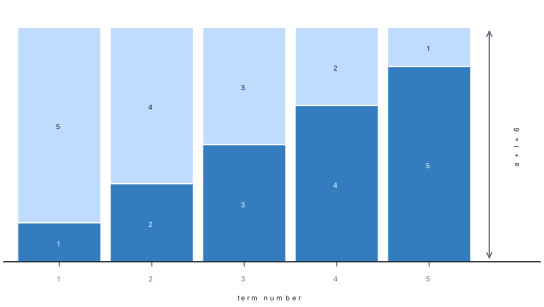
Step 3 — add the two lines, pair by pair. Each pair adds up to a+l, and there are n pairs:
Step 4 — divide by 2.
Step 5 — put l=a+(n-1)d.
What it means. The sum is the number of terms times the average of the first and last term. It works for any AP, including decreasing ones.
(1) writing the series forwards and backwards, (2) adding to get n(a+l), (3) dividing by 2, (4) substituting l=a+(n-1)d to reach the second form.
Use the first form when you know a and d; use the second when you know the last term l. Also t_n=S_n-S_{n-1}.
Three special sums
Take a=1 and d=1 (natural numbers), a=2,\ d=2 (even numbers) and a=1,\ d=2 (odd numbers) in S_n=\frac{n}{2}[2a+(n-1)d]:
| Series | Sum of first n terms | Check with n=10 |
|---|---|---|
| 1+2+3+\cdots+n | \frac{n(n+1)}{2} | 55 |
| 2+4+6+\cdots+2n | n(n+1) | 110 |
| 1+3+5+\cdots+(2n-1) | n^2 | 100 |
Problem. Find the sum of the first 20 terms of 3+7+11+\cdots.
Solution. a=3, d=4, n=20.
Problem. Find the sum of 5+8+11+\cdots+80.
Solution. a=5, d=3, l=80. First find n:
Problem. Find the sum of all multiples of 3 between 1 and 100.
Solution. The multiples are 3, 6, 9, \ldots, 99. Here a=3, d=3, l=99, so n=\frac{99-3}{3}+1=33.
Two answers for the number of terms
Problem. How many terms of the AP 24, 21, 18, \ldots must be taken so that the sum is 78? Explain the double answer.
Solution. a=24, d=-3, S_n=78.
Divide by 3: n^2-17n+52=0, so (n-4)(n-13)=0 and n=4 or n=13.
Both are correct. The terms are 24, 21, 18, 15, 12, 9, 6, 3, 0, -3, -6, -9, -12. The first 4 terms add up to 24+21+18+15=78. The terms t_5 to t_{13} add up to 12+9+6+3+0-3-6-9-12=0, so 13 terms also give 78.
Problem. The sum of the first n terms of a series is S_n=3n^2+2n. Find the first term, the common difference and the nth term.
Solution. t_1=S_1=3+2=5. S_2=3(4)+4=16, so t_2=S_2-S_1=16-5=11. Then d=11-5=6.
For the nth term: t_n=S_n-S_{n-1}=3n^2+2n-\left[3(n-1)^2+2(n-1)\right]=3n^2+2n-3n^2+6n-3-2n+2=6n-1.
Check: t_1=6-1=5 ✓, t_2=12-1=11 ✓.
Problem. Ram saves Rs 100 in the first month and increases his saving by Rs 50 every month. How much does he save in the 12th month, and how much in the whole year?
Solution. a=100, d=50, n=12.
t_{12}=a+11d=100+550=\text{Rs } 650.
S_{12}=\frac{12}{2}\left[2\times 100+11\times 50\right]=6\times 750=\text{Rs } 4{,}500.
1.4 Geometric sequence and the nth term
A sequence in which each term is obtained by multiplying the previous term by the same non-zero number is called a geometric sequence or geometric progression (GP). The constant multiplier is the common ratio r=\frac{t_2}{t_1}=\frac{t_3}{t_2}=\cdots.
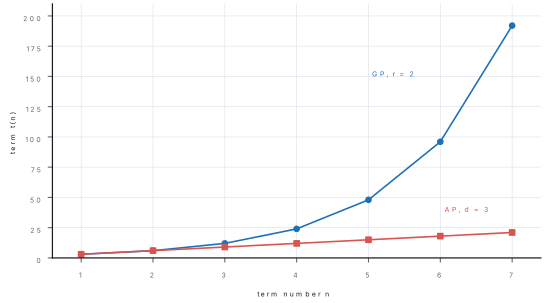
For example 3, 6, 12, 24, \ldots has a=3 and r=2. The sequence 27, 9, 3, 1, \ldots has r=\frac{1}{3}. The sequence 2, -6, 18, -54, \ldots has r=-3; its terms alternate in sign.
The general term
With first term a and common ratio r:
The power of r is one less than the term number.
where a is the first term, r the common ratio. If the last term of an n-term GP is l, then l=ar^{n-1}.
Problem. For the GP 3, 6, 12, \ldots find the 8th term and the position of 768.
Solution. a=3, r=2.
t_8=ar^7=3\times 2^7=3\times 128=384.
If t_n=768: 3\times 2^{n-1}=768, so 2^{n-1}=256=2^8. Hence n-1=8 and n=9.
Problem. The 4th term of a GP is 24 and the 7th term is 192. Find the GP and its 10th term.
Solution. ar^3=24 …… (i) and ar^6=192 …… (ii).
Divide (ii) by (i): r^3=\frac{192}{24}=8, so r=2. From (i): a\times 8=24, so a=3.
The GP is 3, 6, 12, 24, \ldots and t_{10}=3\times 2^9=3\times 512=1536.
Problem. How many terms are there in the GP 2, 6, 18, \ldots, 1458?
Solution. a=2, r=3, l=1458. From l=ar^{n-1}: 3^{n-1}=\frac{1458}{2}=729=3^6. So n-1=6 and n=7.
Three numbers in GP
When three numbers are in GP and their product is given, take them as \frac{a}{r},\ a,\ ar. The r's cancel when we multiply.
Problem. Three numbers are in GP. Their sum is 21 and their product is 216. Find the numbers.
Solution. Let the numbers be \frac{a}{r},\ a,\ ar.
Product: \frac{a}{r}\times a\times ar=a^3=216, so a=6.
Sum: \frac{6}{r}+6+6r=21. Multiply by r: 6+6r+6r^2=21r, so 6r^2-15r+6=0, that is 2r^2-5r+2=0.
(2r-1)(r-2)=0, so r=2 or r=\frac{1}{2}. For r=2 the numbers are 3, 6, 12; for r=\frac{1}{2} they are 12, 6, 3. The numbers are 3, 6, 12.
- Writing t_n=(ar)^{n-1} or ar^n. The correct form is ar^{n-1}; r is raised to n-1 and only r.
- Taking r=t_1\div t_2. The ratio is the later term divided by the earlier one.
- Forgetting the negative ratio. In 2, -6, 18, \ldots the ratio is -3, not 3.
Problem. A culture has 500 bacteria, and the number doubles every hour. How many bacteria are there after 6 hours?
Solution. The counts 500, 1000, 2000, \ldots form a GP with a=500, r=2. After 6 hours we need the 7th term (the 1st term is the count at hour 0):
1.5 Geometric mean
If three positive numbers a, G, b are in GP, then G is the geometric mean of a and b. In a GP, \frac{G}{a}=\frac{b}{G}, so G^2=ab.
The AM, GM and the numbers are related by A\geq G, and A^2-G^2=\left(\frac{a-b}{2}\right)^2.
Inserting several geometric means
To insert n geometric means between a and b, make a, G_1, G_2, \ldots, G_n, b a GP. It has n+2 terms, and the last term is the (n+2)th, so b=ar^{n+1}.
Then G_1=ar,\ G_2=ar^2,\ \ldots,\ G_n=ar^n. The product of the n means is G^n where G=\sqrt{ab}.
Problem. Insert three geometric means between 2 and 32.
Solution. a=2, b=32, n=3. r^4=\frac{32}{2}=16, so r=2.
The means are 2\times 2,\ 2\times 4,\ 2\times 8, that is 4, 8, 16. The GP is 2, 4, 8, 16, 32. Check the product of the means: 4\times 8\times 16=512=8^3, and \sqrt{2\times 32}=8. ✓
Problem. Insert four geometric means between 3 and 729.
Solution. r^5=\frac{729}{3}=243=3^5, so r=3. The means are 9, 27, 81, 243.
Problem. Find the AM and GM of 4 and 16, and the difference between them.
Solution. A=\frac{4+16}{2}=10 and G=\sqrt{4\times 16}=\sqrt{64}=8. The difference is A-G=2, and A>G, as always for two unequal positive numbers.
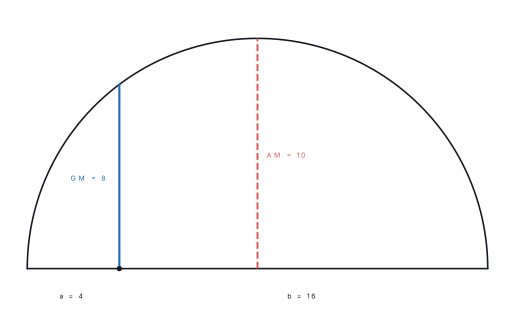
Problem. The AM and GM of two positive numbers are 5 and 4. Find the numbers.
Solution. \frac{a+b}{2}=5 gives a+b=10; \sqrt{ab}=4 gives ab=16. The numbers are the roots of x^2-10x+16=0, i.e. (x-2)(x-8)=0. They are 2 and 8.
1.6 Sum of a geometric series
We start from the GP with first term a, common ratio r and n terms. We are heading for a formula for S_n.
Step 1 — write the sum.
Step 2 — multiply both sides by r. Every term moves one place to the right:
Step 3 — subtract (ii) from (i). All the middle terms cancel:
Step 4 — factorise both sides.
Step 5 — divide by 1-r (needs r\neq 1):
What it means. Multiplying by -1 top and bottom gives the equivalent form S_n=\frac{a(r^n-1)}{r-1}. Use this form when r>1 so that both numerator and denominator are positive. If r=1 all terms equal a and S_n=na.
(1) writing S_n and rS_n, (2) subtracting to cancel the middle terms, (3) factorising to get S_n(1-r)=a(1-r^n), (4) the final formula.
When the last term l is known, S_n=\frac{lr-a}{r-1}.
Problem. Find the sum of the first 6 terms of 2+6+18+\cdots.
Solution. a=2, r=3, n=6.
Problem. Find the sum of the first 8 terms of 1+\frac{1}{2}+\frac{1}{4}+\cdots.
Solution. a=1, r=\frac{1}{2}, n=8.
Problem. How many terms of 3+6+12+\cdots add up to 381?
Solution. a=3, r=2.
So n=7.
Problem. In a GP with positive common ratio, the sum of the first two terms is 12 and the sum of the first four terms is 60. Find the first term, the common ratio and the sum of the first six terms.
Solution. S_2=a(1+r)=12. Also S_4=a(1+r)(1+r^2)=S_2(1+r^2), so 60=12(1+r^2), giving 1+r^2=5, r^2=4 and r=2 (positive).
Then a(1+2)=12, so a=4. The GP is 4, 8, 16, 32, \ldots and
Problem. A girl saves Re 1 on day 1, Rs 2 on day 2, Rs 4 on day 3 and so on, doubling every day. How much has she saved in all after 15 days?
Solution. a=1, r=2, n=15.
Problem. One student tells a rumour to 3 friends. Each of them tells 3 new friends, and so on. Counting the first student, how many people know the rumour after 4 such rounds?
Solution. The number of people who hear in each round is 1, 3, 9, 27, 81, a GP with a=1, r=3 and 5 terms.
1.7 Exercises of the SEE type
These problems mix both patterns, the way the SEE does.
Problem. Three numbers in AP have sum 15. If 1, 4 and 19 are added to them respectively, the new numbers are in GP. Find the numbers.
Solution. Let the numbers be a-d,\ a,\ a+d. Their sum is 3a=15, so a=5.
The new numbers are (5-d)+1=6-d, then 5+4=9, then (5+d)+19=24+d. For a GP the middle term squared equals the product of the others:
(d-3)(d+21)=0, so d=3 or d=-21.
For d=3 the numbers are 2, 5, 8 (new GP: 3, 9, 27). For d=-21 they are 26, 5, -16 (new GP: 27, 9, 3). Both satisfy the conditions.
Problem. A ball is dropped from a height of 64 m. Each time it bounces back to half the previous height. How high does it rise after the 6th bounce, and what total distance has it travelled up to the moment of hitting the ground for the 4th time?
Solution. The rebound heights 32, 16, 8, 4, 2, 1, \ldots form a GP with a=32, r=\frac{1}{2}. After the 6th bounce: t_6=32\left(\frac{1}{2}\right)^5=1 m.
By the 4th landing the ball has fallen 64 m, then risen and fallen 32, 16 and 8 m on the first three rebounds. Total =64+2(32+16+8)=64+112=176 m.
Problem. An auditorium has 20 seats in the first row, and each next row has 2 more seats than the one before. There are 15 rows. Find the number of seats in the last row and in the whole hall.
Solution. AP with a=20, d=2, n=15.
l=t_{15}=20+14\times 2=48 seats.
S_{15}=\frac{15}{2}(20+48)=\frac{15}{2}\times 68=510 seats.
Problem. Rs 10,000 is invested at 10% compound interest per year. The amount after 1 year, 2 years, 3 years, … forms a GP. Find the first three terms and the amount after 5 years.
Solution. Each year the amount is multiplied by 1.1. The amounts are 11000,\ 12100,\ 13310,\ \ldots with a=11000 and r=1.1.
After 5 years: t_5=11000\times 1.1^4=11000\times 1.4641=\text{Rs } 16{,}105.10. (Equivalent to 10000\times 1.1^5.)
Chapter summary
- AP: t_n=a+(n-1)d with d=t_2-t_1; three numbers in AP: a-d,\ a,\ a+d.
- AM: A=\frac{a+b}{2}; to insert n means, d=\frac{b-a}{n+1}.
- Sum of an AP: S_n=\frac{n}{2}[2a+(n-1)d]=\frac{n}{2}(a+l); t_n=S_n-S_{n-1}. Sums of the first n natural, even and odd numbers: \frac{n(n+1)}{2}, n(n+1), n^2.
- GP: t_n=ar^{n-1} with r=\frac{t_2}{t_1}; three numbers in GP: \frac{a}{r},\ a,\ ar.
- GM: G=\sqrt{ab}; to insert n means, r=\left(\frac{b}{a}\right)^{\frac{1}{n+1}}; A\geq G.
- Sum of a GP: S_n=\frac{a(r^n-1)}{r-1} for r>1 and \frac{a(1-r^n)}{1-r} for r<1; S_n=na for r=1.
- Inserting n means gives n+2 terms in all, with b as the (n+2)th term.
Practice questions
Group A — Multiple choice (1 mark each)
- The 10th term of the AP 2, 5, 8, \ldots is [1]a27b29c32d30
- The arithmetic mean between 7 and 19 is [1]a12b26c13d14
- The geometric mean between 4 and 25 is [1]a10b14.5c12d100
- The sum of the first 20 natural numbers is [1]a200b210c400d420
- The 5th term of the GP 2, 6, 18, \ldots is [1]a54b108c162d486
- The common ratio of the GP 27, 9, 3, \ldots is [1]a3b\frac{1}{3}c-3d-\frac{1}{3}
- The sum of the first 10 odd numbers is [1]a55b90c100d110
Answers to Group A
1. (b) — t_{10}=2+9\times 3=29.
2. (c) — \frac{7+19}{2}=13.
3. (a) — \sqrt{4\times 25}=\sqrt{100}=10.
4. (b) — \frac{20\times 21}{2}=210.
5. (c) — 2\times 3^4=162.
6. (b) — \frac{9}{27}=\frac{1}{3}.
7. (c) — the sum of the first n odd numbers is n^2=100.
Group B — Short answer (2 marks each)
- Find the 25th term of the AP 4, 9, 14, \ldots [2]
- Insert three arithmetic means between 5 and 21. [2]
- Find the sum of 4+8+12+\cdots+40. [2]
- Find the 6th term of the GP 3, 6, 12, \ldots [2]
- Insert one geometric mean between 5 and 20. [2]
Answers to Group B
1. a=4, d=5: t_{25}=4+24\times 5=124.
2. d=\frac{21-5}{4}=4. The means are 9, 13, 17.
3. a=4, d=4, l=40, so n=10. S_{10}=\frac{10}{2}(4+40)=220.
4. t_6=3\times 2^5=96.
5. G=\sqrt{5\times 20}=\sqrt{100}=10.
Group C — Short answer (3 marks each)
- In an AP the 3rd term is 12 and the 8th term is 37. Find the first term, the common difference and the 20th term. [3]
- How many terms of the AP 5, 9, 13, \ldots must be added to make 275? [3]
- In a GP the 2nd term is 6 and the 5th term is 48. Find the GP and its 8th term. [3]
- Find the sum of the first 7 terms of 1+3+9+\cdots [3]
- The AM and GM of two positive numbers are 17 and 15. Find the numbers. [3]
Answers to Group C
1. a+2d=12 and a+7d=37. Subtract: 5d=25, d=5, a=2. t_{20}=2+19\times 5=97.
2. a=5, d=4. \frac{n}{2}[10+4(n-1)]=275, so n(2n+3)=275, i.e. 2n^2+3n-275=0. (n-11)(2n+25)=0, so n=11 (the negative root is rejected).
3. ar=6, ar^4=48, so r^3=8, r=2, a=3. The GP is 3, 6, 12, \ldots and t_8=3\times 2^7=384.
4. a=1, r=3: S_7=\frac{3^7-1}{3-1}=\frac{2186}{2}=1093.
5. a+b=34, ab=225. The numbers are the roots of x^2-34x+225=0, i.e. (x-9)(x-25)=0. They are 9 and 25.
Group D — Long answer (4 marks each)
- Three numbers in AP have sum 27 and product 693. Find the numbers. [4]
- The sum of the first n terms of an AP is 2n^2+3n. Find the first term, the common difference and the 10th term. [4]
- Three numbers in GP have sum 39 and product 729. Find them. [4]
- A worker earns Rs 12,000 in the first month and her monthly pay rises by Rs 500 each month. Find her pay in the 12th month and her total earnings in 12 months. [4]
- Insert four geometric means between 3 and 96 and find the sum of all six terms of the GP. [4]
Answers to Group D
1. Let the numbers be a-d,\ a,\ a+d. Sum =3a=27, so a=9. Product: 9(81-d^2)=693, so 81-d^2=77, d^2=4, d=\pm 2. The numbers are 7, 9, 11.
2. t_1=S_1=2+3=5. S_2=8+6=14, so t_2=9 and d=4. t_n=S_n-S_{n-1}=4n+1, so t_{10}=41.
3. Let the numbers be \frac{a}{r},\ a,\ ar. Product =a^3=729, so a=9. Sum: \frac{9}{r}+9+9r=39, so 9r^2-30r+9=0, i.e. 3r^2-10r+3=0, (3r-1)(r-3)=0. The numbers are 3, 9, 27.
4. a=12000, d=500. t_{12}=12000+11\times 500=\text{Rs } 17{,}500. S_{12}=\frac{12}{2}[24000+11\times 500]=6\times 29500=\text{Rs } 1{,}77{,}000.
5. r^5=\frac{96}{3}=32, so r=2. The means are 6, 12, 24, 48. The GP is 3, 6, 12, 24, 48, 96 with sum \frac{3(2^6-1)}{2-1}=189.
Practise more: Optional Mathematics question bank