Unit 9 · Units · 21 min read
Linear Programming and Transformation
What the syllabus asks for 6
- Linear inequalities in two variables and systems of inequalities
- Linear programming: objective function, constraints and corner points
- Composition of transformations
- Inversion transformation and the inversion circle
- Transformation using matrices
- Exercises of the SEE type
This chapter has two halves. The first uses straight-line graphs to make decisions: how many bags, tables or kilograms of feed should a business choose so that profit is largest or cost is smallest, when time, money and materials are limited? That is linear programming. The second half studies transformations of the plane — reflection, rotation, translation, enlargement — and shows how to combine them, how to turn points inside a circle into points outside it (inversion), and how a 2\times2 matrix can carry out a whole transformation in one step.
Expect (i) the graph of a system of inequalities and the shaded solution region; (ii) a word problem in linear programming, with the constraints, the feasible region, the corner points and the optimum value (4–6 marks); (iii) the image of a point or triangle under a combined transformation; (iv) the inverse point P' of P with respect to a circle; (v) the image of a point or a figure under a given matrix, or the matrix that maps given points to given images.
9.1 Linear inequalities in two variables and systems of inequalities
An inequality such as ax+by+c\geq 0 (or >, \leq, <) is a linear inequality in two variables. Its graph is a region of the plane bounded by the straight line ax+by+c=0, called the boundary line.
- Draw the boundary line (replace the inequality sign by =). Use a solid line for \geq or \leq (the line belongs to the region) and a dashed line for > or <.
- Choose a test point not on the line — the origin (0,0) if the line does not pass through it.
- Substitute the test point. If the inequality is true, shade the side of the line that contains the point; if false, shade the other side.
Problem. Draw the graph of x\geq 3.
Solution. The boundary line x=3 is vertical, through (3,0). It is solid because of "\geq". Test (0,0): 0\geq 3 is false, so shade the side that does not contain the origin: the region to the right of the line, including the line.
A system of inequalities is a set of two or more inequalities. Its solution is the region where all the shaded regions overlap.
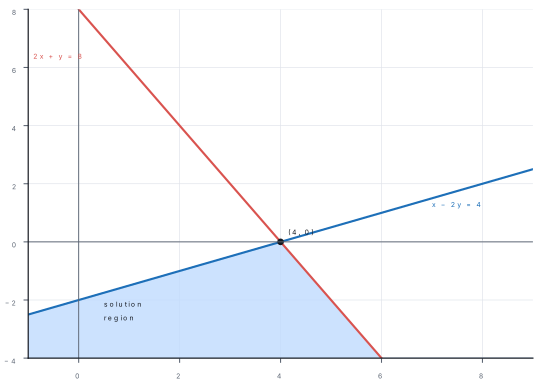
Problem. Draw the graph of x-2y\geq 4 and 2x+y\leq 8.
Solution. First line: x-2y=4 passes through (4,0) and (0,-2). Test (0,0): 0\geq 4 is false, so shade the side not containing the origin (below the line).
Second line: 2x+y=8 passes through (4,0) and (0,8). Test (0,0): 0\leq 8 is true, so shade the side containing the origin.
The two boundary lines meet at (4,0). The solution is the overlap of the two regions, an unbounded wedge to the left and below (4,0).
Problem. Write the inequalities that describe the triangle with vertices (0,0), (4,0) and (0,3) (including its boundary).
Solution. The triangle lies on or above the x-axis: y\geq 0; on or right of the y-axis: x\geq 0. The third side joins (4,0) and (0,3): its equation is \dfrac x4+\dfrac y3=1, i.e. 3x+4y=12. The origin is on the region's side, and 0\leq 12 is true. So the region is
Never shade by guesswork. Always test a point. A common slip is shading "above the line" automatically for \geq: that works only when the coefficient of y is positive and you have rearranged to y\geq \dots.
9.2 Linear programming: objective function, constraints and corner points
Linear programming is a mathematical method for finding the maximum or minimum value of a linear expression (the objective function) when the variables must satisfy a system of linear inequalities (the constraints).
| Term | Meaning |
|---|---|
| Decision variables x,y | the quantities we choose (number of items, kg of feed, …) |
| Objective function z=px+qy | the profit to maximise or cost to minimise |
| Constraints | inequalities from limited resources, e.g. 2x+y\leq 12 |
| Non-negativity | x\geq 0,\ y\geq 0 (we cannot make a negative number of items) |
| Feasible region | the overlap of all the constraint regions |
| Corner (vertex) points | the points where boundary lines of the feasible region meet |
| Optimal solution | the feasible point giving the best value of z |
If a linear programming problem has an optimal solution, it occurs at a corner point of the feasible region. So: (1) find all the corner points, (2) calculate z at each, (3) the largest value is the maximum and the smallest value is the minimum.
Why does the optimum sit at a corner? The lines z=px+qy=\text{constant} are parallel. As z grows, the line slides across the plane; the last point of the feasible region that it touches before leaving is a vertex of the region (or a whole edge, which also contains two vertices).
Steps for a word problem
- Name the variables x and y.
- Write the objective function and the constraints (including x\geq 0, y\geq 0).
- Draw the feasible region (boundary lines, test points, shade the overlap).
- Read or solve for the corner points.
- Evaluate z at each corner; choose the maximum or minimum. Answer in words with units.
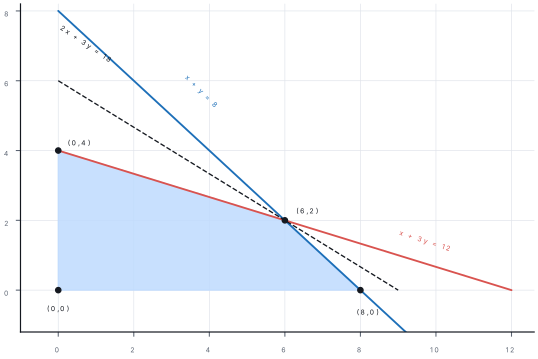
Problem. Maximise and minimise z=2x+3y subject to x+y\leq 8, x+3y\leq 12, x\geq 0, y\geq 0.
Solution. Boundary lines. x+y=8 meets the axes at (8,0) and (0,8). x+3y=12 meets them at (12,0) and (0,4). The two lines intersect where x+y=8 and x+3y=12: subtracting gives 2y=4, so y=2 and x=6: the point (6,2).
Feasible region. The origin satisfies both inequalities, so the region is on the origin's side of each line. Its corner points are (0,0), (8,0), (6,2) and (0,4).
| Corner | z=2x+3y |
|---|---|
| (0,0) | 0 |
| (8,0) | 16 |
| (6,2) | 12+6=18 |
| (0,4) | 12 |
Maximum z=18 at (6,2); minimum z=0 at (0,0).
Problem. A workshop in Bhaktapur makes two kinds of bags, A and B. Each bag A needs 2 hours on machine P and 1 hour on machine Q. Each bag B needs 1 hour on P and 2 hours on Q. Machine P is available for at most 12 hours a day and Q for at most 12 hours. Profit is Rs 30 on a bag A and Rs 40 on a bag B. How many of each should be made per day for maximum profit?
Solution. Let x = number of bags A and y = number of bags B.
Maximise z=30x+40y subject to
Corner points. 2x+y=12 meets the axes at (6,0) and (0,12). x+2y=12 meets them at (12,0) and (0,6). They intersect where 2x+y=12 and x+2y=12: adding gives 3x+3y=24, so x+y=8; subtracting gives x-y=0, so x=y=4. The feasible region has corners (0,0), (6,0), (4,4) and (0,6).
| Corner | z=30x+40y (Rs) |
|---|---|
| (0,0) | 0 |
| (6,0) | 180 |
| (4,4) | 120+160=280 |
| (0,6) | 240 |
The maximum profit is Rs 280 per day, by making 4 bags of A and 4 bags of B.
Problem. A farmer needs at least 8 units of nitrogen and at least 9 units of phosphorus for a field. Fertiliser A (Rs 4 per kg) gives 1 unit of nitrogen and 3 units of phosphorus per kg. Fertiliser B (Rs 3 per kg) gives 2 units of nitrogen and 1 unit of phosphorus per kg. How many kg of each should be bought to meet the need at least cost?
Solution. Let x kg of A and y kg of B. Minimise z=4x+3y subject to
Corner points. The region is above both lines (the origin fails both \geq tests) and is unbounded. x+2y=8 meets the axes at (8,0) and (0,4); 3x+y=9 meets them at (3,0) and (0,9). They intersect: x=8-2y, so 3(8-2y)+y=9\Rightarrow24-5y=9\Rightarrow y=3, x=2: the point (2,3). The corner points are (0,9), (2,3) and (8,0).
| Corner | z=4x+3y (Rs) |
|---|---|
| (0,9) | 27 |
| (2,3) | 8+9=17 |
| (8,0) | 32 |
The least cost is Rs 17, by buying 2 kg of A and 3 kg of B.
(1) x and y defined in words. (2) The objective function and all constraints, including x,y\geq 0. (3) A neat graph with the feasible region shaded and corner points labelled. (4) A table of z at every corner. (5) A final sentence answering the question in context, with units.
9.3 Composition of transformations
You know four basic transformations of the plane. Their effect on a point P(x,y):
| Transformation | Image of P(x,y) |
|---|---|
| Translation by vector (a,b) | (x+a,\ y+b) |
| Reflection in the x-axis | (x,\,-y) |
| Reflection in the y-axis | (-x,\,y) |
| Reflection in the line y=x | (y,\,x) |
| Reflection in the line y=-x | (-y,\,-x) |
| Rotation about O through 90^\circ anticlockwise | (-y,\,x) |
| Rotation about O through 180^\circ | (-x,\,-y) |
| Rotation about O through 270^\circ anticlockwise (90^\circ clockwise) | (y,\,-x) |
| Enlargement, centre O, scale factor k | (kx,\ ky) |
When one transformation T_1 is followed by a second transformation T_2, the result is a combined (composite) transformation, written T_2\circ T_1: do T_1 first, then T_2 on the image. The composite is itself a single transformation.
Problem. A(2,1) is translated by (0,2) to A', then A' is translated by (-2,0) to A''. Find A', A'' and the single translation that maps A to A''.
Solution. A'=(2+0,\ 1+2)=(2,3). A''=(2-2,\ 3+0)=(0,3).
The single translation: (0,3)-(2,1)=(-2,2), which is the sum (0,2)+(-2,0) of the two translation vectors.
Problem. Find the image of P(3,2) under a reflection in the x-axis followed by a rotation of 90^\circ anticlockwise about the origin.
Solution. Reflection in the x-axis: (x,y)\to(x,-y), so P\to P'(3,-2).
Rotation by 90^\circ anticlockwise: (x,y)\to(-y,x), so P'(3,-2)\to P''(2,3).
The image is P''(2,3).
Reverse the order of the two transformations and the answer usually changes. Rotating P(3,2) by 90^\circ first gives (-2,3); reflecting that in the x-axis gives (-2,-3) — not (2,3). Always apply the transformations in the order the question states.
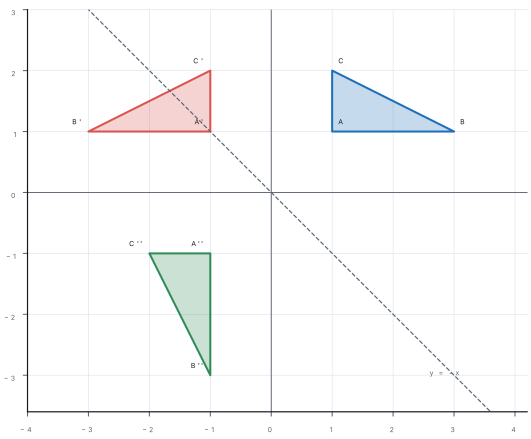
Problem. The triangle ABC has A(1,1), B(3,1), C(1,2). Find its image under a reflection in the y-axis followed by a rotation of 90^\circ anticlockwise about the origin. Name the single transformation that does the same.
Solution. Reflection in the y-axis, (x,y)\to(-x,y): A'(-1,1), B'(-3,1), C'(-1,2).
Rotation (x,y)\to(-y,x): A''(-1,-1), B''(-1,-3), C''(-2,-1).
Combined effect: (x,y)\to(-x,y)\to(-y,-x). The map (x,y)\to(-y,-x) is the reflection in the line y=-x.
Problem. Find the image of P(2,3) under an enlargement with centre O and scale factor 2, followed by a translation by (1,-2).
Solution. Enlargement: (2,3)\to(4,6). Translation: (4,6)\to(4+1,\ 6-2)=(5,4).
Problem. Show that a reflection in the x-axis followed by a reflection in the y-axis is a rotation through 180^\circ about the origin.
Solution. For any point (x,y): reflection in the x-axis gives (x,-y); then reflection in the y-axis gives (-x,-y). The map (x,y)\to(-x,-y) is the rotation through 180^\circ about the origin.
9.4 Inversion transformation and the inversion circle
Let O be the centre and r the radius of a circle. For a point P\ne O, the inverse point P' is the point on the ray OP such that
The circle is the circle of inversion, O the centre of inversion and r the radius of inversion. If r=1, then OP\times OP'=1, i.e. OP'=\dfrac{1}{OP}.
Properties
- Every point of the plane except the centre has exactly one inverse point.
- O, P and P' are collinear, with P and P' on the same side of O.
- A point on the circle is its own inverse (r\times r=r^2).
- If P is inside the circle, P' is outside, and vice versa. The nearer P is to O, the farther P' is.
- The inverse of P' is P: the two points can be interchanged.
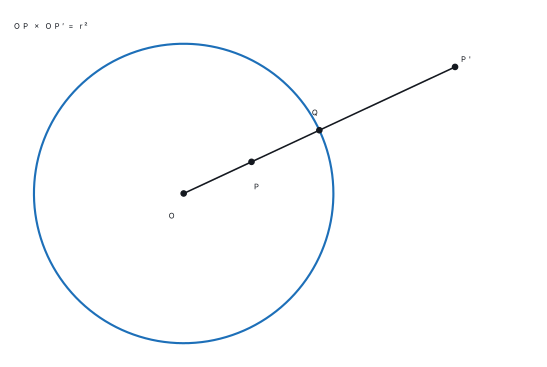
Setting up. The inversion circle is x^2+y^2=r^2. Let P(x,y) and its inverse P'(x',y').
Step 1 — same direction. P and P' are on the same ray from O, so x' and y' are in the same ratio to x and y:
Step 2 — use the definition. OP\times OP'=r^2, so OP'=\dfrac{r^2}{OP} and
Result.
What it means. Multiply each coordinate by the same factor \dfrac{r^2}{OP^2}. If the centre of inversion is C(h,k), apply the same formula to the shifted coordinates: x'=h+\dfrac{r^2(x-h)}{(x-h)^2+(y-k)^2} and y'=k+\dfrac{r^2(y-k)}{(x-h)^2+(y-k)^2}.
Problem. Find the inverse of P(1,2) with respect to the circle x^2+y^2=25.
Solution. x^2+y^2=1+4=5 and r^2=25, so the factor is \dfrac{25}{5}=5.
Check: OP=\sqrt{5}, OP'=\sqrt{25+100}=\sqrt{125}=5\sqrt{5}, and OP\times OP'=\sqrt{5}\times5\sqrt{5}=25=r^2. ✓
Problem. Find the inverse of P(6,8) in the circle x^2+y^2=25.
Solution. x^2+y^2=36+64=100. Factor =\dfrac{25}{100}=\dfrac14.
Check: OP=10, OP'=\sqrt{2.25+4}=2.5, and 10\times2.5=25. ✓ (P is outside, P' is inside.)
Problem. (a) Find the inverse of (3,4) in x^2+y^2=25. (b) Find the inverse of P(2,1) in the circle with centre C(1,1) and radius 2.
Solution. (a) x^2+y^2=25=r^2, factor 1: P'=(3,4). A point on the circle is its own inverse.
(b) Shift coordinates: P is at (2-1,\,1-1)=(1,0) from C; OP^2=1 and r^2=4, so the factor is 4. The shifted inverse is (4,0), i.e. P'=(1+4,\ 1+0)=(5,1). Check: CP=1, CP'=4, product 4=r^2. ✓
Problem. P and P' are inverse points with respect to a circle with centre at the origin, OP=4 and OP'=9. Find the radius of inversion.
Solution. r^2=OP\times OP'=4\times9=36, so r=6.
9.5 Transformation using matrices
Translation as a 2\times1 matrix
Write the point P(x,y) as a 2\times1 column matrix with entries x above y (in running text we write it as the pair (x,y)). A translation by (a,b) adds the translation matrix: (x,y)+(a,b)=(x+a,\ y+b).
A 2\times2 matrix as a transformation
A matrix M with two rows and two columns transforms a point by pre-multiplying its column. The row-by-column rule gives

Step 1. Multiply M by the column (1,0): the result is (a,c), the first column of M.
Step 2. Multiply M by the column (0,1): the result is (b,d), the second column of M.
Result. The columns of M are the images of (1,0) and (0,1).
What it means. To find the matrix of a transformation, find where it sends (1,0) and (0,1) and write those images as columns. Example: rotation by 90^\circ sends (1,0)\to(0,1) and (0,1)\to(-1,0), so M has first column (0,1) and second column (-1,0); its rows are [0,\,-1] and [1,\,0].
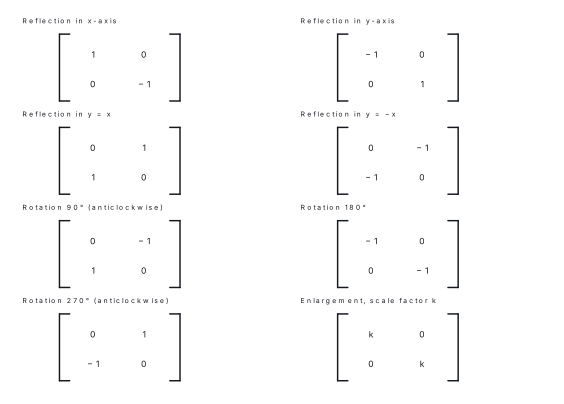
Problem. Find the image of P(3,2) under the matrix with rows [2,\,0] and [1,\,1].
Solution. Row 1: 2\times3+0\times2=6. Row 2: 1\times3+1\times2=5. The image is P'(6,5).
Problem. The triangle PQR has P(1,1), Q(4,1), R(1,3). Find its image under the matrix with rows [0,\,1] and [1,\,0] and name the transformation.
Solution. The matrix sends (x,y)\to(0\cdot x+1\cdot y,\ 1\cdot x+0\cdot y)=(y,x).
P'(1,1), Q'(1,4), R'(3,1). The transformation is a reflection in the line y=x.
Problem. A matrix M maps A(1,2) to A'(-2,1) and B(3,1) to B'(-1,3). Find M and describe the transformation.
Solution. Let M have rows [a,\,b] and [c,\,d].
From A\to A': a+2b=-2 and c+2d=1. From B\to B': 3a+b=-1 and 3c+d=3.
Solving the first pair: b=-1-3a, so a+2(-1-3a)=-2\Rightarrow-5a=0, a=0, b=-1. Solving the second pair: d=3-3c, so c+2(3-3c)=1\Rightarrow-5c=-5, c=1, d=0.
M has rows [0,\,-1] and [1,\,0]: the transformation (x,y)\to(-y,x) is a rotation through 90^\circ anticlockwise about the origin.
Problem. Find the single matrix for a rotation through 90^\circ followed by a reflection in the x-axis.
Solution. Rotation R has rows [0,\,-1],[1,\,0]; reflection X has rows [1,\,0],[0,\,-1]. Doing R first means the combined matrix is XR (the later transformation is written on the left):

The result maps (x,y)\to(-y,-x), a reflection in the line y=-x. Check with P(3,2): rotation gives (-2,3), then the x-axis reflection gives (-2,-3), and (-y,-x)=(-2,-3). ✓
For composition: the intermediate point written out, in the stated order. For inversion: the factor \dfrac{r^2}{x^2+y^2} shown, and OP\times OP'=r^2 as a check. For matrices: the row-by-column working, and the name of the transformation (reflection, rotation, enlargement) with its axis, angle or centre.
9.6 Exercises of the SEE type
Method for any question
- Inequalities: boundary line, test point, shade, overlap.
- Linear programming: variables, objective, constraints, region, corners, table of z, answer in words.
- Composition: apply the transformations one at a time, in order, writing each image.
- Inversion: \text{factor}=\dfrac{r^2}{x^2+y^2}; multiply both coordinates by it.
- Matrices: image =M\times column; columns of M are the images of (1,0) and (0,1).
Chapter summary
- Graph of ax+by+c\geq 0: boundary line (solid for \geq ,\leq; dashed for >,<) and the side confirmed by a test point; a system's solution is the overlap.
- Linear programming: maximise or minimise z=px+qy under linear constraints with x,y\geq 0; the optimum occurs at a corner point of the feasible region.
- Method: variables, objective function, constraints, feasible region, corners, evaluate z, choose.
- Basic images: reflection in x-axis (x,-y); in y-axis (-x,y); in y=x (y,x); in y=-x (-y,-x); rotation 90^\circ (-y,x); 180^\circ (-x,-y); enlargement (kx,ky); translation (x+a,y+b).
- T_2\circ T_1 means T_1 first, then T_2; order matters.
- Inversion: OP\times OP'=r^2; x'=\dfrac{r^2x}{x^2+y^2}, y'=\dfrac{r^2y}{x^2+y^2}; a point on the circle is its own inverse.
- A 2\times2 matrix transforms (x,y) by row-by-column multiplication; its columns are the images of (1,0) and (0,1).
- The matrix of T_1 followed by T_2 is the product M_2M_1.
Practice questions
Group A — Multiple choice (1 mark each)
- The boundary line of the inequality 2x+3y\leq 12 is drawn [1]adashedbsolidcnot drawndas a curve
- The image of (4,-3) under reflection in the x-axis is [1]a(-4,-3)b(4,3)c(-4,3)d(-3,4)
- If OP=2 and the radius of inversion is 6, then OP' is [1]a3b12c18d36
- The rotation through 90^\circ anticlockwise about the origin maps (x,y) to [1]a(y,-x)b(-y,x)c(-x,-y)d(y,x)
- In linear programming the optimum value of the objective function occurs at [1]athe origin onlyba corner point of the feasible regioncthe centre of the regiondany interior point
Answers to Group A
1. (b) — "\leq" includes the line.
2. (b) — (x,-y)=(4,3).
3. (c) — OP'=\frac{r^2}{OP}=\frac{36}{2}=18.
4. (b) — (x,y)\to(-y,x).
5. (b) — the corner point rule.
Group B — Short answer (2 marks each)
- Test whether (1,2) lies in the region x+y\leq 4. Is the boundary line solid or dashed for x+y<4? [2]
- Find the image of (3,-1) under a translation by (-2,5). [2]
- Find the inverse of (3,0) with respect to the circle x^2+y^2=36. [2]
- Find the image of (2,5) under the matrix with rows [1,\,0] and [0,\,-1]. [2]
Answers to Group B
1. 1+2=3\leq 4 is true, so (1,2) is in the region. For x+y<4 the line is dashed.
2. (3-2,\ -1+5)=(1,4).
3. x^2+y^2=9; factor \frac{36}{9}=4; P'=(12,0). Check 3\times12=36. ✓
4. Row 1: 2; row 2: -5. Image (2,-5) (reflection in the x-axis).
Group C — Short answer (3 marks each)
- Find the image of P(4,1) under a rotation of 90^\circ anticlockwise about the origin followed by a translation by (2,3). [3]
- Find the inverse of P(8,6) with respect to the circle x^2+y^2=100 and verify OP\times OP'=r^2. [3]
- Find the corner points of the region x+y\leq 6, x\leq 4, x\geq 0, y\geq 0, and the maximum of z=3x+2y. [3]
- A matrix maps (1,0) to (3,0) and (0,1) to (0,3). Write the matrix and name the transformation. [3]
Answers to Group C
1. Rotation: (4,1)\to(-1,4). Translation: (-1+2,\ 4+3)=(3,7).
2. x^2+y^2=64+36=100; factor \frac{100}{100}=1, so P'=(8,6). The point is on the circle, so it is its own inverse; OP=OP'=10 and 10\times10=100. ✓
3. Corners: (0,0), (4,0), (4,2) (where x=4 meets x+y=6), (0,6). z: 0, 12, 12+4=16, 12. Maximum z=16 at (4,2).
4. Columns are the images: rows [3,\,0] and [0,\,3]. It is an enlargement with centre the origin and scale factor 3.
Group D — Long answer (4 marks each)
- A tailor makes two kinds of shirts. Type A needs 1 hour of cutting and 3 hours of stitching; type B needs 2 hours of cutting and 1 hour of stitching. At most 10 hours of cutting and 15 hours of stitching are available. Profit is Rs 20 on A and Rs 30 on B. Find the number of each for maximum profit. [4]
- The triangle ABC has A(1,1), B(4,1), C(1,3). Find the image under a reflection in the line y=x followed by a reflection in the x-axis, and name the single equivalent transformation. [4]
- A matrix maps A(2,1) to A'(-1,2) and B(1,3) to B'(-3,1). Find the matrix and name the transformation. [4]
- Find the inverse points of P(2,4) and Q(-3,-6) with respect to the circle x^2+y^2=40. Show that O, P' and Q' are collinear. [4]
Answers to Group D
1. Let x of A and y of B. Maximise z=20x+30y subject to x+2y\leq 10, 3x+y\leq 15, x,y\geq 0. Corners: (0,0); (5,0) (from 3x\leq 15); (0,5) (from 2y\leq 10); intersection of x+2y=10 and 3x+y=15: x=10-2y, 30-6y+y=15, y=3, x=4: (4,3). z: 0; 100; 150; 80+90=170. Maximum profit Rs 170 with 4 shirts of A and 3 of B.
2. Reflection in y=x: (x,y)\to(y,x): A'(1,1), B'(1,4), C'(3,1). Reflection in the x-axis: (x,y)\to(x,-y): A''(1,-1), B''(1,-4), C''(3,-1). Combined: (x,y)\to(y,x)\to(y,-x), which is the rotation through 270^\circ anticlockwise (90^\circ clockwise) about the origin.
3. Rows [a,b], [c,d]. 2a+b=-1 and a+3b=-3: b=-1-2a, a+3(-1-2a)=-3\Rightarrow-5a=0, a=0, b=-1. 2c+d=2 and c+3d=1: d=2-2c, c+6-6c=1\Rightarrow c=1, d=0. Matrix rows [0,-1], [1,0]: rotation through 90^\circ anticlockwise about the origin.
4. P: x^2+y^2=20, factor \frac{40}{20}=2, P'=(4,8). Q: 9+36=45, factor \frac{40}{45}=\frac89, Q'=\left(-\frac{8}{3},-\frac{16}{3}\right). Both P' and Q' have y=2x (8=2\times4 and -\frac{16}{3}=2\times-\frac83), so they lie on the line y=2x through O: collinear with O.
Practise more: Optional Mathematics question bank