Unit 3 · Units · 15 min read
Matrices and Determinants
What the syllabus asks for 5
- Determinant of a matrix
- Inverse of a matrix
- Solving linear equations by the matrix method
- Cramer's rule
- Exercises of the SEE type
A shopkeeper who sells pens, copies and bags in two shops keeps the prices in a table of rows and columns. Such a rectangular table of numbers is a matrix. Matrices let us handle many numbers as one object, and they give us a clean way to solve simultaneous equations. In this chapter we attach a single number, the determinant, to every square matrix; use it to decide whether the matrix has an inverse; find that inverse for a 2\times2 matrix; and then solve pairs of linear equations in two ways: by the matrix method (X=A^{-1}B) and by Cramer's rule.
Expect: (i) find the determinant of a 2\times2 matrix and find the unknown that makes it zero (singular); (ii) find the inverse of a 2\times2 matrix and verify AA^{-1}=I; (iii) solve two equations by the matrix method; (iv) solve two equations by Cramer's rule; (v) a word problem (prices, ages, numbers) that you must first turn into two equations. Show every step: the determinant, the inverse, the product.
3.1 Determinant of a matrix
A quick review
A matrix of m rows and n columns has order m\times n. A matrix with equal numbers of rows and columns is a square matrix. In this chapter we write a 2\times2 matrix by listing its rows, for example A=[(3,5),(2,4)] means row 1 is 3,\ 5 and row 2 is 2,\ 4. The identity matrix of order 2 is I=[(1,0),(0,1)]; multiplying by I leaves any 2\times2 matrix unchanged.
To multiply two matrices, take row of the first times column of the second: multiply matching entries and add. The product AB exists when the number of columns of A equals the number of rows of B.

Remember that AB\neq BA in general.
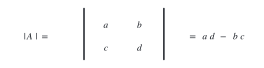
The determinant of a square matrix is a single number attached to it. For A=[(a,b),(c,d)] it is written |A| or \det A and defined by
(the product of the leading diagonal minus the product of the other diagonal). A matrix whose determinant is zero is called singular; otherwise it is non-singular.
Problem. Find the determinant of (i) A=[(3,5),(2,4)], (ii) B=[(2,-1),(4,-2)]. Which is singular?
Solution. (i) |A|=3\times4-5\times2=12-10=2.
(ii) |B|=2\times(-2)-(-1)\times4=-4+4=0. So B is singular; A is non-singular.
Problem. Find x if the matrix [(x,2),(3,x+1)] is singular.
Solution. Its determinant is x(x+1)-2\times3=x^2+x-6. For a singular matrix this is 0:
- |AB|=|A|\,|B| (the determinant of a product is the product of the determinants).
- |kA|=k^2|A| for a 2\times2 matrix: multiplying every entry by k multiplies the determinant by k^2.
- |I|=1.
Problem. Let A=[(1,2),(3,4)] and B=[(0,1),(2,3)]. Verify that |AB|=|A||B| and find |3A|.
Solution. |A|=4-6=-2 and |B|=0-2=-2, so |A||B|=4.
From the figure above, AB=[(4,7),(8,15)] and |AB|=4\times15-7\times8=60-56=4. ✓
3A=[(3,6),(9,12)], so |3A|=36-54=-18=3^2\times(-2). ✓
Problem. If A=[(1,2),(3,4)], show that A^2-5A-2I=O, where O is the zero matrix.
Solution. A^2=A\times A: entry (1,1)=1+6=7, (1,2)=2+8=10, (2,1)=3+12=15, (2,2)=6+16=22. So A^2=[(7,10),(15,22)].
5A=[(5,10),(15,20)] and 2I=[(2,0),(0,2)].
A^2-5A=[(2,0),(0,2)], so A^2-5A-2I=[(0,0),(0,0)]=O. ✓
- Computing |A|=ad+bc or ac-bd. The rule is ad-bc: leading diagonal first.
- Writing |kA|=k|A|. For a 2\times2 matrix it is k^2|A|.
- Multiplying matrices entry by entry. It is row times column.
- Saying "the matrix is zero" when the determinant is zero. The matrix is merely singular.
Problem. Let A=[(2,1),(3,4)] and B=[(1,0),(2,5)]. Find A+B, 3A, AB and BA. Is AB=BA?
Solution. Add or scale entry by entry: A+B=[(3,1),(5,9)] and 3A=[(6,3),(9,12)].
AB: entry (1,1)=2(1)+1(2)=4; (1,2)=2(0)+1(5)=5; (2,1)=3(1)+4(2)=11; (2,2)=3(0)+4(5)=20. So AB=[(4,5),(11,20)].
BA: entry (1,1)=1(2)+0(3)=2; (1,2)=1(1)+0(4)=1; (2,1)=2(2)+5(3)=19; (2,2)=2(1)+5(4)=22. So BA=[(2,1),(19,22)].
Clearly AB\neq BA: matrix multiplication is not commutative.
Problem. (i) Find x and y if [(x+y,\,2),(3,\,x-y)]=[(5,\,2),(3,\,1)]. (ii) Find x if the determinant of [(x,2),(3,4)] is 10.
Solution. (i) Equal matrices have equal entries: x+y=5 and x-y=1. Adding: 2x=6, x=3, and y=2.
(ii) 4x-2\times3=10\Rightarrow4x=16\Rightarrow x=4.
3.2 Inverse of a matrix
For numbers, a\times\frac{1}{a}=1. For matrices, if a square matrix A has a matrix B with AB=BA=I, then B is the inverse of A and is written A^{-1}.
We start from A=[(a,b),(c,d)] and are heading for a formula for A^{-1}.
Step 1 — build a helper matrix. Swap the leading-diagonal entries and change the signs of the other two: B=[(d,-b),(-c,a)].
Step 2 — multiply A by B. - Entry (1,1): ad+b(-c)=ad-bc. - Entry (1,2): a(-b)+ba=0. - Entry (2,1): cd+d(-c)=0. - Entry (2,2): c(-b)+da=ad-bc.
So AB=[(ad-bc,\,0),(0,\,ad-bc)]=(ad-bc)\,I=|A|\,I.
Step 3 — divide by |A| (this needs |A|\neq0): A\left(\frac{1}{|A|}B\right)=I. The matrix in brackets is the inverse.
Result.
What it means. The inverse exists only if ad-bc\neq0, that is, only if A is non-singular. A singular matrix has no inverse.

(1) the determinant |A| found first, (2) the statement |A|\neq0, (3) the swap-and-negate matrix, (4) the factor \frac{1}{|A|} in front, (5) a check by multiplying AA^{-1}=I.
Problem. Find the inverse of A=[(4,3),(3,2)] and verify that AA^{-1}=I.
Solution. |A|=4\times2-3\times3=8-9=-1\neq0, so A^{-1} exists.
Verification: entry (1,1)=4(-2)+3(3)=1, (1,2)=4(3)+3(-4)=0, (2,1)=3(-2)+2(3)=0, (2,2)=3(3)+2(-4)=1.

Problem. Find the inverse of P=[(2,5),(1,3)]. For what value of k is Q=[(k,3),(2,6)] without an inverse?
Solution. |P|=6-5=1, so P^{-1}=\frac{1}{1}[(3,-5),(-1,2)]=[(3,-5),(-1,2)].
Q has no inverse when |Q|=0: 6k-6=0, so k=1.
- AA^{-1}=A^{-1}A=I.
- |A^{-1}|=\frac{1}{|A|}.
- (AB)^{-1}=B^{-1}A^{-1} (the order reverses).
Problem. For A=[(2,1),(1,1)] and B=[(1,2),(1,3)] verify that (AB)^{-1}=B^{-1}A^{-1}.
Solution. |A|=1, A^{-1}=[(1,-1),(-1,2)]. |B|=1, B^{-1}=[(3,-2),(-1,1)].
AB=[(2+1,\,4+3),(1+1,\,2+3)]=[(3,7),(2,5)], |AB|=15-14=1, so (AB)^{-1}=[(5,-7),(-2,3)].
B^{-1}A^{-1}=[(3,-2),(-1,1)]\times[(1,-1),(-1,2)]: entry (1,1)=3+2=5, (1,2)=-3-4=-7, (2,1)=-1-1=-2, (2,2)=1+2=3. So B^{-1}A^{-1}=[(5,-7),(-2,3)]=(AB)^{-1}. ✓
Problem. If A=[(2,1),(5,3)] and B=[(1,2),(3,4)], find the matrix X such that AX=B.
Solution. Multiply both sides on the left by A^{-1}: X=A^{-1}B. |A|=6-5=1, so A^{-1}=[(3,-1),(-5,2)].
X=[(3,-1),(-5,2)]\times[(1,2),(3,4)]: entry (1,1)=3-3=0, (1,2)=6-4=2, (2,1)=-5+6=1, (2,2)=-10+8=-2. So X=[(0,2),(1,-2)].
Check: AX: (1,1)=0+1=1, (1,2)=4-2=2, (2,1)=0+3=3, (2,2)=10-6=4. ✓
3.3 Solving linear equations by the matrix method
A pair of linear equations
can be written as one matrix equation AX=B, with A=[(a_1,b_1),(a_2,b_2)] (the coefficient matrix), X the column of unknowns x,\ y and B the column of constants c_1,\ c_2.
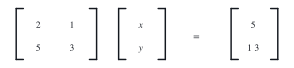
If |A|\neq0, multiply both sides by A^{-1} on the left. Since A^{-1}A=I and IX=X:
Steps: (1) write the equations in the form a_1x+b_1y=c_1; (2) form A and B; (3) find |A| and A^{-1}; (4) multiply A^{-1}B; (5) read x and y; (6) check in the original equations.
Problem. Solve 2x+y=5, 5x+3y=13 by the matrix method.
Solution. A=[(2,1),(5,3)] and B has entries 5,\ 13. |A|=6-5=1, so A^{-1}=[(3,-1),(-5,2)].
So x=2, y=1. Check: 2(2)+1=5 ✓ and 5(2)+3(1)=13 ✓.
Problem. Solve 3x+2y=8, 4x+3y=11 by the matrix method.
Solution. |A|=9-8=1 and A^{-1}=[(3,-2),(-4,3)].
x=3(8)-2(11)=24-22=2 and y=-4(8)+3(11)=-32+33=1. So (x,y)=(2,1).
Problem. Three pens and two copies cost Rs 70. Two pens and five copies cost Rs 65. Find the price of a pen and of a copy by the matrix method.
Solution. Let a pen cost Rs x and a copy Rs y: 3x+2y=70, 2x+5y=65.
A=[(3,2),(2,5)], |A|=15-4=11, A^{-1}=\frac{1}{11}[(5,-2),(-2,3)].
A pen costs Rs 20 and a copy costs Rs 5. Check: 3(20)+2(5)=70 ✓; 2(20)+5(5)=65 ✓.
When the matrix method fails
If |A|=0, A^{-1} does not exist and the method cannot be used. Then the two lines are parallel or the same line.
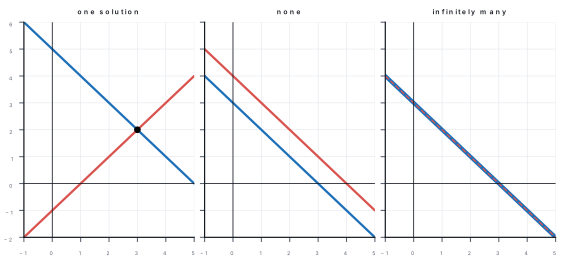
Equations with no solution and with many solutions
Problem. Examine x+2y=3, 2x+4y=7 and also x+2y=3, 2x+4y=6.
Solution. In both cases |A|=1\times4-2\times2=0, so there is no inverse.
First system: doubling the first equation gives 2x+4y=6, which contradicts 2x+4y=7. No solution.
Second system: 2x+4y=6 is just the first equation doubled. The equations are the same line: infinitely many solutions, for example (1,1) and (3,0).
Matrix method with a negative solution
Problem. Solve 2x+3y=3 and 3x+5y=4 by the matrix method.
Solution. A=[(2,3),(3,5)], |A|=10-9=1, A^{-1}=[(5,-3),(-3,2)]. The constants are 3 and 4.
Check: 2(3)+3(-1)=3 ✓; 3(3)+5(-1)=4 ✓. A solution may be negative; do not worry.
Problem. If A=[(2,3),(1,2)], show that A^2-4A+I=O and use it to find A^{-1}.
Solution. A^2: (1,1)=4+3=7, (1,2)=6+6=12, (2,1)=2+2=4, (2,2)=3+4=7. So A^2=[(7,12),(4,7)]. 4A=[(8,12),(4,8)].
A^2-4A+I=[(7-8+1,\ 12-12+0),(4-4+0,\ 7-8+1)]=O. ✓
Multiply A^2-4A+I=O by A^{-1}: A-4I+A^{-1}=O, so A^{-1}=4I-A=[(4-2,\,-3),(-1,\,4-2)]=[(2,-3),(-1,2)].
Check with the formula: |A|=4-3=1, A^{-1}=[(2,-3),(-1,2)]. ✓
3.4 Cramer's rule
Cramer's rule solves the same equations directly with determinants, without finding an inverse.
We start from a_1x+b_1y=c_1 and a_2x+b_2y=c_2 and are heading for x and y in terms of determinants.
Step 1 — eliminate y. Multiply the first equation by b_2 and the second by b_1:
Step 2 — subtract.
Step 3 — divide, if a_1b_2-a_2b_1\neq0:
Step 4 — eliminate x the same way (multiply by a_2 and a_1, subtract):
Result. Each numerator and denominator is a 2\times2 determinant: the denominator is D=|(a_1,b_1),(a_2,b_2)|; the numerator of x is D_x=|(c_1,b_1),(c_2,b_2)| (the x-column replaced by the constants); the numerator of y is D_y=|(a_1,c_1),(a_2,c_2)|.
For a_1x+b_1y=c_1 and a_2x+b_2y=c_2:
- D\neq0: unique solution.
- D=0 and D_x\neq0 or D_y\neq0: no solution.
- D=D_x=D_y=0: infinitely many solutions.

Problem. Solve 3x+4y=10, 2x-y=3 by Cramer's rule.
Solution. D=3(-1)-2(4)=-3-8=-11.
D_x=10(-1)-3(4)=-10-12=-22. D_y=3(3)-2(10)=9-20=-11.
Check: 3(2)+4(1)=10 ✓; 2(2)-1=3 ✓.
Problem. Solve 2(x-1)=y and 3(x-1)=4y by Cramer's rule.
Solution. Write in the form ax+by=c: 2x-y=2 and 3x-4y=3.
D=2(-4)-3(-1)=-8+3=-5. D_x=2(-4)-3(-1)=-5. D_y=2(3)-3(2)=0.
x=\frac{-5}{-5}=1, y=\frac{0}{-5}=0. The solution is (1,0).
Problem. Solve \frac{x}{2}+\frac{y}{3}=3 and \frac{x}{4}-\frac{y}{3}=0.
Solution. Clear fractions: multiply the first by 6 and the second by 12: 3x+2y=18 and 3x-4y=0.
D=3(-4)-3(2)=-18. D_x=18(-4)-0(2)=-72. D_y=3(0)-3(18)=-54.
x=\frac{-72}{-18}=4, y=\frac{-54}{-18}=3. Check: \frac{4}{2}+\frac{3}{3}=2+1=3 ✓; \frac{4}{4}-\frac{3}{3}=0 ✓.
When is there no unique solution?
Problem. For what value of k do 3x+ky=5 and 6x+4y=7 have no unique solution? Do they then have no solution or many?
Solution. D=3(4)-6k=12-6k. No unique solution when D=0, so k=2.
For k=2: the first equation is 3x+2y=5; doubling it gives 6x+4y=10\neq7. The equations contradict each other, so there is no solution.
- Replacing the wrong column: D_x replaces the x-column (first), D_y the second column.
- Not writing the equations as ax+by=c first, so the constants land on the wrong side.
- Forgetting to check D\neq0 before dividing.
- In the matrix method, multiplying BA^{-1} instead of A^{-1}B. The inverse goes on the left.
Problem. Use Cramer's rule to examine (i) 2x+3y=5,\ 4x+6y=10 and (ii) 2x+3y=5,\ 4x+6y=11.
Solution. In both, D=2(6)-4(3)=0.
(i) D_x=5(6)-10(3)=0 and D_y=2(10)-4(5)=0. All three vanish: the second equation is twice the first, so there are infinitely many solutions.
(ii) D_x=5(6)-11(3)=-3\neq0. With D=0 and D_x\neq0 there is no solution.
| Method | Best when | Needs |
|---|---|---|
| Elimination or substitution | numbers are small and easy | nothing special |
| Matrix method X=A^{-1}B | the question says "by the matrix method" | A^{-1} must exist (|A|\neq0) |
| Cramer's rule | the question says "by Cramer's rule" or you want each unknown separately | D\neq0 |
Follow the method named in the question: the marks are for the method.
3.5 Exercises of the SEE type
Problem. Two kg of rice and three kg of lentils cost Rs 650. Three kg of rice and one kg of lentils cost Rs 450. Find the price per kg of each by Cramer's rule.
Solution. Let rice be Rs x/kg and lentils Rs y/kg: 2x+3y=650 and 3x+y=450.
D=2(1)-3(3)=-7. D_x=650(1)-450(3)=650-1350=-700. D_y=2(450)-3(650)=900-1950=-1050.
x=\frac{-700}{-7}=100, y=\frac{-1050}{-7}=150. Rice is Rs 100/kg and lentils Rs 150/kg.
Problem. The sum of two numbers is 12 and their difference is 4. Find the numbers by the matrix method.
Solution. x+y=12, x-y=4. A=[(1,1),(1,-1)], |A|=-1-1=-2, A^{-1}=\frac{1}{-2}[(-1,-1),(-1,1)]=[(\frac{1}{2},\frac{1}{2}),(\frac{1}{2},-\frac{1}{2})].
x=\frac{1}{2}(12)+\frac{1}{2}(4)=8, y=\frac{1}{2}(12)-\frac{1}{2}(4)=4. The numbers are 8 and 4.
Problem. The sum of the ages of a mother and her daughter is 50 years, and the mother is 4 times as old as her daughter. Find their ages by Cramer's rule.
Solution. Let the mother be x years and the daughter y years: x+y=50 and x-4y=0.
D=1(-4)-1(1)=-5. D_x=50(-4)-0(1)=-200. D_y=1(0)-1(50)=-50.
x=\frac{-200}{-5}=40, y=\frac{-50}{-5}=10. The mother is 40 and the daughter 10.
Problem. Three adult tickets and two child tickets cost Rs 1,100. Two adult tickets and three child tickets cost Rs 900. Find the price of each ticket by Cramer's rule.
Solution. Let an adult ticket be Rs a and a child ticket Rs c: 3a+2c=1100 and 2a+3c=900.
D=3(3)-2(2)=5. D_a=1100(3)-900(2)=3300-1800=1500. D_c=3(900)-2(1100)=2700-2200=500.
a=\frac{1500}{5}=300 and c=\frac{500}{5}=100. An adult ticket costs Rs 300 and a child ticket Rs 100.
Problem. The sum of two numbers is 18, and twice the first plus three times the second is 44. Find the numbers by the matrix method.
Solution. x+y=18 and 2x+3y=44. A=[(1,1),(2,3)], |A|=3-2=1, A^{-1}=[(3,-1),(-2,1)].
x=3(18)-1(44)=54-44=10 and y=-2(18)+1(44)=-36+44=8. The numbers are 10 and 8. Check: 10+8=18 ✓; 20+24=44 ✓.
Problem. For which value of k does [(k+1,\,3),(2,\,k)] have no inverse? Then find the inverse of the matrix when k=3.
Solution. The determinant is k(k+1)-6=k^2+k-6=(k+3)(k-2). There is no inverse when k=-3 or k=2.
For k=3 the matrix is [(4,3),(2,3)] with determinant 12-6=6, so the inverse is \frac{1}{6}[(3,-3),(-2,4)].
Chapter summary
- Determinant: |A|=ad-bc for A=[(a,b),(c,d)]. A is singular if |A|=0. |AB|=|A||B|, |kA|=k^2|A|.
- Inverse: A^{-1}=\frac{1}{ad-bc}[(d,-b),(-c,a)], exists only if |A|\neq0. AA^{-1}=A^{-1}A=I; (AB)^{-1}=B^{-1}A^{-1}; |A^{-1}|=\frac{1}{|A|}.
- Matrix method: AX=B\Rightarrow X=A^{-1}B (inverse on the left); needs |A|\neq0.
- Cramer's rule: x=\frac{D_x}{D}, y=\frac{D_y}{D} with D=a_1b_2-a_2b_1, D_x=c_1b_2-c_2b_1, D_y=a_1c_2-a_2c_1.
- D\neq0: one solution; D=0 with D_x\neq0: none; D=D_x=D_y=0: infinitely many.
- Write the equations as ax+by=c before forming any matrix or determinant, and always check the answer.
Practice questions
Group A — Multiple choice (1 mark each)
- The determinant of [(4,3),(2,5)] is [1]a26b14c-14d20
- The matrix [(2,3),(4,6)] is [1]aan identity matrixbsingularcnon-singularda zero matrix
- If |A|=4, then |A^{-1}| is [1]a4b-4c\frac{1}{4}d-\frac{1}{4}
- The matrix [(k,2),(3,6)] is singular when k equals [1]a1b2c3d6
- In Cramer's rule, x equals [1]a\frac{D}{D_x}b\frac{D_x}{D}c\frac{D_y}{D}dD_xD
- The equations x+y=2 and 2x+2y=5 have [1]aone solutionbtwo solutionscno solutiondinfinitely many solutions
Answers to Group A
1. (b) — 4\times5-3\times2=14.
2. (b) — 2\times6-3\times4=0.
3. (c) — |A^{-1}|=\frac{1}{|A|}.
4. (a) — 6k-6=0.
5. (b) — x=D_x/D.
6. (c) — D=0 and doubling the first gives 2x+2y=4\neq5.
Group B — Short answer (2 marks each)
- Find the determinant of [(7,3),(5,2)]. [2]
- Find x if [(x,2),(3,x+1)] is singular. [2]
- Find the inverse of A=[(2,5),(1,3)]. [2]
- Solve x+y=5, x-y=1 by Cramer's rule. [2]
- If A=[(1,2),(3,4)], find |2A|. [2]
Answers to Group B
1. 7\times2-3\times5=-1.
2. x(x+1)-6=0\Rightarrow(x+3)(x-2)=0, so x=-3 or 2.
3. |A|=1; A^{-1}=[(3,-5),(-1,2)].
4. D=-1-1=-2, D_x=-5-1=-6, D_y=1-5=-4. x=3, y=2.
5. |A|=-2, so |2A|=2^2\times(-2)=-8.
Group C — Short answer (3 marks each)
- Find the inverse of A=[(4,3),(3,2)] and verify that AA^{-1}=I. [3]
- Solve 2x+y=5 and 5x+3y=13 by the matrix method. [3]
- Solve 3x+4y=10 and 2x-y=3 by Cramer's rule. [3]
- For what value of k do 3x+ky=5 and 6x+4y=7 have no solution? [3]
- If A=[(1,2),(3,4)], show that A^2-5A-2I=O. [3]
Answers to Group C
1. |A|=8-9=-1. A^{-1}=\frac{1}{-1}[(2,-3),(-3,4)]=[(-2,3),(3,-4)]. AA^{-1} entries: 4(-2)+3(3)=1; 4(3)+3(-4)=0; 3(-2)+2(3)=0; 3(3)+2(-4)=1. So AA^{-1}=I.
2. |A|=1, A^{-1}=[(3,-1),(-5,2)]. x=15-13=2, y=-25+26=1.
3. D=-11, D_x=-22, D_y=-11. x=2, y=1.
4. D=12-6k=0\Rightarrow k=2. Then 3x+2y=5 doubled gives 6x+4y=10\neq7: no solution.
5. A^2=[(7,10),(15,22)], 5A=[(5,10),(15,20)], 2I=[(2,0),(0,2)]. A^2-5A-2I=O.
Group D — Long answer (4 marks each)
- Solve 3x+2y=8 and 4x+3y=11 by the matrix method. [4]
- If A=[(2,1),(5,3)] and B=[(1,2),(3,4)], find the matrix X such that AX=B. [4]
- Two kg of rice and three kg of lentils cost Rs 650, and three kg of rice and one kg of lentils cost Rs 450. Find the price per kg of each by Cramer's rule. [4]
- For A=[(2,1),(1,1)] and B=[(1,2),(1,3)] verify that (AB)^{-1}=B^{-1}A^{-1}. [4]
- Solve \frac{x}{2}+\frac{y}{3}=3 and \frac{x}{4}-\frac{y}{3}=0 by Cramer's rule. [4]
Answers to Group D
1. |A|=9-8=1; A^{-1}=[(3,-2),(-4,3)]. x=3(8)-2(11)=2, y=-4(8)+3(11)=1. (x,y)=(2,1).
2. X=A^{-1}B with A^{-1}=[(3,-1),(-5,2)]. X=[(0,2),(1,-2)] (entries: 3-3=0, 6-4=2, -5+6=1, -10+8=-2).
3. 2x+3y=650, 3x+y=450. D=-7, D_x=-700, D_y=-1050. Rice Rs 100/kg, lentils Rs 150/kg.
4. A^{-1}=[(1,-1),(-1,2)], B^{-1}=[(3,-2),(-1,1)], AB=[(3,7),(2,5)], (AB)^{-1}=[(5,-7),(-2,3)]; B^{-1}A^{-1}=[(5,-7),(-2,3)]. Equal.
5. 3x+2y=18, 3x-4y=0. D=-18, D_x=-72, D_y=-54. x=4, y=3.
Practise more: Optional Mathematics question bank