Unit 8 · Units · 13 min read
Vector
What the syllabus asks for 6
- Scalar (dot) product of two vectors
- Angle between vectors, perpendicular and parallel vectors
- Vector geometry: section formula and collinear points
- Theorems on triangles
- Theorems on quadrilaterals and the semicircle
- Exercises of the SEE type
A force on a rope, the velocity of an aeroplane against the wind and the displacement of a trekker from Lukla to Namche are all quantities that have size and direction. Such quantities are vectors. In earlier classes you added vectors and multiplied them by numbers. In this chapter you meet the second kind of product, the scalar (dot) product, which turns two vectors into a single number and gives a clean way to find angles and to test perpendicularity. You then use vectors to prove facts of ordinary geometry: the midpoint theorem, the diagonals of a rhombus, and the right angle in a semicircle.
Expect (i) a dot product from components, the angle between two vectors and the length of a vector; (ii) a value of k that makes two vectors perpendicular or parallel; (iii) position-vector questions: midpoint, section formula, a missing vertex of a parallelogram, collinear points; (iv) a vector proof of a theorem on triangles or quadrilaterals (4-mark question). A proof earns marks for naming the vectors, using the triangle law, and stating the conclusion in words.
Notation. A vector in the plane is written \vec{a}=(a_1,a_2), which is the same as a_1\hat{i}+a_2\hat{j}. (The CDC textbook stacks the two numbers in a column; they are the same numbers. We write them in a row so they can be typed inside a line of text.) The vector from the origin O to a point A is the position vector \vec{OA}=\vec{a}, and the vector from A to B is \vec{AB}=\vec{b}-\vec{a}, the position vector of the end point minus that of the start. Its length is |\vec{a}|=\sqrt{a_1^2+a_2^2}.
8.1 Scalar (dot) product of two vectors
The scalar product (or dot product) of two non-zero vectors \vec{a} and \vec{b}, with angle \theta between them (between 0^\circ and 180^\circ), is the number
The angle \theta is measured when both vectors start from the same point.
Geometrical meaning
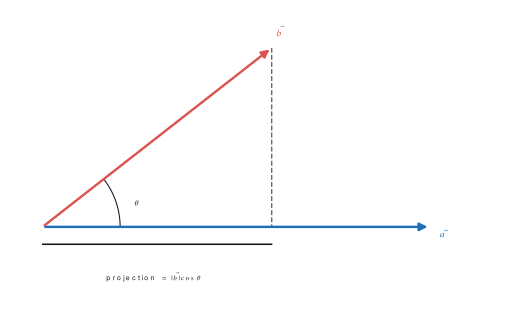
Drop a perpendicular from the tip of \vec{b} onto the line of \vec{a}. The length cut off along \vec{a} is |\vec{b}|\cos\theta, the projection of \vec{b} on \vec{a}. So
Dot products of \hat{i} and \hat{j}
\hat{i} and \hat{j} are unit vectors (|\hat{i}|=|\hat{j}|=1) along the axes, and they are at 90^\circ:
Setting up. Let \vec{a}=a_1\hat{i}+a_2\hat{j} and \vec{b}=b_1\hat{i}+b_2\hat{j}.
Step 1 — expand using the distributive law.
Step 2 — use the values above. The two cross terms are 0, and \hat{i}\cdot\hat{i}=\hat{j}\cdot\hat{j}=1.
Result.
What it means. To find a dot product from coordinates, multiply the first components, multiply the second components and add. No angle is needed.
Length. Put \vec{b}=\vec{a}: \vec{a}\cdot\vec{a}=a_1^2+a_2^2=|\vec{a}|^2, so |\vec{a}|=\sqrt{a_1^2+a_2^2}.
- \vec{a}\cdot\vec{b}=|\vec{a}||\vec{b}|\cos\theta=a_1b_1+a_2b_2 (a number, not a vector).
- \vec{a}\cdot\vec{a}=|\vec{a}|^2, and \vec{a}\cdot\vec{b}=\vec{b}\cdot\vec{a} (commutative).
- \vec{a}\cdot(\vec{b}+\vec{c})=\vec{a}\cdot\vec{b}+\vec{a}\cdot\vec{c} (distributive). Also (k\vec{a})\cdot\vec{b}=k(\vec{a}\cdot\vec{b}).
Algebraic relations
Using the properties, with |\vec{a}|^2=\vec{a}\cdot\vec{a}:
The dot product is largest (|\vec{a}||\vec{b}|) when \theta=0^\circ and smallest (-|\vec{a}||\vec{b}|) when \theta=180^\circ.
\vec{a}\cdot\vec{b} is a scalar. Writing a vector answer, or writing \vec{a}\cdot\vec{b}\cdot\vec{c}, is meaningless. Also, \vec{a}\cdot\vec{b}=0 does not mean \vec{a}=\vec{0} or \vec{b}=\vec{0}: it may mean the vectors are perpendicular.
Problem. If \vec{a}=(3,-2) and \vec{b}=(4,5), find \vec{a}\cdot\vec{b}, |\vec{a}| and |\vec{b}|.
Solution. \vec{a}\cdot\vec{b}=3\times4+(-2)\times5=12-10=2.
|\vec{a}|=\sqrt{9+4}=\sqrt{13} and |\vec{b}|=\sqrt{16+25}=\sqrt{41}.
Problem. If |\vec{a}|=3, |\vec{b}|=4 and the angle between them is 60^\circ, find \vec{a}\cdot\vec{b}, |\vec{a}+\vec{b}| and |\vec{a}-\vec{b}|.
Solution. \vec{a}\cdot\vec{b}=3\times4\times\cos60^\circ=12\times\dfrac12=6.
|\vec{a}+\vec{b}|^2=9+2\times6+16=37, so |\vec{a}+\vec{b}|=\sqrt{37}.
|\vec{a}-\vec{b}|^2=9-12+16=13, so |\vec{a}-\vec{b}|=\sqrt{13}.
8.2 Angle between vectors, perpendicular and parallel vectors
Solve \vec{a}\cdot\vec{b}=|\vec{a}||\vec{b}|\cos\theta for \cos\theta:
| Condition | Test |
|---|---|
| Perpendicular (\theta=90^\circ, \cos\theta=0) | \vec{a}\cdot\vec{b}=0, i.e. a_1b_1+a_2b_2=0 |
| Parallel (\theta=0^\circ or 180^\circ) | \vec{a}=m\vec{b}, i.e. \dfrac{a_1}{b_1}=\dfrac{a_2}{b_2}, i.e. a_1b_2-a_2b_1=0 |
| Angle is acute | \vec{a}\cdot\vec{b}>0 |
| Angle is obtuse | \vec{a}\cdot\vec{b}<0 |
The projection of \vec{a} on \vec{b} is \dfrac{\vec{a}\cdot\vec{b}}{|\vec{b}|}.
Problem. Find the angle between \vec{a}=(3,1) and \vec{b}=(1,2).
Solution. \vec{a}\cdot\vec{b}=3\times1+1\times2=5. |\vec{a}|=\sqrt{10}, |\vec{b}|=\sqrt{5}.
So \theta=45^\circ.
Problem. The vertices of a triangle are A(1,1), B(4,1) and C(1,5). Find \angle B.
Solution. At B the two sides are \vec{BA} and \vec{BC} (both start at B).
\vec{BA}=(1-4,\,1-1)=(-3,0) and \vec{BC}=(1-4,\,5-1)=(-3,4).
\vec{BA}\cdot\vec{BC}=9+0=9, |\vec{BA}|=3, |\vec{BC}|=\sqrt{9+16}=5.
(At A: \vec{AB}=(3,0) and \vec{AC}=(0,4) have dot product 0, so \angle A=90^\circ.)
Problem. (a) Find k so that \vec{a}=(k,2) is perpendicular to \vec{b}=(3,-6). (b) Find k so that \vec{p}=(2,k) is parallel to \vec{q}=(6,9).
Solution. (a) \vec{a}\cdot\vec{b}=3k-12=0, so k=4.
(b) Parallel: 2\times9-k\times6=0, so k=3. Check: \vec{q}=3\vec{p}=(6,9). ✓
Problem. Show that \vec{a}=(1,-2) and \vec{b}=(4,2) are perpendicular, and find a unit vector perpendicular to \vec{c}=(3,4).
Solution. \vec{a}\cdot\vec{b}=4-4=0, so \vec{a}\perp\vec{b}.
A vector perpendicular to (3,4) is (-4,3) (dot product -12+12=0). Its length is \sqrt{16+9}=5, so the unit vector is \dfrac{1}{5}(-4,3)=\left(-\dfrac45,\dfrac35\right).
Problem. Find the projection of \vec{a}=(2,3) on \vec{b}=(3,4).
Solution. \vec{a}\cdot\vec{b}=6+12=18, |\vec{b}|=5. Projection =\dfrac{18}{5}=3.6.
Problem. If |\vec{a}+\vec{b}|=|\vec{a}-\vec{b}|, show that \vec{a}\perp\vec{b}.
Solution. Square both sides: |\vec{a}|^2+2\vec{a}\cdot\vec{b}+|\vec{b}|^2=|\vec{a}|^2-2\vec{a}\cdot\vec{b}+|\vec{b}|^2. So 4\,\vec{a}\cdot\vec{b}=0, i.e. \vec{a}\cdot\vec{b}=0, so the vectors are perpendicular (the diagonals of a parallelogram are equal only for a rectangle).
8.3 Vector geometry: section formula and collinear points
Position vectors and the triangle law
For points A and B with position vectors \vec{a} and \vec{b}, the triangle law gives \vec{OA}+\vec{AB}=\vec{OB}, so \vec{AB}=\vec{b}-\vec{a}.
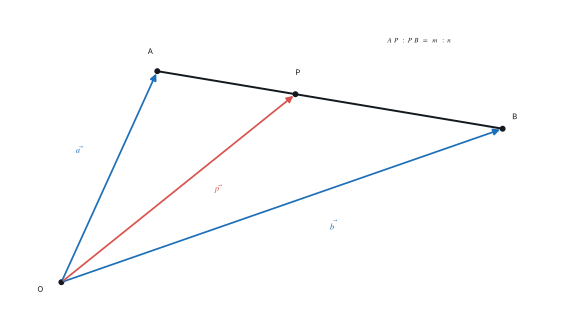
Setting up. Let P divide AB internally in the ratio m:n, i.e. AP:PB=m:n.
Step 1 — compare vectors along the line. \vec{AP} and \vec{PB} are in the same direction, and n\,\vec{AP}=m\,\vec{PB}.
Step 2 — write in position vectors. With \vec{p} the position vector of P:
Step 3 — solve for \vec{p}.
Result.
What it means. P is a weighted average of A and B, closer to the end with the larger weight. For m=n (the midpoint) \vec{p}=\dfrac{\vec{a}+\vec{b}}{2}.
Further results from the same triangle-law reasoning:
| Result | Formula |
|---|---|
| Vector \vec{AB} | \vec{b}-\vec{a} |
| Midpoint of AB | \dfrac{\vec{a}+\vec{b}}{2} |
| Centroid of \triangle ABC | \dfrac{\vec{a}+\vec{b}+\vec{c}}{3} |
| ABCD is a parallelogram | \vec{AB}=\vec{DC}, so \vec{d}=\vec{a}+\vec{c}-\vec{b} |
| A,B,C collinear | \vec{AB}=k\,\vec{AC} for some number k |
Problem. Find the point P that divides the line joining A(2,3) and B(7,8) internally in the ratio 2:3.
Solution. \vec{p}=\dfrac{2\vec{b}+3\vec{a}}{2+3}=\dfrac{2(7,8)+3(2,3)}{5}=\dfrac{(14,16)+(6,9)}{5}=\dfrac{(20,25)}{5}=(4,5).
So P=(4,5). Check: AP=(2,2), PB=(3,3), ratio 2:3. ✓
Problem. Show that A(1,2), B(3,6) and C(4,8) are collinear.
Solution. \vec{AB}=(3-1,\,6-2)=(2,4) and \vec{AC}=(4-1,\,8-2)=(3,6).
\vec{AB}=k\vec{AC} requires \dfrac23=\dfrac46, which is true (k=\dfrac23). The two vectors are parallel and share the point A, so A, B, C lie on one line.
Problem. A(1,1), B(5,2) and C(7,5) are three vertices of a parallelogram ABCD (in order). Find D.
Solution. For a parallelogram \vec{AB}=\vec{DC}, so \vec{d}=\vec{a}+\vec{c}-\vec{b}=(1,1)+(7,5)-(5,2)=(3,4).
Check: the midpoints of the diagonals AC and BD are (4,3) and \dfrac{(5,2)+(3,4)}{2}=(4,3). ✓
Problem. Find the centroid of the triangle with vertices A(1,2), B(5,4) and C(3,9).
Solution. \vec{g}=\dfrac{\vec{a}+\vec{b}+\vec{c}}{3}=\dfrac{(1+5+3,\;2+4+9)}{3}=\dfrac{(9,15)}{3}=(3,5).
8.4 Theorems on triangles
All proofs below follow the same plan: state what is given, state what is to prove, give the proof with the triangle law, conclude.
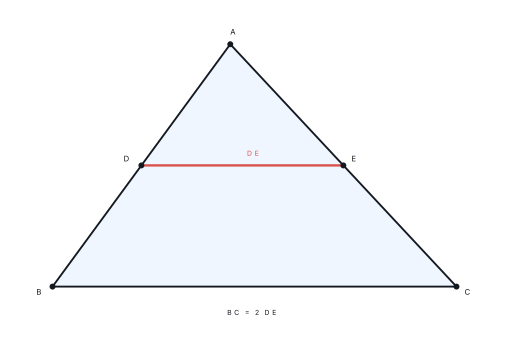
Statement. The line joining the midpoints of two sides of a triangle is parallel to the third side and half of it.
Given. In \triangle ABC, D and E are the midpoints of AB and AC.
To prove. \vec{DE}=\dfrac12\vec{BC} (so DE\parallel BC and DE=\dfrac12BC).
Proof. In \triangle ADE, by the triangle law, \vec{DE}=\vec{DA}+\vec{AE}.
Since D and E are midpoints, \vec{DA}=\dfrac12\vec{BA} and \vec{AE}=\dfrac12\vec{AC}. So
In \triangle ABC, \vec{BA}+\vec{AC}=\vec{BC}. Therefore
Conclusion. \vec{DE} is a scalar multiple of \vec{BC}, so DE\parallel BC, and DE=\dfrac12BC.
Statement. In an isosceles triangle, the median drawn from the vertex to the base is perpendicular to the base.
Given. In \triangle ABC, AB=AC and D is the midpoint of BC.
To prove. AD\perp BC, i.e. \vec{AD}\cdot\vec{BC}=0.
Proof. Since D is the midpoint of BC, \vec{AD}=\dfrac12\left(\vec{AB}+\vec{AC}\right) and \vec{BC}=\vec{AC}-\vec{AB}.
But AB=AC, so |\vec{AC}|^2-|\vec{AB}|^2=0.
Conclusion. \vec{AD}\cdot\vec{BC}=0, so AD\perp BC.
Statement. In a right-angled triangle, the square on the hypotenuse equals the sum of the squares on the other two sides.
Given. In \triangle ABC, \angle A=90^\circ.
To prove. BC^2=AB^2+AC^2.
Proof. \vec{BC}=\vec{AC}-\vec{AB}, so
Since \angle A=90^\circ, \vec{AB}\cdot\vec{AC}=0.
Conclusion. BC^2=AB^2+AC^2.
Statement. The line drawn through the midpoint of one side of a triangle parallel to another side bisects the third side.
Given. In \triangle ABC, D is the midpoint of AB, and DE\parallel BC meets AC at E.
To prove. E is the midpoint of AC.
Proof. Let \vec{AE}=t\,\vec{AC} for some number t (as E lies on AC). Then \vec{DE}=\vec{DA}+\vec{AE}=-\dfrac12\vec{AB}+t\vec{AC}.
Since DE\parallel BC, \vec{DE}=s\,\vec{BC}=s(\vec{AC}-\vec{AB}). Compare coefficients of the independent vectors \vec{AB} and \vec{AC}:
So s=\dfrac12 and t=\dfrac12.
Conclusion. \vec{AE}=\dfrac12\vec{AC}: E is the midpoint of AC.
8.5 Theorems on quadrilaterals and the semicircle
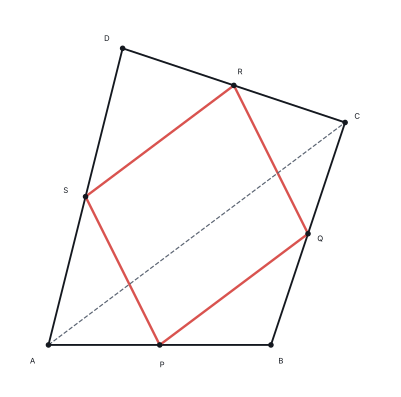
Statement. The figure formed by joining, in order, the midpoints of the sides of any quadrilateral is a parallelogram.
Given. In quadrilateral ABCD, P, Q, R, S are the midpoints of AB, BC, CD, DA.
To prove. \vec{PQ}=\vec{SR}, so PQRS is a parallelogram.
Proof. Join AC. In \triangle ABC, P and Q are midpoints of AB and BC, so by the midpoint theorem
In \triangle ADC, S and R are midpoints of AD and DC, so
Conclusion. \vec{PQ}=\vec{SR}: one pair of opposite sides is equal and parallel, so PQRS is a parallelogram.
Statement. The diagonals of a rhombus are perpendicular to each other.
Given. ABCD is a rhombus: AB=BC=CD=DA.
To prove. AC\perp BD.
Proof. Take A as the origin with \vec{AB}=\vec{u} and \vec{AD}=\vec{v}. Then \vec{AC}=\vec{u}+\vec{v} and \vec{BD}=\vec{v}-\vec{u}.
All sides are equal, so |\vec{u}|=|\vec{v}|.
Conclusion. \vec{AC}\cdot\vec{BD}=0, so the diagonals are perpendicular.
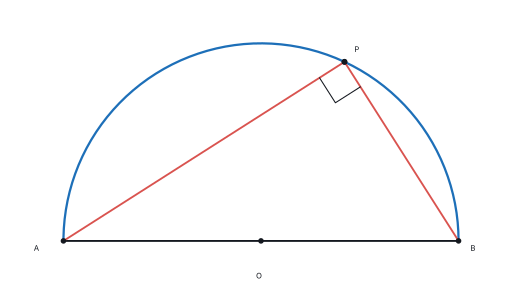
Statement. The angle in a semicircle is a right angle.
Given. AB is a diameter of a circle with centre O, and P is any point on the circle.
To prove. \angle APB=90^\circ.
Proof. Take O as the origin. \vec{OA}=\vec{a}, \vec{OB}=-\vec{a} (opposite ends of a diameter) and \vec{OP}=\vec{p}, with |\vec{p}|=|\vec{a}|=r (the radius).
Conclusion. \vec{PA}\perp\vec{PB}, so \angle APB=90^\circ.
Statement. The diagonals of a parallelogram bisect each other.
Given. ABCD is a parallelogram; diagonals AC and BD meet at O.
To prove. O is the midpoint of AC and of BD.
Proof. Let M be the midpoint of AC: \vec{m}=\dfrac{\vec{a}+\vec{c}}{2}. For a parallelogram \vec{d}=\vec{a}+\vec{c}-\vec{b}, so the midpoint of BD is
Conclusion. The midpoints of AC and BD are the same point, so the diagonals bisect each other.
(1) A labelled diagram. (2) "Given" and "To prove" written out. (3) Each vector equation justified: "by the triangle law", "since D is the midpoint". (4) For perpendicularity, a dot product equal to 0. (5) A final sentence in geometric words.
8.6 Exercises of the SEE type
Method for any question
- Component questions: write \vec{a}\cdot\vec{b}=a_1b_1+a_2b_2, find the two lengths, then \cos\theta.
- For k in perpendicular/parallel questions: perpendicular \Rightarrow dot product 0; parallel \Rightarrow a_1b_2=a_2b_1.
- For vectors between points, always end minus start: \vec{AB}=\vec{b}-\vec{a}.
- For a proof: draw, give, prove, conclude; use the triangle law and the midpoint formula; expand dot products with |\vec{a}|^2=\vec{a}\cdot\vec{a}.
Chapter summary
- \vec{a}\cdot\vec{b}=|\vec{a}||\vec{b}|\cos\theta=a_1b_1+a_2b_2; the result is a number.
- \hat{i}\cdot\hat{i}=\hat{j}\cdot\hat{j}=1, \hat{i}\cdot\hat{j}=0; \vec{a}\cdot\vec{a}=|\vec{a}|^2.
- |\vec{a}\pm\vec{b}|^2=|\vec{a}|^2\pm2\vec{a}\cdot\vec{b}+|\vec{b}|^2; (\vec{a}+\vec{b})\cdot(\vec{a}-\vec{b})=|\vec{a}|^2-|\vec{b}|^2.
- \cos\theta=\dfrac{\vec{a}\cdot\vec{b}}{|\vec{a}||\vec{b}|}; perpendicular \Leftrightarrow\vec{a}\cdot\vec{b}=0; parallel \Leftrightarrow a_1b_2-a_2b_1=0.
- Projection of \vec{a} on \vec{b} =\dfrac{\vec{a}\cdot\vec{b}}{|\vec{b}|}.
- \vec{AB}=\vec{b}-\vec{a}; midpoint \dfrac{\vec{a}+\vec{b}}{2}; section formula \dfrac{m\vec{b}+n\vec{a}}{m+n}; centroid \dfrac{\vec{a}+\vec{b}+\vec{c}}{3}; parallelogram \vec{d}=\vec{a}+\vec{c}-\vec{b}.
- Collinear: \vec{AB}=k\vec{AC}.
- Theorems proved: midpoint theorem; isosceles median; Pythagoras; midpoints of a quadrilateral form a parallelogram; rhombus diagonals perpendicular; angle in a semicircle; parallelogram diagonals bisect.
Practice questions
Group A — Multiple choice (1 mark each)
- If \vec{a}=(2,3) and \vec{b}=(4,-1), then \vec{a}\cdot\vec{b} is [1]a5b11c(8,-3)d-5
- Two non-zero vectors are perpendicular if their dot product is [1]a1b-1c0d|\vec{a}||\vec{b}|
- |\vec{a}|=3, |\vec{b}|=2, angle 60^\circ. Then \vec{a}\cdot\vec{b}= [1]a6b3c3\sqrt{3}d\frac32
- The midpoint of the line joining (2,6) and (8,2) is [1]a(10,8)b(5,4)c(3,2)d(6,4)
- \vec{a}=(1,k) and \vec{b}=(2,6) are parallel when k= [1]a2b3c6d\frac13
Answers to Group A
1. (a) — 8-3=5.
2. (c) — \cos90^\circ=0.
3. (b) — 3\times2\times\frac12=3.
4. (b) — \left(\frac{2+8}{2},\frac{6+2}{2}\right)=(5,4).
5. (b) — 1\times6-k\times2=0, so k=3.
Group B — Short answer (2 marks each)
- Find |\vec{a}| if \vec{a}=(5,-12). [2]
- Find k so that (k,3) and (2,-4) are perpendicular. [2]
- Find the position vector of the point dividing A(1,2) and B(6,7) in the ratio 2:3 internally. [2]
- If |\vec{a}|=5, |\vec{b}|=12 and \vec{a}\perp\vec{b}, find |\vec{a}+\vec{b}|. [2]
Answers to Group B
1. \sqrt{25+144}=13.
2. 2k-12=0, so k=6.
3. \dfrac{2(6,7)+3(1,2)}{5}=\dfrac{(12,14)+(3,6)}{5}=\dfrac{(15,20)}{5}=(3,4).
4. |\vec{a}+\vec{b}|^2=25+0+144=169, so |\vec{a}+\vec{b}|=13.
Group C — Short answer (3 marks each)
- Find the angle between \vec{a}=(1,\sqrt{3}) and \vec{b}=(2,0). [3]
- Show that A(1,1), B(2,3) and C(4,7) are collinear. [3]
- Three vertices of a parallelogram ABCD are A(0,0), B(4,1) and C(7,5). Find D. [3]
- If |\vec{a}|=2, |\vec{b}|=3 and \vec{a}\cdot\vec{b}=3, find |\vec{a}-\vec{b}| and the angle between \vec{a} and \vec{b}. [3]
Answers to Group C
1. \vec{a}\cdot\vec{b}=2, |\vec{a}|=2, |\vec{b}|=2. \cos\theta=\frac{2}{4}=\frac12, so \theta=60^\circ.
2. \vec{AB}=(1,2) and \vec{AC}=(3,6)=3\vec{AB}. The vectors are parallel and share A, so the points are collinear.
3. \vec{d}=\vec{a}+\vec{c}-\vec{b}=(0,0)+(7,5)-(4,1)=(3,4).
4. |\vec{a}-\vec{b}|^2=4-6+9=7, so |\vec{a}-\vec{b}|=\sqrt{7}. \cos\theta=\frac{3}{6}=\frac12, \theta=60^\circ.
Group D — Long answer (4 marks each)
- Prove that the line joining the midpoints of two sides of a triangle is parallel to the third side and half of it. [4]
- Prove by vectors that the diagonals of a rhombus are perpendicular. [4]
- Prove that the angle in a semicircle is a right angle. [4]
- The vertices of a triangle are A(2,1), B(6,1), C(2,4). Show that it is right-angled, and find \angle B and the centroid. [4]
Answers to Group D
1. See Theorem 1: \vec{DE}=\vec{DA}+\vec{AE}=\frac12\vec{BA}+\frac12\vec{AC}=\frac12\vec{BC}.
2. See Theorem 6: with \vec{AB}=\vec{u}, \vec{AD}=\vec{v}, \vec{AC}\cdot\vec{BD}=|\vec{v}|^2-|\vec{u}|^2=0 because the sides are equal.
3. See Theorem 7: \vec{PA}\cdot\vec{PB}=|\vec{p}|^2-|\vec{a}|^2=0.
4. \vec{AB}=(4,0), \vec{AC}=(0,3); \vec{AB}\cdot\vec{AC}=0, so \angle A=90^\circ. At B: \vec{BA}=(-4,0), \vec{BC}=(-4,3); dot =16, lengths 4 and 5: \cos B=\frac{16}{20}=\frac45, B\approx36.87^\circ. Centroid =\dfrac{(2+6+2,\;1+1+4)}{3}=\left(\dfrac{10}{3},2\right).
Practise more: Optional Mathematics question bank