Unit 2 · Units · 18 min read
Quadratic Equations and Graphs
What the syllabus asks for 5
- Quadratic equations: roots and their nature
- Graph of a quadratic function
- Graph of a cubic function
- Solving a quadratic and a linear equation together
- Exercises of the SEE type
When a ball is thrown upward, a bridge cable hangs between two towers, or a farmer fences a rectangular field of fixed area, the mathematics behind the situation is a quadratic. A quadratic equation ax^2+bx+c=0 can be solved by factorisation or by a formula; its discriminant tells us in advance whether real solutions exist; and its graph, the parabola, shows the solutions as the points where the curve meets the x-axis. In this chapter we revise and extend these ideas, draw graphs of quadratic and cubic functions, and then solve a quadratic and a linear equation together, both by algebra and from a graph.
Typical questions are: (i) solve a quadratic equation by factorisation or by the formula; (ii) a word problem that leads to a quadratic equation; (iii) find the vertex, axis and intercepts of y=ax^2+bx+c and draw its graph from a table; (iv) read the roots or the minimum/maximum value from a graph; (v) draw a cubic graph from a table; (vi) solve a quadratic and a linear equation, and find where a line meets a parabola. Always give a table of values and plot at least five points when asked to draw a graph.

2.1 Quadratic equations: roots and their nature
An equation that can be written in the form ax^2+bx+c=0, where a,\,b,\,c are real numbers and a\neq 0, is called a quadratic equation in x. The values of x that satisfy it are its roots (or solutions).
Solving by factorisation
Split the middle term so that the expression becomes a product of two brackets. Then use the rule: if PQ=0, then P=0 or Q=0.
Problem. Solve (i) x^2-5x+6=0, (ii) 2x^2+5x-3=0.
Solution. (i) x^2-5x+6=x^2-2x-3x+6=x(x-2)-3(x-2)=(x-2)(x-3). So x-2=0 or x-3=0, giving x=2 or x=3.
(ii) We need two numbers with product 2\times(-3)=-6 and sum 5: these are 6 and -1.
So x=-3 or x=\frac{1}{2}.
Solving by the formula
When the expression does not factorise easily, use the quadratic formula. We first prove it by completing the square.
We start from ax^2+bx+c=0 (a\neq 0) and are heading for x in terms of a, b, c.
Step 1 — divide by a so that the coefficient of x^2 is 1.
Step 2 — move the constant to the right.
Step 3 — add \left(\frac{b}{2a}\right)^2 to both sides. This turns the left side into a perfect square:
Step 4 — write the left side as a square and combine the right side.
Step 5 — take the square root of both sides.
Step 6 — move \frac{b}{2a} to the right.
What it means. Every quadratic equation has at most two roots, given by this one formula. The number under the root sign decides whether real roots exist.
(1) dividing by a, (2) adding \left(\frac{b}{2a}\right)^2 to both sides, (3) the perfect square on the left, (4) the \pm sign in the final formula.
| Discriminant | Roots |
|---|---|
| D>0 | two real and different roots |
| D=0 | two real and equal roots, x=-\frac{b}{2a} |
| D<0 | no real roots |
If D is a perfect square (and a,b,c are rational), the roots are rational.
Problem. Solve x^2-4x-1=0 and 2x^2-5x-3=0 using the formula.
Solution. For x^2-4x-1=0: a=1, b=-4, c=-1. D=16+4=20.
For 2x^2-5x-3=0: a=2, b=-5, c=-3. D=25+24=49.
Problem. Solve (i) \frac{x+1}{x-1}+\frac{x-1}{x+1}=\frac{5}{2}, (ii) x-\frac{3}{x}=2.
Solution. (i) Multiply by the common denominator 2(x-1)(x+1):
So x=\pm 3. Neither makes a denominator zero, so both are valid.
(ii) Multiply by x (x\neq 0): x^2-3=2x, so x^2-2x-3=0, (x-3)(x+1)=0 and x=3 or x=-1.
Nature of roots
Problem. Find the values of k for which x^2+kx+9=0 has equal roots. Find the nature of the roots of 3x^2-5x+2=0.
Solution. For equal roots D=0: k^2-4(1)(9)=0, so k^2=36 and k=\pm 6.
For 3x^2-5x+2=0: D=25-24=1>0 and 1 is a perfect square, so the roots are real, different and rational (x=1 and x=\frac{2}{3}).
Sum and product of roots
If \alpha and \beta are the roots, the formula gives \alpha+\beta=\frac{-b+\sqrt{D}}{2a}+\frac{-b-\sqrt{D}}{2a}=-\frac{b}{a} and \alpha\beta=\frac{b^2-D}{4a^2}=\frac{4ac}{4a^2}=\frac{c}{a}.
An equation with roots \alpha,\beta is x^2-(\alpha+\beta)x+\alpha\beta=0.
Problem. Find the sum and product of the roots of 3x^2+5x-2=0. Form a quadratic equation whose roots are 3+\sqrt{2} and 3-\sqrt{2}.
Solution. Sum =-\frac{5}{3}, product =\frac{-2}{3}=-\frac{2}{3}.
For the new equation: sum of roots =(3+\sqrt{2})+(3-\sqrt{2})=6; product =3^2-(\sqrt{2})^2=9-2=7. The equation is x^2-6x+7=0.
- Forgetting a\neq 0 and the \pm sign, so only one root is found.
- Dividing both sides of x^2=4x by x. This loses the root x=0. Write x^2-4x=0, x(x-4)=0.
- Writing the equation as x^2+(\alpha+\beta)x+\alpha\beta=0. The sign of the middle term is minus.
- Not checking roots in a word problem: a length or a number of children cannot be negative.
Problem. (i) Solve x^2-6x+2=0 by completing the square. (ii) One root of 2x^2+kx-6=0 is 2. Find k and the other root. (iii) The roots of x^2-7x+k=0 differ by 3. Find k.
Solution. (i) x^2-6x=-2. Add \left(\frac{6}{2}\right)^2=9 to both sides: (x-3)^2=7, so x-3=\pm\sqrt{7} and x=3\pm\sqrt{7}.
(ii) Since 2 is a root: 2(4)+2k-6=0, so k=-1. The equation is 2x^2-x-6=0. The product of roots is \frac{-6}{2}=-3, so the other root is \frac{-3}{2}=-\frac{3}{2}. Check: (2x+3)(x-2)=2x^2-x-6 ✓.
(iii) Let the roots be \alpha and \alpha+3. Sum: 2\alpha+3=7, so \alpha=2 and the roots are 2 and 5. Product =k=2\times 5=10.
Problem. Solve x+\frac{1}{x}=\frac{5}{2}.
Solution. Multiply by 2x (x\neq 0): 2x^2+2=5x, so 2x^2-5x+2=0 and (2x-1)(x-2)=0. Hence x=\frac{1}{2} or x=2.
Problem. (i) The product of two consecutive positive integers is 132. Find them. (ii) The length of a rectangle is 3 m more than its breadth and its area is 70 m². Find its length and breadth.
Solution. (i) Let the integers be x and x+1: x(x+1)=132, so x^2+x-132=0, (x+12)(x-11)=0. Since x>0, x=11. The integers are 11 and 12.
(ii) Let the breadth be x m, so the length is (x+3) m: x(x+3)=70, so x^2+3x-70=0, (x+10)(x-7)=0. A breadth cannot be negative, so x=7. Breadth 7 m, length 10 m.
2.2 Graph of a quadratic function
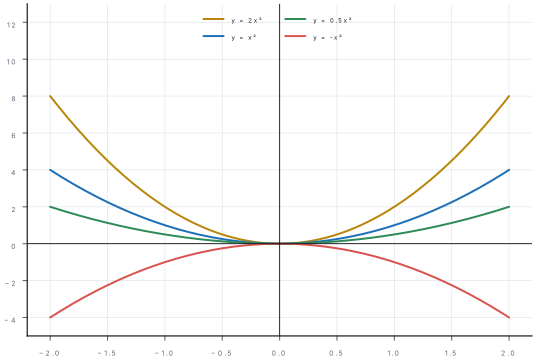
The function y=ax^2+bx+c (a\neq 0) is a quadratic function. Its graph is a smooth U-shaped curve called a parabola.
- Direction: opens upward if a>0 (the vertex is a minimum); downward if a<0 (the vertex is a maximum).
- Axis of symmetry: the vertical line x=-\frac{b}{2a}.
- Vertex: \left(-\frac{b}{2a},\ \frac{4ac-b^2}{4a}\right); find the y-value by substituting x=-\frac{b}{2a} into the function.
- y-intercept: the point (0,\,c).
- x-intercepts: the real roots of ax^2+bx+c=0. Two if D>0, one (the vertex touches the axis) if D=0, none if D<0.
- The larger |a| is, the narrower the parabola.
How to draw a parabola
- Find the vertex \left(-\frac{b}{2a},\,y\right) and the axis.
- Make a table with the vertex in the middle and at least two x-values on each side.
- Compute y for each, plot the points and join them with a smooth curve (not straight segments).
- Mark the axis, the vertex and the intercepts.
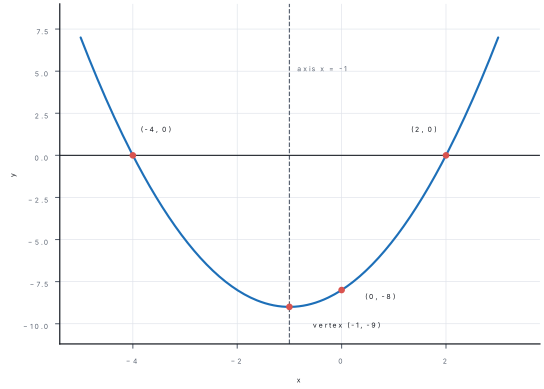
Problem. Draw the graph of y=x^2+2x-8. Write the equation of the axis and the vertex.
Solution. Here a=1, b=2, c=-8. Axis: x=-\frac{2}{2}=-1. At x=-1: y=1-2-8=-9. Vertex (-1,-9).
| x | -4 | -3 | -2 | -1 | 0 | 1 | 2 |
|---|---|---|---|---|---|---|---|
| y | 0 | -5 | -8 | -9 | -8 | -5 | 0 |
Plot the points and join them (Figure above). The roots of x^2+2x-8=0 are x=-4 and x=2, which are the x-intercepts; y-intercept is -8.
Problem. For y=-x^2+6x-5 find the axis, the vertex, the x-intercepts and the maximum value of y.
Solution. a=-1, b=6, c=-5. Since a<0 the parabola opens downward and the vertex is a maximum.
Axis: x=-\frac{6}{2(-1)}=3. At x=3: y=-9+18-5=4. Vertex (3,4); maximum value =4.
x-intercepts: -x^2+6x-5=0\Rightarrow x^2-6x+5=0\Rightarrow(x-1)(x-5)=0, so x=1 and x=5.
Problem. Without drawing, say how many times each parabola meets the x-axis: (i) y=x^2-4x+4, (ii) y=x^2+2x+3, (iii) y=x^2-5x+6.
Solution. Use D=b^2-4ac.
(i) D=16-16=0: the vertex (2,0) touches the x-axis. One intercept.
(ii) D=4-12=-8<0: the parabola does not meet the axis. Its vertex is (-1,2), above the axis, and it opens upward. No intercept.
(iii) D=25-24=1>0: two intercepts, x=2 and x=3.
Problem. A parabola cuts the x-axis at x=1 and x=3 and passes through (0,6). Find its equation and its vertex.
Solution. The roots are 1 and 3, so y=a(x-1)(x-3). At (0,6): 6=a(-1)(-3)=3a, so a=2.
Axis: x=\frac{1+3}{2}=2. At x=2: y=2(1)(-1)=-2. Vertex (2,-2).
Problem. From the graph of y=x^2-2x-3 find the roots of x^2-2x-3=0, the minimum value of y and the range of x for which y<0.
Solution. Axis x=1; at x=1, y=1-2-3=-4. Vertex (1,-4).
| x | -2 | -1 | 0 | 1 | 2 | 3 | 4 |
|---|---|---|---|---|---|---|---|
| y | 5 | 0 | -3 | -4 | -3 | 0 | 5 |
The curve cuts the x-axis at x=-1 and x=3, so the roots are -1 and 3. The minimum value is -4. The curve lies below the x-axis for -1<x<3, so y<0 there.
2.3 Graph of a cubic function
A function of the form y=ax^3+bx^2+cx+d, where a\neq 0, is a cubic function. Its graph has a smooth wavy shape and meets the x-axis at one, two or three points.
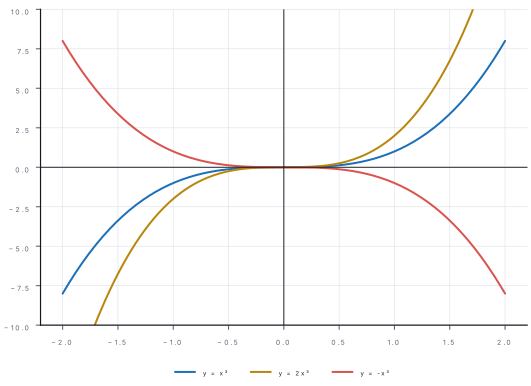
The simplest cubics are y=ax^3. Because (-x)^3=-x^3, the graph is symmetric about the origin: if (p,q) lies on it, so does (-p,-q).
| x | -2 | -1 | 0 | 1 | 2 |
|---|---|---|---|---|---|
| y=x^3 | -8 | -1 | 0 | 1 | 8 |
| y=2x^3 | -16 | -2 | 0 | 2 | 16 |
| y=-x^3 | 8 | 1 | 0 | -1 | -8 |
- If a>0 the curve rises from left to right, passing through the 3rd quadrant, the origin and the 1st quadrant.
- If a<0 it falls from left to right, passing through the 2nd quadrant, the origin and the 4th quadrant.
- A larger |a| gives a steeper curve.
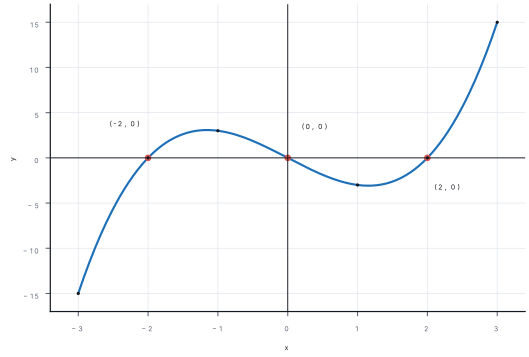
Problem. Draw the graph of y=x^3-4x for -3\leq x\leq 3 and write its roots.
Solution. Factorise: x^3-4x=x(x-2)(x+2), so y=0 at x=-2,\ 0,\ 2.
| x | -3 | -2 | -1 | 0 | 1 | 2 | 3 |
|---|---|---|---|---|---|---|---|
| y | -15 | 0 | 3 | 0 | -3 | 0 | 15 |
The curve comes up from the 3rd quadrant, crosses the axis at -2, rises to a peak between -2 and 0, falls through the origin to a trough between 0 and 2, crosses at 2 and rises again. The graph meets the x-axis at three points, so x^3-4x=0 has three roots: -2,\ 0,\ 2.
- Joining the plotted points with straight lines. A parabola and a cubic are smooth curves.
- Choosing x-values only on one side of the vertex. The table should be centred on the axis of symmetry.
- Using different scales on the two axes without labelling them, or forgetting to label the axes and the curve.
- Drawing a cubic through the origin when d\neq 0. The y-intercept of ax^3+bx^2+cx+d is (0,d).
2.4 Solving a quadratic and a linear equation together
Two equations, one quadratic and one linear, can have two common solutions, one, or none. Algebraically, substitute the linear expression into the quadratic and solve. Graphically, the solutions are the points where the line cuts the parabola.
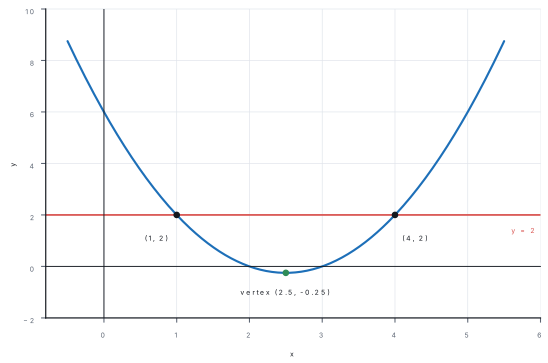
Problem. Solve y=x^2-5x+6 and y=2 simultaneously, and verify with the graph.
Solution. At a common point both y-values are equal:
So x=1 or x=4, and y=2 in both. The solutions are (1,2) and (4,2).
Graph: the vertex of the parabola is at x=\frac{5}{2}, y=\frac{25}{4}-\frac{25}{2}+6=-\frac{1}{4}, so \left(2.5,\,-0.25\right). The horizontal line y=2 lies above the vertex and cuts the parabola at two points.
Substitute the line into the parabola to get a quadratic in x and find its discriminant D.
| D | Line and parabola |
|---|---|
| D>0 | meet at two points |
| D=0 | touch at one point (the line is a tangent) |
| D<0 | do not meet |
Problem. Find the common solutions of y=x^2-4 and y=x-2.
Solution. x^2-4=x-2\Rightarrow x^2-x-2=0\Rightarrow(x-2)(x+1)=0. If x=2 then y=0; if x=-1 then y=-3. Common points: (2,0) and (-1,-3).
Problem. For what value of m does the line y=2x+m touch the parabola y=x^2+1? Find the point of contact.
Solution. x^2+1=2x+m\Rightarrow x^2-2x+(1-m)=0. For one common point D=0: (-2)^2-4(1)(1-m)=4m=0, so m=0.
Then x^2-2x+1=(x-1)^2=0, x=1, y=2. The line y=2x touches the parabola at (1,2).
Problem. Solve (i) x+y=7, xy=12; (ii) x^2+y^2=25, y=x+1.
Solution. (i) y=7-x. Then x(7-x)=12\Rightarrow x^2-7x+12=0\Rightarrow(x-3)(x-4)=0. If x=3, y=4; if x=4, y=3. Solutions (3,4) and (4,3).
(ii) Put y=x+1: x^2+(x+1)^2=25\Rightarrow 2x^2+2x-24=0\Rightarrow x^2+x-12=0\Rightarrow(x+4)(x-3)=0. If x=3, y=4; if x=-4, y=-3. Solutions (3,4) and (-4,-3).
Problem. Using the graph of y=x^2, solve x^2-x-6=0. Using the graph of y=x^2-2x-3, find approximate solutions of x^2-2x-4=0.
Solution. (i) Write x^2=x+6. Draw y=x^2 and the line y=x+6. They meet where x^2=x+6: at (-2,4) and (3,9). So x=-2 or x=3. Check: x^2-x-6=(x-3)(x+2) ✓.
(ii) x^2-2x-4=0 means x^2-2x-3=1. On the graph of y=x^2-2x-3 draw the line y=1. It cuts the curve at two points, at x\approx-1.2 and x\approx 3.2. (By the formula, x=1\pm\sqrt{5}\approx-1.24,\ 3.24.)
Problem. Show that the line y=-2 does not meet the parabola y=x^2+2x+3, and that y=3 meets it at two points.
Solution. For y=-2: x^2+2x+3=-2\Rightarrow x^2+2x+5=0, D=4-20=-16<0. No real solution, so the line does not meet the parabola. (The minimum value of the parabola is 2, so it never goes below y=2.)
For y=3: x^2+2x=0\Rightarrow x(x+2)=0. The points are (0,3) and (-2,3).
2.5 Exercises of the SEE type
Problem. A rectangular garden has perimeter 34 m and area 60 m². Find its length and breadth.
Solution. Let the length be x m. Half the perimeter is 17 m, so the breadth is (17-x) m.
So x=5 or 12. The sides are 12 m and 5 m.
Problem. The product of two consecutive positive odd integers is 143. Find them.
Solution. Let them be x and x+2: x(x+2)=143\Rightarrow x^2+2x-143=0\Rightarrow(x+13)(x-11)=0. Since x>0, x=11. The integers are 11 and 13.
Problem. A ball thrown up from the ground reaches height h=20t-5t^2 metres after t seconds. Find the greatest height and when the ball returns to the ground.
Solution. The graph of h against t is a parabola opening downward (a=-5). Axis t=-\frac{20}{2(-5)}=2 s. At t=2: h=40-20=20 m. The greatest height is 20 m.
On the ground h=0: 20t-5t^2=5t(4-t)=0, so t=0 or t=4. The ball lands after 4 s.
Problem. The sum of two numbers is 15 and the sum of their squares is 117. Find the numbers.
Solution. Let the numbers be x and 15-x.
(x-6)(x-9)=0, so the numbers are 6 and 9. Check: 36+81=117 ✓.
Problem. The hypotenuse of a right-angled triangle is 13 cm. The other two sides differ by 7 cm. Find them.
Solution. Let the sides be x and x+7. By Pythagoras: x^2+(x+7)^2=169\Rightarrow 2x^2+14x-120=0\Rightarrow x^2+7x-60=0\Rightarrow(x+12)(x-5)=0. Since x>0, x=5. The sides are 5 cm and 12 cm.
Problem. A boat takes 5 hours to go 24 km upstream and 24 km back downstream. The speed of the current is 2 km/h. Find the speed of the boat in still water.
Solution. Let the speed in still water be v km/h. Upstream speed is v-2, downstream speed v+2.
So 5v^2-48v-20=0. D=2304+400=2704=52^2, so v=\frac{48\pm52}{10}, giving v=10 or v=-0.4. Speed cannot be negative, so the speed in still water is 10 km/h.
Check: \frac{24}{8}+\frac{24}{12}=3+2=5 ✓.
Chapter summary
- Quadratic formula: x=\frac{-b\pm\sqrt{b^2-4ac}}{2a}, D=b^2-4ac. D>0: two real different roots; D=0: equal roots; D<0: no real roots.
- Sum and product: \alpha+\beta=-\frac{b}{a}, \alpha\beta=\frac{c}{a}; equation x^2-(\alpha+\beta)x+\alpha\beta=0.
- Parabola y=ax^2+bx+c: axis x=-\frac{b}{2a}; vertex found by substituting; y-intercept c; x-intercepts are the roots; opens up if a>0 (minimum), down if a<0 (maximum).
- Cubic y=ax^3: rises through quadrants 3, 1 if a>0; falls through quadrants 2, 4 if a<0; symmetric about the origin.
- To draw a graph: table centred on the vertex, plot, smooth curve, label axes and intercepts.
- Line and parabola: substitute to get a quadratic in x; D>0 two points, D=0 tangent, D<0 none.
Practice questions
Group A — Multiple choice (1 mark each)
- The roots of x^2-7x+12=0 are [1]a2, 6b3, 4c-3, -4d1, 12
- The roots of x^2-6x+9=0 are [1]areal and equalbreal and differentcimaginarydirrational
- The vertex of y=x^2-4x+3 is [1]a(2,1)b(-2,-1)c(2,-1)d(4,3)
- The graph of y=-x^3 passes through the [1]a1st and 3rd quadrantsb2nd and 4th quadrantsc1st and 2nd quadrantsd3rd and 4th quadrants
- The sum of the roots of 2x^2-8x+3=0 is [1]a4b-4c\frac{3}{2}d-\frac{3}{2}
- The number of points common to y=x^2 and y=-1 is [1]a0b1c2d3
Answers to Group A
1. (b) — (x-3)(x-4)=0.
2. (a) — D=36-36=0.
3. (c) — axis x=2, y=4-8+3=-1.
4. (b) — a<0, so the curve passes through quadrants 2 and 4.
5. (a) — -\frac{b}{a}=\frac{8}{2}=4.
6. (a) — x^2=-1 has no real solution.
Group B — Short answer (2 marks each)
- Solve x^2-9x+14=0. [2]
- Find the discriminant of 3x^2-5x+2=0 and state the nature of its roots. [2]
- Find the vertex and the axis of symmetry of y=x^2-6x+5. [2]
- Find the sum and the product of the roots of 3x^2+5x-2=0. [2]
- Find the x-intercepts and the y-intercept of y=x^2-5x+6. [2]
Answers to Group B
1. (x-2)(x-7)=0, so x=2 or 7.
2. D=25-24=1>0: roots are real and different (and rational).
3. Axis x=3; y=9-18+5=-4. Vertex (3,-4), axis x=3.
4. Sum =-\frac{5}{3}, product =-\frac{2}{3}.
5. (x-2)(x-3)=0: x-intercepts (2,0) and (3,0). y-intercept (0,6).
Group C — Short answer (3 marks each)
- Solve 2x^2-5x-3=0 using the quadratic formula. [3]
- Find the values of k for which x^2+kx+16=0 has equal roots. [3]
- Draw the graph of y=x^2-2x-3 for -2\leq x\leq 4. From it find the roots of x^2-2x-3=0 and the minimum value of y. [3]
- Solve y=x^2-3x and y=2x-6 and write the common points. [3]
- Form a quadratic equation whose roots are 3+\sqrt{2} and 3-\sqrt{2}. [3]
Answers to Group C
1. a=2, b=-5, c=-3, D=25+24=49. x=\frac{5\pm7}{4}, so x=3 or x=-\frac{1}{2}.
2. D=k^2-64=0, so k=\pm 8.
3. Table: x=-2,-1,0,1,2,3,4 gives y=5,0,-3,-4,-3,0,5. Vertex (1,-4). Roots x=-1 and x=3. Minimum value of y is -4.
4. x^2-3x=2x-6\Rightarrow x^2-5x+6=0\Rightarrow x=2 or 3. y=2x-6 gives y=-2 and y=0. Common points (2,-2) and (3,0).
5. Sum =6, product =9-2=7. The equation is x^2-6x+7=0.
Group D — Long answer (4 marks each)
- The product of two consecutive positive odd integers is 143. Find them. [4]
- Solve \frac{x+1}{x-1}+\frac{x-1}{x+1}=\frac{5}{2}. [4]
- The perimeter of a rectangular field is 34 m and its area is 60 m². Find its length and breadth. [4]
- Solve x^2+y^2=25 and y=x-1. [4]
- For what value of m does the line y=2x+m touch the parabola y=x^2+1? Find the point of contact. [4]
Answers to Group D
1. Let the integers be x and x+2. x^2+2x-143=0\Rightarrow(x+13)(x-11)=0. x=11. The integers are 11 and 13.
2. 2[(x+1)^2+(x-1)^2]=5(x^2-1)\Rightarrow 4x^2+4=5x^2-5\Rightarrow x^2=9, so x=\pm 3.
3. Let the length be x m; breadth 17-x. x(17-x)=60\Rightarrow x^2-17x+60=0\Rightarrow(x-5)(x-12)=0. Length 12 m, breadth 5 m.
4. x^2+(x-1)^2=25\Rightarrow 2x^2-2x-24=0\Rightarrow x^2-x-12=0\Rightarrow(x-4)(x+3)=0. If x=4, y=3; if x=-3, y=-4. Solutions (4,3) and (-3,-4).
5. x^2+1=2x+m\Rightarrow x^2-2x+1-m=0. D=4-4(1-m)=4m=0, so m=0. Then (x-1)^2=0, x=1, y=2. The point of contact is (1,2).
Practise more: Optional Mathematics question bank