Unit 12 · Units · 24 min read
Functions and Polynomials
What the syllabus asks for 9
- Relations: ordered pairs, domain and range
- Functions: definition, vertical line test, values of a function
- Domain and range of a function; one-one, onto, constant and identity functions
- Composite functions
- Inverse functions and their graphs
- Polynomials: degree, standard form and the division algorithm
- Remainder theorem and factor theorem
- Synthetic division, zeros of a polynomial and factorisation
- Exercises of the SEE type
A vending machine gives exactly one drink for each button you press. A shop gives exactly one price for each item. The area of a square is fixed once its side is known. In each case, one quantity determines another in a definite way. Mathematics calls such a rule a function. Functions are the language in which the rest of mathematics is written, and the polynomial functions, built only from additions and multiplications of x, are the simplest and most useful family. This chapter first studies relations and functions, their domain and range, composite and inverse functions and their graphs, and then turns to polynomials: how to divide them, how to find the remainder without dividing, and how to use the factor theorem to break a polynomial into factors and find its zeros.
Expect 3 to 6 marks. Common types: (i) find the domain and range of a relation or function; (ii) find f(a) or solve f(x)=k; (iii) find f\circ g and g\circ f; (iv) find the inverse f^{-1}(x); (v) find the remainder using the remainder theorem; (vi) show that x-a is a factor and factorise a cubic; (vii) find an unknown constant so that a given binomial is a factor. Show the rule, the substitution and the check.
12.1 Relations
A relation from a set A to a set B is any set of ordered pairs (x,y) with x\in A and y\in B. We say x is related to y. For example, let A=\{1,2,3\} and B=\{2,3,4,5\} and let the relation be "y is one more than x". The ordered pairs are
The set of all first components of the ordered pairs is the domain. The set of all second components is the range. The whole set B into which the pairs may fall is the codomain.
For the relation R above the domain is \{1,2,3\}, the range is \{2,3,4\} and the codomain is \{2,3,4,5\}. Notice that 5 belongs to the codomain but not to the range, because nobody in A is sent to 5. The range is always a subset of the codomain.
Problem. Write the relation R=\{(x,y): y=2x-1,\ x\in\{1,2,3,4\}\} as a set of ordered pairs and state its domain and range.
Solution. For x=1,2,3,4 we get y=1,3,5,7. So
Domain =\{1,2,3,4\} and range =\{1,3,5,7\}.
Problem. Let S=\{(1,2),(1,3),(2,4),(3,4)\}. State its domain and range. Does every element of the domain have only one image?
Solution. The domain is \{1,2,3\} and the range is \{2,3,4\}. The element 1 has two images, 2 and 3, so S is a relation but not a function (see the next section).
12.2 Functions
A relation from A to B is a function if every element of A is related to exactly one element of B. We write f:A\to B and y=f(x), read "y equals f of x". Here x is the independent variable (input) and y=f(x) is the image of x (output).
Two conditions must both hold: no element of the domain is left without an image, and no element has two images. Different elements may share the same image, as in \{(1,4),(2,4),(3,5)\}, which is a function.
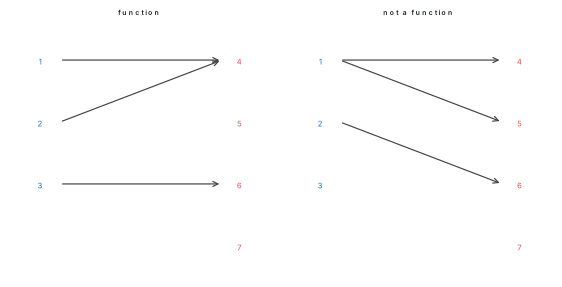
The vertical line test
When a relation is drawn as a graph, every vertical line meets the graph of a function at most once (a vertical line through an element of the domain meets it exactly once). If some vertical line cuts the graph twice, one x has two images and the graph is not that of a function. The parabola y=x^2 passes the test; the sideways parabola x=y^2 fails it.
Finding values of a function
Problem. If f(x)=2x+3, find f(4), f(-1) and the value of x for which f(x)=15.
Solution. f(4)=2\times 4+3=11 and f(-1)=2\times(-1)+3=1.
For f(x)=15: 2x+3=15, so 2x=12 and x=6.
Problem. If f(x)=x^2-3x+2, find f(3), f(-2) and the values of x for which f(x)=0.
Solution. f(3)=9-9+2=2 and f(-2)=4+6+2=12.
f(x)=0 gives x^2-3x+2=0, so (x-1)(x-2)=0 and x=1 or x=2.
Problem. If f(x)=3x-5, find f(a+2) and show that f(a+2)-f(a)=6.
Solution. f(a+2)=3(a+2)-5=3a+1. Also f(a)=3a-5. So f(a+2)-f(a)=(3a+1)-(3a-5)=6.
Problem. A linear function f(x)=ax+b has f(1)=5 and f(3)=11. Find f(x) and f(10).
Solution. a+b=5 and 3a+b=11. Subtracting, 2a=6, so a=3 and b=2. Hence f(x)=3x+2 and f(10)=32.
12.3 Domain and range of a function
The domain of f is the set of all inputs for which the rule makes sense; the range is the set of all outputs actually produced. If the domain is not stated, it is the largest set of real numbers for which f(x) is defined. Two things can go wrong: dividing by zero and taking the square root of a negative number.
- For \frac{1}{g(x)}, exclude every x with g(x)=0.
- For \sqrt{g(x)}, require g(x)\geq 0.
- A polynomial is defined for every real x, so its domain is \mathbb{R}.
Problem. Find the domain of (i) f(x)=\frac{1}{x-3}, (ii) g(x)=\sqrt{x-2}, (iii) h(x)=\frac{x}{x^2-9}.
Solution. (i) x-3\neq 0, so the domain is all real numbers except 3, written \{x\in\mathbb{R}: x\neq 3\}.
(ii) We need x-2\geq 0, so the domain is \{x\in\mathbb{R}: x\geq 2\}.
(iii) x^2-9\neq 0 means x\neq 3 and x\neq -3. The domain is \mathbb{R} without \{3,-3\}.
Problem. Let f(x)=x^2+1 with domain \{-2,-1,0,1,2\}. Find the range.
Solution. f(-2)=5, f(-1)=2, f(0)=1, f(1)=2, f(2)=5. The range is \{1,2,5\}. Two inputs share each of the images 2 and 5, which is allowed.
Problem. Find the domain and range of f(x)=\sqrt{x-2}.
Solution. Domain: x\geq 2. As x takes values from 2 upwards, x-2 takes all values from 0 upwards, and its square root also takes all values from 0 upwards. So the range is \{y: y\geq 0\}.
Reading domain and range from a graph
The domain is the set of x-values covered by the graph, read along the x-axis; the range is the set of y-values covered, read along the y-axis. For a linear function f(x)=mx+c both are all real numbers. For a quadratic f(x)=ax^2+bx+c the domain is all real numbers, but the range stops at the vertex: it is y\geq y_{\min} if a>0 and y\leq y_{\max} if a<0. The vertex of y=ax^2+bx+c lies at x=-\frac{b}{2a}.
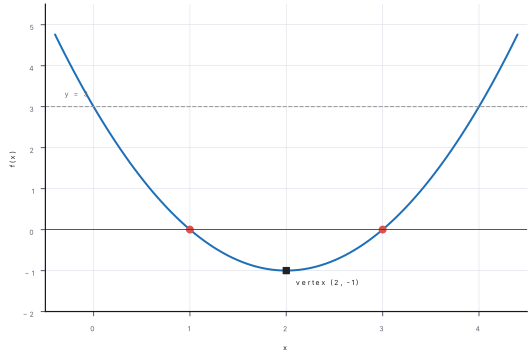
Problem. For f(x)=x^2-4x+3 find the zeros, the vertex, and the range. Draw the graph.
Solution. x^2-4x+3=(x-1)(x-3), so the zeros are x=1 and x=3. The vertex is at x=-\frac{-4}{2}=2, and f(2)=4-8+3=-1, so it is (2,-1). Since the coefficient of x^2 is positive, the parabola opens upwards and the lowest value is -1. The domain is all real numbers and the range is \{y: y\geq -1\}.
Table: x=0,1,2,3,4 give f(x)=3,0,-1,0,3.
Problem. Find the domain of f(x)=\frac{\sqrt{x+3}}{x-1}.
Solution. The root needs x+3\geq 0, that is x\geq -3. The denominator needs x\neq 1. So the domain is \{x: x\geq -3,\ x\neq 1\}.
Problem. The temperature in degrees Fahrenheit is F=f(C)=\frac{9}{5}C+32 where C is the temperature in degrees Celsius. Find f(37), find the inverse function, and use it to convert 212^\circF.
Solution. f(37)=\frac{9}{5}\times 37+32=66.6+32=98.6, so 37^\circC is 98.6^\circF.
Put F=\frac{9}{5}C+32. Then \frac{9}{5}C=F-32 and C=\frac{5}{9}(F-32). So f^{-1}(F)=\frac{5(F-32)}{9} and f^{-1}(212)=\frac{5\times 180}{9}=100. Water boils at 100^\circC.
Kinds of function
| Kind | Meaning | Example |
|---|---|---|
| One-one (injective) | different inputs give different outputs | f(x)=2x+1 |
| Many-one | some different inputs share an output | f(x)=x^2 |
| Onto (surjective) | range equals codomain | f(x)=x+3 on \mathbb{R}\to\mathbb{R} |
| Constant | every input has the same output | f(x)=4 |
| Identity | output equals input | I(x)=x |
A function that is both one-one and onto is called a one-one correspondence (bijection). Only such functions have an inverse, as we see in Section 12.5. To test whether a graph is one-one use the horizontal line test: no horizontal line may cut the graph more than once.
Problem. Are f(x)=3x-1 and g(x)=x^2 (on \mathbb{R}) one-one?
Solution. Suppose f(a)=f(b). Then 3a-1=3b-1, so a=b: f is one-one. But g(2)=4=g(-2) with 2\neq -2, so g is many-one.
12.4 Composite functions
If a machine g turns x into g(x) and a second machine f then acts on that result, the two machines together form one new function.
For functions g:A\to B and f:B\to C the composite function f\circ g:A\to C is defined by
First apply g, then apply f to the result.
Read f\circ g as "f of g" or "f after g". The function nearest to x acts first.
Problem. If f(x)=2x+1 and g(x)=x^2, find f\circ g, g\circ f, and the values (f\circ g)(3) and (g\circ f)(3).
Solution. (f\circ g)(x)=f(x^2)=2x^2+1.
(g\circ f)(x)=g(2x+1)=(2x+1)^2=4x^2+4x+1.
(f\circ g)(3)=2\times 9+1=19 and (g\circ f)(3)=7^2=49. The two answers differ, so in general f\circ g\neq g\circ f: composition is not commutative.
- Mixing the order: f\circ g means g first, then f.
- Writing f(g(x))=f(x)\cdot g(x). A composite is a substitution, not a product.
- Forgetting to expand (2x+1)^2 as 4x^2+4x+1.
Problem. For f(x)=x+1 and g(x)=x^2-2x, find the value of x for which (f\circ g)(x)=(g\circ f)(x).
Solution. (f\circ g)(x)=x^2-2x+1. (g\circ f)(x)=(x+1)^2-2(x+1)=x^2+2x+1-2x-2=x^2-1.
Equating, x^2-2x+1=x^2-1, so -2x=-2 and x=1. Check: both sides equal 0 when x=1.
Problem. If g(x)=x-4 and (f\circ g)(x)=2x-5, find f(x).
Solution. Let t=g(x)=x-4, so x=t+4. Then f(t)=2(t+4)-5=2t+3. Hence f(x)=2x+3. Check: f(g(x))=2(x-4)+3=2x-5. ✓
Problem. If f(x)=3x-2 and g(x)=x^2+1, find (f\circ g)(2) and (g\circ f)(2).
Solution. g(2)=5, so (f\circ g)(2)=f(5)=13. f(2)=4, so (g\circ f)(2)=g(4)=17.
12.5 Inverse functions and their graphs
If f turns x into y, the inverse function f^{-1} turns y back into x. It undoes f.
If f:A\to B is a one-one correspondence, the inverse f^{-1}:B\to A is the function with
so that f\big(f^{-1}(x)\big)=x and f^{-1}\big(f(x)\big)=x. Note that f^{-1}(x) does not mean \frac{1}{f(x)}.
- Write y=f(x).
- Solve the equation for x in terms of y.
- Interchange the letters x and y. The result is y=f^{-1}(x).
- Check that f(f^{-1}(x))=x.
Problem. Find the inverse of f(x)=3x-5 and evaluate f^{-1}(7).
Solution. Put y=3x-5. Then 3x=y+5 and x=\frac{y+5}{3}. Interchanging, f^{-1}(x)=\frac{x+5}{3}.
f^{-1}(7)=\frac{12}{3}=4. Check: f(4)=12-5=7. ✓
Problem. Find the inverse of f(x)=\frac{2x+1}{x-3}, x\neq 3.
Solution. Put y=\frac{2x+1}{x-3}. Then y(x-3)=2x+1, so xy-3y=2x+1 and x(y-2)=3y+1. Hence x=\frac{3y+1}{y-2} and
Check with x=4: f(4)=\frac{9}{1}=9 and f^{-1}(9)=\frac{28}{7}=4. ✓
Problem. If f(x)=\frac{x-4}{5}, find f^{-1}(x) and solve f^{-1}(x)=14.
Solution. y=\frac{x-4}{5} gives x=5y+4, so f^{-1}(x)=5x+4. Then 5x+4=14 gives x=2.
Graph of the inverse
The point (a,b) lies on the graph of f exactly when (b,a) lies on the graph of f^{-1}. Swapping the coordinates reflects a point in the line y=x. Therefore the graph of f^{-1} is the mirror image of the graph of f in the line y=x.
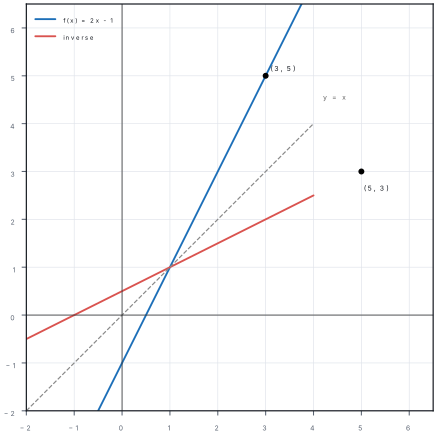
Problem. The point (2,7) lies on the graph of f(x)=x^2+3 (for x\geq 0). Write a point that lies on f^{-1} and find f^{-1}(12).
Solution. Swapping the coordinates, (7,2) lies on f^{-1}. For f^{-1}(12) solve f(x)=12: x^2+3=12, x^2=9, and x=3 (taking x\geq 0). So f^{-1}(12)=3.
12.6 Polynomials
An expression of the form
where n is a non-negative integer and a_n\neq 0, is a polynomial in x of degree n. The numbers a_i are the coefficients, a_n is the leading coefficient and a_0 the constant term.
So 3x^4-2x^2+7 has degree 4, 5x-1 has degree 1 (linear), x^2-9 has degree 2 (quadratic), x^3+x has degree 3 (cubic) and 6 has degree 0. Expressions like x^{-1}+2 or \sqrt{x}+1 are not polynomials, because the powers are not whole numbers. A polynomial is written in standard form when its terms run from the highest power to the lowest.
When polynomials are added, subtracted or multiplied, the degree of a product is the sum of the degrees of the factors. When one polynomial is divided by another, we use the division algorithm.
If p(x) is divided by a non-zero polynomial d(x), there are unique polynomials, the quotient q(x) and the remainder r(x), such that
where r(x)=0 or the degree of r(x) is less than the degree of d(x).
Problem. Divide p(x)=x^3-2x^2+3x-5 by x-2.
Solution. x^3\div x=x^2; subtract x^2(x-2)=x^3-2x^2, leaving 0x^2+3x-5. Next, 0\div x=0, leaving 3x-5. Then 3x\div x=3; subtract 3(x-2)=3x-6, leaving 1.
So the quotient is x^2+3 and the remainder is 1:
Check by expanding: (x-2)(x^2+3)=x^3+3x-2x^2-6; adding 1 gives x^3-2x^2+3x-5. ✓
12.7 The remainder theorem
Long division takes time. When we need only the remainder, there is a shortcut. Divide p(x) by x-a. The remainder is a constant R, and p(x)=(x-a)q(x)+R. Put x=a: the term (x-a)q(x) vanishes, so p(a)=R.
When a polynomial p(x) is divided by x-a, the remainder is p(a). When it is divided by ax+b (with a\neq 0), the remainder is p\left(-\frac{b}{a}\right).
(1) the root of the divisor found first (x-2 gives x=2), (2) substitution into p(x), (3) correct arithmetic with negative numbers, (4) a clear statement "the remainder is …".
Problem. Find the remainder when p(x)=x^3-2x^2+3x-5 is divided by (i) x-2, (ii) x+1, (iii) 2x+1.
Solution. (i) p(2)=8-8+6-5=1. This agrees with the long division above.
(ii) x+1=x-(-1), so the remainder is p(-1)=-1-2-3-5=-11.
(iii) 2x+1=0 gives x=-\frac{1}{2}. p\left(-\frac{1}{2}\right)=-\frac{1}{8}-\frac{1}{2}-\frac{3}{2}-5=-\frac{57}{8}.
Problem. When p(x)=x^3+kx^2-3x+2 is divided by x-2 the remainder is 12. Find k.
Solution. p(2)=8+4k-6+2=4k+4. Setting 4k+4=12 gives k=2.
Problem. The polynomial p(x)=x^3+ax+b leaves remainder 4 when divided by x-1 and is exactly divisible by x+1. Find a and b.
Solution. p(1)=1+a+b=4 so a+b=3. p(-1)=-1-a+b=0 so b-a=1. Adding, 2b=4, b=2, and a=1. So p(x)=x^3+x+2.
12.8 The factor theorem
If the remainder on dividing p(x) by x-a is zero, then x-a divides p(x) exactly, that is, x-a is a factor. The remainder theorem says that the remainder is p(a), so we get the factor theorem at once.
x-a is a factor of p(x) if and only if p(a)=0. In that case a is called a zero (or root) of p(x).
Problem. Show that x-1 is a factor of p(x)=x^3-3x^2+4x-2 and find the other factor.
Solution. p(1)=1-3+4-2=0, so x-1 is a factor. Dividing,
The quadratic factor x^2-2x+2 has discriminant 4-8=-4<0, so it does not factor further over the real numbers.
Problem. For what value of k is x-3 a factor of x^2-5x+k?
Solution. We need p(3)=0: 9-15+k=0, so k=6. Then x^2-5x+6=(x-2)(x-3).
Problem. The polynomial p(x)=x^3+ax^2+bx-6 has x-1 and x+2 as factors. Find a and b and the third factor.
Solution. p(1)=1+a+b-6=0 gives a+b=5. p(-2)=-8+4a-2b-6=0 gives 2a-b=7. Adding, 3a=12, a=4, and b=1. So p(x)=x^3+4x^2+x-6.
Product of the zeros: for a monic cubic the product of the three zeros is -(-6)=6. The known zeros are 1 and -2, so the third is \frac{6}{1\times(-2)}=-3, and the factor is x+3. Hence
12.9 Synthetic division
Dividing by x-a can be done quickly using only the coefficients. This is synthetic division.
- Write the coefficients of p(x) in order (put 0 for any missing power).
- Bring down the first coefficient.
- Multiply it by a, write the product under the next coefficient and add.
- Repeat across the row. The last number is the remainder; the others are the coefficients of the quotient, whose degree is one less than p(x).
Problem. Divide p(x)=2x^3-5x^2+x+6 by x-2.
Solution. Here a=2 and the coefficients are 2,\ -5,\ 1,\ 6.
Bring down 2. Then 2\times 2=4 and -5+4=-1. Next -1\times 2=-2 and 1-2=-1. Next -1\times 2=-2 and 6-2=4.
The row is 2,\ -1,\ -1,\ \mid\ 4. So the quotient is 2x^2-x-1 and the remainder is 4. Check: p(2)=16-20+2+6=4. ✓
Problem. Divide x^3-7x+6 by x-1.
Solution. The x^2 term is missing, so the coefficients are 1,\ 0,\ -7,\ 6 with a=1. Bring down 1; 0+1=1; -7+1=-6; 6-6=0.
The quotient is x^2+x-6 and the remainder is 0, so x-1 is a factor. Further, x^2+x-6=(x+3)(x-2), so
12.10 Zeros of a polynomial and factorisation
To factorise a polynomial of degree 3 or more, we look for a zero by trial, use the factor theorem, divide, and repeat with the quotient.
If a polynomial with whole-number coefficients has a rational zero \frac{m}{n} in lowest terms, then m divides the constant term and n divides the leading coefficient. For a monic polynomial, test the factors of the constant term: \pm1, \pm2, \ldots
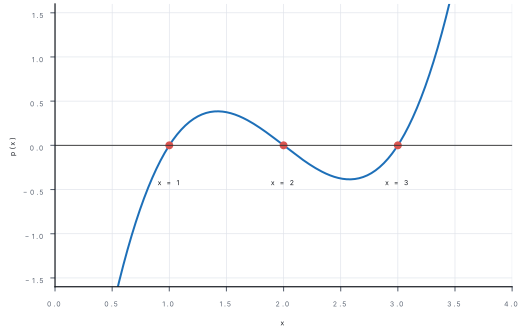
Problem. Factorise p(x)=x^3-6x^2+11x-6.
Solution. The constant term is -6; try its factors. p(1)=1-6+11-6=0, so x-1 is a factor. Synthetic division with a=1: coefficients 1,\ -6,\ 11,\ -6 give 1,\ -5,\ 6,\ \mid\ 0. So
The zeros are 1, 2 and 3.
Problem. Solve 2x^3-3x^2-11x+6=0.
Solution. Let p(x)=2x^3-3x^2-11x+6. Try x=3: 54-27-33+6=0. So x-3 is a factor. Synthetic division with a=3 on 2,\ -3,\ -11,\ 6 gives 2,\ 3,\ -2,\ \mid\ 0, so the quotient is 2x^2+3x-2=(2x-1)(x+2).
Hence p(x)=(x-3)(2x-1)(x+2) and the zeros are x=3,\ \frac{1}{2},\ -2.
Problem. Factorise x^3+2x^2-5x-6.
Solution. p(1)=1+2-5-6=-8\neq0. p(-1)=-1+2+5-6=0, so x+1 is a factor. Synthetic division with a=-1 on 1,\ 2,\ -5,\ -6: 1,\ 1,\ -6,\ \mid\ 0. The quotient is x^2+x-6=(x+3)(x-2), so
- Using p(a) for the divisor x+a. The divisor x+a needs p(-a).
- Forgetting a zero coefficient for a missing power in synthetic division.
- Dividing by 2x-1 with a=1. For 2x-1 use the zero \frac{1}{2} and then divide the quotient by 2.
- Stopping after finding one zero; always factorise the quotient as far as possible.
12.11 Zeros and coefficients
For a quadratic x^2+bx+c with zeros \alpha,\beta we know \alpha+\beta=-b and \alpha\beta=c. The same idea works for a cubic.
If x^3+ax^2+bx+c has zeros \alpha,\beta,\gamma, then
and comparing coefficients,
Problem. The zeros of x^3-6x^2+11x-6 are 1,2,3. Verify the three relations.
Solution. Here a=-6, b=11, c=-6. Sum of zeros =1+2+3=6=-a. Sum of products in pairs =2+3+6=11=b. Product =6=-c. ✓
Problem. Find the monic cubic polynomial whose zeros are 2,\ -1,\ 3.
Solution. p(x)=(x-2)(x+1)(x-3). First (x-2)(x+1)=x^2-x-2. Then (x^2-x-2)(x-3)=x^3-3x^2-x^2+3x-2x+6=x^3-4x^2+x+6.
Check with the relations: sum =2-1+3=4=-(-4) ✓; pair sums 2(-1)+(-1)(3)+3(2)=-2-3+6=1=b ✓; product =-6=-c ✓.
Problem. If (x+2)(x^2+ax+b)=x^3+5x^2+8x+4 for all x, find a and b.
Solution. The left side expands to x^3+(a+2)x^2+(b+2a)x+2b. Equal polynomials have equal coefficients: a+2=5 gives a=3; 2b=4 gives b=2; check b+2a=2+6=8 ✓.
12.12 Exercises of the SEE type
Method for any question
- Function questions: substitute carefully, putting brackets around the replaced value, especially for negatives: f(-2) for x^2-3x is (-2)^2-3(-2)=4+6=10, not -4-6.
- Domain: check each denominator and each square root separately, then combine the conditions.
- Composite: write the inner function first, replace x in the outer function by the whole inner expression, then simplify. Decide the order from the symbol: in f\circ g the function g acts first.
- Inverse: y=f(x), solve for x, interchange the letters, and finish with a numerical check such as f(4)=9 and f^{-1}(9)=4.
- Remainder and factor: write the zero of the divisor, substitute into p(x), and state the conclusion in words. Remainder zero means a factor.
- Factorising a cubic: test \pm1,\pm2,\pm3,\ldots (factors of the constant term), divide synthetically, then factorise the quadratic; list all the factors in the final answer.
- Unknown constants: form one equation for each condition, solve, and substitute back to check.
A good habit is to finish every polynomial question with a quick numerical check: put a convenient value such as x=0 or x=1 into the original polynomial and into the factorised form. If the two values differ, there is an error somewhere in the working, and finding it takes seconds instead of a lost mark.
Problem. If f(x)=2x-3 and g(x)=x+4, find (f\circ g)(x), (g\circ f)(x) and f^{-1}(x). Then show that (f\circ g)(x)\neq(g\circ f)(x).
Solution. (f\circ g)(x)=2(x+4)-3=2x+5. (g\circ f)(x)=(2x-3)+4=2x+1. These differ for every x.
For f^{-1}: y=2x-3 gives x=\frac{y+3}{2}, so f^{-1}(x)=\frac{x+3}{2}.
Problem. When x^3-ax^2+6x-8 is divided by x-2 the remainder is 0. Find a, and factorise the polynomial completely.
Solution. p(2)=8-4a+12-8=12-4a=0, so a=3. Now p(x)=x^3-3x^2+6x-8. Synthetic division with a=2 on 1,\ -3,\ 6,\ -8 gives 1,\ -1,\ 4,\ \mid\ 0, so p(x)=(x-2)(x^2-x+4). The discriminant of x^2-x+4 is 1-16=-15<0, so this is as far as it factorises over the real numbers.
Problem. p(x)=x^2+kx-5 leaves the same remainder when divided by x-1 and by x+2. Find k.
Solution. p(1)=k-4 and p(-2)=4-2k-5=-2k-1. Equating, k-4=-2k-1, so 3k=3 and k=1. The common remainder is -3.
Problem. One zero of x^3-4x^2+kx+6 is 3. Find k and the other zeros.
Solution. p(3)=27-36+3k+6=3k-3=0, so k=1. Now p(x)=x^3-4x^2+x+6. Synthetic division with a=3 on 1,\ -4,\ 1,\ 6 gives 1,\ -1,\ -2,\ \mid\ 0, so p(x)=(x-3)(x^2-x-2)=(x-3)(x-2)(x+1). The zeros are 3,\ 2,\ -1.
Problem. If f(x)=x^2+1 and g(x)=2x-3, find (f\circ g)(x) and (g\circ f)(x), and the values at x=2.
Solution. (f\circ g)(x)=(2x-3)^2+1=4x^2-12x+10. (g\circ f)(x)=2(x^2+1)-3=2x^2-1.
At x=2: (f\circ g)(2)=16-24+10=2; direct check: g(2)=1, f(1)=2 ✓. (g\circ f)(2)=8-1=7; direct check: f(2)=5, g(5)=7 ✓.
Problem. Find the remainder when p(x)=2x^3-3x^2+x-4 is divided by (i) x+1, (ii) 2x-1.
Solution. (i) p(-1)=-2-3-1-4=-10. (ii) The zero of 2x-1 is \frac{1}{2}: p\left(\frac{1}{2}\right)=\frac{2}{8}-\frac{3}{4}+\frac{1}{2}-4=\frac{1}{4}-\frac{3}{4}+\frac{2}{4}-4=-4.
Problem. The binomial x+2 is a factor of x^3+kx^2-4x-12. Find k and all the zeros.
Solution. p(-2)=-8+4k+8-12=4k-12=0, so k=3. Then p(x)=x^3+3x^2-4x-12=x^2(x+3)-4(x+3)=(x+3)(x^2-4)=(x+3)(x-2)(x+2). The zeros are -3,\ 2,\ -2.
Problem. Let f(x)=x^2+2 with domain x\geq 0. Find f^{-1}(x), its domain, and f^{-1}(11).
Solution. y=x^2+2 gives x^2=y-2 and, because x\geq 0, x=\sqrt{y-2}. So f^{-1}(x)=\sqrt{x-2} with domain x\geq 2 (the range of f). f^{-1}(11)=\sqrt{9}=3. Check: f(3)=11 ✓.
Problem. A printer charges Rs c=500+12n to print n copies of a booklet. Find the inverse function and the number of copies for Rs 2,300.
Solution. c=500+12n gives n=\frac{c-500}{12}. For c=2300: n=\frac{1800}{12}=150 copies.
Problem. For f(x)=3x-2 find the value of x for which f(x)=f^{-1}(x).
Solution. f^{-1}(x)=\frac{x+2}{3}. Setting 3x-2=\frac{x+2}{3} gives 9x-6=x+2, so 8x=8 and x=1. This lies on the line y=x, as the mirror-image property predicts: f(1)=1.
Chapter summary
- Relation: a set of ordered pairs; domain = first components, range = second components.
- Function: every element of the domain has exactly one image. Vertical line test; horizontal line test for one-one.
- Domain: exclude zero denominators; keep square-root arguments \geq 0.
- Composite: (f\circ g)(x)=f(g(x)); in general f\circ g\neq g\circ f.
- Inverse: solve y=f(x) for x, then swap letters; the graph of f^{-1} is the mirror image of that of f in y=x.
- Polynomial: degree n, standard form; p(x)=d(x)q(x)+r(x).
- Remainder theorem: remainder on division by x-a is p(a).
- Factor theorem: x-a is a factor iff p(a)=0.
- Synthetic division gives quotient and remainder from the coefficients; factorise cubics by finding one zero, dividing, and factorising the quadratic.
Practice questions
Group A — Multiple choice (1 mark each)
- If f(x)=3x-4, then f(5) is [1]a9b11c19d-1
- The domain of f(x)=\frac{1}{x-5} is [1]aall real numbersbx>5call real numbers except 5dall real numbers except -5
- If f(x)=x+2 and g(x)=x^2, then (g\circ f)(1) is [1]a3b5c9d27
- If f(x)=2x+6, then f^{-1}(4) is [1]a14b-1c1d-5
- The remainder when x^2+x+1 is divided by x-1 is [1]a0b1c3d-1
- x-3 is a factor of x^2-5x+k when k equals [1]a6b-6c2d15
- The degree of (x^2+1)(x^3-x) is [1]a6b5c3d2
Answers to Group A
1. (b) — f(5)=15-4=11.
2. (c) — x-5\neq0.
3. (c) — f(1)=3 and g(3)=9.
4. (b) — f^{-1}(x)=\frac{x-6}{2}, so f^{-1}(4)=-1.
5. (c) — p(1)=1+1+1=3.
6. (a) — 9-15+k=0, so k=6.
7. (b) — the degrees add: 2+3=5.
Group B — Short answer (2 marks each)
- Find the range of f(x)=x^2-1 with domain \{-2,-1,0,1,2\}. [2]
- If f(x)=x^2-2x, find f(3)+f(-1). [2]
- If f(x)=2x+3 and g(x)=x-4, find (f\circ g)(x) and (g\circ f)(x). [2]
- Find the inverse of f(x)=5x+4. [2]
- Find the remainder when x^3+2x^2-x+4 is divided by x+2. [2]
Answers to Group B
1. f(-2)=3, f(-1)=0, f(0)=-1, f(1)=0, f(2)=3. The range is \{-1,0,3\}.
2. f(3)=9-6=3 and f(-1)=1+2=3. The sum is 6.
3. (f\circ g)(x)=2(x-4)+3=2x-5 and (g\circ f)(x)=(2x+3)-4=2x-1.
4. y=5x+4, x=\frac{y-4}{5}, so f^{-1}(x)=\frac{x-4}{5}.
5. p(-2)=-8+8+2+4=6.
Group C — Short answer (3 marks each)
- A linear function f(x)=ax+b has f(1)=5 and f(3)=11. Find a, b and f(10). [3]
- Show that x-1 is a factor of x^3-3x^2+4x-2 and find the quotient. [3]
- When x^3+kx^2-3x+2 is divided by x-2 the remainder is 12. Find k. [3]
- Find the inverse of f(x)=\frac{x+1}{x-2}. [3]
- Use synthetic division to divide 2x^3-5x^2+x+6 by x-2. State the quotient and the remainder. [3]
Answers to Group C
1. a+b=5 and 3a+b=11, so a=3, b=2, f(x)=3x+2 and f(10)=32.
2. p(1)=1-3+4-2=0, so x-1 is a factor. The quotient is x^2-2x+2.
3. p(2)=8+4k-6+2=4k+4=12, so k=2.
4. y(x-2)=x+1, x(y-1)=2y+1, so f^{-1}(x)=\frac{2x+1}{x-1}.
5. Coefficients 2,-5,1,6 with a=2 give 2,-1,-1,\mid 4. Quotient 2x^2-x-1, remainder 4.
Group D — Long answer (4 marks each)
- Factorise x^3-7x+6 completely. [4]
- The polynomial x^3+ax^2+bx-6 has x-1 and x+2 as factors. Find a and b and factorise it. [4]
- If f(x)=x+1 and g(x)=x^2-2x, find x so that (f\circ g)(x)=(g\circ f)(x). [4]
- The polynomial x^3+ax+b leaves remainder 4 on division by x-1 and is exactly divisible by x+1. Find a and b. [4]
- Solve 2x^3-3x^2-11x+6=0. [4]
Answers to Group D
1. p(1)=1-7+6=0. Dividing by x-1 gives x^2+x-6=(x+3)(x-2). So x^3-7x+6=(x-1)(x-2)(x+3).
2. 1+a+b-6=0 gives a+b=5; -8+4a-2b-6=0 gives 2a-b=7. So a=4, b=1 and x^3+4x^2+x-6=(x-1)(x+2)(x+3).
3. (f\circ g)(x)=x^2-2x+1 and (g\circ f)(x)=(x+1)^2-2(x+1)=x^2-1. Equating gives -2x+1=-1, so x=1.
4. 1+a+b=4 and -1-a+b=0. Adding, 2b=4, b=2, a=1.
5. p(3)=54-27-33+6=0. Dividing by x-3 gives 2x^2+3x-2=(2x-1)(x+2). So x=3,\ \frac{1}{2},\ -2.
Practise more: Optional Mathematics question bank