Unit 5 · Units · 17 min read
Conditional Identities, Trigonometric Equations and Height and Distance
What the syllabus asks for 4
- Conditional trigonometric identities
- Trigonometric equations
- Height and distance
- Exercises of the SEE type
This chapter puts the trigonometry of Chapter 4 to work in three ways. First, when the angles of a triangle satisfy A+B+C=180^\circ, a whole family of conditional identities becomes true, and you learn to prove them. Second, you learn to solve trigonometric equations, finding every angle in a given range that makes an equation true. Third, you use right-angled triangles and trigonometric ratios to find heights and distances that cannot be measured directly: the height of a tower, the width of a river, the distance of a boat from a cliff. This is the part of the course where trigonometry becomes surveying.
Expect: (i) prove an identity for angles of a triangle (A+B+C=180^\circ), such as \tan A+\tan B+\tan C=\tan A\tan B\tan C; (ii) solve an equation such as 2\sin^2\theta-\sin\theta-1=0 for 0^\circ\leq\theta\leq360^\circ (give all solutions in the range); (iii) a height-and-distance problem with a figure, using \tan\theta and often \tan30^\circ=\frac{1}{\sqrt{3}}, \tan60^\circ=\sqrt{3}. Draw a clear, labelled diagram first; it earns marks on its own.
5.1 Conditional trigonometric identities
An identity is true for all angles. A conditional identity is true only when the angles satisfy a stated condition. The most common condition is that A, B, C are the angles of a triangle: A+B+C=180^\circ.
If A+B+C=180^\circ then A+B=180^\circ-C and \frac{A+B}{2}=90^\circ-\frac{C}{2}. Hence
| \sin(A+B)=\sin C | \cos(A+B)=-\cos C |
| \tan(A+B)=-\tan C | \sin\frac{A+B}{2}=\cos\frac{C}{2} |
| \cos\frac{A+B}{2}=\sin\frac{C}{2} | \sin2C=-\sin(2A+2B) |
Method: (1) group two of the angles, say A and B; (2) use sum-to-product on them; (3) replace A+B by 180^\circ-C using the table; (4) factor out the common ratio of C and use sum-to-product or product-to-sum again.
We start from the left side and group the first two terms.
Step 1 — sum to product on \sin2A+\sin2B.
Step 2 — use \sin(A+B)=\sin C.
Step 3 — double angle on the third term.
Step 4 — add and factor out 2\sin C.
Step 5 — use \cos C=-\cos(A+B).
Step 6 — product formula \cos(A-B)-\cos(A+B)=2\sin A\sin B:
What it means. The identity holds only for a triangle. Check with the equilateral triangle A=B=C=60^\circ: LHS =3\sin120^\circ=\frac{3\sqrt{3}}{2} and RHS =4\left(\frac{\sqrt{3}}{2}\right)^3=\frac{3\sqrt{3}}{2}. ✓
We start from A+B=180^\circ-C.
Step 1 — take the tangent of both sides.
Step 2 — expand \tan(A+B).
Step 3 — cross-multiply.
Step 4 — bring \tan C to the left.
What it means. In a triangle, the sum and the product of the three tangents are equal. (It needs no right angle: if one angle is 90^\circ its tangent is undefined, so the statement is for non-right triangles.) Check: A=B=C=60^\circ gives 3\sqrt{3}=(\sqrt{3})^3=3\sqrt{3}. ✓
We group A and B and use half-angles for C.
Step 1 — sum to product.
Step 2 — double-angle on \sin C.
Step 3 — add and factor out 2\cos\frac{C}{2}.
Step 4 — use \sin\frac{C}{2}=\cos\frac{A+B}{2}.
Step 5 — sum to product again: \cos\frac{A-B}{2}+\cos\frac{A+B}{2}=2\cos\frac{A}{2}\cos\frac{B}{2}, so
(1) the condition A+B+C=180^\circ written down and used, (2) grouping two angles and using sum-to-product, (3) the replacement such as \sin(A+B)=\sin C, (4) the common factor taken out, (5) stopping when the left side equals the right side.
Problem. If A+B+C=180^\circ prove that (i) \cos2A+\cos2B+\cos2C=-1-4\cos A\cos B\cos C; (ii) \cos A+\cos B+\cos C=1+4\sin\frac{A}{2}\sin\frac{B}{2}\sin\frac{C}{2}.
Solution. (i) \cos2A+\cos2B=2\cos(A+B)\cos(A-B)=-2\cos C\cos(A-B). Also \cos2C=2\cos^2C-1. So
Put \cos C=-\cos(A+B): \cos C-\cos(A-B)=-\left[\cos(A+B)+\cos(A-B)\right]=-2\cos A\cos B. Hence LHS =-4\cos A\cos B\cos C-1.
(ii) \cos A+\cos B=2\cos\frac{A+B}{2}\cos\frac{A-B}{2}=2\sin\frac{C}{2}\cos\frac{A-B}{2}, and \cos C=1-2\sin^2\frac{C}{2}. So
Since \cos\frac{A-B}{2}-\cos\frac{A+B}{2}=2\sin\frac{A}{2}\sin\frac{B}{2}, LHS =1+4\sin\frac{A}{2}\sin\frac{B}{2}\sin\frac{C}{2}.
Problem. If A+B+C=180^\circ prove that \sin^2A+\sin^2B+\sin^2C=2+2\cos A\cos B\cos C.
Solution. \sin^2A+\sin^2B=1-\frac{\cos2A+\cos2B}{2} (since \sin^2\theta=\frac{1-\cos2\theta}{2}). From part (i) above, \cos2A+\cos2B=-2\cos C\cos(A-B), so
Add \sin^2C=1-\cos^2C: LHS =2+\cos C\left[\cos(A-B)-\cos C\right]. With \cos C=-\cos(A+B): \cos(A-B)+\cos(A+B)=2\cos A\cos B, so LHS =2+\cos C\cdot2\cos A\cos B=2+2\cos A\cos B\cos C.
Problem. If A+B+C=90^\circ, prove that \tan A\tan B+\tan B\tan C+\tan C\tan A=1.
Solution. A+B=90^\circ-C, so \tan(A+B)=\cot C=\frac{1}{\tan C}:
Hence \tan A\tan C+\tan B\tan C+\tan A\tan B=1.
- Using the condition in a problem where it is not given. \sin2A+\sin2B+\sin2C=4\sin A\sin B\sin C is false for general angles.
- Writing \cos(A+B)=\cos C. Because A+B=180^\circ-C, \cos(A+B)=-\cos C; only the sine keeps its sign.
- Proving by assuming the result and working on both sides at once. Work on one side and arrive at the other.
- Using A+B+C=90^\circ and 180^\circ conditions interchangeably.
5.2 Trigonometric equations
A trigonometric equation is true only for certain angles. To solve it means to find all angles in the stated range. Always read the range: 0^\circ\leq\theta\leq90^\circ gives one answer, while 0^\circ\leq\theta\leq360^\circ often gives two or more.
Principal value and the other angle
Find the acute angle \alpha (the principal value) from the positive value of the ratio, then use the quadrant rule (All, Sine, Tan, Cos: the letter shows which ratio is positive in the quadrants 1, 2, 3, 4).
| Equation | Solutions in 0^\circ\leq\theta\leq360^\circ |
|---|---|
| \sin\theta=+k | \alpha and 180^\circ-\alpha |
| \sin\theta=-k | 180^\circ+\alpha and 360^\circ-\alpha |
| \cos\theta=+k | \alpha and 360^\circ-\alpha |
| \cos\theta=-k | 180^\circ-\alpha and 180^\circ+\alpha |
| \tan\theta=+k | \alpha and 180^\circ+\alpha |
| \tan\theta=-k | 180^\circ-\alpha and 360^\circ-\alpha |
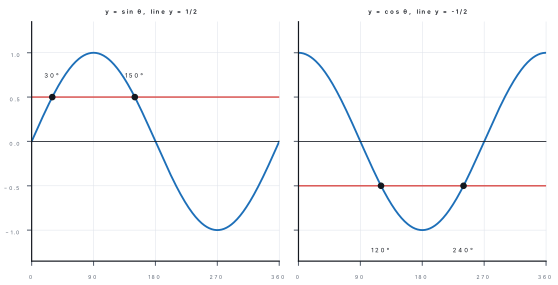
Problem. Solve for 0^\circ\leq\theta\leq360^\circ: (i) 2\sin\theta-1=0; (ii) 2\cos\theta+1=0; (iii) \sqrt{3}\tan\theta=1.
Solution. (i) \sin\theta=\frac{1}{2}. The principal value is 30^\circ, and sine is positive in quadrants 1 and 2: \theta=30^\circ or 180^\circ-30^\circ=150^\circ.
(ii) \cos\theta=-\frac{1}{2}. The principal value is 60^\circ. Cosine is negative in quadrants 2 and 3: \theta=180^\circ-60^\circ=120^\circ or 180^\circ+60^\circ=240^\circ.
(iii) \tan\theta=\frac{1}{\sqrt{3}}, principal value 30^\circ. Tangent is positive in quadrants 1 and 3: \theta=30^\circ or 180^\circ+30^\circ=210^\circ.
Problem. Solve 4\sin^2\theta=\tan^260^\circ for 0^\circ\leq\theta\leq180^\circ.
Solution. \tan^260^\circ=3, so \sin^2\theta=\frac{3}{4} and \sin\theta=\pm\frac{\sqrt{3}}{2}. In 0^\circ\leq\theta\leq180^\circ sine is never negative, so \sin\theta=\frac{\sqrt{3}}{2}: \theta=60^\circ or 120^\circ.
(For 0^\circ\leq\theta\leq360^\circ the negative value would add 240^\circ and 300^\circ.)
Quadratic in one ratio
When the equation contains one ratio in a quadratic form, treat that ratio as the unknown, factorise, and solve each factor. Reject any value outside -1\leq\sin\theta\leq1 (or the cosine range).
Problem. Solve 2\sin^2\theta-\sin\theta-1=0 for 0^\circ\leq\theta\leq360^\circ.
Solution. Let s=\sin\theta: 2s^2-s-1=(2s+1)(s-1)=0, so s=-\frac{1}{2} or s=1.
\sin\theta=1: \theta=90^\circ.
\sin\theta=-\frac{1}{2}: principal value 30^\circ; sine is negative in quadrants 3 and 4: \theta=180^\circ+30^\circ=210^\circ or 360^\circ-30^\circ=330^\circ.
Solutions: \theta=90^\circ,\ 210^\circ,\ 330^\circ.
Using identities first
If two different ratios appear, use an identity (\cos2\theta, \sin^2\theta+\cos^2\theta=1, \csc\theta=\frac{1}{\sin\theta}) to make one ratio.
Problem. Solve \cos2\theta=\sin\theta for 0^\circ\leq\theta\leq360^\circ.
Solution. Use \cos2\theta=1-2\sin^2\theta: 1-2\sin^2\theta=\sin\theta, so 2\sin^2\theta+\sin\theta-1=0, (2\sin\theta-1)(\sin\theta+1)=0.
\sin\theta=\frac{1}{2}: \theta=30^\circ,\ 150^\circ. \sin\theta=-1: \theta=270^\circ.
Solutions: 30^\circ,\ 150^\circ,\ 270^\circ.
Problem. Solve 2\cos^2\theta+3\sin\theta=3 for 0^\circ\leq\theta\leq360^\circ.
Solution. Replace \cos^2\theta=1-\sin^2\theta: 2-2\sin^2\theta+3\sin\theta=3, so 2\sin^2\theta-3\sin\theta+1=0, (2\sin\theta-1)(\sin\theta-1)=0.
\sin\theta=\frac{1}{2}: 30^\circ,\ 150^\circ. \sin\theta=1: 90^\circ. Solutions: 30^\circ,\ 90^\circ,\ 150^\circ.
Problem. Solve \sin2\theta=\sin\theta for 0^\circ\leq\theta\leq180^\circ.
Solution. 2\sin\theta\cos\theta=\sin\theta\Rightarrow\sin\theta\,(2\cos\theta-1)=0.
\sin\theta=0: \theta=0^\circ,\ 180^\circ. \cos\theta=\frac{1}{2}: \theta=60^\circ.
Solutions: 0^\circ,\ 60^\circ,\ 180^\circ. Dividing by \sin\theta would have lost 0^\circ and 180^\circ.
Problem. Solve \csc\theta-2\sin\theta=1 for 0^\circ\leq\theta\leq180^\circ.
Solution. \frac{1}{\sin\theta}-2\sin\theta=1\Rightarrow1-2\sin^2\theta=\sin\theta\Rightarrow2\sin^2\theta+\sin\theta-1=0, i.e. (2\sin\theta-1)(\sin\theta+1)=0.
\sin\theta=\frac{1}{2}: 30^\circ,\ 150^\circ. \sin\theta=-1 gives 270^\circ, outside the range.
Solutions: \theta=30^\circ,\ 150^\circ.
- Giving only the principal value when the range allows more. Always check the other quadrant.
- Dividing both sides by \sin\theta (or \cos\theta): this loses the solutions of \sin\theta=0. Factorise instead.
- Accepting \sin\theta=2 or \cos\theta=-1.5. Sine and cosine lie between -1 and 1.
- Forgetting to check the stated range, for example giving 210^\circ when the range is 0^\circ to 180^\circ.
Problem. Solve for 0^\circ\leq\theta\leq360^\circ: (i) 3\tan^2\theta=1; (ii) 2\cos^2\theta-3\cos\theta+1=0.
Solution. (i) \tan^2\theta=\frac{1}{3}, so \tan\theta=\pm\frac{1}{\sqrt{3}}. For +\frac{1}{\sqrt{3}}: 30^\circ,\ 210^\circ. For -\frac{1}{\sqrt{3}}: 180^\circ-30^\circ=150^\circ and 360^\circ-30^\circ=330^\circ. Solutions: 30^\circ,\ 150^\circ,\ 210^\circ,\ 330^\circ.
(ii) (2\cos\theta-1)(\cos\theta-1)=0. \cos\theta=\frac{1}{2}: \theta=60^\circ,\ 300^\circ. \cos\theta=1: \theta=0^\circ,\ 360^\circ. Solutions: 0^\circ,\ 60^\circ,\ 300^\circ,\ 360^\circ.
5.3 Height and distance
Heights of towers, trees, hills and the width of rivers can be found without climbing or crossing, by measuring an angle and a distance on level ground and using a right-angled triangle.
The angle of elevation of an object is the angle between the horizontal line through the observer's eye and the line of sight, when the object is above the horizontal. The angle of depression is the angle between the horizontal and the line of sight, when the object is below the horizontal.
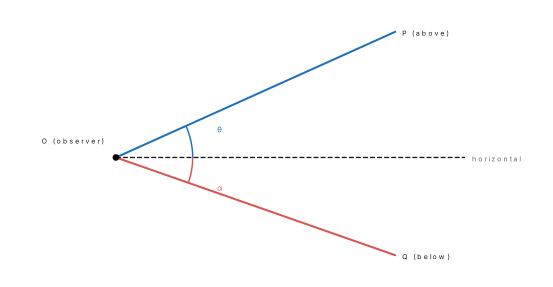
In a right-angled triangle with angle \theta:
- For height h and horizontal distance d: \tan\theta=\frac{h}{d}, so h=d\tan\theta.
- Always draw the figure, mark the right angle, mark the angles of elevation or depression from the horizontal, and label the unknown.
- Useful: \tan30^\circ=\frac{1}{\sqrt{3}}, \tan45^\circ=1, \tan60^\circ=\sqrt{3}, with \sqrt{3}\approx1.732.
Problem. From a point 50 m from the foot of a tower, the angle of elevation of the top of the tower is 60^\circ. Find the height of the tower.
Solution. \tan60^\circ=\frac{h}{50}, so h=50\sqrt{3}\approx50\times1.732=86.6 m.
Problem. From the top of a cliff 60 m high, the angle of depression of a boat is 30^\circ. How far is the boat from the foot of the cliff?
Solution. The angle of elevation of the top of the cliff from the boat is also 30^\circ (alternate angles). Let the distance be d: \tan30^\circ=\frac{60}{d}, so d=\frac{60}{\tan30^\circ}=60\sqrt{3}\approx103.9 m.
Problem. A 10 m ladder leans against a wall and makes an angle of 60^\circ with the ground. How high does it reach and how far is its foot from the wall?
Solution. The ladder is the hypotenuse. Height =10\sin60^\circ=10\cdot\frac{\sqrt{3}}{2}=5\sqrt{3}\approx8.66 m. Distance of the foot =10\cos60^\circ=5 m.
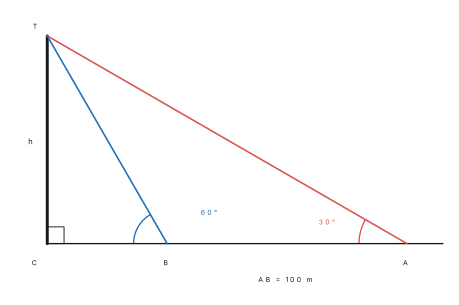
Problem. The angle of elevation of the top of a tower from a point A on the ground is 30^\circ. On moving 100 m towards the tower to a point B, the angle of elevation is 60^\circ. Find the height of the tower and the original distance AC from its foot C.
Solution. Let the height be h and BC=x. In triangle BCT: \tan60^\circ=\frac{h}{x}\Rightarrow x=\frac{h}{\sqrt{3}}. In triangle ACT: \tan30^\circ=\frac{h}{x+100}\Rightarrow x+100=h\sqrt{3}.
Substituting x=\frac{h}{\sqrt{3}}: \frac{h}{\sqrt{3}}+100=h\sqrt{3}\Rightarrow100=h\sqrt{3}-\frac{h}{\sqrt{3}}=\frac{3h-h}{\sqrt{3}}=\frac{2h}{\sqrt{3}}.
So h=50\sqrt{3}\approx86.6 m. Then x=\frac{h}{\sqrt{3}}=50 m and AC=x+100=150 m.
Check: \tan30^\circ=\frac{86.6}{150}=0.577 ✓.
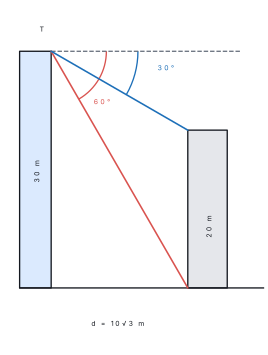
Problem. From the top of a 30 m tower, the angles of depression of the base and the top of a nearby building are 60^\circ and 30^\circ. Find the height of the building and its distance from the tower.
Solution. Let the horizontal distance be d. Base: \tan60^\circ=\frac{30}{d}\Rightarrow d=\frac{30}{\sqrt{3}}=10\sqrt{3}\approx17.32 m.
The top of the building is d\tan30^\circ=10\sqrt{3}\times\frac{1}{\sqrt{3}}=10 m below the top of the tower. So the building is 30-10=20 m high.
Problem. A flagstaff stands on top of a tower. From a point 40 m from the foot of the tower the angles of elevation of the top of the tower and of the top of the flagstaff are 45^\circ and 60^\circ. Find the height of the flagstaff.
Solution. Tower: \tan45^\circ=\frac{h_1}{40}\Rightarrow h_1=40 m. Tower plus flagstaff: \tan60^\circ=\frac{h_1+x}{40}\Rightarrow h_1+x=40\sqrt{3}.
Flagstaff x=40\sqrt{3}-40=40(\sqrt{3}-1)=40(0.732)\approx29.3 m.
Problem. A kite is flying at the end of a 80 m string that is taut and makes an angle of 30^\circ with the horizontal ground. Find the height of the kite above the ground (ignore the sag of the string).
Solution. The string is the hypotenuse: height =80\sin30^\circ=80\times\frac{1}{2}=40 m.
Problem. A student walks 20 m towards the foot of a pole. The angle of elevation of the top changes from 30^\circ to 45^\circ. Find the height of the pole.
Solution. Let the height be h and the final distance from the foot x. \tan45^\circ=\frac{h}{x}\Rightarrow x=h. \tan30^\circ=\frac{h}{x+20}\Rightarrow x+20=h\sqrt{3}.
So h+20=h\sqrt{3}\Rightarrow20=h(\sqrt{3}-1)\Rightarrow h=\frac{20}{\sqrt{3}-1}=\frac{20(\sqrt{3}+1)}{2}=10(\sqrt{3}+1)\approx27.3 m.
Problem. An aeroplane flying 3000 m above level ground passes directly over a point P. Two points A and B on the ground on opposite sides of P are seen from the plane with angles of depression 30^\circ and 60^\circ. Find the distance AB.
Solution. PA=\frac{3000}{\tan30^\circ}=3000\sqrt{3}\approx5196 m and PB=\frac{3000}{\tan60^\circ}=\frac{3000}{\sqrt{3}}=1000\sqrt{3}\approx1732 m. On opposite sides, AB=PA+PB=3000\sqrt{3}+1000\sqrt{3}=4000\sqrt{3}\approx6928 m.
5.4 Exercises of the SEE type
Problem. A tree stands on one bank of a river. From a point directly opposite the tree on the other bank, the angle of elevation of the top of the tree is 60^\circ. From a point 30 m further back, in line, it is 30^\circ. Find the height of the tree and the width of the river.
Solution. Let height =h and width =w. \tan60^\circ=\frac{h}{w}\Rightarrow w=\frac{h}{\sqrt{3}}. \tan30^\circ=\frac{h}{w+30}\Rightarrow w+30=h\sqrt{3}.
\frac{h}{\sqrt{3}}+30=h\sqrt{3}\Rightarrow30=\frac{2h}{\sqrt{3}}\Rightarrow h=15\sqrt{3}\approx25.98 m. Then w=\frac{h}{\sqrt{3}}=15 m.
The tree is about 26 m high and the river is 15 m wide.
Problem. The shadow of a vertical pole on level ground is \sqrt{3} times its height. Find the angle of elevation of the sun.
Solution. \tan\theta=\frac{\text{height}}{\text{shadow}}=\frac{1}{\sqrt{3}}, so \theta=30^\circ.
Problem. (i) In a triangle ABC, prove that \sin A+\sin B+\sin C=4\cos\frac{A}{2}\cos\frac{B}{2}\cos\frac{C}{2} and verify it for A=B=C=60^\circ. (ii) Solve \sin\theta+\cos\theta=1 for 0^\circ\leq\theta\leq360^\circ.
Solution. (i) The proof is in 5.1. Check: LHS =3\sin60^\circ=\frac{3\sqrt{3}}{2}; RHS =4\cos^330^\circ=4\left(\frac{\sqrt{3}}{2}\right)^3=\frac{3\sqrt{3}}{2}. ✓
(ii) Square both sides: \sin^2\theta+2\sin\theta\cos\theta+\cos^2\theta=1\Rightarrow\sin2\theta=0\Rightarrow\theta=0^\circ,\ 90^\circ,\ 180^\circ,\ 270^\circ,\ 360^\circ. Squaring can add false roots, so test each in the original equation: \theta=0^\circ: 0+1=1 ✓; 90^\circ: 1+0=1 ✓; 180^\circ: 0-1=-1 ✗; 270^\circ: -1+0=-1 ✗; 360^\circ: 0+1=1 ✓.
Solutions: \theta=0^\circ,\ 90^\circ,\ 360^\circ.
Chapter summary
- Triangle conditions (A+B+C=180^\circ): \sin(A+B)=\sin C, \cos(A+B)=-\cos C, \tan(A+B)=-\tan C, \sin\frac{A+B}{2}=\cos\frac{C}{2}.
- Identities: \sin2A+\sin2B+\sin2C=4\sin A\sin B\sin C; \tan A+\tan B+\tan C=\tan A\tan B\tan C; \sin A+\sin B+\sin C=4\cos\frac{A}{2}\cos\frac{B}{2}\cos\frac{C}{2}; \cos A+\cos B+\cos C=1+4\sin\frac{A}{2}\sin\frac{B}{2}\sin\frac{C}{2}; \cos2A+\cos2B+\cos2C=-1-4\cos A\cos B\cos C.
- If A+B+C=90^\circ: \tan A\tan B+\tan B\tan C+\tan C\tan A=1.
- Equations: find the principal value \alpha, then use quadrants: \sin\theta=k: \alpha,\ 180^\circ-\alpha; \cos\theta=k: \alpha,\ 360^\circ-\alpha; \tan\theta=k: \alpha,\ 180^\circ+\alpha (for positive k). Factorise, never divide by a ratio, and respect the range.
- Height and distance: \tan\theta=\frac{h}{d}; angle of depression from a point equals the angle of elevation of that point from below (alternate angles). Draw the figure first.
- Two-position problems: write two equations with the same height h and solve; \tan30^\circ=\frac{1}{\sqrt{3}}, \tan60^\circ=\sqrt{3}.
Practice questions
Group A — Multiple choice (1 mark each)
- If A+B+C=180^\circ, then \cos(A+B) equals [1]a\cos Cb-\cos Cc\sin Cd-\sin C
- If A+B+C=180^\circ, then \tan A+\tan B+\tan C equals [1]a\tan A\tan B\tan Cb0c1d\tan A\tan B+\tan B\tan C
- The solutions of 2\sin\theta-1=0 for 0^\circ\leq\theta\leq360^\circ are [1]a30^\circ,\ 330^\circb30^\circ,\ 150^\circc60^\circ,\ 120^\circd30^\circ,\ 210^\circ
- If \tan\theta=\frac{1}{\sqrt{3}} and 0^\circ\leq\theta\leq90^\circ, then \theta is [1]a30^\circb45^\circc60^\circd90^\circ
- The angle of elevation of the top of a tower from a point 20 m from its foot is 45^\circ. The height is [1]a10 mb20 mc20\sqrt{3} md\frac{20}{\sqrt{3}} m
- The angle of depression of an object from an observer equals [1]athe angle of elevation of the observer from the objectb90^\circ minus that anglectwice that anglednone of these
Answers to Group A
1. (b) — A+B=180^\circ-C.
2. (a) — the conditional identity.
3. (b) — \sin\theta=\frac{1}{2} in quadrants 1 and 2.
4. (a) — \tan30^\circ=\frac{1}{\sqrt{3}}.
5. (b) — \tan45^\circ=1, so h=20 m.
6. (a) — alternate angles are equal.
Group B — Short answer (2 marks each)
- If A+B+C=180^\circ, show that \sin(A+B)=\sin C and \cos(A+B)=-\cos C. [2]
- Solve 2\cos\theta+1=0 for 0^\circ\leq\theta\leq360^\circ. [2]
- Solve \sqrt{3}\tan\theta=1 for 0^\circ\leq\theta\leq360^\circ. [2]
- A 10 m ladder makes an angle of 60^\circ with the ground. How high does it reach? [2]
- From the top of a 60 m cliff, the angle of depression of a boat is 30^\circ. Find its distance from the foot of the cliff. [2]
Answers to Group B
1. A+B=180^\circ-C; \sin(180^\circ-C)=\sin C and \cos(180^\circ-C)=-\cos C.
2. \cos\theta=-\frac{1}{2}: \theta=120^\circ or 240^\circ.
3. \tan\theta=\frac{1}{\sqrt{3}}: \theta=30^\circ or 210^\circ.
4. 10\sin60^\circ=5\sqrt{3}\approx8.66 m.
5. d=\frac{60}{\tan30^\circ}=60\sqrt{3}\approx103.9 m.
Group C — Short answer (3 marks each)
- If A+B+C=180^\circ, prove that \tan A+\tan B+\tan C=\tan A\tan B\tan C. [3]
- Solve 2\sin^2\theta-\sin\theta-1=0 for 0^\circ\leq\theta\leq360^\circ. [3]
- Solve \cos2\theta=\sin\theta for 0^\circ\leq\theta\leq360^\circ. [3]
- From a point 50 m from the foot of a tower, the angle of elevation of its top is 60^\circ. Find the height of the tower. [3]
- From a point 40 m from the foot of a tower, the angles of elevation of the tower top and of the top of a flagstaff on it are 45^\circ and 60^\circ. Find the height of the flagstaff. [3]
Answers to Group C
1. \tan(A+B)=-\tan C\Rightarrow\frac{\tan A+\tan B}{1-\tan A\tan B}=-\tan C\Rightarrow\tan A+\tan B=-\tan C+\tan A\tan B\tan C, so the sum equals the product.
2. (2\sin\theta+1)(\sin\theta-1)=0: \sin\theta=1\Rightarrow90^\circ; \sin\theta=-\frac{1}{2}\Rightarrow210^\circ,\ 330^\circ. Solutions 90^\circ,\ 210^\circ,\ 330^\circ.
3. 1-2\sin^2\theta=\sin\theta\Rightarrow(2\sin\theta-1)(\sin\theta+1)=0: 30^\circ,\ 150^\circ,\ 270^\circ.
4. h=50\tan60^\circ=50\sqrt{3}\approx86.6 m.
5. Tower =40\tan45^\circ=40 m; tower plus staff =40\tan60^\circ=40\sqrt{3} m. Flagstaff =40(\sqrt{3}-1)\approx29.3 m.
Group D — Long answer (4 marks each)
- If A+B+C=180^\circ, prove that \sin2A+\sin2B+\sin2C=4\sin A\sin B\sin C. [4]
- If A+B+C=180^\circ, prove that \sin A+\sin B+\sin C=4\cos\frac{A}{2}\cos\frac{B}{2}\cos\frac{C}{2}. [4]
- The angle of elevation of the top of a tower from a point A is 30^\circ. On moving 100 m towards the tower it becomes 60^\circ. Find the height of the tower. [4]
- From the top of a 30 m tower, the angles of depression of the base and the top of a building are 60^\circ and 30^\circ. Find the height of the building. [4]
- Solve 2\cos^2\theta+3\sin\theta=3 for 0^\circ\leq\theta\leq360^\circ. [4]
Answers to Group D
1. \sin2A+\sin2B=2\sin(A+B)\cos(A-B)=2\sin C\cos(A-B). \sin2C=2\sin C\cos C. LHS =2\sin C[\cos(A-B)+\cos C]=2\sin C[\cos(A-B)-\cos(A+B)]=2\sin C\cdot2\sin A\sin B=4\sin A\sin B\sin C.
2. \sin A+\sin B=2\cos\frac{C}{2}\cos\frac{A-B}{2}; \sin C=2\sin\frac{C}{2}\cos\frac{C}{2}. LHS =2\cos\frac{C}{2}[\cos\frac{A-B}{2}+\cos\frac{A+B}{2}]=2\cos\frac{C}{2}\cdot2\cos\frac{A}{2}\cos\frac{B}{2}=4\cos\frac{A}{2}\cos\frac{B}{2}\cos\frac{C}{2}.
3. Let BC=x, height h. x=\frac{h}{\sqrt{3}} and x+100=h\sqrt{3}. So \frac{2h}{\sqrt{3}}=100, h=50\sqrt{3}\approx86.6 m.
4. Distance d=\frac{30}{\tan60^\circ}=10\sqrt{3}. Drop to the building top =d\tan30^\circ=10 m. Height of building =30-10=20 m.
5. 2-2\sin^2\theta+3\sin\theta=3\Rightarrow(2\sin\theta-1)(\sin\theta-1)=0. \sin\theta=\frac{1}{2}: 30^\circ,\ 150^\circ; \sin\theta=1: 90^\circ. Solutions 30^\circ,\ 90^\circ,\ 150^\circ.
Practise more: Optional Mathematics question bank