Unit 7 · Units · 15 min read
Conic Sections and Circle
What the syllabus asks for 5
- Conic sections: circle, parabola, ellipse and hyperbola
- Equation of a circle: centre and radius form
- Diameter form and the general equation of a circle
- Circle through three points and circles under given conditions
- Exercises of the SEE type
A bicycle wheel, the path of a football kicked high, the shape of a satellite dish and the orbit of a planet are all curves you can get by slicing a cone with a flat plane. These curves are the conic sections. The simplest one, the circle, is also the easiest to handle with algebra, because it is just "all points at a fixed distance from a fixed point". This chapter names the four conic sections and then builds the equation of a circle in its three forms: centre–radius, diameter, and general. It ends with the questions the SEE asks: find the centre and radius, find the equation from given conditions, and find the circle through three points.
Expect (i) the centre and radius from an equation such as x^2+y^2-6x+8y-11=0; (ii) the equation of a circle from its centre and radius, or from the ends of a diameter; (iii) the circle through three given points; (iv) a circle that touches the axes or has its centre on given lines. The whole chapter rests on the distance formula d=\sqrt{(x_2-x_1)^2+(y_2-y_1)^2}.
7.1 Conic sections: circle, parabola, ellipse and hyperbola
The cone
Take two lines AB and CD that cross at a point O at an acute angle. Rotate AB about CD. The line AB sweeps out a surface called a right circular cone. The point O is the vertex, CD is the axis, AB is a generator (a slant edge) and the angle between the axis and a generator is the semi-vertical angle \alpha. If the rotation is continued on both sides of O we get a double cone.
Cutting the cone
Cut a cone with a flat plane. The shape of the cut depends on the angle \beta the plane makes with the axis, compared with the semi-vertical angle \alpha of the cone.
| Plane | Section | How to remember it |
|---|---|---|
| perpendicular to the axis (parallel to the base) | circle | cut a carrot straight across |
| tilted, cutting every generator of one nappe | ellipse | cut a carrot at a slant: an oval |
| parallel to one generator (slant edge) | parabola | one open curve, like a thrown ball's path |
| steeper than a generator, cutting both nappes | hyperbola | two separate open branches |
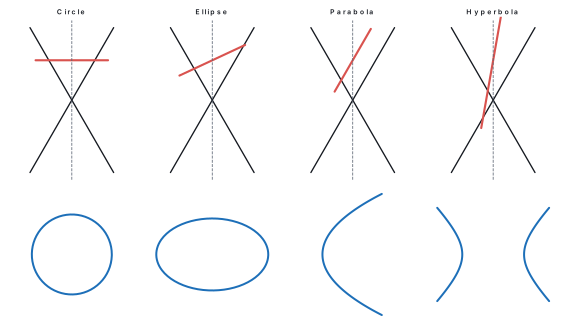
A circle is the special case of an ellipse in which the plane is perpendicular to the axis. In every case the section is a curve with a simple description as a locus (the path of a moving point). For a circle the rule is:
A circle is the locus of a point that moves in a plane so that its distance from a fixed point (the centre) is always constant. The constant distance is the radius.
| Conic | Locus description (for interest) | Eccentricity e |
|---|---|---|
| Circle | fixed distance from the centre | 0 |
| Ellipse | sum of distances from two foci is constant | 0<e<1 |
| Parabola | equal distance from a focus and a line (directrix) | e=1 |
| Hyperbola | difference of distances from two foci is constant | e>1 |
At Grade 10 we study only the equation of the circle; the other conics are met in Grade 11 and 12.
Problem. A plane cuts a cone (i) parallel to its base, (ii) parallel to a slant edge, (iii) at a slant, without being parallel to any edge. Name each section.
Solution. (i) circle; (ii) parabola; (iii) ellipse. If the plane cuts both halves of a double cone, parallel to the axis, we get a hyperbola.
7.2 Equation of a circle: centre and radius form
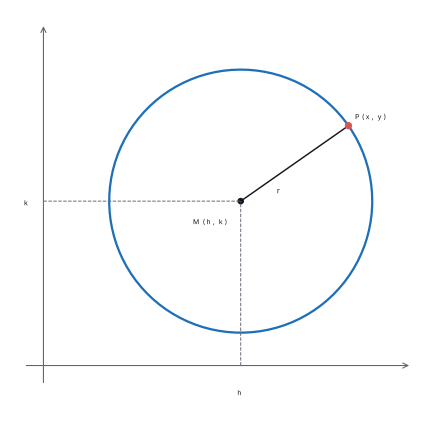
Setting up. Let the centre be M(h,k), the radius r, and let P(x,y) be any point on the circle.
Step 1 — use the definition. P lies on the circle exactly when MP=r.
Step 2 — distance formula.
Step 3 — square both sides.
Result. This is the equation of the circle. If the centre is the origin, h=k=0 and it becomes x^2+y^2=r^2.
What it means. Every point that satisfies the equation is exactly r from the centre, and every point on the circle satisfies it. To read off the centre, take the numbers that are subtracted from x and y (with their signs reversed).
Problem. Find the centre and radius of (a) (x-2)^2+y^2=4; (b) (x+2)^2+(y-1)^2=9; (c) x^2+y^2=25.
Solution. Compare with (x-h)^2+(y-k)^2=r^2.
(a) y^2=(y-0)^2, so h=2, k=0, r^2=4: centre (2,0), radius 2.
(b) (x+2)=(x-(-2)), so h=-2, k=1, r^2=9: centre (-2,1), radius 3.
(c) centre (0,0), radius 5.
Problem. Find the equation of the circle (a) with centre at the origin and radius 4; (b) with centre (-4,5) and radius 6.
Solution. (a) x^2+y^2=16.
(b) (x+4)^2+(y-5)^2=36. Expand: x^2+8x+16+y^2-10y+25=36, so
Problem. A circle has centre (-3,4) and passes through the origin. Find its equation.
Solution. The radius is the distance from the centre to the origin: r=\sqrt{(-3)^2+4^2}=5.
Check: (0,0) gives 0=0. ✓
Circles that touch the axes
A circle of radius r touches the x-axis when the distance from its centre to the axis equals r, i.e. |k|=r. It touches the y-axis when |h|=r. If it touches both axes in the first quadrant, h=k=r.
Problem. Find the equation of the circle of radius 4 that touches both axes in the first quadrant.
Solution. The centre is 4 units from each axis, so (h,k)=(4,4) and r=4.
Problem. Find the equation of the circle with centre (2,3) that touches the x-axis.
Solution. The distance from the centre to the x-axis is |k|=3, so r=3.
7.3 Diameter form and the general equation of a circle
The diameter form
Setting up. Let A(x_1,y_1) and B(x_2,y_2) be the ends of a diameter, and P(x,y) any other point on the circle.
Step 1 — the angle in a semicircle. The angle in a semicircle is a right angle, so \angle APB=90^\circ. Therefore the lines PA and PB are perpendicular and the product of their slopes is -1.
Step 2 — slopes.
Step 3 — clear the fractions.
Result.
What it means. Given only the ends of a diameter, no centre or radius is needed. (The points A and B themselves satisfy the equation, since one factor is zero in each product.)
Problem. Find the equation of the circle whose diameter has ends (4,-1) and (3,-4).
Solution.
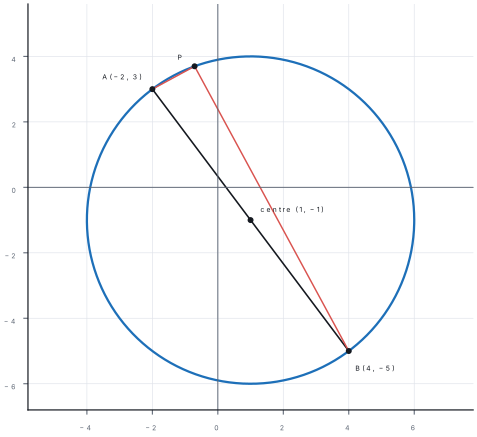
Problem. The ends of a diameter are A(-2,3) and B(4,-5). Find the equation of the circle, its centre and radius.
Solution. (x+2)(x-4)+(y-3)(y+5)=0 gives x^2-2x-8+y^2+2y-15=0, i.e.
Centre = midpoint of AB=\left(\dfrac{-2+4}{2},\dfrac{3-5}{2}\right)=(1,-1). Radius =\dfrac12AB=\dfrac12\sqrt{6^2+8^2}=\dfrac{10}{2}=5.
Check: (x-1)^2+(y+1)^2=25 expands to x^2+y^2-2x+2y-23=0. ✓
The general equation
Expand (x-h)^2+(y-k)^2=r^2:
It has the form of an equation with x^2 and y^2 having equal coefficients (both 1) and no xy term. Write g=-h, f=-k and c=h^2+k^2-r^2:
To find the centre and radius, complete the square:
It is a real circle only if g^2+f^2-c>0. If this is 0 it is a single point; if it is negative there is no real circle. If the equation has ax^2+ay^2+\dots, divide through by a first.
In x^2+y^2+6x-8y+9=0 the coefficient of x is 6=2g, so g=3 and the centre has x-coordinate -3, not +3. The coefficient of y is -8=2f, so f=-4 and the centre is (-3,4). Always halve the coefficient, then change the sign.
Problem. Find the centre and radius of (a) x^2+y^2-6x+8y-11=0; (b) 2x^2+2y^2-4x+8y-8=0.
Solution. (a) 2g=-6\Rightarrow g=-3; 2f=8\Rightarrow f=4; c=-11. Centre =(-g,-f)=(3,-4). Radius =\sqrt{9+16+11}=\sqrt{36}=6.
(b) Divide by 2: x^2+y^2-2x+4y-4=0. g=-1, f=2, c=-4. Centre =(1,-2). Radius =\sqrt{1+4+4}=3.
Problem. Does x^2+y^2+2x+4y+10=0 represent a circle?
Solution. g=1, f=2, c=10. g^2+f^2-c=1+4-10=-5<0. The radius would be \sqrt{-5}, which is not real, so no real circle is represented.
Problem. Find where the circle x^2+y^2-6x-8y=0 meets the coordinate axes.
Solution. Put y=0: x^2-6x=0\Rightarrow x(x-6)=0, so x=0 or 6. The circle meets the x-axis at (0,0) and (6,0).
Put x=0: y^2-8y=0\Rightarrow y=0 or 8. It meets the y-axis at (0,0) and (0,8).
The centre is (3,4) and the radius is 5.
Position of a point
For a circle x^2+y^2+2gx+2fy+c=0 and a point (x_1,y_1), let S_1=x_1^2+y_1^2+2gx_1+2fy_1+c.
| Value of S_1 | Point is |
|---|---|
| S_1<0 | inside the circle |
| S_1=0 | on the circle |
| S_1>0 | outside the circle |
For x^2+y^2-6x-8y=0: the point (1,1) gives 1+1-6-8=-12<0, inside; the point (6,8) gives 36+64-36-64=0, on the circle; the point (8,8) gives 64+64-48-64=16>0, outside.
7.4 Circle through three points and circles under given conditions
Three points not on one line determine exactly one circle. Substitute each point into x^2+y^2+2gx+2fy+c=0 to get three linear equations in g, f and c and solve them.
Problem. Find the equation of the circle through (1,1), (4,4) and (5,1).
Solution. Substitute each point into x^2+y^2+2gx+2fy+c=0:
- (1,1): 2+2g+2f+c=0 — equation (i)
- (4,4): 32+8g+8f+c=0 — equation (ii)
- (5,1): 26+10g+2f+c=0 — equation (iii)
(iii) − (i): 24+8g=0, so g=-3. (ii) − (i): 30+6g+6f=0, so g+f=-5 and f=-2. Then (i): 2-6-4+c=0, so c=8.
Centre (3,2), radius \sqrt{9+4-8}=\sqrt{5}.
Problem. Find the circle through (0,0), (6,0) and (0,8).
Solution. (0,0) gives c=0. (6,0): 36+12g=0, g=-3. (0,8): 64+16f=0, f=-4.
Centre (3,4), radius 5. (The angle at the origin is 90^\circ, so the hypotenuse from (6,0) to (0,8) of length 10 is a diameter. ✓)
A shortcut: the centre is equidistant
The centre (h,k) is the same distance from all three points. Setting (h-x_1)^2+(k-y_1)^2=(h-x_2)^2+(k-y_2)^2 gives a linear equation in h and k (the perpendicular bisector of the chord). Two such equations give the centre; then the radius is the distance to any one point.
Problem. Find the centre and radius of the circle through A(1,1), B(4,4) and C(5,1), using equal distances.
Solution. Let the centre be M(h,k). MA=MC: (h-1)^2+(k-1)^2=(h-5)^2+(k-1)^2\Rightarrow-2h+1=-10h+25\Rightarrow h=3.
MA=MB: (h-1)^2+(k-1)^2=(h-4)^2+(k-4)^2\Rightarrow-2h-2k+2=-8h-8k+32\Rightarrow6h+6k=30\Rightarrow h+k=5. With h=3, k=2.
Centre (3,2); r^2=MA^2=(3-1)^2+(2-1)^2=5. Equation (x-3)^2+(y-2)^2=5. ✓ (same as above)
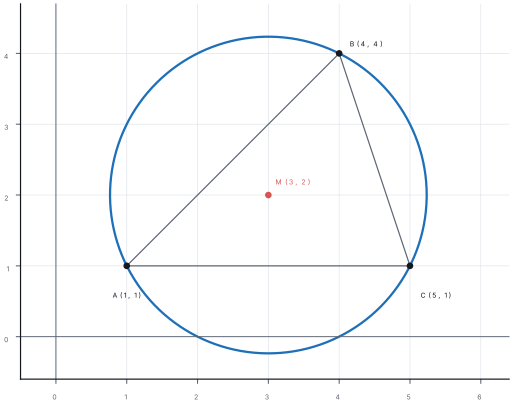
Problem. Show that (1,1), (4,4), (5,1) and (4,0) lie on one circle.
Solution. The circle through the first three is x^2+y^2-6x-4y+8=0. For (4,0): 16+0-24-0+8=0. ✓ The fourth point satisfies the equation, so the four points are concyclic.
Problem. Find the circle whose centre is the point of intersection of x+y=5 and x-y=1 and which passes through the origin.
Solution. Adding the equations: 2x=6, x=3; then y=2. Centre (3,2). Radius^2=3^2+2^2=13.
Problem. A circle passes through (2,0) and (0,2) and its centre lies on the line x=y. Find its equation when it also passes through (4,2).
Solution. Use the general form with the three points. (2,0): 4+4g+c=0. (0,2): 4+4f+c=0. (4,2): 20+8g+4f+c=0. The first two give g=f. Then 20+12g+c=0 and 4+4g+c=0: subtract, 16+8g=0, so g=-2, f=-2 and c=4.
Centre (2,2) (on x=y ✓), radius \sqrt{4+4-4}=2.
The correct choice of form: centre–radius if the centre is known; diameter form if the ends of a diameter are given; general form with three simultaneous equations if three points are given. Marks are given for the substitutions, solving for g,f,c, and the final equation in the form x^2+y^2+2gx+2fy+c=0.
7.5 Exercises of the SEE type
Method for any question
- Read what is given: centre and radius, a diameter, three points, or a condition (touching an axis, centre on a line).
- Choose the form: (x-h)^2+(y-k)^2=r^2, the diameter form, or x^2+y^2+2gx+2fy+c=0.
- For centre and radius from a general equation: divide so the coefficient of x^2 is 1; halve the x and y coefficients and change signs.
- Always expand to the form x^2+y^2+\dots=0 if the question says "find the equation", unless the centre–radius form is asked.
- Check one given point in your final equation.
Chapter summary
- Conic sections: circle (cut parallel to base), ellipse (slanted cut), parabola (cut parallel to a generator), hyperbola (cut of a double cone steeper than a generator).
- A circle is the locus of a point at a fixed distance (radius) from a fixed point (centre).
- Centre–radius form: (x-h)^2+(y-k)^2=r^2; with centre at the origin, x^2+y^2=r^2.
- Diameter form: (x-x_1)(x-x_2)+(y-y_1)(y-y_2)=0.
- General form: x^2+y^2+2gx+2fy+c=0 with centre (-g,-f) and radius \sqrt{g^2+f^2-c}.
- It is a real circle only if g^2+f^2-c>0.
- A circle touches the x-axis if r=|k|, the y-axis if r=|h|; touching both in the first quadrant, h=k=r.
- Circle through three points: substitute into the general form and solve for g,f,c.
Practice questions
Group A — Multiple choice (1 mark each)
- The section of a cone cut by a plane parallel to its base is a [1]aparabolabellipseccircledhyperbola
- The centre of the circle (x-3)^2+(y+4)^2=49 is [1]a(3,4)b(-3,4)c(3,-4)d(-3,-4)
- The radius of the circle x^2+y^2-4x+6y-12=0 is [1]a3b4c5d25
- The equation of the circle with centre at the origin and radius 5 is [1]ax^2+y^2=5bx^2+y^2=10cx^2+y^2=25dx+y=25
- The circle x^2+y^2-8x-8y+16=0 touches [1]aonly the x-axisbonly the y-axiscboth axesdneither axis
Answers to Group A
1. (c) — a cut parallel to the base is a circle.
2. (c) — (x-3)^2+(y-(-4))^2 gives centre (3,-4).
3. (c) — g=-2, f=3, c=-12: r=\sqrt{4+9+12}=5.
4. (c) — r^2=25.
5. (c) — centre (4,4) and r=\sqrt{16+16-16}=4, so the distance to each axis equals the radius.
Group B — Short answer (2 marks each)
- Find the equation of the circle with centre (0,0) and radius 7. [2]
- Find the centre and radius of (x+1)^2+(y-2)^2=16. [2]
- Find the equation of the circle with centre (1,-2) and radius 3. [2]
- Find the equation of the circle whose diameter has ends (0,0) and (6,8). [2]
Answers to Group B
1. x^2+y^2=49.
2. Centre (-1,2), radius 4.
3. (x-1)^2+(y+2)^2=9\Rightarrow x^2+y^2-2x+4y-4=0.
4. (x-0)(x-6)+(y-0)(y-8)=0\Rightarrow x^2+y^2-6x-8y=0.
Group C — Short answer (3 marks each)
- Find the centre and radius of x^2+y^2+10x-4y+13=0. [3]
- Find the equation of the circle with centre (2,-3) passing through (5,1). [3]
- Find the equation of the circle of radius 5 that touches both axes in the first quadrant. [3]
- Show that the point (3,4) lies on the circle x^2+y^2=25 and find whether (2,5) is inside or outside it. [3]
Answers to Group C
1. g=5, f=-2, c=13. Centre (-5,2). r=\sqrt{25+4-13}=\sqrt{16}=4.
2. r^2=(5-2)^2+(1+3)^2=9+16=25. (x-2)^2+(y+3)^2=25\Rightarrow x^2+y^2-4x+6y-12=0.
3. Centre (5,5), r=5: (x-5)^2+(y-5)^2=25\Rightarrow x^2+y^2-10x-10y+25=0.
4. 3^2+4^2=25, so (3,4) is on the circle. For (2,5): 4+25=29>25, so it is outside.
Group D — Long answer (4 marks each)
- Find the equation of the circle passing through (2,0), (0,2) and (4,2). Write down its centre and radius. [4]
- Find the equation of the circle whose centre is the point of intersection of 2x+y=7 and x-y=-1 and whose radius is 3. [4]
- Find the equation of the circle whose diameter has ends (-3,2) and (5,-4). Does it pass through the origin? [4]
- Find where the circle x^2+y^2-10x-24y=0 meets the axes and the length of its diameter. [4]
Answers to Group D
1. Using the general form (see the worked example): x^2+y^2-4x-4y+4=0, centre (2,2), radius 2.
2. Adding: 3x=6, x=2; then y=3. Centre (2,3), r=3. (x-2)^2+(y-3)^2=9\Rightarrow x^2+y^2-4x-6y+4=0.
3. (x+3)(x-5)+(y-2)(y+4)=0\Rightarrow x^2-2x-15+y^2+2y-8=0\Rightarrow x^2+y^2-2x+2y-23=0. At (0,0): -23\neq0, so it does not pass through the origin.
4. g=-5, f=-12, c=0. Centre (5,12), r=\sqrt{25+144}=13, diameter 26. y=0: x^2-10x=0, x=0,10. x=0: y^2-24y=0, y=0,24. It meets the axes at (0,0), (10,0) and (0,24).
Practise more: Optional Mathematics question bank