Unit 10 · Units · 13 min read
Continuity
What the syllabus asks for 4
- Limit of a function: left-hand and right-hand limits
- Continuity and discontinuity on the number line and in graphs
- Continuity of a function at a point
- Exercises of the SEE type
A river flows without a break; the number of students in a class jumps from 40 to 41 with nothing in between. Mathematics calls the first kind of change continuous and the second discontinuous. To make this precise we need one idea: the limit of a function — the value that f(x) gets closer and closer to as x approaches a point. This chapter builds that idea from tables of values, uses it to test continuity at a point, and prepares you for the calculus you will meet in Grade 11.
Expect (i) the limit of a function from a table of values or by simple algebra; (ii) a graph of a function and a decision, with a reason, on whether it is continuous at a point; (iii) the test for a piecewise function: compare the left-hand limit, the right-hand limit and the value f(a); (iv) the value of k that makes a function continuous. The test is always three numbers: \lim_{x\to a^-}f(x), \lim_{x\to a^+}f(x) and f(a).
10.1 Limit of a function: left-hand and right-hand limits
The idea of a limit
Inscribe a regular polygon in a circle. As the number of sides n increases without end (n\to\infty), the polygon becomes more and more like the circle. We say the limit of the polygon is the circle.
For a function the idea is the same. Take f(x)=x^2 and let x come close to 2 from below and from above.
| x (from the left) | 1.9 | 1.99 | 1.999 | x (from the right) | 2.1 | 2.01 | 2.001 | |
|---|---|---|---|---|---|---|---|---|
| f(x)=x^2 | 3.61 | 3.9601 | 3.996001 | f(x)=x^2 | 4.41 | 4.0401 | 4.004001 |
As x approaches 2 from the left (written x\to2^-), f(x) approaches 4. As x approaches 2 from the right (x\to2^+), f(x) also approaches 4.
- The left-hand limit \displaystyle\lim_{x\to a^-}f(x)=L_1 is the value f(x) approaches as x approaches a through values less than a.
- The right-hand limit \displaystyle\lim_{x\to a^+}f(x)=L_2 is the value f(x) approaches as x approaches a through values greater than a.
- The limit \displaystyle\lim_{x\to a}f(x)=L exists only if L_1=L_2=L.
The limit describes what happens near a, not at a. The function may even be undefined at a, as in the next example. That is exactly why limits are useful.
A limit where the function is undefined
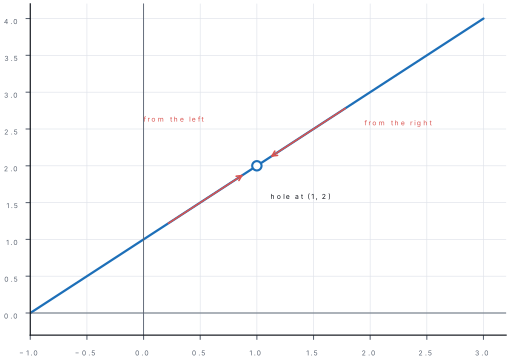
Let f(x)=\dfrac{x^2-1}{x-1}. At x=1 the function is \dfrac00, which has no value. Look at points near 1:
| x | 0.9 | 0.99 | 0.999 | 1.001 | 1.01 | 1.1 |
|---|---|---|---|---|---|---|
| f(x) | 1.9 | 1.99 | 1.999 | 2.001 | 2.01 | 2.1 |
Both sides approach 2, so \displaystyle\lim_{x\to1}\dfrac{x^2-1}{x-1}=2 even though f(1) does not exist. The reason is visible after factorising: for x\neq 1,
The graph is the straight line y=x+1 with a hole at (1,2).
Finding limits by algebra
Tables show the idea but take time. In an exam you may use these rules (the limit of a sum, difference, product and quotient is the sum, difference, product and quotient of the limits, provided the denominator's limit is not zero):
- Substitute x=a. For a polynomial, or any expression that stays defined at a, this gives the limit.
- If you get \dfrac00, factorise the numerator and denominator, cancel the common factor (x-a), then substitute.
- Check one-sided limits when the function is defined by different formulas on the two sides of a.
Problem. Find \displaystyle\lim_{x\to2}(3x^2-5x+4).
Solution. The expression is a polynomial, so substitute: 3(4)-5(2)+4=12-10+4=6.
Problem. Find \displaystyle\lim_{x\to3}\dfrac{x^2-9}{x-3}.
Solution. Substituting x=3 gives \dfrac00. Factorise: \dfrac{x^2-9}{x-3}=\dfrac{(x-3)(x+3)}{x-3}=x+3 for x\neq 3. Therefore
(Table check: f(2.99)=5.99 and f(3.01)=6.01.)
Problem. Find \displaystyle\lim_{x\to2}\dfrac{x^2-5x+6}{x-2}.
Solution. x^2-5x+6=(x-2)(x-3), so for x\neq 2 the fraction is x-3. The limit is 2-3=-1.
Problem. Let f(x)=3x+5 for x<1 and f(x)=9x-1 for x\geq 1. Find \displaystyle\lim_{x\to1^-}f(x) and \displaystyle\lim_{x\to1^+}f(x).
Solution. For x just below 1 the formula is 3x+5: the left-hand limit is 3(1)+5=8.
For x just above 1 the formula is 9x-1: the right-hand limit is 9(1)-1=8.
Both are 8, so \displaystyle\lim_{x\to1}f(x)=8.
In \dfrac{x^2-9}{x-3} you may cancel (x-3) only after writing x^2-9=(x-3)(x+3). Also, \dfrac00 does not mean the limit is 0 or "does not exist": it means more work is needed.
10.2 Continuity and discontinuity on the number line and in graphs
On the number line
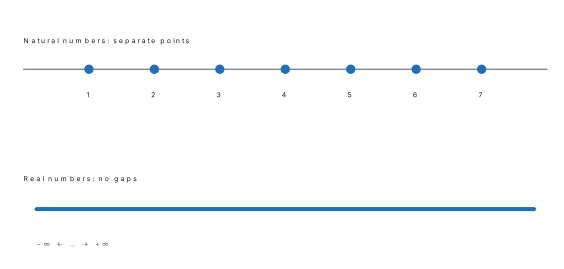
Think of a line with no gaps. Between any two real numbers there is another real number, so the set of real numbers \mathbb{R} is continuous. Other familiar sets are not.
| Set | Is there always an element between two elements? | Continuous? |
|---|---|---|
| Natural numbers \{1,2,3,\dots\} | No — nothing between 4 and 5 | No |
| Whole numbers \{0,1,2,\dots\} | No | No |
| Integers | No — nothing between -2 and -1 | No |
| Rational numbers (fractions) | Yes, but irrational numbers such as \sqrt{2} are missing | No (has gaps) |
| Irrational numbers | Rational numbers are missing between them | No |
| Real numbers | Yes — no gaps | Yes |
The same difference appears in everyday life: the height of a plant, the weight of a person, or the water level of a river changes continuously (it takes every value in between); the number of students present or the number of goals scored changes in steps, with nothing in between.
In graphs
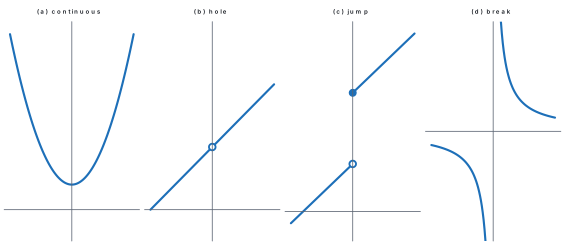
Look at the graph of a function around a point x=c.
A function is continuous at x=c if its graph has no break, jump, gap or hole at x=c — you could draw through that point without lifting your pencil. Otherwise it is discontinuous at x=c.
Problem. The graph of y=\sin x is drawn for -180^\circ<x<360^\circ. Is it continuous at x=-90^\circ and at x=180^\circ?
Solution. The sine graph is one smooth curve with no break, jump, gap or hole anywhere in this interval. It can be drawn without lifting the pencil, so it is continuous at x=-90^\circ (where \sin x=-1) and at x=180^\circ (where \sin x=0).
Problem. Draw the graph of f(x)=x for -3\leq x<0 and f(x)=x+2 for 0\leq x\leq 3 and decide whether it is continuous at x=0.
Solution. The left part ends at (0,0) — but that point is not drawn from the right side. The right part starts at (0,2). The two pieces do not meet: there is a jump from 0 to 2. Hence f is discontinuous at x=0.
10.3 Continuity of a function at a point
Graphs show the idea, but exams want numbers. Put the three observations together.
A function f is continuous at x=a if all three hold:
- f(a) is defined;
- \displaystyle\lim_{x\to a^-}f(x) and \displaystyle\lim_{x\to a^+}f(x) exist and are equal;
- this common limit equals f(a).
If any one fails, f is discontinuous at a.
Polynomials (3x+2, x^2-4x+1, …) are continuous at every real number, because the limit is always found by substitution. Trouble appears only for piecewise functions (different formulas on the two sides of a) and for fractions whose denominator is zero at a.
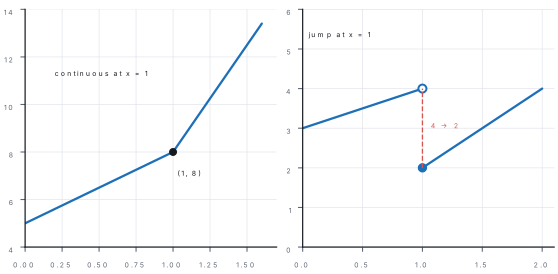
Problem. Examine the continuity of f(x)=3x+5 for x<1, f(x)=9x-1 for x\geq 1 at x=1.
Solution. f(1)=9(1)-1=8 (the formula for x\geq 1 applies at x=1).
Left-hand limit: \displaystyle\lim_{x\to1^-}(3x+5)=8. Right-hand limit: \displaystyle\lim_{x\to1^+}(9x-1)=8.
\lim_{x\to1^-}f(x)=\lim_{x\to1^+}f(x)=f(1)=8, so f is continuous at x=1.
Problem. Examine the continuity of f(x)=x+3 for x<1 and f(x)=2x for x\geq 1 at x=1.
Solution. f(1)=2(1)=2.
Left-hand limit: \displaystyle\lim_{x\to1^-}(x+3)=4. Right-hand limit: \displaystyle\lim_{x\to1^+}2x=2.
The two limits are different (4\neq 2), so the limit does not exist and f is discontinuous at x=1 (a jump of 2).
Problem. f(x)=\dfrac{x^2-4}{x-2} for x\neq 2 and f(2)=3. Is f continuous at x=2?
Solution. For x\neq 2, f(x)=\dfrac{(x-2)(x+2)}{x-2}=x+2, so both one-sided limits at 2 equal 4.
But f(2)=3\neq 4. The limit is not equal to the value, so f is discontinuous at x=2.
If we redefine f(2)=4 the function becomes continuous: this kind of discontinuity can be "repaired".
Problem. Is f(x)=\dfrac{x^2-1}{x-1} continuous at x=1? At x=2?
Solution. At x=1: f(1)=\dfrac00 is undefined, so condition 1 fails. f is discontinuous at x=1 (the limit is 2 but there is no value).
At x=2: f(2)=\dfrac{4-1}{2-1}=3; \lim_{x\to2^-}f(x)=\lim_{x\to2^+}f(x)=2+1=3. All three agree, so f is continuous at x=2.
Problem. Find k so that f(x)=3x+k for x<2 and f(x)=x^2+1 for x\geq 2 is continuous at x=2.
Solution. f(2)=4+1=5. Right-hand limit =5. Left-hand limit =3(2)+k=6+k.
Continuity needs 6+k=5, so k=-1.
Problem. Find k if f(x)=\dfrac{x^2-9}{x-3} for x\neq 3 and f(3)=k is continuous at x=3.
Solution. For x\neq 3, f(x)=x+3, so \lim_{x\to3}f(x)=6. Continuity needs f(3)=6, so k=6.
Problem. f(x)=x for x<0, f(0)=0 and f(x)=x^2 for x>0. Is f continuous at x=0?
Solution. Left-hand limit =0, right-hand limit =0^2=0, f(0)=0. All three equal 0: f is continuous at x=0.
Problem. Is f(x)=\dfrac{1}{x-2} continuous at x=2?
Solution. f(2)=\dfrac10 is undefined. Also, just left of 2 the values are huge and negative (f(1.99)=-100), just right of 2 they are huge and positive (f(2.01)=100). The one-sided limits do not approach a number, so f is discontinuous at x=2 (a break). It is continuous at every other real number.
Three separate lines: left-hand limit, right-hand limit, value of the function. Then a comparison and a conclusion in words: "Since \lim_{x\to a^-}f(x)=\lim_{x\to a^+}f(x)=f(a), f is continuous at x=a." For a table question, show at least two values on each side.
10.4 Exercises of the SEE type
Method for any question
- Limit: substitute; if \dfrac00, factorise and cancel; if the formula changes at the point, find left and right limits separately.
- Continuity at x=a: find f(a); find the left-hand limit with the formula for x<a; find the right-hand limit with the formula for x>a.
- Compare the three values and state the conclusion.
- Find k: set the left limit, right limit and f(a) equal and solve.
- From a graph: look for a break, jump, gap or hole.
Chapter summary
- \displaystyle\lim_{x\to a^-}f(x) is the left-hand limit; \displaystyle\lim_{x\to a^+}f(x) the right-hand limit. The limit exists only if they are equal.
- The limit depends on values near a, not on f(a) itself.
- To find a limit: substitute; if \dfrac00, factorise and cancel.
- The real number line is continuous (no gaps); natural numbers, integers and rational numbers are not.
- A graph is continuous at x=c if it has no break, jump, gap or hole there.
- f is continuous at x=a if \lim_{x\to a^-}f(x)=\lim_{x\to a^+}f(x)=f(a).
- Polynomials are continuous everywhere; piecewise functions and fractions need checking at the joining point or where the denominator is zero.
- To find k: equate the left limit, right limit and f(a).
Practice questions
Group A — Multiple choice (1 mark each)
- \displaystyle\lim_{x\to2}(x+5) is [1]a2b5c7d10
- The set that is continuous on the number line is [1]anatural numbersbintegerscrational numbersdreal numbers
- f is continuous at x=a if [1]af(a) existsb\lim_{x\to a}f(x) existsc\lim_{x\to a^-}f(x)=\lim_{x\to a^+}f(x)=f(a)df(a)=0
- \displaystyle\lim_{x\to4}\dfrac{x^2-16}{x-4}= [1]a0b4c8ddoes not exist
- A graph with a "jump" at x=c is [1]acontinuousbdiscontinuousca straight linedalways zero
Answers to Group A
1. (c) — substitute: 2+5=7.
2. (d) — only the real line has no gaps.
3. (c) — all three conditions are needed.
4. (c) — \frac{(x-4)(x+4)}{x-4}=x+4\to8.
5. (b) — a jump is a break in the graph.
Group B — Short answer (2 marks each)
- If f(x)=3x+2, find f(2.001) and f(1.999) and write \lim_{x\to2}f(x). [2]
- Find \displaystyle\lim_{x\to5}\dfrac{x^2-25}{x-5}. [2]
- Name one example each of continuous and discontinuous change from daily life. [2]
- Is f(x)=x^2+1 continuous at x=3? Give a reason. [2]
Answers to Group B
1. f(2.001)=8.003, f(1.999)=7.997; both approach 8, so \lim_{x\to2}f(x)=8.
2. \frac{(x-5)(x+5)}{x-5}=x+5\to10.
3. Continuous: the height of a growing plant. Discontinuous: the number of students present (changes in whole-number steps).
4. Yes — it is a polynomial; left limit = right limit =f(3)=10.
Group C — Short answer (3 marks each)
- Examine the continuity of f(x)=2x+1 for x<2 and f(x)=x+3 for x\geq 2 at x=2. [3]
- Find k if f(x)=kx+3 for x<1 and f(x)=5-x for x\geq 1 is continuous at x=1. [3]
- Find \displaystyle\lim_{x\to-2}\dfrac{x^2+5x+6}{x+2}. [3]
- For f(x)=\dfrac{x^2-1}{x-1} (x\neq 1), f(1)=3, test continuity at x=1. [3]
Answers to Group C
1. f(2)=2+3=5. Left limit =2(2)+1=5. Right limit =2+3=5. All equal 5: continuous at x=2.
2. f(1)=5-1=4; right limit =4; left limit =k+3. So k+3=4, k=1.
3. x^2+5x+6=(x+2)(x+3); the fraction is x+3 for x\neq -2; limit =-2+3=1.
4. For x\neq 1, f(x)=x+1, so both limits are 2; but f(1)=3\neq 2. Discontinuous at x=1.
Group D — Long answer (4 marks each)
- Examine the continuity of f(x)=x^2 for x<0, f(0)=1 and f(x)=2x for x>0 at x=0, giving a reason. [4]
- Find the values of \displaystyle\lim_{x\to3^-}f(x) and \displaystyle\lim_{x\to3^+}f(x) for f(x)=\dfrac{x^2-9}{x-3} (using x=2.99, 2.999, 3.01, 3.001) and decide whether f is continuous at x=3. [4]
- Find k so that f(x)=\dfrac{x^2-x-6}{x-3} for x\neq 3 and f(3)=k is continuous at x=3. Then state whether f is continuous at x=-1. [4]
- A taxi charges Rs 50 for the first kilometre and Rs 30 for each further kilometre or part of a kilometre. Draw the graph for 0<x\leq 4 of f(x)=50 for 0<x\leq 1, 80 for 1<x\leq 2, 110 for 2<x\leq 3, 140 for 3<x\leq 4 and state where it is discontinuous. [4]
Answers to Group D
1. Left limit =0^2=0. Right limit =2(0)=0. But f(0)=1\neq 0. The limit exists (equal to 0) but differs from f(0), so f is discontinuous at x=0.
2. f(2.99)=5.99, f(2.999)=5.999 so the left limit is 6; f(3.01)=6.01, f(3.001)=6.001 so the right limit is 6. But f(3)=\frac00 is undefined, so f is not continuous at x=3.
3. x^2-x-6=(x-3)(x+2), so f(x)=x+2 for x\neq 3 and the limit at 3 is 5. Continuity needs k=5. At x=-1: f(-1)=1 and both limits are 1, so f is continuous at x=-1.
4. The graph is a staircase of four horizontal segments. At x=1: left value 50, right limit 80 (jump of 30); at x=2: jump from 80 to 110; at x=3: jump from 110 to 140. It is discontinuous at x=1, 2 and 3 and continuous elsewhere.
Practise more: Optional Mathematics question bank