Question bank · 19 min read
Optional Mathematics: Unit-wise Objective Question Bank
Optional Mathematics is the paper where a single mark costs the least work and the most care. Group A of the SEE paper carries ten one-mark items and the first item of almost every later group is also a one-line recall, so roughly a quarter of the paper can be won or lost on formulas that take ten seconds each. This chapter drills those items unit by unit, in multiple-choice form, so that every answer can be checked instantly and every mistake has a name.
Each section opens with a facts line — the four to six results that the items in that section actually use — then gives items, then gives a key with a one-line reason. Work an item in under a minute; correct it in ten seconds; move on.
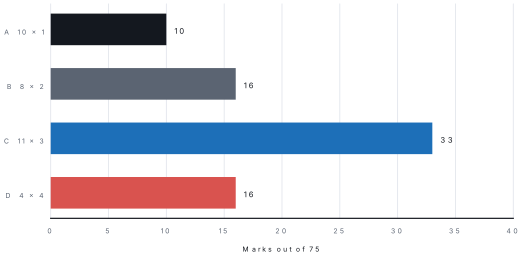
| Group | Items | Marks each | Total | What it tests |
|---|---|---|---|---|
| A | 10 | 1 | 10 | direct recall, single step |
| B | 8 | 2 | 16 | one short method |
| C | 11 | 3 | 33 | a full short-answer method |
| D | 4 | 4 | 16 | longer method, proof or construction |
| Total | 33 | 75 | 3 hours |
Group A is 13% of the paper but takes about 10 of the 180 minutes. It is also the only group with no method marks to fall back on: an item is right or it is zero.
Every item below is an original practice item written to the CDC pattern. None is claimed to have appeared in a particular year's paper. Every numerical answer has been recomputed independently before it was written down.
17.1 Sequence and Series
Facts. For an arithmetic sequence, t_n=a+(n-1)d and S_n=\frac{n}{2}\{2a+(n-1)d\}. For a geometric sequence, t_n=ar^{n-1} and S_n=\frac{a(r^n-1)}{r-1} for r\ne1. The arithmetic mean of two numbers is \frac{a+b}{2}, the geometric mean is \sqrt{ab}, and for positive numbers AM \geq GM with equality only when the numbers are equal.
- The 10th term of the sequence 3, 7, 11, ... is [1]a35b39c40d43
- The number of terms in the sequence 5, 8, 11, ..., 47 is [1]a13b14c15d16
- Which term of the sequence 2, 5, 8, ... is 65? [1]a20thb21stc22ndd23rd
- The sum of the first 20 natural numbers is [1]a190b200c210d420
- The geometric mean of 4 and 9 is [1]a6b6.5c13d36
- If a and b are two unequal positive numbers, then [1]aAM > GMbAM < GMcAM = GMdAM = 2 GM
- The 5th term of the geometric sequence 3, 6, 12, ... is [1]a24b36c48d96
- The sum of 2 + 6 + 18 + ... + 1458 is [1]a2186b2187c1458d729
Answers to 17.1
1. (b) — a=3, d=4, t_{10}=3+9\times4=39.
2. (c) — 47=5+(n-1)3, so n-1=14 and n=15.
3. (c) — 65=2+(n-1)3, so n-1=21 and n=22.
4. (c) — S_{20}=\frac{20\times21}{2}=210.
5. (a) — \sqrt{4\times9}=\sqrt{36}=6.
6. (a) — (\sqrt{a}-\sqrt{b})^2>0 gives \frac{a+b}{2}>\sqrt{ab}.
7. (c) — t_5=3\times2^{4}=48.
8. (a) — the last term is 2\times3^{6}, so S_7=\frac{2(3^7-1)}{3-1}=2186.
17.2 Quadratic Equations and Graphs
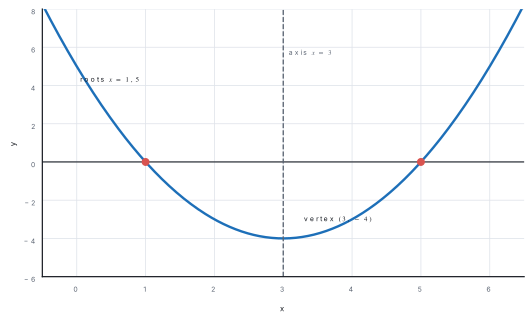
Facts. For ax^2+bx+c=0 the roots are \frac{-b\pm\sqrt{b^2-4ac}}{2a}; the discriminant D=b^2-4ac decides the nature (real and unequal for D>0, equal for D=0, imaginary for D<0); the sum of the roots is -\frac{b}{a} and the product is \frac{c}{a}. The graph of y=ax^2+bx+c is a parabola opening up when a>0, and its vertex is at x=-\frac{b}{2a}.
- The discriminant of 2x^2-5x+3=0 is [1]a1b−1c49d25
- The roots of x^2-5x+6=0 are [1]a1, 6b2, 3c−2, −3d−1, −6
- If the roots of x^2+kx+9=0 are equal, then k is [1]a3b6c9d81
- The sum and the product of the roots of 3x^2-7x+2=0 are [1]a\frac{7}{3} and \frac{2}{3}b-\frac{7}{3} and \frac{2}{3}c\frac{7}{3} and -\frac{2}{3}d\frac{3}{7} and \frac{3}{2}
- The graph of y=x^2-4x+3 cuts the x-axis at [1]ax=1 and x=3bx=-1 and x=-3cx=0 and x=4dx=2 only
- The line of symmetry of the parabola y=x^2-6x+5 is [1]ax=3bx=-3cx=6dy=3
- If one root of x^2-7x+c=0 is 2, then c is [1]a2b5c10d14
- The roots of x^2+4=0 are [1]areal and equalbreal and unequalcimaginarydzero
Answers to 17.2
1. (a) — 25-4\times2\times3=25-24=1.
2. (b) — x^2-5x+6=(x-2)(x-3).
3. (b) — equal roots need k^2=4\times9=36, so k=\pm6; of the options, 6.
4. (a) — sum =-\frac{b}{a}=\frac{7}{3}, product =\frac{c}{a}=\frac{2}{3}.
5. (a) — x^2-4x+3=(x-1)(x-3), so y=0 at x=1 and x=3.
6. (a) — x=-\frac{b}{2a}=\frac{6}{2}=3.
7. (c) — 2 is a root, so 4-14+c=0 and c=10.
8. (c) — D=0-16=-16<0, so the roots are imaginary (x=\pm2i).
17.3 Matrices and Determinants
Facts. A matrix with m rows and n columns has order m\times n; two matrices can be added only when their orders match, and multiplied only when the columns of the first equal the rows of the second. For a square matrix of order 2 with rows (a,b) and (c,d), the determinant is ad-bc — the leading diagonal product minus the other one — and the inverse \frac{1}{ad-bc} times the matrix with rows (d,-b) and (-c,a) exists only when ad-bc\ne0.
- The order of the matrix with 3 rows and 4 columns is [1]a3\times3b4\times4c3\times4d4\times3
- The determinant of the matrix with first row 5, 2 and second row 3, 4 is [1]a26b14c20d6
- A square matrix has an inverse only when its determinant is [1]azerobnot zerocpositivedone
- If A has order 2\times3 and B has order 3\times4, then AB has order [1]a2\times4b4\times2c3\times3dnot defined
- The value of x if the determinant with first row x, 3 and second row 4, 6 equals 12 is [1]a2b4c6d8
- The determinant of the identity matrix of order 3 is [1]a0b1c3d9
- Which of these matrices is singular? [1]afirst row 2, 1, second row 4, 3bfirst row 3, 6, second row 1, 2cfirst row 1, 0, second row 0, 1dfirst row 5, 2, second row 1, 4
- In Cramer's rule the value of y is [1]a\frac{D_y}{D}b\frac{D}{D_y}cD_yDd\frac{D_x}{D}
Answers to 17.3
1. (c) — rows first, then columns: 3\times4.
2. (b) — 5\times4-2\times3=20-6=14.
3. (b) — division by the determinant is impossible when it is zero.
4. (a) — the inner orders (3 and 3) cancel, leaving 2\times4.
5. (b) — 6x-12=12 gives 6x=24 and x=4.
6. (b) — every identity matrix has determinant 1.
7. (b) — 3\times2-6\times1=0.
8. (a) — y=\frac{D_y}{D} when D\ne0.
An item of this shape asks for the letter in the matrix, not for the determinant, and the two numbers are usually different. Item 5 is the model: the determinant is given as 12 and the letter comes out as 4. Read which one the question wants, then substitute your answer back — 6(4)-12=12 — before you mark the option.
17.4 Trigonometry: Multiple, Submultiple and Transformation Formulas
Facts. \sin2A=2\sin A\cos A; \cos2A=\cos^2A-\sin^2A=1-2\sin^2A=2\cos^2A-1; \tan2A=\frac{2\tan A}{1-\tan^2A}; \sin3A=3\sin A-4\sin^3A; \cos3A=4\cos^3A-3\cos A; for submultiples \sin A=\frac{2\tan\frac{A}{2}}{1+\tan^2\frac{A}{2}} and \cos A=\frac{1-\tan^2\frac{A}{2}}{1+\tan^2\frac{A}{2}}; and the transformation formulas \sin C+\sin D=2\sin\frac{C+D}{2}\cos\frac{C-D}{2}, \sin C-\sin D=2\cos\frac{C+D}{2}\sin\frac{C-D}{2}, \cos C+\cos D=2\cos\frac{C+D}{2}\cos\frac{C-D}{2}, \cos C-\cos D=-2\sin\frac{C+D}{2}\sin\frac{C-D}{2}.
- If \sin A=\frac{3}{5} and A is acute, then \sin2A is [1]a\frac{6}{5}b\frac{24}{25}c\frac{7}{25}d\frac{12}{25}
- The value of 2\sin15°\cos15° is [1]a\frac{1}{2}b\frac{\sqrt{3}}{2}c1d\frac{\sqrt{3}}{4}
- \cos2A in terms of \sin A alone is [1]a1+2\sin^2Ab1-2\sin^2Ac2\sin^2A-1d2\sin A\cos A
- If \tan A=\frac{1}{2}, then \tan2A is [1]a\frac{3}{4}b\frac{4}{3}c1d\frac{1}{4}
- \sin3A equals [1]a3\sin A-4\sin^3Ab4\sin^3A-3\sin Ac3\sin A+4\sin^3Ad3\sin^3A
- \sin40°+\sin20° equals [1]a\sin60°b2\sin30°\cos10°c\cos30°d2\cos30°\cos10°
- \cos40°-\cos20° equals [1]a-2\sin30°\sin10°b2\sin30°\sin10°c-2\cos30°\cos10°d2\cos30°\sin10°
- The value of \frac{\sin2A}{1+\cos2A} is [1]a\tan Ab\cot Ac\tan2Ad\sec A
- \cos^2A-\sin^2A equals [1]a2\sin Ab\cos2Ac\sin2Ad1
- If \sin A=\cos A and A is acute, then 2A is [1]a45°b60°c90°d180°
Answers to 17.4
1. (b) — \cos A=\frac{4}{5}, so \sin2A=2\times\frac{3}{5}\times\frac{4}{5}=\frac{24}{25}.
2. (a) — 2\sin15°\cos15°=\sin30°=\frac{1}{2}.
3. (b) — from the three forms of \cos2A, the one with only \sin A is 1-2\sin^2A.
4. (b) — \tan2A=\frac{2\times\frac{1}{2}}{1-\frac{1}{4}}=\frac{1}{\frac{3}{4}}=\frac{4}{3}.
5. (a) — the standard identity; (b) is -\sin3A.
6. (b) — 2\sin30°\cos10°, which is about 0.98, the value of \sin40°+\sin20°.
7. (a) — the minus form carries the negative sign: -2\sin30°\sin10°\approx-0.174.
8. (a) — \frac{2\sin A\cos A}{2\cos^2A}=\tan A.
9. (b) — that is the definition of \cos2A.
10. (c) — A=45°, so 2A=90°.
17.5 Conditional Identities, Trigonometric Equations and Height and Distance
Facts. Three conditional identities govern most items of this type: in a triangle, \sin2A+\sin2B+\sin2C=4\sin A\sin B\sin C, \cos^2A+\cos^2B+\cos^2C=1-2\cos A\cos B\cos C and \tan A+\tan B+\tan C=\tan A\tan B\tan C. A trigonometric equation is solved by reducing it to a single ratio and writing the general value of the angle.
- In any triangle, \sin2A+\sin2B+\sin2C equals [1]a4\cos A\cos B\cos Cb4\sin A\sin B\sin Cc0d2\sin A\sin B\sin C
- If A+B+C=180°, then \tan A+\tan B+\tan C equals [1]a\tan A\tan B\tan Cb0c1d\cot A\cot B\cot C
- If \sin\theta=\frac{\sqrt{3}}{2} and 0°\leq\theta\leq90°, then \theta is [1]a30°b45°c60°d90°
- The general solution of \tan\theta=1 is [1]an\pi+\frac{\pi}{4}b2n\pi+\frac{\pi}{4}cn\pi-\frac{\pi}{4}d\frac{n\pi}{2}
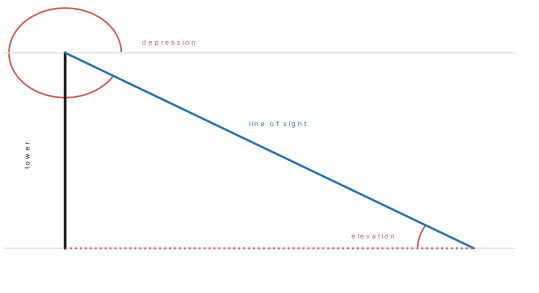
- A pole 10 m high casts a shadow 10 m long. The elevation of the sun is [1]a30°b45°c60°d90°
- From a point 20 m from the foot of a tower the angle of elevation of the top is 45°. The height of the tower is [1]a10 mb20 mc20\sqrt{3} md40 m
- The angle of depression is measured [1]aupward from the horizontalbdownward from the horizontalcfrom the verticaldalong the ground
- If \cos\theta=\frac{1}{2} and \theta is acute, then \theta is [1]a30°b45°c60°d120°
Answers to 17.5
1. (b) — \sin2A+\sin2B+\sin2C=4\sin A\sin B\sin C in a triangle.
2. (a) — the tangent identity for a triangle sum: they are equal.
3. (c) — \sin60°=\frac{\sqrt{3}}{2}.
4. (a) — tangent has period \pi, so \theta=n\pi+\frac{\pi}{4}.
5. (b) — \tan\theta=\frac{10}{10}=1, so the elevation is 45°.
6. (b) — \tan45°=1, so height = distance =20 m.
7. (b) — the depression is the angle below the horizontal.
8. (c) — \cos60°=\frac{1}{2}; 120° has the same cosine but is obtuse.
17.6 Angle between Two Lines and Pair of Straight Lines
Facts. If two lines of slopes m_1 and m_2 meet at an angle \theta, then \tan\theta=\left|\frac{m_1-m_2}{1+m_1m_2}\right|. The lines are parallel when m_1=m_2 and perpendicular when m_1m_2=-1. A homogeneous equation of the second degree ax^2+2hxy+by^2=0 represents a pair of straight lines through the origin, and the angle between them satisfies \tan\theta=\left|\frac{2\sqrt{h^2-ab}}{a+b}\right|, the lines being perpendicular when a+b=0.
- The slope of the line 3x+4y=12 is [1]a\frac{3}{4}b-\frac{3}{4}c\frac{4}{3}d-\frac{4}{3}
- The lines 2x+3y=5 and 4x+6y=7 are [1]aperpendicularbparallelccoincidentdintersecting at 45°
- If two lines of slopes m_1 and m_2 are perpendicular, then [1]am_1=m_2bm_1m_2=1cm_1m_2=-1dm_1+m_2=0
- The angle between the lines y=x and y=\sqrt{3}x is [1]a15°b30°c45°d60°
- The equation x^2-y^2=0 represents [1]aa circleba pair of perpendicular linesca parabolada single line
- For the pair of lines ax^2+2hxy+by^2=0 to be perpendicular, we need [1]aa=bba=-bch^2=abdh=0
Answers to 17.6
1. (b) — rearranging gives y=-\frac{3}{4}x+3.
2. (b) — the second equation is the first multiplied by 2, with a different constant, so the slopes match and the lines never meet.
3. (c) — perpendicular slopes multiply to -1.
4. (a) — slopes 1 and \sqrt{3}, so \tan\theta=\frac{\sqrt{3}-1}{1+\sqrt{3}}=2-\sqrt{3}\approx0.268, and \tan15°=2-\sqrt{3}, so \theta=15°.
5. (b) — x^2-y^2=(x-y)(x+y)=0 gives the lines y=x and y=-x.
6. (b) — a+b=0 is the perpendicular condition.
In item 4 the two slopes are 1 and 1.732, and the value 0.268 that comes out of the formula does not look like any angle on the page. The habit that never fails is: compute the number, then compare it with a value you already know. \tan15°\approx0.27 and \tan30°\approx0.58, so the angle is 15°. Carry that habit into every Group A item.
17.7 Conic Sections and Circle
Facts. The circle with centre (h,k) and radius r has equation (x-h)^2+(y-k)^2=r^2, and the general equation x^2+y^2+2gx+2fy+c=0 has centre (-g,-f) and radius \sqrt{g^2+f^2-c}. A parabola has eccentricity 1, an ellipse less than 1 and a hyperbola more than 1.
- The centre of the circle x^2+y^2-6x+4y-12=0 is [1]a(3,-2)b(-3,2)c(6,-4)d(3,2)
- The radius of the circle in item 1 is [1]a5b25c12d13
- The equation of the circle with centre (0,0) and radius 4 is [1]ax^2+y^2=2bx^2+y^2=4cx^2+y^2=8dx^2+y^2=16
- The eccentricity of a parabola is [1]a0bless than 1c1dmore than 1
- The conic with eccentricity greater than 1 is [1]acirclebellipsecparaboladhyperbola
- The distance of the point (3,4) from the origin is [1]a5b7c12d25
- If the circle x^2+y^2+4x+2y+c=0 passes through the origin, then c is [1]a0b4c2d−4
- The circle x^2+y^2+2x+2y+2=0 has [1]aradius 2bradius \sqrt{2}cno real circledradius 0
Answers to 17.7
1. (a) — compare with x^2+y^2+2gx+2fy+c: g=-3, f=2, centre (-g,-f)=(3,-2).
2. (a) — r=\sqrt{9+4+12}=\sqrt{25}=5.
3. (d) — radius squared is 16.
4. (c) — every point of a parabola is equidistant from the focus and the directrix, so e=1.
5. (d) — an eccentricity greater than 1 gives a hyperbola.
6. (a) — \sqrt{9+16}=5.
7. (a) — putting x=y=0 leaves c=0.
8. (c) — r^2=g^2+f^2-c=1+1-2=0, so the "circle" is a single point.
17.8 Vector
Facts. If \vec a=a_1\hat i+a_2\hat j and \vec b=b_1\hat i+b_2\hat j, then \vec a\cdot\vec b=a_1b_1+a_2b_2=|\vec a||\vec b|\cos\theta; \vec a and \vec b are perpendicular when the dot product is zero and parallel when \frac{a_1}{b_1}=\frac{a_2}{b_2}. The magnitude of \vec a is \sqrt{a_1^2+a_2^2}, and the position vector of the point dividing AB internally in the ratio m:n is \frac{m\vec b+n\vec a}{m+n}.
- If \vec a=2\hat i+3\hat j and \vec b=4\hat i-\hat j, then \vec a\cdot\vec b is [1]a5b11c8d−3
- The magnitude of \vec a=3\hat i+4\hat j is [1]a5b7c12d25
- The vectors 2\hat i+\hat j and x\hat i+2\hat j are perpendicular when x is [1]a1b−1c2d−2
- The unit vector along 3\hat i+4\hat j is [1]a3\hat i+4\hat jb\frac{3\hat i+4\hat j}{5}c\frac{3\hat i+4\hat j}{7}d5(3\hat i+4\hat j)
- If \vec a=2\hat i+\hat j and \vec b=4\hat i+2\hat j, the two vectors are [1]aparallelbperpendicularcequaldopposite
- The position vector of the midpoint of A(2,3) and B(4,7) is [1]a3\hat i+5\hat jb6\hat i+10\hat jc2\hat i+4\hat jd\hat i+2\hat j
- If \vec a\cdot\vec b=0 and neither vector is zero, the angle between them is [1]a0°b45°c90°d180°
- The value of |\hat i+\hat j| is [1]a1b\sqrt{2}c2d0
Answers to 17.8
1. (a) — 2\times4+3\times(-1)=8-3=5.
2. (a) — \sqrt{9+16}=5.
3. (b) — 2x+2=0 gives x=-1; check: 2(-1)+1(2)=0.
4. (b) — divide by the magnitude 5.
5. (a) — \vec b=2\vec a, so they are parallel.
6. (a) — the midpoint is (3,5).
7. (c) — \cos\theta=0, so \theta=90°.
8. (b) — \sqrt{1+1}=\sqrt{2}.
Every item in this chapter that asks for a letter has a "near miss" option next to the right one, because that is how real papers are built. The cheap insurance is the same every time: find the value, then put it back into the condition the question stated. For item 3 that means checking that 2(-1)+1(2) really is zero before you darken the bubble.
17.9 Linear Programming and Transformation
Facts. A linear programming problem has an objective function to be maximised or minimised, constraints written as linear inequalities, and a feasible region that is always convex. The best value is attained at a corner of that region. A transformation with matrix rows (a,b) and (c,d) sends the point (x,y) to (ax+by,\;cx+dy); an inversion transformation with centre O and radius k sends P to P' on the same ray with OP\cdot OP'=k^2.
- In linear programming the objective function is [1]aa constraintbthe quantity to be maximised or minimisedcthe feasible regionda corner point
- The maximum of a linear objective over a feasible region is attained [1]aat the centrebat a corner pointcanywheredoutside the region
- The point (2,3) under the identity transformation goes to [1]a(3,2)b(2,3)c(-2,-3)d(0,0)
- Under the transformation with matrix first row 0, −1 and second row 1, 0, the point (3,4) goes to [1]a(-4,3)b(4,-3)c(3,-4)d(-3,4)
- In an inversion transformation with radius k, the product OP\cdot OP' equals [1]akbk^2c2kd1
- The region satisfying x\geq0, y\geq0 and x+y\leq4 is [1]aa triangleba squarecunboundedda single point
- The maximum of z=x+y subject to x\geq0, y\geq0, x+y\leq4 is [1]a0b2c4d8
- A point on the inversion circle is [1]amoved onto itselfbsent to the centrecsent to infinitydlost
Answers to 17.9
1. (b) — the objective is what the problem asks you to maximise or minimise.
2. (b) — a linear function on a convex polygon peaks at a vertex.
3. (b) — the identity matrix leaves every point fixed.
4. (a) — (0\times3+(-1)\times4,\;1\times3+0\times4)=(-4,3).
5. (b) — that product is the defining property, OP\cdot OP'=k^2.
6. (a) — the three lines close a right triangle with corners (0,0), (4,0), (0,4).
7. (c) — z is largest at (4,0) or (0,4), where z=4.
8. (a) — a point at distance k from the centre satisfies OP\cdot OP'=k^2 with OP'=k, so it is its own image.
17.10 Continuity
Facts. A function is continuous at x=a when the left-hand limit, the right-hand limit and the value of the function at a are all the same number. If the two one-sided limits differ, the gap is a jump discontinuity; if the limit exists but f(a) is different, the point is a removable discontinuity.
- A function f is continuous at x=a if [1]af(a) existsbthe limit existscthe limit exists and equals f(a)df is increasing
- The value of \lim_{x\to2}(3x+1) is [1]a5b6c7ddoes not exist
- The value of \lim_{x\to0}\frac{\sin x}{x} is [1]a0b1c\inftyddoes not exist
- The function f(x)=\frac{1}{x} is discontinuous at [1]ax=0bx=1cevery xdno point
- If \lim_{x\to a^-}f(x)=3 and \lim_{x\to a^+}f(x)=5, then at a the function has [1]aa removable discontinuityba jump discontinuitycno discontinuityda maximum
- The value of \lim_{x\to3}\frac{x^2-9}{x-3} is [1]a0b3c6ddoes not exist
Answers to 17.10
1. (c) — continuity needs the limit and the value to agree.
2. (c) — 3\times2+1=7, and a polynomial is continuous everywhere.
3. (b) — the standard limit is 1.
4. (a) — at x=0 the expression is undefined and grows without bound.
5. (b) — the one-sided limits differ, which is a jump.
6. (c) — cancel the factor: \frac{(x-3)(x+3)}{x-3}=x+3\to6.
17.11 Statistics: Measures of Dispersion
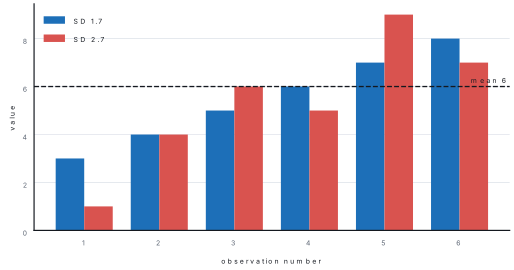
Facts. For a set of n observations with mean \bar x, the mean deviation about the mean is \frac{\sum|x-\bar x|}{n}; the standard deviation is \sigma=\sqrt{\frac{\sum(x-\bar x)^2}{n}}, the variance is \sigma^2, and the coefficient of variation is \frac{\sigma}{\bar x}\times100\%. The quartile deviation is \frac{Q_3-Q_1}{2}.
- The range of 4, 9, 2, 7, 11 is [1]a7b9c11d5
- The mean of 2, 4, 6, 8, 10 is [1]a5b6c7d30
- The standard deviation of 2, 4, 6, 8, 10 is [1]a\sqrt{8}b8c\sqrt{40}d2
- If every observation is increased by 5, the standard deviation [1]aincreases by 5bis unchangedcis multiplied by 5ddoubles
- The coefficient of variation is a measure of [1]acentral tendencybrelative dispersionccorrelationdskewness
- If Q_1=20 and Q_3=40, the quartile deviation is [1]a10b20c30d60
- For a distribution with mean 50 and standard deviation 5, the coefficient of variation is [1]a5%b10%c25%d50%
- The standard deviation of a set in which every observation is equal is [1]aequal to the observationb1c0dundefined
Answers to 17.11
1. (b) — 11-2=9.
2. (b) — \frac{30}{5}=6.
3. (a) — deviations are -4,-2,0,2,4; \frac{16+4+0+4+16}{5}=8, so \sigma=\sqrt{8}\approx2.83.
4. (b) — adding a constant moves every point but not the spread.
5. (b) — it expresses the spread as a percentage of the mean.
6. (a) — \frac{40-20}{2}=10.
7. (b) — \frac{5}{50}\times100=10\%.
8. (c) — no observation departs from the mean.
17.12 Functions and Polynomials
Facts. A relation is a set of ordered pairs; a function sends each input to exactly one output, which the vertical line test checks on a graph. For f(x)=ax^2+bx+c the remainder on division by x-a is f(a) (remainder theorem), and x-a is a factor exactly when f(a)=0 (factor theorem). For f:A\to B and g:B\to C, the composite is (g\circ f)(x)=g(f(x)), and f has an inverse only when it is one-to-one and onto.
- The domain of f(x)=\frac{1}{x-2} is [1]aall real numbersball real numbers except 2call real numbers except 0dx>2
- If f(x)=2x+3, then f(4) is [1]a8b11c14d7
- The remainder when x^3-2x^2+4 is divided by x-2 is [1]a0b4c8d12
- x-1 is a factor of x^3-3x^2+2x because [1]af(1)=0bf(1)=1cf(0)=0dthe degree is 3
- If f(x)=x+1 and g(x)=x^2, then (g\circ f)(2) is [1]a5b9c3d4
- If f(x)=3x-2, then f^{-1}(x) is [1]a\frac{x+2}{3}b\frac{x-2}{3}c3x+2d\frac{1}{3x-2}
- A graph represents a function when no vertical line meets it [1]aat allbmore than oncecexactly oncedbelow the axis
- The function f(x)=x^2 on all real numbers is [1]aone-to-onebnot one-to-onecconstantdthe identity
Answers to 17.12
1. (b) — at x=2 the denominator is zero.
2. (b) — 2\times4+3=11.
3. (b) — f(2)=8-8+4=4.
4. (a) — the factor theorem; indeed 1-3+2=0.
5. (b) — f(2)=3, then g(3)=9.
6. (a) — solve y=3x-2 for x=\frac{y+2}{3}.
7. (b) — one crossing at most is the definition the test checks.
8. (b) — f(2)=f(-2)=4, so two inputs share an output.
Chapter summary
- Sequences: t_n=a+(n-1)d, S_n=\frac n2\{2a+(n-1)d\}, t_n=ar^{n-1}, S_n=\frac{a(r^n-1)}{r-1}; AM =\frac{a+b}{2}, GM =\sqrt{ab}, and AM \geq GM.
- Quadratic: D=b^2-4ac fixes the nature of the roots; sum of roots =-\frac ba, product =\frac ca; vertex at x=-\frac{b}{2a}.
- Matrices: order is rows \times columns; a square matrix is invertible exactly when its determinant is not zero.
- Trigonometry: know \sin2A, the three forms of \cos2A, \tan2A, \sin3A, \cos3A, the four transformation formulas, and the four half-angle results.
- Conditional identities: in a triangle, \tan A+\tan B+\tan C=\tan A\tan B\tan C and \sin2A+\sin2B+\sin2C=4\sin A\sin B\sin C.
- Lines: \tan\theta=\left|\frac{m_1-m_2}{1+m_1m_2}\right|; parallel means equal slopes, perpendicular means the slopes multiply to -1.
- Circle: centre (-g,-f) and radius \sqrt{g^2+f^2-c} for x^2+y^2+2gx+2fy+c=0.
- Vectors: \vec a\cdot\vec b=a_1b_1+a_2b_2; zero dot product means perpendicular.
- Dispersion: \sigma=\sqrt{\frac{\sum(x-\bar x)^2}{n}}, CV =\frac{\sigma}{\bar x}\times100\%, quartile deviation =\frac{Q_3-Q_1}{2}.
- Polynomials: remainder =f(a) on division by x-a; x-a is a factor exactly when f(a)=0.