Question bank · 22 min read
Optional Mathematics: Unit-wise Subjective Question Bank
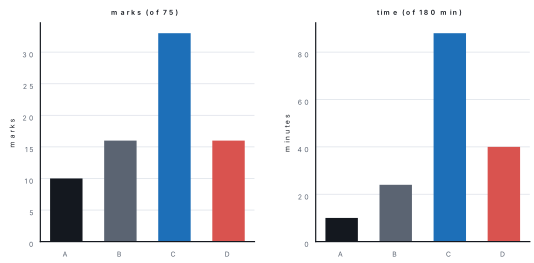
Group A is ten single marks. The other 65 marks of the Optional Mathematics paper come from Groups B, C and D, and here the marks are won by method, not by recall: a 3-mark item is looking for three visible steps, and a 4-mark item for four or five. This chapter works through the twelve units of the syllabus in that order, giving each one a fully worked model question plus a graded set of two-, three- and four-mark questions with complete solutions.
Read the worked model at the head of each unit first, then close the book and write the questions out. Mark yourself against the solutions by method step, not by final answer: in the real paper a right answer with no working loses most of the method marks, and a wrong slip carried through correct working keeps them. Two-mark items should take two minutes, three-mark items four minutes, four-mark items six minutes.
Every question below is an original practice item written to the CDC pattern. None is claimed to have appeared in a particular year's paper. All numerical answers were recomputed independently before being written down, and each one is followed by the check that proves it.
18.1 Sequence and Series
Problem. The arithmetic mean of two positive numbers is 10 and their geometric mean is 8. Find the numbers, and find the sum to infinity of the geometric sequence they begin.
Solution. Write the numbers as a and b. The arithmetic mean gives \frac{a+b}{2}=10, so a+b=20; the geometric mean gives \sqrt{ab}=8, so ab=64. A pair of numbers whose sum and product are known are the roots of t^2-20t+64=0. Factorising, (t-16)(t-4)=0, so the numbers are 16 and 4.
The geometric sequence 16, 4, 1, ... has first term a=16 and common ratio r=\frac{4}{16}=\frac14. Since |r|<1 the sum to infinity is
Check. The partial sums must climb towards 21\frac13: the first four terms already give 16+4+1+0.25=21.25, and everything left over is less than 0.09. So 21.33 is right.
- Find the 15th term of the arithmetic sequence 7, 11, 15, ... [2]
- Which term of the sequence 5, 9, 13, ... is 81? [2]
- Insert four arithmetic means between 3 and 23. [3]
- Find the sum of the first 25 terms of 4, 9, 14, ... [3]
- The third term of a geometric sequence is 24 and the sixth is 192. Find the sequence and the sum of its first 8 terms. [4]
- Two positive numbers have arithmetic mean 12 and geometric mean 6\sqrt{2}. Find the numbers. [4]
Solutions to 18.1
1. a=7, d=4, so t_{15}=7+14\times4=63.
2. 81=5+(n-1)4, so n-1=19 and the term is the 20th.
3. The five gaps between 3 and 23 total 20, so each gap is d=4: the means are 7, 11, 15, 19.
4. a=4, d=5, S_{25}=\frac{25}{2}\{8+24\times5\}=\frac{25}{2}\times128=1600.
5. \frac{t_6}{t_3}=r^3=\frac{192}{24}=8, so r=2 and a=\frac{24}{4}=6; the sequence is 6, 12, 24, ... and S_8=\frac{6(2^8-1)}{2-1}=6\times255=1530.
6. a+b=24 and ab=(6\sqrt{2})^2=72; the roots of t^2-24t+72=0 are t=\frac{24\pm\sqrt{576-288}}{2}=\frac{24\pm\sqrt{288}}{2}=\frac{24\pm12\sqrt{2}}{2} =12\pm6\sqrt{2}. The numbers are 12+6\sqrt{2} and 12-6\sqrt{2}; check the product: (12)^2-(6\sqrt{2})^2=144-72=72.
18.2 Quadratic Equations and Graphs
Problem. Solve the pair of equations y=x^2-3x+2 and y=x+2 simultaneously, and state what the two solutions mean on the graph.
Solution. Both expressions equal y, so equate them:
so x=0 or x=4. Substituting back into the line y=x+2: at x=0, y=2; at x=4, y=6. The solutions are therefore (0,2) and (4,6).
What it means. Each solution is a point where the straight line and the parabola cross, so the line cuts the curve in two places. The number of crossings is decided by the discriminant of the combined quadratic: here x^2-4x=0 has D=16>0, so two real intersections, agreeing with the algebra.
Check. At x=4 the parabola gives 16-12+2=6 and the line gives 6. At x=0 both give 2.
- Solve x^2-7x+12=0. [2]
- Find the value of k for which 2x^2+kx+8=0 has equal roots. [2]
- If \alpha and \beta are the roots of 2x^2-5x+3=0, find \frac{\alpha}{\beta}+\frac{\beta}{\alpha}. [3]
- Solve x^2+2x-8=0 and state the coordinates of the vertex and the equation of the line of symmetry of the graph. [3]
- For what values of p does x^2+px+9=0 have (i) equal roots, (ii) no real roots? [4]
- The sum of a number and its reciprocal is \frac{10}{3}. Find the number. [4]
Solutions to 18.2
1. (x-3)(x-4)=0, so x=3 or x=4.
2. Equal roots need D=0: k^2-4\times2\times8=0, so k^2=64 and k=\pm8.
3. \alpha+\beta=\frac52 and \alpha\beta=\frac32, so \frac{\alpha^2+\beta^2}{\alpha\beta} =\frac{(\alpha+\beta)^2-2\alpha\beta}{\alpha\beta} =\frac{\frac{25}{4}-3}{\frac32}=\frac{\frac{13}{4}}{\frac32}=\frac{13}{6}.
4. (x+4)(x-2)=0 gives roots x=-4 and x=2; the line of symmetry is the midpoint, x=-1, and the vertex is (-1,\,-9) because 1-2-8=-9.
5. D=p^2-36. (i) D=0 when p=\pm6. (ii) D<0 when p^2<36, that is -6<p<6.
6. x+\frac1x=\frac{10}{3} gives 3x^2-10x+3=0, so (3x-1)(x-3)=0 and the number is 3 (or \frac13, its reciprocal — the two answers are the same pair).
18.3 Matrices and Determinants

Problem. Solve 2x+3y=13 and x+2y=8 by the matrix method, and check the answer in both equations.
Solution. Write the system as AX=B, where A has rows (2,3) and (1,2), X is the column of unknowns and B is the column (13,8). The determinant of A is |A|=2\times2-3\times1=4-3=1, which is not zero, so the inverse exists: A^{-1}=\frac{1}{1} times the matrix with rows (2,-3) and (-1,2). Then
Check. 2(2)+3(3)=4+9=13 and 2+2(3)=8. Both hold, so x=2, y=3.
- If A has rows (2,5) and (1,3), find |A| and A^{-1}. [2]
- Solve by Cramer's rule: 3x+2y=7, 2x-y=0. [2]
- If A has rows (1,2), (3,4) and B has rows (2,1), (1,3), find AB and verify that |AB|=|A||B|. [3]
- Solve by the matrix method: x+y=5, 2x-y=1. [3]
- Find the value of k for which the matrix with rows (k,3) and (4,6) has no inverse. [4]
- A shop sells pens at Rs 15 and copies at Rs 40. Ramesh bought 7 items and paid Rs 205. Set the problem up as a matrix equation and solve it. [4]
Solutions to 18.3
1. |A|=6-5=1; A^{-1} has rows (3,-5) and (-1,2).
2. D=3(-1)-2(2)=-7; D_x=7(-1)-2(0)=-7, so x=1; D_y=3(0)-2(7)=-14, so y=2. Check: 3+4=7 and 2-2=0.
3. AB has rows (1\times2+2\times1,\;1\times1+2\times3)=(4,7) and (3\times2+4\times1,\;3\times1+4\times3)=(10,15). Then |AB|=4\times15-7\times10=60-70=-10, while |A|=4-6=-2, |B|=6-1=5 and (-2)(5)=-10. They agree.
4. |A|=1(-1)-1(2)=-3; the inverse is -\frac13 times the matrix with rows (-1,-1) and (-2,1), that is rows \left(\frac13,\frac13\right) and \left(\frac23,-\frac13\right). Then x=\frac13(5)+\frac13(1)=2 and y=\frac23(5)-\frac13(1)=3. Check: 2+3=5 ✓ and 2(2)-3=1 ✓.
5. No inverse means |A|=0: 6k-12=0, so k=2.
6. With p pens and c copies, rows (1,1) and (15,40) acting on the column (p,c) give the column (7,205). |A|=40-15=25; then p=\frac{40\times7-1\times205}{25}=\frac{280-205}{25}=3 and c=\frac{1\times205-15\times7}{25}=\frac{100}{25}=4. Check: 3+4=7 items and 3(15)+4(40)=45+160=205.
A matrix solution has three places to slip: the sign of the determinant, the order of the two rows of the inverse, and the order of the multiplication. All three leave an answer that looks completely reasonable. The cure is thirty seconds long and always works: substitute both unknowns back into both original equations. In question 4 above, the row order decides whether y comes out as 3 or -3; only the substitution tells you which.
18.4 Trigonometry: Multiple, Submultiple and Transformation Formulas
Problem. Find the exact value of \sin15° and use it to find \sin75°.
Solution. Write 15°=45°-30° and use \sin(A-B)=\sin A\cos B-\cos A\sin B:
For \sin75° write 75°=45°+30°: \sin75°=\frac{\sqrt{6}+\sqrt{2}}{4}.
Check. \frac{\sqrt{6}-\sqrt{2}}{4}\approx\frac{2.449-1.414}{4}=0.259, and \sin15°=0.2588. For 75° the value is about 0.966, and \sin75°=0.9659. Both hold to three places.
- If \sin A=\frac{5}{13} and A is acute, find \cos2A. [2]
- If \tan A=\frac13, find \tan2A. [2]
- Prove that \frac{\sin2A}{1+\cos2A}=\tan A. [3]
- Prove that \cos20°+\cos100°+\cos140°=0. [3]
- Prove that \cos^2A+\cos^2(60°+A)+\cos^2(60°-A)=\frac32. [4]
- If \sin A=\frac{3}{5} and \sin B=\frac{5}{13}, with A and B both acute, find \sin(A+B). [4]
Solutions to 18.4
1. \cos2A=1-2\sin^2A=1-2\cdot\frac{25}{169}=1-\frac{50}{169}=\frac{119}{169}.
2. \tan2A=\frac{2\tan A}{1-\tan^2A}=\frac{\frac23}{1-\frac19} =\frac{\frac23}{\frac89}=\frac34.
3. Take the left side: \frac{2\sin A\cos A}{1+2\cos^2A-1} =\frac{2\sin A\cos A}{2\cos^2A}=\frac{\sin A}{\cos A}=\tan A. Done.
4. \cos20°+\cos100°=2\cos60°\cos40°=\cos40°, and then \cos40°+\cos140°=2\cos90°\cos50°=0 because \cos90°=0.
5. Use \cos^2x=\frac{1+\cos2x}{2} three times. The left side becomes \frac32+\frac12\{\cos2A+\cos(120°+2A)+\cos(120°-2A)\}. The bracket is \cos2A+2\cos120°\cos2A=\cos2A-\cos2A=0, since \cos120°=-\frac12. So the left side is \frac32.
6. \cos A=\frac45 and \cos B=\frac{12}{13}. Then \sin(A+B)=\frac35\cdot\frac{12}{13}+\frac45\cdot\frac{5}{13} =\frac{36}{65}+\frac{20}{65}=\frac{56}{65}\approx0.862. Since A\approx36.87° and B\approx22.62°, the sum is about 59.5°, and \sin59.5°\approx0.862. Holds.
18.5 Conditional Identities, Trigonometric Equations and Height and Distance
Problem. The angle of elevation of the top of a tower from a point on the ground is 30°. After walking 60 m straight towards the tower the elevation becomes 60°. Find the height of the tower.
Solution. Let h be the height and let x be the horizontal distance from the second position to the foot of the tower. From the second position, \tan60°=\frac{h}{x}, so x=\frac{h}{\sqrt{3}}. From the first position, \tan30°=\frac{h}{x+60}, so x+60=h\sqrt{3}. Substituting x:
so h=\frac{60\sqrt{3}}{2}=30\sqrt{3}\approx51.96 m.
Check. With h=30\sqrt{3}, x=\frac{30\sqrt{3}}{\sqrt{3}}=30 m and x+60=90 m. Then \frac{h}{90}=\frac{51.96}{90}=0.577=\tan30° ✓ and \frac{h}{30}=1.732=\tan60° ✓. The tower is about 51.96 m high.
- Find the general solution of 2\sin\theta=1. [2]
- A pole 12 m high casts a shadow 12\sqrt{3} m long. Find the elevation of the sun. [2]
- In a triangle, prove that \tan A+\tan B+\tan C=\tan A\tan B\tan C. [3]
- Prove that \cos^2A+\cos^2B+\cos^2C+2\cos A\cos B\cos C=1 when A+B+C=180°. [4]
- From the top of a 20 m building the angle of elevation of the top of a tower is 30° and the angle of depression of its foot is 45°. Find the height of the tower. [4]
Solutions to 18.5
1. \sin\theta=\frac12 has the principal value \theta=\frac{\pi}{6}, so \theta=n\pi+(-1)^n\frac{\pi}{6} for integral n.
2. \tan\theta=\frac{12}{12\sqrt{3}}=\frac{1}{\sqrt{3}}, so the elevation is 30°.
3. A+B=180°-C, so \tan(A+B)=-\tan C. But \tan(A+B)=\frac{\tan A+\tan B}{1-\tan A\tan B}. Cross-multiplying: \tan A+\tan B=-\tan C(1-\tan A\tan B) =-\tan C+\tan A\tan B\tan C. Adding \tan C to both sides gives the identity.
4. Put c=\cos A\cos B and s=\sin A\sin B. Since C=180°-(A+B) we have \cos C=-\cos(A+B)=-c+s, and \cos^2C=(c-s)^2=c^2-2cs+s^2. Also 2\cos A\cos B\cos C=2c(-c+s)=-2c^2+2cs. Adding the left side:
Now c^2=\cos^2A\cos^2B and s^2=\sin^2A\sin^2B, so \cos^2A-c^2=\cos^2A(1-\cos^2B)=\cos^2A\sin^2B. The expression becomes \cos^2A\sin^2B+\cos^2B+\sin^2A\sin^2B =\sin^2B(\cos^2A+\sin^2A)+\cos^2B=\sin^2B+\cos^2B=1. Done. 5. The depression of the foot is 45°, so the horizontal distance from the building to the tower equals the building's height, 20 m. From the same top, the elevation of the tower top is 30° over that 20 m, so the tower stands 20\tan30°=\frac{20}{\sqrt{3}}\approx11.55 m above the building's top. Height =20+11.55\approx31.55 m. Check: the angle from the ground point at 45° gives exactly 20 m to the building's top ✓.
18.6 Angle between Two Lines and Pair of Straight Lines
Problem. Show that 6x^2+5xy-6y^2=0 represents a pair of straight lines through the origin, find them, and show that they are perpendicular.
Solution. The left side factorises as (3x-2y)(2x+3y), since 6x^2+9xy-4xy-6y^2=6x^2+5xy-6y^2. Setting each factor to zero gives the two lines y=\frac32x and y=-\frac23x.
Both pass through the origin, so the equation is a pair of straight lines through the origin. Their slopes multiply to \frac32\times\left(-\frac23\right)=-1, so the lines are perpendicular. This agrees with the coefficient test: for ax^2+2hxy+by^2=0 the lines are perpendicular exactly when a+b=0, and here 6+(-6)=0.
Check. Take a point on the first line, (2,3): 6(4)+5(6)-6(9)=24+30-54=0 ✓. Take (3,-2) on the second: 54-30-24=0 ✓.
- Find the slope of the line joining (2,3) and (4,7). [2]
- Find the angle between the lines whose slopes are \sqrt{3} and \frac{1}{\sqrt{3}}. [2]
- Show that the lines 2x-3y+5=0 and 3x+2y-7=0 are perpendicular. [3]
- Find the angle between the pair of lines 2x^2-5xy+2y^2=0. [3]
- Find the separate equations of the lines represented by x^2-4xy+3y^2=0, and the angle between them. [4]
Solutions to 18.6
1. m=\frac{7-3}{4-2}=2.
2. \tan\theta=\left|\frac{\sqrt{3}-\frac{1}{\sqrt{3}}}{1+1}\right| =\frac{\frac{2}{\sqrt{3}}}{2}=\frac{1}{\sqrt{3}}, so \theta=30°.
3. The slopes are \frac23 and -\frac32; their product is -1, so the lines are perpendicular.
4. Factorise: (2x-y)(x-2y)=0, so the slopes are 2 and \frac12. Then \tan\theta=\left|\frac{2-\frac12}{1+1}\right|=\frac34, so \theta=\tan^{-1}\frac34\approx36.87°.
5. (x-y)(x-3y)=0, so the lines are y=x and y=3x. Then \tan\theta=\left|\frac{1-3}{1+3}\right|=\frac12, so \theta\approx26.57°.
18.7 Conic Sections and Circle
Problem. Find the equation, centre and radius of the circle through (0,0), (1,0) and (0,1).
Solution. Let the circle be x^2+y^2+2gx+2fy+c=0. Putting (0,0) gives c=0. Putting (1,0) gives 1+2g=0, so g=-\frac12. Putting (0,1) gives 1+2f=0, so f=-\frac12. The equation is therefore
The centre is (-g,-f)=\left(\frac12,\frac12\right) and the radius is \sqrt{g^2+f^2-c}=\sqrt{\frac14+\frac14}=\frac{1}{\sqrt{2}}\approx0.707.
Check. The distance from the centre \left(\frac12,\frac12\right) to (0,0) is \sqrt{\frac14+\frac14}=0.707 ✓; to (1,0) it is \sqrt{\frac14+\frac14}=0.707 ✓. All three points lie on the same circle.
- Find the centre and radius of x^2+y^2-4x+6y-12=0. [2]
- Write the equation of the circle with centre (2,-3) and radius 5. [2]
- Find the equation of the circle on the line joining A(1,2) and B(5,6) as diameter. [3]
- Show that x^2+y^2-2x-4y+5=0 represents a single point, and find it. [3]
- Find the equation of the circle passing through the origin with centre (3,-4), and find its radius. [4]
Solutions to 18.7
1. g=-2, f=3, so the centre is (2,-3) and the radius is \sqrt{4+9+12}=5.
2. (x-2)^2+(y+3)^2=25, that is x^2+y^2-4x+6y-12=0.
3. The centre is the midpoint (3,4) and r=\frac12\sqrt{(5-1)^2+(6-2)^2}=\frac12\sqrt{32}=2\sqrt{2}, so (x-3)^2+(y-4)^2=8.
4. g=-1, f=-2, c=5; then r^2=g^2+f^2-c=1+4-5=0. A radius of zero means the circle has collapsed to its centre, (1,2).
5. The radius is the distance from (3,-4) to the origin, \sqrt{9+16}=5. The equation is (x-3)^2+(y+4)^2=25, that is x^2+y^2-6x+8y=0. Check: putting the origin gives 0=0 ✓.
18.8 Vector
Problem. (a) Find the angle between \vec a=\hat i+\hat j and \vec b=\hat i. (b) Show that A(1,2), B(3,6) and C(4,8) are collinear.
Solution. (a) \vec a\cdot\vec b=1\times1+1\times0=1, |\vec a|=\sqrt{2} and |\vec b|=1, so \cos\theta=\frac{1}{\sqrt{2}} and \theta=45°.
(b) \overrightarrow{AB}=(3-1)\hat i+(6-2)\hat j=2\hat i+4\hat j and \overrightarrow{BC}=(4-3)\hat i+(8-6)\hat j=\hat i+2\hat j. Since \overrightarrow{AB}=2\,\overrightarrow{BC}, the two vectors are parallel, and they share the point B. Two parallel segments with a common point lie on one straight line, so the three points are collinear.
Check. The line through A(1,2) and B(3,6) has slope \frac{6-2}{3-1}=2, and at x=4 it gives y=2+2(4-1)=8, which is C. ✓
- If \vec a=3\hat i-2\hat j and \vec b=\hat i+5\hat j, find \vec a\cdot\vec b. [2]
- Find x if 2\hat i+3\hat j and x\hat i+6\hat j are parallel. [2]
- Find the angle between \vec a=2\hat i+2\hat j and \vec b=2\hat i-2\hat j. [3]
- Prove that (\vec a+\vec b)\cdot(\vec a-\vec b)=|\vec a|^2-|\vec b|^2 in component form. [3]
- The position vectors of A and B are 2\hat i+\hat j and 6\hat i+5\hat j. Find the position vector of the point that divides AB internally in the ratio 1:3. [4]
Solutions to 18.8
1. 3(1)+(-2)(5)=3-10=-7.
2. Parallel needs \frac{2}{x}=\frac{3}{6}, so x=4.
3. \vec a\cdot\vec b=4-4=0, and neither vector is zero, so the angle is 90°.
4. With \vec a=(a_1,a_2) and \vec b=(b_1,b_2), the left side is (a_1+b_1)(a_1-b_1)+(a_2+b_2)(a_2-b_2) =a_1^2-b_1^2+a_2^2-b_2^2=|\vec a|^2-|\vec b|^2. Done.
5. The point is \frac{1\vec b+3\vec a}{1+3} =\frac{(6\hat i+5\hat j)+3(2\hat i+\hat j)}{4} =\frac{12\hat i+8\hat j}{4}=3\hat i+2\hat j. Check: it lies on AB since A(2,1), P(3,2), B(6,5) all have slope 1.
18.9 Linear Programming and Transformation
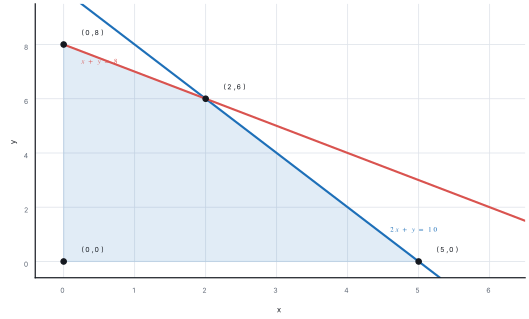
Problem. Maximise z=5x+4y subject to x+y\leq 8, 2x+y\leq 10, x\geq 0, y\geq 0.
Solution. Draw the two constraint lines and shade the region that satisfies all four inequalities. Its corners are where the boundary lines meet:
- (0,0) from the two axes;
- (5,0) where 2x+y=10 meets the x-axis;
- (0,8) where x+y=8 meets the y-axis;
- (2,6) where x+y=8 and 2x+y=10 meet (subtracting gives x=2, then y=6).
Evaluate z at each corner:
The largest value is z=34, at x=2, y=6.
Check. Both constraints hold at (2,6): 2+6=8\leq 8 ✓ and 4+6=10\leq 10 ✓. Moving anywhere inside the region from that corner reduces z, because both constraint boundaries are active there.
- Find the image of the point (2,-3) under the transformation with matrix rows (0,1) and (1,0). [2]
- Find the image of (4,1) under the matrix with rows (2,0) and (0,3), and name the transformation. [2]
- Maximise z=3x+2y subject to x+y\leq 4, x\geq 0, y\geq 0. [3]
- A point P is 3 cm from the centre of an inversion circle of radius 6 cm. Find OP' and say where P' lies. [3]
- A workshop makes chairs and tables. Each chair needs 2 hours of carpentry and earns Rs 300; each table needs 3 hours and earns Rs 500. Only 30 carpenter hours are available and at most 12 pieces can be stored. How many of each maximise the earning? [4]
Solutions to 18.9
1. (0\times2+1\times(-3),\;1\times2+0\times(-3))=(-3,2).
2. (2\times4,\;3\times1)=(8,3); the transformation is an enlargement (stretch) of factor 2 along x and 3 along y.
3. Corners (0,0), (4,0), (0,4); z values 0, 12, 8. Maximum z=12 at (4,0).
4. OP\cdot OP'=k^2 gives OP'=\frac{36}{3}=12 cm, on the ray OP but beyond the circle, on the far side of the inversion circle.
5. Let x chairs and y tables. Maximise z=300x+500y subject to 2x+3y\leq 30 and x+y\leq12. Corners: (0,0); (12,0) from x+y=12; (0,10) from 2x+3y=30; and the intersection of the two lines, where y=12-x gives 2x+36-3x=30, so x=6, y=6. Values: z(12,0)=3600, z(0,10)=5000, z(6,6)=1800+3000=4800. The best is 10 tables and no chairs, earning Rs 5000. Check: 2(0)+3(10)=30 hours ✓ and 0+10\leq12 ✓.
18.10 Continuity
Problem. The function f(x)=\frac{x^2-4}{x-2} is not defined at x=2. Find \lim_{x\to2}f(x), say what kind of discontinuity this is, and give the value that would make the function continuous there.
Solution. Factorise the numerator: x^2-4=(x-2)(x+2). For every x\ne2, the factor x-2 cancels and
so \lim_{x\to2}f(x)=4. The limit exists and is finite, but f(2) is undefined, so the graph is the line y=x+2 with a single missing point at (2,4). That is a removable discontinuity. Defining f(2)=4 fills the hole and makes the function continuous at x=2.
Check. Take x=1.999: \frac{3.996-4}{-0.001}=\frac{-0.004}{-0.001}=4 ✓; take x=2.001: \frac{0.004}{0.001}=4 ✓. Both sides approach 4.
- Evaluate \lim_{x\to2}\frac{x^2-4}{x-2}. [2]
- Evaluate \lim_{x\to0}\frac{3x^2+2x}{x}. [2]
- Test the continuity of f(x)=\frac{x^2-1}{x-1} at x=1, and say what kind of discontinuity it has. [3]
- Find k so that f is continuous at x=3, where f(x)=\frac{x^2-9}{x-3} for x\ne3 and f(3)=k. [3]
- A function is defined by f(x)=2x+1 for x<1, f(x)=5 for x=1 and f(x)=3x-1 for x>1. Show that it has a jump discontinuity at x=1, and draw the two one-sided limits. [4]
Solutions to 18.10
1. Cancel: x+2\to4.
2. Divide by x: 3x+2\to2.
3. Cancelling gives x+1, so the limit at x=1 is 2, but f(1) is undefined: a removable discontinuity.
4. \frac{(x-3)(x+3)}{x-3}=x+3\to6, so k=6.
5. As x\to1^-, f\to2(1)+1=3; as x\to1^+, f\to3(1)-1=2; and f(1)=5. The left limit (3), the right limit (2) and the value (5) are three different numbers, so the graph jumps at x=1. It is a jump discontinuity, and it cannot be repaired by changing f at one point alone.
18.11 Statistics: Measures of Dispersion
Problem. In ten matches a batsman scores a mean of 45 with a standard deviation of 9; a second batsman has a mean of 30 with a standard deviation of 3. Which batsman is more consistent?
Solution. Consistency means small spread relative to the size of the scores, which is what the coefficient of variation measures:
For the first batsman, \text{CV}=\frac{9}{45}\times100=20\%. For the second, \text{CV}=\frac{3}{30}\times100=10\%. The second batsman has the smaller coefficient of variation, so the second batsman is more consistent, even though his scores are lower.
Check. The comparison is fair because both CVs are percentages of their own means. Comparing the raw standard deviations (9 against 3) would have said the same thing here, but it would mislead whenever the means differ a lot — which is exactly why the coefficient exists.
- Find the range and the mean deviation from the mean of 3, 5, 7, 9. [2]
- Find the standard deviation of 4, 8, 10, 12, 16. [2]
- For a distribution the mean is 25 and the standard deviation is 5. Find the coefficient of variation. [3]
- If Q_1=18 and Q_3=42, find the quartile deviation and its coefficient. [3]
- The marks of two students in five tests are: A — 60, 64, 58, 66, 62; B — 48, 52, 50, 54, 51. Compare their consistency using the coefficient of variation. [4]
Solutions to 18.11
1. Range =9-3=6. Mean =6, deviations are -3,-1,1,3, so the mean deviation is \frac{3+1+1+3}{4}=2.
2. Mean =10; deviations -6,-2,0,2,6; sum of squares =36+4+0+4+36=80; variance =\frac{80}{5}=16; \sigma=4.
3. \frac{5}{25}\times100=20\%.
4. Quartile deviation =\frac{42-18}{2}=12; its coefficient is \frac{Q_3-Q_1}{Q_3+Q_1}=\frac{24}{60}=0.4.
5. A: mean =\frac{310}{5}=62, deviations -2,2,-4,4,0, sum of squares =40, variance =8, \sigma_A=\sqrt{8}\approx2.83, CV =\frac{2.83}{62}\times100\approx4.56\%. B: mean =51, deviations -3,1,-1,3,0, sum of squares =20, variance =4, \sigma_B=2, CV =\frac{2}{51}\times100\approx3.92\%. B has the smaller CV, so B is more consistent.
18.12 Functions and Polynomials
Problem. The function f(x)=\frac{2x+1}{x-2} is defined for x\ne2. Find f^{-1}(x) and verify that f(f^{-1}(x))=x.
Solution. Put y=\frac{2x+1}{x-2} and solve for x. Multiply both sides by x-2: y(x-2)=2x+1, so xy-2y=2x+1. Gather the x terms: x(y-2)=1+2y, giving
Verify. f(f^{-1}(x)) =\frac{2\cdot\frac{1+2x}{x-2}+1}{\frac{1+2x}{x-2}-2}. Multiply top and bottom by x-2: the top becomes 2(1+2x)+(x-2)=4x+2+x-2=5x, and the bottom becomes (1+2x)-2(x-2)=1+2x-2x+4=5. The ratio is x, as required.
Check with a number. f(0)=\frac{1}{-2}=-0.5, and f^{-1}(-0.5)=\frac{1-1}{-2.5}=0 ✓.
- If f(x)=x^2-3x+2, find f(-1). [2]
- Find the domain of f(x)=\sqrt{x-3}. [2]
- If f(x)=2x+1 and g(x)=x^2, find (f\circ g)(x) and (g\circ f)(x). [3]
- Find the remainder when x^4-3x^2+2 is divided by x+2. [3]
- Factorise x^3-6x^2+11x-6 completely using the factor theorem. [4]
- If f(x)=\frac{3x-1}{2}, find f^{-1}(x) and verify that f(f^{-1}(5))=5. [4]
Solutions to 18.12
1. 1+3+2=6.
2. The expression under the root must not be negative, so x\geq3; the domain is [3,\infty).
3. (f\circ g)(x)=f(x^2)=2x^2+1 and (g\circ f)(x)=(2x+1)^2.
4. By the remainder theorem the remainder is f(-2)=16-12+2=6.
5. Try x=1: 1-6+11-6=0, so x-1 is a factor. Dividing, x^3-6x^2+11x-6=(x-1)(x^2-5x+6)=(x-1)(x-2)(x-3).
6. Put y=\frac{3x-1}{2}; then 2y=3x-1 and x=\frac{2y+1}{3}, so f^{-1}(x)=\frac{2x+1}{3}. Check: f^{-1}(5)=\frac{11}{3} and f\left(\frac{11}{3}\right)=\frac{11-1}{2}=5 ✓.
Chapter summary
- Sequences: t_n=a+(n-1)d, S_n=\frac n2\{2a+(n-1)d\}; t_n=ar^{n-1}, S_n=\frac{a(r^n-1)}{r-1}; a pair of numbers with known sum S and product P are the roots of t^2-St+P=0.
- Quadratics: D=b^2-4ac decides the nature of the roots; vertex at x=-\frac{b}{2a}; a line meets a parabola as many times as the combined quadratic has real roots.
- Matrices: the inverse of a 2-row matrix needs a non-zero determinant; the matrix method and Cramer's rule give the same answer, and |AB|=|A||B|.
- Trigonometry: \sin(A\pm B), \cos(A\pm B), the three forms of \cos2A, \tan2A, \sin3A, \cos3A, and the sum-to-product formulas are the whole toolkit.
- Height and distance: always draw the two right triangles, write \tan for each, and eliminate the distance you do not know.
- Lines: \tan\theta=\left|\frac{m_1-m_2}{1+m_1m_2}\right|; for ax^2+2hxy+by^2=0 the lines are perpendicular when a+b=0.
- Circle: x^2+y^2+2gx+2fy+c=0 has centre (-g,-f) and radius \sqrt{g^2+f^2-c}; the circle on a diameter has the midpoint as centre.
- Vectors: \vec a\cdot\vec b=a_1b_1+a_2b_2; parallelism is checked with the cross-product-like condition a_1b_2-a_2b_1=0.
- Linear programming: the optimum is always at a corner of the feasible region; an inversion satisfies OP\cdot OP'=k^2.
- Continuity: continuous means the two one-sided limits equal the value; equal limits with a different value is removable, unequal limits is a jump.
- Statistics: \sigma=\sqrt{\frac{\sum(x-\bar x)^2}{n}}, CV =\frac{\sigma}{\bar x}\times100\%, and consistency is judged on the coefficient of variation, never on the standard deviation alone.
- Polynomials: remainder =f(a) on division by x-a; x-a is a factor exactly when f(a)=0.