Question bank · 19 min read
Optional Mathematics: Model Question Sets and Predicted Questions
This chapter does three jobs. It sets out the specification grid of the SEE Optional Mathematics paper and shows what each group is really testing; it gives two complete model papers, each of 75 marks and three hours, to the exact CDC pattern, with a full solution to every question; and it closes with a ranked order of practice priorities, each rank carrying the reason it holds that place.
Nobody outside the examination board knows next year's questions. Every rank in section 19.4 rests on two public facts only: the specification grid (how many questions of each kind and marks), and the syllabus (what may be asked). A high rank means practise this first, never this will come. A low rank means less likely, never safe to skip. None of the questions below is copied from a past paper; all of them are original practice items built to the published pattern.
| Group | Questions | Marks each | Total | What it asks for |
|---|---|---|---|---|
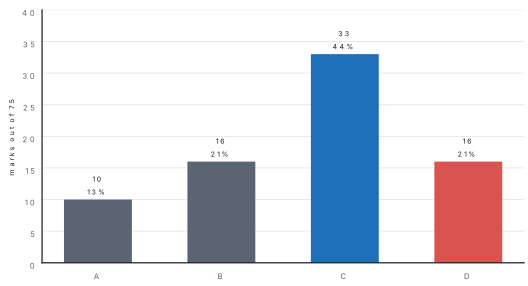
| A | 10 | 1 | 10 | one-line recall or a single substitution |
| B | 8 | 2 | 16 | one short method, two or three lines |
| C | 11 | 3 | 33 | a full short-answer method |
| D | 4 | 4 | 16 | a longer method, a proof, or a two-triangle problem |
| Total | 33 | 75 |
Groups C and D together are 49 of the 75 marks. A student who is slow in Group A but fluent in C and D scores far higher than the reverse.
19.1 What the grid implies
19.1.1 Marks by group
19.1.2 The twelve units and where they normally appear
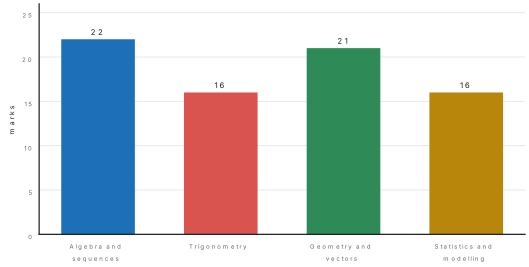
| Unit | Usual home | Note |
|---|---|---|
| 1. Sequence and series | A, B or C | AP and GP formulas pay for themselves in Group A |
| 2. Quadratic equations and graphs | B or C | roots, nature, vertex, line meets curve |
| 3. Matrices and determinants | B or C | almost always a system of two equations |
| 4. Trigonometry: multiple and submultiple | B or C | proofs of identities sit here |
| 5. Conditional identities, equations, height and distance | C or D | one height-and-distance question is close to certain |
| 6. Angle between two lines, pair of lines | A or B | slope conditions |
| 7. Conic sections and circle | B or C | find the circle, or centre and radius |
| 8. Vector | A, B or C | dot product, perpendicularity, collinearity |
| 9. Linear programming and transformation | C or D | maximise an objective at a corner |
| 10. Continuity | A or B | limit by cancelling a factor |
| 11. Statistics: dispersion | C or D | SD, quartile deviation, coefficient of variation |
| 12. Functions and polynomials | B, C or D | remainder, factor, inverse, composite |
19.1.3 The thinking levels
| Level | Approximate marks | What it looks like |
|---|---|---|
| Knowledge | 15 | state a formula, name a transformation, write a centre |
| Understanding | 20 | explain why a line and a curve meet twice; compare consistencies |
| Application | 25 | solve a system, find a height, maximise a profit |
| Higher ability | 15 | prove an identity, complete a two-triangle problem, justify a corner |
Group A: 10 minutes. Group B: 8 items at 3 minutes, 24 minutes. Group C: 11 items at 4 minutes, 44 minutes. Group D: 4 items at 6 minutes, 24 minutes. That is 102 minutes of writing, leaving 18 minutes to check — and the check is where the last five marks live. Never let a Group A item take more than 90 seconds: mark it and come back.
19.2 Model Set 1
Optional Mathematics — Class 10. Time: 3 hours. Full marks: 75. Attempt all questions.
Question paper
Group A — Choose the correct answer. [10\times1=10]
- If the arithmetic mean and the geometric mean of two positive numbers are equal, then the numbersaare equalbare unequalcare reciprocalsdare both zero
- The 7th term of 3, 7, 11, ... isa27b31c35d39
- \cos2A equalsa2\cos Ab\cos^2A-\sin^2Ac1-2\cos^2Ad2\sin A\cos A
- If \tan A=1 and A is acute, then A isa30°b45°c60°d90°
- The centre of the circle x^2+y^2-6x+4y+9=0 isa(3,-2)b(-3,2)c(6,-4)d(3,2)
- If \vec a=\hat i+2\hat j and \vec b=2\hat i-\hat j, then \vec a\cdot\vec b isa4b0c-4d5
- The 5th term of 2, 6, 18, ... isa54b108c162d486
- A quadratic equation has equal roots when its discriminant isapositivebnegativeczerodone
- The maximum of z=2x+3y subject to x+y\le 4, x\ge 0, y\ge 0 isa8b10c12d14
- The standard deviation of 5, 5, 5, 5 isa0b1c5d25
Group B — Answer in short. [8\times2=16]
- Find the 12th term of the arithmetic sequence 4, 9, 14, ...
- Find the sum of the first 20 terms of 3, 7, 11, ...
- Solve x^2-5x-6=0.
- Find the value of k for which x^2+4x+k=0 has equal roots.
- Find the inverse of the matrix with rows (1,2) and (3,7).
- If \sin A=\frac45 and A is acute, find \cos2A.
- Find the angle between two lines whose slopes are 2 and -\frac12.
- Find the radius of the circle x^2+y^2-2x+4y-4=0.
Group C — Answer with working. [11\times3=33]
- Insert three arithmetic means between 4 and 20.
- Find the sum of the geometric series 3+9+27+\dots+2187.
- Solve by the matrix method: 3x+2y=12, 2x-y=1.
- Prove that \frac{1+\cos2A}{\sin2A}=\cot A.
- Prove that \sin3A=3\sin A-4\sin^3A.
- A kite string 100 m long makes an angle of 30° with the ground. Find the height of the kite.
- Find the equation of the circle with centre (3,-2) that passes through (1,1).
- Find the angle between \vec a=3\hat i+4\hat j and \vec b=4\hat i-3\hat j.
- Find the image of (2,5) under the transformation with matrix rows (1,2) and (3,4).
- Evaluate \lim_{x\to1}\frac{x^3-1}{x-1}.
- Find the standard deviation of 6, 8, 10, 12, 14.
Group D — Answer in detail. [4\times4=16]
- The third term of a geometric sequence is 12 and the sixth is 96. Find the sequence and the sum of its first six terms.
- In a triangle, prove that \sin2A+\sin2B+\sin2C=4\sin A\sin B\sin C.
- From the top of a 30 m cliff the angles of depression of two boats on the same side are 30° and 45°. Find the distance between the boats.
- Solve x^2+y^2=25 and y=x+1 simultaneously.
Solutions
Group A — answers with reasons
1. (a) — AM = GM forces (\sqrt{a}-\sqrt{b})^2=0, so a=b.
2. (a) — t_7=a+6d=3+6\times4=27; the exponent is 7-1, not 7.
3. (b) — that is the definition; (c) is the wrong sign, (d) is \sin2A.
4. (b) — \tan45°=1.
5. (a) — g=-3, f=2, centre (-g,-f)=(3,-2).
6. (b) — 1\times2+2\times(-1)=0.
7. (c) — 2\times3^4=162.
8. (c) — D=0 gives the two roots the same value.
9. (c) — corners (0,0), (4,0), (0,4) give 0, 8, 12; the largest is 12.
10. (a) — every observation equals the mean, so there is no spread.
Item 2 asks for the 7th term, so the multiplier is 3^{7-1} for a GP and 6d for an AP — six steps from the first term, not seven. Item 3 offers both (b) \cos^2A-\sin^2A and (c) 1-2\cos^2A; only the first is the standard form, the second has the sign wrong. In both cases the whole method is: write the formula, put the numbers in, and only then look at the options. Choosing by eye is how marks disappear from a 13% group.
Group B — solutions
1. 4+11\times5=59.
2. S_{20}=\frac{20}{2}\{6+19\times4\}=10\times82=820.
3. (x-6)(x+1)=0, so x=6 or x=-1.
4. D=16-4k=0, so k=4.
5. |A|=7-6=1, and the inverse has rows (7,-2) and (-3,1).
6. \cos A=\frac35, so \cos2A=1-2\left(\frac45\right)^2=1-\frac{32}{25} =-\frac{7}{25}.
7. The product of the slopes is 2\times\left(-\frac12\right)=-1, so the angle is 90°.
8. \sqrt{g^2+f^2-c}=\sqrt{1+4+4}=3.
Group C — solutions
1. Between 4 and 20 there are four equal gaps totalling 16, so d=4 and the means are 8, 12, 16.
2. The last term is 3\times3^{6}=2187, so the series has 7 terms and S_7=\frac{3(3^7-1)}{3-1}=\frac{3\times2186}{2}=3279.
3. |A|=3(-1)-2(2)=-7; x=\frac{12(-1)-2(1)}{-7}=\frac{-14}{-7}=2 and y=\frac{3(1)-2(12)}{-7}=\frac{-21}{-7}=3. Check: 6+6=12 ✓ and 4-3=1 ✓.
4. 1+\cos2A=2\cos^2A and \sin2A=2\sin A\cos A, so the left side is \frac{2\cos^2A}{2\sin A\cos A}=\frac{\cos A}{\sin A}=\cot A.
5. \sin3A=\sin(2A+A)=\sin2A\cos A+\cos2A\sin A =2\sin A\cos^2A+(1-2\sin^2A)\sin A =2\sin A(1-\sin^2A)+\sin A-2\sin^3A=3\sin A-4\sin^3A.
6. \sin30°=\frac{1}{2}=\frac{h}{100}, so h=50 m.
7. Radius r=\sqrt{(3-1)^2+(-2-1)^2}=\sqrt{4+9}=\sqrt{13}, so (x-3)^2+(y+2)^2=13, that is x^2+y^2-6x+4y=0. Check the given point: 1+1-6+4=0 ✓.
8. \vec a\cdot\vec b=12-12=0, so the angle is 90°.
9. (1\times2+2\times5,\;3\times2+4\times5)=(12,26).
10. Cancel: \frac{(x-1)(x^2+x+1)}{x-1}=x^2+x+1\to3.
11. Mean =10; deviations -4,-2,0,2,4; sum of squares =40; variance =8; \sigma=2\sqrt{2}\approx2.83.
Group D — solutions
1. r^3=\frac{96}{12}=8, so r=2 and a=\frac{12}{2^2}=3. The sequence is 3, 6, 12, 24, ... and S_6=\frac{3(2^6-1)}{2-1}=3\times63=189.
2. C=180°-(A+B), so 2C=360°-2(A+B) and \sin2C=-\sin2(A+B). Then \sin2A+\sin2B=2\sin(A+B)\cos(A-B), so the left side is 2\sin(A+B)\cos(A-B)-2\sin(A+B)\cos(A+B) =2\sin(A+B)\{\cos(A-B)-\cos(A+B)\}. Now \cos(A-B)-\cos(A+B)=2\sin A\sin B, and \sin(A+B)=\sin(180°-C)=\sin C. The product is 2\cdot2\sin A\sin B\sin C=4\sin A\sin B\sin C.
3. Let the boats be at horizontal distances d_1 and d_2 from the foot of the cliff. A depression of 45° means \tan45°=\frac{30}{d_1}, so d_1=30 m; a depression of 30° means \tan30°=\frac{30}{d_2}, so d_2=\frac{30}{\tan30°}=30\sqrt{3}\approx51.96 m. The boats are d_2-d_1=30\sqrt{3}-30=30(\sqrt{3}-1)\approx21.96 m apart. Check: the nearer boat is at 30 m, the same as the cliff height, which is exactly what a 45° depression requires ✓.
4. Substitute y=x+1 into x^2+y^2=25: x^2+(x+1)^2=25, so 2x^2+2x+1=25, giving x^2+x-12=0. Then (x+4)(x-3)=0, so x=3 or x=-4. With y=x+1: (3,4) and (-4,-3). Check both: 9+16=25 ✓ and 16+9=25 ✓. The line cuts the circle twice, in the first and the third quadrant.
19.3 Model Set 2
Optional Mathematics — Class 10. Time: 3 hours. Full marks: 75. Attempt all questions.
Question paper
Group A — Choose the correct answer. [10\times1=10]
- The common difference of 11, 7, 3, ... isa4b-4c7d11
- The geometric mean of 2 and 18 isa6b10c20d36
- The roots of x^2-9=0 areaequalbimaginarycreal and unequaldzero
- The determinant of the matrix with rows (4,1) and (2,3) isa10b14c12d2
- \sin2A equalsa2\sin Ab2\sin A\cos Ac\sin A\cos Ad1-2\sin^2A
- The slope of the line 2x+3y=6 isa\frac23b-\frac23c\frac32d-\frac32
- The eccentricity of a hyperbola isa0b1cless than 1dgreater than 1
- The magnitude of 5\hat i-12\hat j isa7b13c17d60
- \lim_{x\to0}\frac{\sin x}{x} isa0b1c\inftydnot defined
- The coefficient of variation is expressed asaa numberba percentage of the meanca squared deviationda range
Group B — Answer in short. [8\times2=16]
- Find the 10th term of 5, 8, 11, ...
- Find the sum of the first 15 natural numbers.
- Find the value of m for which 2x^2+mx+8=0 has equal roots.
- If the matrix has rows (3,k) and (2,4), find k for which it has no inverse.
- If \tan A=\frac12, find \tan2A.
- Find the general solution of \cos\theta=\frac12.
- Find the centre and radius of x^2+y^2+4x-6y+4=0.
- If \vec a=2\hat i+\hat j and \vec b=\hat i-2\hat j, find \vec a\cdot\vec b.
Group C — Answer with working. [11\times3=33]
- Which term of 7, 12, 17, ... is 102?
- Insert two geometric means between 3 and 81.
- Solve by Cramer's rule: 2x+3y=13, x+2y=8.
- Prove that \frac{1-\cos2A}{\sin2A}=\tan A.
- Prove that \cos^2A+\cos^2(60°+A)+\cos^2(60°-A)=\frac32.
- A tower is 45 m high. Find the angle of elevation of its top from a point 45 m from its foot.
- Find the equation of the circle on the segment joining (2,3) and (6,7) as diameter.
- Show that the points A(1,3), B(3,7) and C(5,11) are collinear using vectors.
- Find the image of (-1,4) under the matrix with rows (0,-1) and (1,0), and name the transformation.
- Find the value of k that makes f continuous at x=2, where f(x)=\frac{x^2-4}{x-2} for x\ne2 and f(2)=k.
- The mean of five observations is 20 and their standard deviation is 4. Find the coefficient of variation.
Group D — Answer in detail. [4\times4=16]
- Two positive numbers have arithmetic mean 13 and geometric mean 12. Find the numbers.
- Prove that \tan A+\tan B+\tan C=\tan A\tan B\tan C when A+B+C=180°.
- The angle of elevation of the top of a tower from a point on the ground is 30°. Walking 40 m nearer, the elevation becomes 60°. Find the height.
- Find the values of p for which the line y=px+1 touches the circle x^2+y^2=4.
Solutions
Group A — answers with reasons
1. (b) — 7-11=-4.
2. (a) — \sqrt{2\times18}=\sqrt{36}=6.
3. (c) — x^2-9=(x-3)(x+3), so x=\pm3: real and unequal.
4. (a) — 4\times3-1\times2=10.
5. (b) — the double-angle formula for sine.
6. (b) — rearranged, y=-\frac23x+2.
7. (d) — an ellipse is below 1, a parabola exactly 1, a hyperbola above 1.
8. (b) — \sqrt{25+144}=13.
9. (b) — the standard limit.
10. (b) — the coefficient of variation is a percentage of the mean.
Group B — solutions
1. 5+9\times3=32.
2. S_{15}=\frac{15\times16}{2}=120.
3. D=m^2-4\times2\times8=0, so m^2=64 and m=\pm8.
4. No inverse means 12-2k=0, so k=6.
5. \tan2A=\frac{2\times\frac12}{1-\frac14}=\frac{1}{\frac34}=\frac43.
6. \cos\theta=\frac12 has the principal value 60°, so \theta=2n\pi\pm\frac{\pi}{3}, or in degrees \theta=360°n\pm60°.
7. g=2, f=-3, so the centre is (-2,3) and r=\sqrt{4+9-4}=3.
8. 2\times1+1\times(-2)=0.
Group C — solutions
1. 102=7+(n-1)5, so n-1=19 and it is the 20th term.
2. With two means between 3 and 81 there are three equal ratios, so r^3=\frac{81}{3}=27 and r=3. The means are 3r=9 and 3r^2=27, and 81=3r^3 checks ✓.
3. D=2(2)-3(1)=1; D_x=13(2)-3(8)=26-24=2, so x=2; and D_y=2(8)-1(13)=16-13=3, so y=3. Check: 4+9=13 ✓ and 2+6=8 ✓.
4. 1-\cos2A=2\sin^2A, so the left side is \frac{2\sin^2A}{2\sin A\cos A}=\frac{\sin A}{\cos A}=\tan A.
5. Write \cos^2x=\frac{1+\cos2x}{2} for each of the three terms. The left side becomes \frac32+\frac12\{\cos2A+\cos(120°+2A)+\cos(120°-2A)\}. The pair formula gives \cos(120°+2A)+\cos(120°-2A)=2\cos120°\cos2A=-\cos2A, so the bracket cancels to zero and the left side is \frac32.
6. \tan\theta=\frac{45}{45}=1, so the elevation is 45°.
7. The centre is the midpoint (4,5) and r=\frac12\sqrt{(6-2)^2+(7-3)^2}=\frac12\sqrt{32}=2\sqrt{2}, so (x-4)^2+(y-5)^2=8.
8. \overrightarrow{AB}=2\hat i+4\hat j and \overrightarrow{BC}=2\hat i+4\hat j. The two are equal, hence parallel, and they share the point B; so the three points lie on one line. (The slope check agrees: A to C has slope \frac{11-3}{5-1}=2.)
9. (0\times(-1)+(-1)\times4,\;1\times(-1)+0\times4)=(-4,-1). The matrix sends (1,0) to (0,1), so it rotates a point through 90° anticlockwise about the origin: a rotation.
10. Cancelling gives x+2\to4, so k=4.
11. \frac{\sigma}{\bar x}\times100=\frac{4}{20}\times100=20\%.
Group D — solutions
1. a+b=26 and ab=144; the roots of t^2-26t+144=0 are t=\frac{26\pm\sqrt{676-576}}{2}=\frac{26\pm10}{2}=18 and 8. The numbers are 18 and 8. Check: \frac{18+8}{2}=13 ✓ and \sqrt{144}=12 ✓.
2. A+B=180°-C, so \tan(A+B)=-\tan C. Also \tan(A+B)=\frac{\tan A+\tan B}{1-\tan A\tan B}. Cross-multiplying, \tan A+\tan B=-\tan C+\tan A\tan B\tan C; adding \tan C to both sides gives the identity.
3. Let h be the height and x the distance from the nearer point to the foot. From the nearer point, \tan60°=\frac{h}{x}, so x=\frac{h}{\sqrt{3}}. From the farther point, \tan30°=\frac{h}{x+40}, so x+40=h\sqrt{3}. Substituting: \frac{h}{\sqrt{3}}+40=h\sqrt{3}, so 40=h\left(\sqrt{3}-\frac{1}{\sqrt{3}}\right)=\frac{2h}{\sqrt{3}}, giving h=20\sqrt{3}\approx34.64 m. Check: x=20 m and x+40=60 m; \frac{34.64}{60}=0.577=\tan30° ✓.
4. Substitute the line into the circle: x^2+(px+1)^2=4, so (1+p^2)x^2+2px-3=0. Touching means exactly one solution, so the discriminant is zero: 4p^2-4(1+p^2)(-3)=0, that is 4p^2+12+12p^2=0 and 16p^2=-12. That has no real solution, so no real value of p makes the line touch the circle. Check why: the line y=px+1 always passes through (0,1), which is inside the circle of radius 2, so it must cut the circle twice for every real p — a line through an interior point can never be a tangent. The algebra and the picture agree.
19.4 Ranked practice priorities
The order below is a judgement from the grid and the syllabus. Rank 1 means "rehearse this until it is automatic"; a low rank means "less likely to be asked", never "skip it".
| Rank | Item | Why it ranks here |
|---|---|---|
| 1 | A system of two linear equations by matrix or Cramer's rule | Unit 3 has a guaranteed group B or C slot and the method never changes |
| 2 | An arithmetic or geometric sequence problem | Unit 1 is the easiest C-mark in the paper and appears in A and B too |
| 3 | Height and distance with one or two triangles | Unit 5 contains both a C item and, often, the D item; the method is three lines |
| 4 | Trigonometric identity proof using \sin2A, \cos2A or the sum-to-product rules | Unit 4 supplies a C and frequently a D question |
| 5 | Circle: centre, radius, equation through given points | Unit 7 is a dependable B or C slot with a fixed recipe |
| 6 | Vectors: dot product, perpendicularity, collinearity | Unit 8 appears in all four groups in different years |
| 7 | Standard deviation or coefficient of variation of a small set | Unit 11 gives a C or D question with a fixed table method |
| 8 | Linear programming: maximise an objective at a corner | Unit 9's longer item is almost always the same shape |
| 9 | Remainder and factor theorem, inverse function, composite | Unit 12 questions are short and heavily practised |
| 10 | Limit by cancelling a common factor | Unit 10 is usually a single A or B item |
| 11 | Angle between two lines; perpendicularity condition | Unit 6 supplies mostly one-mark items |
| 12 | Graph of a quadratic and its vertex | Unit 2's graph item appears only when a graph question is set |
Work top-down through the table. For each rank, do five items from the matching section of the unit-wise bank and mark them yourself against the solutions. Five clean items in a topic is enough to make the method automatic; ten is wasted time you could spend on the next rank. Then sit both model papers in 19.2 and 19.3 under the clock, in one sitting each, and mark them by method step.
19.5 Three answers written the way the marker pays for them
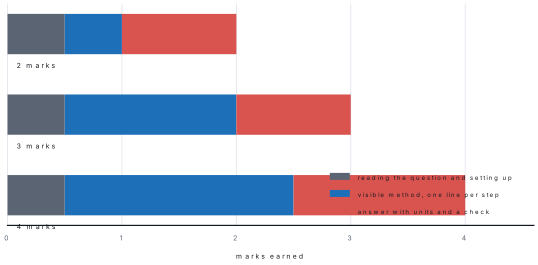
Reading a solution is not the same as writing one. The three answers below take a question of each of the three scored lengths and lay the working out in the order that collects the method marks. The open circles on the figure mark the point in each answer where the marker's pen comes down.
A 2-mark answer: state and substitute
Question. Find the value of k for which 2x^2+kx+8=0 has equal roots.
Model answer. (1) A quadratic has equal roots when its discriminant is zero: b^2-4ac=0. (2) Here a=2, b=k, c=8, so k^2-4(2)(8)=0, giving k^2=64 and k=\pm8.
Two lines, two marks: one for the condition, one for the value. Note that the answer is not 8 but \pm8 — both signs satisfy the condition, and a marker looking for "both values" will deduct for one.
A 3-mark answer: the matrix method laid out
Question. Solve by the matrix method: 3x+2y=12, 2x-y=1.
Model answer. (1) In the form AX=B, the coefficient matrix has rows (3,2) and (2,-1). Its determinant is |A|=3(-1)-2(2)=-7, which is not zero, so the inverse exists. (2) The inverse is -\frac17 times the matrix with rows (-1,-2) and (-2,3). (3) Then
Check. 3(2)+2(3)=12 ✓ and 2(2)-3=1 ✓, so x=2, y=3.
Three marks: one for the determinant and the inverse, one for the multiplication with the signs carried, one for the answer. The check line costs four seconds and protects all three.
A 4-mark answer: the two-triangle problem
Question. The angle of elevation of the top of a tower from a point on the ground is 30°. Walking 40 m nearer, the elevation becomes 60°. Find the height of the tower.
Model answer. (1) Draw and name. Let the height be h and let x be the horizontal distance from the nearer point to the foot of the tower. The farther point is then x+40 from the foot. (2) Write the two tangents. From the nearer point, \tan60°=\frac{h}{x}, so x=\frac{h}{\sqrt{3}}. From the farther point, \tan30°=\frac{h}{x+40}, so x+40=h\sqrt{3}. (3) Eliminate x. Substituting, \frac{h}{\sqrt{3}}+40=h\sqrt{3}, so 40=h\sqrt{3}-\frac{h}{\sqrt{3}}=\frac{2h}{\sqrt{3}}, giving h=20\sqrt{3}. (4) Answer and check. h\approx34.64 m. Check: x=20 m, so the farther point is 60 m away and \frac{34.64}{60}=0.577=\tan30° ✓.
Four marks: one for the diagram and the naming, one for each tangent equation, one for the elimination, one for the value with a check. A bare "34.64 m" with no diagram earns at most one.
Chapter summary
- The Optional Mathematics paper is 10 + 16 + 33 + 16 = 75 marks in three hours. Groups C and D alone carry 49 of those marks.
- A realistic clock is 10 minutes for Group A, 24 for B, 44 for C, 24 for D and 18 minutes to check. A Group A item that stalls past 90 seconds is marked and left.
- Group A rewards formula recall; Group B rewards one short method; Groups C and D reward a complete, visible method with the answer substituted back.
- The five ranks worth rehearsing first are: a two-equation linear system, a sequence problem, height and distance, a trigonometric identity and the circle work.
- Both model papers are original practice items built to the CDC grid. They are a rehearsal, not a forecast: no one outside the board knows the paper.