Question bank · 82 min read
Mathematics: Unit-wise Objective Question Bank
Group A is 11 marks out of 75 — one seventh of the whole Mathematics paper — and it is decided in about fifteen minutes. It is also the cheapest block of marks on the paper, because every item is a single formula, a single condition or a single one-line calculation, and the same handful of formulae come back year after year. Note one change that is verified on the 2082 paper itself: the eleven MCQs now arrive as a separate booklet, issued 30 minutes after the examination starts, and you write their answers on the same answer sheet. So you will begin with Group B, and Group A will interrupt you. Plan for that.
Paper structure (identical on the verified 2079, 2080, 2081 and 2082 papers and on the CDC Model Question-2080):
| Group | Questions | Marks | Printed as |
|---|---|---|---|
| A — multiple choice | 11 (Q1–Q11) | 1 each | 11x1=11 |
| B — short answer | 8 (Q12–Q19) | 5 each | 8x5=40 |
| C — long answer | 3 (Q20–Q22) | 8 each | 3x8=24 |
| Total | 22 | 75 | Time 3 hrs |
There are exactly two "Or" choices in the whole paper, always at Q11 and at Q19. Group C never carries an "Or". Everything else is compulsory.
CDC Specification Grid 2078 — area-wise marks and MCQ counts:
| Content area | Area-wise marks | MCQs |
|---|---|---|
| Algebra | 20 | 2 |
| Trigonometry | 6 | 3 shared |
| Analytic Geometry | 9 | (across these |
| Vector | 6 | three areas) |
| Statistics & Probability | 6 | 1 |
| Calculus | 22 | 4 |
| Computational Methods or Mechanics | 6 | 1 |
| Total | 75 | 11 |
Correct a common error now. The bracketed numbers printed beside each area in the syllabus — Algebra 44, Trigonometry 12, Analytic Geometry 20, Vectors 12, Statistics & Probability 12, Calculus 48, Computational Methods/Mechanics 12, adding to 160 — are working hours, not marks. Many students and many coaching sheets quote them as marks. They cannot be marks: the paper is 75. The marks column is the one in the table above.
The grid's own footnote, verbatim: "At least one multiple choice question should be asked from each area (Trigonometry, Analytic geometry and Vector)." That single sentence is why a Trigonometry MCQ is effectively guaranteed every year, even though Trigonometry is only 6 of the 75 marks.
A second printed note is worth knowing: "Questions should be prepared by giving the context and one question may have more than one sub-questions." That is why Group B items arrive as a table, a figure or a stated theorem followed by five one-mark probes.
This chapter is 216 multiple-choice questions, one section per syllabus unit, in
syllabus order. Every question carrying a year tag — (NEB 2079), (NEB 2080),
(NEB 2081), (NEB 2082), (CDC model 2080) — is a real item from that paper,
transcribed from the scan. Untagged questions were written for this book in the
same style. Every numerical answer in every key was recomputed with a computer
algebra system before printing.
11.1 Permutation and Combination
Of the two Algebra MCQs, one has come from this unit in 2081 and again in 2082. Both times it was pure recall: a counting principle or the relation between P and C. Nothing here needs more than one line of arithmetic.
| Result | Formula / condition |
|---|---|
| Basic counting principle | m ways then n ways gives m \times n ways |
| Arrangements, all different | P(n,r) = \frac{n!}{(n-r)!} |
| Selections, all different | C(n,r) = \frac{n!}{r!(n-r)!} |
| Link between them | C(n,r) \times r! = P(n,r) |
| Arrangements, not all different | \frac{n!}{p!\,q!\,r!} for repeats p,q,r |
| Repetition allowed, r places | n^{r} |
| Circular arrangement of n | (n-1)! |
| Garland / necklace of n | \frac{(n-1)!}{2} (clockwise = anticlockwise) |
| Symmetry of combination | C(n,r) = C(n, n-r) |
| Pascal's rule | C(n,r) + C(n,r-1) = C(n+1,r) |
| Total subsets | \sum_{r=0}^{n} C(n,r) = 2^{n} |
| At least one chosen | 2^{n} - 1 |
| Diagonals of an n-gon | C(n,2) - n |
| Boundary values | C(n,0) = C(n,n) = 1, P(n,0)=1 |
Multiple choice questions
- Which one is the relation between permutation and combination of n things taken r things at a time? (NEB 2082) [1]aC(n,r) = r!\times P(n,r)bC(n,r)\times r! = P(n,r)cC(n,r)\times r = P(n,r)dC(n,r) = P(n,r)\times r
- How many numbers are there in between 999 and 10{,}000? (NEB 2081) [1]a9\times 10^{3}b8\times 10^{3}c9^{4}d8^{4}
- The value of P(5,3) is [1]a10b20c60d120
- The value of C(10,8) is [1]a45b80c90d360
- If C(n,2) = 15 then n equals [1]a5b6c7d15
- Five people are to be seated around a round table. The number of arrangements is [1]a5b20c24d120
- The number of distinct arrangements of the letters of the word COMMITTEE is [1]a362880b181440c90720d45360
- The number of diagonals of a regular decagon is [1]a10b35c45d90
- If C(n,8) = C(n,12) then n equals [1]a4b12c20d96
- How many three-digit numbers, with no digit repeated, can be formed from the digits 2,3,4,5,6,7? [1]a18b20c120d216
- A cricket team of 11 players is to be chosen from 15. The number of ways is [1]a165b455c1365d32760
- The number of different garlands that can be made from 8 distinct flowers is [1]a5040b2520c40320d20160
Answer key — 11.1
1. (b) — C(n,r) counts selections; multiplying by r! orders each selection, which is exactly P(n,r).
2. (a) — the numbers strictly between are 1000 to 9999, i.e. all four-digit numbers: 9999-1000+1 = 9000 = 9\times10^{3}.
3. (c) — P(5,3) = 5\times4\times3 = 60.
4. (a) — C(10,8) = C(10,2) = \frac{10\times9}{2} = 45.
5. (b) — \frac{n(n-1)}{2}=15 \Rightarrow n^{2}-n-30=0 \Rightarrow n=6 (the root -5 is rejected).
6. (c) — circular arrangement of n objects is (n-1)! = 4! = 24.
7. (d) — 9 letters with M, T, E each twice: \frac{9!}{2!\,2!\,2!} = \frac{362880}{8} = 45360.
8. (b) — C(10,2) - 10 = 45-10 = 35; the 10 subtracted are the sides.
9. (c) — C(n,r)=C(n,s) with r \ne s forces r+s=n, so n = 8+12 = 20.
10. (c) — 6\times5\times4 = 120, i.e. P(6,3).
11. (c) — C(15,11) = C(15,4) = \frac{15\times14\times13\times12}{24} = 1365.
12. (b) — a garland can be flipped, so \frac{(8-1)!}{2} = \frac{5040}{2} = 2520.
Reading C(n,r)\times r! = P(n,r) backwards. This is the exact trap in the 2082 MCQ 1. Option (a), C(n,r) = r!\times P(n,r), is the same equation with the r! on the wrong side. Fix it by size: for n=5, r=3 we have C=10 and P=60, so P is the bigger number, so r! multiplies C, never P.
Order-blindness. In Q11 the distractor 32760 is P(15,4): the student selected and ordered eleven players. A team is a selection. If swapping two chosen objects gives the same answer, use C.
Forgetting the circle costs one factor. In Q6 the distractor 120 = 5! is the answer for a straight bench. Around a table, one person's seat is only relative, so divide by n: (n-1)!.
Forgetting that a garland flips. In Q12 the distractor 5040 = 7! is the circular count. A garland (or necklace) read clockwise equals the same garland read anticlockwise, so halve it.
Counting the sides as diagonals. In Q8 the distractor 45 is C(10,2), the number of all lines joining two vertices. Ten of those are sides.
11.2 Binomial Theorem
Worth reading carefully, because of a fact the four verified papers make plain: Binomial Theorem has never appeared as an MCQ in 2079, 2080, 2081 or 2082. It appears every year, but in Group B (2079 Q12, 2080 Q13b, 2081 Q12, 2082 Q12a) and Group C (2081 Q20a, 2082 Q20a). Learn the facts below for Group B; do not spend Group A revision time here beyond one pass.
| Result | Formula / condition |
|---|---|
| Expansion, positive integral index | (a+b)^{n} = \sum_{r=0}^{n} C(n,r)\,a^{n-r}b^{r} |
| General term | T_{r+1} = C(n,r)\,a^{n-r}b^{r} |
| Number of terms | n+1 |
| Middle term, n even | one term, the \left(\frac{n}{2}+1\right)th |
| Middle terms, n odd | two, the \frac{n+1}{2}th and \frac{n+3}{2}th |
| Sum of all coefficients | (1+x)^{n} at x=1 gives 2^{n} |
| Any index | (1+x)^{n} valid only for |x|<1, infinitely many terms |
| Euler's number | e = 1+\frac{1}{1!}+\frac{1}{2!}+\frac{1}{3!}+\cdots, 2<e<3 |
| Exponential series | e^{x} = 1+\frac{x}{1!}+\frac{x^{2}}{2!}+\frac{x^{3}}{3!}+\cdots |
| General exponential | a^{x} = 1 + x\log a + \frac{(x\log a)^{2}}{2!}+\cdots |
| Logarithmic series | \log_e(1+x) = x-\frac{x^{2}}{2}+\frac{x^{3}}{3}-\cdots |
| Its validity | -1 < x \leq 1 |
| Other logarithmic series | \log_e(1-x) = -x-\frac{x^{2}}{2}-\frac{x^{3}}{3}-\cdots, |x|<1 |
| Approximation | for small x, (1+x)^{n} \approx 1+nx |
Multiple choice questions
- The number of terms in the expansion of (2x+3y)^{12} is [1]a11b12c13d24
- In the expansion of (a+b)^{10}, the middle term is the [1]a5thb6thc7thd5th and 6th
- The middle term of (2+3x)^{30} is the [1]a15thb16thc17thd15th and 16th
- The coefficient of x^{5} in (1+x)^{10} is [1]a120b210c252d504
- The sum of the binomial coefficients in the expansion of (1+x)^{n} is [1]anbn!c2^{n}d2^{n}-1
- In (1+x)^{11} the coefficients of x^{r} and x^{r+1} are equal. Then r is [1]a4b5c6d11
- The expansion of \log_e(1+x) is valid for [1]aall xbx>0c-1 < x \leq 1dx \geq 1
- Euler's number e is the sum of the series [1]a\sum \frac{1}{n}b\sum \frac{1}{n!}c\sum \frac{1}{n^{2}}d\sum \frac{(-1)^{n}}{n!}
- The coefficient of x^{3} in the expansion of e^{2x} is [1]a\frac{1}{6}b\frac{2}{3}c\frac{4}{3}d8
- Using the binomial expansion, (1.01)^{5} correct to three decimal places is [1]a1.005b1.050c1.051d1.105
- The term independent of x in the expansion of \left(x+\frac{1}{x}\right)^{6} is [1]a15b20c30d64
- The number of terms in the expansion of (1+x)^{-3}, |x|<1, is [1]a2b3c4dinfinitely many
Answer key — 11.2
1. (c) — a positive integral index n gives n+1 terms, so 12+1=13.
2. (b) — n=10 is even, so there is one middle term, the \left(\frac{10}{2}+1\right)th =6th.
3. (b) — n=30 is even: the \left(\frac{30}{2}+1\right)th =16th term.
4. (c) — C(10,5) = 252.
5. (c) — put x=1: \sum C(n,r) = (1+1)^{n} = 2^{n}.
6. (b) — C(11,r) = C(11,r+1) needs r+(r+1) = 11, so r=5.
7. (c) — the series diverges at x=-1 and for |x|>1; it converges at x=+1 (giving \log 2).
8. (b) — e = \sum_{n=0}^{\infty}\frac{1}{n!} = 1+1+\frac{1}{2}+\frac{1}{6}+\cdots
9. (c) — e^{2x} = \sum \frac{(2x)^{n}}{n!}, so the x^{3} coefficient is \frac{2^{3}}{3!} = \frac{8}{6} = \frac{4}{3}.
10. (c) — (1+0.01)^{5} = 1+5(0.01)+10(0.0001)+\cdots = 1.05101\ldots \approx 1.051.
11. (b) — T_{r+1} = C(6,r)x^{6-2r}; 6-2r=0 gives r=3 and C(6,3)=20.
12. (d) — for a negative (or fractional) index the expansion is an infinite series; it only terminates for a positive integral index.
Counting terms as n instead of n+1. Option (b) in Q1 is the commonest wrong answer. The powers of y run 0,1,2,\ldots,12 — thirteen values.
Confusing "rth term" with "coefficient of x^{r}". T_{r+1} carries x^{r}. In Q4 the answer is C(10,5), not C(10,4); the distractor 210 = C(10,4) is exactly the off-by-one.
Applying the "two middle terms" rule to an even index. In Q2 and Q3 the distractor "(d) two middle terms" is the n odd case. Even n gives one middle term. Count the terms first: 11 terms has a 6th in the middle, 31 terms has a 16th.
Ignoring the validity condition. In Q7 and Q12, option (a) "all x" treats a power series as if it were a polynomial. The general binomial theorem and the logarithmic series are only valid on a restricted interval, and the examiner asks for that interval (2081 Q12c did, for 1 mark).
11.3 Complex Numbers
This unit has supplied an Algebra MCQ twice in four years: 2079 asked for a property of the cube roots of unity, 2081 for the polar form of a product. Both are one-line recall. De Moivre's theorem itself has appeared every year, but in Group B or C.
| Result | Formula / condition |
|---|---|
| Polar (modulus–amplitude) form | z = r(\cos\theta + i\sin\theta) |
| Modulus | r = |z| = \sqrt{x^{2}+y^{2}} |
| Argument | \theta = \tan^{-1}\frac{y}{x}, placed in the correct quadrant |
| Product in polar form | z_1z_2 = r_1r_2\left[\cos(\theta_1+\theta_2)+i\sin(\theta_1+\theta_2)\right] |
| Quotient in polar form | moduli divide, arguments subtract |
| De Moivre's theorem | \left[r(\cos\theta+i\sin\theta)\right]^{n} = r^{n}(\cos n\theta + i \sin n\theta) |
| Euler's formula | e^{i\theta} = \cos\theta + i\sin\theta, so e^{i\pi} = -1 |
| Cube roots of unity | 1,\ \omega,\ \omega^{2} with \omega = \frac{-1+i\sqrt{3}}{2} |
| Their sum | 1+\omega+\omega^{2} = 0 |
| Their product | 1\cdot\omega\cdot\omega^{2} = \omega^{3} = 1 |
| Useful consequence | \omega+\omega^{2} = -1 and (1+\omega)(1+\omega^{2}) = 1 |
| nth roots of unity | n distinct values, and they sum to 0 |
| Powers of i | i^{4k}=1, i^{4k+1}=i, i^{4k+2}=-1, i^{4k+3}=-i |
| Conjugate | z\bar{z} = |z|^{2} |
Multiple choice questions
- The property of cube roots of unity where \omega is the cube root of unity is (NEB 2079) [1]a1+\omega+\omega^{2}=0b\omega^{3}+1=0c\omega = -\omega^{2}d\omega+\omega^{2}=1
- It is given that (r_1,\theta_1) and (r_2,\theta_2) are polar co-ordinates of z_1 and z_2. What are the polar co-ordinates of the image of z_1z_2? (NEB 2081) [1]a(r_1r_2,\ \theta_1-\theta_2)b(r_1r_2,\ \theta_1+\theta_2)c(r_1+r_2,\ \theta_1+\theta_2)d(r_1-r_2,\ \theta_1+\theta_2)
- The modulus of 1+i\sqrt{3} is [1]a1b\sqrt{2}c2d4
- The argument of -1+i is [1]a\frac{\pi}{4}b\frac{3\pi}{4}c-\frac{\pi}{4}d\frac{5\pi}{4}
- If \omega is a complex cube root of unity, then \omega^{10}+\omega^{11} equals [1]a0b1c-1d\omega
- If \omega is a complex cube root of unity, then (1+\omega)(1+\omega^{2}) equals [1]a-1b0c1d2
- By De Moivre's theorem, (\cos 20^{\circ}+i\sin 20^{\circ})^{9} equals [1]a1b-1cid-i
- The value of e^{i\pi/2} is [1]a1b-1cid-i
- The number of distinct fifth roots of unity is [1]a1b2c5dinfinitely many
- The polar form of 1+i is [1]a\sqrt{2}\left(\cos\frac{\pi}{4}+i\sin\frac{\pi}{4}\right)b2\left(\cos\frac{\pi}{4}+i\sin\frac{\pi}{4}\right)c\sqrt{2}\left(\cos\frac{\pi}{3}+i\sin\frac{\pi}{3}\right)d\cos\frac{\pi}{4}+i\sin\frac{\pi}{4}
- The value of i^{37} is [1]a1b-1cid-i
- The sum of all the fifth roots of unity is [1]a0b1c5d-1
Answer key — 11.3
1. (a) — \omega satisfies \omega^{3}=1, i.e. (\omega-1)(\omega^{2}+\omega+1)=0; since \omega \ne 1, 1+\omega+\omega^{2}=0.
2. (b) — multiplying complex numbers multiplies the moduli and adds the arguments.
3. (c) — \sqrt{1^{2}+(\sqrt{3})^{2}} = \sqrt{4} = 2.
4. (b) — the point (-1,1) is in the second quadrant, so \theta = \pi - \frac{\pi}{4} = \frac{3\pi}{4}.
5. (c) — \omega^{10}=\omega^{9}\cdot\omega=\omega and \omega^{11}=\omega^{2}, so the sum is \omega+\omega^{2}=-1.
6. (c) — expand: 1+\omega+\omega^{2}+\omega^{3} = 0 + 1 = 1.
7. (b) — \cos 180^{\circ}+i\sin 180^{\circ} = -1; machine-checked.
8. (c) — \cos\frac{\pi}{2}+i\sin\frac{\pi}{2} = 0+i = i.
9. (c) — the equation z^{5}=1 has exactly 5 distinct roots.
10. (a) — r=\sqrt{2} and \theta = \tan^{-1}1 = \frac{\pi}{4} (first quadrant).
11. (c) — 37 = 4(9)+1, so i^{37}=i^{1}=i.
12. (a) — the roots of z^{5}-1=0 sum to minus the coefficient of z^{4}, which is 0.
Writing \omega^{3}+1=0 instead of \omega^{3}-1=0. Option (b) in the 2079 MCQ 1 is the cube root of -1, not of 1. Anchor it on the real root: \omega=1 must satisfy the equation, and 1^{3}-1=0.
Losing the quadrant when finding an argument. In Q4, \tan^{-1}\frac{1}{-1} = -\frac{\pi}{4} comes straight off a calculator, and it is option (c) — the wrong answer, because (-1,1) is in the second quadrant. Always plot the point first.
Adding the moduli. Option (c) in the 2081 MCQ, (r_1+r_2,\theta_1+\theta_2), treats multiplication as addition in the modulus. Moduli multiply; only arguments add.
Forgetting to reduce the power modulo 3 (or 4). In Q5 and Q11 a student who tries to compute \omega^{10} directly loses time and accuracy. Use \omega^{3}=1 and i^{4}=1 to knock the exponent down first.
11.4 Sequence and Series
This unit is examined as a single-line recall MCQ or, far more often, as mathematical induction in Group B/C — induction appears in every verified year (2079 Q13a, 2080 Q20b, 2081 Q20c, 2082 Q20b, CDC model Q20c). Memorise the three sum formulae exactly; every mark here hangs on them.
| Result | Formula |
|---|---|
| Sum of first n natural numbers | \sum n = \frac{n(n+1)}{2} |
| Sum of their squares | \sum n^{2} = \frac{n(n+1)(2n+1)}{6} |
| Sum of their cubes | \sum n^{3} = \left[\frac{n(n+1)}{2}\right]^{2} |
| A useful identity | \sum n^{3} = \left(\sum n\right)^{2} |
| Sum of first n odd numbers | 1+3+5+\cdots+(2n-1) = n^{2} |
| Sum of first n even numbers | 2+4+6+\cdots+2n = n(n+1) |
| Induction, step 1 | verify the statement for n=1 (the base case) |
| Induction, step 2 | assume it true for n=k (the inductive hypothesis) |
| Induction, step 3 | prove it for n=k+1 using that assumption |
| Induction, conclusion | true for all n \in \mathbb{N} |
Multiple choice questions
- The sum of the first 5 odd natural numbers is (CDC model 2080) [1]a15b20c25d30
- The value of 1^{2}+2^{2}+3^{2}+\cdots+20^{2} is [1]a2470b2870c3080d4410
- The value of 1^{3}+2^{3}+3^{3}+\cdots+10^{3} is [1]a385b1000c3025d3850
- The value of 1+2+3+\cdots+100 is [1]a4950b5000c5050d10100
- The sum of the first n even natural numbers is [1]an^{2}bn(n+1)c\frac{n(n+1)}{2}d2n
- 1^{2}+2^{2}+\cdots+n^{2} equals [1]a\frac{n(n+1)}{2}b\frac{n(n+1)(2n+1)}{6}c\left[\frac{n(n+1)}{2}\right]^{2}d\frac{n(n+1)(n+2)}{6}
- Which statement is true for every positive integer n? [1]a\sum n^{2} = \left(\sum n\right)^{2}b\sum n^{3} = \left(\sum n\right)^{2}c\sum n^{3} = \left(\sum n^{2}\right)^{2}d\sum n = \left(\sum n^{2}\right)^{2}
- In a proof by mathematical induction, the first thing you must do is [1]aassume the result for n=kbverify the result for the smallest ncprove the result for n=k+1ddifferentiate both sides
- The value of 1^{2}+2^{2}+\cdots+6^{2} is [1]a36b49c91d441
- The sum of the cubes of the first 5 natural numbers is [1]a125b225c325d625
Answer key — 11.4
1. (c) — 1+3+5+7+9=25, which is 5^{2}: the sum of the first n odd numbers is n^{2}.
2. (b) — \frac{20\times21\times41}{6} = 2870.
3. (c) — \left[\frac{10\times11}{2}\right]^{2} = 55^{2} = 3025.
4. (c) — \frac{100\times101}{2} = 5050.
5. (b) — 2(1+2+\cdots+n) = 2\cdot\frac{n(n+1)}{2} = n(n+1).
6. (b) — the standard result; (c) is the sum of cubes.
7. (b) — the sum of cubes is the square of the sum of the first powers, e.g. 1+8+27=36=6^{2}.
8. (b) — the base case. Without it the inductive step proves nothing.
9. (c) — \frac{6\times7\times13}{6} = 91.
10. (b) — \left[\frac{5\times6}{2}\right]^{2} = 15^{2} = 225.
Swapping \sum n^{2} and \sum n^{3}. These two formulae are adjacent in memory and are the most-swapped pair in the whole Algebra area. Check with n=2: \sum n^{2} = 5 and \sum n^{3} = 9. Feed n=2 into a formula you are unsure of and see which number comes out.
n^{2} versus n(n+1) for the odd/even sums. Q1 and Q5 pair these deliberately. Odd numbers start at 1 and sum to n^{2}; even numbers start at 2 and sum to n(n+1), which is exactly twice \sum n.
Skipping the base case in induction. Option (a) in Q8 is what most scripts actually do first, and it loses the mark the grid allocates to it. The 2081 paper asked candidates to state the principle of mathematical induction for 2 marks — both the base case and the inductive step must appear in words.
Off-by-one in \sum n for a range. For "the sum of the integers from 1 to 100", 4950 (option (a) in Q4) is \sum_{1}^{99}. Substitute the top limit itself, not one less.
11.5 Matrix Based System of Linear Equations
The 2082 paper put Cramer's rule straight into Group A (MCQ 2), and Group C has carried a full matrix-method system in 2079, 2080 and 2082. Learn the three methods as three different tools for the same job, and learn the consistency conditions — they are what the MCQ actually tests.
| Result | Formula / condition |
|---|---|
| Matrix form of a system | AX = B |
| Cramer's rule | x=\frac{D_x}{D}, y=\frac{D_y}{D}, z=\frac{D_z}{D} |
| D_x | replace the x-column of D by the constants |
| Unique solution | D \ne 0 |
| No solution (inconsistent) | D=0 but some D_x, D_y, D_z \ne 0 |
| Infinitely many solutions | D = 0 and D_x=D_y=D_z=0 |
| Inverse matrix method | X = A^{-1}B, valid only if |A| \ne 0 |
| The inverse itself | A^{-1} = \frac{1}{|A|}\,\mathrm{adj}\,A |
| 2\times2 inverse rule | swap the diagonal, negate the off-diagonal, divide by |A| |
| Singular matrix | |A| = 0, so A^{-1} does not exist |
| Determinant of the adjoint | |\mathrm{adj}\,A| = |A|^{n-1} |
| Determinant of the inverse | |A^{-1}| = \frac{1}{|A|} |
| Row-equivalent (Gauss) method | row-operate the augmented matrix to upper triangular form, then back-substitute |
| Augmented matrix | the coefficient matrix with the constant column attached |
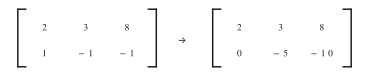
For a two-variable system, Cramer's rule is three determinants and one division. Draw them out before you substitute — that alone prevents most sign errors.

So x = \dfrac{D_x}{D} and y = \dfrac{D_y}{D} — written out,
The row-equivalent method works on the augmented matrix instead. One row operation at a time, and you write the operation beside the row you changed.
Multiple choice questions
- If the system of equations is p_1x+q_1y=r_1 and p_2x+q_2y=r_2, what is the value of y? (NEB 2082) [1]a\frac{r_1q_2-r_2q_1}{p_1q_2-p_2q_1}b\frac{p_1r_2-p_2r_1}{p_1q_2-p_2q_1}c\frac{p_1q_2-p_2q_1}{p_1r_2-p_2r_1}d\frac{p_2r_1-p_1r_2}{p_1q_2-p_2q_1}
- A system of linear equations has a unique solution if and only if [1]aD=0bD \ne 0cD_x = 0dD=D_x=D_y=0
- If A has first row (2,\ 3) and second row (3,\ -1), then |A| equals [1]a-11b-7c7d11
- A square matrix A with |A| = 0 is called [1]asingularbnon-singularcorthogonaldsymmetric
- The last column of the augmented matrix of the system 3x+2y-1=0, 4x+y=3 is [1]a(1,\ 3)b(-1,\ 3)c(3,\ 4)d(2,\ 1)
- In Cramer's rule, x equals [1]a\frac{D}{D_x}b\frac{D_x}{D}cD\cdot D_xd\frac{D_y}{D}
- Solving 2x+3y=7, x-y=1 by Cramer's rule gives x equal to [1]a1b2c-2d\frac{10}{5} and y=2
- If D=0 and D_x \ne 0, the system has [1]aa unique solutionbexactly two solutionscinfinitely many solutionsdno solution
- For a 3\times3 matrix A with |A| = 4, the value of |\mathrm{adj}\,A| is [1]a4b8c16d64
- The inverse of a non-singular matrix A is [1]a|A|\cdot\mathrm{adj}\,Ab\frac{1}{|A|}\mathrm{adj}\,Ac\frac{\mathrm{adj}\,A}{A}d\frac{1}{A}
- The row-equivalent method solves AX=B by reducing the augmented matrix to [1]athe identity matrixbupper triangular (row echelon) formca diagonal matrix of onesdits transpose
- If A is a 2\times2 matrix with |A| = 3, then |A^{-1}| equals [1]a3b9c\frac{1}{3}d-3
Answer key — 11.5
1. (b) — y = \frac{D_y}{D}, and D_y replaces the y-column by the constants, giving p_1r_2-p_2r_1 over p_1q_2-p_2q_1. (The paper printed its four options as determinant ratios; they are written out here.)
2. (b) — D \ne 0 means A^{-1} exists, so X=A^{-1}B is the one and only solution.
3. (a) — (2)(-1)-(3)(3) = -2-9 = -11.
4. (a) — zero determinant means the rows are dependent; the matrix is singular and has no inverse.
5. (a) — write both in the form ax+by=c: 3x+2y=1 and 4x+y=3, so the constant column is (1,\ 3).
6. (b) — numerator is the determinant with the x-column replaced; the denominator is always D.
7. (b) — D = -5, D_x = (7)(-1)-(3)(1) = -10, so x = \frac{-10}{-5} = 2 (and y=1).
8. (d) — D=0 kills the unique solution; a non-zero D_x makes the equations contradict each other.
9. (c) — |\mathrm{adj}\,A| = |A|^{n-1} = 4^{2} = 16.
10. (b) — the adjoint divided by the determinant.
11. (b) — Gauss elimination stops at upper triangular form; back-substitution finishes the job.
12. (c) — |A^{-1}| = \frac{1}{|A|} = \frac{1}{3}.
Inverting the Cramer fraction. Option (c) in the 2082 MCQ 2 is \frac{D}{D_y} — the right two determinants, upside down. The rule is always the modified determinant on top, D underneath. Check the dimensions in your head: if D=0 the answer must blow up, so D belongs in the denominator.
Replacing the wrong column. Option (a) in the same question is D_x over D, i.e. the answer for x offered as the answer for y. Replace the column of the variable you are solving for.
Not moving the constant across first. In Q5 the equation is printed as 3x+2y-1=0. The constant is +1, not -1, once the -1 is moved to the right. Option (b) is exactly this sign slip, and it is the same slip the 2082 Group B item (write the augmented matrix of 3x+2y-1=0 and 4x+y=3) was testing.
Confusing "no solution" with "infinitely many". Both have D=0. The tie is broken by D_x, D_y, D_z: all zero means infinitely many solutions; any one non-zero means none. The 2079 MCQ 10 tested the "infinitely many" branch with the line 0\times z = 0.
Cubing instead of squaring the adjoint determinant. In Q9 the distractor 64 uses |A|^{n}. The correct index is n-1.
11.6 Properties of a Triangle
The grid's footnote guarantees a Trigonometry MCQ every year. But look at what has actually filled that slot: 2081 and 2082 asked for a half-angle formula (\cos\frac{A}{2} and \sec\frac{B}{2}), while 2079 and 2080 filled it with Grade-11 carry-over — inverse circular functions and general solutions of trigonometric equations. All four are included below, tagged. So revise the half-angle set and keep your Grade-11 inverse-circular and general-solution formulae on the same card.
| Result | Formula |
|---|---|
| Sine law | \frac{a}{\sin A}=\frac{b}{\sin B}=\frac{c}{\sin C}=2R |
| Cosine law | \cos A = \frac{b^{2}+c^{2}-a^{2}}{2bc} |
| Tangent law | \tan\frac{B-C}{2} = \frac{b-c}{b+c}\cot\frac{A}{2} |
| Projection law | a = b\cos C + c\cos B |
| Semi-perimeter | s = \frac{a+b+c}{2} |
| Half angle, sine | \sin\frac{A}{2} = \sqrt{\frac{(s-b)(s-c)}{bc}} |
| Half angle, cosine | \cos\frac{A}{2} = \sqrt{\frac{s(s-a)}{bc}} |
| Half angle, tangent | \tan\frac{A}{2} = \sqrt{\frac{(s-b)(s-c)}{s(s-a)}} |
| Area, two sides and included angle | \Delta = \frac{1}{2}ab\sin C |
| Area, three sides (Heron) | \Delta = \sqrt{s(s-a)(s-b)(s-c)} |
| Angle sum | A+B+C = 180^{\circ} |
| Inverse circular identity | \sin^{-1}x = \cos^{-1}\sqrt{1-x^{2}} for 0 \leq x \leq 1 |
| Domain of \sin^{-1}x | [-1,\ 1]; range \left[-\frac{\pi}{2},\frac{\pi}{2}\right] |
| General solution, \tan\theta = \tan\alpha | \theta = n\pi + \alpha |
| General solution, \cos\theta = \cos\alpha | \theta = 2n\pi \pm \alpha |
| General solution, \sin\theta = \sin\alpha | \theta = n\pi + (-1)^{n}\alpha |
Multiple choice questions
- In any triangle ABC, a, b, c are the sides and s is the semi-perimeter. Which one of the following is equal to \cos\frac{A}{2}? (NEB 2081) [1]a\sqrt{\frac{s(s-a)}{bc}}b\sqrt{\frac{(s-b)(s-c)}{s(s-a)}}c\sqrt{\frac{s(s-a)}{(s-b)(s-c)}}d\sqrt{\frac{(s-b)(s-c)}{bc}}
- Which one of the following is the value of \sec\frac{B}{2}? (NEB 2082) [1]a\sqrt{\frac{ca}{s-b}}b\sqrt{\frac{bc}{s(s-a)}}c\sqrt{\frac{bc}{s(s-c)}}d\sqrt{\frac{ca}{s(s-b)}}
- \sin^{-1}x is equal to (NEB 2079) [1]a\cos^{-1}\sqrt{x^{2}-1}b\tan^{-1}\sqrt{1-x^{2}}c\mathrm{cosec}^{-1}\sqrt{1-x^{2}}d\cos^{-1}\sqrt{1-x^{2}}
- If \tan x + \frac{1}{\sqrt{3}} = 0 is a trigonometric equation, the general value of x is (NEB 2079) [1]an\pi \pm \frac{\pi}{6}b2n\pi + \frac{\pi}{6}c2n\pi + \frac{5\pi}{6}dn\pi + \frac{5\pi}{6}
- What is the domain of y = \sin^{-1}x? (NEB 2080) [1]a(-1,\ 1)b(-\infty,\ \infty)c[0,\ 1]d[-1,\ 1]
- Which one of the following is the general solution of 2\cos\theta - 1 = 0? (NEB 2080) [1]an\pi + (-1)^{n}\frac{\pi}{3}bn\pi \pm \frac{\pi}{3}cn\pi + \frac{\pi}{3}d2n\pi \pm \frac{\pi}{3}
- In any triangle ABC, \frac{a}{\sin A} equals [1]aRb2Rc\frac{R}{2}d4R
- The projection law gives a as [1]ab\cos C + c\cos Bbb\cos B + c\cos Ccb\sin C + c\sin Bdb\cos A + c\cos A
- The tangent law states that \tan\frac{B-C}{2} equals [1]a\frac{b+c}{b-c}\cot\frac{A}{2}b\frac{b-c}{b+c}\cot\frac{A}{2}c\frac{b-c}{b+c}\tan\frac{A}{2}d\frac{b+c}{b-c}\tan\frac{A}{2}
- \sin\frac{A}{2} equals [1]a\sqrt{\frac{s(s-a)}{bc}}b\sqrt{\frac{(s-b)(s-c)}{bc}}c\sqrt{\frac{(s-b)(s-c)}{s(s-a)}}d\sqrt{\frac{bc}{s(s-a)}}
- In a triangle with b=4, c=5 and A=30^{\circ}, the area is [1]a5b10c\frac{5\sqrt{3}}{2}d20
- In a triangle with a=7, b=8, c=9, the value of \cos A is [1]a\frac{1}{3}b\frac{2}{3}c\frac{11}{21}d\frac{1}{6}
Answer key — 11.6
1. (a) — \cos\frac{A}{2}=\sqrt{\frac{s(s-a)}{bc}}; (d) is \sin\frac{A}{2} and (b) is \tan\frac{A}{2}.
2. (d) — \cos\frac{B}{2}=\sqrt{\frac{s(s-b)}{ca}}, so its reciprocal is \sqrt{\frac{ca}{s(s-b)}}.
3. (d) — if \sin\theta = x then \cos\theta = \sqrt{1-x^{2}}, so \theta = \cos^{-1}\sqrt{1-x^{2}} (valid for 0 \leq x \leq 1).
4. (d) — \tan x = -\frac{1}{\sqrt{3}} = \tan\frac{5\pi}{6}, so x = n\pi + \frac{5\pi}{6}. Machine-checked: \tan\frac{5\pi}{6} = -\frac{\sqrt{3}}{3}.
5. (d) — \sin\theta takes every value in [-1,1] including the endpoints, so the inverse is defined on the closed interval.
6. (d) — \cos\theta = \frac{1}{2} = \cos\frac{\pi}{3}, and the general solution of \cos\theta=\cos\alpha is \theta = 2n\pi \pm \alpha.
7. (b) — the sine law's common ratio is the diameter of the circumcircle, 2R.
8. (a) — each side is the sum of the projections of the other two onto it.
9. (b) — the difference of the sides over their sum, times \cot of half the third angle.
10. (b) — \sin\frac{A}{2}=\sqrt{\frac{(s-b)(s-c)}{bc}}.
11. (a) — \frac{1}{2}bc\sin A = \frac{1}{2}(4)(5)\left(\frac{1}{2}\right) = 5.
12. (b) — \cos A = \frac{8^{2}+9^{2}-7^{2}}{2(8)(9)} = \frac{96}{144} = \frac{2}{3}.
Rotating the half-angle trio. \sin\frac{A}{2}, \cos\frac{A}{2} and \tan\frac{A}{2} share the same four ingredients s, s-a, s-b, s-c arranged three ways, and every paper offers all three as options. Lock it with one sentence: sine takes (s-b)(s-c) on top, cosine takes s(s-a) on top, and tangent is sine over cosine. The 2081 MCQ 3 and 2082 MCQ 3 are both exactly this.
Forgetting to reciprocate for \sec and \mathrm{cosec}. In the 2082 item the question asks for \sec\frac{B}{2}, not \cos\frac{B}{2}. Option (b) has the right shape with the wrong letter shifted; option (a) has dropped the s out of the denominator entirely. Write \cos\frac{B}{2} first, then flip it.
Using 2n\pi\pm\alpha for a tangent equation. In the 2079 general-value item, option (a) n\pi\pm\frac{\pi}{6} mixes the tangent period with the cosine \pm pattern. Tangent has period \pi and no \pm: \theta = n\pi+\alpha. Cosine gets the \pm; sine gets the (-1)^{n}.
Open versus closed interval for an inverse function. In the 2080 domain item, (-1,1) (option (a)) excludes \pm1, but \sin^{-1}(\pm1) = \pm\frac{\pi}{2} exists. Domains of \sin^{-1} and \cos^{-1} are closed.
Using the wrong pair of sides in the area formula. \Delta = \frac{1}{2}ab\sin C needs the angle between the two sides you use. In Q11 the sides are b and c, so the angle must be A.
11.7 Solution of Triangles
Only 4 working hours, and no MCQ has yet come from it in 2079, 2080, 2081 or 2082. It reached Group C once, in 2081 Q21a ("if a = 3+\sqrt{3}, b=2, c=\sqrt{3} then solve the triangle"); as recorded, those data give b+c<a, which no triangle can satisfy, so the printed numbers were probably misread or misprinted. Learn the decision rule — which law for which given data — and move on.
| Data given | Method to use | Notes |
|---|---|---|
| Three sides a,b,c | cosine law, or the half-angle formulae | exactly one triangle if the largest side is less than the sum of the other two; none otherwise |
| Two sides and the included angle | tangent law for the angles, then sine law | one triangle |
| Two angles and one side | sine law (find the third angle first) | one triangle |
| Two sides and a non-included angle | sine law | the ambiguous case: 0, 1 or 2 triangles |
| Right angle present | Pythagoras and simple ratios | fastest route |
| a=b | then A=B (isosceles) | equal sides face equal angles |
| Largest side | faces the largest angle | use it to spot an obtuse triangle |
| Check | A+B+C must come to 180^{\circ} | always do this |
Multiple choice questions
- To solve a triangle when all three sides are given, the appropriate law is [1]asine lawbcosine lawcprojection lawdtangent law
- Two sides and the included angle are given. The law that leads directly to the other two angles is [1]asine lawbcosine lawctangent lawdprojection law
- Two angles and one side are given. The right tool is [1]asine lawbcosine lawctangent lawdHeron's formula
- In \Delta ABC, if a=b then [1]aA=BbA=CcA+B=90^{\circ}dC=90^{\circ}
- A triangle has b=3, c=3 and A=60^{\circ}. The triangle is [1]aright-angledbobtuse-angledcequilateraldimpossible
- In \Delta ABC, A=45^{\circ}, B=105^{\circ} and a=\sqrt{2}. Then c equals [1]a1b\sqrt{2}c\sqrt{3}d2
- The ambiguous case arises when the data given are [1]athree sidesbtwo sides and the included anglectwo sides and a non-included angledtwo angles and one side
- If a=5, b=12, c=13, then the largest angle of the triangle is [1]a60^{\circ}b90^{\circ}c120^{\circ}d150^{\circ}
Answer key — 11.7
1. (b) — the cosine law is the only one that gives an angle from three sides alone.
2. (c) — the tangent law gives \frac{B-C}{2} directly, and \frac{B+C}{2}=90^{\circ}-\frac{A}{2} is known, so B and C follow by adding and subtracting.
3. (a) — find the third angle from A+B+C=180^{\circ}, then the sine law gives the remaining sides.
4. (a) — equal sides face equal angles; by the sine law \sin A = \sin B.
5. (c) — b=c makes it isosceles with B=C, and B=C=\frac{180^{\circ}-60^{\circ}}{2}=60^{\circ}, so all three angles are 60^{\circ}.
6. (a) — C = 180^{\circ}-45^{\circ}-105^{\circ}=30^{\circ}, and c = \frac{a\sin C}{\sin A} = \frac{\sqrt{2}\times\frac{1}{2}}{\frac{1}{\sqrt{2}}} = 1.
7. (c) — the sine law can give two supplementary angles, so there may be two triangles, one, or none.
8. (b) — 5^{2}+12^{2}=169=13^{2}, so the angle opposite 13 is a right angle. Machine-checked: \cos C = 0.
Distractor analysis — Solution of Triangles
Reaching for the sine law when three sides are given. The sine law needs an angle to start from; with only sides you must use the cosine law (or half-angle formulae). Option (a) in Q1 is the reflex answer and it is a dead end.
Assuming an isosceles triangle cannot be equilateral. In Q5, b=c with A=60^{\circ} forces all angles to 60^{\circ}. Students stop at "isosceles" and pick (a) or (b) without finishing the angle sum.
Missing the ambiguous case. Given a, b and A, \sin B = \frac{b\sin A}{a} has two solutions in (0^{\circ},180^{\circ}) whenever the value is strictly between 0 and 1. Always test whether the obtuse partner still leaves a positive third angle.
Not checking the angle sum. Every solved triangle must satisfy A+B+C=180^{\circ}. It takes five seconds and catches almost every arithmetic slip in a Group C answer.
11.8 Conic Sections
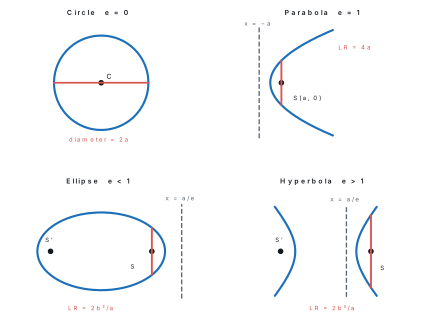
The biggest MCQ payer in the book. Analytic Geometry carries 9 marks and shares 3 MCQs with Trigonometry and Vectors, and a conic item has appeared in all four verified years: 2079 (eccentricity of a hyperbola), 2080 (identify the conic), 2081 (focus of a parabolic reflector), 2082 (tangency condition for a circle). Learn the table below across, not down — the examiner's favourite move is to give you a parabola formula in an ellipse question.
| Circle x^{2}+y^{2}=a^{2} | Parabola y^{2}=4ax | Ellipse \frac{x^{2}}{a^{2}}+\frac{y^{2}}{b^{2}}=1 | Hyperbola \frac{x^{2}}{a^{2}}-\frac{y^{2}}{b^{2}}=1 | |
|---|---|---|---|---|
| Eccentricity e | 0 | 1 | \sqrt{1-\frac{b^{2}}{a^{2}}}, so e<1 | \sqrt{1+\frac{b^{2}}{a^{2}}}, so e>1 |
| Focus / foci | centre only | (a,\ 0) | (\pm ae,\ 0) | (\pm ae,\ 0) |
| Directrix | none | x=-a | x = \pm\frac{a}{e} | x = \pm\frac{a}{e} |
| Latus rectum | 2a (a diameter) | 4a | \frac{2b^{2}}{a} | \frac{2b^{2}}{a} |
| b^{2} relation | — | — | b^{2}=a^{2}(1-e^{2}) | b^{2}=a^{2}(e^{2}-1) |
| Tangency of y=mx+c | c^{2}=a^{2}(1+m^{2}) | c=\frac{a}{m} | c^{2}=a^{2}m^{2}+b^{2} | c^{2}=a^{2}m^{2}-b^{2} |
| Tangent at (x_1,y_1) | xx_1+yy_1=a^{2} | yy_1 = 2a(x+x_1) | \frac{xx_1}{a^{2}}+\frac{yy_1}{b^{2}}=1 | \frac{xx_1}{a^{2}}-\frac{yy_1}{b^{2}}=1 |
| General centre form | x^{2}+y^{2}+2gx+2fy+c=0, centre (-g,-f), radius \sqrt{g^{2}+f^{2}-c} | axis is the x-axis | major axis 2a, minor 2b | transverse 2a, conjugate 2b |
| Length of tangent from (x_1,y_1) | \sqrt{x_1^{2}+y_1^{2}-a^{2}} | — | — | — |
Multiple choice questions
- In which condition will the line y=mx+c be tangent to the circle x^{2}+y^{2}=a^{2}? (NEB 2082) [1]aa = c\sqrt{1+m^{2}}ba = \pm c\sqrt{1+m^{2}}cc = \pm a\sqrt{1+m^{2}}dc = a\sqrt{1+m^{2}}
- A parabolic reflector is 20 cm in diameter and 5 cm deep. Which one of the following gives the co-ordinates of its focus? (NEB 2081) [1]a(0,\ 5)b(0,\ -5)c(5,\ 0)d(-5,\ 0)
- Which one of the following conics is represented by the equation 4x^{2}-16x+y^{2}=48? (NEB 2080) [1]ahyperbolabellipsecparaboladcircle
- The eccentricity of the hyperbola \frac{x^{2}}{16}-\frac{y^{2}}{64}=1 is (NEB 2079) [1]a\frac{3}{5}b\frac{5}{3}c\frac{3}{4}d\frac{4}{3}
- The eccentricity of a parabola is [1]a0b\frac{1}{2}c1dgreater than 1
- The length of the latus rectum of y^{2}=12x is [1]a3b6c12d24
- The focus of the parabola y^{2}=8x is [1]a(0,\ 2)b(2,\ 0)c(4,\ 0)d(8,\ 0)
- The directrix of the parabola y^{2}=4x is [1]ax=1bx=-1cy=1dy=-1
- The eccentricity of the ellipse \frac{x^{2}}{25}+\frac{y^{2}}{16}=1 is [1]a\frac{3}{5}b\frac{4}{5}c\frac{5}{4}d\frac{5}{3}
- The length of the latus rectum of \frac{x^{2}}{25}+\frac{y^{2}}{16}=1 is [1]a\frac{8}{5}b\frac{16}{5}c\frac{32}{5}d\frac{50}{4}
- The eccentricity of \frac{x^{2}}{9}-\frac{y^{2}}{16}=1 is [1]a\frac{3}{5}b\frac{4}{5}c\frac{5}{4}d\frac{5}{3}
- The length of the tangent drawn from (5,\ 4) to the circle x^{2}+y^{2}=16 is [1]a3b4c5d\sqrt{41}
- The equation of the tangent to x^{2}+y^{2}=25 at the point (3,\ 4) is [1]a3x+4y=25b4x+3y=25c3x-4y=25d3x+4y=5
- The line y=mx+c touches the parabola y^{2}=4ax if [1]ac=ambc=\frac{a}{m}cc^{2}=a^{2}(1+m^{2})dc^{2}=a^{2}m^{2}+b^{2}
- The centre of the circle x^{2}+y^{2}-4x+6y-12=0 is [1]a(2,\ -3)b(-2,\ 3)c(4,\ -6)d(-4,\ 6)
- The radius of the circle x^{2}+y^{2}-4x+6y-12=0 is [1]a3b4c5d12
- A normal drawn to a circle at any point on it always passes through [1]athe originbthe centrecthe focusdthe directrix
- The eccentricity of the rectangular hyperbola x^{2}-y^{2}=a^{2} is [1]a1b\sqrt{2}c2d\frac{1}{\sqrt{2}}
Answer key — 11.8
1. (c) — the perpendicular distance from the centre to the line must equal the radius: \frac{|c|}{\sqrt{1+m^{2}}}=a, so c = \pm a\sqrt{1+m^{2}}, i.e. c^{2}=a^{2}(1+m^{2}).
2. (c) — put the vertex at the origin, y^{2}=4ax. The rim is 10 cm from the axis at a depth of 5 cm, so (5,10) lies on it: 100 = 20a, a=5, focus (5,0).
3. (b) — complete the square: 4(x-2)^{2}+y^{2}=64, i.e. \frac{(x-2)^{2}}{16}+\frac{y^{2}}{64}=1 — an ellipse (both squares positive, unequal denominators).
4. No printed option is correct. With the numbers as printed, a^{2}=16, b^{2}=64 and e=\sqrt{1+\frac{64}{16}}=\sqrt{5}\approx2.236. Option (b) \frac{5}{3} is the eccentricity of \frac{x^{2}}{9}-\frac{y^{2}}{16}=1, which is almost certainly the intended curve. Machine-checked both.
5. (c) — a parabola is the locus with SP=PM exactly, so e=1.
6. (c) — 4a=12, and the latus rectum of y^{2}=4ax is 4a, so 12.
7. (b) — 4a=8 gives a=2, so the focus is (2,0).
8. (b) — 4a=4 gives a=1; the directrix of y^{2}=4ax is x=-a=-1.
9. (a) — e=\sqrt{1-\frac{16}{25}}=\sqrt{\frac{9}{25}}=\frac{3}{5}.
10. (c) — \frac{2b^{2}}{a}=\frac{2(16)}{5}=\frac{32}{5}.
11. (d) — e=\sqrt{1+\frac{16}{9}}=\sqrt{\frac{25}{9}}=\frac{5}{3}.
12. (c) — \sqrt{x_1^{2}+y_1^{2}-a^{2}} = \sqrt{25+16-16}=5.
13. (a) — the tangent to x^{2}+y^{2}=a^{2} at (x_1,y_1) is xx_1+yy_1=a^{2}, giving 3x+4y=25.
14. (b) — substituting y=mx+c into y^{2}=4ax and setting the discriminant to zero gives c=\frac{a}{m}.
15. (a) — for x^{2}+y^{2}+2gx+2fy+c=0 the centre is (-g,-f); here 2g=-4, 2f=6, so (2,-3).
16. (c) — \sqrt{g^{2}+f^{2}-c} = \sqrt{4+9+12}=\sqrt{25}=5.
17. (b) — the radius is perpendicular to the tangent, and the normal is along the radius.
18. (b) — here b=a, so e=\sqrt{1+1}=\sqrt{2}.
The tangency condition written with a and c swapped. This is exactly the 2082 MCQ 4. Options (a) and (b) read a = \pm c\sqrt{1+m^{2}}, which makes the radius depend on the intercept instead of the other way round. Test it on a case you know: the horizontal line y=c touches x^{2}+y^{2}=a^{2} when c=\pm a, and with m=0 the correct form gives c = \pm a. The swapped form gives a=\pm c here too — so also test m=1, where only c=\pm a\sqrt{2} is right.
Using the ellipse eccentricity formula on a hyperbola. \sqrt{1-\frac{b^{2}} {a^{2}}} and \sqrt{1+\frac{b^{2}}{a^{2}}} differ by one sign and give answers on opposite sides of 1. Sanity-check the answer: an ellipse must give e<1, a hyperbola must give e>1. In Q9 and Q11 the same pair of numbers 3,4,5 produces \frac{3}{5} for the ellipse and \frac{5}{3} for the hyperbola.
Taking a^{2} as the larger denominator without looking at the sign. In the 2080 "identify the conic" item, a student who sees 4x^{2} and y^{2} with different coefficients often answers "hyperbola". A hyperbola needs a minus sign between the squares. Both signs positive with unequal coefficients is an ellipse; both positive and equal is a circle.
Confusing 4a with a in a parabola. In Q6, Q7 and Q8 the distractors are all built from misreading y^{2}=4ax. Write 4a = (the coefficient) first, then divide, then place the focus at (a,0) and the directrix at x=-a.
Halving or doubling the latus rectum of an ellipse. In Q10 the distractor \frac{16}{5} is \frac{b^{2}}{a} — the semi-latus rectum. The full chord is \frac{2b^{2}}{a}.
A printed option set can be wrong. Question 4 above is a genuine 2079 MCQ whose four options do not contain the right answer. If that happens to you in the hall, do the calculation once more, pick the option nearest to a curve the numbers could have described, and move on — do not lose four minutes on one mark.
11.9 Product of Vectors
A vector MCQ has appeared in every one of 2079, 2080, 2081 and 2082, and in three of those four years the item turned on the sign of a cross product. That is the single most profitable thing in this section.
| Result | Formula / condition |
|---|---|
| Scalar product | \vec{a}\cdot\vec{b} = |\vec{a}||\vec{b}|\cos\theta = a_1b_1+a_2b_2+a_3b_3 |
| Commutative | \vec{a}\cdot\vec{b} = \vec{b}\cdot\vec{a} |
| Perpendicular test | \vec{a}\cdot\vec{b}=0 with neither vector \vec{0} |
| Angle between vectors | \cos\theta = \frac{\vec{a}\cdot\vec{b}}{|\vec{a}||\vec{b}|} |
| Projection of \vec{b} on \vec{a} | \frac{\vec{a}\cdot\vec{b}}{|\vec{a}|} |
| Base-vector dots | \hat{i}\cdot\hat{i}=1, \hat{i}\cdot\hat{j}=0 |
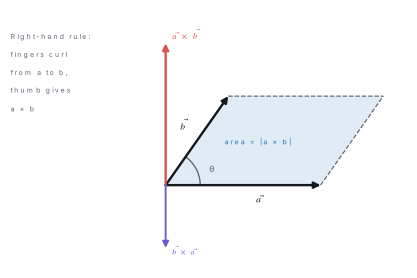
| Vector product | \vec{a}\times\vec{b} = |\vec{a}||\vec{b}|\sin\theta\,\hat{n} |
| Anti-commutative | \vec{a}\times\vec{b} = -(\vec{b}\times\vec{a}) |
| Base-vector crosses, cyclic | \hat{i}\times\hat{j}=\hat{k}, \hat{j}\times\hat{k}=\hat{i}, \hat{k}\times\hat{i}=\hat{j} |
| Base-vector crosses, reversed | \hat{j}\times\hat{i}=-\hat{k}, \hat{k}\times\hat{j}=-\hat{i}, \hat{i}\times\hat{k}=-\hat{j} |
| Self-cross | \vec{a}\times\vec{a} = \vec{0} |
| Parallelogram from adjacent sides | area = |\vec{a}\times\vec{b}| |
| Triangle from two sides | area = \frac{1}{2}|\vec{a}\times\vec{b}| |
| Parallelogram from diagonals | area = \frac{1}{2}|\vec{d_1}\times\vec{d_2}| |
| Link between the products | |\vec{a}\times\vec{b}|^{2} + (\vec{a}\cdot\vec{b})^{2} = |\vec{a}|^{2}|\vec{b}|^{2} |
| Perpendicularity of the cross product | (\vec{a}\times\vec{b})\cdot\vec{a} = (\vec{a}\times\vec{b})\cdot\vec{b} = 0 |
Multiple choice questions
- What is \vec{a}\times\vec{b} if \vec{a}=(0,0,1) and \vec{b}=(0,1,0)? (NEB 2082) [1]a(-1,0,0)b(1,0,0)c(0,1,0)d(0,0,-1)
- If \vec{a} and \vec{b} are two vectors then the value of (\vec{a}-\vec{b})\times(\vec{a}+\vec{b}) is (NEB 2079) [1]a2(\vec{a}\times\vec{b})b|\vec{a}|^{2}-|\vec{b}|^{2}c-2(\vec{a}\times\vec{b})d2\left(|\vec{a}|^{2}-|\vec{b}|^{2}\right)
- Consider \vec{a}\times\vec{b} = \vec{c}\times\vec{d} and \vec{a}\times\vec{c} = \vec{b}\times\vec{d}. Which one of the following is parallel to (\vec{b}-\vec{c})? (NEB 2080) [1]a\vec{a}-\vec{b}b\vec{a}-\vec{c}c\vec{a}-\vec{d}d\vec{c}-\vec{d}
- \vec{a} and \vec{b} are two non-zero vectors. Which of the following results is the smallest number? (NEB 2081) [1]a(\vec{a}\times\vec{b})\cdot(\vec{b}\times\vec{a})b(\vec{a}\times\vec{a})\cdot\vec{a}c(\vec{b}\times\vec{b})\cdot\vec{b}d(\vec{a}\times\vec{a})\cdot\vec{b}
- The value of \hat{i}\cdot\hat{j} is [1]a0b1c\hat{k}d-\hat{k}
- The value of \hat{j}\times\hat{k} is [1]a0b1c\hat{i}d-\hat{i}
- If \vec{a}\cdot\vec{b}=0 and neither vector is zero, then the vectors are [1]aparallelbperpendicularcequaldanti-parallel
- Geometrically, |\vec{a}\times\vec{b}| is the [1]aarea of the parallelogram with \vec{a}, \vec{b} as adjacent sidesbarea of the triangle with sides \vec{a}, \vec{b}cvolume of a parallelepipeddperimeter of the parallelogram
- If \vec{a}=2\hat{i}+3\hat{j}-\hat{k} and \vec{b}=\hat{i}-\hat{j}+2\hat{k}, then \vec{a}\cdot\vec{b} is [1]a-3b1c3d7
- The angle between \hat{i}+\hat{j} and \hat{i}-\hat{j} is [1]a0^{\circ}b45^{\circ}c60^{\circ}d90^{\circ}
- If \vec{a}=4\hat{i}-3\hat{j}+2\hat{k} and \vec{b}=3\hat{i}-2\hat{j}+4\hat{k}, the projection of \vec{b} on \vec{a} is [1]a\frac{26}{\sqrt{29}}b\frac{26}{29}c\frac{29}{\sqrt{26}}d26
- If |\vec{a}|=3, |\vec{b}|=4 and \vec{a}\cdot\vec{b}=6, then |\vec{a}\times\vec{b}| is [1]a6b6\sqrt{3}c12d\sqrt{108}-6
- The value of (\hat{i}+\hat{j})\times(\hat{i}-\hat{j}) is [1]a2\hat{k}b-2\hat{k}c\vec{0}d2\hat{i}
- The area of the parallelogram whose diagonals are \vec{a}=\hat{i}-2\hat{k} and \vec{b}=4\hat{i}+3\hat{j}+\hat{k} is [1]a3\sqrt{14}b\frac{3\sqrt{14}}{2}c\sqrt{126}d\frac{\sqrt{14}}{2}
Answer key — 11.9
1. (a) — \vec{a}=\hat{k} and \vec{b}=\hat{j}, and \hat{k}\times\hat{j} = -\hat{i} = (-1,0,0). The cyclic order is \hat{i}\rightarrow\hat{j}\rightarrow\hat{k}\rightarrow\hat{i}; \hat{k}\times\hat{j} runs backwards, so it takes a minus sign.
2. (a) — expand: \vec{a}\times\vec{a}+\vec{a}\times\vec{b}-\vec{b}\times\vec{a}-\vec{b}\times\vec{b} = \vec{0}+\vec{a}\times\vec{b}+\vec{a}\times\vec{b}-\vec{0} = 2(\vec{a}\times\vec{b}). (The paper prints the label "C)" twice; the fourth option is the intended (d).)
3. (c) — compute (\vec{a}-\vec{d})\times(\vec{b}-\vec{c}) = \vec{a}\times\vec{b}-\vec{a}\times\vec{c}-\vec{d}\times\vec{b}+\vec{d}\times\vec{c}. Using both given conditions this collapses to \vec{0}, so the two vectors are parallel. Machine-checked symbolically.
4. (a) — options (b), (c), (d) all contain \vec{a}\times\vec{a} or \vec{b}\times\vec{b}, which is \vec{0}, so each equals 0. Option (a) is (\vec{a}\times\vec{b})\cdot\left(-(\vec{a}\times\vec{b})\right) = -|\vec{a}\times\vec{b}|^{2}, which is negative (or zero) — the smallest.
5. (a) — \hat{i} and \hat{j} are perpendicular, so \cos 90^{\circ}=0.
6. (c) — \hat{j}\times\hat{k}=\hat{i} by the cyclic rule.
7. (b) — \cos\theta = 0 forces \theta = 90^{\circ}.
8. (a) — |\vec{a}||\vec{b}|\sin\theta is base times height for the parallelogram; half of it is the triangle.
9. (a) — 2(1)+3(-1)+(-1)(2) = 2-3-2 = -3.
10. (d) — the dot product is 1(1)+1(-1) = 0.
11. (a) — \vec{a}\cdot\vec{b} = 12+6+8 = 26 and |\vec{a}|=\sqrt{16+9+4}=\sqrt{29}, so the projection is \frac{26}{\sqrt{29}}.
12. (b) — |\vec{a}\times\vec{b}| = \sqrt{|\vec{a}|^{2}|\vec{b}|^{2}-(\vec{a}\cdot\vec{b})^{2}} = \sqrt{144-36}=\sqrt{108}=6\sqrt{3}.
13. (b) — \hat{i}\times(-\hat{j})+\hat{j}\times\hat{i} = -\hat{k}-\hat{k} = -2\hat{k}. Machine-checked.
14. (b) — for diagonals the area is \frac{1}{2}|\vec{a}\times\vec{b}|. Here \vec{a}\times\vec{b} = 6\hat{i}-9\hat{j}+3\hat{k}, of magnitude \sqrt{126}=3\sqrt{14}, so the area is \frac{3\sqrt{14}}{2}.
The sign error in the cross product. Three separate things must be kept straight, and the papers test all three.
- The \hat{j} component carries a minus. Expanding a 3\times3 determinant, the middle term is subtracted: \vec{a}\times\vec{b} = (a_2b_3-a_3b_2)\hat{i} - (a_1b_3-a_3b_1)\hat{j} + (a_1b_2-a_2b_1)\hat{k}. Dropping that minus is the commonest single error in the whole Vector area.
- The cross product is anti-commutative but the dot product is not. \vec{a}\times\vec{b} = -(\vec{b}\times\vec{a}), while \vec{a}\cdot\vec{b} = \vec{b}\cdot\vec{a}. Order matters for one and not the other.
- The cyclic order. \hat{i}\times\hat{j}=\hat{k}, \hat{j}\times\hat{k}=\hat{i}, \hat{k}\times\hat{i}=\hat{j} — going forwards round the circle. Going backwards flips the sign. The 2082 MCQ 5 is exactly this trap: \hat{k}\times\hat{j} runs backwards, so the answer is -\hat{i}=(-1,0,0), not +\hat{i}=(1,0,0). Option (b) is the trap, and it is the most-chosen wrong answer on that paper.
Treating (\vec{a}-\vec{b})\times(\vec{a}+\vec{b}) like a difference of squares. Options (b) and (d) in the 2079 item are |\vec{a}|^{2}-|\vec{b}|^{2}, which is what (\vec{a}-\vec{b})\cdot(\vec{a}+\vec{b}) gives. A cross product cannot produce a scalar. Check the type of the answer before the value.
Using the adjacent-sides formula on diagonals. In Q14 the distractor 3\sqrt{14} is |\vec{d_1}\times\vec{d_2}| — twice the true area. When the question says diagonals, halve it. The 2081 Group C item asked exactly this.
Dividing by the wrong magnitude in a projection. The projection of \vec{b} on \vec{a} divides by |\vec{a}|, the vector you are projecting onto. Option (b) in Q11 has divided by |\vec{a}|^{2}, which gives the scalar multiple, not the length.
11.10 Correlation and Regression
An important negative finding from the four verified papers: the single Statistics & Probability MCQ has gone to Probability every year, never to correlation. Correlation and regression appear instead as a full 5-mark Group B question built on a small table — 2079 Q16, 2080 Q15, 2081 Q16, 2082 Q16 and the CDC model Q16, without exception. So the questions below are mainly insurance and formula drill; the marks in this unit are in Group B.
| Result | Formula / condition |
|---|---|
| Karl Pearson's coefficient | r = \frac{\sum xy - n\bar{x}\bar{y}}{\sqrt{\left(\sum x^{2}-n\bar{x}^{2}\right)\left(\sum y^{2}-n\bar{y}^{2}\right)}} |
| Range | -1 \leq r \leq 1 |
| Regression line, y on x | y-\bar{y} = b_{yx}(x-\bar{x}) |
| Regression line, x on y | x-\bar{x} = b_{xy}(y-\bar{y}) |
| Regression coefficients | b_{yx} = r\frac{\sigma_y}{\sigma_x}, b_{xy} = r\frac{\sigma_x}{\sigma_y} |
| r from the coefficients | r = \pm\sqrt{b_{yx}\cdot b_{xy}}, sign of b_{yx} |
| Product bound | b_{yx}\cdot b_{xy} = r^{2} \leq 1 |
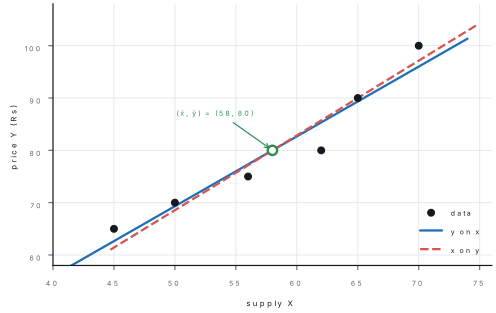
| Point common to both lines | (\bar{x},\ \bar{y}) |
| r=0 | no linear relation; the two lines are perpendicular |
| r=\pm1 | perfect linear relation; the two lines coincide |
| Invariance | r is unchanged by a change of origin or of scale |
| Rank correlation | R = 1-\frac{6\sum d^{2}}{n(n^{2}-1)} |
| Signs | b_{yx}, b_{xy} and r always share one sign |
| To predict y from x | use the y-on-x line only |
| To predict x from y | use the x-on-y line only |
Multiple choice questions
- The range of the correlation coefficient r is [1]a0 \leq r \leq 1b-1 \leq r \leq 1c-1 < r < 1d0 < r < 1
- If b_{yx} = 0.22 and b_{xy} = 0.616, the correlation coefficient is approximately [1]a0.14b0.37c0.42d0.84
- The two regression lines always intersect at [1]athe originb(\bar{x},\ \bar{y})c(0,\ \bar{y})d(\bar{x},\ 0)
- If r=0, the two variables are [1]aperfectly correlatedbuncorrelated (linearly)cinversely proportionaldidentical
- If b_{yx}\cdot b_{xy} = 1, then the two regression lines [1]aare perpendicularbcoincidecare parallel but distinctddo not exist
- The correlation coefficient is unchanged by [1]aa change of origin onlyba change of scale onlyca change of origin and of scaledneither
- Spearman's rank correlation coefficient is [1]a1-\frac{6\sum d^{2}}{n(n^{2}-1)}b1-\frac{6\sum d}{n(n^{2}-1)}c\frac{6\sum d^{2}}{n(n^{2}-1)}d1-\frac{\sum d^{2}}{6n(n^{2}-1)}
- If \sum d^{2}=30 and n=10, the rank correlation coefficient is [1]a0.18b0.62c0.82d0.91
- The regression coefficient of y on x is [1]ar\frac{\sigma_x}{\sigma_y}br\frac{\sigma_y}{\sigma_x}c\frac{\sigma_y}{r\sigma_x}dr\sigma_x\sigma_y
- If r=0.8, \sigma_x=3 and \sigma_y=4, then b_{yx} equals [1]a0.6b1.07c9.6d0.94
- The two regression lines are perpendicular to each other when [1]ar=1br=-1cr=0dr=0.5
- If the regression line of y on x is y=2x+3 and \bar{x}=1, then \bar{y} is [1]a2b3c5d6
Answer key — 11.10
1. (b) — r is a cosine-like ratio; both endpoints are attainable (perfect positive and perfect negative correlation).
2. (b) — r = \sqrt{0.22\times0.616} = \sqrt{0.13555} = 0.3682. Machine-checked; these are the 2079 Group B numbers.
3. (b) — both lines are written as deviations from the means, so both pass through (\bar{x},\bar{y}).
4. (b) — r measures linear association only; r=0 rules out a straight-line trend, not every relationship.
5. (b) — b_{yx}b_{xy}=r^{2}=1 means r=\pm1, perfect linear correlation, and the two lines become one.
6. (c) — r is a pure number, invariant under x \rightarrow \frac{x-A}{h} and y \rightarrow \frac{y-B}{k} for h,k>0.
7. (a) — the standard formula; note the 6 multiplies \sum d^{2}.
8. (c) — 1-\frac{6(30)}{10(99)} = 1-\frac{180}{990} = 0.818.
9. (b) — b_{yx} scales r by \frac{\sigma_y}{\sigma_x}: the dependent variable's spread goes on top.
10. (b) — 0.8\times\frac{4}{3} = 1.0667 \approx 1.07.
11. (c) — no linear relation makes one line horizontal and the other vertical.
12. (c) — the y-on-x line passes through (\bar{x},\bar{y}), so \bar{y} = 2(1)+3 = 5.
Predicting with the wrong line. The 2081 Group B item asked for the likely price y when the supply x is 120: that needs the y-on-x line. The 2082 item asked for the supply x when the price is Rs 150: that needs the x-on-y line. Using one line for both questions is the most expensive mistake in this unit, and the figure above shows why — the two lines are genuinely different.
Inverting \frac{\sigma_y}{\sigma_x} in the regression coefficient. Option (a) in Q9 is b_{xy} offered as b_{yx}. Remember it by the subscript order: b_{yx} predicts y, so \sigma_y goes on top.
Forgetting to take the square root. In Q2 the distractor 0.14 is the product b_{yx}b_{xy} = r^{2}. The correlation coefficient is its square root.
Losing the sign of r. r = \pm\sqrt{b_{yx}b_{xy}} gives only the magnitude; the sign is copied from either regression coefficient. If b_{yx} is negative, r is negative — the square root never tells you that.
Treating r=0 as "no relationship at all". r=0 only says there is no straight-line trend. A perfect parabola through the data can still give r=0.
11.11 Probability
The most reliable MCQ slot in the whole paper. Conditional probability P(B/A) was the Statistics & Probability MCQ in 2080, 2081 and 2082, and in the CDC model question. Four for four. Learn one formula properly and this mark is yours.
| Result | Formula / condition |
|---|---|
| Range of a probability | 0 \leq P(A) \leq 1 |
| Complement | P(A') = 1-P(A) |
| Addition rule | P(A \cup B) = P(A)+P(B)-P(A \cap B) |
| Mutually exclusive | P(A \cap B)=0, so P(A\cup B)=P(A)+P(B) |
| Conditional probability | P(B/A) = \frac{P(A \cap B)}{P(A)}, needs P(A)>0 |
| The other conditional | P(A/B) = \frac{P(A \cap B)}{P(B)} |
| Multiplication rule, dependent | P(A \cap B) = P(A)\cdot P(B/A) |
| Independent events | P(A \cap B) = P(A)\cdot P(B), and then P(B/A)=P(B) |
| Drawing without replacement | dependent: the second denominator drops by one |
| Drawing with replacement | independent: the denominator is unchanged |
| Certain / impossible event | P=1 / P=0 |
| Exhaustive events | probabilities add to 1 |
Multiple choice questions
- The range of the probability of any event A is (NEB 2079) [1]a0 \leq P(A) \leq 1b0 \leq P(A) < 1c-1 \leq P(A) \leq 1d0 < P(A) < 1
- Consider A and B to be two dependent events. If P(A)=\frac{1}{2}, P(B)=\frac{1}{13} and P(A\cap B)=\frac{1}{26}, what is P(B/A)? (NEB 2080) [1]a\frac{1}{52}b\frac{1}{26}c\frac{1}{13}d\frac{1}{2}
- Let A and B be two dependent events with P(A\cap B)=\frac{1}{18}, P(B)=\frac{1}{18} and 2P(A)=5P(B). What is the value of P(B/A)? (NEB 2081) [1]a\frac{1}{324}b\frac{1}{18}c\frac{5}{36}d\frac{2}{5}
- If P(A)=\frac{1}{3}, P(B)=\frac{2}{3} and P(A\cap B)=\frac{1}{5}, which one of the following is P(B/A)? (NEB 2082) [1]a\frac{3}{5}b\frac{2}{5}c\frac{2}{15}d\frac{1}{15}
- The probability that a leap year chosen at random contains 53 Fridays or 53 Saturdays is (CDC model 2080) [1]a\frac{2}{7}b\frac{3}{7}c\frac{4}{7}d\frac{1}{7}
- If A and B are independent with P(A)=\frac{1}{2} and P(B)=\frac{1}{3}, then P(A\cap B) is [1]a\frac{1}{6}b\frac{5}{6}c\frac{2}{3}d\frac{1}{5}
- P(A/B) is defined as [1]a\frac{P(A\cap B)}{P(A)}b\frac{P(A\cap B)}{P(B)}c\frac{P(A)}{P(B)}dP(A)\cdot P(B)
- If A and B are mutually exclusive, then P(A\cap B) is [1]a0b1cP(A)P(B)dP(A)+P(B)
- Two cards are drawn one after another, without replacement, from a well-shuffled pack of 52. The probability that both are aces is [1]a\frac{1}{169}b\frac{1}{221}c\frac{1}{13}d\frac{4}{663}
- If P(A)=0.3, then P(A') is [1]a0.3b0.7c1.3d-0.3
Answer key — 11.11
1. (a) — an impossible event has probability exactly 0 and a certain event exactly 1, so the interval is closed.
2. (c) — P(B/A)=\frac{1/26}{1/2}=\frac{2}{26}=\frac{1}{13}.
3. (d) — P(A)=\frac{5}{2}P(B)=\frac{5}{2}\cdot\frac{1}{18}=\frac{5}{36}, so P(B/A)=\frac{1/18}{5/36}=\frac{36}{90}=\frac{2}{5}.
4. (a) — P(B/A)=\frac{1/5}{1/3}=\frac{3}{5}.
5. (b) — a leap year is 52 weeks plus 2 extra consecutive days; there are 7 equally likely such pairs, and three of them (Thu–Fri, Fri–Sat, Sat–Sun) contain a Friday or a Saturday, giving \frac{3}{7}.
6. (a) — independence gives P(A\cap B)=\frac{1}{2}\times\frac{1}{3}=\frac{1}{6}.
7. (b) — divide by the probability of the event that is given, which here is B.
8. (a) — mutually exclusive events cannot both happen.
9. (b) — \frac{4}{52}\times\frac{3}{51} = \frac{12}{2652} = \frac{1}{221}.
10. (b) — 1-0.3=0.7.
Computing P(B/A) as \frac{P(A\cap B)}{P(B)}. This is the trap, and it has been set four times running — 2080, 2081, 2082 and the CDC model. The rule is: divide by the probability of whatever comes after the slash. For P(B/A) that is P(A). Look at the 2080 item: \frac{1/26}{1/13} = \frac{1}{2} is option (d), which is wrong; \frac{1/26}{1/2} = \frac{1}{13} is option (c), which is right. In the 2082 item the wrong division gives \frac{3}{10} and the right one \frac{3}{5}.
Multiplying instead of dividing. In the 2082 item, option (c) \frac{2}{15} is P(A)\times\frac{2}{5}-flavoured arithmetic, and option (d) \frac{1}{15} is P(A)\cdot P(A\cap B). Conditional probability is a division.
Missing an intermediate quantity. In the 2081 item, P(A) is not given directly — it must be extracted from 2P(A)=5P(B) first. The distractor \frac{5}{36} is P(A) itself, i.e. the answer to the sub-step offered as the answer to the question.
Treating "without replacement" as independent. In Q9 the distractor \frac{1}{169} is \left(\frac{4}{52}\right)^{2}, which is the with-replacement answer. Without replacement, both the numerator and the denominator drop by one.
Reading "or" as "and" in a compound event. In the leap-year item, \frac{2}{7} is the probability of 53 Fridays alone. The union needs the three pairs counted once each — Friday–Saturday must not be double-counted.
11.12 Derivatives
Calculus carries 22 marks and four of the eleven MCQs — more than any other area. Two of those four, on the evidence of all four papers, come from this unit: an inverse-hyperbolic or hyperbolic derivative, and either an L'Hospital limit or a tangent/normal slope. The table below is the single highest-value thing to memorise in this chapter.
| Function | Derivative | Valid for |
|---|---|---|
| \sinh x | \cosh x | all x |
| \cosh x | \sinh x | all x |
| \tanh x | \mathrm{sech}^{2}x | all x |
| \coth x | -\mathrm{cosech}^{2}x | x \ne 0 |
| \mathrm{sech}\,x | -\mathrm{sech}\,x\tanh x | all x |
| \mathrm{cosech}\,x | -\mathrm{cosech}\,x\coth x | x \ne 0 |
| \sinh^{-1}x | \frac{1}{\sqrt{x^{2}+1}} | all x |
| \cosh^{-1}x | \frac{1}{\sqrt{x^{2}-1}} | x>1 |
| \tanh^{-1}x | \frac{1}{1-x^{2}} | |x|<1 |
| \coth^{-1}x | \frac{1}{1-x^{2}} | |x|>1 |
| \mathrm{sech}^{-1}x | \frac{-1}{x\sqrt{1-x^{2}}} | 0<x<1 |
| \mathrm{cosech}^{-1}x | \frac{-1}{|x|\sqrt{1+x^{2}}} | x \ne 0 |
The rest of the unit's MCQ surface is limits and tangents:
| Result | Statement | Condition |
|---|---|---|
| L'Hospital's rule | \lim\frac{f}{g} = \lim\frac{f'}{g'} | only for \frac{0}{0} or \frac{\infty}{\infty} |
| Slope of tangent at (x_1,y_1) | m = \left.\frac{dy}{dx}\right|_{(x_1,y_1)} | |
| Slope of normal | -\frac{1}{m} | m \ne 0 |
| Tangent parallel to the x-axis | \frac{dy}{dx}=0 | |
| Tangent parallel to the y-axis | \frac{dx}{dy}=0, i.e. \frac{dy}{dx} is infinite | |
| Differential | dy = f'(x)\,dx | |
| Rate measure | \frac{dA}{dt} = \frac{dA}{dr}\cdot\frac{dr}{dt} | chain rule |
Multiple choice questions
- What is the derivative of y = 2\sinh\frac{x}{2} with respect to x? (NEB 2080) [1]a\cosh\frac{x}{2}b2\cosh\frac{x}{2}c\cosh\frac{x}{4}d2\cosh\frac{x}{4}
- It is given that f'(x)=3x^{2} and g'(x)=2x. What is the value of \lim_{x\to1}\frac{f(x)}{g(x)} by L'Hospital's rule? (NEB 2081) [1]a\frac{3}{2}b\frac{1}{3}c\frac{1}{2}d\frac{1}{6}
- Which one of the following is the slope of the normal to the curve y=3x^{2}-x at the point where x=-1? (NEB 2082) [1]a-7b-5c\frac{1}{7}d\frac{1}{5}
- The tangents to the curve y=x^{3} at x=2 and x=-2 are (NEB 2079) [1]aparallelbperpendicularcintersectingdnon-existent
- The volume of a sphere is increasing at 25 cm³/sec. At what rate is the radius increasing at the instant when the total surface area is 10\pi cm²? (CDC model 2080) [1]a\frac{5}{2\pi} cm/secb\frac{2\pi}{5} cm/secc\frac{5}{\pi} cm/secd\frac{25}{4\pi} cm/sec
- \frac{d}{dx}(\sinh x) equals [1]a\cosh xb-\cosh xc\mathrm{sech}^{2}xd\cos x
- \frac{d}{dx}\left(\cosh^{-1}x\right) equals [1]a\frac{1}{\sqrt{1-x^{2}}}b\frac{1}{\sqrt{x^{2}-1}}c\frac{1}{\sqrt{x^{2}+1}}d\frac{-1}{\sqrt{x^{2}-1}}
- \frac{d}{dx}\left(\tanh^{-1}x\right) equals [1]a\frac{1}{1+x^{2}}b\frac{1}{1-x^{2}}c\frac{1}{x^{2}-1}d\mathrm{sech}^{2}x
- \frac{d}{dx}\left(\mathrm{sech}^{-1}x\right) = \frac{-1}{x\sqrt{1-x^{2}}} holds under the condition [1]ax>1b0<x<1cx<0dall real x
- \frac{d}{dx}\left(\mathrm{cosech}^{-1}x\right) equals [1]a\frac{-1}{|x|\sqrt{1+x^{2}}}b\frac{1}{|x|\sqrt{1+x^{2}}}c\frac{-1}{x\sqrt{1-x^{2}}}d\frac{1}{\sqrt{x^{2}+1}}
- \lim_{x\to0}\frac{\sin x}{x} equals [1]a0b1c\inftydundefined
- \lim_{x\to0}\frac{e^{x}-1}{x} equals [1]a0b1ced\infty
- The slope of the tangent to y=x^{2}-3x at x=2 is [1]a-2b1c2d4
- The slope of the tangent to y=2x^{3}+x^{2}-7x-2 at x=2 is [1]a5b13c21d28
- A tangent to a curve is parallel to the x-axis where [1]a\frac{dy}{dx}=0b\frac{dy}{dx}=1c\frac{dx}{dy}=0d\frac{d^{2}y}{dx^{2}}=0
- A tangent to the curve y=f(x) is parallel to the y-axis where [1]a\frac{dy}{dx}=0b\frac{dy}{dx}=1c\frac{dx}{dy}=0df(x)=0
- The differential dy of y=f(x) is [1]af'(x)bf'(x)\,dxc\frac{dx}{f'(x)}df(x)\,dx
- The rate of change of the area of a circle with respect to its radius, at r=3, is [1]a3\pib6\pic9\pid12\pi
- \lim_{x\to\infty}\frac{\ln(2x^{2}+5)}{\ln(3x^{3}-4)} equals [1]a\frac{2}{3}b\frac{3}{2}c0d1
- The rate of change of the volume of a sphere with respect to its surface area, when the radius is 7 cm, is [1]a\frac{7}{2}b7c14d\frac{1}{14}
Answer key — 11.12
1. (a) — \frac{d}{dx}\left(2\sinh\frac{x}{2}\right) = 2\cosh\frac{x}{2}\cdot\frac{1}{2} = \cosh\frac{x}{2}. The chain-rule factor \frac{1}{2} cancels the 2 outside.
2. (a) — L'Hospital's rule replaces the ratio by \frac{f'(1)}{g'(1)} = \frac{3}{2}.
3. (c) — \frac{dy}{dx}=6x-1, so at x=-1 the tangent slope is -7 and the normal slope is -\frac{1}{-7}=\frac{1}{7}. (The paper prints the point as (-1,1), but y(-1)=4; the x-value is what the slope depends on, so the answer is unaffected.)
4. (a) — \frac{dy}{dx}=3x^{2} takes the value 12 at both x=2 and x=-2: equal slopes, so parallel.
5. (a) — S=4\pi r^{2}=10\pi gives r^{2}=2.5; then \frac{dV}{dt}=4\pi r^{2}\frac{dr}{dt}=25 gives \frac{dr}{dt}=\frac{25}{10\pi}=\frac{5}{2\pi} cm/sec.
6. (a) — no minus sign here; the minus appears for \frac{d}{dx}(\cos x), not \frac{d}{dx}(\cosh x).
7. (b) — \frac{1}{\sqrt{x^{2}-1}}; (a) is \frac{d}{dx}(\sin^{-1}x) and (c) is \frac{d}{dx}(\sinh^{-1}x).
8. (b) — \frac{1}{1-x^{2}} for |x|<1; (a) is \frac{d}{dx}(\tan^{-1}x).
9. (b) — the \sqrt{1-x^{2}} needs |x|<1 and the \mathrm{sech}^{-1} branch used in NEB work is 0<x<1. This is the 2081 Group B item 17b, worth 1 mark for exactly this condition.
10. (a) — machine-checked: \frac{d}{dx}\mathrm{cosech}^{-1}x = \frac{-1}{|x|\sqrt{1+x^{2}}}.
11. (b) — \frac{0}{0} form; differentiate to get \frac{\cos x}{1} \to 1.
12. (b) — \frac{0}{0} form; differentiate to get \frac{e^{x}}{1} \to 1.
13. (b) — \frac{dy}{dx}=2x-3 = 4-3 = 1.
14. (c) — \frac{dy}{dx}=6x^{2}+2x-7 = 24+4-7 = 21.
15. (a) — a horizontal tangent has zero slope.
16. (c) — a vertical tangent has infinite \frac{dy}{dx}, which is the same as \frac{dx}{dy}=0. This was worth 1 mark in 2082 Group B item 17c.
17. (b) — the differential is the derivative times the increment in x.
18. (b) — A=\pi r^{2}, so \frac{dA}{dr}=2\pi r = 6\pi.
19. (a) — by L'Hospital's rule the limit is \lim\frac{4x/(2x^{2}+5)}{9x^{2}/(3x^{3}-4)}, which tends to \frac{2}{3}; more quickly, the ratio of the leading powers' logarithms is \frac{2}{3}. Machine-checked.
20. (a) — \frac{dV}{dS}=\frac{dV/dr}{dS/dr}=\frac{4\pi r^{2}}{8\pi r}=\frac{r}{2}=\frac{7}{2}.
Circular versus hyperbolic derivatives. \frac{d}{dx}(\cos x)=-\sin x but \frac{d}{dx}(\cosh x)=+\sinh x. The hyperbolic pair has no minus sign; the circular pair does. The minus signs in the hyperbolic family belong to \coth, \mathrm{sech}, \mathrm{cosech} and to the two inverse functions \mathrm{sech}^{-1}, \mathrm{cosech}^{-1} — nowhere else.
Inverse circular versus inverse hyperbolic. The three most-confused pairs are \frac{1}{\sqrt{1-x^{2}}} (for \sin^{-1}) against \frac{1}{\sqrt{x^{2}+1}} (for \sinh^{-1}); \frac{1}{1+x^{2}} (for \tan^{-1}) against \frac{1}{1-x^{2}} (for \tanh^{-1}); and \frac{1}{\sqrt{x^{2}-1}} (for \cosh^{-1}), which has no circular twin at all. Questions 7, 8 and 10 above offer the wrong twin as a distractor every time.
Forgetting the chain-rule factor — or double-counting it. The 2080 MCQ 8 is built on this. y=2\sinh\frac{x}{2} differentiates to \cosh\frac{x}{2}, because 2\times\frac{1}{2}=1. Option (b) keeps the outside 2 and forgets the inside \frac{1}{2}; option (d) halves the argument twice.
Quoting the tangent slope when the normal slope was asked for. The 2082 MCQ 7 offers -7 as option (a) — the correct tangent slope — and \frac{1}{7} as option (c), the normal slope that was asked for. Underline the word "normal" in the stem before you compute anything.
Using L'Hospital's rule where it does not apply. The rule is only valid for \frac{0}{0} and \frac{\infty}{\infty}. Substituting first to check the form is compulsory; the 2080 Group C item made candidates state the relation for the \frac{0}{0} case before using it.
Differentiating with respect to the wrong variable. In question 20 the question asks for \frac{dV}{dS}, not \frac{dV}{dr}. The distractor 14 is 2r, i.e. \frac{dS}{dr} over 4\pi — a derivative taken with respect to the radius when the surface area was wanted. Write down what the numerator and denominator are before you differentiate anything.
11.13 Anti-derivatives
The other reliable Calculus MCQ. An integral has been the subject of an MCQ in 2080, 2081 and 2082, and all three times it was the same shape of question: a standard integral of the form \int\frac{dx}{\text{quadratic}}, with the four options differing only in a constant or in an inverted argument. That is a memory test, not a calculation, and the table below is the whole answer.
| Integral | Result |
|---|---|
| \int x^{n}dx | \frac{x^{n+1}}{n+1}+C, n \ne -1 |
| \int\frac{dx}{x} | \log|x|+C |
| \int e^{x}dx | e^{x}+C |
| \int a^{x}dx | \frac{a^{x}}{\log a}+C |
| \int\sin x\,dx | -\cos x + C |
| \int\cos x\,dx | \sin x + C |
| \int\tan x\,dx | \log|\sec x|+C |
| \int\sec x\,dx | \log|\sec x+\tan x|+C |
| \int\sinh x\,dx | \cosh x + C |
| \int\frac{dx}{x^{2}+a^{2}} | \frac{1}{a}\tan^{-1}\frac{x}{a}+C |
| \int\frac{dx}{x^{2}-a^{2}} | \frac{1}{2a}\log\left|\frac{x-a}{x+a}\right|+C |
| \int\frac{dx}{a^{2}-x^{2}} | \frac{1}{2a}\log\left|\frac{a+x}{a-x}\right|+C |
| \int\frac{dx}{\sqrt{a^{2}-x^{2}}} | \sin^{-1}\frac{x}{a}+C |
| \int\frac{dx}{\sqrt{x^{2}+a^{2}}} | \log\left|x+\sqrt{x^{2}+a^{2}}\right|+C = \sinh^{-1}\frac{x}{a}+C |
| \int\frac{dx}{\sqrt{x^{2}-a^{2}}} | \log\left|x+\sqrt{x^{2}-a^{2}}\right|+C = \cosh^{-1}\frac{x}{a}+C |
| \int\frac{f'(x)}{f(x)}dx | \log|f(x)|+C |
Two supporting facts for the partial-fraction questions:
| Term | Meaning |
|---|---|
| Proper rational fraction | degree of numerator < degree of denominator |
| Partial fractions | one fraction per distinct linear factor |
Multiple choice questions
- Which one of the following is the result of \int\frac{dx}{x^{2}+4}? (NEB 2081) [1]a\frac{1}{2}\tan^{-1}\frac{2}{x}+Cb\frac{1}{2}\tan^{-1}\frac{x}{2}+Cc2\tan^{-1}\frac{x}{2}+Cd\tan^{-1}\frac{x}{2}+C
- What is the integral of \int\frac{dx}{9x^{2}+1}? (NEB 2082) [1]a\frac{1}{3}\tan^{-1}(3x)+Cb\frac{1}{27}\tan^{-1}(3x)+Cc\frac{1}{27}\tan^{-1}\frac{x}{3}+Cd\frac{1}{27}\tan^{-1}\frac{3}{x}+C
- Which of the following is the value of \int\frac{dx}{x^{2}-1}? (NEB 2080) [1]a2\log\frac{x+1}{x-1}+Cb2\log\frac{x-1}{x+1}+Cc\log\frac{x-1}{x+1}+Cd\frac{1}{2}\log\frac{x+1}{x-1}+C
- \int\frac{dx}{\sqrt{1-x^{2}}} equals [1]a\sin^{-1}x+Cb\cos^{-1}x+Cc\tan^{-1}x+Cd\sinh^{-1}x+C
- \int\frac{dx}{\sqrt{x^{2}-a^{2}}} equals [1]a\sin^{-1}\frac{x}{a}+Cb\log\left|x+\sqrt{x^{2}-a^{2}}\right|+Cc\frac{1}{a}\tan^{-1}\frac{x}{a}+Cd\frac{1}{2a}\log\left|\frac{x-a}{x+a}\right|+C
- \int\tan x\,dx equals [1]a\sec^{2}x+Cb\log|\sec x|+Cc\log|\cos x|+Cd\log|\tan x|+C
- \int\sec x\,dx equals [1]a\sec x\tan x+Cb\log|\sec x|+Cc\log|\sec x+\tan x|+Cd\tan x + C
- \int x^{3}dx equals [1]a3x^{2}+Cb\frac{x^{4}}{4}+Cc\frac{x^{2}}{2}+Cd4x^{4}+C
- \int e^{2x}dx equals [1]a2e^{2x}+Cb\frac{e^{2x}}{2}+Cce^{2x}+Cd\frac{e^{3x}}{3}+C
- \int\frac{dx}{x^{2}-9} equals [1]a\frac{1}{3}\log\left|\frac{x-3}{x+3}\right|+Cb\frac{1}{6}\log\left|\frac{x-3}{x+3}\right|+Cc\frac{1}{6}\log\left|\frac{x+3}{x-3}\right|+Cd\frac{1}{3}\tan^{-1}\frac{x}{3}+C
- \int\frac{dx}{4-x^{2}} equals [1]a\frac{1}{4}\log\left|\frac{2+x}{2-x}\right|+Cb\frac{1}{4}\log\left|\frac{x-2}{x+2}\right|+Cc\frac{1}{2}\log\left|\frac{2+x}{2-x}\right|+Cd\sin^{-1}\frac{x}{2}+C
- \int\frac{dx}{x^{2}+2x+2} equals [1]a\tan^{-1}(x+1)+Cb\frac{1}{2}\tan^{-1}(x+1)+Cc\log|x^{2}+2x+2|+Cd\tan^{-1}(x+2)+C
- \int\frac{2x+1}{x^{2}+x+1}dx equals [1]a\log|2x+1|+Cb\log|x^{2}+x+1|+Cc\frac{1}{2}\log|x^{2}+x+1|+Cd\tan^{-1}(2x+1)+C
- \int\frac{dx}{x(x+1)} equals [1]a\log\left|\frac{x}{x+1}\right|+Cb\log\left|\frac{x+1}{x}\right|+Cc\log|x(x+1)|+Cd\frac{1}{2}\log\left|\frac{x}{x+1}\right|+C
- A rational fraction \frac{p(x)}{q(x)} is called proper when [1]a\deg p < \deg qb\deg p > \deg qc\deg p = \deg qdq(x) is linear
- \int\sinh x\,dx equals [1]a\cosh x+Cb-\cosh x+Cc\mathrm{sech}^{2}x+Cd\sinh x+C
- The number of partial fractions needed for \frac{1}{x(x-1)(x+2)} is [1]a1b2c3d4
- \int a^{x}dx equals [1]aa^{x}+Cb\frac{a^{x}}{\log a}+Cca^{x}\log a+Cd\frac{a^{x+1}}{x+1}+C
Answer key — 11.13
1. (b) — \int\frac{dx}{x^{2}+a^{2}}=\frac{1}{a}\tan^{-1}\frac{x}{a} with a=2, giving \frac{1}{2}\tan^{-1}\frac{x}{2}. Machine-checked.
2. (a) — take out the 9: \frac{1}{9}\int\frac{dx}{x^{2}+\frac{1}{9}} = \frac{1}{9}\cdot\frac{1}{1/3}\tan^{-1}(3x) = \frac{1}{3}\tan^{-1}(3x). Machine-checked.
3. No printed option is exactly right. The correct value is \frac{1}{2}\log\left|\frac{x-1}{x+1}\right|+C. Option (b) has the correct ratio \frac{x-1}{x+1} with the constant 2 in place of \frac{1}{2}; option (d) has the correct constant with the ratio inverted, which changes the sign of the whole answer. (b) is the closer of the two, and is the option a marker would have keyed. We machine-checked the integral.
4. (a) — \sin^{-1}x+C; note \cos^{-1}x differentiates to \frac{-1}{\sqrt{1-x^{2}}}, the wrong sign.
5. (b) — this is \cosh^{-1}\frac{x}{a}, usually written in the logarithmic form.
6. (b) — \int\frac{\sin x}{\cos x}dx = -\log|\cos x| = \log|\sec x|.
7. (c) — the standard result; (b) is \int\tan x\,dx.
8. (b) — raise the index by one and divide by the new index.
9. (b) — divide by the coefficient of x in the exponent.
10. (b) — \frac{1}{2a}\log\left|\frac{x-a}{x+a}\right| with a=3, so \frac{1}{6}. Machine-checked.
11. (a) — \frac{1}{2a}\log\left|\frac{a+x}{a-x}\right| with a=2, so \frac{1}{4}\log\left|\frac{2+x}{2-x}\right|. Machine-checked.
12. (a) — complete the square: \int\frac{dx}{(x+1)^{2}+1} = \tan^{-1}(x+1). Machine-checked.
13. (b) — the numerator is exactly the derivative of the denominator, so the integral is \log|f(x)|.
14. (a) — \frac{1}{x(x+1)} = \frac{1}{x}-\frac{1}{x+1}, giving \log|x|-\log|x+1|. Machine-checked.
15. (a) — otherwise divide first to split off a polynomial part.
16. (a) — \int\sinh x\,dx = \cosh x; the minus sign belongs to \int\sin x\,dx.
17. (c) — three distinct linear factors give three partial fractions.
18. (b) — differentiating \frac{a^{x}}{\log a} returns a^{x}.
Differentiating when the question said integrate — and the reverse. This is the most expensive single confusion in the Calculus area, and both directions appear as distractors. In question 18, option (c) a^{x}\log a is the derivative of a^{x} offered as its integral. In question 6, option (a) \sec^{2}x is the derivative of \tan x. In question 16, option (d) \sinh x has done nothing at all. Two habits fix it: (i) underline the word "integral" or "derivative" in the stem before reading the options; (ii) differentiate your chosen option and check it gives back the integrand — for a one-mark MCQ this takes ten seconds and is completely reliable.
\frac{1}{a}\tan^{-1}\frac{x}{a} written as \frac{1}{a}\tan^{-1}\frac{a}{x}. The 2081 MCQ 8 offers exactly this as option (a). The argument of \tan^{-1} must be \frac{x}{a} — the variable on top. Check it by differentiating, or by a dimension-style argument: \tan^{-1} needs a dimensionless argument that grows with x, and \frac{a}{x} shrinks.
The misplaced constant in \int\frac{dx}{9x^{2}+1}. The 2082 MCQ 8 offers \frac{1}{27} three times over. Do it in two clean steps. First factor: \frac{1}{9}\int\frac{dx}{x^{2}+\left(\frac{1}{3}\right)^{2}}. Then apply the formula with a=\frac{1}{3}: \frac{1}{9}\times 3 = \frac{1}{3}. The 27 comes from multiplying \frac{1}{9} by \frac{1}{3} instead of dividing.
Integrating with respect to the wrong variable. When the integrand contains two letters — \int\frac{dx}{a^{2}-x^{2}} — the dx tells you a is a constant. A student who treats a as the variable produces a logarithm of the wrong thing. Read the differential before you start.
Inverting the ratio in \int\frac{dx}{x^{2}-a^{2}}. \frac{x-a}{x+a} and \frac{x+a}{x-a} differ by a sign in the answer, because \log\frac{1}{u} = -\log u. Fix the order by remembering that \int\frac{dx}{x^{2}-a^{2}} has the minus on top and \int\frac{dx}{a^{2}-x^{2}} has the plus on top — the sign pattern of the numerator copies the denominator.
Using \frac{1}{a} where \frac{1}{2a} belongs. In question 10, option (a) \frac{1}{3} is the \tan^{-1} constant applied to a logarithm. The \tan^{-1} family takes \frac{1}{a}; the logarithm family takes \frac{1}{2a}.
11.14 Differential Equations
Two MCQs came from this unit in 2081 (degree, and identifying a homogeneous equation) and two again in 2082 (homogeneous, and an integrating factor), plus one in 2079 (integrating factor). It is the most heavily MCQ'd single unit in the syllabus. Every one of those five items is answered by the table below without any integration at all.
| Result | Formula / condition |
|---|---|
| Order | the order of the highest derivative present |
| Degree | the power of that highest derivative, after clearing radicals and fractions |
| Separable form | \frac{dy}{dx}=f(x)g(y); integrate \frac{dy}{g(y)} = f(x)dx |
| Homogeneous | \frac{dy}{dx}=f\!\left(\frac{y}{x}\right); numerator and denominator of the same degree |
| Substitution for homogeneous | y=vx, so \frac{dy}{dx}=v+x\frac{dv}{dx} |
| Linear standard form | \frac{dy}{dx}+Py=Q, with P,Q functions of x |
| Integrating factor | \mathrm{I.F.} = e^{\int P\,dx} |
| Solution of a linear equation | y\cdot\mathrm{I.F.} = \int Q\cdot\mathrm{I.F.}\,dx + C |
| Exact form | M(x,y)dx+N(x,y)dy=0 |
| Test for exactness | \frac{\partial M}{\partial y}=\frac{\partial N}{\partial x} |
| \frac{dy}{dx}=\frac{y}{x} | y=cx |
| x\,dy+y\,dx=0 | xy=c |
| \frac{dy}{dx}=\frac{1+y^{2}}{1+x^{2}} | \tan^{-1}y=\tan^{-1}x+c |
| \frac{dy}{dx}+\frac{y}{x}=x^{2} | \mathrm{I.F.}=x |
A direction field is the quickest way to see what a first-order equation is saying: at every point it draws the slope \frac{dy}{dx}, and a solution curve is any curve that follows the slopes.
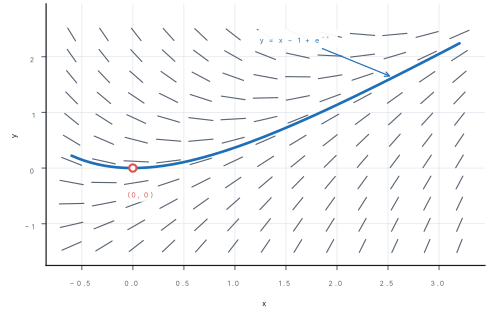
Multiple choice questions
- What is the degree of the ordinary differential equation \frac{d^{3}s}{dt^{3}} = \left(4+\left(\frac{d^{2}s}{dt^{2}}\right)^{2}\right)^{1/2}? (NEB 2081) [1]a1b2c3d4
- Which one of the following is an example of a homogeneous differential equation of the first order? (NEB 2081) [1]a3x\,dy+2y\,dx=4bx\,dy-y\,dx+1=0cx\,dx+y\,dy=2d(x^{2}+xy)dy-(xy-y^{2})dx=0
- Which one of the following is a homogeneous differential equation? (NEB 2082) [1]a\frac{dy}{dx}=\frac{x^{2}+y^{2}}{x+y}b\frac{dy}{dx}=\frac{x^{2}+y^{2}}{x-y}c\frac{dy}{dx}=\frac{x^{2}+y^{2}}{x^{2}-y^{2}}d\frac{dy}{dx}=\frac{x+y}{x^{2}+y^{2}}
- Which is the integrating factor of the linear differential equation \cos^{2}x\,\frac{dy}{dx}=1-y? (NEB 2082) [1]a\tan xbe^{\tan x}ce^{\sec^{2}x}d\sec^{2}x
- The integrating factor of the differential equation \sin x\,\frac{dy}{dx}+y\cos x = x\sin x is (NEB 2079) [1]a\sin xb\cos xc\tan xd\cot x
- The order of \frac{d^{2}y}{dx^{2}}+3\left(\frac{dy}{dx}\right)^{3}=0 is [1]a1b2c3d5
- The degree of \frac{d^{2}y}{dx^{2}}+3\left(\frac{dy}{dx}\right)^{3}=0 is [1]a1b2c3d5
- The integrating factor of \frac{dy}{dx}+\frac{y}{x}=x^{2} is [1]axbx^{2}c\log xde^{x}
- The integrating factor of \frac{dy}{dx}+2y=e^{x} is [1]ae^{x}be^{2x}c2e^{x}de^{-2x}
- The equation M\,dx+N\,dy=0 is exact if [1]a\frac{\partial M}{\partial x}=\frac{\partial N}{\partial y}b\frac{\partial M}{\partial y}=\frac{\partial N}{\partial x}cM=Nd\frac{\partial M}{\partial y}=-\frac{\partial N}{\partial x}
- The general solution of \frac{dy}{dx}=\frac{y}{x} is [1]ay=cxbxy=ccy=x+cdy^{2}=x^{2}+c
- The solution of \frac{dy}{dx}=\frac{1+y^{2}}{1+x^{2}} is [1]a\tan^{-1}y=\tan^{-1}x+cb\log(1+y^{2})=\log(1+x^{2})+ccy=x+cd\sin^{-1}y=\sin^{-1}x+c
- To solve a homogeneous first-order equation, the correct substitution is [1]ay=vxby=v+xcx=vy^{2}dv=xy
- The order and degree of \left(\frac{d^{3}y}{dx^{3}}\right)^{2}+y=0 are respectively [1]a2 and 3b3 and 2c3 and 3d2 and 2
- The solution of x\,dy+y\,dx=0 is [1]ax+y=cbxy=cc\frac{x}{y}=cdx^{2}+y^{2}=c
- The integrating factor of x\frac{dy}{dx}+2y=x^{3} is [1]axbx^{2}cx^{3}d2x
Answer key — 11.14
1. (b) — square both sides to clear the radical: \left(\frac{d^{3}s}{dt^{3}}\right)^{2}=4+\left(\frac{d^{2}s}{dt^{2}}\right)^{2}. The highest derivative is now to the power 2, so the degree is 2 (the order is 3).
2. (d) — every term of (x^{2}+xy) and (xy-y^{2}) has total degree 2, so the equation can be written as a function of \frac{y}{x} alone. The others carry an isolated constant, which breaks homogeneity.
3. (c) — numerator and denominator are both of degree 2, so replacing x \to \lambda x, y \to \lambda y leaves the right-hand side unchanged.
4. (b) — divide by \cos^{2}x: \frac{dy}{dx}+y\sec^{2}x=\sec^{2}x. Then P=\sec^{2}x, \int P\,dx = \tan x and \mathrm{I.F.}=e^{\tan x}. Machine-checked.
5. (a) — divide by \sin x: \frac{dy}{dx}+y\cot x = x. Then \int\cot x\,dx=\log\sin x, so \mathrm{I.F.}=e^{\log\sin x}=\sin x.
6. (b) — the highest derivative present is the second.
7. (a) — the second derivative appears to the first power; the cube is on the first derivative, which does not affect the degree.
8. (a) — P=\frac{1}{x}, \int P\,dx=\log x, \mathrm{I.F.}=e^{\log x}=x.
9. (b) — P=2, so \mathrm{I.F.}=e^{2x}.
10. (b) — both mixed partial derivatives of the same potential function must agree.
11. (a) — separate: \frac{dy}{y}=\frac{dx}{x}, so \log y = \log x + \log c, i.e. y=cx.
12. (a) — separate and integrate both sides directly. This was the 2080 Group B item 17a.
13. (a) — y=vx turns a function of \frac{y}{x} into a function of v alone, making the equation separable.
14. (b) — highest derivative is the third (order 3), raised to the power 2 (degree 2).
15. (b) — \frac{dy}{y}=-\frac{dx}{x} gives \log y + \log x = \log c, i.e. xy=c.
16. (b) — divide by x first: \frac{dy}{dx}+\frac{2}{x}y=x^{2}, so P=\frac{2}{x}, \int P\,dx=2\log x and \mathrm{I.F.}=x^{2}. Machine-checked.
Order confused with degree. This is the real 2081 MCQ 9, and its four options 1,2,3,4 are chosen so that the order (3) and the degree (2) are both available. Say the definitions out loud before answering: order = how many times you differentiated; degree = the power of that highest derivative, after the equation has been cleared of radicals and fractions. In question 1 above the radical must be squared away first — a student who reads the exponent \frac{1}{2} off the right-hand side answers 1.
Taking the degree from the wrong derivative. In question 7, option (c) is 3, the power on \frac{dy}{dx}. Only the power on the highest-order derivative counts.
Forgetting to divide into standard form before finding the I.F. Both real integrating-factor MCQs — 2079 MCQ 9 and 2082 MCQ 10 — are printed with a coefficient in front of \frac{dy}{dx}. You must divide it out first. In the 2082 item, the un-divided equation suggests \sec^{2}x (option (d)); dividing properly gives P=\sec^{2}x and then \mathrm{I.F.}=e^{\tan x}, option (b). Note the sequence: divide, identify P, integrate P, then exponentiate. Option (c) e^{\sec^{2}x} skips the integration step.
Calling an equation homogeneous because it merely looks symmetric. In the 2082 MCQ 9, options (a) and (b) have a degree-2 numerator over a degree-1 denominator, so the right-hand side is not a function of \frac{y}{x} alone. Test it mechanically: replace x by \lambda x and y by \lambda y; if every \lambda cancels, it is homogeneous. A lone constant term, as in the 2081 options (a), (b) and (c), always kills homogeneity.
Integrating instead of exponentiating. Option (a) \tan x in the 2082 item is \int P\,dx — one step short of the integrating factor, which is e^{\int P\,dx}.
11.15 Computational Methods
Exactly one MCQ comes from this area every year, and it has been at Q10 or Q11 in all four verified papers. Three of those four were a Gauss elimination step: you are shown two equations and asked what the elimination produces. Nothing is being tested except arithmetic discipline, so this is a mark you should never drop.
The 2079 and 2080 papers carry an economics / input–output ("Leontief") alternative at Q11 and Q19 — demand-and-supply equilibrium and inter-industry output — which is not in the published CDC curriculum for Grade 12 Mathematics. The 2080 version asks for the equilibrium of a demand and supply pair and reduces to y^{2}+4y-44=0. It has not reappeared in 2081 or 2082 and the specification grid has no room for it. Read this paragraph, recognise the format if it appears, and spend no more time on it: build your preparation on linear programming, Gauss elimination, Gauss–Seidel and the simplex method, which are all in the curriculum.
| Method | Key point |
|---|---|
| Gauss elimination | reduce the augmented matrix to upper triangular, then back-substitute |
| Elementary row operations | swap two rows; multiply a row by k\ne0; add a multiple of one row to another |
| Gauss–Jordan | continue to the identity matrix on the left, reading the solution off directly |
| Gauss–Seidel | iterative: use each new value immediately inside the same sweep |
| Convergence of Gauss–Seidel | guaranteed if the system is diagonally dominant |
| Unique solution | \mathrm{rank}(A)=\mathrm{rank}(A\mid B)=n |
| Infinitely many solutions | \mathrm{rank}(A)=\mathrm{rank}(A\mid B)<n |
| No solution (inconsistent) | \mathrm{rank}(A)\ne\mathrm{rank}(A\mid B); a row reads 0=k, k\ne0 |
| LP feasible region | the intersection of all the constraint half-planes |
| LP optimum | occurs at a vertex of the feasible region |
| Simplex: slack variable | converts \leq into =; \;3x+2y\leq12 \Rightarrow 3x+2y+s=12 |
| Simplex: pivot column | the most negative entry of the objective (bottom) row |
| Simplex: pivot row | the smallest non-negative ratio \dfrac{\text{RHS}}{\text{pivot-column entry}} |
| Simplex: stop when | no negative entries remain in the bottom row |
Multiple choice questions
- In solving the system x+3y=5, 2x-y=3 by Gauss elimination, the operation R_2 \to 2R_1-R_2 gives (NEB 2080) [1]a5y=5b7y=13c7y=7dy=7
- In solving x+3y=7, 2x-4y=4 by Gauss elimination, the operation R_2 \to 2R_1-R_2 gives (NEB 2082) [1]a10y=10b10y=18c2y=10d-10y=10
- If in the row-echelon form of an augmented matrix the rank of the coefficient matrix equals the rank of the augmented matrix but is less than the number of unknowns, the system is (NEB 2079) [1]ainconsistentbconsistent with a unique solutioncinconsistent with infinitely many solutionsdconsistent with infinitely many solutions
- Which elementary row operation is not permitted on an augmented matrix? (NEB 2081) [1]ainterchanging two rowsbadding a multiple of one row to anothercmultiplying a row by 0dmultiplying a row by -3
- Solving 2x+3y=8, x-y=-1 by Gauss elimination, the operation R_2 \to 2R_2-R_1 gives [1]a-5y=-10b5y=10c-5y=10dy=-10
- The solution of the system in question 5 is [1]ax=1,\;y=2bx=2,\;y=1cx=-1,\;y=2dx=1,\;y=-2
- A system of linear equations is inconsistent when a row of the reduced augmented matrix reads [1]a0\;\;0\;\mid\;0b0\;\;0\;\mid\;5c1\;\;0\;\mid\;0d0\;\;1\;\mid\;3
- The Gauss–Seidel method is certain to converge if the coefficient matrix is [1]asymmetricbsingularcdiagonally dominantdtriangular
- In the Gauss–Jordan method the left block of the augmented matrix is reduced to [1]aan upper triangular matrixbthe identity matrixca diagonal matrix with zero entriesda null matrix
- Introducing a slack variable turns the constraint 3x+2y\leq12 into [1]a3x+2y-s=12b3x+2y+s=12c3x+2y+s\leq12d3x+2y=12-s^{2}
- In the simplex method, the entering variable is chosen from the column with [1]athe largest positive entry in the objective rowbthe most negative entry in the objective rowcthe largest right-hand sidedthe smallest ratio
- The maximum value of a linear objective function over a bounded feasible region occurs [1]aat the centre of the regionbat a vertex of the regioncanywhere inside the regiondonly on the x-axis
Answer key — 11.15
1. (c) — 2R_1 = 2x+6y=10; subtracting R_2 = 2x-y=3 gives 7y=7, so y=1 and then x=2. Machine-checked.
2. (a) — 2R_1 = 2x+6y=14; subtracting R_2 = 2x-4y=4 gives 10y=10, so y=1 and x=4. Machine-checked.
3. (d) — equal ranks means consistent; rank below the number of unknowns leaves a free variable, hence infinitely many solutions. Option (c) is self-contradictory and is the trap.
4. (c) — multiplying a row by 0 destroys information and is not reversible; the scalar must be non-zero.
5. (a) — 2R_2 = 2x-2y=-2; subtracting R_1 = 2x+3y=8 gives -5y=-10.
6. (a) — from -5y=-10, y=2, then x-2=-1 gives x=1. Machine-checked.
7. (b) — that row says 0=5, which is impossible, so no solution exists.
8. (c) — diagonal dominance, |a_{ii}| > \sum_{j\ne i}|a_{ij}| in every row, is the standard sufficient condition.
9. (b) — Gauss elimination stops at upper triangular; Gauss–Jordan goes all the way to I.
10. (b) — a slack variable absorbs the unused capacity and is itself \ge 0, turning the inequality into an equation.
11. (b) — the most negative objective-row entry marks the variable whose increase improves the objective fastest.
12. (b) — a linear function on a convex polygon attains its extremes at corner points.
Subtracting in the wrong direction. In both real elimination MCQs an option carries the correct coefficient with the wrong sign — question 2's option (d) is -10y=10. Write the operation on the paper exactly as the question states it (R_2 \to 2R_1-R_2 means first row doubled minus second row, not the reverse) and do the constants in the same order as the coefficients.
Doubling the coefficients but forgetting the constant. Option (b) 10y=18 in question 2 comes from doubling only the left side of R_1. The row operation acts on the whole row of the augmented matrix, constant column included. This is why §11.5's augmented-matrix figure keeps the constants inside the bracket.
"Inconsistent with infinitely many solutions." The 2079 option (c) is a sentence that cannot be true: inconsistent means no solution. Read all four options before choosing; the examiner is testing whether you know the vocabulary, not the arithmetic.
Confusing the pivot column rule with the pivot row rule. Question 11's option (d) "the smallest ratio" is the rule for the departing variable (the pivot row), not the entering one. Column first by the most negative objective entry, then row by the smallest non-negative ratio.
Treating rank alone as decisive. Rank of the coefficient matrix on its own tells you nothing: it must be compared with the rank of the augmented matrix, and then both with n. Three quantities, two comparisons.
11.16 Mechanics (alternative to Unit 15)
If your school teaches Mechanics instead of Computational Methods, this section replaces §11.15 — you answer the "Or" at Q11 and again at Q19, not both. The MCQ has been a projectile item in 2081 and 2082, a weight item in 2080 and a momentum item in 2079. The projectile formulae below answer the first two in about twenty seconds each.
| Quantity | Formula (launch speed u, angle \theta, gravity g) |
|---|---|
| Horizontal component | u\cos\theta, constant throughout |
| Vertical component | u\sin\theta-gt |
| Time to greatest height | t=\dfrac{u\sin\theta}{g} |
| Time of flight | T=\dfrac{2u\sin\theta}{g} |
| Greatest height | H=\dfrac{u^{2}\sin^{2}\theta}{2g} |
| Horizontal range | R=\dfrac{u^{2}\sin 2\theta}{g} |
| Maximum range | R_{\max}=\dfrac{u^{2}}{g}, at \theta=45^\circ |
| Equation of the path | y=x\tan\theta-\dfrac{gx^{2}}{2u^{2}\cos^{2}\theta} (a parabola) |
| Weight of mass m | W=mg newtons |
| Newton's second law | F=ma |
| Momentum | p=mv; change of momentum =mv-mu |
| Impulse | Ft = mv-mu |
| Triangle law of forces | three forces in equilibrium form a closed triangle taken in order |
| Lami's theorem | \dfrac{P}{\sin\alpha}=\dfrac{Q}{\sin\beta}=\dfrac{R}{\sin\gamma} |
| Resultant of P,Q at angle \theta | \sqrt{P^{2}+Q^{2}+2PQ\cos\theta} |
| Two like parallel forces | resultant X+Y, dividing AB internally in the ratio Y:X |
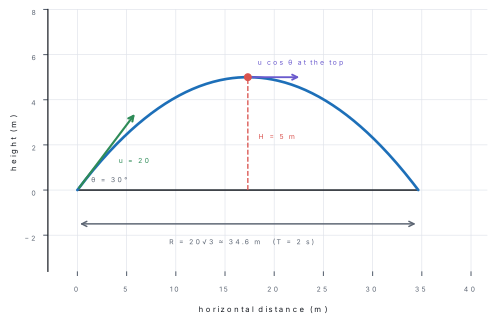
Multiple choice questions
- What is the greatest height attained by a projectile whose initial velocity and angle of elevation are 160\ \mathrm{ms^{-1}} and 30^\circ respectively? (g=10\ \mathrm{ms^{-2}}) (NEB 2081) [1]a203 mb230 mc320 md640 m
- What is the maximum height attained by a particle in projectile motion if the initial velocity and angle of inclination are 40\ \mathrm{m/s} and 30^\circ? (g=10\ \mathrm{ms^{-2}}) (NEB 2082) [1]a20 mb40 mc80 md160 m
- What is the amount of gravity exerted by the earth on a mass of 100 kg? (g is the acceleration due to gravity) (NEB 2080) [1]a100 newtonsb100g newtonsc\frac{g}{100} newtonsd\frac{100}{g} newtons
- A force acts on a body of mass m for a time t and changes its velocity from u to v. The change in momentum of the body in time t is (NEB 2079) [1]a\frac{mu-mv}{t}b\frac{mv-mu}{t}c\frac{tm-tv}{uv}d\frac{u-v}{mt}
- The time of flight of the projectile of question 2 is [1]a2 sb4 sc8 sd\frac{1}{2} s
- A projectile is fired with speed u. Its horizontal range is greatest when the angle of projection is [1]a30^\circb45^\circc60^\circd90^\circ
- At the highest point of its path the velocity of a projectile is [1]azerobu\sin\thetacu\cos\theta, horizontaldu, along the tangent
- The path of a projectile under uniform gravity, with air resistance neglected, is [1]aa straight lineba circleca paraboladan ellipse
- Three forces P, Q, R acting at a point are in equilibrium, with \alpha, \beta, \gamma the angles opposite to them. Lami's theorem states [1]a\frac{P}{\sin\alpha}=\frac{Q}{\sin\beta}=\frac{R}{\sin\gamma}bP\sin\alpha=Q\sin\beta=R\sin\gammac\frac{P}{\cos\alpha}=\frac{Q}{\cos\beta}=\frac{R}{\cos\gamma}dP+Q+R=0
- The resultant of two like parallel forces X and Y acting at A and B divides AB internally in the ratio [1]aX:YbY:XcX^{2}:Y^{2}d1:1
Answer key — 11.16
1. (c) — H=\frac{u^{2}\sin^{2}\theta}{2g}=\frac{160^{2}\times(1/2)^{2}}{2\times10}=\frac{25600\times0.25}{20}=320 m. Machine-checked.
2. (a) — H=\frac{40^{2}\times 0.25}{20}=\frac{400}{20}=20 m. Machine-checked.
3. (b) — the gravitational force on a mass is its weight W=mg=100g newtons. Option (a) drops g and is the commonest answer given.
4. (b) — as printed. Strictly, the change of momentum is mv-mu and \frac{mv-mu}{t} is the average force; every printed option divides by t, so (b) is the only defensible choice. Flagged as a printing fault, not a mathematical result.
5. (b) — T=\frac{2u\sin\theta}{g}=\frac{2\times40\times\frac12}{10}=\frac{40}{10}=4 s. Note that T is twice the time to the top, and that it does not depend on the horizontal component at all. Machine-checked.
6. (b) — R=\frac{u^{2}\sin2\theta}{g} is largest when \sin2\theta=1, i.e. 2\theta=90^\circ.
7. (c) — the vertical component has been reduced to zero; the horizontal component u\cos\theta is unchanged throughout.
8. (c) — eliminating t from x=u\cos\theta\,t and y=u\sin\theta\,t-\frac{1}{2}gt^{2} gives a quadratic in x.
9. (a) — each force is proportional to the sine of the angle between the other two.
10. (b) — the resultant is nearer the larger force, so the ratio of the segments is the reciprocal of the ratio of the forces.
Time of flight halved. Question 5's option (a), 2 s, is \frac{u\sin\theta}{g} — the time to the greatest height, which is half the time of flight. The 2082 stem gives you the same u and \theta as the height question above it, so the two are easy to answer in one breath and equally easy to mix up: t_{\text{top}}=\frac{u\sin\theta}{g}=2 s, T=4 s.
Halving in the wrong place. In the 2081 item, u^{2}=25600 and \sin^{2}30^\circ=\frac14; option (d) 640 m is what you get from \frac{u^{2}\sin^{2}\theta}{g}, forgetting the 2 in the denominator, and option (a) 203 m is a decimal-slip distractor. Write H=\frac{u^{2}\sin^{2}\theta}{2g} out fully before substituting.
Squaring the sine, or not. In the 2082 item, option (b) 40 m is \frac{u^{2}\sin\theta}{2g} — the sine used un-squared. H carries \sin^{2}\theta; R carries \sin 2\theta. These are different functions and the options are built to punish swapping them: \sin^{2}30^\circ=0.25 but \sin 60^\circ\approx0.866.
Dropping g from a weight. The 2080 item's option (a), "100 newtons", treats kilograms as newtons. Mass is in kilograms; weight is the force mg in newtons. The examiner left g symbolic precisely so that you could not hide behind a number.
Force confused with change of momentum. The 2079 item's printed options all divide by t, which makes them all forces. Impulse =Ft=mv-mu is the change of momentum; \frac{mv-mu}{t} is the average force. Know both relations and you can still pick the intended option, (b), while recognising that the question stem does not match its options.
Force ratio read the right way round. In question 10, the resultant of two like parallel forces sits closer to the bigger force, so AP:PB = Y:X, the inverse of the force ratio. Test it with X=3, Y=1: the resultant should be a quarter of the way from A, and Y:X=1:3 gives exactly that.
11.17 Appendix: Retained Examinable Topics
A few topics sit outside the fifteen numbered units of the Grade 12 spine but have still appeared as Group A questions. They are collected here so that you can see exactly how much time each deserves, rather than guessing.
Group Theory. An MCQ in 2079 (recognising an abelian group) and again in 2080 (naming the associative law for a binary operation) — and then absent from both 2081 and 2082. The 2078 specification grid has no line for it. Treat it as a fifteen-minute revision: learn the four group axioms and the word "abelian", and move on. Do not learn subgroups, cosets or cyclic groups for this paper.
Rolle's theorem and the Mean Value Theorem. Appeared in 2080 only, and not in 2079, 2081 or 2082. Learn the two statements and the difference between them — that is the whole examinable surface.
Numerical integration (trapezoidal and Simpson's rules). Not seen as an MCQ in any of the four verified years, but the formulae are short and they occasionally appear inside a Group B part. Ten minutes.
Sum and product of the roots of a quadratic. A Grade 11 result, but it was MCQ 2 in 2080. It costs one line to remember.
| Result | Statement |
|---|---|
| Group (G,*) | closure, associativity, identity, inverse |
| Abelian group | additionally a*b=b*a for all a,b\in G |
| Associative law | (a*b)*c = a*(b*c) |
| (\mathbb{Z},+), (\mathbb{Q}-\{0\},\times) | standard abelian groups |
| (\mathbb{N},+) | not a group — no identity, no inverses |
| Rolle's theorem | f continuous on [a,b], differentiable on (a,b), f(a)=f(b)\Rightarrow f'(c)=0 for some c |
| Mean value theorem | same hypotheses without f(a)=f(b): f'(c)=\dfrac{f(b)-f(a)}{b-a} |
| Trapezoidal rule | \dfrac{h}{2}\left[y_0+2(y_1+\dots+y_{n-1})+y_n\right] |
| Simpson's \frac{1}{3} rule | \dfrac{h}{3}\left[y_0+4(y_1+y_3+\dots)+2(y_2+y_4+\dots)+y_n\right] |
| Simpson's rule needs | an even number of sub-intervals |
| Sum of the roots of ax^{2}+bx+c=0 | -\dfrac{b}{a} |
| Product of the roots | \dfrac{c}{a} |
Multiple choice questions
- Which of the following is an abelian group under the given operation? (NEB 2079) [1]athe set of integers under additionbthe set of natural numbers under additioncthe set of integers under multiplicationdthe set of all real numbers under multiplication
- If * is a binary operation on a set G and (a*b)*c = a*(b*c) for all a,b,c\in G, then * satisfies the (NEB 2080) [1]aclosure lawbcommutative lawcidentity lawdassociative law
- The sum of the roots of the equation x^{2}-6x+8=0 is (NEB 2080) [1]a2b4c6d8
- If f(x)=x^{2}-4x+3 on [1,3], the value of c given by Rolle's theorem is [1]a1b2c3d\frac{3}{2}
- Rolle's theorem requires, in addition to continuity and differentiability, that [1]af(a)=fb (b) f(a)=0cf'(a)=f'(b)df be increasing
- For f(x)=x^{2} on [1,3], the value of c given by the mean value theorem is [1]a1b2c\sqrt{3}d\frac{5}{2}
- Simpson's \frac{1}{3} rule can be applied only when the number of sub-intervals is [1]aoddbevencprimeda multiple of 3
- Using the trapezoidal rule with n=2, the value of \int_{0}^{1}x^{2}\,dx is [1]a\frac{1}{3}b\frac{3}{8}c\frac{1}{2}d\frac{1}{4}
Answer key — 11.17
1. (a) — (\mathbb{Z},+) has closure, associativity, identity 0, inverse -a and commutativity. (\mathbb{N},+) has no identity or inverses; (\mathbb{Z},\times) has no inverses; \mathbb{R} under multiplication fails because 0 has no inverse.
2. (d) — the bracket can be moved without changing the result; that is precisely associativity.
3. (c) — sum of the roots =-\frac{b}{a}=-\frac{-6}{1}=6. The roots are 2 and 4; option (a) and (b) are the roots themselves and (d) is their product. Machine-checked.
4. (b) — f(1)=f(3)=0, and f'(x)=2x-4=0 gives c=2, which lies in (1,3). Machine-checked.
5. (a) — equal endpoint values are what force a horizontal tangent somewhere in between.
6. (b) — \frac{f(3)-f(1)}{3-1}=\frac{9-1}{2}=4, and f'(c)=2c=4 gives c=2. Machine-checked.
7. (b) — the rule pairs the sub-intervals, fitting one parabola across each pair, so their number must be even.
8. (b) — h=\frac12; \frac{h}{2}[y_0+2y_1+y_2]=\frac14\left[0+2\times\frac14+1\right]=\frac{3}{8}. The exact value is \frac13, so the trapezoidal rule over-estimates here — as it always does for a convex curve. Machine-checked.
Answering with a root instead of the sum. In the real 2080 item the roots of x^{2}-6x+8=0 are 2 and 4, and both appear as options, as does the product 8. Use -\frac{b}{a} and \frac{c}{a} directly; do not solve the quadratic at all — solving is what makes you reach for the wrong number.
Sign lost from -\frac{b}{a}. The sum of the roots is -\frac{b}{a}, not \frac{b}{a}. With b=-6 the two differ only in sign, and in a paper where the answer happens to be positive the mistake goes unnoticed until the year it does not.
Confusing the group axioms by name. The 2080 item prints all four axiom names as options. Memorise them as a sentence: closure keeps you in the set, associativity moves the brackets, identity does nothing, inverse undoes. Commutativity is the extra one that makes a group abelian — it is not one of the four.
Calling (\mathbb{N},+) a group. It is closed and associative but has no identity element (0\notin\mathbb{N}) and no inverses. This is option (b) in the 2079 item and it is the one most often chosen.
Rolle answered with an endpoint. In question 4, options (a) and (c) are a and b themselves. Rolle's theorem promises a c strictly inside (a,b); an endpoint can never be the answer.
Trapezoidal answer replaced by the exact value. In question 8, option (a) \frac13 is \int_0^1 x^2dx done exactly. The question asks what the rule produces, which is deliberately not the exact value — that gap is the whole point of an error estimate.
Chapter summary
- Group A is eleven marks in fifteen minutes, and since 2082 it arrives as a separate booklet thirty minutes after the paper starts. Do the eleven MCQs first, in one pass, and hand the booklet back before you settle into Group B.
- Four of the eleven MCQs are Calculus — the single largest block. Across 2079–2082 the reliable slots have been a derivative (often an inverse hyperbolic or inverse trigonometric one), a standard integral of the \frac{1}{a}\tan^{-1}\frac{x}{a} family, and one or two differential-equation items on order/degree, homogeneity or the integrating factor.
- One MCQ is guaranteed from each of Trigonometry, Analytic Geometry and Vector by the grid's own footnote. In practice that has meant a half-angle or triangle law, a conic property (eccentricity, latus rectum or a tangency condition), and a dot- or cross-product item.
- One MCQ is guaranteed from Computational Methods or Mechanics, and three of the four verified years made it a Gauss-elimination row-operation step; the Mechanics alternative has twice been the greatest height of a projectile. Both are pure substitution.
- The Statistics and Probability MCQ has gone to Probability every single year, never to correlation or regression, and conditional probability has appeared in 2080, 2081, 2082 and the CDC model. P(B/A)=\frac{P(A\cap B)}{P(A)} — divide by the event that has already happened.
- Exactly two "Or" choices appear per paper, at Q11 and Q19, never in Group C. Decide in advance which branch you are taking so that you do not spend reading time on both.
- The traps that cost the most marks are, in order of how often they are printed: differentiating when asked to integrate; the \hat{j} sign and the non-commutativity of \vec{a}\times\vec{b}; \frac{1}{a}\tan^{-1}\frac{a}{x} written for \frac{1}{a}\tan^{-1}\frac{x}{a}, and the constant misplaced in \int\frac{dx}{9x^{2}+1}; dividing by P(B) instead of P(A) in a conditional probability; degree read as order; C(n,r)\times r! = P(n,r) read backwards; and c^{2}=a^{2}(1+m^{2}) with a and c swapped.
- Binomial Theorem and Solution of Triangles have never carried an MCQ in the four verified years, and Group Theory vanished after 2080 while Rolle/MVT appeared in 2080 only. Prepare them for Groups B and C, not for Group A.
- Every numerical answer key in this chapter was recomputed with a computer algebra system before it was printed, including the option sets of the real past papers — where three genuine printing faults were found and are flagged in place.
Minutes 0–1: sort, do not solve. Read all eleven stems once and mark each one recall, one-line, or work. Roughly half of any NEB Group A is pure recall — order and degree, a group axiom, Lami's theorem, the exactness condition, the pivot rule.
Minutes 1–6: clear every recall item. Answer them straight off the fact tables in this chapter. Do not check them twice; you either know a definition or you do not.
Minutes 6–12: the one-line items. These are the substitution questions — greatest height, an integrating factor, a conditional probability, a row operation, an eccentricity. Write the formula down before you write any number. Nearly every distractor in this book is generated by substituting into a half-remembered formula, so the formula on the page is your defence.
Minutes 12–15: the work items and a sweep. Usually one or two: a determinant, a cross product, a definite integral. Then sweep the whole sheet and confirm you have shaded exactly eleven bubbles.
Three habits worth more than any formula. (i) Read the operator. "Find \int…" versus "find \frac{d}{dx}…" and "\hat{k}\times\hat{j}" versus "\hat{j}\times\hat{k}" change the sign or invert the whole answer. (ii) Check the variable. Differentiate with respect to whatever the question names, not whatever letter is most prominent. (iii) Never leave a blank. There is no negative marking; eliminate the two options that are dimensionally or structurally impossible and choose between the rest.