Unit 3 · Algebra · 8 teaching hours · 28 min read
Complex Numbers
What the syllabus asks for 4
- Polar form of a complex number
- De Moivre's theorem and its application to roots
- Properties of cube roots of unity
- Euler's formula
A complex number z = x + iy has two parts, so it needs two pieces of information to pin it down. Writing it as x + iy answers "how far right, how far up". Writing it in polar form answers "how far from the origin, and in which direction" — and that second description turns multiplication into addition of angles. Once that is seen, De Moivre's theorem makes powers and roots of complex numbers as easy as multiplying angles by n, and Euler's formula ties the whole subject to the exponential series of Unit 2.
Convert between x + iy and r(\cos\theta + i\sin\theta) with the correct quadrant for \theta; use De Moivre to compute a high power such as (1+i)^{10}; find the n n^{\text{th}} roots of a complex number and mark them on an Argand diagram; prove and apply the properties of the cube roots of unity 1, \omega, \omega^{2}; and state Euler's formula e^{i\theta} = \cos\theta + i\sin\theta.
3.1 Polar form of a complex number
Plot z = x + iy as the point (x, y). This picture is the Argand diagram: the horizontal axis is the real axis, the vertical axis is the imaginary axis.
For z = x + iy with z \neq 0:
- The modulus r = |z| = \sqrt{x^{2} + y^{2}} is the distance OP from the origin. It is real and positive.
- The argument (or amplitude) \theta = \arg z is the angle POX measured from the positive real axis, anticlockwise positive.
The argument is only fixed up to multiples of 2\pi. The value in -\pi < \theta \leq \pi is the principal argument, and "the" argument always means this one unless the question says otherwise.
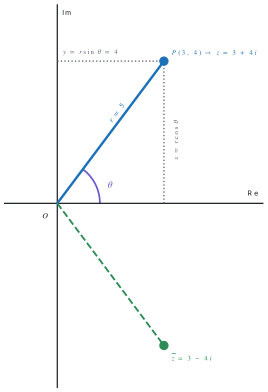
From the right-angled triangle in the figure, x = r\cos\theta and y = r\sin\theta. Substituting these into z = x + iy gives the polar form.
Reverse direction: x = r\cos\theta, y = r\sin\theta.
A calculator returns \tan^{-1} between -90^{\circ} and 90^{\circ}, so it cannot tell -1-i from 1+i. Always plot the point first. Let \alpha = \tan^{-1}\left(\dfrac{y}{x}\right) taken as a positive acute angle. Then:
| Position of (x, y) | Signs | Principal argument \theta |
|---|---|---|
| First quadrant | x>0,\ y>0 | \alpha |
| Second quadrant | x<0,\ y>0 | \pi - \alpha |
| Third quadrant | x<0,\ y<0 | -(\pi - \alpha) |
| Fourth quadrant | x>0,\ y<0 | -\alpha |
On the axes, read the argument straight off the picture: \arg(5) = 0, \arg(3i) = \pi/2, \arg(-2) = \pi, \arg(-4i) = -\pi/2.
Problem. Express in polar form, using principal arguments: (a) 1 + i\sqrt{3} (b) -1 + i (c) -\sqrt{3} - i (d) 1 - i.
Solution. In each case find r, find the acute angle \alpha, then fix the quadrant.
(a) r = \sqrt{1 + 3} = 2; \tan\alpha = \sqrt{3}/1 so \alpha = 60^{\circ}. The point (1, \sqrt{3}) is in the first quadrant, so \theta = 60^{\circ}:
(b) r = \sqrt{1+1} = \sqrt{2}; \tan\alpha = 1/1 so \alpha = 45^{\circ}. The point (-1, 1) is in the second quadrant, so \theta = 180^{\circ} - 45^{\circ} = 135^{\circ}:
(c) r = \sqrt{3+1} = 2; \tan\alpha = 1/\sqrt{3} so \alpha = 30^{\circ}. The point (-\sqrt{3}, -1) is in the third quadrant, so \theta = -(180^{\circ} - 30^{\circ}) = -150^{\circ}:
(d) r = \sqrt{2}, \alpha = 45^{\circ}, fourth quadrant, so \theta = -45^{\circ}:
Check (c): 2\cos(-150^{\circ}) = 2(-\sqrt{3}/2) = -\sqrt{3} and 2\sin(-150^{\circ}) = 2(-1/2) = -1. Correct.
Multiplication and division in polar form
Let z_{1} = r_{1}(\cos\theta_{1} + i\sin\theta_{1}) and z_{2} = r_{2}(\cos\theta_{2} + i\sin\theta_{2}). Multiply:
Expand the bracket and use i^{2} = -1:
The two brackets are exactly the compound-angle formulas for \cos(\theta_{1}+\theta_{2}) and \sin(\theta_{1}+\theta_{2}), so
For the quotient, multiply numerator and denominator by \cos\theta_{2} - i\sin\theta_{2}; the denominator becomes \cos^{2}\theta_{2} + \sin^{2}\theta_{2} = 1, and the same compound-angle step with -\theta_{2} gives
In words: multiply the moduli, add the arguments; divide the moduli, subtract the arguments. \blacksquare
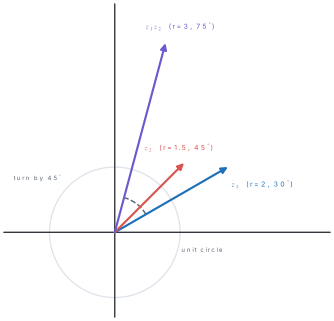
Problem. Find the modulus and principal argument of z = \dfrac{1+i}{1 - i\sqrt{3}}, and write z in polar form.
Solution. Do the numerator and denominator separately.
Numerator: |1+i| = \sqrt{2}, \arg(1+i) = 45^{\circ} (first quadrant).
Denominator: |1 - i\sqrt{3}| = \sqrt{1+3} = 2; \alpha = 60^{\circ} and (1, -\sqrt{3}) is in the fourth quadrant, so \arg = -60^{\circ}.
Divide the moduli and subtract the arguments:
Since 105^{\circ} lies in (-180^{\circ}, 180^{\circ}] it is already the principal value, and 105^{\circ} = \dfrac{7\pi}{12}. Hence
|z_{1}z_{2}| = |z_{1}||z_{2}|, \left|\dfrac{z_{1}}{z_{2}}\right| = \dfrac{|z_{1}|}{|z_{2}|}, |z^{n}| = |z|^{n} and z\overline{z} = |z|^{2}. These let you find a modulus without ever rationalising the fraction.
3.2 De Moivre's theorem and its application to roots
For every n,
and more generally
If n is an integer the right side is the only value; if n is a rational p/q in lowest terms, the left side has q values.
Case 1: n a positive integer — induction. Let P(n) be the statement (\cos\theta + i\sin\theta)^{n} = \cos n\theta + i\sin n\theta.
Base step. P(1) reads \cos\theta + i\sin\theta = \cos\theta + i\sin\theta, which is true.
Inductive step. Assume P(k) holds, i.e. (\cos\theta + i\sin\theta)^{k} = \cos k\theta + i\sin k\theta. Multiply both sides by (\cos\theta + i\sin\theta):
By the product rule of §3.1 (moduli 1, arguments k\theta and \theta), the right side is \cos(k\theta + \theta) + i\sin(k\theta+\theta), that is
which is P(k+1). Since P(1) is true and P(k) \Rightarrow P(k+1), by induction P(n) is true for all positive integers n.
Case 2: n = 0. Both sides equal 1.
Case 3: n a negative integer, say n = -m with m > 0. Then
Multiply top and bottom by \cos m\theta - i\sin m\theta; the denominator becomes \cos^{2}m\theta + \sin^{2}m\theta = 1, so
using \cos(-A) = \cos A, \sin(-A) = -\sin A. So the theorem holds for n = -m too.
Case 4: n = p/q rational. Put w = \cos\dfrac{\theta}{q} + i\sin\dfrac{\theta}{q}. By Case 1, w^{q} = \cos\theta + i\sin\theta, so w is one q^{\text{th}} root of \cos\theta + i\sin\theta; raising w to the power p gives \cos\dfrac{p\theta}{q} + i\sin\dfrac{p\theta}{q} as one of the values of (\cos\theta+i\sin\theta)^{p/q}. \blacksquare
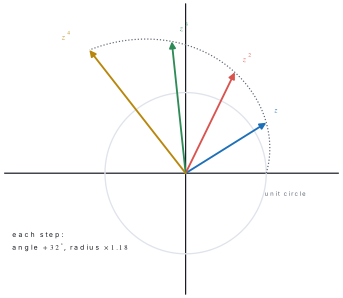
Problem. Evaluate (1+i)^{10}.
Solution. Expanding by the binomial theorem would take eleven terms. Use polar form instead: |1+i| = \sqrt{2} and \arg(1+i) = 45^{\circ}, so
Apply De Moivre with n = 10:
Now \left(\sqrt{2}\right)^{10} = 2^{5} = 32, and 450^{\circ} = 360^{\circ} + 90^{\circ}, so \cos 450^{\circ} = \cos 90^{\circ} = 0 and \sin 450^{\circ} = 1:
Problem. Show that \left(\sqrt{3} + i\right)^{7} = -64\left(\sqrt{3}+i\right).
Solution. |\sqrt{3}+i| = \sqrt{3+1} = 2 and \tan\alpha = 1/\sqrt{3}, first quadrant, so \arg = 30^{\circ}:
as required. (Note 210^{\circ} is in the third quadrant, where both cosine and sine are negative — a sign slip here is the commonest lost mark.)
Problem. Use De Moivre's theorem to prove \cos 3\theta = 4\cos^{3}\theta - 3\cos\theta and \sin 3\theta = 3\sin\theta - 4\sin^{3}\theta.
Solution. By De Moivre with n = 3:
Expand the right side by the binomial theorem, writing c = \cos\theta, s = \sin\theta:
using i^{2} = -1, i^{3} = -i. Group real and imaginary parts:
Two complex numbers are equal only if their real parts and imaginary parts match separately, so
where s^{2} = 1 - c^{2} and c^{2} = 1 - s^{2} were used to remove the unwanted letter. \blacksquare
Application to roots
To solve w^{n} = z where z = r(\cos\theta + i\sin\theta), first note that adding 2k\pi to the argument does not change z at all:
This is the whole trick: the same number has infinitely many arguments, and taking the n^{\text{th}} root divides each of them by n, which spreads them apart. Applying De Moivre with index 1/n,
Every root has the same modulus r^{1/n} (the real positive n^{\text{th}} root of r), and the arguments differ by \dfrac{2\pi}{n} as k increases by 1. After n steps the argument has grown by 2\pi and we are back at the first root, so exactly
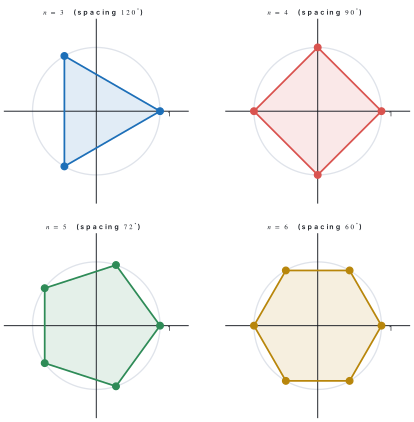
give n distinct roots. Because they share a modulus and are equally spaced in angle, they lie on a circle of radius r^{1/n} at the vertices of a regular n-gon. \blacksquare
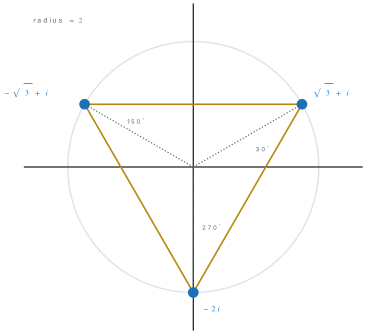
Problem. Find the cube roots of 8i and show them on an Argand diagram.
Solution. Write 8i in polar form: |8i| = 8 and the point (0, 8) is on the positive imaginary axis, so \arg(8i) = 90^{\circ}. Including the general argument,
Take the cube root, so the modulus becomes 8^{1/3} = 2 and each argument is divided by 3:
The three arguments are 30^{\circ}, 150^{\circ} and 270^{\circ} — spaced 120^{\circ} apart, as expected:
Check. \left(\sqrt{3}+i\right)^{3} = 2^{3}\left(\cos 90^{\circ} + i\sin 90^{\circ}\right) = 8i. Also the three roots sum to (\sqrt{3} - \sqrt{3} + 0) + i(1 + 1 - 2) = 0, which it must be, since the coefficient of w^{2} in w^{3} - 8i = 0 is zero.
Problem. Solve z^{4} + 16 = 0.
Solution. The equation is z^{4} = -16. Now |-16| = 16 and \arg(-16) = 180^{\circ}, so
Here 16^{1/4} = 2 and the arguments are 45^{\circ}, 135^{\circ}, 225^{\circ}, 315^{\circ}, each 90^{\circ} apart. Since \cos 45^{\circ} = \sin 45^{\circ} = 1/\sqrt{2}, every root has both coordinates of size 2/\sqrt{2} = \sqrt{2}:
That is z = \pm\sqrt{2} \pm i\sqrt{2}, the four vertices of a square of circumradius 2. Check: (\sqrt{2}+i\sqrt{2})^{2} = 2 + 4i + 2i^{2} = 4i, and (4i)^{2} = -16.
The n^{\text{th}} roots of unity
Putting z = 1, so r = 1 and \theta = 0, gives the roots of w^{n} = 1:
Writing w = \cos\dfrac{2\pi}{n} + i\sin\dfrac{2\pi}{n}, the roots are 1, w, w^{2}, \ldots, w^{n-1}: all on the unit circle, at the vertices of a regular n-gon with one vertex at 1.
- Their sum is 0 (for n \geq 2).
- Their product is (-1)^{n+1}.
The roots are the solutions of w^{n} - 1 = 0, so
Comparing the coefficient of w^{n-1} on both sides: on the left it is 0, on the right it is -(w_{0} + w_{1} + \cdots + w_{n-1}). Hence the sum of the roots is 0.
Comparing constant terms: the left side gives -1, the right side gives (-1)^{n}w_{0}w_{1}\cdots w_{n-1}. So the product is \dfrac{-1}{(-1)^{n}} = (-1)^{n+1}.
The sum can also be seen as a geometric series: with w = \cos\dfrac{2\pi}{n} + i\sin\dfrac{2\pi}{n} \neq 1,
since w^{n} = \cos 2\pi + i\sin 2\pi = 1. \blacksquare
Problem. Find the five fifth roots of 32 and show that their sum is zero.
Solution. 32 is real and positive, so |32| = 32 and \arg 32 = 0:
Since 32^{1/5} = 2 and 360^{\circ}/5 = 72^{\circ}, the roots are
that is 2, 2(\cos 72^{\circ} + i\sin 72^{\circ}), 2(\cos 144^{\circ} + i\sin 144^{\circ}), 2(\cos 216^{\circ} + i\sin 216^{\circ}) and 2(\cos 288^{\circ} + i\sin 288^{\circ}) — five points on a circle of radius 2, forming a regular pentagon.
Every root is 2w^{k} where w = \cos 72^{\circ} + i\sin 72^{\circ} is a fifth root of unity, so the sum is
because w^{5} = \cos 360^{\circ} + i\sin 360^{\circ} = 1. Numerically the roots are 2, 0.618 \pm 1.902i and -1.618 \pm 1.176i, and 2 + 2(0.618) + 2(-1.618) = 0 — the imaginary parts cancel in conjugate pairs.
3.3 Properties of cube roots of unity
Put n = 3 in the work above, or simply factorise:
Solve z^{3} = 1, i.e. z^{3} - 1 = 0. Factorising the difference of cubes,
So either z = 1, or z^{2}+z+1 = 0, which by the quadratic formula gives
The three cube roots of unity are therefore
To see that the third root really is the square of the second:
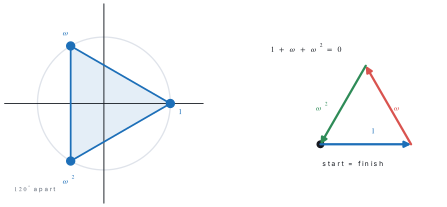
Each has modulus \sqrt{\frac14 + \frac34} = 1, and their arguments are 0^{\circ}, 120^{\circ} and -120^{\circ}. \blacksquare
If \omega is a complex (non-real) cube root of unity, then
- \omega^{3} = 1, and generally \omega^{3m} = 1 for any integer m — so reduce any index modulo 3.
- 1 + \omega + \omega^{2} = 0 (sum of the roots of z^{3}-1=0). Hence 1 + \omega = -\omega^{2}, 1 + \omega^{2} = -\omega and \omega + \omega^{2} = -1.
- \omega and \omega^{2} are conjugates, and \omega \cdot \omega^{2} = \omega^{3} = 1, so \omega^{2} = \dfrac{1}{\omega} = \overline{\omega}.
- The three roots are the vertices of an equilateral triangle inscribed in the unit circle.
- a^{3}+b^{3}+c^{3}-3abc = (a+b+c)\left(a+b\omega+c\omega^{2}\right)\left(a+b\omega^{2}+c\omega\right).
Problem. If \omega is a complex cube root of unity, find the value of \omega^{100} + \omega^{200} + \omega^{300}.
Solution. Reduce each index modulo 3, using \omega^{3} = 1.
100 = 3(33) + 1, so \omega^{100} = \left(\omega^{3}\right)^{33}\omega = 1^{33}\omega = \omega.
200 = 3(66)+2, so \omega^{200} = \left(\omega^{3}\right)^{66}\omega^{2} = \omega^{2}.
300 = 3(100), so \omega^{300} = \left(\omega^{3}\right)^{100} = 1.
Adding, and using property 2:
Problem. Prove that \left(1 + \omega - \omega^{2}\right)^{3} + \left(1 - \omega + \omega^{2}\right)^{3} = -16.
Solution. Use 1 + \omega + \omega^{2} = 0 to simplify each bracket before cubing — never expand the cube directly.
From 1+\omega+\omega^{2} = 0 we get 1 + \omega = -\omega^{2}, so
Similarly 1 + \omega^{2} = -\omega, so
Now cube both:
Adding, the required value is -8 + (-8) = -16. \blacksquare
Problem. Show that a^{3}+b^{3}+c^{3}-3abc = (a+b+c)\left(a+b\omega+c\omega^{2}\right)\left(a+b\omega^{2}+c\omega\right), and hence evaluate the right side when a=1, b=2, c=3.
Solution. Multiply the last two factors first. Expanding term by term:
Use \omega^{3} = 1 and \omega^{4} = \omega, then collect the \omega and \omega^{2} terms:
Since \omega+\omega^{2} = -1, this is a^{2}+b^{2}+c^{2}-ab-bc-ca. Therefore the product of all three factors is
which is the standard identity. For a=1, b=2, c=3:
(As a check, a+b+c = 6 and the other two factors multiply to 1+4+9-2-6-3 = 3, and 6 \times 3 = 18.)
3.4 Euler's formula
In Unit 2 the exponential series e^{x} = 1 + x + \dfrac{x^{2}}{2!} + \dfrac{x^{3}}{3!} + \cdots was established for every real x. It also holds when the exponent is imaginary, and the result is remarkable.
Put x = i\theta in the exponential series:
The powers of i cycle i, -1, -i, 1:
Separate the terms without i from the terms with i:
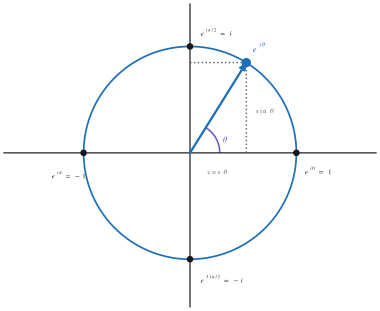
The first bracket is the series for \cos\theta and the second is the series for \sin\theta. Hence
Replacing \theta by -\theta gives e^{-i\theta} = \cos\theta - i\sin\theta. \blacksquare
De Moivre's theorem is now just the index law \left(e^{i\theta}\right)^{n} = e^{in\theta}. Putting \theta = \pi gives Euler's identity e^{i\pi} + 1 = 0, which links e, i, \pi, 1 and 0 in one equation.
Problem. Express 1+i in the exponential form re^{i\theta}, and use it to find (1+i)^{10}.
Solution. From Worked example 3.3, r = \sqrt{2} and \theta = \pi/4, so
Raise to the tenth power using the index laws:
Reduce the angle: \dfrac{5\pi}{2} = 2\pi + \dfrac{\pi}{2}, and e^{2\pi i} = 1, so e^{5i\pi/2} = e^{i\pi/2} = i. Hence
the same answer as before, with less writing — this is why physicists and engineers keep complex numbers in exponential form.
Problem. Use Euler's formula to prove \cos^{3}\theta = \dfrac{3\cos\theta + \cos 3\theta}{4}.
Solution. Start from 2\cos\theta = e^{i\theta} + e^{-i\theta} and cube both sides:
Expand by the binomial theorem, with a = e^{i\theta}, b = e^{-i\theta}, and note that ab = e^{i\theta}e^{-i\theta} = e^{0} = 1:
Each bracket is twice a cosine, by Euler's formula:
Divide by 8:
Check at \theta = 0: left side 1, right side (3+1)/4 = 1. \blacksquare
Problem. If x + \dfrac{1}{x} = 2\cos\theta, prove that x^{n} + \dfrac{1}{x^{n}} = 2\cos n\theta.
Solution. Multiply through by x to get the quadratic x^{2} - 2x\cos\theta + 1 = 0, so
Now \cos^{2}\theta - 1 = -\sin^{2}\theta, and \sqrt{-\sin^{2}\theta} = i\sin\theta, so
Take x = e^{i\theta} (the other sign only swaps the two terms below). Then by De Moivre, x^{n} = e^{in\theta} = \cos n\theta + i\sin n\theta and
Adding, the imaginary parts cancel:
\blacksquare (The companion result, from subtracting, is x^{n} - \dfrac{1}{x^{n}} = 2i\sin n\theta.)
Chapter summary
- Polar form: z = r(\cos\theta + i\sin\theta) with r = |z| = \sqrt{x^{2}+y^{2}} and \tan\theta = y/x; fix \theta from the quadrant of (x, y), principal value in -\pi < \theta \leq \pi.
- Multiply: moduli multiply, arguments add. Divide: moduli divide, arguments subtract.
- De Moivre: \left[r(\cos\theta+i\sin\theta)\right]^{n} = r^{n}(\cos n\theta + i\sin n\theta), proved by induction for positive integers and extended to negative and rational indices.
- Equating real and imaginary parts in (\cos\theta+i\sin\theta)^{n} = \cos n\theta + i\sin n\theta gives the multiple-angle formulas, e.g. \cos 3\theta = 4\cos^{3}\theta - 3\cos\theta.
- n^{\text{th}} roots: z^{1/n} = r^{1/n}\left[\cos\dfrac{\theta+2k\pi}{n} + i\sin\dfrac{\theta+2k\pi}{n}\right], k = 0, 1, \ldots, n-1 — exactly n roots, equally spaced on a circle of radius r^{1/n}, forming a regular n-gon.
- n^{\text{th}} roots of unity: 1, w, \ldots, w^{n-1} with w = \cos\dfrac{2\pi}{n} + i\sin\dfrac{2\pi}{n}; sum = 0, product = (-1)^{n+1}.
- Cube roots of unity: 1, \omega = \dfrac{-1+i\sqrt{3}}{2}, \omega^{2} = \dfrac{-1-i\sqrt{3}}{2} with \omega^{3}=1 and 1+\omega+\omega^{2}=0; reduce indices modulo 3.
- Euler: e^{i\theta} = \cos\theta+i\sin\theta, z = re^{i\theta}, e^{i\pi}+1=0, \cos\theta = \dfrac{e^{i\theta}+e^{-i\theta}}{2}.
Practice questions
Group A — Multiple choice (1 mark each)
- The modulus of 1 - i\sqrt{3} is [1]a1b2c4d\sqrt{2}
- The principal argument of -1-i is [1]a\dfrac{\pi}{4}b\dfrac{3\pi}{4}c-\dfrac{3\pi}{4}d\dfrac{5\pi}{4}
- The value of i^{2026} is [1]a1b-1cid-i
- If \omega is a complex cube root of unity, then \omega^{4} + \omega^{2} + 1 equals [1]a0b1c\omegad3
- The number of distinct fifth roots of -32 is [1]a1b2c5dinfinitely many
- e^{i\pi/2} equals [1]a1b-1cid-i
Answers to Group A
1. (b) — \sqrt{1^{2}+(\sqrt{3})^{2}} = \sqrt{4} = 2.
2. (c) — (-1,-1) is in the third quadrant with \alpha = \pi/4, so \theta = -(\pi - \pi/4) = -3\pi/4.
3. (b) — 2026 = 4(506) + 2, so i^{2026} = i^{2} = -1.
4. (a) — \omega^{4} = \omega^{3}\omega = \omega, so the sum is 1 + \omega + \omega^{2} = 0.
5. (c) — a non-zero complex number has exactly n distinct n^{\text{th}} roots.
6. (c) — e^{i\pi/2} = \cos 90^{\circ} + i\sin 90^{\circ} = i.
Group B — Short answer (5 marks each)
- Express -1 + i\sqrt{3} in polar form and hence evaluate \left(-1+i\sqrt{3}\right)^{5}. [5]
- State De Moivre's theorem and prove it for a positive integral index. [5]
- Find the modulus and principal argument of \dfrac{1+i}{1-i}, and write it in exponential form. [5]
- Solve z^{3} = -1, giving the roots in the form x+iy, and show that they lie at the vertices of an equilateral triangle. [5]
- If 1, \omega, \omega^{2} are the cube roots of unity, prove that (1+\omega)\left(1+\omega^{2}\right)\left(1+\omega^{4}\right) \left(1+\omega^{8}\right) = 1. [5]
- Using De Moivre's theorem, prove that \sin 3\theta = 3\sin\theta - 4\sin^{3}\theta. [5]
Answers to Group B
1. r = \sqrt{(-1)^{2}+(\sqrt{3})^{2}} = 2; \tan\alpha = \sqrt{3}/1 gives \alpha = 60^{\circ}, and (-1, \sqrt{3}) is in the second quadrant, so \theta = 180^{\circ}-60^{\circ} = 120^{\circ}: -1+i\sqrt{3} = 2\left(\cos 120^{\circ} + i\sin 120^{\circ}\right). By De Moivre, \left(-1+i\sqrt{3}\right)^{5} = 2^{5}\left(\cos 600^{\circ} + i\sin 600^{\circ}\right). Since 600^{\circ} = 360^{\circ}+240^{\circ}, use 240^{\circ}: \cos 240^{\circ} = -\tfrac12, \sin 240^{\circ} = -\tfrac{\sqrt{3}}{2}. So the value is 32\left(-\tfrac12 - \tfrac{\sqrt{3}}{2}i\right) = -16 - 16\sqrt{3}\,i.
2. Statement: for a positive integer n, (\cos\theta+i\sin\theta)^{n} = \cos n\theta + i\sin n\theta. Proof by induction: P(1) is an identity. Assuming (\cos\theta+i\sin\theta)^{k} = \cos k\theta + i\sin k\theta and multiplying by (\cos\theta+i\sin\theta) gives (\cos k\theta\cos\theta - \sin k\theta\sin\theta) + i(\sin k\theta\cos\theta + \cos k\theta\sin\theta) = \cos(k+1)\theta + i\sin(k+1)\theta, using the compound-angle formulas. So P(k) \Rightarrow P(k+1) and the result holds for all positive integers n.
3. |1+i| = \sqrt{2} with argument 45^{\circ}; |1-i| = \sqrt{2} with argument -45^{\circ}. Dividing, the modulus is \sqrt{2}/\sqrt{2} = 1 and the argument is 45^{\circ}-(-45^{\circ}) = 90^{\circ} = \pi/2. Hence \dfrac{1+i}{1-i} = 1 \cdot e^{i\pi/2} = i, which the direct calculation \dfrac{(1+i)^{2}}{(1-i)(1+i)} = \dfrac{2i}{2} = i confirms.
4. -1 = 1\left[\cos(180^{\circ}+360^{\circ}k) + i\sin(180^{\circ}+360^{\circ}k)\right], so z = \cos\dfrac{180^{\circ}+360^{\circ}k}{3} + i\sin\dfrac{180^{\circ}+360^{\circ}k}{3} for k = 0,1,2: arguments 60^{\circ}, 180^{\circ}, 300^{\circ}. The roots are \tfrac12 + \tfrac{\sqrt{3}}{2}i, -1, and \tfrac12 - \tfrac{\sqrt{3}}{2}i. All have modulus 1 and their arguments differ by 120^{\circ}, so they are equally spaced on the unit circle — the vertices of an equilateral triangle.
5. Reduce the indices modulo 3: \omega^{4} = \omega and \omega^{8} = \omega^{6}\omega^{2} = \omega^{2}. The product becomes \left[(1+\omega)(1+\omega^{2})\right]^{2}. Since 1+\omega = -\omega^{2} and 1+\omega^{2} = -\omega, we get (1+\omega)(1+\omega^{2}) = \omega^{3} = 1, so the product is 1^{2} = 1.
6. By De Moivre, \cos 3\theta + i\sin 3\theta = (\cos\theta+i\sin\theta)^{3}. Expanding with c = \cos\theta, s = \sin\theta: c^{3} + 3ic^{2}s - 3cs^{2} - is^{3}. Equating imaginary parts, \sin 3\theta = 3c^{2}s - s^{3} = 3(1-s^{2})s - s^{3} = 3\sin\theta - 4\sin^{3}\theta.
Group C — Long answer (8 marks each)
- State De Moivre's theorem and prove it for a positive integral index. Hence find the five fifth roots of 32, and show that they are the vertices of a regular pentagon inscribed in a circle of radius 2. [8]
- Derive the general expression for the n n^{\text{th}} roots of unity. Prove that their sum is zero and their product is (-1)^{n+1}, and verify both results for n = 6. [8]
- Find the cube roots of unity from z^{3}-1 = 0 and prove that 1+\omega+\omega^{2} = 0. Hence prove that (1+\omega)^{3} - \left(1+\omega^{2}\right)^{3} = 0 and that a^{3}+b^{3}+c^{3}-3abc = (a+b+c)\left(a+b\omega+c\omega^{2}\right)\left(a+b\omega^{2}+c\omega\right). [8]
Answers to Group C
1. Statement and proof: as in Group B question 2 — state (\cos\theta+i\sin\theta)^{n} = \cos n\theta+i\sin n\theta, verify P(1), assume P(k), multiply by (\cos\theta+i\sin\theta) and use the compound-angle formulas to reach P(k+1); conclude by induction.
Fifth roots of 32: 32 = 32\left[\cos(0+360^{\circ}k) + i\sin(0+360^{\circ}k)\right], so z = 32^{1/5}\left[\cos\dfrac{360^{\circ}k}{5} + i\sin\dfrac{360^{\circ}k}{5}\right] with k = 0,1,2,3,4. As 32^{1/5} = 2, the roots are 2\left(\cos 72^{\circ}k + i\sin 72^{\circ}k\right), i.e. 2, 2(\cos 72^{\circ}+i\sin 72^{\circ}) \approx 0.618 + 1.902i, 2(\cos 144^{\circ}+i\sin 144^{\circ}) \approx -1.618+1.176i, 2(\cos 216^{\circ}+i\sin 216^{\circ}) \approx -1.618-1.176i and 2(\cos 288^{\circ}+i\sin 288^{\circ}) \approx 0.618-1.902i.
Pentagon: every root has modulus 2, so all five lie on the circle |z| = 2; consecutive arguments differ by exactly 72^{\circ} = 360^{\circ}/5, so the chords joining them are equal and the five points are the vertices of a regular pentagon of circumradius 2.
2. Derivation: 1 = \cos(0 + 2k\pi) + i\sin(0+2k\pi) for every integer k, so by De Moivre with index 1/n, w_{k} = \cos\dfrac{2k\pi}{n} + i\sin\dfrac{2k\pi}{n}. Increasing k by n increases the argument by 2\pi and repeats a root, so k = 0,1,\ldots,n-1 give all n distinct roots, and w_{k} = w^{k} where w = \cos\dfrac{2\pi}{n}+i\sin\dfrac{2\pi}{n}.
Sum: 1 + w + \cdots + w^{n-1} = \dfrac{w^{n}-1}{w-1} = 0 because w^{n} = \cos 2\pi + i\sin 2\pi = 1 while w \neq 1 for n \geq 2.
Product: 1 \cdot w \cdot w^{2}\cdots w^{n-1} = w^{0+1+\cdots+(n-1)} = w^{n(n-1)/2} = \left(\cos\dfrac{2\pi}{n}+i\sin\dfrac{2\pi}{n}\right)^{n(n-1)/2} = \cos(n-1)\pi + i\sin(n-1)\pi = (-1)^{n-1} = (-1)^{n+1}.
Check n = 6: the roots are \pm 1, \pm\tfrac12 \pm \tfrac{\sqrt{3}}{2}i, i.e. 1, \tfrac12+\tfrac{\sqrt{3}}{2}i, -\tfrac12+\tfrac{\sqrt{3}}{2}i, -1, -\tfrac12-\tfrac{\sqrt{3}}{2}i, \tfrac12-\tfrac{\sqrt{3}}{2}i. Their sum is (1 + \tfrac12 - \tfrac12 - 1 - \tfrac12 + \tfrac12) + i(\tfrac{\sqrt{3}}{2} +\tfrac{\sqrt{3}}{2}-\tfrac{\sqrt{3}}{2}-\tfrac{\sqrt{3}}{2}) = 0. For the product, pair conjugates: \left(\tfrac12+\tfrac{\sqrt{3}}{2}i\right) \left(\tfrac12-\tfrac{\sqrt{3}}{2}i\right) = \tfrac14+\tfrac34 = 1 and likewise \left(-\tfrac12+\tfrac{\sqrt{3}}{2}i\right)\left(-\tfrac12-\tfrac{\sqrt{3}}{2}i\right) = 1, so the product is 1 \times (-1) \times 1 \times 1 = -1 = (-1)^{7}. Both results check.
3. Cube roots: z^{3}-1 = (z-1)(z^{2}+z+1) = 0 gives z = 1 or z = \dfrac{-1\pm i\sqrt{3}}{2}. Writing \omega = \dfrac{-1+i\sqrt{3}}{2}, direct squaring gives \omega^{2} = \dfrac{-1-i\sqrt{3}}{2}, so the three roots are 1, \omega, \omega^{2}.
Sum: \omega and \omega^{2} satisfy z^{2}+z+1 = 0, so \omega^{2}+\omega+1 = 0, i.e. 1+\omega+\omega^{2} = 0. (Equivalently, \tfrac{-1+i\sqrt{3}}{2}+\tfrac{-1-i\sqrt{3}}{2} = -1, and adding 1 gives 0.)
First identity: 1+\omega = -\omega^{2} and 1+\omega^{2} = -\omega, so (1+\omega)^{3} = -\omega^{6} = -\left(\omega^{3}\right)^{2} = -1 and \left(1+\omega^{2}\right)^{3} = -\omega^{3} = -1. Their difference is -1-(-1) = 0.
Factorisation: multiply the last two brackets and use \omega^{3}=1, \omega^{4}=\omega: \left(a+b\omega+c\omega^{2}\right)\left(a+b\omega^{2}+c\omega\right) = a^{2}+b^{2}+c^{2}+(ab+bc+ca)\left(\omega+\omega^{2}\right) = a^{2}+b^{2}+c^{2}-ab-bc-ca, since \omega+\omega^{2} = -1. Multiplying by (a+b+c) and using the standard identity (a+b+c)\left(a^{2}+b^{2}+c^{2}-ab-bc-ca\right) = a^{3}+b^{3}+c^{3}-3abc completes the proof.
Practise more: Mathematics question bank