Unit 6 · Trigonometry · 8 teaching hours · 25 min read
Properties of a Triangle
What the syllabus asks for 5
- Sine law
- Cosine law
- Tangent law
- Projection laws
- Half angle laws
A triangle has six parts — three sides and three angles. Fix any three of them (as long as one is a side) and the other three are decided. The formulae in this unit are the dictionary that translates between the two halves: sides into angles, angles into sides. The sine law, the cosine law, the tangent law, the projection laws and the half-angle laws are all consequences of one picture, an altitude dropped inside a triangle, and every one of them is derivable in a few lines. Learn the derivations, not just the results — the board asks for them.
Three shapes of question. (i) "Prove the sine/cosine/tangent/projection/ half-angle law" — a straight 5- or 8-mark derivation. (ii) "In a triangle a = 13, b = 14, c = 15, find \cos A, \tan\frac{A}{2}, the area, R, r" — substitution, but you must pick the right formula. (iii) "Prove that a(b\cos C - c\cos B) = b^{2}-c^{2}" — an identity. Turn everything into sides (projection or cosine law) or everything into sines (sine law), never a mixture.
6.1 Sine law
Throughout the unit ABC is a triangle with standard notation: the side opposite vertex A has length a, the side opposite B is b, the side opposite C is c, and A, B, C also denote the sizes of the angles, so A + B + C = 180^{\circ}. Write s = \frac{a+b+c}{2} for the semi-perimeter and \Delta for the area. A single triangle, a = 13, b = 14, c = 15, is used as the running example in this chapter; its numbers are unusually clean.
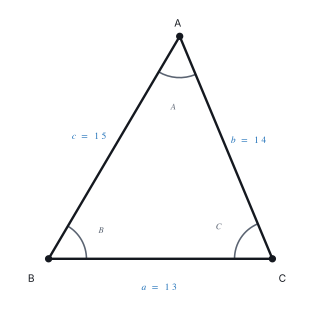
Drop the perpendicular AD from A onto BC, and call its length h.
In the right triangle ABD, the angle at B is B and the hypotenuse is AB = c, so h = c\sin B. In the right triangle ACD, the angle at C is C and the hypotenuse is AC = b, so h = b\sin C. The two expressions are the same length, hence
Repeating with the perpendicular from B onto CA gives \frac{a}{\sin A} = \frac{c}{\sin C}. Combining,
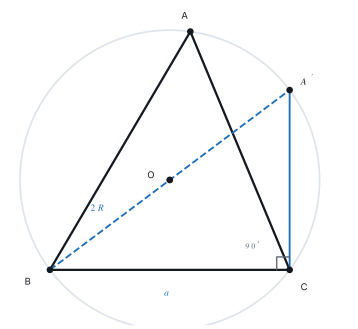
The common value of the three ratios is not an accident — it is the diameter of the circle through A, B and C (the circumcircle, radius R).
Draw the circumcircle, centre O, and the diameter BA' through B. Then
- \angle BCA' = 90^{\circ}, because an angle in a semicircle is a right angle.
- \angle BA'C = \angle BAC = A, because angles in the same segment (standing on the chord BC) are equal.
In the right triangle BCA', \sin(\angle BA'C) = \dfrac{BC}{BA'}, that is \sin A = \dfrac{a}{2R}, so \dfrac{a}{\sin A} = 2R. Hence
Use it when you know two angles and a side, or two sides and the angle opposite one of them. In an identity, a = 2R\sin A is the switch that turns every side into a sine and lets the 2R cancel.
Problem. In triangle ABC, A = 30^{\circ}, B = 45^{\circ} and a = 10 cm. Find b and c.
Solution. C = 180^{\circ} - 30^{\circ} - 45^{\circ} = 105^{\circ} — angle sum.
By the sine law \dfrac{b}{\sin B} = \dfrac{a}{\sin A}, so
For c, use \sin 105^{\circ} = \sin(60^{\circ}+45^{\circ}) = \sin 60^{\circ}\cos 45^{\circ} + \cos 60^{\circ}\sin 45^{\circ} = \frac{\sqrt{6}+\sqrt{2}}{4} = 0.9659:
Check. The largest side c faces the largest angle C. ✓
Problem. In any triangle prove that a(\sin B - \sin C) + b(\sin C - \sin A) + c(\sin A - \sin B) = 0.
Solution. Put a = 2R\sin A, b = 2R\sin B, c = 2R\sin C — the sine law in the form that removes all the sides:
Expand inside the bracket:
Each product appears twice with opposite signs, so the bracket is 0, and \text{LHS} = 0. ∎
6.2 Cosine law
The sine law fails when you know all three sides, or two sides and the angle between them: in both cases every equation it gives has two unknowns. The cosine law covers exactly those cases.
Drop the perpendicular CD from C onto AB, of length h, and let D lie on AB with AD = b\cos A (from right triangle ACD, hypotenuse b) and h = b\sin A. Then DB = c - b\cos A.
Apply Pythagoras in right triangle CDB:
Now b^{2}\sin^{2}A + b^{2}\cos^{2}A = b^{2}(\sin^{2}A + \cos^{2}A) = b^{2}, so
If A is obtuse, D falls outside the segment AB and \cos A is negative; the signed length AD = b\cos A is then negative and every line above still holds. Cycling the letters gives the other two forms.
Rearranged to give an angle from three sides:
Problem. In a triangle a = 13 cm, b = 14 cm, c = 15 cm. Find A and \sin C.
Solution.
so A = \cos^{-1}0.6 = 53^{\circ}8' (to the nearest minute).
Since C is an angle of a triangle, \sin C > 0, so
Check. B = 180^{\circ} - 53^{\circ}8' - 67^{\circ}23' = 59^{\circ}29', and \cos B = \frac{225+169-196}{2\times 15\times 13} = \frac{198}{390} = 0.5077, which does give 59^{\circ}29'. ✓
Problem. In triangle ABC, b = 7 cm, c = 8 cm and A = 60^{\circ}. Find a.
Solution. The angle lies between the two known sides, so use the cosine law:
Check. a lies between |b-c| = 1 and b+c = 15, and because A = 60^{\circ} < the other angles' likely sizes, a is the middle side. ✓
\cos A comes out negative exactly when a^{2} > b^{2} + c^{2}, i.e. when A is obtuse. Do not "lose" the minus sign: \cos A = -0.5 gives A = 120^{\circ}, not 60^{\circ}. At most one angle of a triangle can be obtuse, and it is the one facing the longest side.
6.3 Tangent law
Two sides and the angle between them leave the other two angles unknown. The cosine law can find them one at a time; the tangent law (also called Napier's analogy) finds them together, and needs only logarithm tables — which is why it was invented.
Start from the sine law in the form a = 2R\sin A, b = 2R\sin B:
Apply the sum-to-product formulae \sin A - \sin B = 2\cos\frac{A+B}{2}\sin\frac{A-B}{2} and \sin A + \sin B = 2\sin\frac{A+B}{2}\cos\frac{A-B}{2}:
Finally A + B = 180^{\circ} - C, so \frac{A+B}{2} = 90^{\circ} - \frac{C}{2} and \cot\frac{A+B}{2} = \tan\frac{C}{2}. Therefore
Given a, b and C it gives \frac{A-B}{2}; and \frac{A+B}{2} = 90^{\circ}-\frac{C}{2} is already known. Add and subtract to get A and B.
Problem. In triangle ABC, a = 9, b = 7 and C = 60^{\circ}. Find A, B and c.
Solution. Half the known sum first:
Now the tangent law, with \cot 30^{\circ} = \sqrt{3}:
Add and subtract the two half-quantities:
For c, the cosine law: c^{2} = 81 + 49 - 2(9)(7)\left(\frac12\right) = 67, so c = \sqrt{67} = 8.19.
Check. A+B+C = 72^{\circ}13' + 47^{\circ}47' + 60^{\circ} = 180^{\circ} ✓, and the largest side a = 9 faces the largest angle A. ✓
6.4 Projection laws
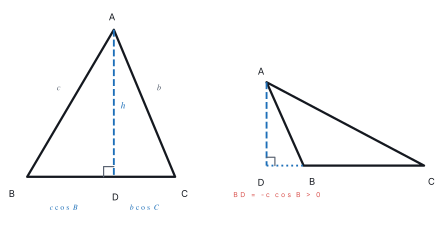
Look again at the altitude figure. The base BC is cut by the foot D into two pieces, and each piece is the projection of one of the other sides onto BC.
With AD \perp BC: in right triangle ABD, BD = c\cos B; in right triangle ACD, DC = b\cos C. Since D lies between B and C,
If B is obtuse, D lies outside on the far side of B, so a = DC - DB = b\cos C - c\cos(180^{\circ}-B) = b\cos C + c\cos B again — the formula is unchanged.
Purely algebraically, from the cosine law,
Each side equals the sum of the other two, each multiplied by the cosine of the angle it is next to. These are the fastest tool for identities in which sides and cosines are mixed.
Problem. In any triangle prove that a(b\cos C - c\cos B) = b^{2}-c^{2}.
Solution. Replace both cosines using the cosine law:
Subtract:
Multiply by a: a(b\cos C - c\cos B) = b^{2}-c^{2}. ∎
Check with the running triangle (a=13, b=14, c=15): b\cos C = 14 \times \frac{5}{13} = 5.385 and c\cos B = 15 \times 0.5077 = 7.615, so 13(5.385 - 7.615) = 13(-2.231) = -29, while b^{2}-c^{2} = 196-225 = -29. ✓
Problem. Prove that b\cos B + c\cos C = a\cos(B-C).
Solution. Turn the sides into sines with b = 2R\sin B, c = 2R\sin C:
using 2\sin\theta\cos\theta = \sin 2\theta. By the sum-to-product formula,
But B + C = 180^{\circ} - A, so \sin(B+C) = \sin A. Hence
since 2R\sin A = a. ∎
6.5 Half angle laws
The cosine law gives \cos A, but many results (areas, radii, Heron's formula) need \sin\frac{A}{2}, \cos\frac{A}{2} or \tan\frac{A}{2}. All three come out of the cosine law in one step each, and all three are written with the semi-perimeter s = \frac{a+b+c}{2}. Note the useful rewritings b+c-a = 2(s-a), c+a-b = 2(s-b), a+b-c = 2(s-c).
Sine. Use 1 - \cos A = 2\sin^{2}\frac{A}{2} and the cosine law:
Factorise the difference of squares: a^{2}-(b-c)^{2} = (a+b-c)(a-b+c) = 2(s-c)\cdot 2(s-b), so
the positive root, because 0 < \frac{A}{2} < 90^{\circ}.
Cosine. Use 1 + \cos A = 2\cos^{2}\frac{A}{2}:
Tangent. Divide the two results; the bc cancels:
with s = \frac{a+b+c}{2}; cycle a \to b \to c \to a and A \to B \to C \to A for the others. Every root is positive, because each half-angle is acute.
s is half the perimeter, so s - a, s - b, s - c are all positive and add up to s. Writing s = a+b+c is the single commonest slip in this unit and it wrecks every number that follows. Always check: (s-a)+(s-b)+(s-c) = s.
Problem. For a = 13, b = 14, c = 15 find \sin\frac{A}{2}, \cos\frac{A}{2} and \tan\frac{A}{2}.
Solution. s = \frac{13+14+15}{2} = 21, so s-a = 8, s-b = 7, s-c = 6 (and 8+7+6 = 21 = s ✓).
Check. \frac{A}{2} = \tan^{-1}0.5 = 26^{\circ}34', so A = 53^{\circ}8' — the same A as in Example 6.3. ✓
Problem. Find the angles of the triangle with sides a = 3, b = 5, c = 7 cm.
Solution. s = \frac{3+5+7}{2} = \frac{15}{2} = 7.5, so s-a = 4.5, s-b = 2.5, s-c = 0.5.
\frac{A}{2} = 10^{\circ}54', so A = 21^{\circ}47'.
\frac{C}{2} = 60^{\circ}, so C = 120^{\circ}.
Check. C is obtuse, and indeed c^{2} = 49 > a^{2}+b^{2} = 34. ✓
| You are given | Use |
|---|---|
| two angles and any side (AAS/ASA) | sine law |
| two sides and an opposite angle (SSA) | sine law — but watch for two answers |
| two sides and the included angle (SAS) | cosine law, or tangent law |
| three sides (SSS) | cosine law, or half angle law for the angles |
6.6 Area of a triangle, and the radii R, r, r_1
The altitude from A has length h = b\sin C, and the base is a, so
Now write \sin A = 2\sin\frac{A}{2}\cos\frac{A}{2} and put in the half-angle formulae:
Therefore
which is Heron's formula — the area from the three sides alone.
R is the circumradius (circle through the vertices), r the inradius (circle touching all three sides from inside) and r_1, r_2, r_3 the exradii — the circles touching one side and the other two produced.
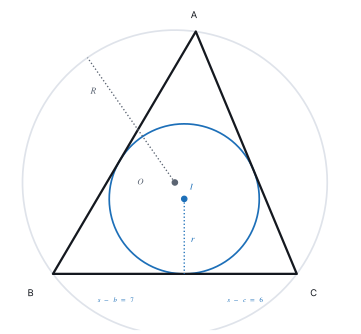
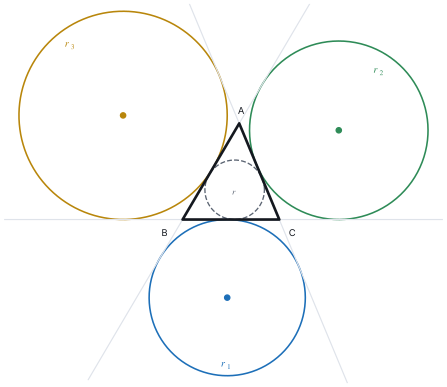
Problem. Find the area of the triangle a = 13, b = 14, c = 15, and hence \sin B.
Solution. By Heron, with s = 21:
Now use \Delta = \frac{1}{2}ca\sin B backwards:
Check. B = \sin^{-1}0.8615 = 59^{\circ}29', matching Example 6.3. ✓
Problem. For the same triangle find R, r, r_1, r_2, r_3.
Solution. From Example 6.10, \Delta = 84, s = 21, s-a = 8, s-b = 7, s-c = 6.
Check. r = (s-a)\tan\frac{A}{2} = 8 \times \frac12 = 4 ✓ and r_1 = s\tan\frac{A}{2} = 21 \times \frac12 = 10.5 ✓ (Example 6.8).
Problem. Prove it.
Solution. Two ingredients. First, from \Delta = \frac{1}{2}ab\sin C with a = 2R\sin A, b = 2R\sin B:
Second, s = \frac{a+b+c}{2} = R(\sin A + \sin B + \sin C), and the Grade 11 identity \sin A + \sin B + \sin C = 4\cos\frac{A}{2}\cos\frac{B}{2}\cos\frac{C}{2} for angles of a triangle gives s = 4R\cos\frac{A}{2}\cos\frac{B}{2}\cos\frac{C}{2}. Now divide, writing each \sin A as 2\sin\frac{A}{2}\cos\frac{A}{2}:
Check (13, 14, 15): 4(8.125)(0.4472)(0.4961)(0.5547) = 4.00 = r ✓.
Problem. Prove it.
Solution. Write every radius as \Delta over something:
Pair the brackets cleverly. Since (s-a)+(s-b) = 2s-a-b = c,
Add these two:
The numerator simplifies: s(s-c)+(s-a)(s-b) = 2s^{2} - s(a+b+c) + ab = 2s^{2}-2s^{2}+ab = ab. Hence
Check: 10.5 + 12 + 14 - 4 = 32.5 = 4 \times 8.125 ✓.
Chapter summary
- Standard notation: a faces A, s = \frac{a+b+c}{2}, area \Delta.
- Sine law: \frac{a}{\sin A} = \frac{b}{\sin B} = \frac{c}{\sin C} = 2R, so a = 2R\sin A — the switch from sides to sines.
- Cosine law: a^{2} = b^{2}+c^{2}-2bc\cos A, i.e. \cos A = \frac{b^{2}+c^{2}-a^{2}}{2bc}; negative cosine means an obtuse angle.
- Tangent law: \tan\frac{A-B}{2} = \frac{a-b}{a+b}\cot\frac{C}{2}, with \frac{A+B}{2} = 90^{\circ}-\frac{C}{2}.
- Projection laws: a = b\cos C + c\cos B, and its two cyclic partners.
- Half angle laws: \sin\frac{A}{2} = \sqrt{\frac{(s-b)(s-c)}{bc}}, \cos\frac{A}{2} = \sqrt{\frac{s(s-a)}{bc}}, \tan\frac{A}{2} = \sqrt{\frac{(s-b)(s-c)}{s(s-a)}}.
- Area: \Delta = \frac12 ab\sin C = \sqrt{s(s-a)(s-b)(s-c)} (Heron).
- Radii: R = \frac{abc}{4\Delta}, r = \frac{\Delta}{s} = 4R\sin\frac{A}{2} \sin\frac{B}{2}\sin\frac{C}{2}, r_1 = \frac{\Delta}{s-a} = s\tan\frac{A}{2}, and r_1+r_2+r_3-r = 4R.
Practice questions
Group A — Multiple choice (1 mark each)
- In any triangle \dfrac{a}{\sin A} equals [1]aRb2Rc\frac{R}{2}d4R
- \cos A equals [1]a\frac{b^{2}+c^{2}-a^{2}}{2bc}b\frac{a^{2}+b^{2}-c^{2}}{2bc}c\frac{b^{2}+c^{2}-a^{2}}{2ab}d\frac{a^{2}-b^{2}-c^{2}}{2bc}
- b\cos C + c\cos B equals [1]aabbccd2s
- \tan\frac{A}{2} equals [1]a\sqrt{\frac{s(s-a)}{(s-b)(s-c)}}b\sqrt{\frac{(s-b)(s-c)}{s(s-a)}}c\sqrt{\frac{(s-b)(s-c)}{bc}}d\sqrt{\frac{s(s-a)}{bc}}
- The area of the triangle with sides 13, 14, 15 cm is [1]a84 cm²b42 cm²c168 cm²d21 cm²
- If r = 4 and s = 21 then \Delta is [1]a21b84c5.25d336
Answers to Group A
1. (b) — the common ratio is the diameter of the circumcircle.
2. (a) — rearrange a^{2} = b^{2}+c^{2}-2bc\cos A; the denominator carries the two sides enclosing A.
3. (a) — the projection law: the two projections onto BC add to BC = a.
4. (b) — (c) and (d) are \sin\frac{A}{2} and \cos\frac{A}{2}; their ratio is (b).
5. (a) — s = 21 and \sqrt{21 \times 8 \times 7 \times 6} = 84.
6. (b) — \Delta = rs = 4 \times 21 = 84.
Group B — Short answer (5 marks each)
- In triangle ABC, b = \sqrt{3} cm, c = 1 cm and A = 30^{\circ}. Find a, B and C. [5]
- Find the greatest angle of the triangle whose sides are 7 cm, 8 cm and 9 cm. [5]
- In any triangle ABC prove that a(b\cos C - c\cos B) = b^{2}-c^{2} and deduce that c(a\cos B - b\cos A) = a^{2}-b^{2}. [5]
- In a triangle a = 9 cm, b = 7 cm and C = 60^{\circ}. Using the tangent law find A and B, and then find c. [5]
- If a = 13, b = 14, c = 15, find \tan\frac{A}{2}, \tan\frac{B}{2}, \tan\frac{C}{2} and verify that \tan\frac{A}{2}\tan\frac{B}{2} + \tan\frac{B}{2}\tan\frac{C}{2} + \tan\frac{C}{2}\tan\frac{A}{2} = 1. [5]
- For the triangle with sides 5, 12, 13 cm find \Delta, r, R, r_1, r_2, r_3, and verify r_1+r_2+r_3-r = 4R. [5]
Answers to Group B
1. Two sides and the included angle, so the cosine law: a^{2} = b^{2}+c^{2}-2bc\cos A = 3 + 1 - 2(\sqrt{3})(1)\left(\frac{\sqrt{3}}{2}\right) = 4 - 3 = 1, so a = 1 cm. Then by the sine law \sin B = \frac{b\sin A}{a} = \frac{\sqrt{3} \times \frac12}{1} = \frac{\sqrt{3}}{2}, giving B = 60^{\circ} or 120^{\circ}. Since b = \sqrt{3} is the largest side, B is the largest angle, so B = 120^{\circ} and C = 180^{\circ}-30^{\circ}-120^{\circ} = 30^{\circ}. (The triangle is isosceles with a = c = 1, which agrees with A = C = 30^{\circ}.)
2. The greatest angle faces the greatest side, so it is the angle C opposite 9 cm. With a = 7, b = 8, c = 9:
so C = \cos^{-1}0.2857 = 73^{\circ}24'.
3. By the cosine law b\cos C = \frac{a^{2}+b^{2}-c^{2}}{2a} and c\cos B = \frac{a^{2}+c^{2}-b^{2}}{2a}. Subtracting, b\cos C - c\cos B = \frac{2b^{2}-2c^{2}}{2a} = \frac{b^{2}-c^{2}}{a}, so a(b\cos C - c\cos B) = b^{2}-c^{2}. The second result is the same statement with the letters advanced one step, a \to c, b \to a, c \to b (and A \to C, B \to A, C \to B): c(a\cos B - b\cos A) = a^{2}-b^{2}.
4. \frac{A+B}{2} = 90^{\circ}-\frac{C}{2} = 60^{\circ}. By the tangent law
so \frac{A-B}{2} = 12^{\circ}13'. Then A = 60^{\circ}+12^{\circ}13' = 72^{\circ}13' and B = 60^{\circ}-12^{\circ}13' = 47^{\circ}47'. By the cosine law c^{2} = 81+49-2(9)(7)\left(\frac12\right) = 67, so c = 8.19 cm.
5. s = 21, s-a = 8, s-b = 7, s-c = 6. \tan\frac{A}{2} = \sqrt{\frac{7 \times 6}{21 \times 8}} = \sqrt{\frac14} = \frac12; \tan\frac{B}{2} = \sqrt{\frac{8 \times 6}{21 \times 7}} = \sqrt{\frac{48}{147}} = \frac47; \tan\frac{C}{2} = \sqrt{\frac{8 \times 7}{21 \times 6}} = \sqrt{\frac{56}{126}} = \frac23. Then \frac12 \cdot \frac47 + \frac47 \cdot \frac23 + \frac23 \cdot \frac12 = \frac27 + \frac{8}{21} + \frac13 = \frac{6+8+7}{21} = 1 ✓.
6. s = \frac{5+12+13}{2} = 15; s-a = 10, s-b = 3, s-c = 2. \Delta = \sqrt{15 \times 10 \times 3 \times 2} = \sqrt{900} = 30 cm² (it is right-angled, and \frac12 \times 5 \times 12 = 30 ✓). r = \frac{\Delta}{s} = \frac{30}{15} = 2 cm; R = \frac{abc}{4\Delta} = \frac{5 \times 12 \times 13}{120} = 6.5 cm (half the hypotenuse, as expected for a right angle). r_1 = \frac{30}{10} = 3, r_2 = \frac{30}{3} = 10, r_3 = \frac{30}{2} = 15 cm. Finally r_1+r_2+r_3-r = 3+10+15-2 = 26 = 4 \times 6.5 = 4R ✓.
Group C — Long answer (8 marks each)
- State and prove the cosine law for a triangle. Hence find all three angles and the area of the triangle whose sides are 4 cm, 5 cm and 6 cm. [8]
- Prove that \sin\frac{A}{2} = \sqrt{\frac{(s-b)(s-c)}{bc}} and \cos\frac{A}{2} = \sqrt{\frac{s(s-a)}{bc}}, and deduce Heron's formula \Delta = \sqrt{s(s-a)(s-b)(s-c)}. Use them on the triangle with sides 5, 6, 7 cm. [8]
- Prove that r = 4R\sin\frac{A}{2}\sin\frac{B}{2}\sin\frac{C}{2} and r_1 = 4R\sin\frac{A}{2}\cos\frac{B}{2}\cos\frac{C}{2}, and verify both for the triangle 13, 14, 15. [8]
Answers to Group C
1. Statement: a^{2} = b^{2}+c^{2}-2bc\cos A (and cyclically). Proof: drop CD \perp AB. Then AD = b\cos A, CD = b\sin A and DB = c - b\cos A. Pythagoras in \triangle CDB gives a^{2} = b^{2}\sin^{2}A + (c-b\cos A)^{2} = b^{2}\sin^{2}A + b^{2}\cos^{2}A + c^{2} - 2bc\cos A = b^{2}+c^{2}-2bc\cos A. (If A is obtuse, D lies outside AB, \cos A < 0, and the same algebra holds with the signed length AD.) Application, a = 4, b = 5, c = 6:
Area: s = 7.5, so \Delta = \sqrt{7.5 \times 3.5 \times 2.5 \times 1.5} = \sqrt{98.4375} = 9.92 cm² \left(= \frac{15\sqrt{7}}{4}\right). Check with \frac12 bc\sin A = \frac12(5)(6)(0.6614) = 9.92 ✓.
2. From the cosine law, 1-\cos A = \frac{2bc - b^{2}-c^{2}+a^{2}}{2bc} = \frac{a^{2}-(b-c)^{2}}{2bc} = \frac{(a+b-c)(a-b+c)}{2bc} = \frac{2(s-c)\cdot 2(s-b)}{2bc}. Since 1-\cos A = 2\sin^{2}\frac{A}{2}, \sin^{2}\frac{A}{2} = \frac{(s-b)(s-c)}{bc}, and the half angle is acute so the root is positive. Similarly 1+\cos A = \frac{(b+c)^{2}-a^{2}}{2bc} = \frac{2s \cdot 2(s-a)}{2bc} = 2\cos^{2}\frac{A}{2}, giving \cos\frac{A}{2} = \sqrt{\frac{s(s-a)}{bc}}. Then \sin A = 2\sin\frac{A}{2}\cos\frac{A}{2} = \frac{2}{bc}\sqrt{s(s-a)(s-b)(s-c)} and \Delta = \frac12 bc\sin A = \sqrt{s(s-a)(s-b)(s-c)}. Application, a=5, b=6, c=7: s = 9, s-a = 4, s-b = 3, s-c = 2. \Delta = \sqrt{9 \times 4 \times 3 \times 2} = \sqrt{216} = 6\sqrt{6} = 14.70 cm². \tan\frac{A}{2} = \sqrt{\frac{3 \times 2}{9 \times 4}} = \sqrt{\frac16} = 0.4082 \Rightarrow A = 44^{\circ}25'; \tan\frac{B}{2} = \sqrt{\frac{4 \times 2}{9 \times 3}} = 0.5443 \Rightarrow B = 57^{\circ}7'; C = 180^{\circ}-44^{\circ}25'-57^{\circ}7' = 78^{\circ}28'.
3. Using a = 2R\sin A etc., \Delta = \frac12 ab\sin C = 2R^{2}\sin A\sin B\sin C, and s = R(\sin A+\sin B+\sin C) = 4R\cos\frac{A}{2}\cos\frac{B}{2}\cos\frac{C}{2}. Dividing and writing \sin A = 2\sin\frac{A}{2}\cos\frac{A}{2} (and likewise for B, C) cancels all three cosines:
For r_1 we need s-a. Now s - a = R(\sin B + \sin C - \sin A), and \sin B+\sin C = 2\cos\frac{A}{2}\cos\frac{B-C}{2} while \sin A = 2\sin\frac{A}{2}\cos\frac{A}{2} = 2\cos\frac{A}{2}\cos\frac{B+C}{2}, so
Hence
Verification (13, 14, 15; R = 8.125): \sin\frac{A}{2} = 0.4472, \sin\frac{B}{2} = 0.4961, \sin\frac{C}{2} = 0.5547, \cos\frac{B}{2} = 0.8682, \cos\frac{C}{2} = 0.8321. 4R\sin\frac{A}{2}\sin\frac{B}{2}\sin\frac{C}{2} = 32.5 \times 0.1231 = 4.00 = r ✓ and 4R\sin\frac{A}{2}\cos\frac{B}{2}\cos\frac{C}{2} = 32.5 \times 0.3231 = 10.5 = r_1 ✓.
Practise more: Mathematics question bank