Unit 9 · Vectors · 12 teaching hours · 53 min read
Product of Vectors
What the syllabus asks for 5
- Scalar (dot) product; angle between two vectors
- Geometric interpretation and properties of scalar product
- Applications of scalar product in geometry and trigonometry
- Vector (cross) product; geometrical interpretation and properties
- Applications of vector product in geometry and trigonometry
Grade 11 gave you everything about vectors except how to multiply them. This unit supplies the two products, and they are different animals. The scalar product returns a number measuring how much two vectors point the same way — the tool for angles, perpendicularity and work. The vector product returns a third vector, at right angles to both, whose length is an area — the tool for areas, perpendicular directions and moments. With both in hand, most of the trigonometry of Units 6 and 7 can be proved again in two lines.
Group A asks you to evaluate: a dot product, a cross product, an angle, an area. Group B asks you to apply: an angle, a projection, a unit vector perpendicular to two given vectors, the area of a triangle, the moment of a force. Group C asks you to prove: the cosine law, the sine law, the projection law, \cos(A \pm B), \sin(A \pm B) and short geometry theorems. Learn those as proofs — every line of the working carries a mark.
9.1 Scalar (dot) product; angle between two vectors
Unit 14 of Grade 11 stated the scalar product and used it. We now start again from the definition and prove the results, as a Grade 12 paper requires.
Let \vec{a} and \vec{b} be two non-zero vectors and let \theta be the angle between them, measured with both vectors drawn from a common point, so that 0^{\circ} \leq \theta \leq 180^{\circ}. Their scalar product is
The answer is a scalar. If either vector is \vec{0} the product is 0.
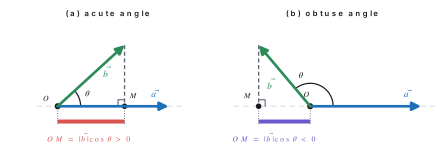
Two points are worth saying out loud. First, \theta is the angle between the vectors when they start from the same point: given \vec{AB} and \vec{BC}, the angle between them is not the interior angle B, so move one vector until both tails meet. Second, since \cos\theta changes sign at 90^{\circ}, the sign of \vec{a}\cdot\vec{b} alone tells you whether the angle is acute, right or obtuse.
Applying the definition to \hat{i}, \hat{j}, \hat{k} gives a table worth memorising: a base vector makes 0^{\circ} with itself, 90^{\circ} with the other two.
| \cdot | \hat{i} | \hat{j} | \hat{k} |
|---|---|---|---|
| \hat{i} | 1 | 0 | 0 |
| \hat{j} | 0 | 1 | 0 |
| \hat{k} | 0 | 0 | 1 |
So \hat{i}\cdot\hat{i} = \hat{j}\cdot\hat{j} = \hat{k}\cdot\hat{k} = 1 (each is a unit vector, \cos 0^{\circ} = 1) and \hat{i}\cdot\hat{j} = \hat{j}\cdot\hat{k} = \hat{k}\cdot\hat{i} = 0 (perpendicular, \cos 90^{\circ} = 0).
The component form, and why it agrees with the definition
Almost every calculation uses components rather than |\vec{a}||\vec{b}|\cos\theta, so the two forms must be shown to agree. The bridge is the cosine law of Unit 6.
We start from the geometric definition \vec{a}\cdot\vec{b} = |\vec{a}||\vec{b}|\cos\theta and finish with a formula that needs no angle at all, only the components.
Setting up. Draw both vectors from one point O: let \vec{OA} = \vec{a} and \vec{OB} = \vec{b}, with
Let \theta = \angle AOB. The sides meeting at O are OA = |\vec{a}| and OB = |\vec{b}|, and the third side is \vec{AB} = \vec{b} - \vec{a} (head minus tail), so AB = |\vec{b} - \vec{a}|.
Step 1 — apply the cosine law to triangle OAB. The angle \theta sits between the two known sides, and AB is opposite it:
In vector language that is
Step 2 — write the left-hand side in components. The vector \vec{b} - \vec{a} has components b_1 - a_1, b_2 - a_2, b_3 - a_3, so
Step 3 — expand every bracket. Each square gives three terms:
Step 4 — recognise the first two brackets. They are exactly the squared magnitudes:
Step 5 — compare with Step 1. The two expressions for |\vec{b}-\vec{a}|^{2} must be equal. Cancel |\vec{a}|^{2}+|\vec{b}|^{2} from both sides and divide by -2:
Result. The left side is \vec{a}\cdot\vec{b}, so
What it means. Multiply matching components and add. No angle, no square roots, no drawing — which is why this is the form you compute with.
Conditions used. Only that \hat{i},\hat{j},\hat{k} are mutually perpendicular unit vectors, so that the distance formula |\vec{r}|^{2} = x^{2}+y^{2}+z^{2} holds. For plane vectors drop the third component.
Four marks, four steps: the cosine law for triangle OAB with \vec{AB} = \vec{b}-\vec{a}; |\vec{b}-\vec{a}|^{2} expanded in components; the magnitudes identified; the comparison. Never skip the expansion — that is the step being tested.
The angle between two vectors
Reading the two forms as one equation and solving for \cos\theta gives the single most used formula of the unit.
For non-zero \vec{a} and \vec{b},
and \vec{a}, \vec{b} are parallel exactly when \vec{a}\cdot\vec{b} = \pm|\vec{a}||\vec{b}| (+ for the same sense, - for opposite senses).
Problem. Find the angle between \vec{a} = 2\hat{i}+2\hat{j}-\hat{k} and \vec{b} = 6\hat{i}-3\hat{j}+2\hat{k}.
Solution. Take the scalar product in components:
Now the two magnitudes:
The scalar product is positive, so the angle had to come out acute. ✔
Problem. Show that the triangle with vertices A(2,1,1), B(2,2,3) and C(4,4,2) is right-angled, and find its other two angles.
Solution. The angle of the triangle at B is the angle between the vectors \vec{BA} and \vec{BC} — both must start at B:
A zero scalar product between two non-zero vectors means they are perpendicular, so \angle B = 90^{\circ} and the triangle is right-angled at B.
For the angle at A, use \vec{AB} = \hat{j}+2\hat{k} and \vec{AC} = 2\hat{i}+3\hat{j}+\hat{k}:
so A = 53.30^{\circ}. The third angle needs no new work: C = 180^{\circ} - 90^{\circ} - 53.30^{\circ} = 36.70^{\circ}.
Check by Pythagoras: AB^{2}+BC^{2} = 5 + 9 = 14 = AC^{2}. ✔
For the angle at A use \vec{AB} and \vec{AC}, never \vec{BA} and \vec{AC}: reversing one vector reverses the sign and hands you 180^{\circ}-A. In Worked example 9.2, \vec{BA}\cdot\vec{AC} = -5 gives 126.70^{\circ}, the supplement of the correct 53.30^{\circ}. Draw the arrows before you multiply.
9.2 Geometric interpretation and properties of scalar product
The scalar product is a length times a shadow
Group |\vec{a}||\vec{b}|\cos\theta as |\vec{a}| \times \left(|\vec{b}|\cos\theta\right). The bracket is the shadow \vec{b} casts on the line of \vec{a} when light falls at right angles to it. Drop a perpendicular from the head of \vec{b} onto that line, meeting it at M: then OM is the projection of \vec{b} on \vec{a}.
The scalar projection (or component) of \vec{b} along \vec{a} is
The vector projection of \vec{b} on \vec{a} is that number times the unit vector \hat{a}:
The scalar projection is signed: negative when \theta is obtuse, because the shadow then falls on the backward extension of \vec{a}.
Problem. For \vec{a} = \hat{i}+3\hat{j}+2\hat{k} and \vec{b} = 3\hat{i}+2\hat{j}+6\hat{k} find (a) the scalar projection of \vec{a} on \vec{b}, (b) the vector projection of \vec{a} on \vec{b}, (c) the angle between them.
Solution. One scalar product serves all three parts:
(a) Divide by the magnitude of the vector you are projecting onto:
(b) Multiply that length by the unit vector \hat{b} = \vec{b}/7:
(c) For the angle, divide by both magnitudes:
so \theta = 36.70^{\circ}.
Dividing by |\vec{a}||\vec{b}| gives \cos\theta, a pure number; dividing by |\vec{b}| alone gives a length. Remember the word order: "projection of \vec{a} on \vec{b}" divides by the magnitude of the vector after "on".
Algebraic properties, with proofs
For all vectors \vec{a},\vec{b},\vec{c} and every scalar m:
- Commutative: \vec{a}\cdot\vec{b} = \vec{b}\cdot\vec{a}
- Square: \vec{a}\cdot\vec{a} = |\vec{a}|^{2}, often written \vec{a}^{2}
- Scalars pull out: (m\vec{a})\cdot\vec{b} = m(\vec{a}\cdot\vec{b}) = \vec{a}\cdot(m\vec{b})
- Distributive: \vec{a}\cdot(\vec{b}+\vec{c}) = \vec{a}\cdot\vec{b} + \vec{a}\cdot\vec{c}
- Perpendicularity: \vec{a}\cdot\vec{b} = 0 \Leftrightarrow \vec{a} \perp \vec{b} (non-zero vectors)
- Expansion: |\vec{a}\pm\vec{b}|^{2} = |\vec{a}|^{2} \pm 2\,\vec{a}\cdot\vec{b} + |\vec{b}|^{2}
- Bound: |\vec{a}\cdot\vec{b}| \leq |\vec{a}||\vec{b}|, with equality only when the vectors are parallel
The proofs are short, and NEB asks for them.
1. Commutative. The angle between \vec{a} and \vec{b} is the same angle as between \vec{b} and \vec{a}, and multiplication of numbers is commutative:
2. Square of a vector. A vector makes an angle 0^{\circ} with itself, and \cos 0^{\circ} = 1:
This is the identity that turns every length question into a scalar product question. In components it reads a_1^{2}+a_2^{2}+a_3^{2}, the distance formula.
3. Scalars. Take m > 0 first. Multiplying \vec{a} by m multiplies its length by m and leaves its direction alone, so \theta does not change:
If m < 0, then |m\vec{a}| = -m|\vec{a}| and the direction of m\vec{a} is reversed, so the angle becomes 180^{\circ}-\theta and the cosine changes sign:
Both signs give the same rule, and m = 0 makes both sides zero.
5. Perpendicularity. If \vec{a} and \vec{b} are non-zero then |\vec{a}||\vec{b}| \ne 0, so \vec{a}\cdot\vec{b} = 0 forces \cos\theta = 0, i.e. \theta = 90^{\circ}. Running the argument backwards, \theta = 90^{\circ} gives \cos\theta = 0 and the product vanishes.
6. Expansion. Use property 2 on \vec{a}\pm\vec{b}, then expand by distributivity and collect the two middle terms with commutativity:
Replacing \vec{b} by -\vec{b} gives the minus version. These two lines do the work in most Group B problems about |\vec{a}+\vec{b}|.
7. Bound. Since -1 \leq \cos\theta \leq 1,
and |\cos\theta| = 1 only for \theta = 0^{\circ} or 180^{\circ}, that is, only for parallel vectors.
Property 4 is the one that needs a picture rather than algebra.
We start from the fact that projections add along a line, and finish with the rule that lets you multiply out brackets of vectors.
Setting up. Let \hat{a} be the unit vector along \vec{a}. Draw \vec{OP} = \vec{b} and \vec{PQ} = \vec{c} head to tail, so \vec{OQ} = \vec{b}+\vec{c}. Drop perpendiculars from O, P, Q onto the line through O along \hat{a}; call the feet O, P', Q'.
Step 1 — name the three shadows. By definition OP' = \vec{b}\cdot\hat{a}, P'Q' = \vec{c}\cdot\hat{a} and OQ' = (\vec{b}+\vec{c})\cdot\hat{a}, each a signed length along \hat{a}.
Step 2 — signed lengths on one line add. The points O, P', Q' all lie on one straight line, and for signed lengths on a line
whatever order the three points fall in — the only geometric fact used, and the reason projections carry a sign.
Step 3 — substitute the names from Step 1.
Step 4 — restore the length of \vec{a}. Multiply through by the number |\vec{a}| and use \vec{a} = |\vec{a}|\hat{a} with property 3:
Step 5 — turn each product round using the commutative law:
Result. Brackets of vectors may be multiplied out exactly as in ordinary algebra, provided every product is a dot product.
What it means. This is the property that makes vector proofs possible: (\vec{a}+\vec{b})\cdot(\vec{a}-\vec{b}), |\vec{a}+\vec{b}|^{2} and every expansion in §9.3 depend on it.
Conditions. None beyond the definition of projection; the law holds for all vectors, including the zero vector.
Problem. If |\vec{a}| = 3, |\vec{b}| = 4 and |\vec{a}+\vec{b}| = 5, find \vec{a}\cdot\vec{b}, the angle between the vectors, and |\vec{a}-\vec{b}|.
Solution. Square the given magnitude of the sum and expand (property 6):
So \vec{a}\cdot\vec{b} = 0, and since neither vector is zero the angle is \theta = 90^{\circ}.
For the difference, use the minus version of the same expansion:
The two diagonals are equal, as they must be for a rectangle — and 3,4,5 is exactly the Pythagorean triple you should have expected.
Work done by a force
The scalar product was invented for this.
If a constant force \vec{F} acts on a body while its displacement is \vec{d}, the work done is
where \theta is the angle between force and displacement. Work is a scalar, in joules (J) for \vec{F} in newtons and \vec{d} in metres.
Only the part of the force along the displacement does work — the projection idea of §9.2. A force at right angles to the motion, such as the string tension on a whirling stone, does zero work because \cos 90^{\circ} = 0.
Problem. A force \vec{F} = 4\hat{i}+\hat{j}-3\hat{k} newton moves a particle from A(1,-2,3) to B(5,-1,2), distances in metres. Find the work done and the angle between the force and the displacement.
Solution. The displacement is head minus tail:
For the angle, |\vec{F}| = \sqrt{16+1+9} = \sqrt{26} and |\vec{d}| = \sqrt{16+1+1} = \sqrt{18}, so
giving \theta = 22.38^{\circ}. The work is positive because the force has a component along the motion.
From \vec{a}\cdot\vec{b} = \vec{a}\cdot\vec{c} it does not follow that \vec{b} = \vec{c}, only that \vec{a}\perp(\vec{b}-\vec{c}). There is no division by a vector, so never write \vec{b} = (\vec{a}\cdot\vec{c})/\vec{a}. Nor does \vec{a}\cdot\vec{b} = 0 force either vector to be \vec{0}.
9.3 Applications of scalar product in geometry and trigonometry
The method never changes: name the sides as vectors, write the one relation they satisfy, and dot both sides with something useful.
For a triangle ABC the standard naming is
taken in order round the triangle, so that by the triangle law
and the side lengths are a = |\vec{a}| = BC, b = |\vec{b}| = CA, c = |\vec{c}| = AB, as in Unit 6.
Care is needed with the angles. \vec{b} and \vec{c} do not make the angle A: \vec{c} = \vec{AB} leaves A while \vec{b} = \vec{CA} arrives at A. Reversing \vec{b} gives \vec{AC}, which does. So the angle between \vec{b} and \vec{c} is 180^{\circ}-A, and
The same argument at the other two vertices gives \vec{c}\cdot\vec{a} = -ca\cos B and \vec{a}\cdot\vec{b} = -ab\cos C. Those three lines are the engine of everything in this section.
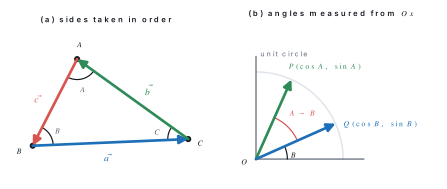
We start from \vec{a}+\vec{b}+\vec{c} = \vec{0} and reach the cosine law of Unit 6 in four lines.
Setting up. In triangle ABC put \vec{a} = \vec{BC}, \vec{b} = \vec{CA}, \vec{c} = \vec{AB}, so that \vec{a}+\vec{b}+\vec{c} = \vec{0}.
Step 1 — isolate the side you want. Move the other two vectors across:
Step 2 — square by dotting with itself. Property 2 says \vec{a}\cdot\vec{a} = |\vec{a}|^{2} = a^{2}, and the two minus signs cancel:
Step 3 — multiply out, using the distributive and commutative laws:
Step 4 — put in the angle. As shown above, \vec{b}\cdot\vec{c} = -bc\cos A, so
Result. The cosine law. The other two forms follow by starting from \vec{b} = -(\vec{c}+\vec{a}) and \vec{c} = -(\vec{a}+\vec{b}):
What it means. The extra term -2bc\cos A is the correction to Pythagoras when the angle at A is not a right angle. Put A = 90^{\circ} and it vanishes.
Conditions. None. Only the triangle law and the algebra of the scalar product are used, so obtuse triangles are covered too (there \cos A < 0).
In §9.1 the cosine law proved the component form; here the scalar product proves the cosine law. That is not circular: this proof uses only the definition \vec{a}\cdot\vec{b} = |\vec{a}||\vec{b}|\cos\theta and the distributive law, and §9.2 proved the distributive law from projections alone.
We start from the same relation and this time dot it with one of the sides.
Setting up. Again \vec{a}+\vec{b}+\vec{c} = \vec{0} in triangle ABC.
Step 1 — dot the whole relation with \vec{a}. Anything dotted with \vec{0} is 0:
Step 2 — distribute.
Step 3 — name each term. The first is a^{2}; the other two use the angle rules above, \vec{a}\cdot\vec{b} = -ab\cos C and \vec{c}\cdot\vec{a} = -ca\cos B:
Step 4 — divide by a (a side length, so a \ne 0):
Result. With the other two choices of dotting vector,
What it means. Each side is the sum of the projections of the other two onto it — the shadow picture of §9.2, read along BC.
Conditions. Only that ABC is a genuine triangle.
Both proofs start with the same first line, \vec{a}+\vec{b}+\vec{c}=\vec{0}; the cosine law then squares, the projection law dots with one side. State \vec{b}\cdot\vec{c} = -bc\cos A and say why the minus sign is there — that line is usually worth a mark.
Geometry theorems in three lines
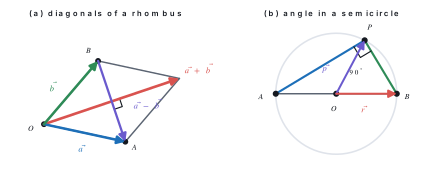
Problem. OACB is a parallelogram with \vec{OA} = \vec{a} and \vec{OB} = \vec{b}. Prove that (a) the diagonals are perpendicular if and only if OACB is a rhombus, and (b) the diagonals are equal in length if and only if OACB is a rectangle.
Solution. The two diagonals are
(a) Take their scalar product and expand:
The middle two terms cancel because the scalar product is commutative, leaving
So the diagonals are perpendicular \Leftrightarrow this is zero \Leftrightarrow |\vec{a}| = |\vec{b}| \Leftrightarrow the adjacent sides are equal \Leftrightarrow the parallelogram is a rhombus.
(b) Now compare the squares of the two diagonal lengths:
Subtracting, |\vec{a}+\vec{b}|^{2} - |\vec{a}-\vec{b}|^{2} = 4\,\vec{a}\cdot\vec{b}. The diagonals are equal \Leftrightarrow this difference is zero \Leftrightarrow \vec{a}\cdot\vec{b} = 0 \Leftrightarrow \vec{a} \perp \vec{b} \Leftrightarrow the parallelogram is a rectangle.
We start with a circle and one point on it and finish with a right angle.
Setting up. Let O be the centre of a circle of radius r, AB a diameter, and take O as origin with \vec{OB} = \vec{r}. Since O is the midpoint of AB, \vec{OA} = -\vec{r}. Let P be any point of the circle, \vec{OP} = \vec{p}.
Step 1 — write down the one fact you are given. A, B and P all lie on the circle, so all three are at distance r from O:
Step 2 — form the two vectors that meet at P (head minus tail):
Step 3 — dot them. Take a factor -1 out of \vec{PA} first, so that the brackets are a difference of two squares:
Step 4 — expand. The cross terms cancel as in Worked example 9.6:
Step 5 — use Step 1. Both magnitudes equal r:
Result. \vec{PA} and \vec{PB} are non-zero and their scalar product is zero, so \vec{PA} \perp \vec{PB}, i.e. \angle APB = 90^{\circ}.
What it means. \vec{p} cancelled, so the result holds wherever P sits: every point of the semicircle sees the diameter at a right angle.
Conditions. AB must be a diameter — that is what gives \vec{OA} = -\vec{OB}. For any other chord the cross terms survive.
Compound angles by scalar product
The addition formulas of trigonometry fall straight out of the two expressions for one scalar product. This is a favourite Group C question.
We start with two unit vectors and finish with the cosine addition formulas.
Setting up. In the xy-plane let \vec{OP} and \vec{OQ} be unit vectors making angles A and B with the positive x-axis, with A > B, as in the figure above. Resolving each into components,
Both are unit vectors, and the angle between them is A-B.
Step 1 — the scalar product from the definition. With |\vec{OP}| = |\vec{OQ}| = 1 and angle A-B:
Step 2 — the same scalar product in components. Multiply matching components and add:
Step 3 — the two answers must agree.
Step 4 — get the other formula for free. Replace B by -B throughout, and use \cos(-B) = \cos B, \sin(-B) = -\sin B:
Result. Both cosine addition formulas, from one scalar product.
What it means. The formula says the scalar product does not care which axes you use: rotating both unit vectors together changes A and B but not A-B.
Conditions. None, once both angles are measured from the same axis. The results hold for all A and B, because (\cos\theta, \sin\theta) is the unit vector in every quadrant.
Problem. Use the scalar product of two suitable unit vectors to find the exact value of \cos 15^{\circ}.
Solution. Write 15^{\circ} = 45^{\circ}-30^{\circ} and take unit vectors at 45^{\circ} and 30^{\circ} to the x-axis:
The angle between them is 15^{\circ} and both have magnitude 1, so \vec{OP}\cdot\vec{OQ} = \cos 15^{\circ}. In components,
Rationalise by multiplying top and bottom by \sqrt{2}:
which agrees with the tables. ✔
9.4 Vector (cross) product; geometrical interpretation and properties
The scalar product throws away all direction information. Often the direction is what you need — the normal to a plane, the axis of a turning effect. That calls for a product whose answer is a vector.
Let \vec{a} and \vec{b} be non-zero, non-parallel vectors with angle \theta between them, 0^{\circ} < \theta < 180^{\circ}. Their vector product is
where \hat{n} is the unit vector perpendicular to both, in the sense given by the right-hand rule: curl your right fingers from \vec{a} towards \vec{b} through \theta, and the thumb points along \hat{n}.
If \vec{a} and \vec{b} are parallel or either is \vec{0}, then \vec{a}\times\vec{b} = \vec{0}.
Since \sin\theta \geq 0 on 0^{\circ} to 180^{\circ}, the factor |\vec{a}||\vec{b}|\sin\theta is never negative: it is the magnitude |\vec{a}\times\vec{b}|, and all the directional information sits in \hat{n}.
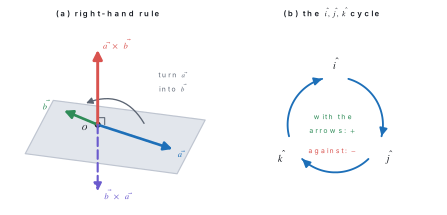
Applying the definition to the base vectors gives the results every calculation rests on. Distinct base vectors are perpendicular, so \sin 90^{\circ} = 1 and the product has magnitude 1; the right-hand rule picks the sign.
Write \hat{i}, \hat{j}, \hat{k} round a circle in that order, as in the figure. Reading with the arrows — ij, jk, ki — the product is the remaining letter with a plus. Reading against the arrows — ji, kj, ik — it is the remaining letter with a minus. Nothing else needs memorising; a base vector crossed with itself is \vec{0}.
Properties, with proofs
- Anti-commutative: \vec{b}\times\vec{a} = -(\vec{a}\times\vec{b})
- Self product: \vec{a}\times\vec{a} = \vec{0}
- Parallel test: for non-zero vectors, \vec{a}\times\vec{b} = \vec{0} \Leftrightarrow \vec{a} \parallel \vec{b}
- Scalars pull out: (m\vec{a})\times\vec{b} = m(\vec{a}\times\vec{b}) = \vec{a}\times(m\vec{b})
- Distributive: \vec{a}\times(\vec{b}+\vec{c}) = \vec{a}\times\vec{b} + \vec{a}\times\vec{c}
- Not associative: in general \vec{a}\times(\vec{b}\times\vec{c}) \ne (\vec{a}\times\vec{b})\times\vec{c}
- Magnitude: |\vec{a}\times\vec{b}| = |\vec{a}||\vec{b}|\sin\theta, so \sin\theta = \dfrac{|\vec{a}\times\vec{b}|}{|\vec{a}||\vec{b}|}
- Lagrange's identity: |\vec{a}\times\vec{b}|^{2} = |\vec{a}|^{2}|\vec{b}|^{2} - (\vec{a}\cdot\vec{b})^{2}
1. Anti-commutativity. The magnitude is unchanged, because |\vec{b}||\vec{a}|\sin\theta = |\vec{a}||\vec{b}|\sin\theta and \theta is the same angle. Only the direction changes: turning \vec{b} into \vec{a} instead of \vec{a} into \vec{b} reverses the sense of the right-hand rule, so \hat{n} becomes -\hat{n}. Same length, opposite direction:
This is the single biggest difference from the scalar product, and the commonest source of sign errors. Order matters.
2 and 3. Parallel vectors. A vector makes an angle 0^{\circ} with itself, and \sin 0^{\circ} = 0, so \vec{a}\times\vec{a} = \vec{0}. More generally if \vec{a} and \vec{b} are parallel then \theta = 0^{\circ} (same sense) or 180^{\circ} (opposite sense), and \sin\theta = 0 either way. Conversely, if neither vector is \vec{0} and |\vec{a}||\vec{b}|\sin\theta = 0 then \sin\theta = 0, so \theta is 0^{\circ} or 180^{\circ} and the vectors are parallel. This is the cross-product test for parallelism, and it is neater than comparing ratios of components because it never divides by zero.
4. Scalars. For m > 0 neither the angle nor \hat{n} changes and the magnitude is multiplied by m. For m < 0 the direction of m\vec{a} reverses, so the angle becomes 180^{\circ}-\theta — but \sin(180^{\circ}-\theta) = \sin\theta, so the magnitude picks up only the factor |m| = -m, while \hat{n} reverses. The two sign changes give m overall.
5. Distributivity holds, and is what makes the determinant formula below work. Its proof is longer than the syllabus requires — NEB quotes it — but you may use it freely.
6. No associativity. One counterexample settles it. On the left, \hat{i}\times\hat{j} = \hat{k}, so
On the right, \hat{i}\times\hat{i} = \vec{0}, so
and -\hat{j} \ne \vec{0}. Never move the brackets in a cross product.
8. Lagrange's identity. Start from the magnitude and use \sin^{2}\theta = 1-\cos^{2}\theta:
This identity links the two products, and it is the quickest way to get one of |\vec{a}\times\vec{b}| and \vec{a}\cdot\vec{b} from the other.
The determinant form
We start from the definition and the base-vector products, and finish with the 3\times3 determinant you actually compute with.
Setting up. Let \vec{a} = a_1\hat{i}+a_2\hat{j}+a_3\hat{k} and \vec{b} = b_1\hat{i}+b_2\hat{j}+b_3\hat{k}.
Step 1 — multiply out using distributivity. Every term of \vec{a} crosses every term of \vec{b}, giving nine products. Written out, and pulling the scalar coefficients through by property 4:
Step 2 — kill the three diagonal terms. Each of \hat{i}\times\hat{i}, \hat{j}\times\hat{j}, \hat{k}\times\hat{k} is \vec{0}, so the terms in a_1b_1, a_2b_2, a_3b_3 disappear.
Step 3 — replace the six survivors using the cycle:
Step 4 — collect the \hat{i}, \hat{j} and \hat{k} terms separately.
Result. Those three brackets are exactly the three 2\times2 minors of a 3\times3 array whose first row is \hat{i},\hat{j},\hat{k}, whose second row is the components of \vec{a} and whose third row is the components of \vec{b} — the determinant shown in the figure below.
What it means. The middle component carries a minus sign when you expand the determinant, which is why a_3b_1 comes before a_1b_3 in the \hat{j} bracket. Writing the second bracket as a_1b_3 - a_3b_1 is the single commonest error in the whole unit.
Conditions. Right-handed axes, i.e. \hat{i}\times\hat{j} = +\hat{k}. Every sign in the answer depends on that convention.
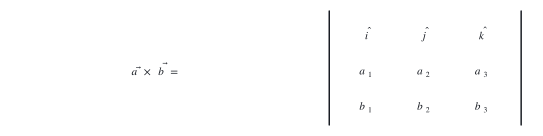
Cover the \hat{i} column: what is left is a_2b_3-a_3b_2 — that is the \hat{i} component. Cover the \hat{j} column: what is left is a_1b_3-a_3b_1, and you change its sign. Cover the \hat{k} column: what is left is a_1b_2-a_2b_1. Cover, cross-multiply, subtract; minus in the middle.
Geometrical interpretation: |\vec{a}\times\vec{b}| is an area
We start from the elementary formula "area = base \times height" and finish with the cross product.
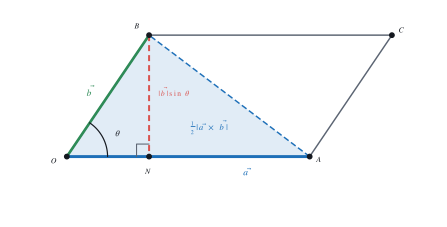
Setting up. Let OACB be the parallelogram with \vec{OA} = \vec{a} and \vec{OB} = \vec{b}, and let \theta = \angle AOB be the angle between them. Take OA as the base. Drop a perpendicular from B to the line OA, meeting it at N, so BN is the height.
Step 1 — the base. By definition, base = OA = |\vec{a}|.
Step 2 — the height. In the right triangle ONB the hypotenuse is OB = |\vec{b}| and the angle at O is \theta, so the side opposite \theta is
Step 3 — multiply.
Step 4 — recognise the right-hand side. That is precisely the magnitude of the vector product:
Step 5 — halve it for the triangle. The diagonal AB cuts the parallelogram into two congruent triangles, so
What it means. The cross product is an area with an orientation: its length is how big the parallelogram is, and its direction is the normal to the plane the parallelogram lies in. When \vec{a} and \vec{b} are parallel the parallelogram collapses to a line, area zero — which is property 3 again.
Conditions. \theta must be the angle between the vectors drawn from the common vertex O. If the question gives you three vertices, form two vectors from the same vertex first.
Problem. If \vec{a} = 2\hat{i}+\hat{j}+3\hat{k} and \vec{b} = 3\hat{i}+5\hat{j}-2\hat{k}, find \vec{a}\times\vec{b} and |\vec{a}\times\vec{b}|. Verify that \vec{a}\times\vec{b} is perpendicular to \vec{a}.
Solution. Expand the determinant with \vec{a} in the second row and \vec{b} in the third. Cover the \hat{i} column:
Cover the \hat{j} column and change the sign:
Cover the \hat{k} column:
Check the perpendicularity with a scalar product:
✔ As it must be, since \vec{a}\times\vec{b} is normal to the plane of \vec{a} and \vec{b}.
Problem. Find a unit vector perpendicular to both \vec{a} = \hat{i}+2\hat{j}+2\hat{k} and \vec{b} = 2\hat{i}+\hat{j}-2\hat{k}.
Solution. Any vector perpendicular to both is parallel to \vec{a}\times\vec{b}, so compute that first:
Divide by the magnitude:
Since -\hat{n} works too, the full answer is \pm\hat{n}. Note also \vec{a}\cdot\vec{b} = 2+2-4 = 0: the vectors are perpendicular, so |\vec{a}\times\vec{b}| = |\vec{a}||\vec{b}| = 9, as found. ✔
Problem. For \vec{a} = 3\hat{i}-\hat{j}+2\hat{k} and \vec{b} = 2\hat{i}+\hat{j}-\hat{k}, find the angle between the vectors using (a) the scalar product, (b) the vector product, and check that the two agree.
Solution. Both products first.
Also |\vec{a}| = \sqrt{14} and |\vec{b}| = \sqrt{6}, so |\vec{a}||\vec{b}| = \sqrt{84}.
(a) \cos\theta = \dfrac{3}{\sqrt{84}} = 0.3273, giving \theta = 70.89^{\circ}.
(b) \sin\theta = \dfrac{5\sqrt{3}}{\sqrt{84}} = \dfrac{8.660}{9.165} = 0.9449, giving \theta = 70.89^{\circ} (taking the acute value, which is right because \cos\theta > 0).
Dividing one by the other avoids the magnitudes altogether:
✔ All three routes agree.
Problem. If |\vec{a}| = 5, |\vec{b}| = 13 and |\vec{a}\times\vec{b}| = 25, find \vec{a}\cdot\vec{b} and the angle between the vectors.
Solution. Use Lagrange's identity rather than looking for the vectors themselves:
Both signs are possible, because the data fixes \sin\theta but not the quadrant:
so \theta = 22.62^{\circ} (which gives \vec{a}\cdot\vec{b} = +60) or \theta = 180^{\circ}-22.62^{\circ} = 157.38^{\circ} (which gives -60).
\vec{a}\cdot\vec{b} is a number; \vec{a}\times\vec{b} is a vector. So \vec{a}\cdot\vec{b} = 3\hat{i} is meaningless, and so is \vec{a}\times\vec{b} = 12. Watch two more traps: \vec{a}\times\vec{b} = \vec{0} means parallel, not perpendicular (that is the dot product); and \vec{a}\times\vec{b} = \vec{a}\times\vec{c} does not give \vec{b} = \vec{c} — only that \vec{b}-\vec{c} is parallel to \vec{a}.
9.5 Applications of vector product in geometry and trigonometry
Everything here follows from two proved facts: |\vec{a}\times\vec{b}| is an area, and the product vanishes exactly when the vectors are parallel.
Areas
For a parallelogram with adjacent sides \vec{a} and \vec{b}:
For a triangle ABC, take two sides from the same vertex:
For a parallelogram whose diagonals are \vec{d_1} and \vec{d_2}:
The third needs a one-line proof. With sides \vec{p}, \vec{q} the diagonals are \vec{d_1} = \vec{p}+\vec{q} and \vec{d_2} = \vec{q}-\vec{p}, so by distributivity
The two self-products are \vec{0}, and -\vec{q}\times\vec{p} = +\vec{p}\times\vec{q} by anti-commutativity, so \vec{d_1}\times\vec{d_2} = 2(\vec{p}\times\vec{q}). Taking magnitudes and halving gives the area |\vec{p}\times\vec{q}| as claimed.
Problem. Find the area of the triangle with vertices A(1,1,1), B(1,2,3) and C(2,3,1).
Solution. Build two sides from the same vertex, A:
Cross them, with components (0,1,2) and (1,2,0):
Problem. The diagonals of a parallelogram are 3\hat{i}+\hat{j}-2\hat{k} and \hat{i}-3\hat{j}+4\hat{k}. Find its area.
Solution. Use \text{area} = \tfrac{1}{2}|\vec{d_1}\times\vec{d_2}| with (3,1,-2) and (1,-3,4):
Had you forgotten the \tfrac{1}{2} you would have doubled the answer — that factor is what distinguishes diagonals from sides.
Collinear points and parallel lines
Three points A, B, C are collinear exactly when \vec{AB} and \vec{AC} are parallel, so by property 3 the test is a single cross product:
Geometrically, triangle ABC has zero area. The same product tests two lines for parallelism: their directions satisfy \vec{d_1}\times\vec{d_2} = \vec{0}.
Problem. Show that the points A(3,-2,4), B(1,1,1) and C(-1,4,-2) are collinear.
Solution.
So \vec{AB}\times\vec{AC} = \vec{0}: the vectors are parallel and share A, so the points are collinear. ✔ Indeed \vec{AC} = 2\vec{AB}, so B is the midpoint of AC.
The sine law
We start from the closed triangle relation and finish with \dfrac{a}{\sin A} = \dfrac{b}{\sin B} = \dfrac{c}{\sin C}.
Setting up. As in §9.3, take the sides of triangle ABC as vectors in order: \vec{a} = \vec{BC}, \vec{b} = \vec{CA}, \vec{c} = \vec{AB}, with a = |\vec{a}|, b = |\vec{b}|, c = |\vec{c}|. Going once round the triangle returns you to the start, so
Step 1 — substitute for \vec{a} in \vec{a}\times\vec{b}. From the relation, \vec{a} = -\vec{b}-\vec{c}, so
Step 2 — simplify the two terms. \vec{b}\times\vec{b} = \vec{0}, and -(\vec{c}\times\vec{b}) = \vec{b}\times\vec{c} by anti-commutativity. Hence
Step 3 — repeat with \vec{b} = -\vec{c}-\vec{a}. The same two moves give \vec{b}\times\vec{c} = \vec{c}\times\vec{a}, so all three products are equal:
Step 4 — take magnitudes. Drawn tail to tail, \vec{a} and \vec{b} make an angle 180^{\circ}-C (see Figure 2a), and \sin(180^{\circ}-C) = \sin C, so |\vec{a}\times\vec{b}| = ab\sin C. The same reasoning gives |\vec{b}\times\vec{c}| = bc\sin A and |\vec{c}\times\vec{a}| = ca\sin B. Therefore
Step 5 — divide right through by abc. Every side is positive, so this is legal:
Result. Inverting,
What it means. The three equal cross products are the three ways of writing twice the area of the triangle; the sine law just says the area does not care which pair of sides you compute it from.
Conditions. A genuine triangle, so none of a, b, c is zero. Note where the sine law comes from compared with the cosine law: cross product versus dot product, area versus length.
For the sine law: write \vec{a}+\vec{b}+\vec{c} = \vec{0}, cross with one side, show the three products are equal, take magnitudes using \sin(180^{\circ}-C) = \sin C, divide by abc. Marks are lost almost every year for using \sin C without explaining the 180^{\circ}-C; write that line down.
Moment of a force
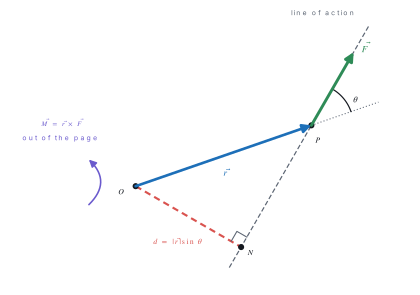
If a force \vec{F} acts at a point P whose position vector relative to a point O is \vec{r} = \vec{OP}, the moment of \vec{F} about O is
Its magnitude is |\vec{M}| = |\vec{r}||\vec{F}|\sin\theta = |\vec{F}|\,d, with d = |\vec{r}|\sin\theta the perpendicular distance from O to the line of action. Its direction, by the right-hand rule, is the axis of turning. Unit: newton metre (N m).
|\vec{M}| = |\vec{F}|d is the "force times perpendicular distance" rule of elementary mechanics, with the cross product supplying the axis as well. A door turns easily at the handle because d is large; pushing along the line of the hinge does nothing, since then \vec{r}\times\vec{F} = \vec{0}.
Problem. A force \vec{F} = \hat{i}+2\hat{j}-2\hat{k} newtons acts at the point P(3,2,2). Find the moment of \vec{F} about the origin, its magnitude, and the perpendicular distance from the origin to the line of action of \vec{F}.
Solution. Here \vec{r} = \vec{OP} = 3\hat{i}+2\hat{j}+2\hat{k}, with components (3,2,2) and (1,2,-2):
For the distance use |\vec{M}| = |\vec{F}|d, with |\vec{F}| = \sqrt{1+4+4} = 3 N:
Compound angles by vector product
In §9.3 the scalar product gave \cos(A\pm B). The same two unit vectors, crossed instead of dotted, give the sine formulas.
We start from two unit vectors in the xy-plane and finish with the sine compound-angle formulas.
Setting up. Work in the plane z = 0, with A > B both acute. Let \vec{OP} and \vec{OQ} be unit vectors making angles A and B with the positive x-axis (Figure 2b), so
Step 1 — cross them in components, taking \vec{OQ}\times\vec{OP} with components (\cos B, \sin B, 0) and (\cos A, \sin A, 0). The \hat{i} and \hat{j} parts each contain a factor 0 and vanish, leaving only the \hat{k} part:
Step 2 — cross them from the definition. Both vectors are unit vectors, the angle from \vec{OQ} to \vec{OP} is A-B, and turning \vec{OQ} towards \vec{OP} is anticlockwise, so the right-hand rule gives +\hat{k}:
Step 3 — compare the coefficients of \hat{k}. Two expressions for the same vector must agree component by component:
Step 4 — replace B by -B. Since \cos(-B) = \cos B and \sin(-B) = -\sin B,
Result. Both sine compound-angle formulas, from one cross product.
What it means. The area of the parallelogram on two unit vectors is the sine of the angle between them. Reading that area in components is the whole proof.
Conditions. The derivation as written assumes A > B so that A-B is the actual (positive) angle between the vectors; the identity itself holds for all A and B, as the general theory of trigonometric functions shows.
Problem. Use the vector product to evaluate \sin 75^{\circ} exactly.
Solution. Take A = 45^{\circ}, B = 30^{\circ} and use the sum formula derived above, which is \sin(A+B) = \sin A\cos B + \cos A\sin B:
Rationalising by multiplying top and bottom by \sqrt{2}:
Compare Worked example 9.7: \cos 15^{\circ} has the same value, as it must, since \cos 15^{\circ} = \sin(90^{\circ}-15^{\circ}) = \sin 75^{\circ}. ✔
\cos(A\pm B) comes from the dot product (a number equals a number); \sin(A\pm B) comes from the cross product (the \hat{k} components must match). If a question says "using vector methods, prove \sin(A+B) = \dots", a dot-product proof earns nothing.
Chapter summary
- Scalar product: \vec{a}\cdot\vec{b} = |\vec{a}||\vec{b}|\cos\theta = a_1b_1+a_2b_2+a_3b_3, a number. The two forms agree by the cosine law applied to the triangle on \vec{a}, \vec{b} and \vec{b}-\vec{a}.
- Angle and perpendicularity: \cos\theta = \dfrac{\vec{a}\cdot\vec{b}}{|\vec{a}||\vec{b}|}; for non-zero vectors \vec{a}\perp\vec{b} \Leftrightarrow \vec{a}\cdot\vec{b} = 0. Also \vec{a}\cdot\vec{a} = |\vec{a}|^{2}, \hat{i}\cdot\hat{i} = 1, \hat{i}\cdot\hat{j} = 0.
- Properties of \cdot: commutative, distributive over addition, (m\vec{a})\cdot\vec{b} = m(\vec{a}\cdot\vec{b}), and |\vec{a}\cdot\vec{b}| \leq |\vec{a}||\vec{b}|. You may not cancel a vector factor.
- Projection: the scalar projection of \vec{b} on \vec{a} is \dfrac{\vec{a}\cdot\vec{b}}{|\vec{a}|} (signed), and the vector projection is \dfrac{\vec{a}\cdot\vec{b}}{|\vec{a}|^{2}}\vec{a}. Work done is W = \vec{F}\cdot\vec{d}.
- Dot-product geometry: cosine law a^{2} = b^{2}+c^{2}-2bc\cos A; projection law a = b\cos C + c\cos B; \cos(A\pm B) = \cos A\cos B \mp \sin A\sin B; diagonals of a rhombus are perpendicular because (\vec{a}+\vec{b})\cdot(\vec{a}-\vec{b}) = |\vec{a}|^{2}-|\vec{b}|^{2}; the angle in a semicircle is 90^{\circ}.
- Vector product: \vec{a}\times\vec{b} = |\vec{a}||\vec{b}|\sin\theta\,\hat{n} with \hat{n} given by the right-hand rule — a vector. In components it is the 3\times3 determinant with first row \hat{i},\hat{j},\hat{k}, i.e. (a_2b_3-a_3b_2)\hat{i}+(a_3b_1-a_1b_3)\hat{j}+(a_1b_2-a_2b_1)\hat{k}.
- Properties of \times: anti-commutative \vec{b}\times\vec{a} = -(\vec{a}\times\vec{b}); \vec{a}\times\vec{a} = \vec{0}; distributive; not associative; \hat{i}\times\hat{j} = \hat{k} round the cycle; and \vec{a}\times\vec{b} = \vec{0} \Leftrightarrow \vec{a}\parallel\vec{b} for non-zero vectors.
- Areas and Lagrange: |\vec{a}\times\vec{b}| is the area of the parallelogram on \vec{a},\vec{b}; a triangle is \tfrac{1}{2}|\vec{AB}\times\vec{AC}|; a parallelogram from its diagonals is \tfrac{1}{2}|\vec{d_1}\times\vec{d_2}|; and |\vec{a}\times\vec{b}|^{2}+(\vec{a}\cdot\vec{b})^{2} = |\vec{a}|^{2}|\vec{b}|^{2}.
- Cross-product geometry: sine law \dfrac{a}{\sin A} = \dfrac{b}{\sin B} = \dfrac{c}{\sin C} from \vec{a}\times\vec{b} = \vec{b}\times\vec{c} = \vec{c}\times\vec{a}; \sin(A\pm B) = \sin A\cos B \pm \cos A\sin B; collinearity of A,B,C from \vec{AB}\times\vec{AC} = \vec{0}; moment \vec{M} = \vec{r}\times\vec{F} with |\vec{M}| = |\vec{F}|d.
Practice questions
Group A — Multiple choice (1 mark each)
- The value of \hat{i}\cdot\hat{j} + \hat{j}\cdot\hat{k} + \hat{k}\cdot\hat{i} is [1]a0b1c3d-1
- \hat{j}\times\hat{k} equals [1]a\hat{i}b-\hat{i}c\hat{k}d\vec{0}
- If |\vec{a}| = 3, |\vec{b}| = 4 and the angle between them is 60^{\circ}, then \vec{a}\cdot\vec{b} is [1]a6b12c6\sqrt{3}d\dfrac{1}{2}
- The angle between 2\hat{i}+3\hat{j}+\hat{k} and \hat{i}-\hat{j}+\hat{k} is [1]a0^{\circ}b45^{\circ}c60^{\circ}d90^{\circ}
- |\vec{a}\times\vec{b}|^{2} + (\vec{a}\cdot\vec{b})^{2} equals [1]a|\vec{a}|^{2}+|\vec{b}|^{2}b|\vec{a}|^{2}|\vec{b}|^{2}c2|\vec{a}||\vec{b}|d0
- For non-zero vectors, \vec{a}\times\vec{b} = \vec{0} means that \vec{a} and \vec{b} are [1]aperpendicularbparallelcequaldunit vectors
- If the diagonals of a parallelogram are \vec{d_1} and \vec{d_2}, its area is [1]a|\vec{d_1}\times\vec{d_2}|b\dfrac{1}{2}|\vec{d_1}\times\vec{d_2}|c\vec{d_1}\cdot\vec{d_2}d2|\vec{d_1}\times\vec{d_2}|
- If \hat{a} and \hat{b} are unit vectors inclined at 60^{\circ}, then |\hat{a}-\hat{b}| is [1]a1b\sqrt{2}c\sqrt{3}d2
- The projection of 2\hat{i}-\hat{j}+\hat{k} on \hat{i}+2\hat{j}-2\hat{k} is [1]a-\dfrac{2}{3}b\dfrac{2}{3}c-2d\dfrac{2}{\sqrt{6}}
- A force 2\hat{i}+3\hat{j}-\hat{k} newtons moves a body through a displacement \hat{i}+\hat{j}+\hat{k} metres. The work done is [1]a2 Jb4 Jc6 Jd-4 J
Answers to Group A
1. (a) — every term is the dot product of two different base vectors, and each of those is 0.
2. (a) — reading \hat{j}\to\hat{k} with the arrows of the cycle gives the remaining letter with a plus sign.
3. (a) — \vec{a}\cdot\vec{b} = (3)(4)\cos 60^{\circ} = 12\left(\tfrac12\right) = 6.
4. (d) — the dot product is 2-3+1 = 0, and neither vector is \vec{0}.
5. (b) — this is Lagrange's identity, |\vec{a}|^{2}|\vec{b}|^{2}\left(\sin^{2}\theta+\cos^{2}\theta\right).
6. (b) — \sin\theta = 0, so \theta = 0^{\circ} or 180^{\circ}.
7. (b) — \vec{d_1}\times\vec{d_2} = 2(\vec{p}\times\vec{q}) for sides \vec{p},\vec{q}, so the area is half the diagonal product.
8. (a) — |\hat{a}-\hat{b}|^{2} = 1+1-2\cos 60^{\circ} = 1.
9. (a) — the dot product is 2-2-2 = -2 and the second vector has magnitude 3, so the projection is -\tfrac{2}{3}. It is negative because the angle is obtuse.
10. (b) — W = \vec{F}\cdot\vec{d} = 2+3-1 = 4 J.
Group B — Short answer (5 marks each)
- Find the angle between the vectors \hat{i}-2\hat{j}+3\hat{k} and 3\hat{i}-2\hat{j}+\hat{k}. [5]
- Prove by vector method that the diagonals of a rhombus bisect each other at right angles. [5]
- Find the value of \lambda for which \lambda\hat{i}+2\hat{j}+\hat{k} is perpendicular to 4\hat{i}-9\hat{j}+2\hat{k}, and state the magnitude of the first vector for that \lambda. [5]
- If |\vec{a}| = 5, |\vec{b}| = 4 and \vec{a}\cdot\vec{b} = 10, find the angle between \vec{a} and \vec{b}, and the values of |\vec{a}+\vec{b}| and |\vec{a}-\vec{b}|. [5]
- Find a unit vector perpendicular to both 2\hat{i}-6\hat{j}-3\hat{k} and 4\hat{i}+3\hat{j}-\hat{k}. [5]
- Find the area of the triangle whose vertices are A(1,1,2), B(2,3,5) and C(1,5,5). [5]
- A force \vec{F} = 2\hat{i}-\hat{j}+2\hat{k} newtons acts at the point A(1,3,4). Find its moment about B(1,2,2) and the perpendicular distance from B to the line of action of \vec{F}. [5]
- Find the scalar and the vector projection of \vec{a} = \hat{i}-2\hat{j}+\hat{k} on \vec{b} = 2\hat{i}-\hat{j}+2\hat{k}, and the angle between them. [5]
Answers to Group B
1. Dot the two vectors and find both magnitudes.
2. Let the rhombus be OACB with \vec{OA} = \vec{a} and \vec{OB} = \vec{b}. All four sides are equal, so |\vec{a}| = |\vec{b}|.
Bisection. \vec{OC} = \vec{a}+\vec{b}, so the midpoint of OC has position vector \tfrac{1}{2}(\vec{a}+\vec{b}). The midpoint of AB has position vector \tfrac{1}{2}(\vec{a}+\vec{b}) as well. The two midpoints coincide, so the diagonals bisect each other.
Right angles. The diagonals are \vec{OC} = \vec{a}+\vec{b} and \vec{AB} = \vec{b}-\vec{a}. Then
Neither diagonal is \vec{0}, so they are perpendicular.
3. Perpendicular means the dot product vanishes:
With \lambda = 4 the first vector is 4\hat{i}+2\hat{j}+\hat{k}, so
4. From the definition of the scalar product,
For the sums, square and expand:
5. A vector perpendicular to both is \vec{a}\times\vec{b}, with components (2,-6,-3) and (4,3,-1):
6. Take two sides from A: \vec{AB} = \hat{i}+2\hat{j}+3\hat{k} and \vec{AC} = 4\hat{j}+3\hat{k}, i.e. components (1,2,3) and (0,4,3).
7. The position vector of A relative to B is
With components (0,1,2) and (2,-1,2):
Since |\vec{F}| = \sqrt{4+1+4} = 3 N,
8. First the dot product and the magnitude of \vec{b}:
Scalar projection of \vec{a} on \vec{b}:
Vector projection:
For the angle, |\vec{a}| = \sqrt{1+4+1} = \sqrt{6}, so
Group C — Long answer (8 marks each)
- (a) Define the scalar product of two vectors and prove by vector method that a^{2} = b^{2}+c^{2}-2bc\cos A in any triangle ABC. [6](b) Hence find the largest angle of the triangle whose sides are 3, 5 and 7 units. [2]
- (a) Prove by vector method that \sin(A-B) = \sin A\cos B - \cos A\sin B. [6](b) Hence evaluate \sin 15^{\circ} in surd form. [2]
- (a) Prove by vector method the sine law \dfrac{a}{\sin A} = \dfrac{b}{\sin B} = \dfrac{c}{\sin C} for any triangle ABC. [6](b) In a triangle, A = 30^{\circ}, B = 45^{\circ} and a = 10 cm. Find b. [2]
- For the points A(1,1,1), B(0,1,3) and C(3,5,5), find(a) the area of triangle ABC,(b) a unit vector perpendicular to the plane ABC, and(c) the angle \angle BAC. Verify your area using \tfrac{1}{2}\,bc\sin A. [8]
Answers to Group C
1. (a) The scalar product of \vec{a} and \vec{b} is \vec{a}\cdot\vec{b} = |\vec{a}||\vec{b}|\cos\theta, where \theta is the angle between them when they are drawn from a common point; the answer is a real number.
In triangle ABC put \vec{AB} = \vec{c} and \vec{AC} = \vec{b}, both drawn from A, so the angle between them is A and
By the triangle law, \vec{BC} = \vec{AC}-\vec{AB} = \vec{b}-\vec{c}. Square it with the dot product:
Expand by the distributive law:
The scalar product is commutative, so the middle terms combine:
Substituting \vec{b}\cdot\vec{c} = bc\cos A:
(b) The largest angle faces the longest side, 7. Put a = 7, b = 3, c = 5:
2. (a) Work in the plane z = 0 with A > B. Let \vec{OP} and \vec{OQ} be unit vectors making angles A and B with the positive x-axis:
Cross them in components, taking \vec{OQ}\times\vec{OP} with (\cos B, \sin B, 0) and (\cos A, \sin A, 0). The \hat{i} and \hat{j} parts both contain a factor 0, so
Now use the definition: both are unit vectors, the angle from \vec{OQ} to \vec{OP} is A-B, and the turn is anticlockwise, so \hat{n} = +\hat{k}:
Comparing the coefficients of \hat{k} in the two expressions:
(b) Take A = 45^{\circ} and B = 30^{\circ}:
which is 0.2588.
3. (a) Take the sides of triangle ABC as vectors in order: \vec{a} = \vec{BC}, \vec{b} = \vec{CA}, \vec{c} = \vec{AB}. Going once round the triangle returns to the start, so
Substitute \vec{a} = -\vec{b}-\vec{c} into \vec{a}\times\vec{b}:
Now \vec{b}\times\vec{b} = \vec{0} and -(\vec{c}\times\vec{b}) = \vec{b}\times\vec{c}, so \vec{a}\times\vec{b} = \vec{b}\times\vec{c}. Repeating with \vec{b} = -\vec{c}-\vec{a} gives \vec{b}\times\vec{c} = \vec{c}\times\vec{a}, so
Take magnitudes. Tail to tail, \vec{a} and \vec{b} are inclined at 180^{\circ}-C and \sin(180^{\circ}-C) = \sin C, so |\vec{a}\times\vec{b}| = ab\sin C, and likewise for the others. Hence
Dividing throughout by abc, which is non-zero:
(b) Using the sine law with a = 10, A = 30^{\circ}, B = 45^{\circ}:
Exactly, b = 10\sqrt{2} cm.
4. Build both sides from A:
(a) Cross them:
(b) The cross product is normal to the plane, so a unit normal is
(c) For the angle at A use the scalar product of the same two vectors:
Check. With c = |\vec{AB}| = \sqrt{5}, b = |\vec{AC}| = 6 and \sin 63.43^{\circ} = 0.8944,
✔ in agreement with part (a).
Practise more: Mathematics question bank