Unit 8 · Analytic Geometry · 20 teaching hours · 44 min read
Conic Sections
What the syllabus asks for 6
- Condition of tangency of a line to a circle
- Tangent and normal to a circle
- Standard equation of parabola
- Tangent and normal to a parabola
- Standard equation of ellipse
- Standard equation of hyperbola
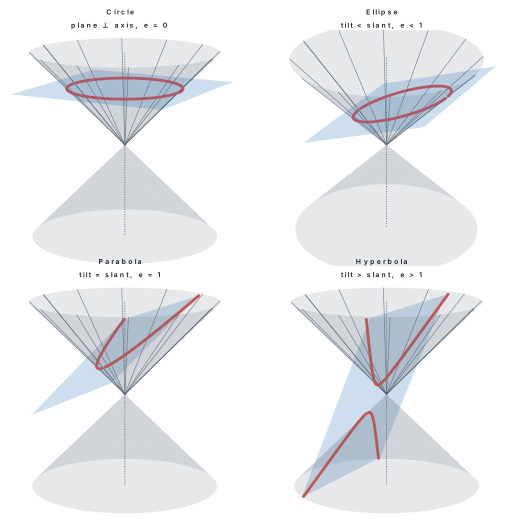
Slice a double cone with a flat plane and the edge of the cut is a conic section. Tilt the plane a little and you get a circle, an ellipse, a parabola or a hyperbola — four curves that look different but come from one construction and obey one rule. This is the longest unit in Analytic Geometry, and it is the most mechanical: almost every question is find the curve from its data or find the data from its curve, plus a tangent. Learn the four standard equations and the table of elements that goes with each, and the unit becomes arithmetic.
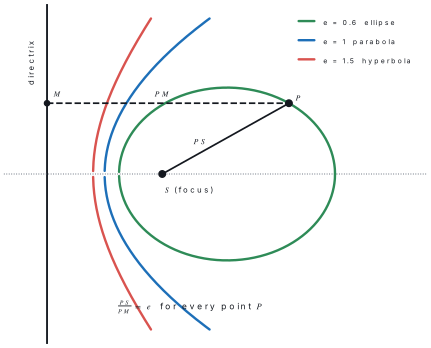
The unified rule behind all four curves is a statement about distances.
A conic section is the set of all points P in a plane whose distance from a fixed point S (the focus) is a constant multiple e of its distance from a fixed straight line (the directrix):
where PM is the perpendicular distance from P to the directrix. The constant e is the eccentricity. The line through S perpendicular to the directrix is the axis of the conic; the point where the conic crosses its axis is a vertex.
| Eccentricity | Curve |
|---|---|
| e = 0 | circle (a limiting case: the directrix moves off to infinity) |
| 0 < e < 1 | ellipse |
| e = 1 | parabola |
| e > 1 | hyperbola |
Recognising a conic from its equation
Every conic in this unit has an equation of the form
with no xy term, because we always choose axes parallel to the axes of the curve. The two leading coefficients alone tell you which curve you have, before any completing of squares.
| Signs of A and B | Curve |
|---|---|
| A = B \ne 0 | circle |
| exactly one of A, B is zero | parabola |
| A \ne B, same sign | ellipse |
| A and B opposite in sign | hyperbola |
So 4x^{2}+9y^{2}-16x+18y-11=0 is an ellipse (both positive, unequal), 9x^{2}-16y^{2}=144 is a hyperbola (opposite signs), and y^{2}-8y-4x+20=0 is a parabola (no x^{2} term at all). Identify the curve first; the arithmetic that follows is then routine.
- Divide so that the coefficient of the squared term(s) is tidy.
- Complete the square in x, in y, or in both.
- Match the result to a standard form and write down a and b (or r).
- Compute e from the correct relation for that curve.
- Only then quote centre/vertex, foci, directrices and latus rectum — each of them measured from the centre or vertex, not from the origin.
Steps 1-3 are worth marks on their own, so write them out even if you can see the answer.
A latus rectum is the chord through a focus perpendicular to the axis. Its length appears in almost every question, so it is worth knowing for each curve. Every conic is also described by a second-degree equation in x and y; for the curves in this unit that equation has no xy term, so it always factors into a recognisable standard form after completing the square.
Three question shapes cover the whole unit. 1. Build the curve. You are given a focus, a directrix, foci and an eccentricity, vertices, or the length of a latus rectum. Fit them into the standard equation. 2. Read the curve. You are given an equation, often untidy. Complete the square, match it to a standard form, then quote centre/vertex, foci, directrices, eccentricity and latus rectum. 3. Tangency. Either "is this line a tangent?" (use the condition) or "find the tangent and normal at this point" (use the T = 0 rule).
Write the standard form down first, every time. Most lost marks come from starting to calculate before the equation has been put in standard form.
8.1 Condition of tangency of a line to a circle
The equation of a circle, in all its forms
A circle is the set of points at a fixed distance r (the radius) from a fixed point C (the centre). Everything else follows from the distance formula.
1. Centre–radius form. Let the centre be C(h,k) and let P(x,y) be any point of the circle. Then CP = r, so by the distance formula
Squaring both sides removes the root and gives the standard form
2. Centre at the origin. Put h = k = 0:
3. General form. Expand the standard form:
Write g = -h, f = -k and c = h^{2}+k^{2}-r^{2}. Then every circle has an equation of the shape
Reading this backwards, the centre is (-g,-f) — half the coefficients, sign changed — and since r^{2} = h^{2}+k^{2}-c,
The equation represents a real circle only when g^{2}+f^{2}-c > 0. If it is zero the "circle" is the single point (-g,-f); if it is negative there are no real points at all.
4. Diameter form. If A(x_1,y_1) and B(x_2,y_2) are the ends of a diameter, then the angle APB in the semicircle is a right angle for every point P(x,y) on the circle. The slopes of PA and PB therefore multiply to -1:
Clearing the denominators gives the diameter form
Two consequences are used constantly. A circle that touches the x-axis has |k| = r; one that touches the y-axis has |h| = r; one that touches both has centre (\pm r, \pm r). And a general second-degree equation ax^{2}+by^{2}+2hxy+2gx+2fy+c = 0 is a circle only if a = b and h = 0 — so if the coefficients of x^{2} and y^{2} differ, divide through before reading off the centre.
For 3x^{2}+3y^{2}-12x+18y-6=0 the centre is not (6,-9). Divide by 3 to get x^{2}+y^{2}-4x+6y-2=0 first; then 2g=-4, 2f=6, so the centre is (2,-3) and r = \sqrt{4+9+2} = \sqrt{15}.
When does a line meet a circle?
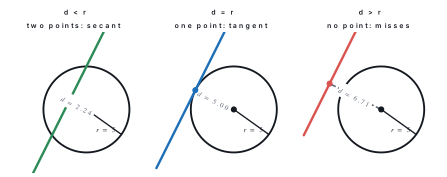
Let the line be y = mx+c and the circle x^{2}+y^{2} = a^{2} with centre O and radius a. Let d be the perpendicular distance from O to the line. There are exactly three possibilities.
Algebraic route. Substitute y = mx+c into the circle:
This quadratic gives the x-coordinates of the intersection points. The line touches the circle when the two points coincide, i.e. when the discriminant is zero:
Geometric route (quicker). The line touches the circle exactly when the perpendicular distance from the centre equals the radius. For mx - y + c = 0 and centre (0,0),
Both routes give the same answer, and the second is the one to use in an exam.
For the circle x^{2}+y^{2}=a^{2}:
so the two tangents of slope m are \;y = mx \pm a\sqrt{1+m^{2}}, and the point of contact is \left(-\dfrac{a^{2}m}{c},\ \dfrac{a^{2}}{c}\right).
For the line lx+my+n = 0 the same condition reads n^{2} = a^{2}(l^{2}+m^{2}).
For any circle, centre C and radius r: the line touches it if and only if the perpendicular distance from C to the line equals r.
Problem. Find the equation of the circle passing through the points (0,0), (6,0) and (0,8). State its centre and radius.
Solution. Take the general form x^{2}+y^{2}+2gx+2fy+c = 0 and substitute each point in turn.
Through (0,0): \;c = 0.
Through (6,0): \;36 + 12g + c = 0 \Rightarrow 12g = -36 \Rightarrow g = -3.
Through (0,8): \;64 + 16f + c = 0 \Rightarrow 16f = -64 \Rightarrow f = -4.
So the circle is
Centre = (-g,-f) = (3,4) and r = \sqrt{g^{2}+f^{2}-c} = \sqrt{9+16-0} = 5.
Check. The distance from (3,4) to (6,0) is \sqrt{9+16} = 5. Correct.
Problem. (a) Find the centre and radius of x^{2}+y^{2}-8x+6y-11 = 0. (b) Find the equation of the circle with centre (3,4) which touches the line 4x-3y+10 = 0.
Solution. (a) Compare with x^{2}+y^{2}+2gx+2fy+c=0: \;2g = -8 so g=-4; 2f = 6 so f = 3; c = -11.
(b) A circle touches a line when the perpendicular distance from the centre to the line equals the radius. For the line 4x-3y+10=0 and the point (3,4),
So the circle is (x-3)^{2} + (y-4)^{2} = 4, i.e. x^{2}+y^{2}-6x-8y+21 = 0.
Problem. Find the value of c for which the line y = 2x + c touches the circle x^{2}+y^{2} = 20. Find the point of contact for the positive value.
Solution. Here a^{2} = 20 and m = 2. The condition of tangency is
For c = 10 the point of contact is
Check. (-4)^{2} + 2^{2} = 20, and 2(-4)+10 = 2. The point lies on both.
If the line is given in the form y = mx+c, use c^{2} = a^{2}(1+m^{2}). If it is given as lx+my+n=0, or if the circle is not centred at the origin, use "distance from centre = radius". Never expand and take discriminants in an exam unless you are explicitly asked to derive the condition.
8.2 Tangent and normal to a circle
The tangent at a point of a circle is the line touching it there; the normal is the line through that point perpendicular to the tangent. For a circle the normal is especially simple, because the radius is already perpendicular to the tangent.
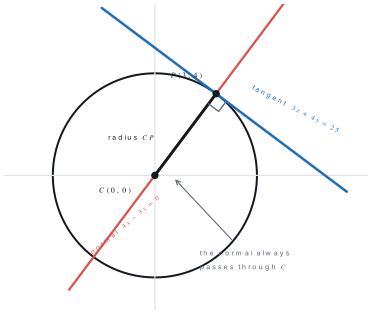
Let P(x_1,y_1) lie on x^{2}+y^{2} = a^{2}, so x_1^{2}+y_1^{2} = a^{2}.
The radius CP joins (0,0) to (x_1,y_1), so its slope is y_1/x_1. The tangent is perpendicular to the radius, so its slope is -x_1/y_1. Using the point–slope form,
So the tangent at (x_1,y_1) is
For the general circle x^{2}+y^{2}+2gx+2fy+c = 0 the same argument (or differentiation) gives the rule of T = 0: replace x^{2} by xx_1, y^{2} by yy_1, 2x by x+x_1 and 2y by y+y_1:
The normal passes through P and the centre, so for x^{2}+y^{2}=a^{2} it is the line through the origin with slope y_1/x_1:
and for the general circle it is the line joining (-g,-f) to (x_1,y_1).
- Tangent at (x_1,y_1) on x^{2}+y^{2}=a^{2}: \;xx_1+yy_1 = a^{2}.
- Normal at (x_1,y_1): passes through the centre — always.
- Length of the tangent from an external point P(x_1,y_1) to S \equiv x^{2}+y^{2}+2gx+2fy+c = 0:
because PT^{2} = CP^{2} - r^{2} by Pythagoras. - Pair of tangents from P: \;SS_1 = T^{2}. - Director circle (locus of points from which the two tangents are perpendicular) of x^{2}+y^{2}=a^{2}: \;x^{2}+y^{2} = 2a^{2}.
Problem. Find the equations of the tangent and the normal to the circle x^{2}+y^{2} = 25 at the point (3,4).
Solution. First check the point lies on the circle: 9 + 16 = 25. It does.
Tangent. Use xx_1+yy_1 = a^{2} with (x_1,y_1) = (3,4) and a^{2}=25:
Normal. The normal passes through the centre (0,0) and through (3,4), so its slope is 4/3:
Check. The perpendicular distance from (0,0) to 3x+4y-25 = 0 is 25/\sqrt{9+16} = 25/5 = 5, which is the radius. The tangent is correct, and the product of the slopes, \left(-\tfrac34\right)\left(\tfrac43\right) = -1, confirms the normal.
Problem. From the point (7,1), tangents are drawn to the circle x^{2}+y^{2} = 25. Find (a) the length of each tangent, (b) the equations of the two tangents, and (c) the angle between them.
Solution. (a) With S \equiv x^{2}+y^{2}-25,
(b) Any line through (7,1) with slope m is y - 1 = m(x-7), i.e. y = mx + (1-7m). So c = 1-7m. Apply c^{2} = a^{2}(1+m^{2}):
The tangents are
(c) The product of the slopes is \left(\tfrac43\right)\left(-\tfrac34\right) = -1, so the tangents are perpendicular: the angle is 90^{\circ}. This had to happen, because 7^{2}+1^{2} = 50 = 2(25) puts (7,1) on the director circle.
8.3 Standard equation of parabola
A parabola is the conic with e = 1: every point of it is equally far from the focus and from the directrix.
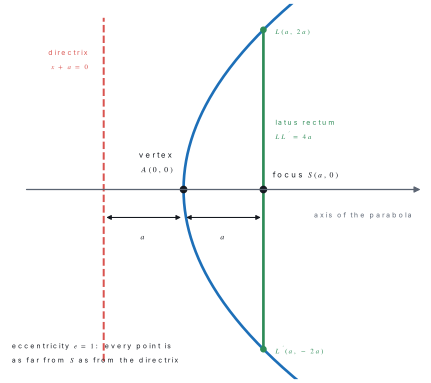
Choose the axes to make the algebra as simple as possible. Let the focus be S(a,0) with a>0, and let the directrix be the line x = -a, i.e. x+a = 0. The origin is then midway between focus and directrix, so the origin is the vertex.
Let P(x,y) be any point on the curve and M the foot of the perpendicular from P to the directrix. The defining condition PS = PM gives
Square both sides:
The x^{2} and a^{2} terms cancel, leaving
This is the standard equation of the parabola. Because the right side must be non-negative, x \ge 0: the curve lies entirely to the right of the tangent at the vertex, and it opens towards the focus.
Latus rectum. Put x = a in y^{2}=4ax: \;y^{2} = 4a^{2}, so y = \pm 2a. The latus rectum runs from (a,2a) to (a,-2a) and its length is
which is why the coefficient is written as 4a rather than as a single letter.
Replacing x by -x, or swapping x and y, turns the curve to face the other three directions. All four forms have vertex at the origin.
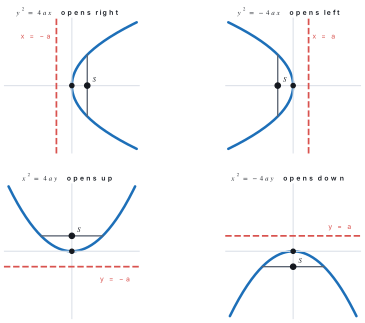
| Equation | Opens | Axis | Vertex | Focus | Directrix | Latus rectum |
|---|---|---|---|---|---|---|
| y^{2} = 4ax | right | y=0 | (0,0) | (a,0) | x=-a | 4a |
| y^{2} = -4ax | left | y=0 | (0,0) | (-a,0) | x=a | 4a |
| x^{2} = 4ay | up | x=0 | (0,0) | (0,a) | y=-a | 4a |
| x^{2} = -4ay | down | x=0 | (0,0) | (0,-a) | y=a | 4a |
For all of them e = 1, and a > 0 is the distance from the vertex to the focus. Shifted vertex: if the vertex moves to (h,k) the equations become (y-k)^{2} = \pm 4a(x-h) and (x-h)^{2} = \pm 4a(y-k). Everything else shifts with it: the focus is a units from the vertex along the axis, the directrix is a units from it on the other side.
A convenient parametric form of y^{2}=4ax is \;x = at^{2},\ y = 2at.
Which variable is squared decides which way the parabola opens. In y^{2} = 4ax only y is squared, so the axis is horizontal. In x^{2}=4ay the axis is vertical. Students who memorise "4a goes with x" without noticing this reverse the whole diagram.
Problem. Find the equation of the parabola with vertex at the origin, axis along the x-axis, passing through the point (3,-6). State its focus, directrix and latus rectum.
Solution. Axis along Ox and vertex at the origin means the form is y^{2} = 4ax (the point has x>0, so it opens right). Substitute (3,-6):
Hence 4a = 12 and the parabola is
Focus (a,0) = (3,0); directrix x = -3; latus rectum = 4a = 12 units; eccentricity e=1.
Problem. Reduce y^{2} - 8y - 4x + 20 = 0 to standard form and find its vertex, focus, directrix, axis and length of latus rectum.
Solution. Only y is squared, so collect the y terms and complete the square.
Compare with (y-k)^{2} = 4a(x-h): \;h = 1, k = 4, 4a = 4 so a = 1.
- Vertex: (1,4).
- Axis: horizontal through the vertex, y = 4. Opens to the right.
- Focus: a=1 unit right of the vertex, (1+1, 4) = (2,4).
- Directrix: 1 unit left of the vertex, x = 1-1 = 0, i.e. the y-axis.
- Latus rectum: 4a = 4 units.
Check. Take the point of the curve with y=6: (6-4)^{2} = 4(x-1) gives x = 2. Distance to focus (2,4) is \sqrt{0+4} = 2; distance to the line x=0 is 2. Equal, as required.
Problem. Find the vertex, focus, directrix and latus rectum of x^{2} - 4x - 8y + 20 = 0.
Solution. Now x is squared, so the axis is vertical.
Compare with (x-h)^{2} = 4a(y-k): h=2, k=2, 4a = 8 so a = 2; the parabola opens upwards.
- Vertex (2,2); axis x = 2.
- Focus: 2 units above the vertex, (2, 2+2) = (2,4).
- Directrix: 2 units below, y = 2-2 = 0, the x-axis.
- Latus rectum = 4a = 8 units.
Problem. A suspension bridge across the Karnali has a parabolic cable. The span between the two towers is 80 m, each tower rises 20 m above the roadway, and the lowest point of the cable is 4 m above the roadway. Find the height of the cable at a point 20 m horizontally from the lowest point.
Solution. Put the origin at the lowest point of the cable, with the y-axis vertical. Then the cable is x^{2} = 4ay (opening upward, vertex at the origin).
Each tower is 40 m horizontally from the lowest point and rises 20 - 4 = 16 m above it, so the cable passes through (40,16):
So the cable is x^{2} = 100y. At x = 20:
That is 4 m above the lowest point of the cable, so the height above the roadway is 4 + 4 = 8 m.
8.4 Tangent and normal to a parabola
Let P(x_1,y_1) lie on y^{2} = 4ax. Differentiate the equation implicitly:
At P the gradient of the tangent is therefore 2a/y_1, and the tangent is
Now use y_1^{2} = 4ax_1 to replace y_1^{2}:
So the tangent at (x_1,y_1) is
which is again the rule T=0: replace y^{2} by yy_1 and x by \tfrac12(x+x_1).
The normal is perpendicular to the tangent, so its gradient is -y_1/(2a):
Substitute y = mx+c into y^{2}=4ax:
For a tangent the two roots must coincide, so the discriminant vanishes:
So every line of the form
touches y^{2}=4ax. Putting c = a/m back into the quadratic gives the double root x = a/m^{2}, and then y = 2a/m, so the point of contact is
| Cartesian point (x_1,y_1) | Parametric point (at^{2},2at) | Slope form | |
|---|---|---|---|
| Tangent | yy_1 = 2a(x+x_1) | ty = x + at^{2} | y = mx + \dfrac{a}{m} |
| Normal | y - y_1 = -\dfrac{y_1}{2a}(x-x_1) | y = -tx + 2at + at^{3} | y = mx - 2am - am^{3} |
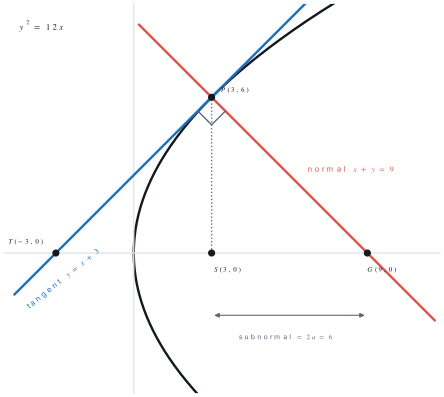
Useful extras, all provable from the figure above: - The tangent at (x_1,y_1) meets the axis at (-x_1,0), and the tangent at the vertex is the y-axis. - Subnormal =2a, the same at every point. - The tangent at any point bisects the angle between the focal radius and the line through the point parallel to the axis — the reflector property used in headlamps and dish antennas.
Problem. Find the equations of the tangent and normal to the parabola y^{2} = 12x at the point (3,6).
Solution. Check: 6^{2} = 36 = 12(3). The point is on the curve. Here 4a = 12, so a = 3 and 2a = 6.
Tangent. yy_1 = 2a(x+x_1) with (x_1,y_1) = (3,6):
Normal. Gradient = -y_1/(2a) = -6/6 = -1:
Check. The tangent y = x+3 has m=1 and c=3 = a/m = 3/1. The condition of tangency holds.
Problem. Show that the line y = 2x+2 is a tangent to the parabola y^{2} = 16x and find the point of contact.
Solution. For y^{2}=16x, 4a = 16 so a = 4. The line has m = 2 and c = 2. The condition of tangency is c = a/m:
The condition is satisfied, so the line touches the parabola. The point of contact is
Check. 4^{2} = 16 = 16(1), and 2(1)+2 = 4. The point is on both.
Problem. Find the equation of the normal to the parabola y^{2} = 4x at the point (4,4).
Solution. Here 4a = 4, so a = 1. In parametric form (at^{2},2at) = (t^{2},2t), and (4,4) gives t = 2.
Use the parametric normal y = -tx + 2at + at^{3} with t=2, a=1:
Check with the Cartesian form. Gradient of the normal is -y_1/(2a) = -4/2 = -2, and y - 4 = -2(x-4) gives 2x+y = 12. The same.
8.5 Standard equation of ellipse
An ellipse is the conic with 0 < e < 1. Because e<1 the curve closes up: the focus is nearer than the directrix, so the curve can never escape.
Let the focus be S(ae,0) and the directrix the line x = a/e, with 0 < e < 1. (This choice of letters is deliberate; a will turn out to be the semi-major axis.) For any point P(x,y) on the conic, PS = e PM gives
Squaring:
The -2aex terms cancel. Gather like terms:
Divide throughout by a^{2}(1-e^{2}), which is positive because e<1:
Now define b^{2} = a^{2}(1-e^{2}). Since 0<e<1 we have b < a, and the equation becomes the standard equation of the ellipse
Two relations follow immediately and must be memorised:
Symmetry gives a second focus. Replacing x by -x leaves the equation unchanged, so the curve is symmetric about the y-axis; hence S_1(-ae,0) is a focus too, with directrix x = -a/e.
Latus rectum. Put x = ae in the standard equation:
so y = \pm b^{2}/a and the length of each latus rectum is 2b^{2}/a.
Focal distance property. From PS = e PM = e\left(\dfrac ae - x\right) we get PS = a - ex, and similarly PS_1 = a + ex. Therefore
The sum of the distances from any point of an ellipse to the two foci is constant and equal to the major axis. This is the "string and two pins" construction.
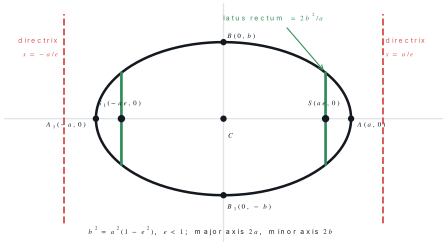
If the larger denominator sits under y^{2} the ellipse is taller than it is wide and every element turns through 90^{\circ}.
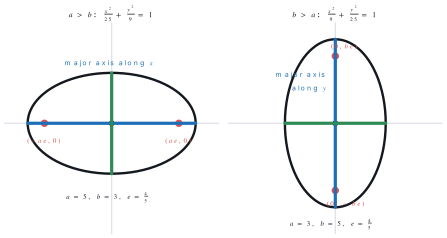
| Element | a > b (major axis Ox) | b > a (major axis Oy) |
|---|---|---|
| Centre | (0,0) | (0,0) |
| Vertices | (\pm a, 0) | (0,\pm b) |
| Major / minor axis | 2a / 2b | 2b / 2a |
| Eccentricity | e = \sqrt{1 - b^{2}/a^{2}} | e = \sqrt{1 - a^{2}/b^{2}} |
| Foci | (\pm ae, 0) | (0, \pm be) |
| Directrices | x = \pm a/e | y = \pm b/e |
| Latus rectum | 2b^{2}/a | 2a^{2}/b |
Rule to remember: the foci and the directrices always belong to the larger denominator. Shifted centre (h,k): \dfrac{(x-h)^{2}}{a^{2}} + \dfrac{(y-k)^{2}}{b^{2}} = 1. Parametric form: x = a\cos\theta, y = b\sin\theta.
If you are handed \dfrac{x^{2}}{9} + \dfrac{y^{2}}{25} = 1, do not rename things so that a=5. Keep a^{2}=9 under x^{2} and b^{2}=25 under y^{2}, notice that b>a, and use the right-hand column of the table. The foci are (0,\pm 4), not (\pm 4,0).
Problem. Find the equation of the ellipse whose foci are (\pm 4, 0) and whose eccentricity is 2/3.
Solution. The foci are on the x-axis, so the form is x^{2}/a^{2} + y^{2}/b^{2} = 1 with a>b and foci (\pm ae,0).
The ellipse is
Check. a^{2}-b^{2} = 36-20 = 16 = (ae)^{2} = 4^{2}. Correct.
Problem. For the ellipse 9x^{2} + 25y^{2} = 225, find the lengths of the axes, the eccentricity, the foci, the directrices and the latus rectum.
Solution. Divide throughout by 225 to reach standard form:
So a^{2} = 25, b^{2} = 9, i.e. a = 5, b = 3, and a>b: the major axis lies along Ox.
- Major axis 2a = 10; minor axis 2b = 6.
- Eccentricity: e = \sqrt{1 - \dfrac{9}{25}} = \sqrt{\dfrac{16}{25}} = \dfrac45.
- Foci: ae = 5 \times \dfrac45 = 4, so (\pm 4, 0).
- Directrices: x = \pm \dfrac{a}{e} = \pm \dfrac{5}{4/5} = \pm \dfrac{25}{4}.
- Latus rectum: \dfrac{2b^{2}}{a} = \dfrac{2 \times 9}{5} = \dfrac{18}{5} = 3.6 units.
Problem. Reduce 4x^{2} + 9y^{2} - 16x + 18y - 11 = 0 to standard form. Find its centre, the lengths of its axes and its eccentricity.
Solution. Group and complete the square in each variable.
Divide by 36:
So the centre is (2,-1), with a^{2}=9, b^{2}=4, i.e. a=3, b=2 and a>b.
- Major axis 2a = 6 (parallel to Ox); minor axis 2b = 4.
- Eccentricity e = \sqrt{1 - \dfrac49} = \dfrac{\sqrt{5}}{3} \approx 0.745.
- Foci: ae = \sqrt{5}, so (2 \pm \sqrt{5}, -1).
Tangent and normal to an ellipse
Write the ellipse as b^{2}x^{2} + a^{2}y^{2} = a^{2}b^{2} and substitute y = mx+c:
Set the discriminant to zero for a tangent:
Divide by 4a^{2} and expand:
Cancel a^{2}m^{2}c^{2} from both sides and divide by b^{2}:
So y = mx \pm \sqrt{a^{2}m^{2}+b^{2}} are the two tangents of slope m.
Tangent at a point. Differentiating \dfrac{x^{2}}{a^{2}} + \dfrac{y^{2}}{b^{2}} = 1 gives \dfrac{2x}{a^{2}} + \dfrac{2y}{b^{2}} \dfrac{dy}{dx} = 0, so at (x_1,y_1) the gradient is -\dfrac{b^{2}x_1}{a^{2}y_1} and
Multiplying out and using \dfrac{x_1^{2}}{a^{2}}+\dfrac{y_1^{2}}{b^{2}}=1 tidies this to the T=0 form
- Condition of tangency of y=mx+c: \;c^{2} = a^{2}m^{2}+b^{2}.
- Tangent at (x_1,y_1): \;\dfrac{xx_1}{a^{2}} + \dfrac{yy_1}{b^{2}} = 1.
- Normal at (x_1,y_1): \;\dfrac{a^{2}x}{x_1} - \dfrac{b^{2}y}{y_1} = a^{2}-b^{2}.
- Tangent at the parametric point (a\cos\theta, b\sin\theta): \;\dfrac{x\cos\theta}{a} + \dfrac{y\sin\theta}{b} = 1.
- Director circle: x^{2}+y^{2} = a^{2}+b^{2}.
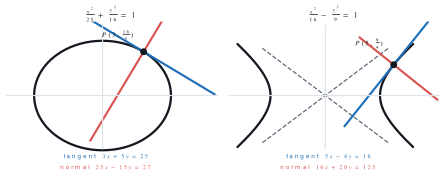
Problem. Find the equations of the tangent and normal to the ellipse \dfrac{x^{2}}{25} + \dfrac{y^{2}}{16} = 1 at the point \left(3, \dfrac{16}{5}\right).
Solution. Check the point: \dfrac{9}{25} + \dfrac{(16/5)^{2}}{16} = \dfrac{9}{25} + \dfrac{256/25}{16} = \dfrac{9}{25} + \dfrac{16}{25} = 1. Good.
Tangent. \dfrac{xx_1}{a^{2}} + \dfrac{yy_1}{b^{2}} = 1 with a^{2}=25, b^{2}=16:
Multiply by 25:
Normal. \dfrac{a^{2}x}{x_1} - \dfrac{b^{2}y}{y_1} = a^{2}-b^{2}:
Multiply by 3:
Check. The tangent has slope -3/5; the normal has slope 25/15 = 5/3. The product is -1, as it must be.
8.6 Standard equation of hyperbola
A hyperbola is the conic with e > 1. The focus is now further from the vertex than the directrix, and the curve escapes to infinity in two separate branches.
Take the focus S(ae,0) and the directrix x = a/e, exactly as for the ellipse, but now with e>1. The condition PS = e PM again gives
This is the same intermediate equation as for the ellipse — the whole difference is the sign of 1-e^{2}. Since e>1, write it as -(e^{2}-1) and multiply through by -1:
Divide by a^{2}(e^{2}-1):
Define b^{2} = a^{2}(e^{2}-1) and the standard equation of the hyperbola appears:
with
Asymptotes. Solve for y: \;y = \pm\dfrac{b}{a}\sqrt{x^{2}-a^{2}} = \pm\dfrac{b}{a}x\sqrt{1 - \dfrac{a^{2}}{x^{2}}}. As |x| \to \infty the root tends to 1, so the curve approaches the pair of lines
Latus rectum. Putting x = ae gives y = \pm b^{2}/a, so each latus rectum has length 2b^{2}/a — the same expression as for the ellipse.
Focal distance property. PS = |ex - a| and PS_1 = |ex+a|, so
the difference of the focal distances is constant, where for the ellipse it was the sum.
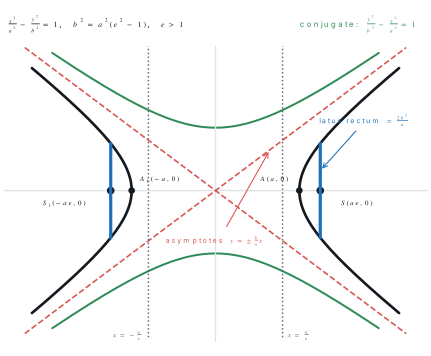
| Element | Value |
|---|---|
| Centre | (0,0) |
| Vertices | (\pm a, 0) — the curve does not cross Oy |
| Transverse / conjugate axis | 2a / 2b |
| Eccentricity | e = \sqrt{1 + b^{2}/a^{2}} > 1 |
| Foci | (\pm ae, 0), with a^{2}e^{2} = a^{2}+b^{2} |
| Directrices | x = \pm a/e |
| Latus rectum | 2b^{2}/a |
| Asymptotes | y = \pm \dfrac{b}{a}x |
- Conjugate hyperbola: \dfrac{y^{2}}{b^{2}} - \dfrac{x^{2}}{a^{2}} = 1, with foci (0,\pm be) and eccentricity e_1 = \sqrt{1+a^{2}/b^{2}}. It shares the asymptotes, and \dfrac{1}{e^{2}} + \dfrac{1}{e_1^{2}} = 1.
- Rectangular (equilateral) hyperbola: a = b, so x^{2}-y^{2}=a^{2}, asymptotes y = \pm x at right angles, and e = \sqrt{2}.
- Condition of tangency of y = mx+c: \;c^{2} = a^{2}m^{2} - b^{2}.
- Tangent at (x_1,y_1): \;\dfrac{xx_1}{a^{2}} - \dfrac{yy_1}{b^{2}} = 1.
- Normal at (x_1,y_1): \;\dfrac{a^{2}x}{x_1} + \dfrac{b^{2}y}{y_1} = a^{2}+b^{2}.
For the ellipse b^{2} = a^{2}(1-e^{2}) and a^{2}e^{2} = a^{2}-b^{2}; for the hyperbola b^{2} = a^{2}(e^{2}-1) and a^{2}e^{2} = a^{2}+b^{2}. One sign flip changes the eccentricity, the foci and the directrices together. Decide which conic you have before touching e.
Problem. Find the equation of the hyperbola whose foci are (\pm 5,0) and whose eccentricity is 5/4.
Solution. The foci are on the x-axis, so the form is \dfrac{x^{2}}{a^{2}} - \dfrac{y^{2}}{b^{2}} = 1 with foci (\pm ae,0).
The hyperbola is
Check. a^{2}+b^{2} = 16+9 = 25 = (ae)^{2}. Correct.
Problem. For the hyperbola 9x^{2} - 16y^{2} = 144, find the vertices, eccentricity, foci, directrices, length of latus rectum and the asymptotes.
Solution. Divide by 144:
so a^{2}=16, b^{2}=9, i.e. a = 4, b = 3.
- Vertices: (\pm 4, 0); transverse axis 2a = 8, conjugate axis 2b = 6.
- Eccentricity: e = \sqrt{1 + \dfrac{9}{16}} = \sqrt{\dfrac{25}{16}} = \dfrac54.
- Foci: ae = 4 \times \dfrac54 = 5, so (\pm 5, 0).
- Directrices: x = \pm \dfrac{a}{e} = \pm \dfrac{4}{5/4} = \pm \dfrac{16}{5}.
- Latus rectum: \dfrac{2b^{2}}{a} = \dfrac{18}{4} = \dfrac92 = 4.5 units.
- Asymptotes: y = \pm \dfrac{b}{a}x = \pm \dfrac34 x, i.e. 3x \pm 4y = 0.
Problem. Find the equations of the tangent and the normal to the hyperbola \dfrac{x^{2}}{16} - \dfrac{y^{2}}{9} = 1 at the point \left(5, \dfrac94\right).
Solution. Check: \dfrac{25}{16} - \dfrac{(9/4)^{2}}{9} = \dfrac{25}{16} - \dfrac{81/16}{9} = \dfrac{25}{16} - \dfrac{9}{16} = 1. Good.
Tangent. \dfrac{xx_1}{a^{2}} - \dfrac{yy_1}{b^{2}} = 1:
Multiply by 16:
Normal. \dfrac{a^{2}x}{x_1} + \dfrac{b^{2}y}{y_1} = a^{2}+b^{2}:
Multiply by 5:
Check. Tangent slope = 5/4; normal slope = -16/20 = -4/5. Their product is -1.
| Circle | Parabola | Ellipse (a>b) | Hyperbola | |
|---|---|---|---|---|
| Standard equation | x^{2}+y^{2}=a^{2} | y^{2}=4ax | \dfrac{x^{2}}{a^{2}}+\dfrac{y^{2}}{b^{2}}=1 | \dfrac{x^{2}}{a^{2}}-\dfrac{y^{2}}{b^{2}}=1 |
| Eccentricity | e=0 | e=1 | e=\sqrt{1-\dfrac{b^{2}}{a^{2}}}<1 | e=\sqrt{1+\dfrac{b^{2}}{a^{2}}}>1 |
| Centre / vertex | centre (0,0) | vertex (0,0) | centre (0,0) | centre (0,0) |
| Vertices | every point | (0,0) | (\pm a,0) | (\pm a,0) |
| Foci | centre only | (a,0) | (\pm ae,0) | (\pm ae,0) |
| Relation | — | — | a^{2}e^{2}=a^{2}-b^{2} | a^{2}e^{2}=a^{2}+b^{2} |
| Directrices | none | x=-a | x=\pm \dfrac ae | x=\pm \dfrac ae |
| Latus rectum | — | 4a | \dfrac{2b^{2}}{a} | \dfrac{2b^{2}}{a} |
| Asymptotes | none | none | none | y=\pm\dfrac ba x |
| Tangency of y=mx+c | c^{2}=a^{2}(1+m^{2}) | c=\dfrac am | c^{2}=a^{2}m^{2}+b^{2} | c^{2}=a^{2}m^{2}-b^{2} |
| Tangent at (x_1,y_1) | xx_1+yy_1=a^{2} | yy_1=2a(x+x_1) | \dfrac{xx_1}{a^{2}}+\dfrac{yy_1}{b^{2}}=1 | \dfrac{xx_1}{a^{2}}-\dfrac{yy_1}{b^{2}}=1 |
Learn this table. Roughly a third of the marks in this unit are a direct read-off from one of its rows.
Chapter summary
- A conic is the locus of P with PS/PM = e, where S is the focus and the directrix gives PM. e=0 circle, 0<e<1 ellipse, e=1 parabola, e>1 hyperbola. The latus rectum is the focal chord perpendicular to the axis.
- Circle: (x-h)^{2}+(y-k)^{2}=r^{2}; general form x^{2}+y^{2}+2gx+2fy+c=0 has centre (-g,-f) and r=\sqrt{g^{2}+f^{2}-c}; diameter form (x-x_1)(x-x_2)+(y-y_1)(y-y_2)=0.
- A line touches a circle when the perpendicular distance from the centre equals the radius; for x^{2}+y^{2}=a^{2} and y=mx+c this is c^{2}=a^{2}(1+m^{2}), with contact point (-a^{2}m/c,\ a^{2}/c).
- Tangent to x^{2}+y^{2}=a^{2} at (x_1,y_1) is xx_1+yy_1=a^{2}; the normal always passes through the centre; the length of the tangent from (x_1,y_1) is \sqrt{S_1}; the director circle is x^{2}+y^{2}=2a^{2}.
- Parabola: y^{2}=4ax has vertex (0,0), focus (a,0), directrix x=-a, latus rectum 4a, parametric point (at^{2},2at). Three sign/axis variants give the other three orientations.
- Parabola tangency: y=mx+a/m touches at (a/m^{2}, 2a/m); the tangent at (x_1,y_1) is yy_1=2a(x+x_1); the subnormal is always 2a.
- Ellipse: \dfrac{x^{2}}{a^{2}}+\dfrac{y^{2}}{b^{2}}=1 with b^{2}=a^{2}(1-e^{2}); foci (\pm ae,0), directrices x=\pm a/e, latus rectum 2b^{2}/a, and PS+PS_1=2a. If b>a everything rotates onto the y-axis.
- Hyperbola: \dfrac{x^{2}}{a^{2}}-\dfrac{y^{2}}{b^{2}}=1 with b^{2}=a^{2}(e^{2}-1); foci (\pm ae,0), directrices x=\pm a/e, latus rectum 2b^{2}/a, asymptotes y=\pm bx/a, and |PS_1-PS|=2a. Rectangular when a=b, where e=\sqrt{2}.
- Tangency conditions in one line: circle c^{2}=a^{2}(1+m^{2}); parabola c=a/m; ellipse c^{2}=a^{2}m^{2}+b^{2}; hyperbola c^{2}=a^{2}m^{2}-b^{2}. Tangents at a point all follow the rule T=0.
Practice questions
Group A — Multiple choice (1 mark each)
- The radius of the circle x^{2}+y^{2}-4x+6y-12 = 0 is [1]a3b4c5d6
- The line y = x + c touches the circle x^{2}+y^{2} = 8 when c equals [1]a\pm 2b\pm 2\sqrt{2}c\pm 4d\pm 8
- The eccentricity of the ellipse 16x^{2} + 25y^{2} = 400 is [1]a\dfrac{3}{5}b\dfrac{4}{5}c\dfrac{5}{4}d\dfrac{9}{25}
- The focus of the parabola y^{2} = -8x is [1]a(2,0)b(-2,0)c(0,2)d(0,-2)
- The foci of the hyperbola \dfrac{x^{2}}{9} - \dfrac{y^{2}}{16} = 1 are [1]a(\pm 4,0)b(\pm 5,0)c(0,\pm 5)d(\pm 7,0)
- The length of the latus rectum of \dfrac{x^{2}}{16} + \dfrac{y^{2}}{9} = 1 is [1]a\dfrac{9}{2}b\dfrac{9}{4}c\dfrac{32}{3}d6
- The tangent to the circle x^{2}+y^{2} = 25 at the point (3,4) is [1]a4x+3y=25b3x+4y=25c3x-4y=25d4x-3y=0
- The eccentricity of a rectangular hyperbola is [1]a1b\sqrt{2}c2d\dfrac{1}{\sqrt{2}}
- The directrix of the parabola y^{2} = 12x is [1]ax = 3bx = -3cy = -3dx = -12
- The length of the tangent drawn from (4,3) to the circle x^{2}+y^{2} = 9 is [1]a3b4c5d\sqrt{34}
Answers to Group A
1. (c) — g=-2, f=3, c=-12, so r = \sqrt{4+9+12} = \sqrt{25} = 5.
2. (c) — c^{2} = a^{2}(1+m^{2}) = 8(1+1) = 16, so c = \pm4.
3. (a) — dividing by 400 gives \dfrac{x^{2}}{25}+\dfrac{y^{2}}{16}=1, so e = \sqrt{1-\tfrac{16}{25}} = \tfrac35.
4. (b) — 4a = 8 so a = 2; the curve opens left, focus (-a,0) = (-2,0).
5. (b) — a^{2}e^{2} = a^{2}+b^{2} = 9+16 = 25, so ae = 5.
6. (a) — a^{2}=16, b^{2}=9, and \dfrac{2b^{2}}{a} = \dfrac{18}{4} = \dfrac92.
7. (b) — xx_1+yy_1 = a^{2} gives 3x+4y = 25.
8. (b) — a=b makes e = \sqrt{1 + a^{2}/a^{2}} = \sqrt{2}.
9. (b) — 4a=12 so a=3; the directrix is x = -a = -3.
10. (b) — \sqrt{S_1} = \sqrt{16+9-9} = 4.
Group B — Short answer (5 marks each)
- Find the equation of the circle passing through the points (-1,1) and (6,2) whose centre lies on the line 2x+y = 4. State its centre and radius. [5]
- Find the equations of the tangents to the circle x^{2}+y^{2} = 16 which are parallel to the line 3x+4y = 5. [5]
- Find the vertex, focus, directrix, axis and length of latus rectum of the parabola y^{2}+4y+4x-4 = 0. [5]
- Find the equation of the tangent to the parabola y^{2} = 8x which makes an angle of 45^{\circ} with the x-axis. Find the point of contact and the equation of the normal there. [5]
- Find the equation of the ellipse whose foci are (\pm 3, 0) and whose latus rectum has length \dfrac{32}{5}. Also find its eccentricity. [5]
- Find the eccentricity, foci, directrices and length of latus rectum of the hyperbola 25x^{2} - 144y^{2} = 3600. [5]
Answers to Group B
1. Let the circle be x^{2}+y^{2}+2gx+2fy+c = 0, centre (-g,-f).
Through (-1,1): \;1+1-2g+2f+c = 0 \Rightarrow -2g+2f+c = -2. Through (6,2): \;36+4+12g+4f+c = 0 \Rightarrow 12g+4f+c = -40. Centre on 2x+y=4: \;2(-g)+(-f) = 4 \Rightarrow 2g+f = -4.
From the third equation f = -4-2g. Substituting into the first two: -2g+2(-4-2g)+c=-2 \Rightarrow -6g+c = 6, and 12g+4(-4-2g)+c = -40 \Rightarrow 4g+c = -24. Subtracting, 10g = -30, so g = -3, then c = -24-4(-3) = -12 and f = -4+6 = 2.
Centre (3,-2) and r = \sqrt{9+4+12} = 5. (Check: the distance from (3,-2) to (6,2) is \sqrt{9+16}=5.)
2. Lines parallel to 3x+4y=5 have slope m = -\dfrac34. With a^{2}=16,
So y = -\dfrac34 x \pm 5, i.e.
Check: the distance from (0,0) to 3x+4y-20=0 is 20/5 = 4 = r.
3. Only y is squared, so complete the square in y:
Compare with (y-k)^{2} = -4a(x-h): h=2, k=-2, 4a=4 so a=1, and the parabola opens left.
Vertex (2,-2); axis y = -2; focus 1 unit left of the vertex, (1,-2); directrix 1 unit right, x = 3; latus rectum 4a = 4 units.
4. y^{2}=8x gives 4a=8, so a=2. A 45^{\circ} line has m = \tan 45^{\circ} = 1. For a tangent, c = \dfrac{a}{m} = 2, so the tangent is
Point of contact \left(\dfrac{a}{m^{2}}, \dfrac{2a}{m}\right) = (2,4). (Check: 4^{2} = 16 = 8(2).)
Normal gradient = -\dfrac{y_1}{2a} = -\dfrac{4}{4} = -1, so y-4 = -(x-2), i.e.
5. Foci (\pm 3,0) lie on Ox, so a>b, ae = 3 and a^{2}-b^{2} = 9. The latus rectum gives
Substituting into a^{2}-b^{2}=9:
so a = 5 (the negative root is rejected), and b^{2} = \dfrac{16 \times 5}{5} = 16. The ellipse is
with e = \dfrac{ae}{a} = \dfrac35.
6. Divide by 3600:
so a = 12, b = 5.
Foci: ae = 12 \times \dfrac{13}{12} = 13, so (\pm 13, 0). Directrices: x = \pm\dfrac ae = \pm\dfrac{12}{13/12} = \pm\dfrac{144}{13}. Latus rectum: \dfrac{2b^{2}}{a} = \dfrac{50}{12} = \dfrac{25}{6} units.
Group C — Long answer (8 marks each)
- (a) Define a conic section in terms of focus, directrix and eccentricity, and derive the standard equation y^{2} = 4ax of a parabola. [5](b) Hence find the vertex, focus, directrix and length of latus rectum of y^{2} - 6y - 8x + 25 = 0. [3]
- (a) Derive the standard equation \dfrac{x^{2}}{a^{2}} + \dfrac{y^{2}}{b^{2}} = 1 of an ellipse from the focus–directrix definition, stating clearly where b^{2} = a^{2}(1-e^{2}) comes from. [5](b) Find the axes, eccentricity, foci, directrices and latus rectum of 25x^{2} + 9y^{2} = 225. [3]
- (a) Find the condition that the line y = mx+c is a tangent to the ellipse \dfrac{x^{2}}{a^{2}} + \dfrac{y^{2}}{b^{2}} = 1. [4](b) Hence find the tangents of slope 1 to \dfrac{x^{2}}{16} + \dfrac{y^{2}}{9} = 1. [2](c) Find the tangent and the normal to \dfrac{x^{2}}{9} + \dfrac{y^{2}}{4} = 1 at the point \left(\sqrt{5}, \dfrac43\right). [2]
Answers to Group C
1. (a) A conic section is the locus of a point P whose distance from a fixed point S (focus) bears a constant ratio e (eccentricity) to its distance from a fixed line (directrix): PS = e PM. For a parabola e = 1.
Take S(a,0) and the directrix x+a = 0, so that the origin bisects the perpendicular from S to the directrix. For P(x,y),
Putting x=a gives y=\pm2a, so the latus rectum has length 4a.
(b) y^{2}-6y = 8x-25, so y^{2}-6y+9 = 8x-16, i.e.
Here 4a = 8, so a = 2; the parabola opens right from vertex (2,3). Focus (2+2, 3) = (4,3); directrix x = 2-2 = 0; axis y = 3; latus rectum = 8 units.
2. (a) Let S(ae,0) be the focus and x = a/e the directrix, with 0<e<1. For P(x,y), PS = e PM gives
Dividing by a^{2}(1-e^{2}), which is positive because e<1,
The denominator under y^{2} is a positive constant; calling it b^{2}, i.e. defining b^{2} = a^{2}(1-e^{2}), gives \dfrac{x^{2}}{a^{2}} + \dfrac{y^{2}}{b^{2}} = 1 with b<a. Rearranging the definition also gives a^{2}e^{2} = a^{2}-b^{2}.
(b) Divide by 225: \;\dfrac{x^{2}}{9} + \dfrac{y^{2}}{25} = 1. Here a^{2}=9 and b^{2}=25, so b>a and the major axis is along Oy.
Major axis 2b = 10; minor axis 2a = 6. e = \sqrt{1-\dfrac{a^{2}}{b^{2}}} = \sqrt{1-\dfrac{9}{25}} = \dfrac45. Foci (0,\pm be) = (0,\pm 4). Directrices y = \pm\dfrac be = \pm\dfrac{25}{4}. Latus rectum \dfrac{2a^{2}}{b} = \dfrac{18}{5} units.
3. (a) Write the ellipse as b^{2}x^{2}+a^{2}y^{2} = a^{2}b^{2} and put y = mx+c:
For tangency the roots coincide, so the discriminant is zero:
(b) With a^{2}=16, b^{2}=9, m=1: \;c^{2} = 16+9 = 25, so c=\pm5 and the tangents are
(c) Check the point: \dfrac59 + \dfrac{16/9}{4} = \dfrac59+\dfrac49 = 1.
Tangent \dfrac{xx_1}{a^{2}}+\dfrac{yy_1}{b^{2}} = 1:
Normal \dfrac{a^{2}x}{x_1}-\dfrac{b^{2}y}{y_1} = a^{2}-b^{2}:
Practise more: Mathematics question bank