Unit 2 · Algebra · 10 teaching hours · 26 min read
Binomial Theorem
What the syllabus asks for 6
- Binomial theorem for a positive integral index
- General term; binomial coefficients
- Binomial theorem for any index (without proof)
- Approximation using binomial expansion
- Euler's number e
- Expansion of e^x, a^x and log(1+x) (without proof)
Multiplying out (a+b)^{2} is easy, (a+b)^{5} is tedious, and (a+b)^{20} by hand is out of the question. The binomial theorem gives every term of (a+b)^{n} directly, without multiplying anything out, and the coefficients turn out to be exactly the combination numbers ^{n}C_{r} of Unit 1 — which is no coincidence. The theorem then stretches beyond whole-number powers to negative and fractional ones, where it becomes an infinite series and a practical tool for computing roots such as \sqrt[3]{127} by hand. The same style of series produces the number e, the most important constant in calculus.
Four things, again and again: expand a binomial; find a particular term (general term, middle term, term independent of x, coefficient of x^{k}); expand for a negative or fractional index and state the validity condition; and approximate a root or a power to a stated number of decimal places. The e and \log(1+x) series are usually a short sum-the-series item.
2.1 Binomial theorem for a positive integral index
Multiply out the first few powers and watch the coefficients:
The powers of a fall from n to 0, the powers of b rise from 0 to n, their sum is always n, and the coefficients are ^{n}C_{0}, {}^{n}C_{1}, \ldots, {}^{n}C_{n}.
There are exactly n+1 terms. Putting a = 1, b = x:
Why combinations? Because (a+b)^{n} is n brackets multiplied together, and to build the term a^{n-r}b^{r} you must choose which r of the n brackets contribute a b. That can be done in ^{n}C_{r} ways, so a^{n-r}b^{r} appears ^{n}C_{r} times. Here is the same fact proved formally.
Let P(n) be the statement \;(a+b)^{n} = \sum_{r=0}^{n}{}^{n}C_{r}\,a^{n-r}b^{r}.
Base step. For n = 1 the right side is ^{1}C_{0}a + {}^{1}C_{1}b = a + b = (a+b)^{1}. So P(1) is true.
Inductive step. Assume P(k) is true for some positive integer k:
Multiply both sides by (a+b):
In the second sum replace the dummy r by r-1, so that it runs from r=1 to r=k+1 and its general term becomes ^{k}C_{r-1}a^{k+1-r}b^{r} — the same shape as the first sum. Separating the term r=0 from the first sum and r=k+1 from the second:
By Pascal's rule (Unit 1, property iv), ^{k}C_{r} + {}^{k}C_{r-1} = {}^{k+1}C_{r}. Also a^{k+1} = {}^{k+1}C_{0}a^{k+1} and b^{k+1} = {}^{k+1}C_{k+1}b^{k+1}, so the two loose terms slot into the sum:
which is P(k+1). Since P(1) holds and P(k) \Rightarrow P(k+1), by the principle of mathematical induction P(n) is true for every positive integer n. \blacksquare
For (a-b)^{n}, write b \to -b: the signs alternate, (a-b)^{n} = a^{n} - {}^{n}C_{1}a^{n-1}b + {}^{n}C_{2}a^{n-2}b^{2} - \cdots. For something like (2x - 3y)^{9} the whole of -3y is the second quantity, so the r^{\text{th}} power is (-3)^{r}y^{r} — cube the 3 as well as the y.
Problem. Expand \left(2x + \dfrac{3}{x}\right)^{5}.
Solution. Take a = 2x, b = 3/x, n = 5, with coefficients 1, 5, 10, 10, 5, 1:
Work out each piece:
Problem. Evaluate (\sqrt{3}+1)^{5} - (\sqrt{3}-1)^{5} without a calculator.
Solution. In (a+b)^{5} - (a-b)^{5} the even-power-of-b terms are identical and cancel, while the odd ones double:
With a = \sqrt{3} (so a^{2} = 3, a^{4} = 9) and b = 1:
The surds have vanished — which is the point of pairing the two expansions.
2.2 General term; binomial coefficients
The (r+1)^{\text{th}} term of (a+b)^{n} is
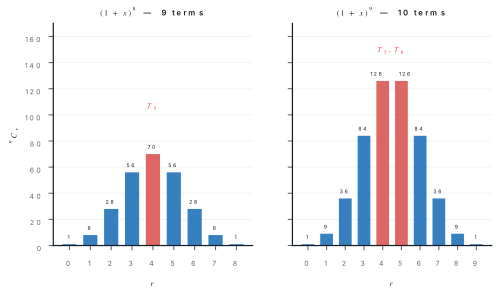
Middle term. There are n+1 terms. - n even: one middle term, T_{\frac{n}{2}+1}. - n odd: two middle terms, T_{\frac{n+1}{2}} and T_{\frac{n+3}{2}}.
The theorem lists the terms as r runs 0, 1, 2, \ldots, n. The term with subscript r is therefore not the r^{\text{th}} term but the (r+1)^{\text{th}}, because r = 0 gives the first term. Hence T_{r+1} = {}^{n}C_{r}a^{n-r}b^{r} — always write the r+1 down before substituting, or you will be one term out.
For the middle term, count the n+1 terms. If n is even, n+1 is odd and a single term stands in the middle, at position \dfrac{(n+1)+1}{2} = \dfrac{n}{2}+1. If n is odd, n+1 is even and no single term is central; the two middle ones are at positions \dfrac{n+1}{2} and \dfrac{n+1}{2}+1 = \dfrac{n+3}{2}.
Pascal's triangle and the binomial coefficients
The numbers ^{n}C_{r} are called the binomial coefficients. Written in rows they form Pascal's triangle, in which each entry is the sum of the two directly above it — which is exactly Pascal's rule ^{n}C_{r-1} + {}^{n}C_{r} = {}^{n+1}C_{r}.
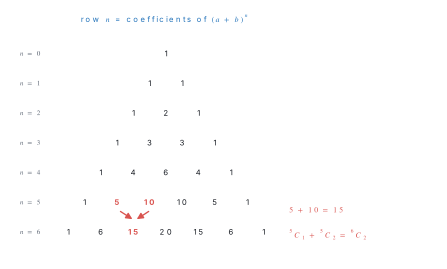
Three facts follow from putting numbers into (1+x)^{n}:
Adding and subtracting these two gives the sum of the even-placed coefficients and of the odd-placed ones, each equal to 2^{n-1}.
Problem. Prove that ^{n}C_{0} + {}^{n}C_{1} + \cdots + {}^{n}C_{n} = 2^{n}, and hence find the sum of the coefficients in the expansion of (2x - 3y)^{12}.
Solution. In the binomial theorem put a = b = 1:
The left side is 2^{n} and the right side is the required sum, so the two are equal. (In words: a set of n elements has 2^{n} subsets, counted here by size.)
For the second part, "the sum of the coefficients" means the value of the expansion when every variable is set to 1. Putting x = y = 1 in (2x-3y)^{12}:
Problem. Find the term independent of x in the expansion of \left(x^{2} - \dfrac{2}{x}\right)^{9}.
Solution. The general term is
"Independent of x" means the power of x is zero:
So the term is the seventh, and its value is
Problem. Find the coefficient of x^{32} in \left(x^{4} - \dfrac{1}{x^{3}}\right)^{15}.
Solution.
Set 60 - 7r = 32, so 7r = 28 and r = 4 — a whole number, so such a term exists. Its coefficient is
Problem. Find the middle term(s) of (a) \left(\dfrac{x}{2} + \dfrac{2}{x}\right)^{8} and (b) (2x - y)^{7}.
Solution. (a) n = 8 is even, so there is one middle term, T_{\frac{8}{2}+1} = T_{5}, i.e. r = 4:
(b) n = 7 is odd, so the middle terms are T_{4} (r=3) and T_{5} (r=4):
Problem. Three consecutive coefficients in the expansion of (1+x)^{n} are 45, 120 and 210. Find n and the position of these terms.
Solution. Let them be ^{n}C_{r-1} = 45, ^{n}C_{r} = 120, ^{n}C_{r+1} = 210. Use the ratio of consecutive coefficients, \dfrac{^{n}C_{r}}{^{n}C_{r-1}} = \dfrac{n-r+1}{r}:
Subtracting (1) from (2): \;n - 10 = 0, so n = 10; then (1) gives 33 = 11r, so r = 3.
Check: ^{10}C_{2} = 45, ^{10}C_{3} = 120, ^{10}C_{4} = 210. ✓ The terms are the 3^{\text{rd}}, 4^{\text{th}} and 5^{\text{th}}.
2.3 Binomial theorem for any index (without proof)
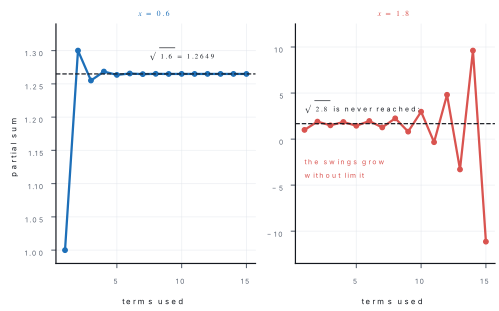
If n is not a positive integer, the list ^{n}C_{0}, {}^{n}C_{1}, \ldots never stops, because no factor (n-r) is ever zero. The expansion then becomes an infinite series, and an infinite series is only worth writing if it converges.
For any real number n and |x| < 1,
with general term
The condition |x| < 1 is part of the statement. State it every time.
Two remarks tie this to §2.1. First, if n is a positive integer the factor (n-n) appears when r = n+1, every later term is zero, and the series stops by itself at n+1 terms — the old theorem is the special case. Second, the coefficients are no longer ^{n}C_{r} (that symbol needs a whole number), so write them out as the product n(n-1)\cdots(n-r+1)/r!.
Four expansions are worth knowing by sight, all valid for |x| < 1:
| Expansion | Series |
|---|---|
| (1-x)^{-1} | 1 + x + x^{2} + x^{3} + \cdots |
| (1+x)^{-1} | 1 - x + x^{2} - x^{3} + \cdots |
| (1-x)^{-2} | 1 + 2x + 3x^{2} + 4x^{3} + \cdots |
| (1+x)^{1/2} | 1 + \dfrac{x}{2} - \dfrac{x^{2}}{8} + \dfrac{x^{3}}{16} - \cdots |
Problem. Expand in ascending powers of x as far as the term in x^{3}, stating the range of validity: (a) (1-2x)^{1/2}, (b) (4+x)^{-1/2}.
Solution. (a) Use the series with n = \tfrac12 and the quantity (-2x) in place of x:
Take the terms one at a time. The second is \tfrac12(-2x) = -x. The third has coefficient \dfrac{\frac12\left(-\frac12\right)}{2} = -\dfrac18 and (-2x)^{2} = 4x^{2}, giving -\tfrac18(4x^{2}) = -\tfrac12 x^{2}. The fourth has coefficient \dfrac{\frac12\left(-\frac12\right)\left(-\frac32\right)}{6} = \dfrac{3/8}{6} = \dfrac{1}{16} and (-2x)^{3} = -8x^{3}, giving \tfrac{1}{16}(-8x^{3}) = -\tfrac12 x^{3}. So
(b) The series needs a leading 1, so take the 4 outside first:
With n = -\tfrac12:
Multiplying by \tfrac12:
(4+x)^{-1/2} is not 4^{-1/2} + \ldots term by term. Always factor out the constant so the bracket reads (1 + \text{something small}), and remember that the validity condition applies to that something, giving |x| < 4 here, not |x| < 1.
2.4 Approximation using binomial expansion
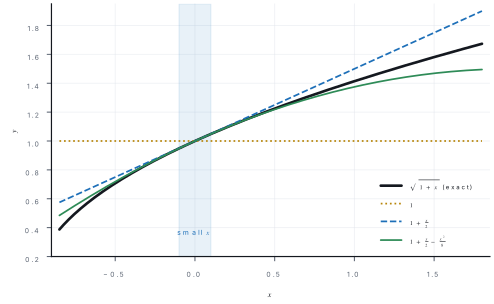
When x is small, x^{2} is very small and x^{3} smaller still, so the first two or three terms of the series already give an accurate value. This is how roots were computed before calculators, and it is still the fastest way to see how a quantity depends on a small change.
Problem. Find the value of (1.02)^{1/3} correct to five decimal places.
Solution. Write 1.02 = 1 + 0.02 and expand with n = \tfrac13, x = 0.02:
The next term is of order x^{3} \approx 10^{-6} multiplied by a coefficient less than 1, so it cannot change the fifth decimal place. Hence
(A calculator gives 1.0066227 — the two agree to seven places.)
Problem. Using the binomial theorem, find \sqrt[3]{127} correct to four decimal places.
Solution. Choose the nearest perfect cube, 125 = 5^{3}, and factor it out so that the bracket is close to 1:
Now expand with x = 0.016:
So \sqrt[3]{127} \approx 5.0265 (the true value is 5.026526).
Problem. Find \sqrt{102} correct to four decimal places, and evaluate (1.02)^{10} to four significant figures.
Solution. First part. 102 = 100(1 + 0.02), so
Hence \sqrt{102} \approx 10.0995.
Second part. Here n = 10 is a positive integer, so the expansion is exact and finite; we simply stop when the terms become negligible:
To approximate \sqrt[k]{N}, split N as (nearest perfect k^{\text{th}} power) + (small remainder), then factor the power out. For \sqrt{102} use 100, for \sqrt[3]{127} use 125, for \sqrt[4]{17} use 16. The smaller the ratio remainder/power, the faster the series converges.
2.5 Euler's number e
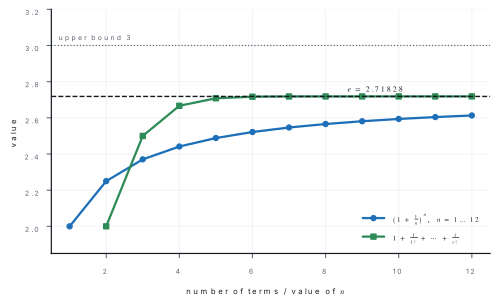
Its value is e = 2.718281828\ldots, an irrational number.
Expand \left(1+\dfrac1n\right)^{n} by the binomial theorem (n a positive integer):
Divide each n in the numerators by one factor of n from the denominator:
Let n \to \infty. Every bracket \left(1 - \dfrac{k}{n}\right) \to 1, so
Bounds. Every term is positive, and the first two already give e > 1 + 1 = 2. For an upper bound, note r! \ge 2^{\,r-1} for r \ge 1, so
and the inequality is strict because 3! = 6 > 4 = 2^{2}. Hence 2 < e < 3.
2.6 Expansion of e^{x}, a^{x} and \log(1+x) (without proof)
Putting x \to -x in the last and subtracting,
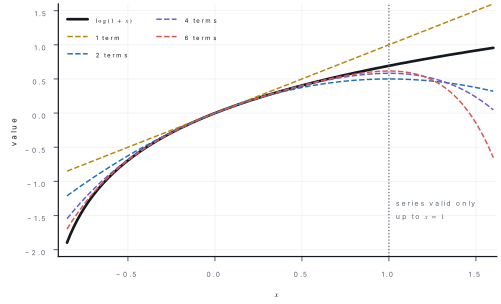
In NEB work \log with no base written means the natural logarithm \log_{e}, also written \ln. Note that the e^{x} series converges for every x, while the logarithmic series needs -1 < x \le 1: the graph below shows what happens just outside that range.
Problem. Find the sum of the series \;\dfrac{1}{1!} + \dfrac{2}{2!} + \dfrac{3}{3!} + \dfrac{4}{4!} + \cdots
Solution. The general term is \dfrac{n}{n!}. Cancel one factor of n, using n! = n\,(n-1)!:
So the series becomes, as n runs 1, 2, 3, \ldots,
The sum is e = 2.71828\ldots
Problem. Show that \;1 + \dfrac{1}{2!} + \dfrac{1}{4!} + \dfrac{1}{6!} + \cdots = \dfrac{e + e^{-1}}{2}, and evaluate it to four decimal places.
Solution. Write the two exponential series with x = 1 and x = -1:
Adding, every odd-factorial term cancels and every even one doubles:
Dividing by 2 gives the required result. Numerically,
(Subtracting instead gives the companion result \dfrac{1}{1!} + \dfrac{1}{3!} + \dfrac{1}{5!} + \cdots = \dfrac{e-e^{-1}}{2}.)
Problem. Use the logarithmic series to compute \log_{e} 2 correct to four decimal places.
Solution. Putting x = 1 in \log(1+x) gives 1 - \tfrac12 + \tfrac13 - \cdots, which is correct but crawls: you would need thousands of terms. Use the faster series instead. Choose x so that \dfrac{1+x}{1-x} = 2, which gives x = \dfrac13:
So \log_{e} 2 \approx 0.6931 (true value 0.6931472) — four terms were enough.
Problem. Expand 3^{x} in ascending powers of x as far as the term in x^{3}, and hence evaluate 3^{0.1} to four decimal places. Also write down the coefficient of x^{4} in e^{2x}.
Solution. Any power a^{x} is turned into an exponential by a = e^{\log_{e} a}, so a^{x} = e^{x\log_{e} a}. With a = 3:
Collect the powers of x:
Now put \log_{e} 3 = 1.098612, so (\log 3)^{2}/2 = 0.603474 and (\log 3)^{3}/6 = 0.220995:
At x = 0.1 each term is smaller than the last by a factor of about ten, so three terms after the 1 are ample:
Hence 3^{0.1} \approx 1.1161 (calculator: 1.1161232).
For e^{2x}, replace x by 2x in e^{x} = \sum x^{r}/r!; the term in x^{4} is (2x)^{4}/4!, so the coefficient is
Chapter summary
- (a+b)^{n} = \sum_{r=0}^{n}{}^{n}C_{r}a^{n-r}b^{r} for a positive integer n; it has n+1 terms and is proved by induction using Pascal's rule.
- General term: T_{r+1} = {}^{n}C_{r}a^{n-r}b^{r}. To find a particular term, simplify the power of x in T_{r+1} and equate it to the power wanted.
- Middle term: T_{\frac{n}{2}+1} if n is even; T_{\frac{n+1}{2}} and T_{\frac{n+3}{2}} if n is odd.
- Binomial coefficients: ^{n}C_{r} = {}^{n}C_{n-r}, they build Pascal's triangle, \sum{}^{n}C_{r} = 2^{n}, and the alternating sum is 0.
- For any index and |x| < 1: (1+x)^{n} = 1 + nx + \dfrac{n(n-1)}{2!}x^{2} + \cdots — always state |x| < 1, and factor out constants first so the bracket starts with 1.
- Approximation: split N into (nearest exact power) + (small part), factor out, expand, and keep terms until they fall below the required place value.
- e = \lim_{n\to\infty}\left(1+\dfrac1n\right)^{n} = \sum_{r=0}^{\infty}\dfrac{1}{r!} = 2.71828\ldots, and 2 < e < 3.
- e^{x} = \sum \dfrac{x^{r}}{r!} (all x); a^{x} = e^{x\log a}; \log(1+x) = x - \dfrac{x^{2}}{2} + \dfrac{x^{3}}{3} - \cdots for -1 < x \le 1.
Practice questions
Group A — Multiple choice (1 mark each)
- The number of terms in the expansion of (2x + 3y)^{12} is [1]a12b13c14d24
- The middle term of (1+x)^{10} is [1]aT_{5}bT_{6}cT_{5} and T_{6}dT_{11}
- The value of ^{n}C_{0} + {}^{n}C_{1} + \cdots + {}^{n}C_{n} is [1]a2^{n}b2^{n-1}cn^{2}d0
- The expansion of (1+x)^{-3} is valid for [1]aall xbx > 0c|x| < 1d|x| > 1
- The coefficient of x^{2} in (1-x)^{-2} is [1]a1b2c3d4
- The sum 1 + \dfrac{1}{1!} + \dfrac{1}{2!} + \dfrac{1}{3!} + \cdots equals [1]ae - 1bece + 1d\log e
Answers to Group A
1. (b) — a positive integral index n gives n+1 = 13 terms.
2. (b) — n = 10 is even, so there is one middle term, T_{\frac{10}{2}+1} = T_{6}.
3. (a) — put x = 1 in (1+x)^{n}.
4. (c) — the binomial series for a non-positive-integral index needs |x| < 1.
5. (c) — (1-x)^{-2} = 1 + 2x + 3x^{2} + \cdots
6. (b) — this is exactly the series \sum_{r\ge 0} 1/r! = e.
Group B — Short answer (5 marks each)
- State and prove the binomial theorem for a positive integral index by mathematical induction. [5]
- Find the term independent of x in the expansion of \left(2x^{2} - \dfrac{1}{x}\right)^{9}. [5]
- Find the middle term in the expansion of \left(\dfrac{2x}{3} - \dfrac{3}{2x}\right)^{6}. [5]
- Expand (1+3x)^{-2} in ascending powers of x up to the term in x^{3}, stating the range of values of x for which the expansion is valid. [5]
- Using the binomial theorem, find the value of \sqrt[5]{33} correct to four decimal places. [5]
- Find the sum of the series \dfrac{1}{2!} + \dfrac{1}{4!} + \dfrac{1}{6!} + \cdots in terms of e. [5]
Answers to Group B
1. Statement: (a+b)^{n} = \sum_{r=0}^{n}{}^{n}C_{r}a^{n-r}b^{r} for every positive integer n.
Proof. For n=1 the right-hand side is a+b, so the statement holds. Assume it holds for n = k. Multiplying by (a+b),
Shifting the index in the second sum (r \to r-1) makes both general terms a^{k+1-r}b^{r}, and collecting them gives
By Pascal's rule the bracket is ^{k+1}C_{r}, and the two loose terms are the r=0 and r=k+1 members, so the whole is \sum_{r=0}^{k+1}{}^{k+1}C_{r}a^{k+1-r}b^{r}. Hence the result holds for k+1, and by induction for all positive integers n.
2. T_{r+1} = {}^{9}C_{r}(2x^{2})^{9-r}\left(-\dfrac1x\right)^{r} = {}^{9}C_{r}\,2^{9-r}(-1)^{r}x^{18-2r-r}.
Set 18 - 3r = 0, so r = 6:
3. n = 6 is even, so the middle term is T_{4}, with r = 3:
4. With n = -2 and the quantity 3x:
Valid when |3x| < 1, that is |x| < \dfrac13.
5. The nearest fifth power is 32 = 2^{5}:
With n = \tfrac15 and x = 0.03125:
So \sqrt[5]{33} \approx 2.0123 (true value 2.0123466).
6. From Worked example 2.13, 1 + \dfrac{1}{2!} + \dfrac{1}{4!} + \cdots = \dfrac{e+e^{-1}}{2}. Subtracting the leading 1,
Group C — Long answer (8 marks each)
- (a) Write down the general term of (a+b)^{n} and use it to find the coefficient of x^{5} in \left(2x^{2} + \dfrac{3}{x}\right)^{10}. [4](b) If the coefficients of the 5^{\text{th}}, 6^{\text{th}} and 7^{\text{th}} terms in the expansion of (1+x)^{n} are in arithmetic progression, find n. [4]
- (a) State the binomial theorem for any index and the condition for its validity. Expand (1-x)^{-3} up to the term in x^{3}. [4](b) Find \sqrt[4]{17} correct to five decimal places using the binomial expansion. [4]
- (a) Show that e = \displaystyle\sum_{r=0}^{\infty}\frac{1}{r!} by expanding \left(1+\dfrac1n\right)^{n}, and prove that 2 < e < 3. [4](b) Prove that \log_{e}\dfrac{1+x}{1-x} = 2\left(x + \dfrac{x^{3}}{3} + \dfrac{x^{5}}{5} + \cdots\right) and hence find \log_{e} 1.5 correct to four decimal places. [4]
Answers to Group C
1. (a) T_{r+1} = {}^{n}C_{r}a^{n-r}b^{r}. For \left(2x^{2} + \dfrac3x\right)^{10},
Set 20 - 3r = 5, so r = 5. The coefficient is
(b) The coefficients are ^{n}C_{4}, ^{n}C_{5}, ^{n}C_{6}, and in AP means
Divide throughout by ^{n}C_{5} and use \dfrac{^{n}C_{4}}{^{n}C_{5}} = \dfrac{5}{n-4} and \dfrac{^{n}C_{6}}{^{n}C_{5}} = \dfrac{n-5}{6}:
Multiply by 6(n-4):
So n = 7 or n = 14. Check n = 14: ^{14}C_{4} = 1001, ^{14}C_{5} = 2002, ^{14}C_{6} = 3003, and 2(2002) = 1001 + 3003. ✓ Check n = 7: 35, 21, 7 and 2(21) = 35 + 7. ✓
2. (a) For any real n and |x| < 1,
Put n = -3 and replace x by -x:
(The coefficients are the triangular numbers — a useful check.)
(b) The nearest fourth power is 16 = 2^{4}:
With n = \tfrac14, x = 0.0625:
So \sqrt[4]{17} \approx 2.03054 (true value 2.0305432).
3. (a) By the binomial theorem,
Letting n \to \infty, each bracket tends to 1, giving e = 1 + \dfrac{1}{1!} + \dfrac{1}{2!} + \cdots
All terms are positive, so e > 1 + 1 = 2. Since r! \ge 2^{\,r-1} for r \ge 1,
Hence 2 < e < 3.
(b) From the logarithmic series,
Subtracting, the even powers cancel and the odd ones double:
For \log 1.5 we need \dfrac{1+x}{1-x} = \dfrac32, which gives 2 + 2x = 3 - 3x, so x = \dfrac15 = 0.2. Then
So \log_{e}1.5 \approx 0.4055 (true value 0.4054651).
Practise more: Mathematics question bank