Unit 13 · Calculus · 18 teaching hours · 48 min read
Anti-derivatives
What the syllabus asks for 3
- Standard integrals
- Integrals reducible to standard forms
- Integrals of rational functions
Differentiation asks: given a function, how fast is it changing? This unit asks the opposite question: given the rate of change, what was the function? The answer is called an anti-derivative, and the process of finding it is integration. Eighteen teaching hours make this the largest single unit in Grade 12 Mathematics, and it is also the one that pays best in the examination: Group B always carries integration items and Group C almost always carries one. The same machinery then measures areas, and in the next unit it solves differential equations.
Three things, in this order of frequency. (1) Evaluate an indefinite integral — you must recognise which of about a dozen methods applies. (2) Evaluate a definite integral, often using a symmetry property to avoid work. (3) Find an area, or evaluate an integral as the limit of a sum. Students lose marks by choosing the wrong method, not by mis-executing the right one, so learn the decision table in §13.2 before you learn any single technique.
13.1 Standard integrals
The anti-derivative and the indefinite integral
A function F is an anti-derivative of f on an interval if F'(x) = f(x) for every x in that interval.
If F is one anti-derivative of f, then so is F(x) + C for every constant C, because the derivative of a constant is zero. Conversely, any two anti-derivatives of the same function differ by a constant. The whole family is written
and is called the indefinite integral of f. Here f(x) is the integrand, x is the variable of integration, and C is the constant of integration.
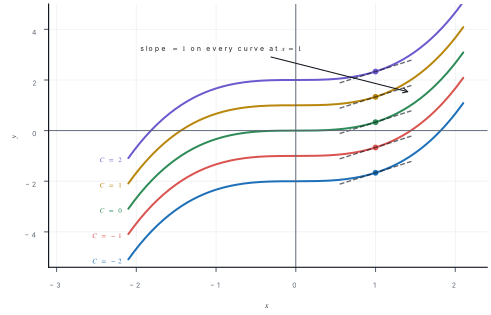
Why must two anti-derivatives differ only by a constant? If F' = G' = f, then (F-G)' = 0 everywhere, and a function with zero derivative on an interval is constant. So the picture of an indefinite integral is a vertical stack of identical curves: at any fixed x every member of the stack has exactly the same slope.
The table you must know by heart
Every integration problem in the syllabus ends by matching something to a line of this table. Learn it by reading each line backwards as a derivative.
| f(x) | \int f(x)\,dx |
|---|---|
| x^{n}, n \ne -1 | \frac{x^{n+1}}{n+1} + C |
| \frac{1}{x} | \ln|x| + C |
| e^{x} | e^{x} + C |
| a^{x}, a>0, a \ne 1 | \frac{a^{x}}{\ln a} + C |
| \sin x | -\cos x + C |
| \cos x | \sin x + C |
| \sec^{2} x | \tan x + C |
| \csc^{2} x | -\cot x + C |
| \sec x \tan x | \sec x + C |
| \csc x \cot x | -\csc x + C |
| \tan x | \ln|\sec x| + C |
| \cot x | \ln|\sin x| + C |
| \sec x | \ln|\sec x + \tan x| + C |
| \csc x | \ln|\csc x - \cot x| + C |
| \frac{1}{\sqrt{1-x^{2}}} | \sin^{-1} x + C |
| \frac{1}{1+x^{2}} | \tan^{-1} x + C |
| \frac{1}{x^{2}+a^{2}} | \frac{1}{a}\tan^{-1}\frac{x}{a} + C |
| \frac{1}{x^{2}-a^{2}} | \frac{1}{2a}\ln\left|\frac{x-a}{x+a}\right| + C |
| \frac{1}{a^{2}-x^{2}} | \frac{1}{2a}\ln\left|\frac{a+x}{a-x}\right| + C |
| \frac{1}{\sqrt{a^{2}-x^{2}}} | \sin^{-1}\frac{x}{a} + C |
| \frac{1}{\sqrt{x^{2}+a^{2}}} | \ln\left|x+\sqrt{x^{2}+a^{2}}\right| + C |
| \frac{1}{\sqrt{x^{2}-a^{2}}} | \ln\left|x+\sqrt{x^{2}-a^{2}}\right| + C |
| \sqrt{a^{2}-x^{2}} | \frac{x}{2}\sqrt{a^{2}-x^{2}} + \frac{a^{2}}{2}\sin^{-1}\frac{x}{a} + C |
| \sqrt{x^{2}+a^{2}} | \frac{x}{2}\sqrt{x^{2}+a^{2}} + \frac{a^{2}}{2}\ln\left|x+\sqrt{x^{2}+a^{2}}\right| + C |
| \sqrt{x^{2}-a^{2}} | \frac{x}{2}\sqrt{x^{2}-a^{2}} - \frac{a^{2}}{2}\ln\left|x+\sqrt{x^{2}-a^{2}}\right| + C |
The last nine lines are the quadratic standard forms. Roughly half of all Group B integration questions reduce to one of them.
Two rules let you use the table on a whole expression at once. For constants k and integrable f, g:
There is no product rule and no quotient rule for integrals. That missing pair of rules is the reason this unit needs so many separate methods.
Because of that, integration is a recognition skill rather than a procedure. Differentiation can be done mechanically by anyone who knows three rules, but integration asks you to look at an expression and decide what it is disguised as. That is why practice matters more here than anywhere else in the syllabus, and why the first thing to do with any integral is not to start writing but to spend ten seconds classifying it.
A third rule follows from the chain rule and costs nothing to learn. If \int f(x)\,dx = F(x) + C then, for constants a \ne 0 and b,
because differentiating the right side brings a factor a down, which cancels the \frac{1}{a}.
Problem. Evaluate \int \left(3x^{2} - \frac{4}{x} + 5\sqrt{x} + e^{x}\right)dx.
Solution. Split the integral term by term and apply the table to each.
For 5\sqrt{x} = 5x^{1/2} the power rule gives exponent \frac12 + 1 = \frac32:
and \int e^{x}dx = e^{x}. Collecting, and writing one constant for all four,
Check. Differentiate: 3x^{2} - \frac4x + \frac{10}{3}\cdot\frac32 x^{1/2} + e^{x} = 3x^{2} - \frac4x + 5\sqrt{x} + e^{x}. Correct.
Problem. Evaluate \int \left(\sqrt{x} + \frac{1}{\sqrt{x}}\right)^{2}dx and \int \frac{(x^{2}+1)^{2}}{x^{2}}\,dx.
Solution. Neither integrand is in the table, but both become table entries after ordinary algebra. Always expand or divide out first.
For the second, expand the numerator and divide each term by x^{2}:
Problem. Evaluate (a) \int \tan^{2}x\,dx, (b) \int \sin^{2}x\,dx, (c) \int \frac{dx}{1+\cos x}.
Solution. Every one of these is solved by a trigonometric identity, not by a new integration rule.
(a) Use \sec^{2}x - \tan^{2}x = 1, so \tan^{2}x = \sec^{2}x - 1:
(b) Use the power-reduction identity \cos 2x = 1 - 2\sin^{2}x, so \sin^{2}x = \frac{1 - \cos 2x}{2}:
(c) Use 1 + \cos x = 2\cos^{2}\frac{x}{2}:
Problem. Evaluate (a) \int (2x+3)^{5}dx, (b) \int \frac{dx}{3x+2}, (c) \int \sin(5x-2)\,dx, (d) \int \frac{dx}{\sqrt{2x+1}}.
Solution. All four are of the form f(ax+b), so integrate as if the bracket were x and divide by a.
(a) a = 2: \quad \int (2x+3)^{5}dx = \frac{1}{2}\cdot\frac{(2x+3)^{6}}{6} + C = \frac{(2x+3)^{6}}{12} + C
(b) a = 3: \quad \int \frac{dx}{3x+2} = \frac{1}{3}\ln|3x+2| + C
(c) a = 5: \quad \int \sin(5x-2)\,dx = -\frac{1}{5}\cos(5x-2) + C
(d) a = 2 and \int x^{-1/2}dx = 2\sqrt{x}: \quad \int \frac{dx}{\sqrt{2x+1}} = \frac{1}{2}\cdot 2\sqrt{2x+1} + C = \sqrt{2x+1} + C
It works for (2x+3)^{5} but not for (2x^{2}+3)^{5}, because differentiating (2x^{2}+3)^{6} produces 4x, not a constant. A non-linear inside function always needs a substitution, and the substitution only closes if the derivative of the inside function is already present as a factor.
An indefinite integral without +C is one function instead of a whole family, and NEB markers deduct for it every single time. Also remember \ln|x|, not \ln x: the modulus is what makes the formula valid for negative x too.
13.2 Integrals reducible to standard forms
Most integrands are not in the table. The art is to change them into something that is. Read this decision table first; then learn the individual techniques.
Read the table from the top down and stop at the first row that fits. The rows are deliberately in that order: the cheap checks — is it already standard, can it be expanded, is it linear inside — come before the expensive ones. A great many marks are thrown away each year by students who reach for integration by parts on an integral that a single substitution would have finished in two lines, or who attempt partial fractions on a fraction that is not yet proper.
| The integrand looks like | Method | Typical example |
|---|---|---|
| a table entry, or a constant times one | read it off the table | \int \sec^{2}x\,dx |
| a sum, product or quotient of powers | expand or divide out, then the table | \int \frac{(x^{2}+1)^{2}}{x^{2}}dx |
| f(ax+b) with \int f known | integrate, divide by a | \int (2x+3)^{5}dx |
| contains g(x) and its derivative g'(x) | substitute u = g(x) | \int x\sqrt{x^{2}+1}\,dx |
| exactly \frac{g'(x)}{g(x)} | answer is \ln|g(x)| | \int \tan x\,dx |
| product of two unlike functions | by parts, order by ILATE | \int x e^{x}dx |
| a lone \ln or inverse-trig function | by parts against 1 | \int \tan^{-1}x\,dx |
| e^{ax}\sin bx or e^{ax}\cos bx | by parts twice, then solve for I | \int e^{x}\sin x\,dx |
| quadratic in the denominator, no x on top | complete the square, then table | \int \frac{dx}{x^{2}+6x+13} |
| \frac{px+q}{ax^{2}+bx+c} or \frac{px+q}{\sqrt{ax^{2}+bx+c}} | split px+q = \lambda\,(\text{denom})' + \mu | \int \frac{2x+3}{x^{2}+4x+5}dx |
| \sqrt{a^{2}-x^{2}}, \sqrt{a^{2}+x^{2}}, \sqrt{x^{2}-a^{2}} | x=a\sin\theta, a\tan\theta, a\sec\theta | \int \sqrt{9-x^{2}}\,dx |
| a rational function of \sin x and \cos x | t = \tan\frac{x}{2} | \int \frac{dx}{5+4\cos x} |
| a ratio of two polynomials | divide if improper, then partial fractions | \int \frac{x^{2}+1}{(x+1)(x+2)}dx |
| a single x outside a heavy radical | inverse substitution x = \frac1t | \int \frac{dx}{x\sqrt{1+x^{2}}} |
Integration by substitution
If we put u = g(x) then du = g'(x)\,dx, and
The substitution closes only when every remaining x disappears. That is the test: after substituting, if any x is left, the choice of u was wrong.
Problem. Evaluate \int x\sqrt{x^{2}+1}\,dx.
Solution. The derivative of x^{2}+1 is 2x, and an x is already present.
Put u = x^{2}+1, so du = 2x\,dx, i.e. x\,dx = \frac{du}{2}.
Put u back: \quad = \frac{1}{3}\left(x^{2}+1\right)^{3/2} + C.
Check. \frac{d}{dx}\frac{(x^{2}+1)^{3/2}}{3} = \frac{1}{3}\cdot\frac32(x^{2}+1)^{1/2}\cdot 2x = x\sqrt{x^{2}+1}. Correct.
Whenever the numerator is exactly the derivative of the denominator (or a constant times it), write down the logarithm immediately. This one pattern produces \int\tan x\,dx, \int\cot x\,dx, \int\frac{x^{3}}{x^{4}+5}dx and half of every partial-fraction answer.
Problem. Prove that \int \tan x\,dx = \ln|\sec x| + C and \int \cot x\,dx = \ln|\sin x| + C.
Solution. Write \tan x = \dfrac{\sin x}{\cos x} and put u = \cos x, so du = -\sin x\,dx:
For the cotangent, u = \sin x gives du = \cos x\,dx and the numerator is already \cos x:
Problem. Evaluate (a) \int \frac{e^{\tan^{-1}x}}{1+x^{2}}\,dx, (b) \int \frac{x^{3}}{x^{4}+5}\,dx, (c) \int \frac{dx}{x\ln x}, (d) \int \sin^{3}x\cos x\,dx.
Solution. In each case spot the inside function and its derivative.
(a) u = \tan^{-1}x, du = \frac{dx}{1+x^{2}}: \quad \int e^{u}du = e^{u} + C = e^{\tan^{-1}x} + C
(b) u = x^{4}+5, du = 4x^{3}dx: \quad \frac14\int\frac{du}{u} = \frac14\ln\left|x^{4}+5\right| + C
(c) u = \ln x, du = \frac{dx}{x}: \quad \int\frac{du}{u} = \ln\left|\ln x\right| + C
(d) u = \sin x, du = \cos x\,dx: \quad \int u^{3}du = \frac{u^{4}}{4} + C = \frac{\sin^{4}x}{4} + C
Problem. Prove the standard result \int \sec x\,dx = \ln|\sec x + \tan x| + C.
Solution. The trick is to multiply and divide by \sec x + \tan x, which manufactures a "derivative over function" pattern.
Now put u = \sec x + \tan x. Then du = \left(\sec x\tan x + \sec^{2}x\right)dx, which is exactly the numerator:
The same trick with \csc x - \cot x gives \int \csc x\,dx = \ln|\csc x - \cot x| + C.
Integration by parts
Start from the product rule for two differentiable functions u and v:
Integrate both sides with respect to x. The left side integrates back to uv:
Rearranging gives the working formula
or, with u = u(x) and dv = v'(x)\,dx written out in full,
The method is useful exactly when \int v\,du is easier than \int u\,dv.
Choose u as the function that comes first in this list:
I — Inverse trigonometric (\sin^{-1}x, \tan^{-1}x, …) L — Logarithmic (\ln x) A — Algebraic (x, x^{2}, polynomials) T — Trigonometric (\sin x, \cos x) E — Exponential (e^{x}, a^{x})
The rest of the integrand is dv. The logic is that I and L get simpler when differentiated, while T and E are just as easy to integrate as to differentiate.
Problem. Evaluate \int x e^{x}\,dx.
Solution. Algebraic before Exponential, so u = x and dv = e^{x}dx.
Then du = dx and v = e^{x}.
Check. \frac{d}{dx}\left[(x-1)e^{x}\right] = e^{x} + (x-1)e^{x} = x e^{x}. Correct.
Had we chosen u = e^{x} instead, we would have got \frac{x^{2}}{2}e^{x} - \int \frac{x^{2}}{2}e^{x}dx — a harder integral. That is what ILATE protects you from.
Problem. Evaluate \int x^{2}\sin x\,dx (the repeated case).
Solution. Algebraic before Trigonometric: u = x^{2}, dv = \sin x\,dx, so du = 2x\,dx and v = -\cos x.
The new integral is still a product, but the power of x has dropped by one. Apply parts again with u = x, dv = \cos x\,dx, v = \sin x:
Substituting back,
Check. Differentiating gives -2x\cos x + x^{2}\sin x + 2\sin x + 2x\cos x - 2\sin x = x^{2}\sin x. Correct. An integrand x^{n}\sin x needs exactly n applications of parts.
Problem. Evaluate \int \ln x\,dx, \int x^{2}\ln x\,dx and \int \tan^{-1}x\,dx.
Solution. A lone logarithm or inverse-trig function is integrated against the invisible factor 1.
(a) u = \ln x, dv = 1\,dx, so du = \frac{dx}{x} and v = x:
(b) L before A: u = \ln x, dv = x^{2}dx, so v = \frac{x^{3}}{3}:
(c) u = \tan^{-1}x, dv = 1\,dx, so du = \frac{dx}{1+x^{2}} and v = x:
using \int\frac{g'}{g} = \ln|g| with g = 1+x^{2} (always positive, so no modulus is needed).
Problem. Evaluate I = \int e^{x}\sin x\,dx (the cyclic case).
Solution. Neither factor simplifies on differentiation, so parts will never terminate. Instead, apply it twice and recover the original integral.
Take u = \sin x, dv = e^{x}dx, so v = e^{x}:
Apply parts to the new integral with u = \cos x, dv = e^{x}dx:
Substituting back,
The general result, obtained the same way, is
For example \int e^{2x}\cos 3x\,dx = \frac{e^{2x}}{13}\left(2\cos 3x + 3\sin 3x\right) + C.
Proof: differentiate the right side. So \int e^{x}(\sin x + \cos x)\,dx = e^{x}\sin x + C in one line. Look for this pattern before doing parts twice — it saves several minutes in the examination.
Reducing to the quadratic standard forms
First form. Split by partial fractions, using \frac{1}{x^{2}-a^{2}} = \frac{1}{(x-a)(x+a)} and the identity \frac{1}{(x-a)(x+a)} = \frac{1}{2a}\left[\frac{1}{x-a} - \frac{1}{x+a}\right]:
Second form. Put x = a\tan\theta, so dx = a\sec^{2}\theta\,d\theta and \sqrt{x^{2}+a^{2}} = a\sec\theta:
From the reference triangle, \tan\theta = \frac{x}{a} and \sec\theta = \frac{\sqrt{x^{2}+a^{2}}}{a}, so
because -\ln a is itself a constant and is absorbed into C.
Any quadratic can be pushed into one of these forms by completing the square: ax^{2}+bx+c = a\left[\left(x+\frac{b}{2a}\right)^{2} + \frac{4ac-b^{2}}{4a^{2}}\right]. Then substitute t = x + \frac{b}{2a}.
Problem. Evaluate (a) \int \frac{dx}{4x^{2}+9}, (b) \int \frac{dx}{x^{2}-16}, (c) \int \frac{dx}{\sqrt{9-4x^{2}}}.
Solution. Force each into the shape x^{2} \pm a^{2} by taking the leading coefficient outside.
(a) 4x^{2}+9 = 4\left(x^{2} + \frac94\right), so a = \frac32:
(b) Here a = 4 directly:
(c) 9-4x^{2} = 4\left(\frac94 - x^{2}\right), so \sqrt{9-4x^{2}} = 2\sqrt{\left(\frac32\right)^{2}-x^{2}}:
Problem. Evaluate (a) \int \frac{dx}{x^{2}+6x+13}, (b) \int \frac{dx}{\sqrt{x^{2}+4x+13}}, (c) \int \frac{dx}{\sqrt{5-4x-x^{2}}}.
Solution. Complete the square in every case.
(a) x^{2}+6x+13 = (x+3)^{2} + 4 = (x+3)^{2} + 2^{2}. Put t = x+3, dt = dx:
(b) x^{2}+4x+13 = (x+2)^{2} + 9 = (x+2)^{2} + 3^{2}. With t = x+2:
(c) Take out the minus sign first: 5-4x-x^{2} = 5 - \left(x^{2}+4x\right) = 5 + 4 - (x+2)^{2} = 3^{2} - (x+2)^{2}. With t = x+2:
\sqrt{x^{2}+4x+13} leads to a logarithm; \sqrt{5-4x-x^{2}} leads to an inverse sine. The difference is only the sign of x^{2}, and it changes the whole answer. Write the bracket out fully rather than doing it in your head.
The forms \frac{px+q}{ax^{2}+bx+c} and \frac{px+q}{\sqrt{ax^{2}+bx+c}}
With an x in the numerator, split the numerator into a multiple of the derivative of the quadratic plus a constant:
Comparing coefficients, \lambda = \frac{p}{2a} and \mu = q - \frac{pb}{2a}. The \lambda piece is a \frac{g'}{g} pattern (a logarithm, or a square root); the \mu piece is one of the quadratic standard forms just done.
Problem. Evaluate \int \frac{2x+3}{x^{2}+4x+5}\,dx.
Solution. The derivative of x^{2}+4x+5 is 2x+4. Write
so the integral splits into two:
The first is \frac{g'}{g}, giving \ln\left|x^{2}+4x+5\right|; and since x^{2}+4x+5 = (x+2)^{2}+1 > 0 we may drop the modulus. For the second, t = x+2 gives \int \frac{dt}{t^{2}+1} = \tan^{-1}(x+2). Hence
Problem. Evaluate \int \frac{x+2}{\sqrt{x^{2}+2x+3}}\,dx.
Solution. The derivative of x^{2}+2x+3 is 2x+2, so
In the first integral put u = x^{2}+2x+3, du = (2x+2)dx:
For the second, x^{2}+2x+3 = (x+1)^{2}+2, so with t = x+1, \int\frac{dt}{\sqrt{t^{2}+2}} = \ln\left|t+\sqrt{t^{2}+2}\right|. Altogether
Integration has a free self-check that differentiation does not: differentiate your answer and see whether you get the integrand back. It takes fifteen seconds and it catches sign slips, missing factors of \frac12, and wrong partial fraction constants. In the examination, if a question is worth five marks, spend one of your minutes on this check — a wrong answer with perfect method still loses most of the marks.
Trigonometric substitutions
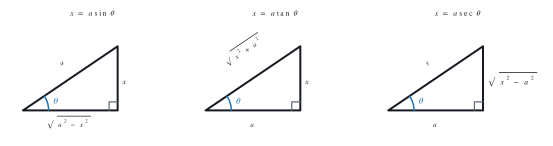
When a radical cannot be removed by completing the square alone, replace x by a trigonometric function chosen to make the radical collapse by a Pythagorean identity. Draw the reference triangle so that you can change back at the end.
| Radical | Substitute | Radical becomes | Because |
|---|---|---|---|
| \sqrt{a^{2}-x^{2}} | x = a\sin\theta | a\cos\theta | 1-\sin^{2}\theta = \cos^{2}\theta |
| \sqrt{a^{2}+x^{2}} | x = a\tan\theta | a\sec\theta | 1+\tan^{2}\theta = \sec^{2}\theta |
| \sqrt{x^{2}-a^{2}} | x = a\sec\theta | a\tan\theta | \sec^{2}\theta-1 = \tan^{2}\theta |
Problem. Derive \int \sqrt{a^{2}-x^{2}}\,dx = \frac{x}{2}\sqrt{a^{2}-x^{2}} + \frac{a^{2}}{2}\sin^{-1}\frac{x}{a} + C.
Solution. Put x = a\sin\theta, so dx = a\cos\theta\,d\theta and \sqrt{a^{2}-x^{2}} = a\cos\theta.
Use \cos^{2}\theta = \frac{1+\cos 2\theta}{2}:
From the first reference triangle, \theta = \sin^{-1}\frac{x}{a}, \sin\theta = \frac{x}{a} and \cos\theta = \frac{\sqrt{a^{2}-x^{2}}}{a}, so
Problem. Evaluate \int \frac{dx}{x^{2}\sqrt{x^{2}-9}}.
Solution. The radical is \sqrt{x^{2}-a^{2}} with a = 3, so put x = 3\sec\theta, dx = 3\sec\theta\tan\theta\,d\theta and \sqrt{x^{2}-9} = 3\tan\theta.
From the third reference triangle, the hypotenuse is x, the adjacent side is 3, and the opposite side is \sqrt{x^{2}-9}, so \sin\theta = \frac{\sqrt{x^{2}-9}}{x}. Hence
Check. Differentiating \frac{1}{9}\left(1 - \frac{9}{x^{2}}\right)^{1/2}, written this way to make the algebra short, returns \frac{1}{x^{2}\sqrt{x^{2}-9}}. Correct.
Problem. Evaluate \int \frac{dx}{x\sqrt{1+x^{2}}} by the inverse substitution x = \frac{1}{t}.
Solution. When a single power of x sits outside a heavy radical, the substitution x = \frac1t turns the radical inside out. Here dx = -\frac{dt}{t^{2}} and
Taking t>0 (i.e. x>0),
Putting t = \frac1x back,
The forms \frac{1}{a+b\cos x} and \frac{1}{a\sin x + b\cos x}
Put t = \tan\dfrac{x}{2}. Then
Every rational function of \sin x and \cos x becomes a rational function of t, which §13.3 can always finish. To see where dx comes from: t=\tan\frac x2 gives \frac{dt}{dx} = \frac12\sec^{2}\frac{x}{2} = \frac{1+t^{2}}{2}.
Problem. Evaluate \int \frac{dx}{5+4\cos x}.
Solution. Put t = \tan\frac{x}{2}. Then
and dx = \frac{2\,dt}{1+t^{2}}, so the factor 1+t^{2} cancels completely:
Problem. Evaluate \int \frac{dx}{3\sin x + 4\cos x}.
Solution. Again put t = \tan\frac{x}{2}:
Split by partial fractions. Writing \frac{1}{(2t+1)(t-2)} = \frac{A}{2t+1} + \frac{B}{t-2} gives 1 = A(t-2) + B(2t+1). Put t=2: 1 = 5B, so B = \frac15. Put t = -\frac12: 1 = -\frac52 A, so A = -\frac25. Hence
Notice the coefficient \frac15 = \frac{1}{\sqrt{3^{2}+4^{2}}}. That is no accident: a\sin x + b\cos x = \sqrt{a^{2}+b^{2}}\,\sin(x+\alpha), so the integral always carries a factor \frac{1}{\sqrt{a^{2}+b^{2}}} — a fast way to check your answer.
13.3 Integrals of rational functions
A rational function is a quotient \frac{P(x)}{Q(x)} of two polynomials. If \deg P \ge \deg Q the fraction is improper: divide first, so that
Once the fraction is proper, factorise Q(x) and split it into partial fractions. There are exactly four cases, decided entirely by the factors of the denominator.
| Factor of Q(x) | Contributes |
|---|---|
| distinct linear (x-a) | \dfrac{A}{x-a} |
| repeated linear (x-a)^{2} | \dfrac{A}{x-a} + \dfrac{B}{(x-a)^{2}} |
| distinct irreducible quadratic (x^{2}+px+q) | \dfrac{Ax+B}{x^{2}+px+q} |
| repeated quadratic (x^{2}+px+q)^{2} | \dfrac{Ax+B}{x^{2}+px+q} + \dfrac{Cx+D}{(x^{2}+px+q)^{2}} |
The number of unknown constants always equals \deg Q. Find them either by substituting convenient values of x (fastest for linear factors) or by comparing coefficients (necessary for quadratic factors).
Problem. Evaluate \int \frac{dx}{(x-1)(x+2)} — distinct linear factors.
Solution. Write
Multiply through by (x-1)(x+2): \quad 1 = A(x+2) + B(x-1).
Put x = 1: \;1 = 3A, so A = \frac13. Put x = -2: \;1 = -3B, so B = -\frac13. Therefore
Problem. Evaluate \int \frac{dx}{(x-1)(x-2)(x-3)} and \int \frac{x\,dx}{(x-1)(x-2)}.
Solution. (a) With \frac{1}{(x-1)(x-2)(x-3)} = \frac{A}{x-1}+\frac{B}{x-2}+\frac{C}{x-3} we get 1 = A(x-2)(x-3) + B(x-1)(x-3) + C(x-1)(x-2).
Put x=1: 1 = A(-1)(-2) = 2A, so A = \frac12. Put x=2: 1 = B(1)(-1) = -B, so B = -1. Put x=3: 1 = C(2)(1) = 2C, so C = \frac12.
(b) \frac{x}{(x-1)(x-2)} = \frac{A}{x-1} + \frac{B}{x-2} gives x = A(x-2)+B(x-1). Put x=1: A = -1. Put x=2: B = 2. So
Problem. Evaluate \int \frac{3x+5}{(x-1)^{2}(x+1)}\,dx — a repeated linear factor.
Solution. The repeated factor needs two terms:
Multiplying by (x-1)^{2}(x+1):
Put x=1: \;8 = 2B, so B = 4. Put x=-1: \;2 = 4D, so D = \frac12. Compare the coefficients of x^{2}: \;0 = A + D, so A = -\frac12.
using \int (x-1)^{-2}dx = -\frac{1}{x-1}. Note that only the first-power terms give logarithms.
Writing only \frac{A}{(x-1)^{2}} + \frac{D}{x+1} gives two equations for a problem that needs three constants, and the identity then fails for general x. A factor (x-a)^{n} always contributes n terms, with denominators (x-a), (x-a)^{2}, \dots, (x-a)^{n}.
Problem. Evaluate \int \frac{dx}{(x-1)\left(x^{2}+1\right)} — an irreducible quadratic factor.
Solution. Since x^{2}+1 has no real factors, it takes a linear numerator:
Put x=1: \;1 = 2A, so A = \frac12. Coefficient of x^{2}: \;0 = A + B, so B = -\frac12. Constant term: \;1 = A - D, so D = -\frac12.
Split the second integral: \frac{x}{x^{2}+1} is a \frac{g'}{2g} pattern and \frac{1}{x^{2}+1} is a standard form.
Problem. Evaluate \int \frac{x^{3}+2x+1}{\left(x^{2}+1\right)^{2}}\,dx — a repeated quadratic factor.
Solution. The decomposition is
Multiplying up, \;x^{3}+2x+1 = (Ax+B)\left(x^{2}+1\right) + Dx + E, i.e.
Comparing coefficients: A = 1, B = 0, A + D = 2 so D = 1, and B + E = 1 so E = 1. Hence
The first two use u = x^{2}+1, du = 2x\,dx:
The third needs x = \tan\theta, dx = \sec^{2}\theta\,d\theta:
With \theta = \tan^{-1}x, \sin\theta = \frac{x}{\sqrt{1+x^{2}}} and \cos\theta = \frac{1}{\sqrt{1+x^{2}}}, this is \frac12\tan^{-1}x + \frac{x}{2\left(1+x^{2}\right)}. Collecting everything,
Problem. Evaluate \int \frac{x^{2}+1}{(x+1)(x+2)}\,dx and \int \frac{x^{2}}{x^{2}+1}\,dx — improper fractions.
Solution. In both, the numerator degree is not less than the denominator degree, so divide first.
(a) \frac{x^{2}+1}{x^{2}+3x+2} = 1 + \frac{-3x-1}{(x+1)(x+2)}. Now \frac{-3x-1}{(x+1)(x+2)} = \frac{A}{x+1} + \frac{B}{x+2} gives -3x-1 = A(x+2)+B(x+1). Put x=-1: 2 = A. Put x=-2: 5 = -B, so B=-5.
(b) \frac{x^{2}}{x^{2}+1} = 1 - \frac{1}{x^{2}+1}, so the integral is x - \tan^{-1}x + C at once. Dividing out first turns a hard-looking problem into a one-line one.
Problem. Evaluate \int \frac{dx}{x^{3}+1}.
Solution. Factorise the denominator using a^{3}+b^{3} = (a+b)\left(a^{2}-ab+b^{2}\right): \;x^{3}+1 = (x+1)\left(x^{2}-x+1\right), and x^{2}-x+1 is irreducible (discriminant 1-4 = -3 < 0). So
Put x=-1: \;1 = 3A, so A = \frac13. Coefficient of x^{2}: 0 = A + B, so B = -\frac13. Constant: 1 = A + D, so D = \frac23. Then
For the second integral, split the numerator using (x^{2}-x+1)' = 2x-1: \;x-2 = \frac12(2x-1) - \frac32. Also x^{2}-x+1 = \left(x-\frac12\right)^{2} + \frac34, so
Therefore
13.4 The definite integral and its properties
Everything so far produced a family of functions. A definite integral produces a single number, and that number measures an accumulation: area, distance, total charge, total cost.
The shift is worth dwelling on. If v(t) is the velocity of a bus on the Prithvi Highway, then \int v(t)\,dt is a family of position functions — useless until you know where the bus started. But \int_{9}^{12} v(t)\,dt is the distance covered between nine and twelve o'clock, and that is a definite number you can quote in kilometres. Definite integration is how a rate becomes a total.
If f is continuous on [a,b] and F is any anti-derivative of f, then
Here a is the lower limit and b the upper limit. The constant of integration cancels, since \left(F(b)+C\right) - \left(F(a)+C\right) = F(b)-F(a), which is why a definite integral never carries +C.
The link between the two halves of calculus is the fundamental theorem: if A(x) = \int_{a}^{x} f(t)\,dt is the accumulated area up to x, then A'(x) = f(x). Differentiating an area function gives back the curve. The picture below is worth memorising, because it is the whole of calculus in two panels.
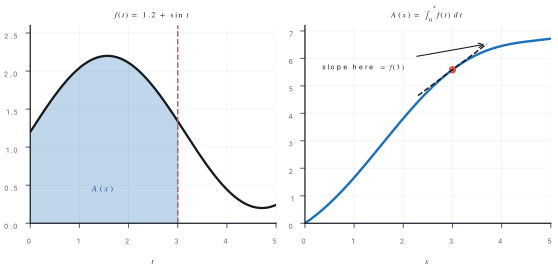
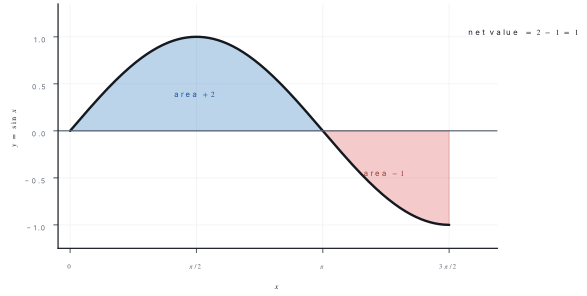
A definite integral counts area below the axis as negative. So \int_{a}^{b} f\,dx is a signed area, and it can be zero even when the region is large.
Problem. Evaluate (a) \int_{1}^{2}\left(x^{2}+1\right)dx, (b) \int_{0}^{\pi}\sin x\,dx, (c) \int_{0}^{3\pi/2}\sin x\,dx, (d) \int_{0}^{2\pi}\sin x\,dx.
Solution. Find an anti-derivative, then subtract.
(a) \left[\frac{x^{3}}{3}+x\right]_{1}^{2} = \left(\frac83+2\right) - \left(\frac13+1\right) = \frac{14}{3} - \frac43 = \frac{10}{3}
(b) \left[-\cos x\right]_{0}^{\pi} = -\cos\pi + \cos 0 = 1+1 = 2
(c) \left[-\cos x\right]_{0}^{3\pi/2} = -\cos\frac{3\pi}{2} + \cos 0 = 0 + 1 = 1
(d) \left[-\cos x\right]_{0}^{2\pi} = -1+1 = 0
Parts (b), (c) and (d) are the three cases drawn in the figure: all area above, part below, and exact cancellation.
In a definite integral you may either (i) convert the limits to the new variable, or (ii) integrate back to x first and then substitute. What you must never do is use the old limits with the new variable. In \int_{0}^{4}\frac{x\,dx}{\sqrt{x^{2}+9}} with u = x^{2}+9, the limits become u = 9 and u = 25, not 0 and 4.
Problem. Evaluate \int_{0}^{4}\frac{x}{\sqrt{x^{2}+9}}\,dx and \int_{0}^{1} x e^{x}\,dx.
Solution. (a) Put u = x^{2}+9, so du = 2x\,dx. When x=0, u=9; when x=4, u=25.
(b) By parts, using Worked example 13.9:
The eight properties
P1 \displaystyle\int_{a}^{b} f(x)\,dx = -\int_{b}^{a} f(x)\,dx, and \displaystyle\int_{a}^{a} f(x)\,dx = 0
P2 \displaystyle\int_{a}^{b} f(x)\,dx = \int_{a}^{c} f(x)\,dx + \int_{c}^{b} f(x)\,dx for any c
P3 \displaystyle\int_{a}^{b} f(x)\,dx = \int_{a}^{b} f(t)\,dt — the variable of integration is a dummy
P4 \displaystyle\int_{0}^{a} f(x)\,dx = \int_{0}^{a} f(a-x)\,dx
P5 \displaystyle\int_{a}^{b} f(x)\,dx = \int_{a}^{b} f(a+b-x)\,dx
P6 \displaystyle\int_{-a}^{a} f(x)\,dx = 2\int_{0}^{a} f(x)\,dx if f is even, and = 0 if f is odd
P7 \displaystyle\int_{0}^{2a} f(x)\,dx = 2\int_{0}^{a} f(x)\,dx if f(2a-x) = f(x), and = 0 if f(2a-x) = -f(x)
P8 \displaystyle\int_{0}^{a} f(x)\,dx \ge 0 if f(x)\ge 0 on [a,b], and \left|\int_{a}^{b}f\right| \le \int_{a}^{b}|f|
In \int_{0}^{a} f(x)\,dx put x = a - t, so dx = -dt. When x=0, t=a, and when x=a, t=0:
using P1 to swap the limits and absorb the minus sign. By P3 the dummy t may be renamed x, which is P4. The same substitution x = a+b-t proves P5.
P4 and P5 are the two properties that make "impossible" integrals collapse: add the original to the reflected copy and the integrand often becomes a constant.
Problem. Evaluate I = \displaystyle\int_{0}^{\pi/2} \frac{\sqrt{\sin x}}{\sqrt{\sin x}+\sqrt{\cos x}}\,dx.
Solution. No anti-derivative of this integrand exists in elementary terms, so use P4 with a = \frac{\pi}{2}. Since \sin\left(\frac{\pi}{2}-x\right) = \cos x and \cos\left(\frac{\pi}{2}-x\right) = \sin x,
Add the two expressions for I. The denominators are now identical:
The same argument gives \int_{0}^{\pi/2}\frac{dx}{1+\tan x} = \frac{\pi}{4} and \int_{0}^{\pi/2}\sin^{2}x\,dx = \int_{0}^{\pi/2}\cos^{2}x\,dx = \frac{\pi}{4}, because in each case the two copies add to 1.
Problem. Use P6 to evaluate \int_{-1}^{1}\left(x^{3}+x\right)dx and \int_{-2}^{2}x^{2}\,dx.
Solution. Test the parity first.
(a) f(-x) = -x^{3}-x = -f(x), so f is odd and the integral over a symmetric interval is 0. (Check directly: \left[\frac{x^{4}}{4}+\frac{x^{2}}{2}\right]_{-1}^{1} = \frac34 - \frac34 = 0.)
(b) f(-x) = x^{2} = f(x), so f is even:
For a mixed integrand, split it: \int_{-2}^{2}\left(x^{3}+3x^{2}\right)dx = 0 + 3 \cdot \frac{16}{3} = 16, because the cube is odd and the square is even. Recognising parity turns a two-substitution problem into one line.
Problem. Evaluate \int_{0}^{\pi} x\sin x\,dx two ways.
Solution. By parts. With u = x and dv = \sin x\,dx,
By P4. Replacing x by \pi - x and using \sin(\pi-x) = \sin x,
so 2I = \pi \cdot 2 = 2\pi and I = \pi. The second method needs only \int_{0}^{\pi}\sin x\,dx = 2, and it generalises: for any f, \int_{0}^{\pi}x f(\sin x)\,dx = \frac{\pi}{2}\int_{0}^{\pi}f(\sin x)\,dx.
Problem. Evaluate (a) \int_{1}^{2}\frac{dx}{x(x+1)}, (b) \int_{3}^{5}\frac{dx}{\sqrt{x^{2}-9}}, (c) \int_{0}^{\pi/2}\cos^{3}x\,dx.
Solution. (a) Partial fractions: \frac{1}{x(x+1)} = \frac1x - \frac{1}{x+1}, so
(b) A standard form with a=3:
(c) Write \cos^{3}x = \cos x\left(1-\sin^{2}x\right) and put u = \sin x, with limits u=0 to u=1:
13.5 The definite integral as the limit of a sum
The definite integral was defined long before anti-derivatives, as the limiting total of thin rectangles. NEB asks for this derivation, so learn the four steps.
The idea is older than calculus: Greek mathematicians found areas by filling shapes with polygons and letting the number of sides grow. What Newton and Leibniz added was the discovery that this limit can be computed without any limits at all, by anti-differentiating. When a question says "evaluate as the limit of a sum", however, it is asking for the long method, and no marks are available for quoting F(b)-F(a).
Divide [a,b] into n equal sub-intervals, each of width h = \frac{b-a}{n}. The division points are a,\;a+h,\;a+2h,\;\dots,\;a+nh = b.
Step 1. On the r-th sub-interval take the rectangle of height f(a+rh) (the right-hand endpoint). Its area is h\,f(a+rh).
Step 2. Add the n rectangles:
Step 3. As n\to\infty the rectangles get thinner and S_{n} closes in on the exact area. Define
Step 4. Evaluate the sum in closed form using \sum r = \frac{n(n+1)}{2}, \sum r^{2} = \frac{n(n+1)(2n+1)}{6}, \sum r^{3} = \frac{n^{2}(n+1)^{2}}{4}, or the geometric series for e^{x}, and then take the limit.
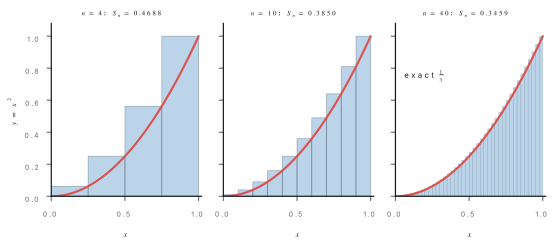
Problem. Evaluate \int_{0}^{1}x^{2}\,dx as the limit of a sum.
Solution. Here a=0, b=1, f(x)=x^{2} and h = \frac1n, so f(a+rh) = \left(\frac{r}{n}\right)^{2}.
Expand the numerator and divide through by n^{3}:
Let n\to\infty, so that \frac3n\to 0 and \frac{1}{n^{2}}\to 0:
This agrees with \left[\frac{x^{3}}{3}\right]_{0}^{1} = \frac13, and the numbers in the figure — 0.4688, 0.3850, 0.3459 — are S_4, S_{10} and S_{40} from this very formula.
Problem. Evaluate \int_{0}^{1}e^{x}\,dx and \int_{0}^{2}\left(x^{2}+1\right)dx as limits of sums.
Solution. (a) With h = \frac1n, f(a+rh) = e^{r/n}, so the sum is geometric with first term e^{1/n} and ratio e^{1/n}:
Write t = \frac1n, so t\to 0 as n\to\infty:
using the standard limit \lim_{t\to 0}\frac{e^{t}-1}{t} = 1. And indeed \left[e^{x}\right]_{0}^{1} = e-1.
(b) Now a=0, b=2, h = \frac2n and f(a+rh) = \frac{4r^{2}}{n^{2}}+1:
which matches \left[\frac{x^{3}}{3}+x\right]_{0}^{2} = \frac83+2 = \frac{14}{3}.
13.6 Area under a curve and area between two curves
Under a curve, above the x-axis:
Between a curve and the y-axis (horizontal strips):
Between two curves, with f the upper one on [a,b]:
When the curve dips below the axis, integrate each piece separately and add the absolute values, because area is never negative.
The strip is the thing to picture. A vertical strip at x has height y and thickness dx, so its area is y\,dx, and the integral sweeps it from a to b. A horizontal strip at height y has length x and thickness dy, giving x\,dy.
Every area question is then the same four steps.
- Sketch the curves, roughly but with the intersections and axis crossings in the right places.
- Find the limits by solving the two equations simultaneously, or by setting y=0 if one boundary is the axis.
- Decide the strip direction, and which boundary is the upper or outer one.
- Integrate the strip area and evaluate.
Skipping the sketch is what causes the two classic errors: subtracting the curves the wrong way round, and missing a region where the curve crosses the axis.
Problem. Find the area bounded by y = x^{2}, the x-axis and the lines x=0 and x=3.
Solution. The curve is above the axis throughout [0,3], so
Similarly \int_{0}^{2}x^{3}dx = \left[\frac{x^{4}}{4}\right]_{0}^{2} = 4 and \int_{1}^{e}\frac{dx}{x} = \left[\ln x\right]_{1}^{e} = 1 — the area under the rectangular hyperbola from 1 to e is exactly one square unit, which is what makes e the natural base.
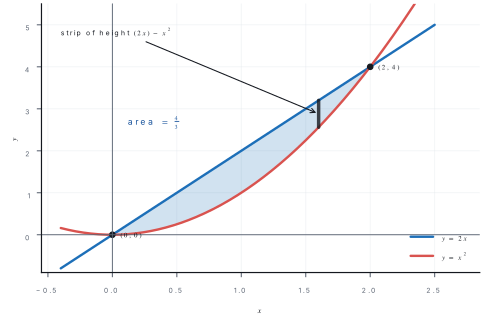
Problem. Find the area enclosed between the line y = 2x and the parabola y = x^{2}.
Solution. Step 1 — find the intersections. Solve x^{2} = 2x, i.e. x(x-2) = 0, so x = 0 and x = 2.
Step 2 — decide which curve is on top. At x=1, the line gives 2 and the parabola gives 1, so the line is above throughout (0,2).
Step 3 — integrate the difference.
Step 4 — state the answer. The enclosed area is \frac43 square units.
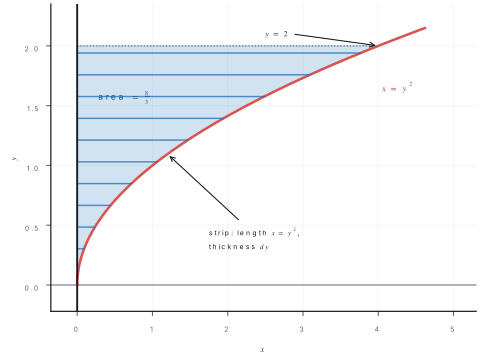
Problem. Find the area bounded by the parabola x = y^{2}, the y-axis and the line y = 2.
Solution. The bounding line is horizontal and the region touches the y-axis, so use horizontal strips and integrate with respect to y. A strip at height y has length x = y^{2} and thickness dy, so
Doing the same region with vertical strips would need \int_{0}^{4}\left(2-\sqrt{x}\right)dx — correct, but longer. Choose the strip direction that makes the limits constants.
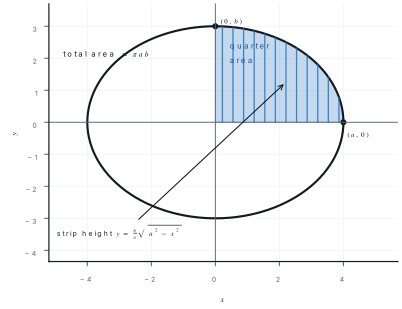
Problem. Find the area of the circle x^{2}+y^{2} = a^{2}, and hence the area of the ellipse \frac{x^{2}}{a^{2}} + \frac{y^{2}}{b^{2}} = 1.
Solution. Circle. By symmetry the total area is four times the first quadrant piece, where y = \sqrt{a^{2}-x^{2}} and x runs from 0 to a:
using Worked example 13.17. At x=a the first term vanishes and \sin^{-1}1 = \frac{\pi}{2}, so
Ellipse. In the first quadrant y = \frac{b}{a}\sqrt{a^{2}-x^{2}}, so the whole calculation is scaled by \frac ba:
With a=4 and b=3 this gives 12\pi, and the shaded quarter in the figure is 3\pi.
Problem. Find the area enclosed between the parabolas y^{2} = 4x and x^{2} = 4y.
Solution. Intersections. From the second, y = \frac{x^{2}}{4}. Substituting into the first, \frac{x^{4}}{16} = 4x, so x^{4} = 64x, giving x\left(x^{3}-64\right) = 0 and hence x = 0 or x = 4.
Upper curve. At x=1, y^{2}=4x gives y = 2 while x^{2}=4y gives y = \frac14. So y = 2\sqrt{x} is above y = \frac{x^{2}}{4}.
Problem. Find the area bounded by y = 4-x^{2} and the x-axis, and the area enclosed between y = x^{2} and y = x^{3}.
Solution. (a) The parabola cuts the axis where 4-x^{2}=0, i.e. x = \pm 2, and is above the axis between them. The function is even, so
(b) x^{2} = x^{3} gives x^{2}(1-x) = 0, so x = 0 and x = 1. On (0,1) we have x^{2} > x^{3} (test x = \frac12: \frac14 > \frac18), so
\int_{-1}^{1}x^{3}dx = 0, but the region between the cubic and the axis from -1 to 1 has area \frac12. If the curve crosses the axis inside the interval, find the crossing points first, integrate over each piece, and add the magnitudes. Writing a single integral and reporting a negative "area" loses the mark every time.
Chapter summary
- Anti-differentiation reverses differentiation: \int f(x)\,dx = F(x)+C where F' = f. The +C is compulsory, and it makes the answer a whole family of parallel curves.
- Learn the table of standard integrals to the point of recall, including \int\frac{dx}{x} = \ln|x|, the nine quadratic forms, and \int\tan x\,dx = \ln|\sec x|, \int\sec x\,dx = \ln|\sec x+\tan x|.
- Substitution works when the integrand contains g(x) together with g'(x). The master pattern is \int\frac{g'(x)}{g(x)}dx = \ln|g(x)|+C.
- By parts: \int u\,dv = uv - \int v\,du, with u chosen by ILATE. Polynomial times sine or exponential needs repeated parts; e^{ax}\sin bx is cyclic, so apply parts twice and solve for I; and \int e^{x}\left[f+f'\right]dx = e^{x}f(x)+C in one step.
- A quadratic denominator is handled by completing the square; an x in the numerator by splitting px+q = \lambda(\text{denominator})' + \mu.
- Radicals \sqrt{a^{2}-x^{2}}, \sqrt{a^{2}+x^{2}}, \sqrt{x^{2}-a^{2}} call for x = a\sin\theta, a\tan\theta, a\sec\theta; draw the reference triangle to convert back.
- Any rational function of \sin x and \cos x yields to t = \tan\frac{x}{2}, using \sin x = \frac{2t}{1+t^{2}}, \cos x = \frac{1-t^{2}}{1+t^{2}}, dx = \frac{2\,dt}{1+t^{2}}.
- Rational functions: divide first if improper, then split into partial fractions according to the four denominator cases.
- \int_{a}^{b}f = F(b)-F(a) is a number and a signed area. The properties P4, P5 (reflection) and P6, P7 (symmetry) evaluate integrals whose anti-derivatives do not exist in elementary form.
- As a limit of a sum, \int_{a}^{b}f\,dx = \lim_{n\to\infty}\frac{b-a}{n}\sum_{r=1}^{n} f\left(a+\frac{r(b-a)}{n}\right).
- Areas: \int_{a}^{b}y\,dx for vertical strips, \int_{c}^{d}x\,dy for horizontal strips, \int_{a}^{b}(\text{upper}-\text{lower})\,dx between two curves, and split the interval wherever the curve crosses the axis.
Practice questions
Group A — Multiple choice (1 mark each)
- \int \dfrac{dx}{x} equals [1]a-\dfrac{1}{x^{2}}+Cb\ln|x|+Ccx\ln x - x + Cd\dfrac{1}{2x^{2}}+C
- \int \dfrac{dx}{x^{2}+9} equals [1]a\dfrac13\tan^{-1}\dfrac{x}{3}+Cb\tan^{-1}\dfrac{x}{3}+Cc\dfrac19\tan^{-1}\dfrac{x}{3}+Cd\dfrac13\sin^{-1}\dfrac{x}{3}+C
- \int_{0}^{1}e^{x}\,dx equals [1]aebe-1c1-ede+1
- \int_{-2}^{2}x^{3}\,dx equals [1]a8b16c0d\dfrac{16}{3}
- \int \tan x\,dx equals [1]a\sec^{2}x+Cb\ln|\sin x|+Cc\ln|\sec x|+Cd\ln|\sec x+\tan x|+C
- To evaluate \int\sqrt{x^{2}-a^{2}}\,dx the correct substitution is [1]ax=a\sin\thetabx=a\tan\thetacx=a\sec\thetadx=a\cos\theta
- The area bounded by y=x^{2}, the x-axis, x=0 and x=3 is [1]a3b9c27d\dfrac{27}{2}
Answers to Group A
1. (b) — the only case of \int x^{n}dx that is not a power, and the modulus keeps it valid for x<0.
2. (a) — standard form \int\frac{dx}{x^{2}+a^{2}} = \frac1a\tan^{-1}\frac xa+C with a=3.
3. (b) — \left[e^{x}\right]_{0}^{1} = e - 1.
4. (c) — x^{3} is odd and the interval is symmetric, so P6 gives 0.
5. (c) — put u=\cos x: \int\tan x\,dx = -\ln|\cos x| = \ln|\sec x|+C. Option (d) is \int\sec x\,dx.
6. (c) — then x^{2}-a^{2} = a^{2}\left(\sec^{2}\theta-1\right) = a^{2}\tan^{2}\theta and the radical disappears.
7. (b) — \int_{0}^{3}x^{2}dx = \left[\frac{x^{3}}{3}\right]_{0}^{3} = 9.
Group B — Short answer (5 marks each)
- Evaluate \int x^{2}\sin x\,dx. [5]
- Evaluate \int \dfrac{dx}{x^{2}+6x+13}. [5]
- Evaluate \int \dfrac{2x+1}{(x+1)(x-2)}\,dx. [5]
- Using the properties of definite integrals, evaluate \int_{0}^{\pi/2}\dfrac{dx}{1+\tan x}. [5]
- Evaluate \int \dfrac{dx}{1+\sin x} by the substitution t=\tan\dfrac{x}{2}. [5]
- Find the area of the region enclosed between the line y=x and the curve y=x^{3} in the first quadrant. [5]
Answers to Group B
1. By ILATE take u=x^{2}, dv=\sin x\,dx, so v=-\cos x:
Apply parts again with u=x, dv=\cos x\,dx, v=\sin x: \int x\cos x\,dx = x\sin x + \cos x. Hence
2. Complete the square: x^{2}+6x+13 = (x+3)^{2}+2^{2}. Put t = x+3, so dt = dx:
3. Let \frac{2x+1}{(x+1)(x-2)} = \frac{A}{x+1}+\frac{B}{x-2}, so 2x+1 = A(x-2)+B(x+1). Put x=-1: -1 = -3A, so A = \frac13. Put x=2: 5 = 3B, so B = \frac53. Therefore
4. Write I = \int_{0}^{\pi/2}\frac{dx}{1+\tan x} = \int_{0}^{\pi/2}\frac{\cos x\,dx}{\cos x+\sin x}. By P4, replacing x by \frac{\pi}{2}-x swaps \sin and \cos:
Adding the two forms, 2I = \int_{0}^{\pi/2}1\,dx = \frac{\pi}{2}, so I = \frac{\pi}{4}.
5. With t=\tan\frac x2 we have \sin x = \frac{2t}{1+t^{2}} and dx = \frac{2\,dt}{1+t^{2}}, so
6. The curves meet where x = x^{3}, i.e. x\left(x^{2}-1\right)=0, so in the first quadrant x=0 and x=1. On (0,1), x > x^{3} (at x=\frac12, \frac12 > \frac18), so the line is above:
Group C — Long answer (8 marks each)
- Prove that \int\dfrac{dx}{\sqrt{x^{2}-a^{2}}} = \ln\left|x+\sqrt{x^{2}-a^{2}}\right|+C by a suitable trigonometric substitution, and hence evaluate \int_{3}^{5}\dfrac{dx}{\sqrt{x^{2}-9}}. [8]
- (a) Define the definite integral as the limit of a sum and use the definition to evaluate \int_{0}^{1}\left(x^{2}+x\right)dx.(b) State the property \int_{0}^{a}f(x)\,dx = \int_{0}^{a}f(a-x)\,dx and use it to evaluate \int_{0}^{\pi/2}\sin^{2}x\,dx. [8]
- (a) Find the area of the region bounded by the parabola y^{2}=8x and its latus rectum x=2.(b) Find the area enclosed between the parabola y=x^{2} and the line y=x+2. [8]
Answers to Group C
1. Put x = a\sec\theta. Then dx = a\sec\theta\tan\theta\,d\theta and
so
From the reference triangle, \sec\theta = \frac xa and \tan\theta = \frac{\sqrt{x^{2}-a^{2}}}{a}, so
since -\ln a is absorbed into the constant. With a=3,
2. (a) Divide [a,b] into n equal parts of width h=\frac{b-a}{n} and define
Here a=0, b=1, h=\frac1n and f\left(\frac rn\right) = \frac{r^{2}}{n^{2}}+\frac rn, so
Letting n\to\infty gives \frac{2}{6}+\frac12 = \frac13+\frac12 = \frac{5}{6}, which agrees with \left[\frac{x^{3}}{3}+\frac{x^{2}}{2}\right]_{0}^{1}.
(b) Substituting x = a-t in \int_{0}^{a}f(x)\,dx gives dx = -dt with limits reversed, so \int_{0}^{a}f(x)\,dx = \int_{0}^{a}f(a-t)\,dt, which is the stated property. Taking a=\frac{\pi}{2} and f(x)=\sin^{2}x, and using \sin\left(\frac{\pi}{2}-x\right)=\cos x,
Adding, 2I = \int_{0}^{\pi/2}\left(\sin^{2}x+\cos^{2}x\right)dx = \int_{0}^{\pi/2}1\,dx = \frac{\pi}{2}, so I = \frac{\pi}{4}.
3. (a) For y^{2}=8x we have 4a = 8, so a = 2 and the latus rectum is x = 2. The curve is symmetric about the x-axis, so the area is twice the part above it, where y = \sqrt{8x} = 2\sqrt{2}\,\sqrt{x}:
(b) The curves meet where x^{2} = x+2, i.e. x^{2}-x-2 = 0, giving (x-2)(x+1)=0, so x=-1 and x=2. Between them the line is above (at x=0 it gives 2 against 0), so
Practise more: Mathematics question bank