Unit 4 · Algebra · 8 teaching hours · 25 min read
Sequence and Series
What the syllabus asks for 3
- Sum of first n natural numbers
- Sum of squares and cubes of first n natural numbers
- Principle of mathematical induction
In Grade 11 you summed arithmetic, geometric and harmonic progressions. This unit sums the three series that are not progressions at all but turn up everywhere: 1+2+\cdots+n, the squares 1^2+2^2+\cdots+n^2 and the cubes 1^3+2^3+\cdots+n^3. With these three results and the sigma rules you can total any series whose n^{\text{th}} term is a polynomial in n. The unit then gives you mathematical induction, the proof method that settles "is this formula true for every n?", and closes with the two infinite series that define e and the natural logarithm.
Three shapes cover nearly every question. (i) "Find the sum to n terms of 1\cdot 2 + 2\cdot 3 + \cdots" — write the n^{\text{th}} term, split it with sigma rules, substitute the three standard sums. (ii) "Prove by induction that …" — the three-step layout is worth marks on its own, so never skip the basis step. (iii) "Sum the series 1 + \frac{1}{2!} + \frac{1}{3!} + \cdots" — recognise it as e^x or \log(1+x) with a particular x.
4.1 Sum of first n natural numbers
Sigma notation
The symbol \sum (capital sigma) is shorthand for "add up". The statement
is read "the sum of t_k as k runs from 1 to n". The letter k is a dummy: \sum_{k=1}^{5} k^2 and \sum_{r=1}^{5} r^2 are the same number, 55.
Two rules follow straight from the fact that addition can be reordered, and both are used in every question in this unit.
A constant comes out in front; a constant on its own gives \sum_{k=1}^{n} c = nc. There is no rule for a product: \sum a_k b_k \ne \left(\sum a_k\right)\left(\sum b_k\right).
The sum itself
Write the sum forwards, then backwards underneath it:
Add the two lines column by column. Every column gives the same total n+1, and there are n columns, so
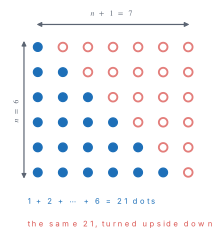
This is also the arithmetic-series formula S_n = \frac{n}{2}(a+l) with a=1 and l=n; the numbers \frac{n(n+1)}{2} are called triangular numbers because 1, 3, 6, 10, \ldots dots stack into triangles.
The pairing argument is exactly what the picture below shows: two copies of the triangle of dots, one turned upside down, interlock into a full rectangle.
Problem. Find (a) 51 + 52 + 53 + \cdots + 100 and (b) the sum of the first n odd natural numbers.
Solution. (a) Subtract the shorter sum from the longer one:
(b) The k^{\text{th}} odd number is 2k-1, so
The first n odd numbers always add to n^2. Check with n=4: 1+3+5+7 = 16 = 4^2.
Problem. How many consecutive natural numbers, starting from 1, add up to 465?
Solution. Solve \dfrac{n(n+1)}{2} = 465, i.e. n^2 + n - 930 = 0:
A count of terms cannot be negative, so n = 30. Check: \frac{30 \times 31}{2} = 465.
n counts terms, so it must be a positive whole number. If the quadratic gives no positive integer root, the correct answer is "no such n exists" — not the nearest integer.
4.2 Sum of squares and cubes of first n natural numbers
Both results come from the same trick: find an expression whose difference between consecutive values is the term you want, then add the differences so that almost everything cancels. This is called telescoping.
Start from the identity (k+1)^3 - k^3 = 3k^2 + 3k + 1. Write it out for k = 1, 2, \ldots, n and add all n lines. On the left the terms cancel in pairs — 2^3 cancels with -2^3, 3^3 with -3^3, and so on — leaving only the last and the first:
Substitute the two sums we already know:
Use the next identity up, (k+1)^4 - k^4 = 4k^3 + 6k^2 + 4k + 1. Adding for k = 1 to n telescopes the left side to (n+1)^4 - 1:
Now (n+1)^4 - 1 - n = (n+1)^4 - (n+1) = (n+1)\left[(n+1)^3 - 1\right] = (n+1)(n^3 + 3n^2 + 3n)= n(n+1)(n^2+3n+3), so taking out n(n+1) throughout,
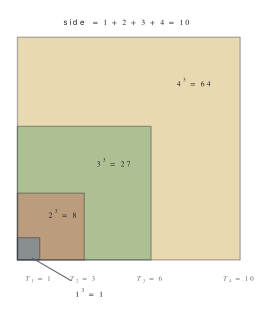
That last line is worth remembering on its own: the sum of the first n cubes is the square of the sum of the first n natural numbers. It has a pretty picture. Draw squares of side 1, 3, 6, 10, \ldots (the triangular numbers) one inside the other; the L-shaped strip added at stage k has area T_k^2 - T_{k-1}^2 = k^3.
Memorise the denominators 2, 6, 4 — they are the commonest thing to get wrong under pressure.
The method for any series with a polynomial term
To sum a series such as 1\cdot 2 + 2\cdot 3 + 3\cdot 4 + \cdots:
- Write down the n^{\text{th}} term t_k as a polynomial in k.
- Apply \sum and split it with the sigma rules.
- Substitute the three standard sums.
- Factorise the answer, then test it on n=1 or n=2.
Problem. Find (a) 1^2 + 2^2 + \cdots + 20^2 and (b) 1^3 + 2^3 + \cdots + 15^3.
Solution. (a) With n = 20,
(b) With n = 15,
(Equivalently \left[\frac{15\times 16}{2}\right]^2 = 120^2 = 14400.)
Problem. Find the sum to n terms of 1\cdot 2 + 2\cdot 3 + 3\cdot 4 + \cdots and hence the sum of the first 20 terms.
Solution. The k^{\text{th}} term is t_k = k(k+1) = k^2 + k, so
Take out \dfrac{n(n+1)}{6}:
Test: n=2 gives \frac{2(3)(4)}{3} = 8 = 1\cdot 2 + 2\cdot 3. Correct.
For n = 20: S_{20} = \dfrac{20(21)(22)}{3} = \dfrac{9240}{3} = 3080.
Problem. Find the sum of the squares of the first n odd natural numbers, 1^2 + 3^2 + 5^2 + \cdots + (2n-1)^2, and evaluate it for n = 10.
Solution. The k^{\text{th}} odd number is 2k-1, so t_k = (2k-1)^2 = 4k^2 - 4k + 1 and
Take out n: the bracket is 2(n+1)(2n+1) - 6(n+1) + 3 = 4n^2 + 6n + 2 - 6n - 6 + 3 = 4n^2 - 1, so
Test: n=2 gives \frac{2(3)(5)}{3} = 10 = 1 + 9. Correct.
For n = 10: S_{10} = \dfrac{10(19)(21)}{3} = \dfrac{3990}{3} = 1330.
Problem. Find the sum to n terms of the series 1\cdot 3 + 2\cdot 4 + 3\cdot 5 + \cdots, and its value for n = 12.
Solution. The factors differ by 2, so t_k = k(k+2) = k^2 + 2k:
Test: n=2 gives \frac{2(3)(11)}{6} = 11 = 3 + 8. Correct.
For n = 12: S_{12} = \dfrac{12(13)(31)}{6} = 2 \times 13 \times 31 = 806.
Problem. Find 11^3 + 12^3 + \cdots + 20^3.
Solution. Subtract two standard sums:
For a sum that starts part-way along (\sum_{k=m}^{n}), use \sum_{k=1}^{n} - \sum_{k=1}^{m-1}. Note the m-1: if you subtract \sum_{k=1}^{m} you have thrown away the term you were asked to keep.
4.3 Principle of mathematical induction
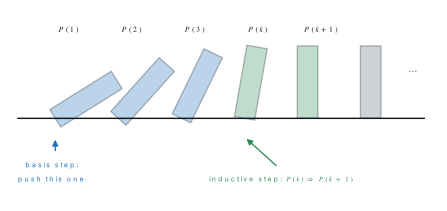
A formula checked for n = 1, 2, 3 may still fail at n = 40. Induction is the method that proves a statement for all natural numbers at once, using a domino argument: knock over the first domino, and make sure each domino knocks over the next.
Let P(n) be a statement about the natural number n. If
- (Basis) P(1) is true, and
- (Inductive step) for every k \in \mathbb{N}, the truth of P(k) forces the truth of P(k+1),
then P(n) is true for every natural number n.
- "Let P(n) be the statement …"
- "Basis. For n=1, LHS = … = RHS, so P(1) is true."
- "Assume P(k) is true, i.e. …" (the inductive hypothesis — say the word)
- "Then … = the formula with k+1 in place of k, so P(k+1) is true. Hence by the principle of mathematical induction P(n) holds for all n \in \mathbb{N}."
Problem. Prove by induction that 1^{3} + 2^{3} + \cdots + n^{3} = \dfrac{n^{2}(n+1)^{2}}{4} for all n \in \mathbb{N}.
Solution. Let P(n) be that statement.
Basis. For n = 1: LHS = 1^3 = 1 and RHS = \dfrac{1 \times 4}{4} = 1. So P(1) is true.
Inductive step. Assume P(k) is true:
Add the next term (k+1)^{3} to both sides:
which is exactly the formula with k+1 in place of n. So P(k) true forces P(k+1) true.
Hence by the principle of mathematical induction the formula holds for all n \in \mathbb{N}.
Problem. Prove by induction that 3^{2n} - 1 is divisible by 8 for every n \in \mathbb{N}.
Solution. Let P(n): "3^{2n} - 1 is divisible by 8".
Basis. n=1: 3^{2} - 1 = 8, which is divisible by 8. True.
Inductive step. Assume P(k): 3^{2k} - 1 = 8m for some integer m, so 3^{2k} = 8m + 1. Then
Since 9m+1 is an integer, 3^{2(k+1)} - 1 is divisible by 8, i.e. P(k+1) is true. By induction 8 \mid 3^{2n}-1 for all n.
Problem. Prove by induction that \dfrac{1}{1\cdot 2} + \dfrac{1}{2\cdot 3} + \cdots + \dfrac{1}{n(n+1)} = \dfrac{n}{n+1}.
Solution. Let P(n) be the statement.
Basis. n=1: LHS = \dfrac{1}{2}, RHS = \dfrac{1}{2}. True.
Inductive step. Assume the sum to k terms is \dfrac{k}{k+1}. Adding the (k+1)^{\text{th}} term \dfrac{1}{(k+1)(k+2)}:
which is the formula with n = k+1. Hence P(n) is true for all n by induction.
You must use the hypothesis. Start from the left side for k+1, split off the last term, replace the first k terms by the assumed formula, and then do algebra. A proof that merely rewrites the right-hand side with k+1 everywhere scores zero, and a proof with no basis step scores at most half.
4.4 Exponential and logarithmic series
The two series below are named in Unit 2 as standard results; here they are derived and used, because every "sum the series" question in this unit is one of them in disguise.
By definition e = \lim_{n\to\infty}\left(1 + \frac{1}{n}\right)^{n}. Expand by the binomial theorem for a positive integral index:
Divide each numerator by the powers of n underneath it:
As n \to \infty every \frac{r}{n} \to 0, so each bracket tends to 1:
The terms shrink faster than any GP, so the series converges very fast: five terms already give 2.7083.
Replace \frac1n by \frac{x}{n} in the same limit, e^{x} = \lim_{n\to\infty} \left(1+\frac{x}{n}\right)^{n}, and expand:
Letting n \to \infty,
For any base a > 0 write a = e^{\log a}, so a^{x} = e^{x\log a} and
where \log means the natural logarithm, to base e. Putting x = -1 in the exponential series gives e^{-1} = 1 - 1 + \frac{1}{2!} - \frac{1}{3!} + \cdots, which is how the "alternating factorial" series are recognised.
Expand (1+x)^{n} in two different ways and compare the coefficients of n.
First way — the binomial series:
Multiply out each numerator and keep only the terms in the first power of n: from nx we get x; from \frac{n^{2}-n}{2}x^{2} we get -\frac{x^{2}}{2}; from \frac{n^{3}-3n^{2}+2n}{6}x^{3} we get +\frac{x^{3}}{3}, and so on. So the coefficient of n is
Second way — write (1+x)^{n} = e^{\,n\log(1+x)} and use the exponential series:
Here the coefficient of n is \log(1+x). The two expansions are the same function of n, so their coefficients of n must agree:
Replacing x by -x gives \log(1-x) = -x - \frac{x^{2}}{2} - \frac{x^{3}}{3} - \cdots, and subtracting,
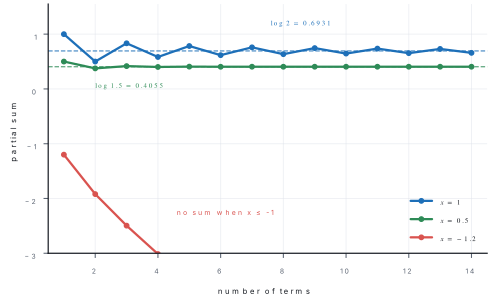
Put x = 1 in the log series and you get \log 2 = 1 - \frac12 + \frac13 - \cdots; put x = -1 and the terms become -1 - \frac12 - \frac13 - \cdots, which has no sum. That is why the condition x > -1 must be stated.
The exponential series converges because its terms carry a factorial in the denominator: each new term is the previous one multiplied by x/r, a factor that eventually becomes tiny. Laying the terms end to end on a line, the pieces pack into a finite length.
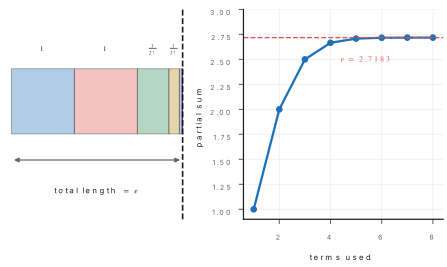
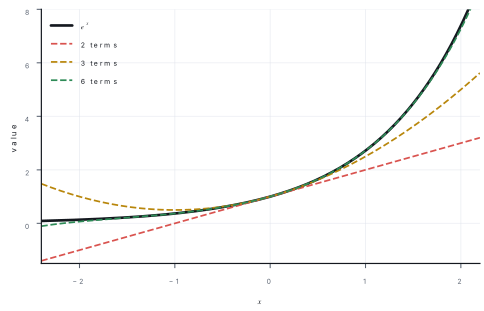
Truncating the exponential series gives polynomials that hug e^{x} over a wider and wider range as more terms are kept.
Problem. Sum the series 1 + \dfrac{1}{2!} + \dfrac{1}{3!} + \dfrac{1}{4!} + \cdots and the series \dfrac{1}{1!} + \dfrac{1}{3!} + \dfrac{1}{5!} + \cdots
Solution. First series. The exponential series with x = 1 is e = 1 + \frac{1}{1!} + \frac{1}{2!} + \frac{1}{3!} + \cdots. Our series is that one without the leading 1 (since \frac{1}{1!} = 1 is the given first term):
Second series. Write both x = 1 and x = -1:
Subtracting kills all the even-power terms and doubles the odd ones:
Numerically \frac{2.71828 - 0.36788}{2} = 1.17520.
Problem. Show that \dfrac{1}{1!} + \dfrac{2}{2!} + \dfrac{3}{3!} + \cdots = e.
Solution. Look at the general term and cancel:
So the series is
using 0! = 1. The whole method is "simplify the general term until a factorial series appears".
Problem. Using \log\dfrac{1+x}{1-x} = 2\left(x + \dfrac{x^{3}}{3} + \dfrac{x^{5}}{5} + \cdots\right), find \log 1.2 correct to four decimal places.
Solution. Choose x so that \dfrac{1+x}{1-x} = 1.2 = \dfrac{6}{5}:
Since |x| is small the series converges quickly:
So \log 1.2 \approx 0.1823. (Using the plain series \log(1+x) with x = 0.2 would need six terms for the same accuracy.)
In this unit \log x always means the natural logarithm \ln x. Every series above is wrong by a factor of \log_{10} e = 0.4343 if you read it as a base-10 logarithm.
Chapter summary
- \sum_{k=1}^{n} k = \dfrac{n(n+1)}{2}, \sum_{k=1}^{n} k^{2} = \dfrac{n(n+1)(2n+1)}{6}, \sum_{k=1}^{n} k^{3} = \dfrac{n^{2}(n+1)^{2}}{4} = \left(\sum k\right)^{2}.
- Sigma is linear: \sum(a_k \pm b_k) = \sum a_k \pm \sum b_k and \sum c\,a_k = c\sum a_k, with \sum_{k=1}^{n} c = nc.
- To sum a series, write t_k as a polynomial in k, split with the sigma rules, substitute the three standard sums, factorise, then test on n = 1.
- For a part-sum, \sum_{k=m}^{n} = \sum_{k=1}^{n} - \sum_{k=1}^{m-1}.
- Induction: state P(n); prove P(1); assume P(k); use the assumption to prove P(k+1); conclude for all n \in \mathbb{N}.
- e = 1 + \frac{1}{1!} + \frac{1}{2!} + \cdots = 2.71828 and e^{x} = \sum_{r\ge 0} \frac{x^{r}}{r!} for every real x; a^{x} = e^{x\log a}.
- e + e^{-1} = 2\left(1 + \frac{1}{2!} + \frac{1}{4!} + \cdots\right) and e - e^{-1} = 2\left(\frac{1}{1!} + \frac{1}{3!} + \cdots\right).
- \log(1+x) = x - \frac{x^{2}}{2} + \frac{x^{3}}{3} - \cdots for -1 < x \le 1, and \log\frac{1+x}{1-x} = 2\left(x + \frac{x^{3}}{3} + \frac{x^{5}}{5} + \cdots\right).
Practice questions
Group A — Multiple choice (1 mark each)
- \sum_{k=1}^{n} k^{2} equals [1]a\frac{n(n+1)}{2}b\frac{n(n+1)(2n+1)}{6}c\frac{n^{2}(n+1)^{2}}{4}d\frac{n(n+1)(n+2)}{3}
- The value of 1^{3} + 2^{3} + \cdots + 10^{3} is [1]a385b2025c3025d5050
- In a proof by induction, the step that is proved first is [1]aP(k+1)bP(k)cP(1)dP(n) for all n
- The sum 1 + \frac{1}{1!} + \frac{1}{2!} + \frac{1}{3!} + \cdots equals [1]aebe - 1ce + 1de^{-1}
- The series x - \frac{x^{2}}{2} + \frac{x^{3}}{3} - \cdots is valid for [1]aall xbx > 0c-1 < x \le 1d|x| > 1
- If \sum_{k=1}^{n} k = 210, then n is [1]a19b20c21d22
Answers to Group A
1. (b) — the standard sum of squares; the denominator is 6.
2. (c) — \left[\frac{10 \times 11}{2}\right]^{2} = 55^{2} = 3025.
3. (c) — the basis step; without it the chain has nothing to start from.
4. (c) — the series for e is 1 + \frac{1}{1!} + \frac{1}{2!} + \cdots, and this one has an extra leading 1, so the sum is 1 + e.
5. (c) — at x = -1 the terms become -1 - \frac12 - \frac13 - \cdots, which has no sum.
6. (b) — \frac{n(n+1)}{2} = 210 gives n^{2}+n-420 = 0, (n-20)(n+21)=0, so n = 20.
Group B — Short answer (5 marks each)
- Prove that \sum_{k=1}^{n} k^{2} = \dfrac{n(n+1)(2n+1)}{6} and hence find 11^{2} + 12^{2} + \cdots + 30^{2}. [5]
- Find the sum to n terms of 1\cdot 2\cdot 3 + 2\cdot 3\cdot 4 + 3\cdot 4\cdot 5 + \cdots and evaluate it for n = 10. [5]
- Find the sum of the cubes of the first n odd natural numbers, 1^{3} + 3^{3} + \cdots + (2n-1)^{3}, and evaluate it for n = 10. [5]
- Prove by mathematical induction that n(n+1)(n+2) is divisible by 6 for every natural number n. [5]
- Prove by mathematical induction that 1 + 4 + 7 + \cdots + (3n-2) = \dfrac{n(3n-1)}{2}. [5]
- Sum the series 1 + \dfrac{1}{2!} + \dfrac{1}{4!} + \dfrac{1}{6!} + \cdots [5]
Answers to Group B
1. Add the identity (k+1)^{3} - k^{3} = 3k^{2} + 3k + 1 for k = 1, \ldots, n. The left side telescopes to (n+1)^{3} - 1, so
which rearranges to \sum k^{2} = \frac{n(n+1)(2n+1)}{6} (full working in §4.2).
Then
2. t_k = k(k+1)(k+2) = k^{3} + 3k^{2} + 2k, so
Take out \dfrac{n(n+1)}{4}:
Test n=1: \frac{1(2)(3)(4)}{4} = 6 = 1\cdot 2\cdot 3. Correct. For n = 10: S_{10} = \frac{10(11)(12)(13)}{4} = \frac{17160}{4} = 4290.
3. t_k = (2k-1)^{3} = 8k^{3} - 12k^{2} + 6k - 1, so
Take out n and expand the bracket: 2n(n+1)^{2} - 2(n+1)(2n+1) + 3(n+1) - 1 = 2n^{3}+4n^{2}+2n - 4n^{2}-6n-2 + 3n+3-1 = 2n^{3} - n. Hence
Test n = 2: 4(8-1) = 28 = 1 + 27. Correct. For n = 10: S_{10} = 100(199) = 19900.
4. Let P(n): "6 \mid n(n+1)(n+2)".
Basis: n=1 gives 1\cdot 2\cdot 3 = 6, divisible by 6.
Step: assume k(k+1)(k+2) = 6m for an integer m. Then
Of the two consecutive integers k+1, k+2 one is even, so (k+1)(k+2) = 2p for an integer p and 3(k+1)(k+2) = 6p. Hence the total is 6(m+p), divisible by 6. By induction the result holds for all n.
5. Let P(n): 1 + 4 + \cdots + (3n-2) = \frac{n(3n-1)}{2}.
Basis: n=1: LHS =1, RHS =\frac{1(2)}{2} = 1. True.
Step: assume the sum to k terms is \frac{k(3k-1)}{2}. The next term is 3(k+1)-2 = 3k+1, so
and 3k+2 = 3(k+1)-1, so this is the formula with n = k+1. Hence true for all n by induction.
6. Add the series for e and e^{-1}:
because the odd-power terms cancel. Therefore
Group C — Long answer (8 marks each)
- (a) Prove that 1^{3} + 2^{3} + \cdots + n^{3} = \left[\frac{n(n+1)}{2}\right]^{2} by telescoping (k+1)^{4} - k^{4}. [4](b) Find the sum to n terms of the series whose n^{\text{th}} term is n(n+1)(2n+1), and check your formula for n = 2. [4]
- (a) State the principle of mathematical induction and use it to prove that 2^{n} > n for every natural number n. [4](b) Prove by induction that \frac{1}{1\cdot 3} + \frac{1}{3\cdot 5} + \cdots + \frac{1}{(2n-1)(2n+1)} = \frac{n}{2n+1}. [4]
- (a) Derive the exponential series for e^{x} from e^{x} = \lim_{n\to\infty}\left(1+\frac{x}{n}\right)^{n}. [4](b) Prove that \log\frac{1+x}{1-x} = 2\left(x + \frac{x^{3}}{3} + \frac{x^{5}}{5} + \cdots\right) and use it to compute \log 1.1 correct to four decimal places. [4]
Answers to Group C
1. (a) (k+1)^{4} - k^{4} = 4k^{3} + 6k^{2} + 4k + 1. Summing for k = 1, \ldots, n telescopes the left side to (n+1)^{4} - 1:
Since (n+1)^{4} - 1 - n = n(n+1)(n^{2}+3n+3),
so \sum k^{3} = \frac{n^{2}(n+1)^{2}}{4} = \left[\frac{n(n+1)}{2}\right]^{2}.
(b) t_k = k(k+1)(2k+1) = 2k^{3} + 3k^{2} + k, so
Check n = 2: formula gives \frac{2(9)(4)}{2} = 36; direct sum is 1\cdot2\cdot3 + 2\cdot3\cdot5 = 6 + 30 = 36. Correct.
2. (a) Statement: if P(1) is true and P(k) \Rightarrow P(k+1) for every k \in \mathbb{N}, then P(n) is true for all n \in \mathbb{N}.
Let P(n): 2^{n} > n. Basis: 2^{1} = 2 > 1. True. Step: assume 2^{k} > k. Then
since k \ge 1. So 2^{k+1} > k+1, i.e. P(k+1) holds, and the result follows for all n by induction.
(b) Basis: n=1: LHS = \frac{1}{1\cdot 3} = \frac13 and RHS = \frac{1}{3}. True.
Step: assume the sum to k terms is \frac{k}{2k+1}. Add the next term \frac{1}{(2k+1)(2k+3)}:
which is the formula with n = k+1. Hence it holds for all n.
3. (a) Expand \left(1+\frac{x}{n}\right)^{n} by the binomial theorem:
As n \to \infty each bracket \to 1, so e^{x} = 1 + \frac{x}{1!} + \frac{x^{2}}{2!} + \frac{x^{3}}{3!} + \cdots
(b) From the logarithmic series, \log(1+x) = x - \frac{x^{2}}{2} + \frac{x^{3}}{3} - \cdots and, replacing x by -x, \log(1-x) = -x - \frac{x^{2}}{2} - \frac{x^{3}}{3} - \cdots. Subtracting, the even powers cancel and the odd ones double:
For \log 1.1 put \frac{1+x}{1-x} = \frac{11}{10}, i.e. 10+10x = 11-11x, so x = \frac{1}{21}:
So \log 1.1 \approx 0.0953.
Practise more: Mathematics question bank