Unit 16 · Computational Methods OR Mechanics · 12 teaching hours · 30 min read
Mechanics (alternative to Unit 15)
What the syllabus asks for 3
- Statics: triangle law of forces; Lami's theorem
- Dynamics: Newton's laws of motion
- Dynamics: projectile motion
Mechanics is the mathematics of forces and motion. Statics asks when a body stays still: the forces on it must cancel, and so must their turning effects. Dynamics asks how a body moves when they do not cancel, and the answer is Newton's second law. This chapter is the full alternative to Unit 15: the CDC syllabus offers Computational Methods or Mechanics as the final 12-hour unit, your school teaches one of them, and the question paper sets the two as alternatives. Everything you need for the Mechanics option is here — nothing is left in Unit 15.
Statics questions are nearly always "three concurrent forces in equilibrium" — resolve, or use Lami's theorem. Dynamics questions are F = ma applied to one body at a time, or a projectile with T, H and R to find. Group C usually wants a derivation (Lami's theorem, or the range formula) followed by a numerical part. Take g = 10\ \text{m s}^{-2} unless the question says otherwise, and always draw the free-body diagram — markers give a mark for it.
16.1 Statics: triangle law of forces; Lami's theorem
Force as a vector
A force has magnitude (newtons, N) and direction, so forces add like vectors. The single force that has the same effect as two or more forces together is their resultant.
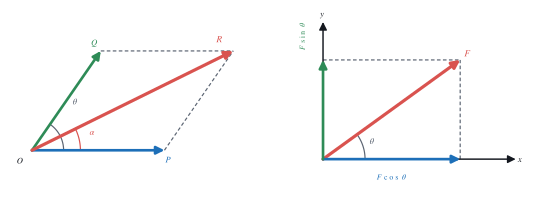
Let P and Q act at a point O with angle \theta between them. Complete the parallelogram; the diagonal is the resultant R. Resolve along and perpendicular to P:
Square and add. Since \cos^2\alpha + \sin^2\alpha = 1,
Dividing the two starting equations gives the direction of R, measured from P:
Two special cases are worth remembering: \theta = 0^\circ gives R = P+Q, and \theta = 90^\circ gives R = \sqrt{P^2+Q^2}.
The reverse operation, resolution, replaces one force by two perpendicular components. A force F at angle \theta to the x-axis has components F\cos\theta and F\sin\theta.
Problem. Two forces of 5 N and 12 N act at a point at right angles. Find the magnitude of the resultant and the angle it makes with the 5 N force.
Solution. With \theta = 90^\circ, \cos\theta = 0:
The resultant is 13 N at 67.4^\circ to the 5 N force.
Problem. Forces of 5 N and 3 N act at a point with 60^\circ between them. Find their resultant, and state the force needed to keep the point in equilibrium.
Solution. \cos 60^\circ = \tfrac12, so
The equilibrant is the force that balances the resultant: it has the same magnitude, 7 N, but the opposite direction, i.e. at 21.8^\circ + 180^\circ to the 5 N force.
The triangle law and the polygon of forces
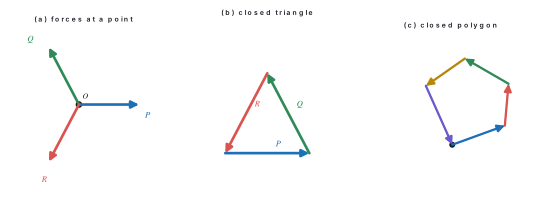
If three forces acting at a point can be represented in magnitude and direction by the three sides of a triangle taken in order, the forces are in equilibrium.
Its converse is equally useful: if three concurrent forces are in equilibrium, they can be represented by the sides of some triangle taken in order — so drawing them head to tail gives a closed triangle.
Extending head-to-tail drawing to more forces gives the polygon of forces: any number of concurrent forces are in equilibrium exactly when their head-to-tail polygon closes. If it does not close, the closing side (drawn from the last head back to the first tail) is the equilibrant, and its reverse is the resultant.
Problem. Three forces of 3 N, 4 N and 5 N act at a point and keep it in equilibrium. Find the angle between the 3 N and the 4 N forces.
Solution. In equilibrium the 5 N force must be the equilibrant of the other two, so the resultant of the 3 N and 4 N forces is 5 N. If \theta is the angle between them,
The 3 N and 4 N forces are perpendicular. (The head-to-tail triangle is the 3–4–5 right-angled triangle.)
Lami's theorem
If three coplanar forces P, Q, R acting at a point are in equilibrium, then
where \alpha is the angle between the other two forces Q and R, \beta the angle between R and P, and \gamma the angle between P and Q. Note \alpha + \beta + \gamma = 360^\circ.
Because the three forces are in equilibrium, drawing them head to tail gives a closed triangle ABC with AB, BC, CA representing P, Q, R.
Each side of this triangle is parallel to one of the forces, so the interior angle of the triangle between the sides representing Q and R is the supplement of the angle \alpha between the forces themselves: it equals 180^\circ - \alpha. In the same way the other two interior angles are 180^\circ - \beta and 180^\circ - \gamma.
Apply the sine law to triangle ABC — each side is proportional to the sine of the opposite angle:
Now match each force to the angle opposite its own side. The side representing P is opposite the interior angle 180^\circ - \alpha, so
and since \sin(180^\circ - x) = \sin x,
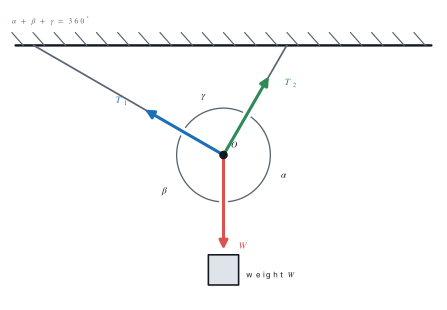
Problem. A body of weight 100 N hangs at O from two light strings OA and OB attached to a horizontal ceiling, OA making 30^\circ and OB making 60^\circ with the ceiling. Find the tension in each string.
Solution. The three forces at O are T_1 (along OA), T_2 (along OB) and the weight W = 100 N vertically down.
The angle between T_1 and T_2 is 180^\circ - 30^\circ - 60^\circ = 90^\circ. T_1 makes 30^\circ with the ceiling, so it makes 90^\circ + 30^\circ = 120^\circ with the downward vertical; similarly T_2 makes 150^\circ with it. Check: 90 + 120 + 150 = 360^\circ.
By Lami's theorem, each force over the sine of the angle between the other two:
Check by resolving. Horizontally T_1\cos 30^\circ = T_2\cos 60^\circ: 50(0.8660) = 43.3 and 86.6(0.5) = 43.3 — equal. Vertically T_1\sin 30^\circ + T_2\sin 60^\circ = 25 + 75 = 100 = W. Correct.
\sin\alpha under P means \alpha is the angle between Q and R — the two forces that are not P. Writing P/\sin(\text{angle next to } P) is the standard error and loses every mark in the question. Also, Lami's theorem works only for exactly three concurrent forces; with four or more, resolve instead.
Moment of a force
A force also turns a body. The moment (or torque) of a force about a point is
where d is the perpendicular distance from the point to the line of action of F. The unit is the newton metre (N m). Anticlockwise moments are taken positive.
The first two stop it sliding; the third stops it turning. Take moments about a point through which an unknown force passes — that unknown then disappears from the equation.
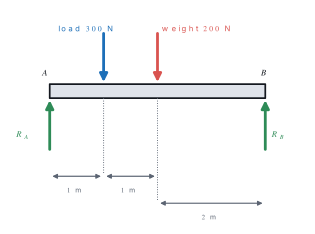
Problem. A uniform beam AB of length 4 m and weight 200 N rests horizontally on supports at A and B. A load of 300 N is hung 1 m from A. Find the reactions at the supports.
Solution. The beam is uniform, so its weight acts at the midpoint, 2 m from A. Let the (vertical) reactions be R_A and R_B.
Moments about A (anticlockwise positive; R_A passes through A so it contributes nothing):
Vertical forces:
Check by taking moments about B: 325(4) - 200(2) - 300(3) = 1300 - 400 - 900 = 0. Correct.
Free-body diagrams
A free-body diagram shows one body alone, with every force acting on it drawn as an arrow starting at the point where that force is applied. Draw nothing else: no forces the body exerts on other things, and no velocities.
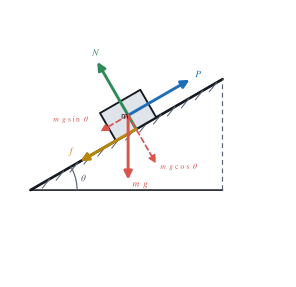
Problem. A body of mass 20 kg rests on a smooth plane inclined at 30^\circ to the horizontal. Find the force P, acting up the line of greatest slope, needed to keep it in equilibrium, and the normal reaction. (Take g = 10\ \text{m s}^{-2}.)
Solution. Weight = mg = 20(10) = 200 N. Smooth means f = 0. Resolve along and perpendicular to the plane.
Along the plane: \;P = mg\sin 30^\circ = 200\left(\tfrac12\right) = 100\ \text{N}
Perpendicular: \;N = mg\cos 30^\circ = 200\left(\dfrac{\sqrt{3}}{2}\right) = 100\sqrt{3} = 173.2\ \text{N}
So P = 100 N and N = 173.2 N.
16.2 Dynamics: Newton's laws of motion
First law. A body stays at rest, or moves with constant velocity in a straight line, unless an external force acts on it. (This defines force as the thing that changes motion, and inertia as the reluctance to change.)
Second law. The rate of change of momentum of a body is proportional to the resultant force and takes place in the direction of that force:
Third law. To every action there is an equal and opposite reaction; the two act on different bodies.
Momentum is p = mv (kg m s^{-1}). Rewriting the second law over a time \Delta t gives the impulse–momentum equation
and because the action–reaction pair in a collision are equal and opposite for the same time, the total momentum of an isolated system is unchanged:
Momentum is conserved in every collision; kinetic energy is conserved only in a perfectly elastic one.
For motion in a straight line with constant acceleration the three equations of motion apply, and vertical motion under gravity is the case a = \pm g:
Work–energy theorem. The work done by the resultant force equals the change in kinetic energy:
Problem. A body of mass 3 kg at rest on a smooth horizontal floor is acted on by a horizontal force of 12 N. Find (a) the acceleration, (b) the velocity after 5 s, (c) the distance travelled in that time, and (d) the work done.
Solution. (a) F = ma \Rightarrow a = \dfrac{12}{3} = 4\ \text{m s}^{-2}.
(b) v = u + at = 0 + 4(5) = 20\ \text{m s}^{-1}.
(c) s = ut + \tfrac12 at^2 = 0 + \tfrac12(4)(25) = 50\ \text{m}.
(d) W = Fs = 12(50) = 600\ \text{J}.
Check with the work–energy theorem: \tfrac12 mv^2 - 0 = \tfrac12(3)(20)^2 = 600\ \text{J}. The two agree.
Problem. A block of mass 10 kg is pulled along a rough horizontal floor by a horizontal force of 40 N. The coefficient of friction is 0.25. Find the acceleration. (g = 10\ \text{m s}^{-2}.)
Solution. Vertically there is no acceleration, so the normal reaction is
Friction opposes the motion: \;f = \mu N = 0.25(100) = 25\ \text{N}.
Horizontally, the resultant force is 40 - 25 = 15 N, so
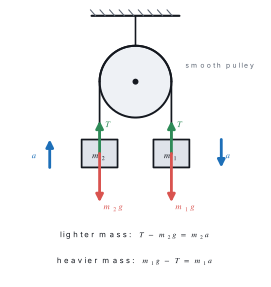
Problem. Masses of 5 kg and 3 kg hang from the ends of a light inextensible string passing over a smooth fixed pulley. Find the acceleration of the system and the tension in the string. (g = 10\ \text{m s}^{-2}.)
Solution. Let a be the common acceleration and T the tension. Take the direction of motion as positive for each block.
For the 5 kg mass (moving down): \;5g - T = 5a, i.e. 50 - T = 5a. For the 3 kg mass (moving up): \;T - 3g = 3a, i.e. T - 30 = 3a.
Add the two equations; T cancels:
Substitute back: \;T = 30 + 3(2.5) = 37.5\ \text{N}.
Check in the other equation: 50 - 37.5 = 12.5 = 5(2.5). Correct.
In general a = \dfrac{(m_1-m_2)g}{m_1+m_2} and T = \dfrac{2m_1m_2 g}{m_1+m_2}.
Problem. A person of mass 60 kg stands in a lift. Find the reaction of the floor on the person when the lift (a) accelerates upwards at 2\ \text{m s}^{-2}, (b) accelerates downwards at 2\ \text{m s}^{-2}, (c) falls freely. (g = 10\ \text{m s}^{-2}.)
Solution. Two forces act on the person: the weight mg down and the floor reaction R up.
(a) Upward acceleration: \;R - mg = ma, so
(b) Downward acceleration: \;mg - R = ma, so
(c) Free fall means a = g, so R = m(g-g) = 0 — the person feels weightless.
Problem. A ball of mass 0.15 kg strikes a wall normally at 20\ \text{m s}^{-1} and rebounds at 15\ \text{m s}^{-1}. Find the impulse on the ball, and the average force if the contact lasts 0.05 s.
Solution. Take the direction towards the wall as positive, so the rebound velocity is -15\ \text{m s}^{-1}.
The impulse is 5.25\ \text{N s} directed away from the wall.
Problem. A trolley of mass 3 kg moving at 4\ \text{m s}^{-1} collides with a stationary trolley of mass 5 kg and the two move off together. Find the common velocity and the kinetic energy lost.
Solution. Conservation of momentum:
Kinetic energy before = \tfrac12(3)(4)^2 = 24\ \text{J}. Kinetic energy after = \tfrac12(8)(1.5)^2 = 9\ \text{J}.
The collision is inelastic: momentum is conserved but 15 J becomes heat and sound.
Problem. A stone is thrown vertically upwards from the ground with a speed of 20\ \text{m s}^{-1}. Find the greatest height, the time to reach it and the total time in the air. (g = 10\ \text{m s}^{-2}.)
Solution. Taking upwards positive, u = 20 and a = -10.
At the highest point v = 0, so from v^2 = u^2 + 2as:
From v = u + at: \;0 = 20 - 10t \Rightarrow t = 2\ \text{s}.
By symmetry the fall takes the same time, so the total time in the air is 4\ \text{s}.
In a pulley or lift question, write F = ma separately for each body, with its own set of forces, and never mix the two into one equation. And use the resultant force on that body — for the 5 kg mass above it is 5g - T, not 5g.
16.3 Dynamics: projectile motion
A projectile is a body given an initial velocity and then left to gravity alone (air resistance ignored). The key idea is that the horizontal and vertical motions are completely independent:
- horizontally there is no force, so the velocity u\cos\theta is constant;
- vertically there is a constant acceleration -g.
Project a body from the origin with speed u at angle \theta above the horizontal. After time t,
Trajectory. From the first, t = \dfrac{x}{u\cos\theta}. Substituting,
which is of the form y = ax - bx^2: a parabola.
Time of flight. The body lands when y = 0 and t \ne 0:
Greatest height. The vertical velocity u\sin\theta - gt is zero at t = \dfrac{u\sin\theta}{g} = \dfrac{T}{2}, and then
Horizontal range. R = (u\cos\theta)T = u\cos\theta\cdot\dfrac{2u\sin\theta}{g}, and 2\sin\theta\cos\theta = \sin 2\theta, so
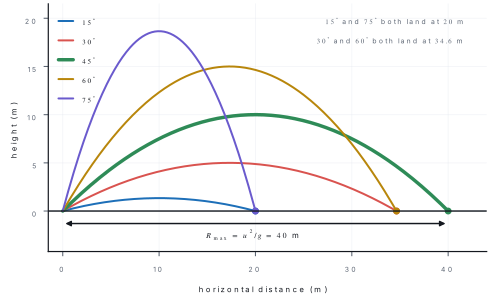
R = \dfrac{u^2\sin 2\theta}{g} is greatest when \sin 2\theta = 1, i.e. 2\theta = 90^\circ:
Because \sin(180^\circ - 2\theta) = \sin 2\theta, the angles \theta and 90^\circ - \theta give the same range — so 30^\circ and 60^\circ carry a ball equally far, though not equally high or for equally long.
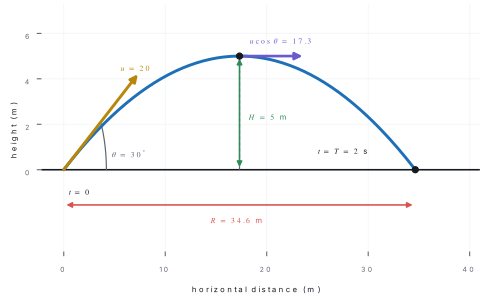
Problem. A ball is projected with a speed of 20\ \text{m s}^{-1} at 30^\circ to the horizontal. Find (a) the time of flight, (b) the greatest height, (c) the horizontal range, and (d) the speed of the ball 1 s after projection. (g = 10\ \text{m s}^{-2}.)
Solution. u\cos\theta = 20\cos 30^\circ = 17.32\ \text{m s}^{-1} and u\sin\theta = 20\sin 30^\circ = 10\ \text{m s}^{-1}.
(a) \;T = \dfrac{2u\sin\theta}{g} = \dfrac{2(10)}{10} = 2\ \text{s}
(b) \;H = \dfrac{u^2\sin^2\theta}{2g} = \dfrac{(10)^2}{2(10)} = 5\ \text{m}
(c) \;R = \dfrac{u^2\sin 2\theta}{g} = \dfrac{400\sin 60^\circ}{10} = 40(0.8660) = 34.6\ \text{m}
(d) At t = 1 s the horizontal component is still 17.32\ \text{m s}^{-1} and the vertical component is 10 - 10(1) = 0. The ball is at the top of its path, so its speed is 17.3\ \text{m s}^{-1}, horizontal.
Problem. A stone is thrown horizontally at 20\ \text{m s}^{-1} from the top of a cliff 45 m high. Find the time to reach the ground, the horizontal distance travelled, and the speed with which it strikes the ground. (g = 10\ \text{m s}^{-2}.)
Solution. Take downwards positive for the vertical motion; the initial vertical velocity is zero.
Horizontal distance = 20(3) = 60\ \text{m}.
At landing the horizontal velocity is still 20\ \text{m s}^{-1} and the vertical one is v_y = 0 + 10(3) = 30\ \text{m s}^{-1}, so
at an angle \tan^{-1}\left(\dfrac{30}{20}\right) = 56.3^\circ below the horizontal.
Problem. A ball is projected with speed 20\ \text{m s}^{-1}. Find the two angles of projection that give a horizontal range of 20 m, and the maximum range possible with this speed. (g = 10\ \text{m s}^{-2}.)
Solution. \;R = \dfrac{u^2\sin 2\theta}{g}, so
The two angles are complementary, as expected. The maximum range is at 45^\circ:
Horizontal and vertical motions are separate problems that share only the time t. Horizontally a = 0, so x = (u\cos\theta)t — never x = (u\cos\theta)t + \frac12 gt^2. Solve the vertical equation for t first, then feed that t into the horizontal one.
Chapter summary
- Resultant of P and Q at angle \theta: R = \sqrt{P^2+Q^2+2PQ\cos\theta}, at \tan\alpha = \dfrac{Q\sin\theta}{P+Q\cos\theta} to P. Resolution: components F\cos\theta, F\sin\theta.
- Triangle law. Three concurrent forces are in equilibrium exactly when they form a closed head-to-tail triangle; with more forces, a closed polygon.
- Lami's theorem. For three concurrent forces in equilibrium, \dfrac{P}{\sin\alpha} = \dfrac{Q}{\sin\beta} = \dfrac{R}{\sin\gamma}, each angle being between the other two forces.
- Moment M = F\times d; a rigid body is in equilibrium when \sum F_x = 0, \sum F_y = 0 and \sum M = 0.
- Newton's laws. F = ma; impulse F\Delta t = mv - mu; momentum m_1u_1 + m_2u_2 = m_1v_1 + m_2v_2 is conserved in every collision.
- Atwood machine: a = \dfrac{(m_1-m_2)g}{m_1+m_2}, T = \dfrac{2m_1m_2g}{m_1+m_2}. Lift: R = m(g \pm a).
- Work W = Fs\cos\theta; work–energy theorem W = \tfrac12 mv^2 - \tfrac12 mu^2; power P = Fv.
- Projectile (u, \theta): y = x\tan\theta - \dfrac{gx^2}{2u^2\cos^2\theta}, T = \dfrac{2u\sin\theta}{g}, H = \dfrac{u^2\sin^2\theta}{2g}, R = \dfrac{u^2\sin2\theta}{g}, with R_{\max} = \dfrac{u^2}{g} at \theta = 45^\circ and equal ranges for \theta and 90^\circ-\theta.
Practice questions
Group A — Multiple choice (1 mark each)
- The resultant of two equal forces P acting at 120^\circ to each other is [1]a2PbP\sqrt{3}cPd0
- Three concurrent forces in equilibrium, drawn head to tail, form [1]aa straight lineba closed triangleca right angleda circle
- In Lami's theorem, the force P is divided by the sine of the angle [1]abetween P and Qbbetween P and Rcbetween Q and Rdof 90^\circ
- The SI unit of impulse is the same as that of [1]aforcebenergycmomentumdpower
- A projectile has maximum horizontal range when the angle of projection is [1]a30^\circb45^\circc60^\circd90^\circ
- At the highest point of its path a projectile's velocity is [1]azerobverticalchorizontal, u\cos\thetadequal to u
- The reaction of the floor on a person of mass m in a lift falling freely is [1]amgb2mgcmg/2dzero
Answers to Group A
1. (c) — R = \sqrt{P^2+P^2+2P^2\cos 120^\circ} = \sqrt{2P^2 - P^2} = P.
2. (b) — that is exactly the triangle law of forces.
3. (c) — each force pairs with the angle between the other two.
4. (c) — impulse = F\Delta t = mv - mu, a change of momentum (N s = kg m s^{-1}).
5. (b) — R = u^2\sin2\theta/g is greatest when \sin2\theta = 1.
6. (c) — the vertical component is momentarily zero, the horizontal one never changes.
7. (d) — free fall means a = g, so R = m(g-g) = 0.
Group B — Short answer (5 marks each)
- Two forces of 7 N and 8 N act at a point with an angle of 60^\circ between them. Find the magnitude of the resultant and the angle it makes with the 7 N force. [5]
- State Lami's theorem. A body of weight 100 N hangs at a point O from two strings making angles of 30^\circ and 60^\circ with the vertical, on opposite sides. Find the tension in each string. [5]
- A uniform rod AB of length 6 m and weight 120 N rests horizontally on supports at A and B. A weight of 180 N hangs from a point 2 m from A. Find the reactions at the supports. [5]
- A body of mass 5 kg is pulled along a rough horizontal floor by a horizontal force of 30 N against a frictional force of 10 N. Find the acceleration and the distance travelled in 4 s starting from rest. [5]
- A bullet of mass 20 g is fired with a speed of 400\ \text{m s}^{-1} from a gun of mass 4 kg. Find the recoil speed of the gun and the kinetic energy of the bullet. [5]
- A ball is projected with a speed of 40\ \text{m s}^{-1} at 30^\circ to the horizontal. Find the time of flight, the greatest height and the horizontal range. (g = 10\ \text{m s}^{-2}.) [5]
Answers to Group B
1. R = \sqrt{7^2 + 8^2 + 2(7)(8)\cos 60^\circ} = \sqrt{49+64+56} = \sqrt{169} = 13\ \text{N}.
So the resultant is 13 N at 32.2^\circ to the 7 N force.
2. Lami's theorem. If three coplanar forces acting at a point are in equilibrium, each force is proportional to the sine of the angle between the other two: \dfrac{P}{\sin\alpha} = \dfrac{Q}{\sin\beta} = \dfrac{R}{\sin\gamma}.
Here T_1 makes 30^\circ with the upward vertical and T_2 makes 60^\circ on the other side, so the angle between T_1 and T_2 is 90^\circ; the angle between T_1 and W (downward) is 180^\circ - 30^\circ = 150^\circ, and between T_2 and W it is 180^\circ - 60^\circ = 120^\circ.
Check: horizontally 86.6\sin 30^\circ = 43.3 = 50\sin 60^\circ; vertically 86.6\cos 30^\circ + 50\cos 60^\circ = 75 + 25 = 100. Correct.
3. The weight of the uniform rod acts at its midpoint, 3 m from A. Taking moments about A:
Resolving vertically: R_A + R_B = 120 + 180 = 300, so R_A = 180\ \text{N}.
Check about B: 180(6) - 120(3) - 180(4) = 1080 - 360 - 720 = 0. Correct.
4. Resultant force = 30 - 10 = 20\ \text{N}, so
5. Momentum before firing is zero, so by conservation (taking the bullet's direction positive), with m_b = 0.02 kg:
The gun recoils at 2\ \text{m s}^{-1} in the opposite direction.
6. u\sin\theta = 40\sin 30^\circ = 20\ \text{m s}^{-1}.
Group C — Long answer (8 marks each)
- (a) State the triangle law of forces and use it, with the sine law, to prove Lami's theorem. [4](b) A weight of 60 N is supported by two strings attached to a point, one horizontal and the other making 30^\circ with the vertical. Find the tension in each string. [4]
- (a) State Newton's three laws of motion and deduce F = ma from the second law. [3](b) Masses of 12 kg and 8 kg hang from the ends of a light string passing over a smooth pulley. Find the acceleration, the tension, and the distance fallen by the heavier mass in 2 s from rest. (g = 10\ \text{m s}^{-2}.) [5]
- (a) Derive expressions for the time of flight, the greatest height and the horizontal range of a projectile fired with speed u at an angle \theta, and hence show that the range is greatest when \theta = 45^\circ. [5](b) A ball is projected at 30\ \text{m s}^{-1}. Find the two angles of projection giving a range of 45 m, and the greatest height in each case. (g = 10\ \text{m s}^{-2}.) [3]
Answers to Group C
1. (a) Triangle law. If three forces acting at a point are represented in magnitude and direction by the three sides of a triangle taken in order, they are in equilibrium.
Proof of Lami's theorem. Let P, Q, R be in equilibrium at O, with \alpha the angle between Q and R, \beta between R and P, \gamma between P and Q. Draw the forces head to tail: by the converse of the triangle law they close into a triangle ABC whose sides AB, BC, CA represent P, Q, R.
Each side is parallel to its force, so the interior angle of the triangle opposite the side representing P equals 180^\circ - \alpha, and similarly for the others. By the sine law, each side is proportional to the sine of the opposite angle:
Since \sin(180^\circ - x) = \sin x,
(b) Let T_1 be the horizontal tension and T_2 the tension in the string at 30^\circ to the vertical. Resolving:
horizontally \;T_2\sin 30^\circ = T_1; vertically \;T_2\cos 30^\circ = 60.
(By Lami's theorem the same numbers come from \frac{T_1}{\sin 150^\circ} = \frac{T_2}{\sin 90^\circ} = \frac{60}{\sin 120^\circ}.)
2. (a) First law: a body continues at rest or in uniform motion in a straight line unless acted on by an external force. Second law: the rate of change of momentum is proportional to the applied force and is in its direction. Third law: action and reaction are equal in magnitude and opposite in direction, and act on different bodies.
From the second law, with p = mv,
for constant mass. Choosing the newton so that the constant of proportionality is 1 gives F = ma.
(b) For the 12 kg mass moving down and the 8 kg mass moving up:
Adding, \;4g = 20a, so
From (2), \;T = 8(10) + 8(2) = 96\ \text{N}. (Check in (1): 120 - 96 = 24 = 12(2).)
3. (a) With the origin at the point of projection, x = (u\cos\theta)t and y = (u\sin\theta)t - \frac12gt^2.
Time of flight: set y = 0; then t\left(u\sin\theta - \frac12gt\right) = 0, and the non-zero root is
Greatest height: the vertical velocity u\sin\theta - gt vanishes at t = u\sin\theta/g, and substituting gives
Range: R = (u\cos\theta)T = \dfrac{2u^2\sin\theta\cos\theta}{g} = \dfrac{u^2\sin 2\theta}{g}.
Since u and g are fixed, R is greatest when \sin2\theta is greatest, i.e. \sin 2\theta = 1, giving 2\theta = 90^\circ, \theta = 45^\circ and R_{\max} = u^2/g.
(b) \;45 = \dfrac{900\sin 2\theta}{10} = 90\sin 2\theta, so \sin 2\theta = \tfrac12 and 2\theta = 30^\circ or 150^\circ:
Greatest heights, from H = \dfrac{u^2\sin^2\theta}{2g} = 45\sin^2\theta:
The ranges are equal but the high trajectory rises about fourteen times higher.
Practise more: Mathematics question bank