Unit 15 · Computational Methods OR Mechanics · 12 teaching hours · 34 min read
Computational Methods
What the syllabus asks for 3
- System of linear equations: Gauss Elimination Method
- System of linear equations: Gauss-Seidel Method
- Linear programming problems (LPP): simplex method (two variables)
Some problems have no tidy algebraic answer, and many that do have one are faster to solve by a fixed recipe. Computational methods are those recipes: finite sequences of arithmetic steps that a person with a calculator — or a machine — can carry out without thinking. This unit gives you three of them. Two solve a system of linear equations, one by systematic cancelling (Gauss elimination) and one by repeated guessing that improves itself (Gauss–Seidel); the third, the simplex method, finds the best value of a linear quantity subject to linear restrictions. The unit closes with the question every computed answer must answer: how wrong is it?
The CDC syllabus offers Computational Methods or Mechanics as the final 12-hour unit. Your school teaches one of them, and the question paper gives the two as alternatives: attempt only the one you studied. If your school chose Mechanics, turn to Unit 16.
Group B almost always wants one full method carried out on a 3\times3 system — elimination with back substitution, or three Gauss–Seidel iterations laid out in a table. Group C is usually a simplex problem: set up the tableau, pivot twice, read the optimum. Marks are awarded per row operation and per pivot, so show every tableau. Never skip to the answer.
15.1 System of linear equations: Gauss Elimination Method
The augmented matrix
Write the system
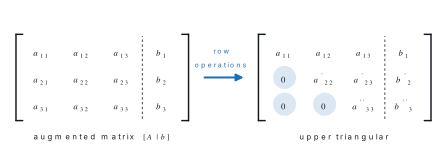
as a table of its numbers only. The coefficient matrix A has entries a_{ij}; attaching the right-hand column b to it gives the augmented matrix, written [A \,|\, b]. Every step of the method is a change to the rows of this table, and the vertical bar just reminds you which column is the right-hand side.
The three elementary row operations
Only three moves are allowed, and none of them changes the solution set:
- swap two rows (R_i \leftrightarrow R_j);
- multiply a row by a non-zero constant (R_i \rightarrow kR_i);
- add a multiple of one row to another (R_i \rightarrow R_i - mR_j).
The third is the workhorse. To kill the entry in column k of row i, use the multiplier
where row k is the pivot row and a_{kk} the pivot.
Forward elimination. Use R_1 to clear column 1 below the diagonal, then R_2 to clear column 2 below the diagonal, and so on, until the table is upper triangular.
Back substitution. The last row now involves one unknown only. Solve it, put the value into the row above, and climb upwards.
Problem. Solve by Gauss elimination: \;x+y+z=6,\;\;2x+3y+z=11,\;\;3x+y+4z=17.
Solution. Augmented matrix, written as a table:
| step | x | y | z | RHS | operation |
|---|---|---|---|---|---|
| R_1 | 1 | 1 | 1 | 6 | pivot row |
| R_2 | 2 | 3 | 1 | 11 | |
| R_3 | 3 | 1 | 4 | 17 |
Multipliers for column 1: m_{21} = 2/1 = 2 and m_{31} = 3/1 = 3.
| step | x | y | z | RHS | operation |
|---|---|---|---|---|---|
| R_1 | 1 | 1 | 1 | 6 | unchanged |
| R_2' | 0 | 1 | -1 | -1 | R_2 - 2R_1 |
| R_3' | 0 | -2 | 1 | -1 | R_3 - 3R_1 |
Now column 2, with R_2' as pivot row: m_{32} = -2/1 = -2.
| step | x | y | z | RHS | operation |
|---|---|---|---|---|---|
| R_1 | 1 | 1 | 1 | 6 | |
| R_2' | 0 | 1 | -1 | -1 | |
| R_3'' | 0 | 0 | -1 | -3 | R_3' + 2R_2' |
Back substitution. From R_3'': \;-z = -3 \Rightarrow z = 3. From R_2': \;y - z = -1 \Rightarrow y = -1 + 3 = 2. From R_1: \;x + y + z = 6 \Rightarrow x = 6 - 2 - 3 = 1.
Check in the equation not used last: 3(1) + 2 + 4(3) = 3+2+12 = 17. Correct.
Problem. Solve \;2x+y-z=8,\;\;-3x-y+2z=-11,\;\;-2x+y+2z=-3.
Solution. Pivot a_{11} = 2, so m_{21} = -3/2 and m_{31} = -2/2 = -1.
| step | x | y | z | RHS | operation |
|---|---|---|---|---|---|
| R_1 | 2 | 1 | -1 | 8 | |
| R_2' | 0 | \frac12 | \frac12 | 1 | R_2 + \frac32 R_1 |
| R_3' | 0 | 2 | 1 | 5 | R_3 + R_1 |
Column 2: m_{32} = 2 \div \frac12 = 4.
| step | x | y | z | RHS | operation |
|---|---|---|---|---|---|
| R_1 | 2 | 1 | -1 | 8 | |
| R_2' | 0 | \frac12 | \frac12 | 1 | |
| R_3'' | 0 | 0 | -1 | 1 | R_3' - 4R_2' |
Back substitution: -z = 1 \Rightarrow z = -1; then \frac12 y + \frac12(-1) = 1 \Rightarrow \frac12 y = \frac32 \Rightarrow y = 3; then 2x + 3 - (-1) = 8 \Rightarrow 2x = 4 \Rightarrow x = 2.
When the pivot is zero: partial pivoting
If a pivot comes out 0 you cannot divide by it. Swap the pivot row with a lower row whose entry in that column is non-zero — operation (1), so nothing is lost. Choosing the row with the largest entry in that column is called partial pivoting; it also keeps rounding errors small, which is why every computer program does it.
Problem. Solve \;x+y+z=6,\;\;2x+2y+5z=21,\;\;4x+6y+8z=40 by Gauss elimination with row interchange where necessary.
Solution. m_{21} = 2, m_{31} = 4:
| step | x | y | z | RHS | operation |
|---|---|---|---|---|---|
| R_1 | 1 | 1 | 1 | 6 | |
| R_2' | 0 | 0 | 3 | 9 | R_2 - 2R_1 |
| R_3' | 0 | 2 | 4 | 16 | R_3 - 4R_1 |
The next pivot would be the 0 in position (2,2) — impossible. Swap R_2' \leftrightarrow R_3':
| step | x | y | z | RHS |
|---|---|---|---|---|
| R_1 | 1 | 1 | 1 | 6 |
| R_2'' | 0 | 2 | 4 | 16 |
| R_3'' | 0 | 0 | 3 | 9 |
The table is already upper triangular, so no more elimination is needed. 3z = 9 \Rightarrow z = 3; 2y + 12 = 16 \Rightarrow y = 2; x = 6 - 2 - 3 = 1.
A zero pivot is not "no solution"
A zero in the pivot position only means swap rows. You may conclude something about the system only when a whole row of the coefficient part becomes zero: - 0\;0\;0\,|\,k with k \ne 0 — impossible equation, the system is inconsistent (no solution); - 0\;0\;0\,|\,0 — a redundant equation, so there are infinitely many solutions.
Problem. In a Pokhara stationery shop, 1 pen, 1 notebook and 1 eraser cost Rs 60 together. Two pens, three notebooks and one eraser cost Rs 110; three pens, one notebook and four erasers cost Rs 170. Find each price.
Solution. Let the prices be x, y, z rupees. Then
These are the equations of Worked example 15.1 with every right-hand side multiplied by 10, so every unknown is 10 times larger:
A pen costs Rs 10, a notebook Rs 20 and an eraser Rs 30. Check: 3(10)+20+4(30) = 30+20+120 = 170. Correct.
Do not convert \frac12 to 0.5 and \frac13 to 0.333 during elimination. In a hand-worked exam answer, fractions stay exact and the final check works perfectly; decimals accumulate rounding error and cost you the check mark.
15.2 System of linear equations: Gauss–Seidel Method
Elimination is direct: a fixed number of steps and you are finished. The Gauss–Seidel method is iterative: you start with a guess and improve it over and over, stopping when the numbers stop changing to the accuracy you want.
Setting up the iteration
Solve each equation for the unknown on its own diagonal:
For a_{11}x + a_{12}y + a_{13}z = b_1 and its two companions,
The point of Gauss–Seidel is the superscript (k+1) on the right: use each new value the moment you have it, within the same iteration. (Waiting until the end of the sweep gives the slower Jacobi method.)
Start from x^{(0)} = y^{(0)} = z^{(0)} = 0 unless the question says otherwise.
Will it converge?
A square matrix is diagonally dominant if in every row the size of the diagonal entry exceeds the sum of the sizes of the other entries in that row:
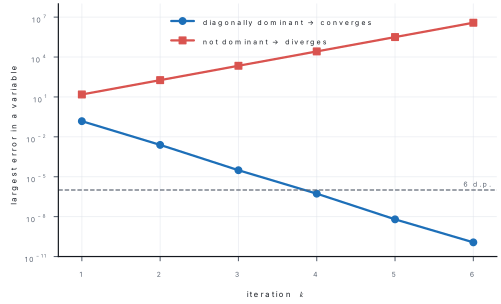
If the coefficient matrix is diagonally dominant, Gauss–Seidel converges from any starting guess. If it is not, the iteration may still converge — but it may also fly apart, and then no amount of patience helps. If the rows of the given system are not dominant, reorder the equations before you start.
Problem. Solve, correct to three decimal places, by the Gauss–Seidel method:
Solution. Each row is dominant (20 > 1+2, 20 > 3+1, 20 > 2+3), so the method will converge. Rearranged:
Start at x=y=z=0 and tabulate. (In each row, y uses the x just found, and z uses both.)
| k | x^{(k)} | y^{(k)} | z^{(k)} |
|---|---|---|---|
| 0 | 0 | 0 | 0 |
| 1 | 0.850000 | -1.027500 | 1.010875 |
| 2 | 1.002462 | -0.999826 | 0.999780 |
| 3 | 0.999969 | -1.000006 | 1.000002 |
| 4 | 1.000001 | -1.000000 | 1.000000 |
| 5 | 1.000000 | -1.000000 | 1.000000 |
Row 1 in full, to show the arithmetic: x^{(1)} = \frac{17-0+0}{20} = 0.85; y^{(1)} = \frac{-18-3(0.85)+0}{20} = \frac{-20.55}{20} = -1.0275; z^{(1)} = \frac{25-2(0.85)+3(-1.0275)}{20} = \frac{20.2175}{20} = 1.010875.
Iterations 4 and 5 agree to six decimal places, so
Problem. Perform four Gauss–Seidel iterations on \;10x+y+z=12,\;\;2x+10y+z=13,\;\;2x+2y+10z=14.
Solution. x = \frac{12-y-z}{10}, y = \frac{13-2x-z}{10}, z = \frac{14-2x-2y}{10}.
| k | x^{(k)} | y^{(k)} | z^{(k)} |
|---|---|---|---|
| 0 | 0 | 0 | 0 |
| 1 | 1.200000 | 1.060000 | 0.948000 |
| 2 | 0.999200 | 1.005360 | 0.999088 |
| 3 | 0.999555 | 1.000180 | 1.000053 |
| 4 | 0.999977 | 0.999999 | 1.000005 |
The values are settling on x = y = z = 1, which satisfies all three equations exactly (10+1+1 = 12, 2+10+1 = 13, 2+2+10 = 14).
The reason iteration works is easy to see with two unknowns. Solving for x moves you horizontally onto the first line; solving for y moves you vertically onto the second. The path is a staircase that closes in on the intersection.
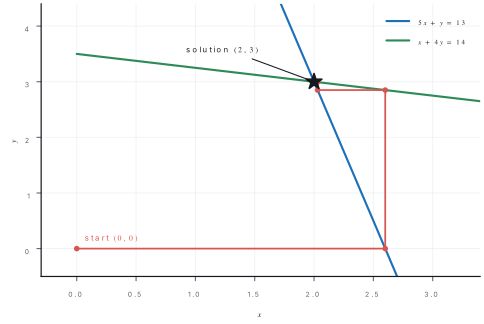
For x + 3y = 5, 4x + y = 6 the first row has |1| < |3|, so the system is not dominant and Gauss–Seidel explodes: (5, -14), (47, -182), (551, -2198), …, although the true solution is only x = \tfrac{13}{11}, y = \tfrac{14}{11}. Swap the two equations to get 4x + y = 6, x + 3y = 5; both rows are then dominant and the iteration converges. One row interchange is the difference between an answer and a disaster.
Problem. Explain why Gauss–Seidel applied as written to \;x + 4y - z = 6,\;\;5x - y + z = 7,\;\;x + y + 6z = 12 is unsafe, and fix it.
Solution. Row 1: |1| < |4| + |-1| = 5 — not dominant. Row 2: |-1| < |5| + |1| = 6 — not dominant. Row 3: |6| > |1| + |1| — dominant.
Reorder the equations so the largest coefficient of each unknown sits on the diagonal. Put the 5x equation first and the 4y equation second:
Now 5 > 1+1, 4 > 1+1 and 6 > 1+1: all three rows are dominant, so the iteration x = \frac{7+y-z}{5}, y = \frac{6-x+z}{4}, z = \frac{12-x-y}{6} is safe to run.
15.3 Linear programming problems (LPP): simplex method (two variables)
A linear programming problem asks for the largest (or smallest) value of a linear expression when the variables obey linear inequalities.
- Decision variables x, y \ge 0 — what you choose.
- Objective function Z = c_1x + c_2y — what you maximise.
- Constraints a_1x + b_1y \le d_1, … — the limits you must respect.
- Feasible region — the set of points satisfying every constraint.
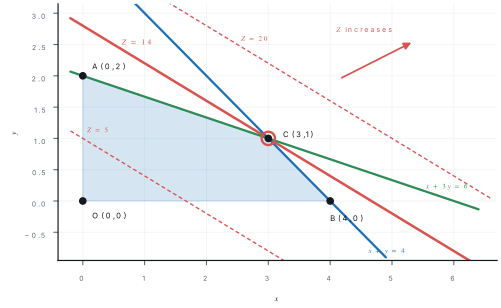
The feasible region of a two-variable problem is a convex polygon, and the optimum always sits at a corner of it. That is the whole idea: instead of testing infinitely many points, test the corners.
Slack variables and standard form
An inequality cannot be put in a table, so turn each \le constraint into an equation by adding a non-negative slack variable that soaks up the unused capacity:
subject to a_ix + b_iy + s_i = d_i and x, y, s_i \ge 0.
All d_i must be \ge 0. To minimise Z, maximise -Z instead and change the sign of the answer at the end.
The tableau and the pivot rules
The starting tableau lists the constraint equations, then the objective row. The basic variables are the slacks (value d_i) and the non-basic variables x, y are zero — that is the corner (0,0).
- Pivot column — the objective row's most negative entry. (No negative entry left \Rightarrow you are at the optimum; stop.)
- Pivot row — compute ratio = \dfrac{\text{RHS}}{\text{pivot-column entry}} for the positive entries only, and choose the smallest ratio.
- Pivot — divide the pivot row by the pivot element to make it 1, then add multiples of that row to every other row (including the objective row) to make the rest of the pivot column 0.
Problem. Maximise Z = 3x + 5y subject to x+y \le 4, x+3y \le 6, x, y \ge 0, by the simplex method.
Solution. Add slacks: x+y+s_1 = 4, x+3y+s_2 = 6, and write Z - 3x - 5y = 0.
Tableau 1.
| basic | x | y | s_1 | s_2 | RHS | ratio |
|---|---|---|---|---|---|---|
| s_1 | 1 | 1 | 1 | 0 | 4 | 4/1 = 4 |
| s_2 | 1 | \mathbf{3} | 0 | 1 | 6 | 6/3 = 2 ← |
| Z | -3 | -5 | 0 | 0 | 0 |
Most negative entry is -5, so y enters. Smallest ratio is 2, so row s_2 leaves; the pivot is 3.
Divide the pivot row by 3, then R_1 \rightarrow R_1 - R_2 and Z \rightarrow Z + 5R_2.
Tableau 2.
| basic | x | y | s_1 | s_2 | RHS | ratio |
|---|---|---|---|---|---|---|
| s_1 | \mathbf{\frac23} | 0 | 1 | -\frac13 | 2 | 2 \div \frac23 = 3 ← |
| y | \frac13 | 1 | 0 | \frac13 | 2 | 2 \div \frac13 = 6 |
| Z | -\frac43 | 0 | 0 | \frac53 | 10 |
Still one negative, -\frac43, so x enters; smallest ratio 3, so s_1 leaves and the pivot is \frac23. Multiply that row by \frac32, then R_2 \rightarrow R_2 - \frac13 R_1 and Z \rightarrow Z + \frac43 R_1.
Tableau 3.
| basic | x | y | s_1 | s_2 | RHS |
|---|---|---|---|---|---|
| x | 1 | 0 | \frac32 | -\frac12 | 3 |
| y | 0 | 1 | -\frac12 | \frac12 | 1 |
| Z | 0 | 0 | 2 | 1 | 14 |
No negative entry in the Z row, so this is optimal:
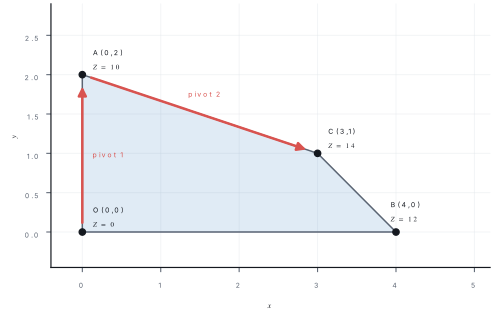
Check. x+y = 4 \le 4 and x+3y = 6 \le 6 — both tight, so both slacks are zero, and 3(3)+5(1) = 14. The corner is C(3,1) in the figure above.
Each tableau is one corner of the feasible region, and each pivot is a walk along one edge to a better corner. The simplex method never goes backwards, which is why it stops.
Problem. A furniture workshop in Butwal makes chairs and tables. A chair needs 4 hours of carpentry and 2 hours of finishing; a table needs 2 hours of carpentry and 4 hours of finishing. Only 60 carpentry hours and 48 finishing hours are available in a week. The profit is Rs 800 on a chair and Rs 600 on a table. How many of each should be made, and what is the maximum profit?
Solution. Let x chairs and y tables be made, and measure profit in hundreds of rupees, Z = 8x + 6y.
Tableau 1.
| basic | x | y | s_1 | s_2 | RHS | ratio |
|---|---|---|---|---|---|---|
| s_1 | \mathbf{4} | 2 | 1 | 0 | 60 | 15 ← |
| s_2 | 2 | 4 | 0 | 1 | 48 | 24 |
| Z | -8 | -6 | 0 | 0 | 0 |
x enters, s_1 leaves, pivot 4. Divide R_1 by 4; R_2 \rightarrow R_2 - 2R_1; Z \rightarrow Z + 8R_1.
Tableau 2.
| basic | x | y | s_1 | s_2 | RHS | ratio |
|---|---|---|---|---|---|---|
| x | 1 | \frac12 | \frac14 | 0 | 15 | 30 |
| s_2 | 0 | \mathbf{3} | -\frac12 | 1 | 18 | 6 ← |
| Z | 0 | -2 | 2 | 0 | 120 |
y enters, s_2 leaves, pivot 3. Divide R_2 by 3; R_1 \rightarrow R_1 - \frac12 R_2; Z \rightarrow Z + 2R_2.
Tableau 3.
| basic | x | y | s_1 | s_2 | RHS |
|---|---|---|---|---|---|
| x | 1 | 0 | \frac13 | -\frac16 | 12 |
| y | 0 | 1 | -\frac16 | \frac13 | 6 |
| Z | 0 | 0 | \frac53 | \frac23 | 132 |
All entries of the Z row are \ge 0, so stop: x = 12, y = 6, Z = 132.
Make 12 chairs and 6 tables for a maximum profit of 132 \times 100 = Rs 13{,}200. Check: carpentry 4(12)+2(6) = 60 h, finishing 2(12)+4(6) = 48 h — both fully used, and 800(12) + 600(6) = 9600 + 3600 = 13{,}200.
Problem. Maximise Z = 5x + 3y subject to x + y \le 6, 2x + 3y \le 15, x, y \ge 0.
Solution. Tableau 1.
| basic | x | y | s_1 | s_2 | RHS | ratio |
|---|---|---|---|---|---|---|
| s_1 | \mathbf{1} | 1 | 1 | 0 | 6 | 6 ← |
| s_2 | 2 | 3 | 0 | 1 | 15 | 7.5 |
| Z | -5 | -3 | 0 | 0 | 0 |
Pivot 1 in row s_1, column x. Row 1 is already divided; R_2 \rightarrow R_2 - 2R_1; Z \rightarrow Z + 5R_1.
Tableau 2.
| basic | x | y | s_1 | s_2 | RHS |
|---|---|---|---|---|---|
| x | 1 | 1 | 1 | 0 | 6 |
| s_2 | 0 | 1 | -2 | 1 | 3 |
| Z | 0 | 2 | 5 | 0 | 30 |
No negative entry remains, so the optimum has been reached after one pivot:
The second constraint is slack (s_2 = 3, i.e. 2(6) + 0 = 12 < 15), which the tableau tells you directly.
When choosing the pivot row, ignore any row whose pivot-column entry is 0 or negative — a negative ratio is meaningless and would let a variable go negative. If every entry in the pivot column is \le 0, the feasible region is unbounded in that direction and Z has no maximum; say so.
15.4 How accurate is a computed answer?
Gauss–Seidel and the simplex method both stop somewhere. A computed answer is therefore only as good as the error attached to it, and every numerical method comes with an error estimate. Two more retained methods make the point sharply; Unit 17 §17.3 revises the integration rules in exam form.
Newton–Raphson: doubling the correct digits each step
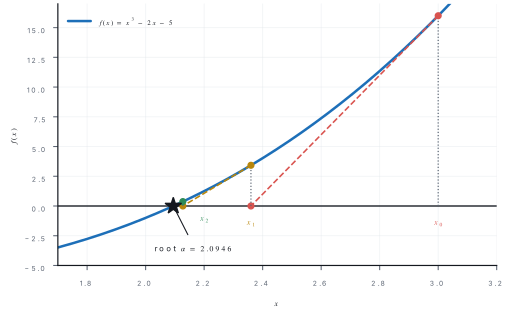
To solve f(x) = 0, take a guess x_0, follow the tangent to the curve down to the x-axis, and use where it lands as the next guess. The tangent at (x_n, f(x_n)) meets y = 0 at
Near a simple root the error is squared each step, so the number of correct decimal places roughly doubles per iteration.
Problem. Find the real root of x^3 - 2x - 5 = 0 correct to four decimal places, taking x_0 = 2.
Solution. f(x) = x^3 - 2x - 5, f'(x) = 3x^2 - 2, so
f(2) = -1 < 0 and f(3) = 16 > 0, so a root lies in (2,3).
| n | x_n | f(x_n) | f'(x_n) | x_{n+1} |
|---|---|---|---|---|
| 0 | 2.000000 | -1.000000 | 10.000000 | 2.100000 |
| 1 | 2.100000 | 0.061000 | 11.230000 | 2.094568 |
| 2 | 2.094568 | 0.000186 | 11.161647 | 2.094551 |
| 3 | 2.094551 | 0.000000 | 11.161438 | 2.094551 |
Two successive iterates agree to six decimal places, so the root is
Notice the error sizes: 10^{-1}, then 10^{-3}, then 10^{-6} — squared each time, as promised.
Problem. Use the Newton–Raphson method to compute \sqrt{5} to five decimal places.
Solution. \sqrt{5} is the positive root of f(x) = x^2 - 5, with f'(x) = 2x. The formula simplifies:
Take x_0 = 2 (since 2^2 = 4 is close to 5).
| n | x_n | x_{n+1} = \frac12\left(x_n + 5/x_n\right) |
|---|---|---|
| 0 | 2.000000 | 2.250000 |
| 1 | 2.250000 | 2.236111 |
| 2 | 2.236111 | 2.236068 |
| 3 | 2.236068 | 2.236068 |
Order of a quadrature rule
For \int_a^b f(x)\,dx with n equal strips of width h = \dfrac{b-a}{n} and ordinates y_0, y_1, \ldots, y_n:
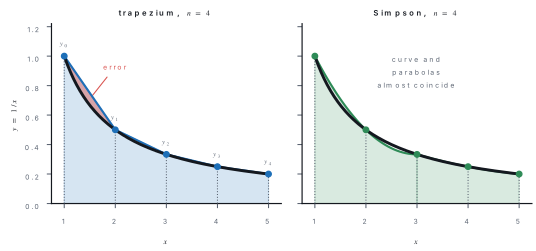
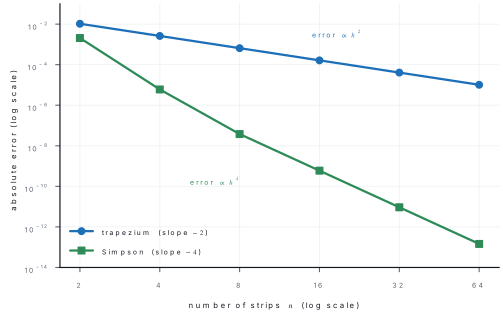
The trapezium rule replaces the curve by chords, so its error is proportional to h^2; Simpson's rule replaces it by parabolas through three ordinates at a time, so its error is proportional to h^4. Halving h divides the trapezium error by 4 but the Simpson error by 16.
Problem. Evaluate \displaystyle\int_0^1 \frac{dx}{1+x^2} with n = 4 by both the trapezium rule and Simpson's rule, state the error bound for each, and compare with the exact value \frac{\pi}{4}.
Solution. h = \dfrac{1-0}{4} = 0.25. Ordinate table:
| i | x_i | y_i = 1/(1+x_i^2) | used as |
|---|---|---|---|
| 0 | 0.00 | 1.000000 | end |
| 1 | 0.25 | 0.941176 | odd |
| 2 | 0.50 | 0.800000 | even |
| 3 | 0.75 | 0.640000 | odd |
| 4 | 1.00 | 0.500000 | end |
Trapezium. Ends = 1.000000 + 0.500000 = 1.500000; others = 0.941176+0.800000+0.640000 = 2.381176.
Simpson. Odd ordinates y_1 + y_3 = 1.581176; even (interior) y_2 = 0.800000.
Error bounds. Here f''(x) = \dfrac{2(3x^2-1)}{(1+x^2)^3} and f^{(4)}(x) have maximum sizes 2 and 24 on [0,1], so
Comparison. \frac{\pi}{4} = 0.785398. The actual errors are 0.002604 and 0.000006 — both comfortably inside their bounds, and Simpson is about 400 times more accurate for the same five ordinates.
Chapter summary
- Gauss elimination. Form [A\,|\,b]; use R_i \rightarrow R_i - m_{ik}R_k with m_{ik} = a_{ik}/a_{kk} to make it upper triangular; back substitute. Swap rows if a pivot is 0 (partial pivoting).
- A row 0\;0\;0\,|\,k with k \ne 0 means no solution; 0\;0\;0\,|\,0 means infinitely many.
- Gauss–Seidel. x^{(k+1)} = \frac{1}{a_{11}}(b_1 - a_{12}y^{(k)} - a_{13}z^{(k)}), and so on, always using the newest value available. Converges for certain when |a_{ii}| > \sum_{j\ne i}|a_{ij}| in every row — reorder the equations if it is not so.
- Direct methods (elimination) finish in a set number of steps; iterative methods (Gauss–Seidel) are stopped when successive iterates agree to the required accuracy.
- LPP. Maximise Z = c_1x + c_2y over a convex feasible region; the optimum lies at a corner.
- Simplex. Add slacks, write Z - c_1x - c_2y = 0. Pivot column = most negative Z entry; pivot row = smallest positive ratio RHS \div column entry; pivot to make the column (1,0,\ldots,0). Stop when no Z entry is negative.
- Newton–Raphson. x_{n+1} = x_n - f(x_n)/f'(x_n); correct digits roughly double each step.
- Quadrature. Trapezium \frac{h}{2}[y_0+y_n+2(\text{rest})] with |E| \le \frac{(b-a)h^2}{12}\max|f''|; Simpson \frac{h}{3}[y_0+y_n+4(\text{odd})+2(\text{even})], n even, with |E| \le \frac{(b-a)h^4}{180}\max|f^{(4)}|.
Practice questions
Group A — Multiple choice (1 mark each)
- In Gauss elimination the augmented matrix is reduced to [1]aa diagonal matrixban upper triangular matrixcan identity matrixda symmetric matrix
- The Gauss–Seidel method is certain to converge if the coefficient matrix is [1]asymmetricbsingularcdiagonally dominantdtriangular
- In a simplex tableau the entering variable is chosen from the objective row's [1]alargest positive entrybmost negative entrycsmallest ratiodlast column
- A slack variable added to 3x + 4y \le 12 satisfies [1]as \le 0bs = 0cs \ge 0ds = 12
- If a row of the reduced augmented matrix reads 0\;0\;0\,|\,5, the system has [1]aa unique solutionbno solutioncinfinitely many solutionsdexactly two solutions
- Simpson's rule can be applied only when the number of strips n is [1]aoddbevenca multiple of 3dprime
- For the Newton–Raphson method, x_{n+1} equals [1]ax_n + \frac{f(x_n)}{f'(x_n)}bx_n - \frac{f'(x_n)}{f(x_n)}cx_n - \frac{f(x_n)}{f'(x_n)}d\frac{f(x_n)}{f'(x_n)}
Answers to Group A
1. (b) — forward elimination puts zeros below the diagonal so the last row has one unknown.
2. (c) — diagonal dominance guarantees convergence from any starting guess.
3. (b) — the most negative coefficient promises the fastest increase in Z.
4. (c) — slack measures unused capacity, which cannot be negative.
5. (b) — it states 0 = 5, an impossibility, so the system is inconsistent.
6. (b) — the ordinates are taken three at a time (two strips per parabola).
7. (c) — the tangent at x_n meets the x-axis at x_n - f(x_n)/f'(x_n).
Group B — Short answer (5 marks each)
- Solve by Gauss elimination: \;x + 2y + 3z = 14, \;2x + 5y + 2z = 18, \;3x + y + 5z = 20. [5]
- State the three elementary row operations and explain, with the system 2x + 4y = 6, \;3x + y = -1, why a row interchange can be necessary during Gauss elimination. Solve the system. [5]
- Carry out three iterations of the Gauss–Seidel method on \;8x - 3y + 2z = 20, \;4x + 11y - z = 33, \;6x + 3y + 12z = 35, starting from (0,0,0). Give your answers to four decimal places. [5]
- Test whether \;x + 5y = 7, \;4x + y = 6 is suitable for Gauss–Seidel as written. Rearrange if necessary and perform three iterations. [5]
- Maximise Z = 5x + 7y subject to x + y \le 4, 3x + 8y \le 24, x, y \ge 0 by the simplex method. [5]
- Using the Newton–Raphson method with x_0 = 1, find the root of x^3 + x - 3 = 0 correct to four decimal places. [5]
Answers to Group B
1. Augmented matrix rows (1,2,3\,|\,14), (2,5,2\,|\,18), (3,1,5\,|\,20).
m_{21} = 2: R_2 - 2R_1 = (0,1,-4\,|\,-10). m_{31} = 3: R_3 - 3R_1 = (0,-5,-4\,|\,-22). m_{32} = -5: R_3 + 5R_2 = (0,0,-24\,|\,-72).
Back substitution: -24z = -72 \Rightarrow z = 3; y - 4(3) = -10 \Rightarrow y = 2; x + 2(2) + 3(3) = 14 \Rightarrow x = 1.
Check in equation 2: 2(1) + 5(2) + 2(3) = 2 + 10 + 6 = 18. Correct.
2. The operations are (i) R_i \leftrightarrow R_j, (ii) R_i \rightarrow kR_i with k \ne 0, (iii) R_i \rightarrow R_i - mR_j. None of them changes the solution set.
A swap is needed whenever the intended pivot a_{kk} is zero, because the multiplier m_{ik} = a_{ik}/a_{kk} would require division by zero. (Swapping to the largest available entry — partial pivoting — also limits rounding error.)
Here the pivot 2 is non-zero, so no swap is needed: m_{21} = \frac32 gives R_2 - \frac32 R_1 = (0, -5\,|\,-10), so y = 2 and then 2x + 8 = 6 \Rightarrow x = -1. So x = -1, y = 2.
3. The rows are dominant (8 > 5, 11 > 5, 12 > 9). The formulas are x = \frac{20 + 3y - 2z}{8}, y = \frac{33 - 4x + z}{11}, z = \frac{35 - 6x - 3y}{12}.
| k | x^{(k)} | y^{(k)} | z^{(k)} |
|---|---|---|---|
| 1 | 2.5000 | 2.0909 | 1.1439 |
| 2 | 2.9981 | 2.0138 | 0.9142 |
| 3 | 3.0266 | 1.9825 | 0.9077 |
Row 1 in detail: x = \frac{20+0-0}{8} = 2.5; y = \frac{33-4(2.5)+0}{11} = \frac{23}{11} = 2.0909; z = \frac{35-6(2.5)-3(2.0909)}{12} = \frac{13.7273}{12} = 1.1439.
Continuing gives x \to 3.0168, y \to 1.9859, z \to 0.9118; after three iterations every value is already correct to one decimal place.
4. Row 1 has |1| < |5|, so the system is not diagonally dominant as written and Gauss–Seidel is unsafe. Interchange the equations:
Now 4 > 1 and 5 > 1: both rows dominant. With x = \frac{6-y}{4}, y = \frac{7-x}{5} from (0,0):
| k | x^{(k)} | y^{(k)} |
|---|---|---|
| 1 | 1.500000 | 1.100000 |
| 2 | 1.225000 | 1.155000 |
| 3 | 1.211250 | 1.157750 |
The exact solution is x = \frac{23}{19} = 1.210526, y = \frac{22}{19} = 1.157895.
5. Slacks: x+y+s_1 = 4, 3x+8y+s_2 = 24, and Z - 5x - 7y = 0.
| basic | x | y | s_1 | s_2 | RHS | ratio |
|---|---|---|---|---|---|---|
| s_1 | 1 | 1 | 1 | 0 | 4 | 4 |
| s_2 | 3 | \mathbf{8} | 0 | 1 | 24 | 3 ← |
| Z | -5 | -7 | 0 | 0 | 0 |
y enters, s_2 leaves, pivot 8. After R_2 \div 8, R_1 - R_2, Z + 7R_2:
| basic | x | y | s_1 | s_2 | RHS | ratio |
|---|---|---|---|---|---|---|
| s_1 | \mathbf{\frac58} | 0 | 1 | -\frac18 | 1 | \frac85 ← |
| y | \frac38 | 1 | 0 | \frac18 | 3 | 8 |
| Z | -\frac{19}{8} | 0 | 0 | \frac78 | 21 |
x enters, s_1 leaves, pivot \frac58. After R_1 \times \frac85, R_2 - \frac38 R_1, Z + \frac{19}{8}R_1:
| basic | x | y | s_1 | s_2 | RHS |
|---|---|---|---|---|---|
| x | 1 | 0 | \frac85 | -\frac15 | \frac85 |
| y | 0 | 1 | -\frac35 | \frac15 | \frac{12}{5} |
| Z | 0 | 0 | \frac{19}{5} | \frac25 | \frac{124}{5} |
Check: 1.6 + 2.4 = 4 and 3(1.6) + 8(2.4) = 4.8 + 19.2 = 24 — both tight.
6. f(x) = x^3 + x - 3, f'(x) = 3x^2 + 1. f(1) = -1 < 0, f(2) = 7 > 0, so the root lies in (1,2).
| n | x_n | f(x_n) | f'(x_n) | x_{n+1} |
|---|---|---|---|---|
| 0 | 1.000000 | -1.000000 | 4.000000 | 1.250000 |
| 1 | 1.250000 | 0.203125 | 5.687500 | 1.214286 |
| 2 | 1.214286 | 0.004738 | 5.423469 | 1.213412 |
| 3 | 1.213412 | 0.000003 | 5.417107 | 1.213412 |
Group C — Long answer (8 marks each)
- (a) Describe the Gauss elimination method, explaining the roles of the pivot, the multiplier and back substitution. [3](b) Hence solve \;2x + y + z = 10, \;3x + 2y + 3z = 18, \;x + 4y + 9z = 16. [5]
- (a) Write down the Gauss–Seidel iteration formulas for a 3 \times 3 system and state the condition for convergence. Contrast a direct with an iterative method. [3](b) Solve, correct to three decimal places, \;10x + y - z = 11.19, \;x + 10y + z = 28.08, \;-x + y + 10z = 35.61. [5]
- (a) Explain what slack variables are and why the optimum of an LPP must occur at a corner of the feasible region. [3](b) Maximise Z = 4x + 3y subject to 2x + y \le 10, x + 3y \le 15, x, y \ge 0 by the simplex method, and verify your answer by evaluating Z at every corner of the feasible region. [5]
Answers to Group C
1. (a) Write the system as the augmented matrix [A\,|\,b]. For each column k in turn, the diagonal entry a_{kk} is the pivot and its row is the pivot row; for every row i below it form the multiplier m_{ik} = a_{ik}/a_{kk} and replace R_i by R_i - m_{ik}R_k, which makes the entry in column k zero. If a pivot is zero, interchange with a lower row (partial pivoting). After all columns are treated the matrix is upper triangular, and back substitution solves the last equation for one unknown, substitutes it into the row above, and works upwards.
(b) Rows (2,1,1\,|\,10), (3,2,3\,|\,18), (1,4,9\,|\,16).
m_{21} = \frac32: R_2 - \frac32R_1 gives the row 0,\ \frac12,\ \frac32\ |\ 3. m_{31} = \frac12: R_3 - \frac12R_1 gives the row 0,\ \frac72,\ \frac{17}{2}\ |\ 11.
m_{32} = \frac72 \div \frac12 = 7: R_3 - 7R_2 = (0, 0, -2\,|\,-10).
Back substitution: -2z = -10 \Rightarrow z = 5; \frac12 y + \frac{15}{2} = 3 \Rightarrow \frac12 y = -\frac92 \Rightarrow y = -9; 2x - 9 + 5 = 10 \Rightarrow 2x = 14 \Rightarrow x = 7.
Check in equation 3: 7 + 4(-9) + 9(5) = 7 - 36 + 45 = 16. Correct.
2. (a) With x^{(0)} = y^{(0)} = z^{(0)} = 0,
Convergence is guaranteed when the coefficient matrix is diagonally dominant, |a_{ii}| > \sum_{j \ne i}|a_{ij}| for every i. A direct method such as Gauss elimination reaches the exact answer in a fixed, known number of arithmetic steps; an iterative method produces a sequence of approximations and is stopped when two successive ones agree to the wanted accuracy, so its cost depends on the accuracy demanded and on how fast it converges.
(b) All rows are dominant (10 > 2 in each). Using x = \frac{11.19 - y + z}{10}, y = \frac{28.08 - x - z}{10}, z = \frac{35.61 + x - y}{10}:
| k | x^{(k)} | y^{(k)} | z^{(k)} |
|---|---|---|---|
| 1 | 1.119000 | 2.696100 | 3.403290 |
| 2 | 1.189719 | 2.348699 | 3.445102 |
| 3 | 1.228640 | 2.340626 | 3.449801 |
| 4 | 1.229918 | 2.340028 | 3.449989 |
| 5 | 1.229996 | 2.340001 | 3.449999 |
Check in equation 3: -1.23 + 2.34 + 10(3.45) = 35.61. Correct.
3. (a) A slack variable s_i \ge 0 is added to a \le constraint to turn it into an equation, a_ix + b_iy + s_i = d_i; its value is the amount of that resource left unused. Because every constraint is linear, the feasible region is the intersection of half-planes and is therefore a convex polygon. The objective Z = c_1x + c_2y is constant along a family of parallel lines; pushing such a line in the direction of increasing Z, the last point of the polygon it meets is either a vertex or (if the line is parallel to an edge) a whole edge whose endpoints are vertices. Either way a vertex attains the maximum, so only the corners need testing.
(b) Slacks: 2x + y + s_1 = 10, x + 3y + s_2 = 15, and Z - 4x - 3y = 0.
| basic | x | y | s_1 | s_2 | RHS | ratio |
|---|---|---|---|---|---|---|
| s_1 | \mathbf{2} | 1 | 1 | 0 | 10 | 5 ← |
| s_2 | 1 | 3 | 0 | 1 | 15 | 15 |
| Z | -4 | -3 | 0 | 0 | 0 |
x enters, s_1 leaves, pivot 2. After R_1 \div 2, R_2 - R_1, Z + 4R_1:
| basic | x | y | s_1 | s_2 | RHS | ratio |
|---|---|---|---|---|---|---|
| x | 1 | \frac12 | \frac12 | 0 | 5 | 10 |
| s_2 | 0 | \mathbf{\frac52} | -\frac12 | 1 | 10 | 4 ← |
| Z | 0 | -1 | 2 | 0 | 20 |
y enters, s_2 leaves, pivot \frac52. After R_2 \times \frac25, R_1 - \frac12R_2, Z + R_2:
| basic | x | y | s_1 | s_2 | RHS |
|---|---|---|---|---|---|
| x | 1 | 0 | \frac35 | -\frac15 | 3 |
| y | 0 | 1 | -\frac15 | \frac25 | 4 |
| Z | 0 | 0 | \frac95 | \frac25 | 24 |
No negative entry remains, so x = 3, y = 4, Z_{\max} = 24.
Corner check. The lines 2x+y=10 and x+3y=15 meet where x = 3, y = 4. The corners are (0,0), (5,0), (3,4), (0,5):
| corner | (0,0) | (5,0) | (3,4) | (0,5) |
|---|---|---|---|---|
| Z = 4x+3y | 0 | 20 | \mathbf{24} | 15 |
The maximum is 24 at (3,4), agreeing with the simplex result.
Practise more: Mathematics question bank