Unit 1 · Algebra · 10 teaching hours · 27 min read
Permutation and Combination
What the syllabus asks for 6
- Basic principle of counting
- Permutation of objects all different
- Permutation of objects not all different
- Circular permutation; permutation with repeated use of objects
- Combination of things all different
- Properties of combination
Counting sounds like the easiest thing in mathematics until the list gets too long to write out. How many different number plates can Bagmati Province issue? In how many orders can eleven players bat? How many five-member committees can a class of thirty form? This unit gives you machinery that answers such questions without listing anything. Two ideas do all the work: a permutation counts arrangements, where order matters, and a combination counts selections, where order does not.
Every question reduces to one decision: does order matter? If it does, you are counting permutations (^{n}P_{r}); if it does not, combinations (^{n}C_{r}). Then ask whether the objects are all different, whether repetition is allowed, and whether the arrangement is in a line or a circle. Group B items are usually word-arrangements or committee selections with a restriction; Group C usually asks you to derive ^{n}P_{r} or ^{n}C_{r} and then apply it.
1.1 Basic principle of counting
Almost everything in this unit grows from two short rules.
Multiplication principle (the "AND" rule). If one job can be done in m ways and, after it has been done, a second job can be done in n ways, then the two jobs can be done one after the other in m \times n ways. This extends to any number of jobs done in succession.
Addition principle (the "OR" rule). If one job can be done in m ways and a different, mutually exclusive job in n ways, then exactly one of the two jobs can be done in m + n ways.
The word that tells you which rule to use is the connective. "Choose a shirt and a pair of trousers" multiplies. "Travel by bus or by plane" adds.
Factorial notation
For a positive integer n, the product of all positive integers up to n is written n! and read "n factorial":
So 5! = 120 and 6! = 720. Putting n = 1 in n! = n(n-1)! gives 1! = 1 \cdot 0!, which forces
This is a definition made necessary by the formula, not an accident; without it ^{n}P_{n} = n!/0! would be meaningless.
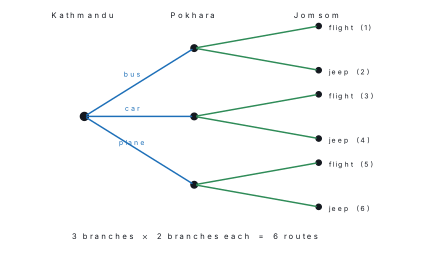
Problem. A traveller can go from Kathmandu to Pokhara by 3 bus services or 2 flights, and from Pokhara to Jomsom by 4 jeeps. In how many ways can the whole journey Kathmandu → Pokhara → Jomsom be made?
Solution. The first leg is "bus or flight", so the addition principle gives 3 + 2 = 5 ways. The first leg and then the second leg gives, by the multiplication principle,
Problem. How many three-digit numbers can be formed from the digits 1, 2, 3, 4, 5, 6 if (a) repetition is allowed, (b) repetition is not allowed, (c) repetition is not allowed and the number must be even?
Solution. Draw three boxes — hundreds, tens, units — and fill them.
(a) Each box can take any of the 6 digits: \;6 \times 6 \times 6 = 216.
(b) Once a digit is used it is gone: \;6 \times 5 \times 4 = 120.
(c) Fill the restricted box first. The units digit must be 2, 4 or 6, so it has 3 choices; the hundreds box then has 5 digits left and the tens box 4:
Note that we multiplied in the order hundreds \times tens \times units at the end — the order of filling does not change the product, but filling the restricted box first keeps the counts honest.
If a question says "must end in 0", "must begin with a vowel", or "a particular person must sit at the head", fill that position before any free position. If you fill the free positions first you will not know how many choices are left for the restricted one.
1.2 Permutation of objects all different
A permutation of r objects taken from n distinct objects is an arrangement of r of them in a definite order. The number of such arrangements is written ^{n}P_{r} (also P(n,r)), where 0 \le r \le n.
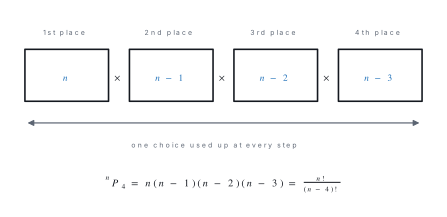
Think of r empty boxes standing in a row, to be filled from n distinct objects with no object used twice.
- The first box can be filled in n ways (any object).
- For each of those, the second box can be filled in n-1 ways, since one object has been used.
- The third box: n-2 ways. And so on.
- The r^{\text{th}} box is the r^{\text{th}} in the list n, n-1, n-2, \ldots, so it can be filled in n-(r-1) = n-r+1 ways.
By the multiplication principle, multiply the counts:
There are exactly r factors. Multiply and divide by (n-r)! to close the product into factorials:
Putting r = n gives ^{n}P_{n} = n!/0! = n!: n distinct objects can be arranged among themselves in n! ways.
Two useful consequences: ^{n}P_{r} = n \cdot {}^{n-1}P_{r-1} and ^{n}P_{r} = {}^{n-1}P_{r} + r\cdot{}^{n-1}P_{r-1}.
Problem. (a) Find n if ^{n}P_{4} = 20 \cdot {}^{n}P_{2}. (b) Find r if ^{10}P_{r} = 720.
Solution. (a) Write both sides as products, not factorials — the cancelling is then obvious:
Since n \ge 4, the factor n(n-1) is non-zero and may be cancelled:
A number of objects cannot be negative, so n = 7. Check: ^{7}P_{4} = 840 and 20 \times {}^{7}P_{2} = 20 \times 42 = 840. ✓
(b) ^{10}P_{r} = 10 \times 9 \times 8 \cdots Taking three factors gives 10 \times 9 \times 8 = 720, so r = 3.
Problem. In how many ways can the letters of the word TRIANGLE be arranged if (a) there is no restriction, (b) all the vowels come together, (c) no two vowels are together?
Solution. TRIANGLE has 8 different letters: consonants T, R, N, G, L (5 of them) and vowels I, A, E (3).
(a) Eight distinct letters: \;8! = 40\,320.
(b) Tie the three vowels into one block. There are now 5 + 1 = 6 units to arrange, in 6! ways, and the vowels inside the block can be ordered in 3! ways:
(c) Use the gap method. Arrange the 5 consonants first: 5! = 120 ways. This creates 6 gaps (before, between and after them):
Put the three vowels into three different gaps, which is an arrangement of 3 vowels in 6 places: ^{6}P_{3} = 6 \times 5 \times 4 = 120 ways. Hence
In TRIANGLE, arrangements with no two vowels adjacent number 14\,400, while arrangements in which the vowels are not all three together number 40\,320 - 4320 = 36\,000. Read the wording carefully: "together" glued as a block, "no two together" needs the gap method.
1.3 Permutation of objects not all different
If some objects are identical, swapping them produces no new arrangement, so the count n! over-counts.
Suppose n objects contain p alike of one kind, q alike of a second kind, s alike of a third kind, and the rest all different. Let the required number of distinct arrangements be x.
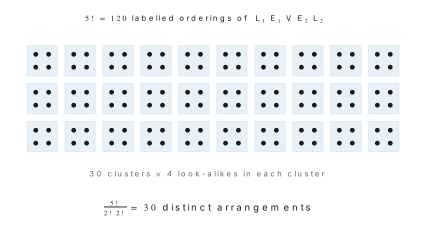
Take any one of these x arrangements. If the p identical objects were labelled to make them distinguishable, they could be permuted among their own p places in p! ways, and every one of those would then look different. Similarly the q alike give q! and the s alike give s!. So each of the x arrangements would spread into p!\,q!\,s! distinguishable ones.
But if every object were distinct the total would be exactly n!. Therefore
Problem. How many distinct arrangements can be made of the letters of the word KATHMANDU? In how many of them are the three vowels together?
Solution. KATHMANDU has 9 letters: K, A, T, H, M, A, N, D, U. Only A is repeated, twice; every other letter appears once. So n = 9, p = 2:
For the vowels A, A, U together, tie them into one block. The consonants K, T, H, M, N, D (6 of them) plus the block make 7 units, all different, giving 7! arrangements; inside the block the three letters A, A, U can be ordered in 3!/2! ways because two of them are alike:
Problem. How many different arrangements are there of the letters of MISSISSIPPI? In how many of them do no two I's come together?
Solution. Eleven letters: M (1), I (4), S (4), P (2).
For no two I's together, first arrange the other seven letters M, S, S, S, S, P, P:
These seven letters create 8 gaps, and the four identical I's must occupy four different gaps — a selection, not an arrangement, since the I's are alike: ^{8}C_{4} = 70. Hence
1.4 Circular permutation; permutation with repeated use of objects
Arrangements round a circle
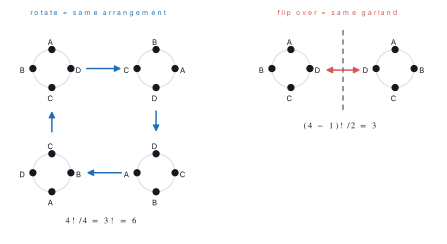
Around a round table there is no "first seat". Rotating everybody one place to the left gives the same cyclic order, so each circular arrangement corresponds to several linear ones.
Fix one person, say A, in any seat. This removes the rotational freedom, because every arrangement of the circle can be rotated until A sits in that chosen seat, and it can be done in exactly one way. The remaining n-1 people now fill n-1 distinct seats relative to A, which can be done in (n-1)! ways. Hence
Equivalently: the n! linear arrangements fall into groups of n that are rotations of one another, so the count is n!/n = (n-1)!.
If the circle may also be turned over — a garland of flowers, a necklace of beads, a bracelet — then a clockwise arrangement and its mirror image are the same object, and the count halves:
Problem. Eight friends sit at a round table. In how many ways can they sit if (a) there is no restriction, (b) two particular friends sit together, (c) those two never sit together? (d) In how many ways can 8 different flowers be strung into a garland?
Solution. (a) \;(8-1)! = 7! = 5040.
(b) Tie the two friends into one block. There are now 7 units round the circle, giving (7-1)! = 6! = 720 ways; the two inside the block can swap in 2! ways:
(c) "Never together" is everything else: \;5040 - 1440 = 3600.
(d) A garland can be turned over, so
Permutations with repeated use of objects
Now allow each object to be used as often as we like.
There are r places to fill and n objects available. Because an object may be used again, the number of choices does not shrink: each of the r places can be filled in n ways independently. By the multiplication principle the number of arrangements is
Note the contrast with ^{n}P_{r}: there the factors decrease, here they stay at n because nothing is used up.
| Situation | Count |
|---|---|
| r from n, order matters, no repetition | ^{n}P_{r} = \dfrac{n!}{(n-r)!} |
| r from n, order matters, repetition allowed | n^{r} |
| r from n, order does not matter | ^{n}C_{r} = \dfrac{n!}{r!(n-r)!} |
| all n in a row, p and q alike | \dfrac{n!}{p!\,q!} |
| all n round a circle | (n-1)! |
| all n in a garland or necklace | \dfrac{(n-1)!}{2} |
Problem. (a) How many four-digit numbers can be formed using the digits 1 to 9 if a digit may be repeated? (b) In how many ways can 5 letters be posted into 3 letter-boxes?
Solution. (a) Four places, 9 choices for each, repetition allowed:
(b) Ask the question from the side that makes the choices independent: each letter must pick a box. Letter 1 has 3 choices, letter 2 has 3, and so on for 5 letters:
Not 5^{3} — a box may hold many letters, but a letter goes into exactly one box, so the letters do the choosing.
1.5 Combination of things all different
A combination of r objects out of n distinct objects is a selection of r of them in which order is irrelevant. The number of such selections is written ^{n}C_{r}, or \binom{n}{r}, with 0 \le r \le n.
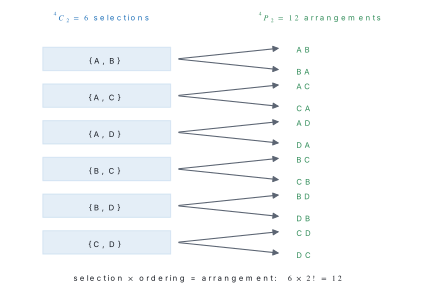
Count the permutations ^{n}P_{r} in two stages instead of one.
Stage 1. Choose which r objects to use. By definition this can be done in ^{n}C_{r} ways.
Stage 2. Arrange the chosen r objects among themselves. They are all different, so this can be done in r! ways.
Every arrangement of r objects out of n arises from exactly one selection followed by exactly one ordering, so by the multiplication principle
Therefore
The last form — r factors on top, r! underneath — is the one to compute with.
Problem. A committee of 5 is to be chosen from 7 men and 4 women. In how many ways can this be done if the committee must contain (a) exactly 2 women, (b) at least 2 women, (c) at most 1 woman?
Solution. Order of selection is irrelevant, so use combinations.
(a) Choose 2 of the 4 women and 3 of the 7 men:
(b) "At least 2" means 2, 3 or 4 women — mutually exclusive cases, so add:
(c) The total number of committees is ^{11}C_{5} = 462, and "at most 1 woman" is the complement of "at least 2":
Check directly: ^{4}C_{0}{}^{7}C_{5} + {}^{4}C_{1}{}^{7}C_{4} = 21 + 4(35) = 21 + 140 = 161. ✓
Problem. There are 12 points in a plane, of which 5 are collinear and no other three are collinear. How many (a) straight lines and (b) triangles can be drawn using these points? (c) How many diagonals has a regular 12-gon?
Solution. (a) Any 2 points give a line: ^{12}C_{2} = 66. But the 5 collinear points would give ^{5}C_{2} = 10 lines, whereas in fact they all lie on one line. Subtract the wrong ten and add back the one:
(b) Any 3 points give a triangle unless they are collinear:
(c) Joining 12 vertices in pairs gives ^{12}C_{2} = 66 segments, of which 12 are sides:
1.6 Properties of combination
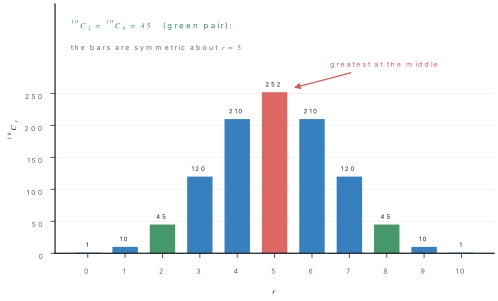
(i) ^{n}C_{0} = {}^{n}C_{n} = 1. \;^{n}C_{0} = \dfrac{n!}{0!\,n!} = 1 and ^{n}C_{n} = \dfrac{n!}{n!\,0!} = 1. There is exactly one way to choose nothing, and one way to choose everything.
(ii) ^{n}C_{r} = {}^{n}C_{n-r}. Replace r by n-r in the formula:
Why it is obvious: choosing r objects to take is the same act as choosing the n-r objects to leave behind.
(iii) If ^{n}C_{r} = {}^{n}C_{s} then r = s or r + s = n. By (ii), ^{n}C_{s} = {}^{n}C_{n-s}, and ^{n}C_{x} takes each value at most twice, so either r = s or r = n - s.
(iv) Pascal's rule: ^{n}C_{r} + {}^{n}C_{r-1} = {}^{n+1}C_{r}.
Take out n! and make the denominators match, using r! = r(r-1)! and (n-r+1)! = (n-r+1)(n-r)!:
Why it is obvious: to choose r from n+1 objects, either leave out a marked object (then choose all r from the other n: ^{n}C_{r} ways) or include it (then choose r-1 from the other n: ^{n}C_{r-1} ways).
(v) r \cdot {}^{n}C_{r} = n \cdot {}^{n-1}C_{r-1}.
Why it is obvious: both sides count "choose a committee of r from n people and appoint one of them chairperson".
A sixth property follows from Pascal's rule and is proved in Unit 2: \;^{n}C_{0} + {}^{n}C_{1} + \cdots + {}^{n}C_{n} = 2^{n}, the total number of subsets of a set of n elements.
Problem. If ^{n}C_{r-1} = 36, ^{n}C_{r} = 84 and ^{n}C_{r+1} = 126, find n and r.
Solution. Take ratios, because consecutive combinations have a very simple ratio:
So the first pair gives
The second pair, with r replaced by r+1, gives
Multiply (2) by 2 and subtract (1): \;(4n - 10r - 6) - (3n - 10r + 3) = 0, so n - 9 = 0 and n = 9. Then from (2), \;18 - 5r - 3 = 0, giving r = 3.
Check: ^{9}C_{2} = 36, ^{9}C_{3} = 84, ^{9}C_{4} = 126. ✓
Problem. (a) If ^{2n}C_{3} : {}^{n}C_{2} = 44 : 3, find n. (b) If ^{n}C_{8} = {}^{n}C_{12}, find ^{n}C_{17}.
Solution. (a) Write both in the "r factors over r!" form:
Set this equal to \dfrac{44}{3}: \;4(2n-1) = 44, so 2n - 1 = 11 and n = 6. Check: ^{12}C_{3} = 220, ^{6}C_{2} = 15, and 220:15 = 44:3. ✓
(b) Since 8 \ne 12, property (iii) forces 8 + 12 = n, so n = 20. Then
^{20}C_{3} is three numbers over 3!, not 20! divided by two more factorials. Always cancel first: with ^{n}C_{r}, use the smaller of r and n-r, so compute ^{50}C_{48} as ^{50}C_{2} = 1225.
Chapter summary
- Multiplication principle (AND): multiply the counts. Addition principle (OR): add them. A tree diagram makes which one applies visible.
- n! = n(n-1)\cdots 1 and 0! = 1.
- Permutation (order matters): ^{n}P_{r} = n(n-1)\cdots(n-r+1) = \dfrac{n!}{(n-r)!}, and ^{n}P_{n} = n!.
- n objects with p, q, s alike arrange in \dfrac{n!}{p!\,q!\,s!} ways.
- Round a circle: (n-1)! arrangements; a garland or necklace, which can be flipped: \dfrac{(n-1)!}{2}.
- With unlimited repetition, r places filled from n objects: n^{r}.
- Combination (order irrelevant): ^{n}C_{r}\cdot r! = {}^{n}P_{r}, so ^{n}C_{r} = \dfrac{n!}{r!\,(n-r)!}.
- Properties: ^{n}C_{0} = {}^{n}C_{n} = 1; ^{n}C_{r} = {}^{n}C_{n-r}; ^{n}C_{r} = {}^{n}C_{s} \Rightarrow r = s or r+s = n; ^{n}C_{r} + {}^{n}C_{r-1} = {}^{n+1}C_{r}; r\,{}^{n}C_{r} = n\,{}^{n-1}C_{r-1}; and \sum_{r=0}^{n}{}^{n}C_{r} = 2^{n}.
- Standard techniques: fill the restricted place first; tie objects together into a block for "together"; use the gap method for "no two together"; use the complement for "at least" and "never".
Practice questions
Group A — Multiple choice (1 mark each)
- The value of ^{8}P_{3} is [1]a56b168c336d6720
- The number of ways in which 6 people can sit at a round table is [1]a720b360c120d60
- If ^{n}C_{9} = {}^{n}C_{7}, then n is [1]a2b9c16d63
- The number of distinct arrangements of the letters of the word LEVEL is [1]a120b60c30d20
- ^{n}C_{r} + {}^{n}C_{r-1} equals [1]a^{n}C_{r+1}b^{n+1}C_{r}c^{n+1}C_{r-1}d^{n-1}C_{r}
- The number of diagonals of a regular octagon is [1]a16b20c28d56
Answers to Group A
1. (c) — ^{8}P_{3} = 8 \times 7 \times 6 = 336.
2. (c) — (6-1)! = 5! = 120.
3. (c) — 9 \ne 7, so n = 9 + 7 = 16.
4. (c) — LEVEL has 5 letters with L twice and E twice: 5!/(2!\,2!) = 120/4 = 30.
5. (b) — Pascal's rule.
6. (b) — ^{8}C_{2} - 8 = 28 - 8 = 20.
Group B — Short answer (5 marks each)
- Derive the formula ^{n}P_{r} = \dfrac{n!}{(n-r)!} from the basic principle of counting, and hence find n if ^{n}P_{3} = 12 \cdot {}^{n}P_{2}. [5]
- In how many ways can the letters of the word EQUATION be arranged so that all the vowels are together? In how many arrangements do no two vowels come together? [5]
- In how many ways can 7 boys and 3 girls stand in a row so that no two girls stand next to each other? [5]
- A cricket team of 11 is to be chosen from 15 players, of whom 5 are bowlers. In how many ways can the team be chosen so that it contains exactly 4 bowlers? [5]
- Prove that ^{n}C_{r} + {}^{n}C_{r-1} = {}^{n+1}C_{r}, and use it to evaluate ^{12}C_{5} + {}^{12}C_{4}. [5]
- How many numbers greater than 3000 can be formed using the digits 1, 2, 3, 4, 5 without repetition? [5]
Answers to Group B
1. Fill r ordered places from n distinct objects. The first place has n choices, the second n-1, …, the r^{\text{th}} has n-r+1. Multiplying, ^{n}P_{r} = n(n-1)\cdots(n-r+1); multiplying top and bottom by (n-r)! gives ^{n}P_{r} = \dfrac{n!}{(n-r)!}.
Now n(n-1)(n-2) = 12\,n(n-1). Cancel n(n-1) \ne 0: \;n - 2 = 12, so n = 14. Check: ^{14}P_{3} = 2184 = 12 \times 182 = 12\,{}^{14}P_{2}. ✓
2. EQUATION has 8 different letters, 5 vowels (E, U, A, I, O) and 3 consonants (Q, T, N).
Vowels together: tie them into one block, giving 3 + 1 = 4 units:
No two vowels together: arrange the 3 consonants in 3! = 6 ways; they make 4 gaps, and 5 vowels cannot fit into 4 gaps without two sharing a gap. Hence the number of such arrangements is \mathbf{0} — it is impossible.
3. Arrange the 7 boys: 7! = 5040 ways. They create 8 gaps, and the 3 girls must go into 3 different gaps, which can be done in ^{8}P_{3} = 8 \times 7 \times 6 = 336 ways. Total
4. Exactly 4 bowlers from 5, and the remaining 7 players from the 10 non-bowlers:
5. ^{n}C_{r} + {}^{n}C_{r-1} = \dfrac{n!}{r!(n-r)!} + \dfrac{n!}{(r-1)!(n-r+1)!}. Taking out \dfrac{n!}{(r-1)!\,(n-r)!} leaves \left[\dfrac{1}{r} + \dfrac{1}{n-r+1}\right] = \dfrac{n+1}{r(n-r+1)}, so the sum is \dfrac{(n+1)!}{r!\,(n+1-r)!} = {}^{n+1}C_{r}.
Hence ^{12}C_{5} + {}^{12}C_{4} = {}^{13}C_{5} = \dfrac{13\cdot12\cdot11\cdot10\cdot9}{120} = 1287.
6. The numbers may have 4 or 5 digits (any 5-digit number made from these digits exceeds 3000).
Four-digit numbers greater than 3000: the leading digit must be 3, 4 or 5 — that is 3 choices — and the other three places are filled from the remaining 4 digits in ^{4}P_{3} = 24 ways: \;3 \times 24 = 72.
Five-digit numbers: 5! = 120, all of which exceed 3000.
Total = 72 + 120 = 192.
Group C — Long answer (8 marks each)
- (a) Prove that ^{n}C_{r} = \dfrac{n!}{r!\,(n-r)!} by first showing that ^{n}P_{r} = {}^{n}C_{r} \times r!. [4](b) Out of 6 teachers and 8 students, a committee of 6 is to be formed containing at least 2 teachers. In how many ways can it be done? [4]
- (a) Derive the number of circular permutations of n distinct objects, and explain why the number for a garland is \dfrac{(n-1)!}{2}. [4](b) In how many ways can 5 men and 4 women be seated at a round table so that no two women sit together? [4]
- (a) How many arrangements can be made of the letters of the word INDEPENDENCE? In how many of these do all the vowels occur together? [4](b) There are 10 points in a plane, no three of which are collinear except 4 which lie on one straight line. Find the number of straight lines and the number of triangles determined by these points. [4]
Answers to Group C
1. (a) An arrangement of r objects chosen from n can be made in two stages: select the r objects (^{n}C_{r} ways, by definition), then order them (r! ways, as they are all different). Every arrangement arises exactly once, so ^{n}P_{r} = {}^{n}C_{r} \times r!. Hence
(b) "At least 2 teachers" from 6 teachers and 8 students, committee of 6. Count by number of teachers t = 2, 3, 4, 5, 6:
| t teachers | students 6-t | ways |
|---|---|---|
| 2 | 4 | ^{6}C_{2}{}^{8}C_{4} = 15 \times 70 = 1050 |
| 3 | 3 | ^{6}C_{3}{}^{8}C_{3} = 20 \times 56 = 1120 |
| 4 | 2 | ^{6}C_{4}{}^{8}C_{2} = 15 \times 28 = 420 |
| 5 | 1 | ^{6}C_{5}{}^{8}C_{1} = 6 \times 8 = 48 |
| 6 | 0 | ^{6}C_{6}{}^{8}C_{0} = 1 |
Total = 1050 + 1120 + 420 + 48 + 1 = 2639.
Check by complement: ^{14}C_{6} = 3003, and committees with 0 or 1 teacher number ^{8}C_{6} + {}^{6}C_{1}{}^{8}C_{5} = 28 + 6(56) = 364; 3003 - 364 = 2639. ✓
2. (a) Fix one object in one seat; every circular arrangement can be rotated into exactly one position with that object there, so nothing is lost or double-counted. The other n-1 objects then fill n-1 distinguishable places in (n-1)! ways. Equivalently the n! linear arrangements come in rotation-groups of size n, giving n!/n = (n-1)!. A garland can be picked up and turned over, so an arrangement and its mirror image are the same garland; the arrangements therefore pair off and the count is \dfrac{(n-1)!}{2}.
(b) Seat the 5 men round the table first: (5-1)! = 4! = 24 ways. This creates 5 gaps between neighbouring men, and the 4 women must occupy 4 different gaps: ^{5}P_{4} = 5 \times 4 \times 3 \times 2 = 120 ways. Total
3. (a) INDEPENDENCE has 12 letters: N appears 3 times, E appears 4 times, D twice, and I, P, C once each (3+4+2+1+1+1 = 12).
The vowels are I, E, E, E, E (5 of them). Tie them into one block; the block plus the 7 consonants N, D, P, N, D, N, C make 8 units, of which N occurs 3 times and D twice:
(b) Lines. ^{10}C_{2} = 45 pairs, but the 4 collinear points give ^{4}C_{2} = 6 pairs that all determine the same single line:
Triangles. ^{10}C_{3} = 120 triples, minus the ^{4}C_{3} = 4 collinear triples which form no triangle:
Practise more: Mathematics question bank