Unit 12 · Calculus · 18 teaching hours · 47 min read
Derivatives
What the syllabus asks for 5
- Derivatives of hyperbolic and inverse hyperbolic functions
- L'Hospital's rule (0/0 and infinity/infinity forms)
- Differentials
- Tangent and normal to a curve
- Derivative as a rate measure
At 18 teaching hours this is the largest unit in the Grade 12 course, and it carries the most marks. Grade 11 taught you what a derivative is — the limit of a difference quotient, the slope of a tangent — and how to differentiate polynomials, trigonometric functions and composites. Grade 12 finishes the toolkit (hyperbolic and inverse hyperbolic functions, implicit and parametric forms, logarithmic differentiation, higher derivatives) and then spends most of its time on what the derivative is for: evaluating stubborn limits, estimating small changes, writing down tangents and normals, measuring how fast one quantity changes when another does, and finding the largest or smallest value a quantity can take.
Expect one or two Group A items on a standard derivative or a limit, two or three Group B questions (differentiate this; find the tangent and normal; a rate problem; an L'Hospital limit), and very often a full Group C question on maxima and minima — usually an applied optimisation problem worth 8 marks. Show the derivative, set it to zero, and apply the second derivative test; markers award a mark for the test alone.
Revision: the differentiation toolkit
Everything in this unit rests on the table below. Learn it in the direction "function \to derivative" and also backwards, because Unit 13 will need it reversed.
Let u be a differentiable function of x and c, n, a constants.
| y | \dfrac{dy}{dx} | y | \dfrac{dy}{dx} |
|---|---|---|---|
| c | 0 | \sin^{-1}x | \dfrac{1}{\sqrt{1-x^{2}}} |
| x^{n} | n x^{n-1} | \cos^{-1}x | -\dfrac{1}{\sqrt{1-x^{2}}} |
| \sqrt{x} | \dfrac{1}{2\sqrt{x}} | \tan^{-1}x | \dfrac{1}{1+x^{2}} |
| e^{x} | e^{x} | \cot^{-1}x | -\dfrac{1}{1+x^{2}} |
| a^{x} | a^{x}\ln a | \sec^{-1}x | \dfrac{1}{|x|\sqrt{x^{2}-1}} |
| \ln x | \dfrac{1}{x} | \mathrm{cosec}^{-1}x | -\dfrac{1}{|x|\sqrt{x^{2}-1}} |
| \log_a x | \dfrac{1}{x\ln a} | \sinh x | \cosh x |
| \sin x | \cos x | \cosh x | \sinh x |
| \cos x | -\sin x | \tanh x | \mathrm{sech}^{2}x |
| \tan x | \sec^{2}x | \coth x | -\mathrm{cosech}^{2}x |
| \cot x | -\mathrm{cosec}^{2}x | \mathrm{sech}\,x | -\mathrm{sech}\,x\tanh x |
| \sec x | \sec x\tan x | \mathrm{cosech}\,x | -\mathrm{cosech}\,x\coth x |
| \mathrm{cosec}\,x | -\mathrm{cosec}\,x\cot x | \sinh^{-1}x | \dfrac{1}{\sqrt{x^{2}+1}} |
| \cosh^{-1}x | \dfrac{1}{\sqrt{x^{2}-1}} | \tanh^{-1}x | \dfrac{1}{1-x^{2}} |
| \coth^{-1}x | \dfrac{1}{1-x^{2}} | \mathrm{sech}^{-1}x | -\dfrac{1}{x\sqrt{1-x^{2}}} |
Rules. (u \pm v)' = u' \pm v'; product (uv)' = u'v + uv'; quotient \left(\dfrac{u}{v}\right)' = \dfrac{u'v - uv'}{v^{2}}; chain \dfrac{dy}{dx} = \dfrac{dy}{du}\cdot\dfrac{du}{dx}.
Every entry generalises by the chain rule: for example \dfrac{d}{dx}\sin^{-1}u = \dfrac{1}{\sqrt{1-u^{2}}}\dfrac{du}{dx}.
Three notations appear in NEB papers and all mean the same thing: \dfrac{dy}{dx} (Leibniz), f'(x) (Lagrange) and y_{1} (used mainly for higher derivatives, where y_{2} = \frac{d^{2}y}{dx^{2}} and so on). Use whichever the question uses.
Read the shape of the function before you start.
| The function looks like | Use |
|---|---|
| u \pm v, uv, u/v | sum, product, quotient rule |
| f(g(x)) | chain rule |
| an equation in x and y not solved for y | implicit differentiation |
| x and y both given in terms of t or \theta | parametric: \dfrac{dy/dt}{dx/dt} |
| [u(x)]^{v(x)}, or a long product of powers | logarithmic differentiation |
| an inverse trig function of a messy argument | substitute x=\tan\theta, x=\sin\theta first |
Problem. Differentiate (a) y = \tan^{-1}\!\left(\dfrac{2x}{1-x^{2}}\right), (b) y = \tan^{-1}\sqrt{\dfrac{1-\cos x}{1+\cos x}}.
Solution. Both look terrible and both collapse under a substitution — always try that before the chain rule.
(a) Put x = \tan\theta, so \theta = \tan^{-1}x. Then \dfrac{2x}{1-x^{2}} = \dfrac{2\tan\theta}{1-\tan^{2}\theta} = \tan 2\theta, using the double-angle identity. Hence
(b) Use 1 - \cos x = 2\sin^{2}\frac{x}{2} and 1 + \cos x = 2\cos^{2}\frac{x}{2}:
Problem. Differentiate (a) y = e^{2x}\sin 3x, (b) y = \ln\left[\tan\!\left(\dfrac{x}{2} + \dfrac{\pi}{4}\right)\right].
Solution.
(a) Product rule, with each factor needing the chain rule:
(b) Let u = \tan\left(\frac{x}{2}+\frac{\pi}{4}\right). Then \dfrac{dy}{dx} = \dfrac{1}{u}\dfrac{du}{dx} and \dfrac{du}{dx} = \frac12\sec^{2}\left(\frac{x}{2}+\frac{\pi}{4}\right):
because \dfrac{\sec^{2}A}{\tan A} = \dfrac{1}{\sin A\cos A}. Now 2\sin A\cos A = \sin 2A with 2A = x + \frac{\pi}{2}:
Problem. If x^{3} + y^{3} = 3axy (the folium of Descartes), find \dfrac{dy}{dx}.
Solution. Differentiate every term with respect to x, remembering that y is a function of x so each y contributes a factor \dfrac{dy}{dx}:
Divide by 3 and collect the \dfrac{dy}{dx} terms on one side:
Problem. If x = a(\theta - \sin\theta) and y = a(1 - \cos\theta), find \dfrac{dy}{dx}.
Solution. Differentiate each coordinate with respect to the parameter and divide:
Use \sin\theta = 2\sin\frac{\theta}{2}\cos\frac{\theta}{2} and 1-\cos\theta = 2\sin^{2}\frac{\theta}{2}:
Problem. Differentiate y = x^{\sin x} + (\sin x)^{x}.
Solution. A variable raised to a variable power cannot be handled by the power rule or by the exponential rule. Split y = u + v and take logarithms of each part separately.
Let u = x^{\sin x}. Then \ln u = \sin x \ln x. Differentiating both sides:
Let v = (\sin x)^{x}. Then \ln v = x\ln(\sin x), so
Problem. If y = e^{m\sin^{-1}x}, prove that (1-x^{2})y_{2} - x y_{1} - m^{2}y = 0, where y_1 = \dfrac{dy}{dx} and y_2 = \dfrac{d^{2}y}{dx^{2}}.
Solution. Differentiate once, by the chain rule:
Clear the surd before differentiating again — this is the standard trick:
Differentiate this with respect to x:
Divide throughout by 2y_{1} (non-zero except at isolated points):
12.1 Derivatives of hyperbolic and inverse hyperbolic functions
with \mathrm{coth}\,x, \mathrm{sech}\,x and \mathrm{cosech}\,x as the reciprocals. The fundamental identity is
(a minus sign, unlike \sin^2 x + \cos^2 x = 1), from which 1 - \tanh^{2}x = \mathrm{sech}^{2}x and \coth^{2}x - 1 = \mathrm{cosech}^{2}x.
The name comes from the fact that (\cosh t, \sinh t) traces the hyperbola x^{2}-y^{2}=1 just as (\cos t, \sin t) traces the circle x^{2}+y^{2}=1. Physically, \cosh is the shape of a hanging chain or a power line.
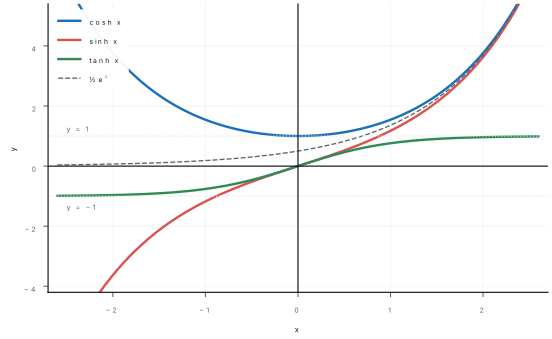
Every trigonometric identity has a hyperbolic twin. Write the trigonometric identity, replace \sin \to \sinh and \cos \to \cosh, and then change the sign of every term that contains a product of two sines (including \tan^{2} and \cot^{2}, which hide one).
| Trigonometric | Hyperbolic |
|---|---|
| \cos^{2}x + \sin^{2}x = 1 | \cosh^{2}x - \sinh^{2}x = 1 |
| 1 + \tan^{2}x = \sec^{2}x | 1 - \tanh^{2}x = \mathrm{sech}^{2}x |
| \sin(A+B) = \sin A\cos B + \cos A\sin B | \sinh(A+B) = \sinh A\cosh B + \cosh A\sinh B |
| \cos(A+B) = \cos A\cos B - \sin A\sin B | \cosh(A+B) = \cosh A\cosh B + \sinh A\sinh B |
| \sin 2x = 2\sin x\cos x | \sinh 2x = 2\sinh x\cosh x |
| \cos 2x = 2\cos^{2}x - 1 | \cosh 2x = 2\cosh^{2}x - 1 |
These are what let you simplify a hyperbolic derivative once you have found it.
Differentiate the definitions directly, using \dfrac{d}{dx}e^{x} = e^{x} and \dfrac{d}{dx}e^{-x} = -e^{-x}:
Note there is no minus sign in the second one. For \tanh x use the quotient rule:
From the logarithmic form. With y = \ln\left(x+\sqrt{x^{2}+1}\right),
The bracket cancels the denominator, leaving
By implicit differentiation. Let y = \sinh^{-1}x, so x = \sinh y. Differentiate with respect to x:
using \cosh^{2}y - \sinh^{2}y = 1 and \cosh y > 0. The same method gives \dfrac{d}{dx}\cosh^{-1}x = \dfrac{1}{\sqrt{x^{2}-1}} and \dfrac{d}{dx}\tanh^{-1}x = \dfrac{1}{1-x^{2}}.
Problem. Differentiate (a) y = \cosh(x^{2}+1), (b) y = \ln(\cosh x), (c) y = \sinh^{3}2x, (d) y = \sinh x\cosh x.
Solution.
(a) Chain rule with u = x^{2}+1:
(b) \dfrac{dy}{dx} = \dfrac{1}{\cosh x}\cdot\sinh x = \tanh x.
(c) Write y = (\sinh 2x)^{3} and apply the chain rule twice:
(d) Product rule:
(the last step by the identity \cosh 2x = \cosh^2 x + \sinh^2 x; you could also write y = \frac12\sinh 2x first and differentiate in one line).
Problem. Differentiate (a) y = \sinh^{-1}\dfrac{x}{3}, (b) y = \cosh^{-1}(2x), (c) y = \tanh^{-1}(x^{2}).
Solution. Each is a standard derivative composed with an inner function.
(a) With u = \dfrac{x}{3}, \dfrac{du}{dx} = \dfrac13:
(b) With u = 2x:
(c) With u = x^{2}:
\dfrac{d}{dx}\cosh x = +\sinh x, but \dfrac{d}{dx}\cos x = -\sin x. Likewise \dfrac{d}{dx}\tanh^{-1}x = \dfrac{1}{1-x^{2}} while \dfrac{d}{dx}\tan^{-1}x = \dfrac{1}{1+x^{2}}. Whenever you meet a hyperbolic function, check the sign against the table before you write it down.
12.2 L'Hospital's rule (0/0 and \infty/\infty forms)
Some limits refuse to yield to factorising or to the standard limits \lim_{x\to0}\frac{\sin x}{x} = 1. L'Hospital's rule turns them into a derivative problem.
If f and g are differentiable near a, g'(x) \ne 0, and
then
provided the right-hand limit exists. The rule may be applied repeatedly. It holds for a finite or infinite.
Two mistakes cost marks every year. First, verify that substituting x = a really gives \frac00 or \frac{\infty}{\infty} — applying the rule to \lim_{x\to0}\frac{\cos x}{x+1} gives the wrong answer because the form is \frac{1}{1}, not indeterminate. Second, \frac{f'}{g'} is not the quotient rule: differentiate the numerator and the denominator independently.
Suppose f(a) = g(a) = 0. Divide numerator and denominator of the difference quotients by (x-a):
As x \to a the top tends to f'(a) and the bottom to g'(a), so the quotient tends to \dfrac{f'(a)}{g'(a)} whenever g'(a) \ne 0. The full theorem, proved from Cauchy's mean value theorem, removes that last restriction and extends the result to \frac{\infty}{\infty} and to a = \pm\infty.
Other indeterminate forms — 0\cdot\infty, \infty - \infty, 0^{0}, 1^{\infty}, \infty^{0} — must first be rewritten as a quotient (or have logarithms taken) before the rule applies. The table below shows the standard rearrangements.
| Form | Rewrite as | Becomes |
|---|---|---|
| 0\cdot\infty | \dfrac{f}{1/g} | \dfrac00 |
| \infty-\infty | put over a common denominator | \dfrac00 |
| 0^{0}, 1^{\infty}, \infty^{0} | take \ln, then \ln y = v\ln u | 0\cdot\infty |
Problem. Evaluate (a) \displaystyle\lim_{x\to0}\frac{e^{x} - e^{-x} - 2x}{x - \sin x}, (b) \displaystyle\lim_{x\to0}\frac{\tan x - x}{x - \sin x}.
Solution.
(a) At x = 0 the numerator is 1 - 1 - 0 = 0 and the denominator is 0 - 0 = 0: the form is \frac00, so the rule applies.
(b) Again \frac00 at every stage:
using \tan x = \dfrac{\sin x}{\cos x} to cancel the \sin x at the third step.
Problem. Evaluate (a) \displaystyle\lim_{x\to\infty}\frac{x^{2}}{e^{x}}, (b) \displaystyle\lim_{x\to 0^{+}} x\ln x, (c) \displaystyle\lim_{x\to 0^{+}} x^{x}.
Solution.
(a) The form is \dfrac{\infty}{\infty}. Apply the rule twice:
The exponential beats every power — this is why e^{x} dominates in growth comparisons.
(b) The form is 0 \cdot (-\infty), which is indeterminate but not a quotient. Rewrite it as one:
(c) The form is 0^{0}. Take logarithms: let y = x^{x}, so \ln y = x\ln x. By part (b), \ln y \to 0, hence
Problem. Using L'Hospital's rule, evaluate (a) \displaystyle\lim_{x\to0}\frac{a^{x}-b^{x}}{x} (a, b > 0), (b) \displaystyle\lim_{x\to0}\frac{\sinh x}{x}, (c) \displaystyle\lim_{x\to0}\left(\frac1x - \frac{1}{\sin x}\right).
Solution.
(a) At x=0 the numerator is 1 - 1 = 0: the form is \frac00. Using \dfrac{d}{dx}a^{x} = a^{x}\ln a,
(b) Again \frac00:
the hyperbolic twin of \lim_{x\to0}\frac{\sin x}{x} = 1.
(c) The form is \infty - \infty, so combine into a single fraction first:
12.3 Differentials
The derivative \dfrac{dy}{dx} was introduced as a single symbol, not a fraction. The language of differentials gives dy and dx separate meanings so that the fraction becomes literal — and that makes the derivative a practical tool for estimating small changes.
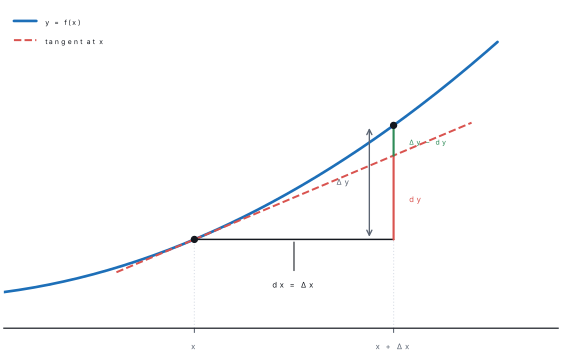
For y = f(x), let dx = \Delta x be any increment in x. The differential of y is defined as
dy is the change in the tangent line; \Delta y = f(x+\Delta x) - f(x) is the change in the curve. For small dx the two are nearly equal:
Problem. (a) Find the approximate value of \sqrt{49.5}. (b) The radius of a sphere is measured as 7 cm with a possible error of 0.02 cm. Find the approximate error in the calculated volume.
Solution.
(a) Take y = \sqrt{x} with x = 49 (a perfect square nearby) and \Delta x = 0.5. Then f'(x) = \dfrac{1}{2\sqrt{x}}, so
(The calculator value is 7.03562, so the estimate is correct to four decimal places.)
(b) V = \dfrac43\pi r^{3}, so \dfrac{dV}{dr} = 4\pi r^{2} and
The relative error is worth noting: \dfrac{dV}{V} = \dfrac{4\pi r^{2}dr}{\frac43\pi r^{3}} = 3\dfrac{dr}{r}, so a 0.29\% error in the radius becomes a 0.86\% error in the volume — errors are tripled by cubing.
If x is measured with error \Delta x and y = f(x) is computed from it:
| Formula | |
|---|---|
| absolute error in y | dy = f'(x)\,dx |
| relative error | \dfrac{dy}{y} |
| percentage error | \dfrac{dy}{y}\times 100\% |
For a power law y = kx^{n} the relative errors are simply related: \dfrac{dy}{y} = n\dfrac{dx}{x}. So squaring doubles the percentage error and cubing triples it.
Problem. The side of a cube is measured as 10 cm with a possible error of 0.01 cm. Find the approximate error in the calculated surface area, and the percentage error in the calculated volume.
Solution. Let a be the side, S = 6a^{2} the surface area and V = a^{3} the volume, with a = 10 and da = 0.01.
For the volume, use the relative-error shortcut. The percentage error in the side is
and since V = a^{3},
12.4 Tangent and normal to a curve
Let P(x_{1}, y_{1}) lie on the curve y = f(x) and let m = \left.\dfrac{dy}{dx}\right|_{(x_1,y_1)}.
| Slope | Equation | |
|---|---|---|
| Tangent at P | m | y - y_{1} = m(x - x_{1}) |
| Normal at P | -\dfrac{1}{m} | y - y_{1} = -\dfrac{1}{m}(x - x_{1}) |
Special cases: if m = 0 the tangent is y = y_{1} (horizontal) and the normal is x = x_{1}; if \dfrac{dy}{dx} is infinite the tangent is x = x_{1} and the normal is y = y_{1}.
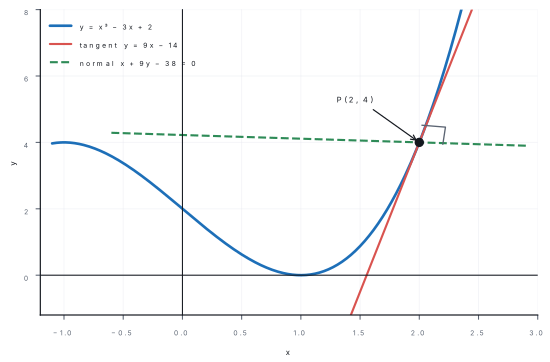
Problem. Find the equations of the tangent and the normal to the curve y = x^{3} - 3x + 2 at the point (2, 4).
Solution. First check the point lies on the curve: 2^{3} - 3(2) + 2 = 8 - 6 + 2 = 4 ✓.
Tangent: y - 4 = 9(x - 2), that is
Normal: slope = -\dfrac19, so y - 4 = -\dfrac19(x-2). Multiply by 9:
Problem. (a) Find the point on the curve y = x^{3} - 11x + 5 at which the tangent is the line y = x - 11. (b) Find the equation of the tangent to the circle x^{2} + y^{2} = 25 at (3, 4).
Solution.
(a) The given line has slope 1, so we need \dfrac{dy}{dx} = 3x^{2} - 11 = 1, giving x^{2} = 4, x = \pm 2.
- At x = 2: y = 8 - 22 + 5 = -9. The line at x=2 gives y = 2 - 11 = -9 ✓ — the point (2, -9) is on both.
- At x = -2: y = -8 + 22 + 5 = 19, but the line gives y = -13 ✗ — here the tangent is parallel to the line, not the line itself.
Hence the required point is (2, -9).
(b) Differentiate implicitly:
(Consistent with the Unit 8 result that the tangent to x^2+y^2=a^2 at (x_1,y_1) is xx_{1} + yy_{1} = a^{2}.)
The angle between two curves at a point of intersection is the angle between their tangents there. If the slopes are m_{1} and m_{2},
The curves are orthogonal (cut at right angles) if m_{1}m_{2} = -1, and touch each other if m_{1} = m_{2}.
Problem. Find the angle of intersection of the curves y = x^{2} and y^{2} = x at the point other than the origin.
Solution. Points of intersection. Substitute y = x^{2} into y^{2} = x:
So the required point is (1, 1).
Slopes there. For y = x^{2}: \dfrac{dy}{dx} = 2x, so m_{1} = 2.
For y^{2} = x, differentiate implicitly: 2y\dfrac{dy}{dx} = 1, so \dfrac{dy}{dx} = \dfrac{1}{2y} and m_{2} = \dfrac12.
Angle.
Substitute the given coordinates into the equation of the curve before you differentiate. If they do not satisfy it, the question is asking for a tangent from an external point, which is a different (and longer) calculation.
12.5 Derivative as a rate measure
If y depends on x, then \dfrac{dy}{dx} is the rate at which y changes per unit change in x. When both depend on time, the chain rule links their rates:
These are called related rates problems.
- Draw a diagram and name the varying quantities with letters, not numbers.
- Write the equation connecting them (geometry, usually).
- Differentiate the whole equation with respect to t.
- Now substitute the numerical values for the instant asked about.
- State the answer with units, and say whether it is increasing or decreasing — a negative rate means decreasing.
The same idea is used far beyond geometry. If C(x) is the cost of producing x items, \dfrac{dC}{dx} is the marginal cost — the extra cost of one more item. If Q is the charge flowing past a point in a wire, \dfrac{dQ}{dt} is the current. In every case the derivative answers the question "per unit of what, how much of this?"
If you put r = 15 into V = \frac43\pi r^{3} before differentiating, V becomes a constant and \dfrac{dV}{dt} comes out as zero. Differentiate first, substitute second.
Problem. Air is pumped into a spherical balloon at 100 cm³ s⁻¹. Find the rate at which the radius is increasing when the radius is 15 cm. Find also the rate of increase of the surface area at that instant.
Solution. Let V, S and r be the volume, surface area and radius at time t. Then V = \dfrac43\pi r^{3} and S = 4\pi r^{2}.
Differentiate V with respect to t (chain rule):
Substitute \dfrac{dV}{dt} = 100 and r = 15:
For the surface area,
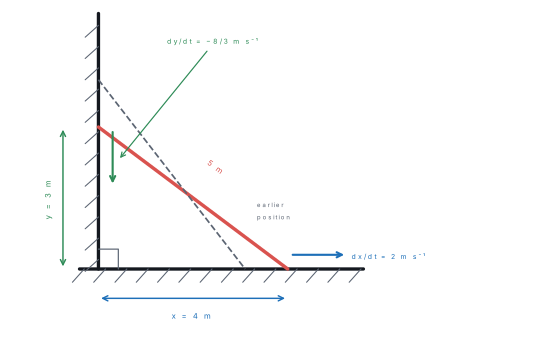
Problem. A ladder 5 m long rests against a vertical wall. The foot of the ladder is pulled away from the wall at 2 m s⁻¹. How fast is the top sliding down the wall when the foot is 4 m from the wall?
Solution. Let x be the distance of the foot from the wall and y the height of the top, at time t. By Pythagoras the ladder length is constant:
Differentiate with respect to t:
When x = 4: y = \sqrt{25 - 16} = 3, and \dfrac{dx}{dt} = 2:
The negative sign means y is decreasing: the top slides down at \dfrac83 m s⁻¹.
Derivative as velocity and acceleration
The oldest use of the derivative is in mechanics. If a particle moves along a straight line so that its displacement at time t is s = f(t), then
The particle is momentarily at rest when v = 0, is moving forward when v > 0 and backward when v < 0. Speed is |v|, which is why a particle can have negative velocity and increasing speed at the same time.
Problem. Water is poured into an inverted right circular cone at the rate of 3 m³ min⁻¹. The cone is 10 m deep and its base radius is 5 m. Find the rate at which the water level is rising when the water is 4 m deep.
Solution. Let h be the depth of water and r the radius of the water surface at time t. By similar triangles (the water cone is similar to the whole cone),
This is the constraint that removes r. The volume of water is
Differentiate with respect to t:
Now substitute \dfrac{dV}{dt} = 3 and h = 4:
Note that \dfrac{dh}{dt} is proportional to \dfrac{1}{h^{2}}: the deeper the water, the more slowly the level rises.
Problem. A particle moves along a straight line so that its displacement after t seconds is s = t^{3} - 6t^{2} + 9t + 4 metres. Find (a) its initial velocity, (b) the times when it is momentarily at rest and its displacement then, (c) its acceleration at those times.
Solution.
(a) Initial velocity is v at t = 0: v = 9 m s⁻¹.
(b) At rest when v = 0, that is t = 1 s and t = 3 s.
(c) a(1) = 6 - 12 = -6 m s⁻² and a(3) = 18 - 12 = 6 m s⁻².
Between t = 1 and t = 3 the velocity is negative, so the particle moves backwards by 8 - 4 = 4 m before turning round again.
12.6 Increasing and decreasing functions
A function f is increasing on an interval I if x_{1} < x_{2} \Rightarrow f(x_{1}) \le f(x_{2}) for all x_1, x_2 \in I, and decreasing if x_{1} < x_{2} \Rightarrow f(x_{1}) \ge f(x_{2}). Strict inequalities give strictly increasing/decreasing.
On an interval where f is differentiable:
| Sign of f'(x) | Behaviour of f | Tangent |
|---|---|---|
| f'(x) > 0 | strictly increasing | slopes upward |
| f'(x) < 0 | strictly decreasing | slopes downward |
| f'(x) = 0 | stationary | horizontal |
So: differentiate, factorise f'(x), find where it is zero, and test the sign of f' in each interval those roots create.
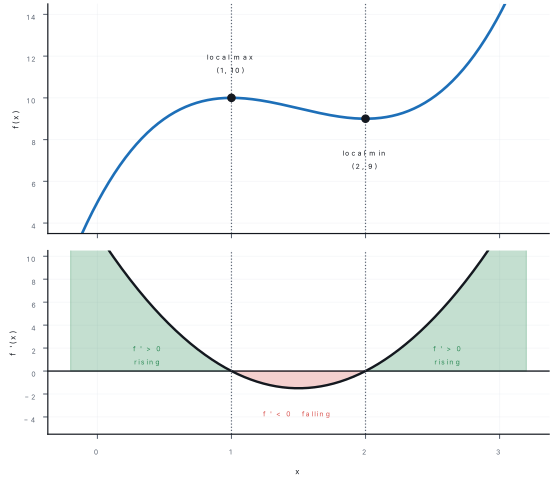
Problem. Find the intervals in which f(x) = 2x^{3} - 9x^{2} + 12x + 5 is increasing and decreasing.
Solution.
f'(x) = 0 at x = 1 and x = 2. These split the real line into three intervals; test the sign of each factor in each.
| Interval | (x-1) | (x-2) | f'(x) | f is |
|---|---|---|---|---|
| x < 1 | - | - | + | increasing |
| 1 < x < 2 | + | - | - | decreasing |
| x > 2 | + | + | + | increasing |
So f is increasing on (-\infty, 1) and (2, \infty), and decreasing on (1, 2).
12.7 Maxima and minima
f has a local maximum at x = c if f(c) \ge f(x) for all x near c, and a local minimum if f(c) \le f(x) for all x near c. A point where f'(c) = 0 is called a stationary (or critical) point. Every local extremum of a differentiable function is a stationary point — but not every stationary point is an extremum.
Step 1. Solve f'(x) = 0 to find the stationary points x = c.
Step 2 — second derivative test. Compute f''(c):
| f''(c) | Conclusion |
|---|---|
| f''(c) < 0 | local maximum at c |
| f''(c) > 0 | local minimum at c |
| f''(c) = 0 | test fails — use the first derivative test |
First derivative test. If f' changes from + to - as x increases through c, it is a maximum; from - to +, a minimum; no change of sign, it is a point of inflection with a horizontal tangent.
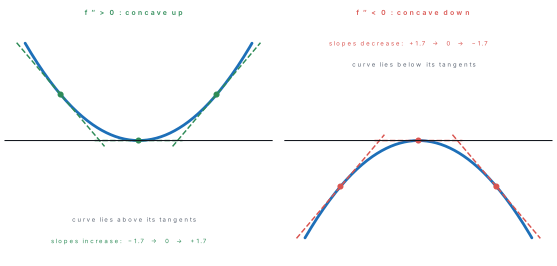
f'' < 0 means the slope is falling, so the curve bends downward like a frown — that is a maximum. f'' > 0 bends upward like a smile — a minimum. Negative is a frown; positive is a smile.
Problem. Find the local maximum and minimum values of f(x) = x^{3} - 6x^{2} + 9x + 15.
Solution.
At x = 1: f''(1) = 6 - 12 = -6 < 0, so there is a local maximum, of value
At x = 3: f''(3) = 18 - 12 = 6 > 0, so there is a local minimum, of value
Note the "maximum" 19 is larger than the "minimum" 15 only locally — the cubic itself is unbounded in both directions.
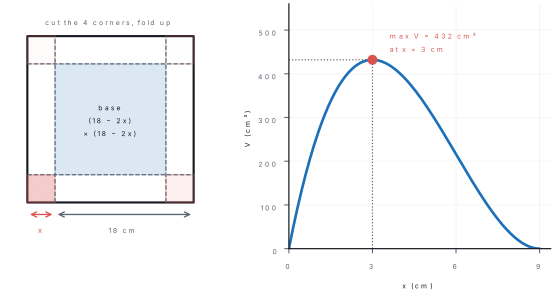
Problem. A square sheet of tin of side 18 cm has a small square cut from each corner, and the flaps are folded up to make an open box. Find the side of the square cut off so that the volume of the box is a maximum, and find that maximum volume.
Solution. Let x cm be the side of the square cut from each corner, where 0 < x < 9. The base is a square of side 18 - 2x and the height is x, so
Differentiate by the product rule:
Set \dfrac{dV}{dx} = 0: x = 9 or x = 3. Reject x = 9 (then the base has side 0 and V = 0), leaving x = 3.
At x = 3: \dfrac{d^{2}V}{dx^{2}} = 72 - 144 = -72 < 0, confirming a maximum. Hence
The square cut from each corner should have side 3 cm.
Problem. Show that the cylinder of greatest volume that can be inscribed in a sphere of radius R has height \dfrac{2R}{\sqrt{3}}, and find that volume.
Solution. Let the cylinder have radius r and height h. Its axis passes through the centre of the sphere, so a radius of the sphere, half the height, and the cylinder's radius form a right triangle:
This is the constraint that removes one variable. The volume is
Now R is a constant and h is the only variable:
so this is a maximum. The volume is
which is \dfrac{4\sqrt{3}\,\pi R^{3}}{9} \approx 0.7698 R^{3}, about 58\% of the sphere's own volume \frac43\pi R^{3}.
On a closed interval [a, b] a continuous function always attains a largest and a smallest value. They occur either at a stationary point inside the interval or at an endpoint. So: evaluate f at every stationary point in [a,b] and at both endpoints, and compare the list. No second derivative test is needed.
Problem. Find the absolute maximum and minimum values of f(x) = 2x^{3} - 24x + 107 on the interval [1, 3].
Solution.
Only x = 2 lies in [1, 3]; discard x = -2. Now evaluate f at that point and at both endpoints:
| x | 1 (endpoint) | 2 (stationary) | 3 (endpoint) |
|---|---|---|---|
| f(x) | 2 - 24 + 107 = 85 | 16 - 48 + 107 = 75 | 54 - 72 + 107 = 89 |
The absolute maximum is 89, at x = 3, and the absolute minimum is 75, at x = 2. Notice that the maximum occurs at an endpoint, where f'(x) \ne 0 — which is why endpoints must always be tested.
- Not reducing to one variable. You cannot differentiate V = \pi r^{2}h with respect to h while r still depends on h — substitute the constraint first.
- Not rejecting impossible roots. x = 9 in the open-box problem is a root of \frac{dV}{dx} = 0, but it is outside the domain 0 < x < 9; say so.
- Not applying the test. Writing "maximum" because the answer looks right earns nothing. State f''(c) < 0 (or the sign change of f') explicitly.
Structure of every optimisation answer
Write the quantity to be optimised; use the constraint to reduce it to one variable; state the domain; differentiate; solve =0; reject impossible roots with a reason; apply the second derivative test; compute the optimal value; answer the question in words with units. Eight marks, eight steps.
12.8 Concavity and points of inflection
The first derivative says whether a curve rises or falls. The second derivative says which way it bends.
A curve is concave upward on an interval if it lies above all its tangents there, and concave downward if it lies below them. Then
A point of inflection is a point at which the concavity changes. At such a point f''(x) = 0 (or fails to exist) and f'' changes sign there.
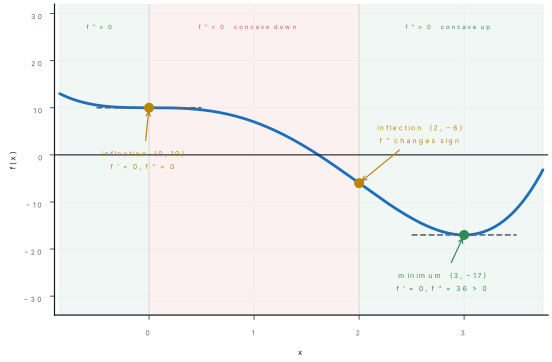
Problem. For f(x) = x^{4} - 4x^{3} + 10, find the intervals of concavity, the points of inflection, and the local extrema.
Solution.
Stationary points. f'(x) = 0 at x = 0 and x = 3.
- At x = 3: f''(3) = 12(3)(1) = 36 > 0, so a local minimum, value f(3) = 81 - 108 + 10 = -17.
- At x = 0: f''(0) = 0, so the second derivative test fails. Use the first derivative test: f'(x) = 4x^{2}(x-3) is negative on both sides of 0 (because 4x^{2} > 0 and x - 3 < 0), so f' does not change sign. Hence (0, 10) is not an extremum.
Concavity. f''(x) = 12x(x-2) = 0 at x = 0 and x = 2.
| Interval | 12x | (x-2) | f'' | Concavity |
|---|---|---|---|---|
| x < 0 | - | - | + | upward |
| 0 < x < 2 | + | - | - | downward |
| x > 2 | + | + | + | upward |
f'' changes sign at both x = 0 and x = 2, so there are two points of inflection: (0, 10) and (2, -6), since f(2) = 16 - 32 + 10 = -6.
Chapter summary
- The standard derivatives, the product, quotient and chain rules, and the techniques for implicit (y gives a factor \frac{dy}{dx}), parametric (\frac{dy}{dx} = \frac{dy/dt}{dx/dt}) and logarithmic differentiation (take \ln of both sides, for u^{v} forms) are the working toolkit.
- Hyperbolic: \sinh x = \frac{e^{x}-e^{-x}}{2}, \cosh x = \frac{e^{x}+e^{-x}}{2}, \cosh^{2}x-\sinh^{2}x=1, and (\sinh x)' = \cosh x, (\cosh x)' = \sinh x, (\tanh x)' = \mathrm{sech}^{2}x. Inverses: (\sinh^{-1}x)' = \frac{1}{\sqrt{x^{2}+1}}, (\cosh^{-1}x)' = \frac{1}{\sqrt{x^{2}-1}}, (\tanh^{-1}x)' = \frac{1}{1-x^{2}}.
- L'Hospital: for \frac00 or \frac{\infty}{\infty} only, \lim\frac{f}{g} = \lim\frac{f'}{g'}, repeated as needed. Convert 0\cdot\infty, \infty-\infty, 0^{0}, 1^{\infty} to a quotient first.
- Differentials: dy = f'(x)dx and f(x+\Delta x)\approx f(x) + f'(x)\Delta x; relative error \frac{dy}{y}.
- Tangent at (x_1,y_1): y-y_1 = m(x-x_1) with m = f'(x_1); normal: y-y_1 = -\frac{1}{m}(x-x_1).
- Angle between curves: \tan\theta = \left|\frac{m_1-m_2}{1+m_1m_2}\right|; orthogonal if m_1m_2=-1.
- Rates: \frac{dy}{dt} = \frac{dy}{dx}\cdot\frac{dx}{dt}; differentiate the relation with respect to t, then substitute. In motion, v = \frac{ds}{dt} and a = \frac{d^{2}s}{dt^{2}}.
- f' > 0 \Rightarrow increasing; f' < 0 \Rightarrow decreasing; f' = 0 \Rightarrow stationary.
- Second derivative test: f'(c)=0 with f''(c)<0 gives a maximum, f''(c)>0 a minimum, f''(c)=0 is inconclusive.
- Absolute extrema on [a,b]: compare f at every interior stationary point and at both endpoints.
- f''>0 concave up, f''<0 concave down; a point of inflection needs f''=0 and a change of sign.
Practice questions
Group A — Multiple choice (1 mark each)
- \dfrac{d}{dx}(\cosh x) is [1]a-\sinh xb\sinh xc\mathrm{sech}^{2}xd\cosh x
- \displaystyle\lim_{x\to0}\frac{1-\cos x}{x^{2}} equals [1]a0b\dfrac12c1d2
- \dfrac{d}{dx}\sinh^{-1}(3x) is [1]a\dfrac{3}{\sqrt{1-9x^{2}}}b\dfrac{3}{\sqrt{9x^{2}+1}}c\dfrac{1}{\sqrt{9x^{2}+1}}d\dfrac{3}{9x^{2}+1}
- The slope of the normal to y = x^{2} at (1, 1) is [1]a2b-2c\dfrac12d-\dfrac12
- If f''(c) = 0 and f'' changes sign at c, the point x = c is a [1]amaximumbminimumcpoint of inflectiondnone of these
- If y = x^{3}, the approximate change in y when x changes from 2 to 2.01 is [1]a0.01b0.12c0.6d1.2
- f(x) = x^{3} + 3x is [1]aincreasing for all xbdecreasing for all xcincreasing only for x>0dneither
- \displaystyle\lim_{x\to0}\frac{a^{x}-b^{x}}{x} equals [1]a\ln(ab)b\ln\dfrac{a}{b}ca - bd0
- The function f(x) = x^{3} - 3x is decreasing on [1]a(-\infty, -1)b(-1, 1)c(1, \infty)d\mathbb{R}
- Two curves cut orthogonally at a point if the slopes m_{1}, m_{2} of their tangents there satisfy [1]am_{1} = m_{2}bm_{1}m_{2} = 1cm_{1}m_{2} = -1dm_{1} + m_{2} = 0
- A particle moves with s = t^{3} - 3t^{2}. Its acceleration at t = 2 is [1]a0b6c-6d12
Answers to Group A
1. (b) — no minus sign, unlike \dfrac{d}{dx}\cos x.
2. (b) — L'Hospital twice: \dfrac{\sin x}{2x} \to \dfrac{\cos x}{2} = \dfrac12.
3. (b) — \dfrac{1}{\sqrt{u^{2}+1}}\cdot 3 with u = 3x.
4. (d) — tangent slope 2x = 2, so normal slope =-\dfrac12.
5. (c) — that is the definition of a point of inflection.
6. (b) — dy = 3x^{2}dx = 3(4)(0.01) = 0.12.
7. (a) — f'(x) = 3x^{2}+3 > 0 for every real x.
8. (b) — L'Hospital: \dfrac{a^{x}\ln a - b^{x}\ln b}{1} \to \ln a - \ln b.
9. (b) — f'(x) = 3(x^{2}-1) < 0 exactly when -1 < x < 1.
10. (c) — perpendicular tangents.
11. (b) — a = \dfrac{d^{2}s}{dt^{2}} = 6t - 6 = 6 at t = 2.
Group B — Short answer (5 marks each)
- Differentiate with respect to x:(a) y = \ln(\cosh 3x),(b) y = \tanh^{-1}(x^{2}). [5]
- If y = x^{\sin x}, find \dfrac{dy}{dx}. [5]
- Evaluate \displaystyle\lim_{x\to0}\frac{x - \sin x}{x^{3}} using L'Hospital's rule. [5]
- Find the approximate value of \sqrt{36.6} using differentials. [5]
- Find the equations of the tangent and the normal to the curve y = x^{2} - 4x + 3 at the point where it meets the y-axis. [5]
- The radius of a circular plate is increasing at 0.02 cm s⁻¹. Find the rate at which its area is increasing when the radius is 10 cm. [5]
- Find the intervals in which f(x) = x^{3} - 3x^{2} - 9x + 5 is increasing or decreasing, and find its local maximum and minimum values. [5]
- Find two positive numbers whose sum is 24 and whose product of one with the square of the other is a maximum. [5]
- Water is poured into an inverted right circular cone of depth 10 m and base radius 5 m at 3 m³ min⁻¹. Find the rate at which the water level rises when the water is 4 m deep. [5]
- Find the absolute maximum and minimum values of f(x) = 2x^{3} - 24x + 107 on the interval [1, 3]. [5]
Answers to Group B
1. (a) Chain rule, outer \ln u with u = \cosh 3x:
(b) Standard derivative \dfrac{d}{dx}\tanh^{-1}u = \dfrac{1}{1-u^{2}}\dfrac{du}{dx} with u = x^{2}:
2. Take logarithms: \ln y = \sin x\,\ln x. Differentiate both sides with respect to x (product rule on the right):
3. At x=0 the form is \dfrac00, so the rule applies (three times):
4. Let y = \sqrt{x}, x = 36, \Delta x = 0.6. Then \dfrac{dy}{dx} = \dfrac{1}{2\sqrt{x}} = \dfrac{1}{12} and
(Calculator: 6.0498, so the error is under 0.0003.)
5. The curve meets the y-axis where x = 0, giving y = 3; the point is (0, 3).
Tangent: y - 3 = -4(x-0), that is 4x + y - 3 = 0.
Normal: slope \dfrac14, so y - 3 = \dfrac14 x, that is x - 4y + 12 = 0.
6. A = \pi r^{2}, so differentiating with respect to t,
7. f'(x) = 3x^{2} - 6x - 9 = 3(x-3)(x+1), zero at x = -1 and x = 3.
| Interval | f'(x) | f |
|---|---|---|
| x<-1 | + | increasing |
| -1<x<3 | - | decreasing |
| x>3 | + | increasing |
f''(x) = 6x - 6. At x = -1, f'' = -12 < 0: local maximum f(-1) = -1 - 3 + 9 + 5 = 10. At x = 3, f'' = 12 > 0: local minimum f(3) = 27 - 27 - 27 + 5 = -22.
8. Let the numbers be x and y = 24 - x, with 0 < x < 24, and maximise P = x y^{2} = x(24-x)^{2}.
\dfrac{dP}{dx} = 0 gives x = 24 (rejected, then y = 0 and P = 0) or x = 8.
At x = 8: 48 - 96 = -48 < 0, a maximum. The numbers are 8 and 16, giving P = 8 \times 256 = 2048.
9. Let h be the depth and r the surface radius of the water at time t. By similar triangles \dfrac{r}{h} = \dfrac{5}{10}, so r = \dfrac{h}{2} and
Differentiating with respect to t,
Put \dfrac{dV}{dt} = 3 and h = 4:
10. f'(x) = 6x^{2} - 24 = 6(x-2)(x+2), so the stationary points are x = \pm2; only x = 2 lies in [1,3]. Evaluate f there and at the endpoints:
| x | 1 | 2 | 3 |
|---|---|---|---|
| f(x) | 85 | 75 | 89 |
Absolute maximum = 89 at x = 3 (an endpoint); absolute minimum = 75 at x = 2.
Group C — Long answer (8 marks each)
- (a) Define the hyperbolic functions \sinh x and \cosh x in terms of exponentials, and hence prove that \dfrac{d}{dx}(\sinh x) = \cosh x and \dfrac{d}{dx}(\tanh x) = \mathrm{sech}^{2}x. [4](b) Prove, by putting y = \sinh^{-1}x, that \dfrac{d}{dx}\sinh^{-1}x = \dfrac{1}{\sqrt{1+x^{2}}}, and hence differentiate y = \sinh^{-1}\left(\dfrac{x}{2}\right) + \cosh^{-1}(3x). [4]
- (a) State L'Hospital's rule and the conditions under which it may be used. [2](b) Evaluate \displaystyle\lim_{x\to0}\frac{e^{x}-e^{-x}-2x}{x-\sin x}. [3](c) Evaluate \displaystyle\lim_{x\to\infty}\frac{x^{2}}{e^{x}} and explain why the rule had to be applied twice. [3]
- A square sheet of tin of side 18 cm has an equal square cut from each corner and the edges folded up to form an open box.(a) Express the volume V as a function of the side x of the square cut off, and state the domain of x. [3](b) Find the value of x that makes V a maximum, applying the second derivative test, and find the maximum volume. [5]
- (a) Find the equations of the tangent and the normal to the curve y = x^{3} - 3x + 2 at the point (2, 4). [4](b) Find the intervals in which f(x) = 2x^{3} - 9x^{2} + 12x + 5 is increasing and decreasing, and find its local maximum and minimum values using the second derivative test. [4]
Answers to Group C
1. (a) By definition
Differentiating the first, and using \dfrac{d}{dx}e^{-x} = -e^{-x},
Similarly \dfrac{d}{dx}\cosh x = \dfrac{e^{x}-e^{-x}}{2} = \sinh x. Then by the quotient rule, with \tanh x = \dfrac{\sinh x}{\cosh x},
using the identity \cosh^{2}x-\sinh^{2}x = 1.
(b) Let y = \sinh^{-1}x, so that x = \sinh y. Differentiating both sides with respect to x:
Since \cosh^{2}y = 1 + \sinh^{2}y = 1 + x^{2} and \cosh y > 0 always,
Applying this and the corresponding result for \cosh^{-1} with the chain rule,
2. (a) If f and g are differentiable in a neighbourhood of a (except possibly at a) with g'(x)\ne 0 there, and if \lim_{x\to a}\dfrac{f(x)}{g(x)} takes the indeterminate form \dfrac00 or \dfrac{\infty}{\infty}, then
provided the right-hand limit exists (finitely or infinitely). The rule may be repeated, and a may be \pm\infty.
(b) Substituting x = 0 gives \dfrac{1-1-0}{0-0} = \dfrac00, so the rule applies:
(c) As x \to \infty both x^{2} and e^{x} tend to \infty, so the form is \dfrac{\infty}{\infty}:
The new quotient is still \dfrac{\infty}{\infty} — one differentiation only reduces the degree of the numerator by one, while e^{x} is unchanged — so the rule must be applied again:
3. (a) Let x cm be the side of each square cut off. The base of the box is a square of side 18 - 2x and the height is x, so
For a box to exist we need x > 0 and 18 - 2x > 0, so the domain is 0 < x < 9.
(b)
Setting \dfrac{dV}{dx} = 0 gives x = 3 or x = 9; x = 9 is outside the domain (the base would vanish), so x = 3.
At x = 3: \dfrac{d^{2}V}{dx^{2}} = 72 - 144 = -72 < 0, so V is a maximum at x = 3.
So a square of side 3 cm should be cut from each corner, giving a maximum volume of 432 cm³.
4. (a) First verify the point lies on the curve: 2^{3} - 3(2) + 2 = 4 ✓. Then
Tangent: y - 4 = 9(x-2), i.e. 9x - y - 14 = 0.
Normal: slope -\dfrac19, so y - 4 = -\dfrac19(x-2), i.e. x + 9y - 38 = 0.
(b)
so f'(x) = 0 at x = 1 and x = 2, and the sign of f' is
| Interval | f'(x) | f |
|---|---|---|
| x<1 | + | increasing |
| 1<x<2 | - | decreasing |
| x>2 | + | increasing |
Hence f increases on (-\infty,1) and (2,\infty) and decreases on (1,2).
f''(x) = 12x - 18. At x = 1, f''(1) = -6 < 0, so a local maximum of
At x = 2, f''(2) = 6 > 0, so a local minimum of
Practise more: Mathematics question bank