Unit 14 · Calculus · 12 teaching hours · 33 min read
Differential Equations
What the syllabus asks for 6
- Order and degree of a differential equation
- Differential equations of first order and first degree
- Separable variables
- Homogeneous differential equations
- Linear differential equations
- Exact differential equations
A differential equation is an equation that contains a derivative. It does not tell you what y is — it tells you how y changes, and you have to integrate to recover y itself. Almost every law of nature is written this way: Newton's second law, radioactive decay, the cooling of a cup of tea, the growth of a population. This unit takes the integration machinery of Unit 13 and points it at those laws.
(1) Write down the order and degree of a given equation, and form a differential equation from a family of curves — short, and almost free marks. (2) Solve a first-order first-degree equation. Everything turns on identifying the type: separable, homogeneous, linear or exact. (3) A Group C question combining a solution with an initial condition, or an application to growth, decay or cooling. The four-line identification checklist in §14.2 is the single most valuable thing in this chapter.
14.1 Order and degree of a differential equation
A differential equation is an equation involving an independent variable x, a dependent variable y, and one or more derivatives of y with respect to x.
The order is the order of the highest derivative that appears.
The degree is the power of that highest derivative, after the equation has been made free of radicals and fractional powers of the derivatives, and is written as a polynomial in the derivatives.
An equation in one independent variable is called ordinary. If it contains partial derivatives such as \frac{\partial z}{\partial x} it is a partial differential equation, which is beyond this syllabus. Every equation in this chapter is ordinary.
The degree is defined only for an equation that is polynomial in the derivatives. So
does not have degree \frac12. Square both sides first: \left(\frac{dy}{dx}\right)^{2} = 1 + \frac{d^{2}y}{dx^{2}}, which is order 2 and degree 1. If no amount of algebra removes the radical — for instance \sin\frac{dy}{dx} = x — the degree is not defined.
Problem. State the order and degree of each equation.
(a) \dfrac{dy}{dx} + 3y = e^{x} (b) \dfrac{d^{2}y}{dx^{2}} + 5\left(\dfrac{dy}{dx}\right)^{3} - 4y = 0 (c) \left(\dfrac{d^{3}y}{dx^{3}}\right)^{2} + \dfrac{dy}{dx} = \sin x (d) \dfrac{d^{2}y}{dx^{2}} = \sqrt{1+\left(\dfrac{dy}{dx}\right)^{2}}
Solution.
(a) The highest derivative is \frac{dy}{dx}, appearing to the first power. Order 1, degree 1.
(b) The highest derivative is \frac{d^{2}y}{dx^{2}}, to the first power. The cube belongs to a lower derivative and does not affect the degree. Order 2, degree 1.
(c) Highest derivative \frac{d^{3}y}{dx^{3}}, squared. Order 3, degree 2.
(d) Squaring gives \left(\frac{d^{2}y}{dx^{2}}\right)^{2} = 1+\left(\frac{dy}{dx}\right)^{2}, so the highest derivative is of order 2 and now appears squared. Order 2, degree 2.
Problem. State the order and degree of (a) x\left(\dfrac{d^{2}y}{dx^{2}}\right)^{3} + y\left(\dfrac{dy}{dx}\right)^{4} + y^{5} = 0, (b) \dfrac{d^{2}y}{dx^{2}} + \sin\left(\dfrac{dy}{dx}\right) = 0, (c) \left(\dfrac{dy}{dx}\right)^{3} - 4\dfrac{dy}{dx} + y = 0.
Solution.
(a) Highest derivative: order 2, and it is cubed. Order 2, degree 3. The powers 4 and 5 are irrelevant to both answers.
(b) The highest derivative is of order 2 and appears to the first power, so the order is 2. But the equation is not polynomial in \frac{dy}{dx} — \sin of a derivative cannot be cleared — so the degree is not defined.
(c) Order 1, and the first derivative is cubed. Order 1, degree 3. Notice that order and degree are quite independent of each other.
Solution of a differential equation
A solution (or primitive) is any relation between x and y, free of derivatives, that satisfies the equation.
The general solution of an n-th order equation contains n arbitrary constants. A particular solution is obtained by using extra information — initial or boundary conditions — to fix those constants.
14.2 Differential equations of first order and first degree
The whole of the rest of this chapter is about the single type
Its general solution contains exactly one arbitrary constant, so it is a one-parameter family of curves. That family is the right mental picture, and the slope field draws it: at each point of the plane, draw a short segment whose gradient is f(x,y). Any curve that stays tangent to those segments is a solution.
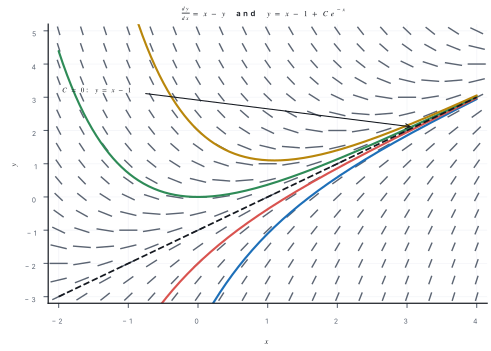
One extra condition picks out one member of the family. Geometrically, you nominate a single point and follow the field through it.

| Test | Type | Method |
|---|---|---|
| can you write it as f(y)\,dy = g(x)\,dx | separable | integrate both sides |
| is every term of the same total degree in x and y | homogeneous | put y = vx |
| does it look homogeneous apart from constants | reducible | shift the origin |
| is it \dfrac{dy}{dx} + Py = Q with P,Q functions of x | linear | integrating factor e^{\int P\,dx} |
| is M\,dx + N\,dy = 0 with \dfrac{\partial M}{\partial y} = \dfrac{\partial N}{\partial x} | exact | integrate M with respect to x |
Work down the list and stop at the first match. Separable is cheapest, so always test it first — many equations that look homogeneous or linear separate at once.
Formation of a differential equation
The reverse problem also appears in the examination: given a family of curves with n arbitrary constants, produce the differential equation it satisfies. The recipe is to differentiate n times and eliminate the constants.
Problem. Form the differential equation of (a) the family of straight lines y = mx through the origin, (b) the family of circles x^{2}+y^{2} = a^{2} centred at the origin, (c) the family y = Ae^{2x}.
Solution. Each family has one constant, so differentiate once.
(a) y = mx gives \frac{dy}{dx} = m. From the original equation m = \frac{y}{x}, so eliminating m,
(b) Differentiating x^{2}+y^{2}=a^{2} with respect to x: 2x + 2y\frac{dy}{dx} = 0, and a has already vanished, so
This is the equation whose slope field is drawn in §14.3 — the circles are everywhere perpendicular to the radius, which is exactly what \frac{dy}{dx} = -\frac{x}{y} says.
(c) \frac{dy}{dx} = 2Ae^{2x} = 2y, so
Problem. Verify that y = x - 1 + Ce^{-x} is the general solution of \dfrac{dy}{dx} + y = x, and find the solution with y(0) = 2.
Solution. Verification. Differentiate: \frac{dy}{dx} = 1 - Ce^{-x}. Add y:
The Ce^{-x} terms cancel for every C, so the whole family satisfies the equation, which is what "general solution" means.
Particular solution. Put x=0 and y=2 into y = x-1+Ce^{-x}:
That is the red curve in the second figure. Always substitute the condition into the general solution, never into the differential equation.
14.3 Separable variables
A first-order equation is separable if it can be written with all the y terms (including dy) on one side and all the x terms (including dx) on the other:
Integrating both sides gives the general solution
One constant is enough: the two constants of integration combine into one.
The test is whether \frac{dy}{dx} factorises into a function of x times a function of y. If \frac{dy}{dx} = h(x)\,k(y) then \frac{dy}{k(y)} = h(x)\,dx and you are done. Equations such as \frac{dy}{dx} = x+y do not factorise and are not separable.
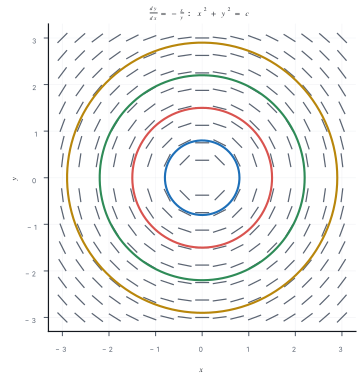
Problem. Solve \left(1+x^{2}\right)\dfrac{dy}{dx} = 1+y^{2}.
Solution. Separate, putting everything in y on the left:
Integrate both sides, using the standard form \int\frac{dt}{1+t^{2}} = \tan^{-1}t:
That is the general solution. It can also be written \tan^{-1}y - \tan^{-1}x = C, or, taking the tangent of both sides and using the subtraction formula, \frac{y-x}{1+xy} = k — a family of circles.
Check. Differentiating \tan^{-1}y - \tan^{-1}x = C gives \frac{1}{1+y^{2}}\frac{dy}{dx} - \frac{1}{1+x^{2}} = 0, which rearranges to the original equation.
Problem. Solve \dfrac{dy}{dx} = e^{x-y}.
Solution. The exponential factorises, which is what makes this separable:
Integrating both sides,
or y = \ln\left(e^{x}+C\right). Note that e^{x-y} had to be split before the variables could be separated — always look for a hidden product.
Problem. Solve \sec^{2}x\tan y\,dx + \sec^{2}y\tan x\,dy = 0.
Solution. Divide throughout by \tan x\tan y, which separates the variables:
Each term is now \frac{g'}{g}, since \frac{d}{dx}\tan x = \sec^{2}x:
Combining the logarithms and removing them,
Writing the constant as \ln|c| rather than C at the start is a standard trick whenever the answer is going to be a product.
Problem. Solve x\left(1+y^{2}\right)dx = y\left(1+x^{2}\right)dy and find the particular solution through (0,1).
Solution. Divide both sides by \left(1+x^{2}\right)\left(1+y^{2}\right):
Both sides are \frac{g'}{2g} patterns, so integrating gives
Multiply by 2 and remove the logarithms:
Particular solution. Put x=0, y=1: \;1 = c(2), so c = \frac12, giving 2\left(1+x^{2}\right) = 1+y^{2}, that is y^{2} = 2x^{2}+1.
Problem. Solve x\dfrac{dy}{dx} = y(x-1).
Solution. Separate:
Integrate both sides:
Collect the logarithms: \ln|y| + \ln|x| = x + \ln|C|, so \ln|xy| - \ln|C| = x and therefore
Check. \frac{dy}{dx} = \frac{Ce^{x}(x-1)}{x^{2}} = \frac{y(x-1)}{x}, as required.
Do not lose the constant, and do not lose solutions
Two habits to keep. First, add the constant at the moment you integrate, not at the end — half of all lost marks in this chapter are a missing C. Second, when you divide by something like \tan y or y, you are assuming it is not zero. The constant solution y = 0 often satisfies the equation as well, and a careful answer mentions it.
14.4 Homogeneous differential equations
A function f(x,y) is homogeneous of degree n if f(tx,ty) = t^{n}f(x,y) for every t. In practice: every term has the same total degree in x and y. So x^{2}+xy+y^{2} is homogeneous of degree 2, and x^{2}+y is not homogeneous at all.
The equation M(x,y)\,dx + N(x,y)\,dy = 0 is homogeneous if M and N are homogeneous of the same degree. Equivalently
the right side depending on x and y only through the ratio \frac{y}{x}.
Suppose \frac{dy}{dx} = F\left(\frac yx\right). Put y = vx, where v is a new function of x. By the product rule,
Substituting into the equation gives
and this always separates:
Integrate, then replace v by \frac yx. If the equation is easier the other way round, the substitution x = vy works identically.
Problem. Solve \dfrac{dy}{dx} = \dfrac{x^{2}+y^{2}}{2xy}.
Solution. Numerator and denominator are both homogeneous of degree 2, so put y = vx, \frac{dy}{dx} = v + x\frac{dv}{dx}:
Separate the variables:
The left side is -\frac{g'}{g} with g = 1-v^{2}, so integrating gives
Finally put v = \frac yx:
Check. Differentiating x^{2}-y^{2}=Cx gives 2x - 2y\frac{dy}{dx} = C = \frac{x^{2}-y^{2}}{x}, and solving for \frac{dy}{dx} returns \frac{x^{2}+y^{2}}{2xy}.
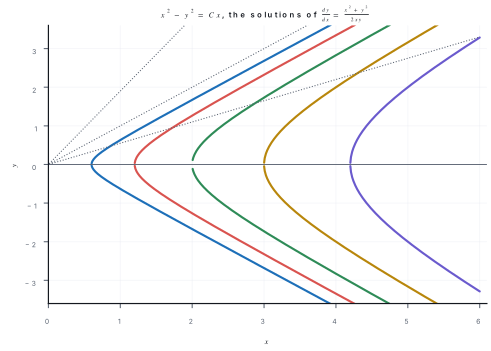
Problem. Solve \dfrac{dy}{dx} = \dfrac{x-y}{x+y}.
Solution. Both parts are homogeneous of degree 1. Put y = vx:
Separating,
The derivative of 1-2v-v^{2} is -2-2v = -2(1+v), so the left side is -\frac{1}{2}\cdot\frac{g'}{g}:
Multiply by -2 and combine:
With v = \frac yx this is
Problem. Solve x\dfrac{dy}{dx} = y + x\tan\dfrac{y}{x}.
Solution. Divide through by x to expose the ratio:
Put y = vx:
The v terms cancel, which always happens when the equation has this shape:
Equations reducible to homogeneous form
An equation
fails to be homogeneous only because of the constants c_{1} and c_{2}. Shift the origin to the point where both numerator and denominator vanish: put x = X + h and y = Y + k, choose h and k to kill the constants, and note that \frac{dy}{dx} = \frac{dY}{dX} because the shift does not change the gradient. The result is homogeneous in X and Y.
Problem. Solve \dfrac{dy}{dx} = \dfrac{x+2y-3}{2x+y-3}.
Solution. Step 1 — find the shift. Solve x+2y-3 = 0 and 2x+y-3 = 0 simultaneously. Subtracting gives y = x, and then 3x = 3, so x = 1, y = 1. Put
Step 2 — the equation is now homogeneous.
Step 3 — put Y = vX.
Step 4 — separate and integrate.
Partial fractions: \frac{2+v}{(1-v)(1+v)} = \frac{A}{1-v} + \frac{B}{1+v} gives 2+v = A(1+v) + B(1-v). Put v=1: 3 = 2A, so A = \frac32. Put v=-1: 1 = 2B, so B = \frac12. Hence
Multiply by 2 and collect:
Step 5 — go back. With v = \frac YX, the left side is \frac{(X+Y)X^{2}}{(X-Y)^{3}}, so the X^{2} cancels and
Finally X = x-1 and Y = y-1, so X+Y = x+y-2 and X-Y = x-y:
14.5 Linear differential equations
An equation is linear of the first order if it can be written
where P and Q are functions of x alone. "Linear" means y and \frac{dy}{dx} appear only to the first power, and never multiplied together.
Multiply the equation by an unknown positive function I(x):
We would like the left side to be the exact derivative of Iy. Since
the two agree provided \frac{dI}{dx} = IP. That is a separable equation:
This I is the integrating factor. With it, the equation becomes
and integrating both sides gives the general solution
- Force the equation into the form \frac{dy}{dx} + Py = Q — divide by whatever multiplies \frac{dy}{dx}.
- Compute I = e^{\int P\,dx}. No constant is needed here, and if \int P\,dx = \ln f(x) then I = f(x) straight away.
- Write Iy = \int IQ\,dx + C and finish the integral.
Problem. Solve x\dfrac{dy}{dx} + 2y = x^{3}.
Solution. Step 1. Divide by x to reach standard form:
Step 2. \int P\,dx = \int\frac{2}{x}dx = 2\ln x = \ln x^{2}, so
Step 3.
Check. \frac{dy}{dx} = \frac{3x^{2}}{5} - \frac{2C}{x^{3}}, so x\frac{dy}{dx} + 2y = \frac{3x^{3}}{5} - \frac{2C}{x^{2}} + \frac{2x^{3}}{5} + \frac{2C}{x^{2}} = x^{3}. Correct for every C.
Problem. Solve \dfrac{dy}{dx} + y\cot x = 2\cos x.
Solution. Already in standard form with P = \cot x and Q = 2\cos x.
Multiplying through,
The right side is the derivative of \sin^{2}x, so
where \csc x is the cosecant. Equations with \cot x or \tan x as P always give a trigonometric integrating factor: \sin x and \sec x respectively.
Problem. Solve \left(1+x^{2}\right)\dfrac{dy}{dx} + 2xy = 4x^{2}.
Solution. Divide by 1+x^{2}:
Notice that I is exactly the factor we divided by — that is common, and it is worth spotting, because then the equation was already in the form \frac{d}{dx}(Iy) = \text{something}:
Problem. Solve (a) \dfrac{dy}{dx} + y = e^{-x}, (b) \dfrac{dy}{dx} - y\tan x = \sec x, (c) \dfrac{dy}{dx} + y = e^{x} with y(0)=1.
Solution. (a) P=1, so I = e^{x} and
(b) P = -\tan x, so \int P\,dx = \ln|\cos x| and I = \cos x:
(c) I = e^{x} again, but now Q = e^{x}:
Now apply y(0) = 1: \;1 = \frac12 + C, so C = \frac12 and
\frac{dy}{dx} + x^{3}y = \sin x is linear — the powers of x do not matter. But \frac{dy}{dx} + y^{2} = x is not linear, and neither is y\frac{dy}{dx} = x. Also, if the roles are reversed and you find P and Q turning out to be functions of y, treat x as the dependent variable and use \frac{dx}{dy} + P(y)x = Q(y) with integrating factor e^{\int P\,dy}.
14.6 Exact differential equations
The equation
is exact if its left side is the total differential du of some function u(x,y), that is if M = \frac{\partial u}{\partial x} and N = \frac{\partial u}{\partial y}. The general solution is then simply
Test for exactness. The equation is exact if and only if
because both sides then equal the mixed second derivative \frac{\partial^{2}u}{\partial x\,\partial y}.
- Test: differentiate M with respect to y and N with respect to x. If they disagree, the equation is not exact.
- Integrate M with respect to x, holding y constant. The "constant" of integration is an unknown function g(y).
- Differentiate that result with respect to y, set it equal to N, and solve for g'(y).
- Integrate g'(y) and write u(x,y) = C.
A shortcut that works for every equation in this syllabus: integrate M\,dx and N\,dy, then write down each distinct term once.
Problem. Solve \left(3x^{2}+2y\right)dx + \left(2x+3y^{2}\right)dy = 0.
Solution. Test. M = 3x^{2}+2y and N = 2x+3y^{2}, so
They agree, so the equation is exact.
Find u. Integrate M with respect to x, treating y as a constant:
Differentiate with respect to y and compare with N:
Solution.
Check. The total differential is \left(3x^{2}+2y\right)dx + \left(2x+3y^{2}\right)dy = 0, the original equation.
Problem. Solve \left(2xy+y^{2}\right)dx + \left(x^{2}+2xy\right)dy = 0.
Solution. \frac{\partial M}{\partial y} = 2x+2y and \frac{\partial N}{\partial x} = 2x+2y, so the equation is exact.
So g is a constant and the solution is
Problem. Solve (a) \left(y\cos x + 1\right)dx + \sin x\,dy = 0, (b) \left(x^{2}+y^{2}\right)dx + 2xy\,dy = 0.
Solution. (a) \frac{\partial M}{\partial y} = \cos x and \frac{\partial N}{\partial x} = \cos x, so it is exact.
(b) \frac{\partial M}{\partial y} = 2y and \frac{\partial N}{\partial x} = 2y, so it is exact.
This equation is also homogeneous of degree 2, so y = vx would solve it as well — a reminder that the types overlap, and the cheapest applicable method is the right one.
14.7 Applications of differential equations
Every application in this section is the same equation. If a quantity changes at a rate proportional to its own size, then
where y_{0} is the value at t=0. A positive k gives growth, a negative k gives decay. Two data points are always enough: the first fixes y_{0} and the second fixes k.
Population growth
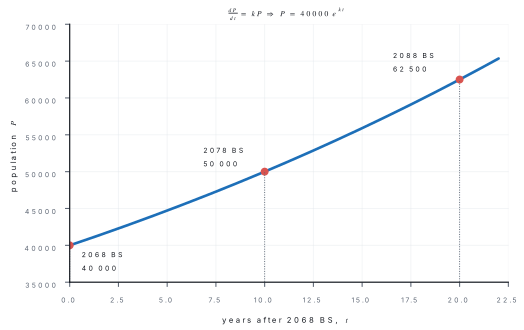
Problem. The population of a municipality grows at a rate proportional to the population present. It was 40{,}000 in 2068 BS and 50{,}000 in 2078 BS. What will it be in 2088 BS?
Solution. Let P be the population t years after 2068 BS. Then
using P = 40000 when t = 0. At t = 10, P = 50000:
For 2088 BS, t = 20, and since e^{20k} = \left(e^{10k}\right)^{2}:
Notice that the second step avoided evaluating k at all. Whenever the times are equally spaced, work with the ratio and the arithmetic stays exact.
Problem. A bacterial culture doubles in 3 hours. By what factor has it grown after 12 hours?
Solution. With N = N_{0}e^{kt} and N = 2N_{0} at t=3,
After 12 hours, 12 = 4\times 3, so
The culture is 16 times its original size. Exponential growth doubles in a fixed time, no matter how large the population already is.
Newton's law of cooling
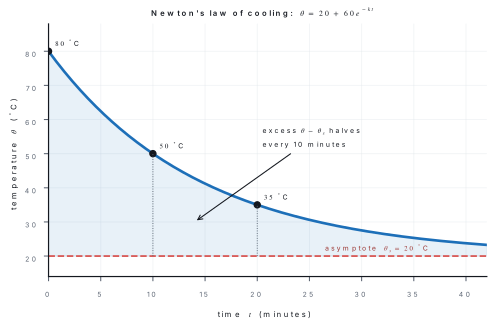
A body at temperature \theta in surroundings at temperature \theta_{s} loses heat at a rate proportional to the temperature excess:
Separate the variables, writing \theta - \theta_{s} as the single quantity that matters:
where \theta_{0} is the initial temperature. As t\to\infty the exponential dies and \theta\to\theta_{s}: the surrounding temperature is a horizontal asymptote, and the body never quite reaches it.
Problem. A glass of tea at 80\,^{\circ}C is left in a room at 20\,^{\circ}C. After 10 minutes it has cooled to 50\,^{\circ}C. Find its temperature after a further 10 minutes, and the time at which it reaches 30\,^{\circ}C.
Solution. Here \theta_{s} = 20 and \theta_{0} = 80, so the excess starts at 60:
At t=10, \theta = 50, so the excess is 30:
The excess halves every 10 minutes. At t = 20 the excess is 60\times\frac14 = 15, so
For \theta = 30 the excess is 10:
Radioactive decay
For a radioactive sample the number of undecayed nuclei satisfies \frac{dN}{dt} = -\lambda N, so N = N_{0}e^{-\lambda t}. The half-life T is the time for half the sample to decay, and putting N = \frac{N_{0}}{2} gives
The half-life does not depend on how much you started with — that is the single most useful fact about decay.
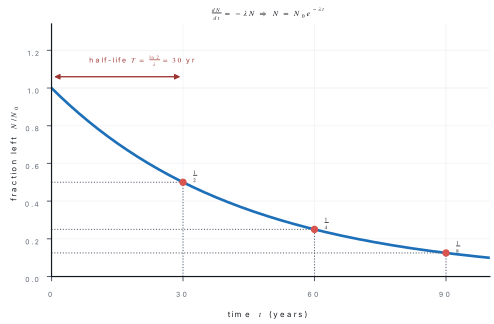
Problem. Radium has a half-life of 1600 years. What fraction of a sample remains after 3200 years? And if a different substance loses 20\% of its mass in 10 days, find its half-life.
Solution. (a) 3200 = 2\times 1600, so two half-lives have passed and
(b) Losing 20\% leaves 80\%, so e^{-10\lambda} = 0.8 and
Chapter summary
- A differential equation relates y to its derivatives. Its order is the highest derivative present; its degree is the power of that derivative once all radicals in the derivatives have been cleared. The degree may be undefined.
- The general solution of an n-th order equation contains n arbitrary constants. Extra conditions turn it into a particular solution. To form the equation of a family with n constants, differentiate n times and eliminate the constants.
- A first-order first-degree equation has a one-parameter family of solutions, and the slope field is the picture of that family.
- Separable: write f(y)\,dy = g(x)\,dx and integrate both sides. Test this first, because it is the cheapest method.
- Homogeneous: if \frac{dy}{dx} = F\left(\frac yx\right), put y = vx so that \frac{dy}{dx} = v + x\frac{dv}{dx}. The result always separates.
- Reducible to homogeneous: for \frac{dy}{dx} = \frac{a_{1}x+b_{1}y+c_{1}}{a_{2}x+b_{2}y+c_{2}}, shift the origin with x = X+h, y = Y+k chosen to kill both constants.
- Linear: for \frac{dy}{dx} + Py = Q the integrating factor is I = e^{\int P\,dx}, and then Iy = \int IQ\,dx + C.
- Exact: M\,dx + N\,dy = 0 is exact when \frac{\partial M}{\partial y} = \frac{\partial N}{\partial x}, and the solution is u = C where \frac{\partial u}{\partial x} = M and \frac{\partial u}{\partial y} = N.
- Applications. Proportional change gives \frac{dy}{dt} = ky and y = y_{0}e^{kt}: growth for k>0, decay for k<0, with half-life T = \frac{\ln 2}{\lambda}. Newton's law of cooling gives \theta = \theta_{s} + \left(\theta_{0}-\theta_{s}\right)e^{-kt}, with \theta_{s} as a horizontal asymptote.
- Whenever the given times are equally spaced, work with ratios rather than computing k — the arithmetic stays exact and much shorter.
Practice questions
Group A — Multiple choice (1 mark each)
- The order and degree of \left(\dfrac{d^{2}y}{dx^{2}}\right)^{3} + \left(\dfrac{dy}{dx}\right)^{2} = 0 are [1]a2 and 2b2 and 3c3 and 2d1 and 2
- The general solution of a differential equation of order 3 contains [1]a1 constantb2 constantsc3 constantsdno constant
- The integrating factor of \dfrac{dy}{dx} + \dfrac{y}{x} = x^{2} is [1]axb\ln xc\dfrac1xde^{x}
- The differential equation of the family of lines y = mx is [1]a\dfrac{dy}{dx} = xb\dfrac{dy}{dx} = mc\dfrac{dy}{dx} = \dfrac{y}{x}dx\dfrac{dy}{dx} = 1
- The substitution that reduces a homogeneous equation to separable form is [1]ay = vxbx+y = vcy = e^{v}dv = \dfrac{dy}{dx}
- M\,dx + N\,dy = 0 is exact if [1]aM = Nb\dfrac{\partial M}{\partial x} = \dfrac{\partial N}{\partial y}c\dfrac{\partial M}{\partial y} = \dfrac{\partial N}{\partial x}dMN = 1
- If a radioactive substance decays with constant \lambda, its half-life is [1]a\dfrac{1}{\lambda}b\dfrac{\ln 2}{\lambda}c\lambda\ln 2d\dfrac{2}{\lambda}
Answers to Group A
1. (b) — the highest derivative is of order 2 and it is cubed.
2. (c) — one arbitrary constant for each integration.
3. (a) — I = e^{\int dx/x} = e^{\ln x} = x.
4. (c) — differentiating gives \frac{dy}{dx}=m, and m = \frac yx from the family itself.
5. (a) — then \frac{dy}{dx} = v + x\frac{dv}{dx} and the variables separate.
6. (c) — both sides equal the mixed partial derivative of the same function u.
7. (b) — \frac12 = e^{-\lambda T} gives T = \frac{\ln 2}{\lambda}.
Group B — Short answer (5 marks each)
- Form the differential equation of the family of circles x^{2}+y^{2} = a^{2} and state its order and degree. [5]
- Solve \dfrac{dy}{dx} = e^{x-y}. [5]
- Solve \dfrac{dy}{dx} = \dfrac{x-y}{x+y}. [5]
- Solve x\dfrac{dy}{dx} + 2y = x^{3}. [5]
- Show that \left(y\cos x + 1\right)dx + \sin x\,dy = 0 is exact and solve it. [5]
- A body cools from 100\,^{\circ}C to 70\,^{\circ}C in 5 minutes in a room at 20\,^{\circ}C. Find its temperature after 10 minutes. [5]
Answers to Group B
1. Differentiate x^{2}+y^{2}=a^{2} with respect to x: 2x + 2y\frac{dy}{dx} = 0, so
The constant a disappeared on its own because the family has one constant and we differentiated once. The equation is of order 1 and degree 1.
2. Split the exponential and separate: e^{y}dy = e^{x}dx. Integrating, e^{y} = e^{x} + C, that is y = \ln\left(e^{x}+C\right).
3. Both parts are homogeneous of degree 1, so put y = vx:
Separating and noting that \frac{d}{dv}\left(1-2v-v^{2}\right) = -2(1+v),
so x^{2}\left(1-2v-v^{2}\right) = C, and with v = \frac yx,
4. Divide by x: \frac{dy}{dx} + \frac2x y = x^{2}, so P = \frac2x and I = e^{2\ln x} = x^{2}. Then
5. M = y\cos x + 1 and N = \sin x, so \frac{\partial M}{\partial y} = \cos x = \frac{\partial N}{\partial x} and the equation is exact. Integrating M with respect to x, u = y\sin x + x + g(y). Then \frac{\partial u}{\partial y} = \sin x + g'(y) = N = \sin x, so g'(y)=0. The solution is
6. With \theta_{s}=20 and \theta_{0}=100 the excess starts at 80: \theta = 20 + 80e^{-kt}. At t=5, \theta = 70, so the excess is 50:
At t = 10 the excess is 80\left(e^{-5k}\right)^{2} = 80\times\frac{25}{64} = 31.25, so
Group C — Long answer (8 marks each)
- (a) Derive the integrating factor of the linear equation \dfrac{dy}{dx} + P(x)y = Q(x).(b) Hence solve \dfrac{dy}{dx} + y\cot x = 2\cos x. [8]
- (a) State Newton's law of cooling as a differential equation and solve it to show that \theta = \theta_{s} + \left(\theta_{0}-\theta_{s}\right)e^{-kt}.(b) A body at 100\,^{\circ}C is left in a room at 25\,^{\circ}C and cools to 70\,^{\circ}C in 10 minutes. Find its temperature after 20 minutes and the time it takes to reach 40\,^{\circ}C. [8]
- (a) Solve x\dfrac{dy}{dx} = y + \sqrt{x^{2}+y^{2}} for x>0.(b) Show that (2x+3y)\,dx + (3x+4y)\,dy = 0 is exact and solve it. [8]
Answers to Group C
1. (a) Multiply the equation by an unknown function I(x): I\frac{dy}{dx} + IPy = IQ. We want the left side to be \frac{d}{dx}(Iy), which equals I\frac{dy}{dx} + \frac{dI}{dx}y. Comparing the two, \frac{dI}{dx} = IP. This separates:
With this I the equation reads \frac{d}{dx}(Iy) = IQ, and integrating gives Iy = \int IQ\,dx + C.
(b) Here P = \cot x and Q = 2\cos x, so \int P\,dx = \ln|\sin x| and I = \sin x. Then
The right side is the derivative of \sin^{2}x, so y\sin x = \sin^{2}x + C and
2. (a) The rate of cooling is proportional to the excess over the surroundings:
Separating the variables, \frac{d\theta}{\theta-\theta_{s}} = -k\,dt, so \ln\left|\theta-\theta_{s}\right| = -kt + c and \theta - \theta_{s} = Ae^{-kt}. At t=0, \theta = \theta_{0}, so A = \theta_{0}-\theta_{s} and
(b) Here \theta_{s} = 25 and \theta_{0} = 100, so the excess starts at 75 and \theta = 25 + 75e^{-kt}. At t=10, \theta = 70, so the excess is 45:
At t=20 the excess is 75\left(\frac35\right)^{2} = 75\times\frac{9}{25} = 27, so
For \theta = 40 the excess is 15, so e^{-kt} = \frac{15}{75} = \frac15 and kt = \ln 5. Since k = \frac{1}{10}\ln\frac53,
3. (a) Divide by x (positive) to get \frac{dy}{dx} = \frac{y}{x} + \sqrt{1+\frac{y^{2}}{x^{2}}}, which depends only on \frac yx, so the equation is homogeneous. Put y = vx:
using the standard integral \int\frac{dv}{\sqrt{v^{2}+1}} = \ln\left|v+\sqrt{v^{2}+1}\right|. Removing the logarithms, v+\sqrt{1+v^{2}} = Cx, and putting v = \frac yx and multiplying by x:
(b) M = 2x+3y and N = 3x+4y, so \frac{\partial M}{\partial y} = 3 = \frac{\partial N}{\partial x} and the equation is exact. Integrating M with respect to x,
Differentiating with respect to y and comparing with N:
The general solution is
Practise more: Mathematics question bank