Question bank · 36 min read
Mathematics: Model Question Sets and Predicted Questions
This chapter does three things. It reads the real papers — the NEB Grade 12 Mathematics papers of 2079, 2080, 2081 and 2082 and the CDC model question of 2080, all transcribed from the printed scans — and tabulates what the examiner asks, unit by unit. It then sets two complete model papers to the exact grid of the real paper (11\times1+8\times5+3\times8=75 marks, three hours), each with full solutions. Finally it lists forty-four predicted questions, ranked, with the reason for each rank and a short model answer.
No paper is leaked to anyone, and this chapter does not claim to know what will be set. A prediction is a judgement from three things shown in the tables below: how often a topic appeared in the five papers read, how many marks its area carries in the CDC grid, and how long it has been since it last appeared. Five papers are a small sample. Use the list to decide what to practise first, never what to skip. Model papers and predicted questions are original, not reproductions, except where a year tag says that a question was read in that paper.
Seventy-five marks in 180 minutes is 2.4 minutes a mark. Plan it: Group A, 15 minutes (11 marks, about 1.4 min each); Group B, 85 minutes (40 marks, about 10 min per five-mark question); Group C, 65 minutes (24 marks, about 22 min per eight-mark question); 15 minutes left to re-check. Since 2082 the eleven MCQs reach you as a separate booklet 30 minutes after the start — begin with Group B, and answer Group A when the booklet arrives. Show the formula, every substitution and the units: a correct answer without working earns little in Group B or C.
13.1 Pattern analysis of the Grade 12 Mathematics papers
13.1.1 The grid, and what has been fixed for years
| Group | Questions | Marks | What the examiner does |
|---|---|---|---|
| A | 11 MCQs (Q1–Q11) | 11\times1=11 | one mark each; Q11 carries an "Or" |
| B | Q12–Q19 | 8\times5=40 | five marks split 1+4, 2+3 or five one-mark parts; Q19 carries an "Or" |
| C | Q20–Q22 | 3\times8=24 | almost always three parts 3+3+2, 2+3+3 or 4+2+2; no "Or" |
The same grid sits in all five papers. The CDC Specification Grid 2078 fixes the area-wise marks and the number of questions of each type:
| Area | Area-wise marks | MCQ | Group B | Group C |
|---|---|---|---|---|
| Algebra (Units 1–5) | 20 | 2 | 2 | 1 |
| Trigonometry + Analytic Geometry + Vector (6–9) | 6+9+6=21 | 3 | 2 | 1 |
| Statistics and Probability (10–11) | 6 | 1 | 1 | — |
| Calculus (12–14) | 22 | 4 | 2 | 1 |
| Computational Methods or Mechanics (15 or 16) | 6 | 1 | 1 | — |
| Total | 75 | 11 | 8 | 3 |
The first column of figures printed beside each area in the syllabus (44,12,20,12,12,48,12; total 160) is working hours, not marks. The CDC publishes only this 2078 grid for Grade 12 Mathematics; no revised grid exists for the 2080-revised curriculum, and the 2081 and 2082 papers still follow it exactly. The grid's own footnote says: "At least one multiple choice question should be asked from each area (Trigonometry, Analytic geometry and Vector)."
13.1.2 Where the questions sit
The papers of 2081, 2082 and the CDC model place every question in an order that follows the grid, and that order is worth knowing before you open the paper.
| Slot | What was set |
|---|---|
| Group A, Q1–Q2 | two algebra items (counting, complex numbers, Cramer's rule, sum of series) |
| Group A, Q3, Q4, Q5 | one item each from trigonometry (half-angle formula), conics (parabola, tangency, eccentricity) and vectors (cross product, smallest value) |
| Group A, Q6 | probability: P(B/A) from three given numbers |
| Group A, Q7–Q10 | four calculus items: a derivative or L'Hospital limit, an integral, a differential-equation type or degree, a tangent slope |
| Group A, Q11 | Computational Methods ("eliminate x or y") Or Mechanics (maximum height, momentum) |
| Group B, Q12–Q13 | algebra: Q12 is often five one-mark recall parts; Q13 is counting, a committee, a complex root or a system of equations |
| Group B, Q14–Q15 | trigonometry + vectors + conics: a half-angle proof and a dot product; a conic's eccentricity and a tangency condition |
| Group B, Q16 | statistics: a table of six or seven pairs, correlation and a regression estimate |
| Group B, Q17–Q18 | calculus: five one-mark recall parts, derivative, integral, tangent |
| Group B, Q19 | simplex LPP Or Mechanics |
| Group C, Q20 | algebra: binomial or complex number + induction + a matrix system |
| Group C, Q21 | trigonometry + conics + vectors in three parts |
| Group C, Q22 | calculus: rate of change + an integral + a differential equation |
The 2079 and 2080 papers differ in two ways. The simplex question was compulsory (Q18), and the Q11/Q19 "Or" paired Mechanics against an economics input–output problem. Those papers were written by the old-course cohorts (registration numbers 78 and 79); NEB's notice for the 2082 examinations records that the Mathematics curriculum was revised in 2080 BS and that the "New Course" paper goes to registration numbers beginning 80 and 81. That explains why Group Theory, Rolle/Mean Value Theorem, inverse circular functions, trigonometric equations and three-dimensional planes appear in 2079 and 2080 and do not appear in 2081, 2082 or the CDC model.
13.1.3 Unit by unit: marks carried, years seen, expected weight
B/C counts the five papers (2079, 2080, 2081, 2082, CDC model 2080) in which the unit supplied at least one Group B or Group C question or part. MCQ counts the papers in which it supplied a Group A item. Expected weight is our estimate from the grid and these counts.
| # | Unit | Hours | B/C (of 5) | MCQ (of 5) | Typical item | Expected weight |
|---|---|---|---|---|---|---|
| 1 | Permutation and Combination | 10 | 3 | 3 | committee; word arrangement | medium |
| 2 | Binomial Theorem | 10 | 5 | 0 | middle term; coefficients; e^{x}, \log(1\pm x) | high |
| 3 | Complex Numbers | 8 | 4 | 2 | De Moivre roots; polar form | high |
| 4 | Sequence and Series | 8 | 5 | 1 | induction proof | very high |
| 5 | Linear Systems | 8 | 5 | 1 | three-equation system | very high |
| 6 | Properties of a Triangle | 8 | 3 | 2 | half-angle proof; isosceles | high |
| 7 | Solution of Triangles | 4 | 1 | 1 | solve a triangle | low |
| 8 | Conic Sections | 20 | 4 | 5 | eccentricity, foci, tangency | very high |
| 9 | Product of Vectors | 12 | 5 | 5 | dot/cross product, area | very high |
| 10 | Correlation and Regression | 8 | 5 | 0 | table numerical | very high |
| 11 | Probability | 4 | 0 | 5 | P(B/A) MCQ | high (MCQ only) |
| 12 | Derivatives | 18 | 5 | 5 | hyperbolic derivative; limit; rate | very high |
| 13 | Anti-derivatives | 18 | 5 | 3 | partial fractions; \int dx/(a+b\cos x) | very high |
| 14 | Differential Equations | 12 | 5 | 4 | linear, separable, modelling | very high |
| 15 | Computational Methods | 12 | 5 | 5 | simplex LPP; eliminate | very high |
| 16 | Mechanics | 12 | 5 (as option) | 5 (as option) | parallel forces; projectile | high |
| 17 | Appendix: group, Rolle/MVT | 0 | 1 | 2 | group axioms; MVT test | low (old course) |
Three things stand out. Nothing in Algebra or Calculus is ignored: Units 2, 4, 5, 9, 10, 12, 13, 14 and 15 were each set as a Group B or C question in all five papers (Unit 3 in four, with a one-mark part in 2079). Probability never had a subjective question in the papers read; its marks are the single MCQ. And Unit 7 was asked once, so Solution of Triangles is best learned as an extension of the half-angle and cosine-law work of Unit 6.
13.1.4 The numericals and derivations that recur
| Type | Forms seen | Papers |
|---|---|---|
| Simplex LPP | two variables, two constraints, maximise | 2079, 2080, 2081, 2082, CDC |
| Correlation/regression from a small table | 5–7 pairs; estimate y from x or x from y | 2080, 2081, 2082, CDC (2079 from given lines) |
| Mathematical induction | identity or inequality | all five |
| Three-equation system | Cramer, row-equivalent, inverse | all five |
| Conditional probability MCQ | P(B/A)=P(A\cap B)/P(A) | 2080, 2081, 2082, CDC |
| "Eliminate x / y" MCQ | two simultaneous equations at Q10 or Q11 | all five |
| De Moivre | roots, polar form | 2080, 2081, 2082, CDC |
| Integrating factor | linear first-order ODE | 2079, 2081, 2082 |
| Inverse-hyperbolic derivative | \cosh^{-1}, \text{sech}^{-1}, \coth^{-1} | 2080, 2081, 2082, CDC |
Proofs set more than once: the half-angle identity in a triangle (2081 twice, CDC); the sine law by vectors (2079) and the projection or cosine law; the like-parallel-forces theorem (2080, CDC); n! versus 2^{n} by induction (2080, 2081).
Printed items that could not be taken at face value (they are discussed in Chapter 12 and should be recognised if a similar one appears): the 2081 induction item n!<2^{n} (true only for n\leq3); the 2081 triangle with a=3+\sqrt{3}, b=2, c=\sqrt{3} (violates the triangle inequality); the 2081 tangent "at (2,5)" to a curve passing through (2,4); the 2080 "dependent" events that are in fact independent.
How the marks are really won. Group A is decided by fluency in one-line results. In Group B and C, the five-mark questions with five one-mark parts are the cheapest marks in the paper — they are pure recall (2079 Q12, 2080 Q12 and Q16, 2081 Q12 and Q17, 2082 Q12 and Q17). Learn the formula sheets of Chapters 11 and 12 and you start with about 10 of those 40 marks.
13.2 Model Question Set 1
NEB-style model paper — Grade 12 — Mathematics · Time: 3 hrs. · Full marks: 75 Candidates are required to give their answers in their own words as far as practicable. The figures in the margin indicate full marks. Attempt all the questions.
Group A — Multiple choice \qquad 11\times1=11 Rewrite the correct option of each question in your answer sheet.
- In how many ways can 5 different books be arranged on a shelf so that two particular books are always together? [1]a24b48c120d240
- The middle term in the expansion of \left(x+\dfrac{1}{x}\right)^{10} is [1]a45b120c210d252
- In a triangle ABC, a=5, b=7, c=8. The angle B is [1]a30^{\circ}b45^{\circ}c60^{\circ}d90^{\circ}
- The eccentricity of the ellipse 9x^{2}+25y^{2}=225 is [1]a\dfrac35b\dfrac45c\dfrac54d\dfrac53
- If |\vec{a}|=3, |\vec{b}|=4 and \vec{a}\cdot\vec{b}=6, then |\vec{a}\times\vec{b}| is [1]a6b6\sqrt{3}c12d12\sqrt{3}
- If P(A)=\dfrac35, P(B)=\dfrac23 and P(A\cap B)=\dfrac25, then P(A/B) is [1]a\dfrac23b\dfrac35c\dfrac49d\dfrac{6}{25}
- The derivative of \cosh^{-1}(x^{2}) with respect to x is [1]a\dfrac{2x}{\sqrt{x^{4}+1}}b\dfrac{2x}{\sqrt{x^{4}-1}}c\dfrac{1}{\sqrt{x^{4}-1}}d\dfrac{2x}{1-x^{4}}
- \displaystyle\lim_{x\to0}\dfrac{e^{x}-e^{-x}}{\sin x} equals [1]a0b1c2d\infty
- \displaystyle\int\dfrac{e^{x}}{1+e^{2x}}\,dx equals [1]a\tan^{-1}(e^{x})+Cb\ln(1+e^{2x})+Cc2\tan^{-1}(e^{x})+Cd\dfrac{1}{1+e^{2x}}+C
- The integrating factor of \dfrac{dy}{dx}+\dfrac{2}{x}\,y=x^{2} is [1]axbx^{2}c\dfrac{1}{x^{2}}de^{2x}
-
Eliminating y from 2x+3y=12 and x-y=1 gives the equation [1](a) 5x=15(b) x=5(c) 5x=9(d) 5y=10
Or — A stone is projected with speed 20\ \text{m s}^{-1} at 30^{\circ} to the horizontal (g=10\ \text{m s}^{-2}). The greatest height reached is (a) 5 m (b) 10 m (c) 15 m (d) 20 m
Group B — Short answer questions \qquad 8\times5=40
- (a) State De Moivre's theorem. [1](b) Write the formula for P(n,r). [1](c) Write the general term of the expansion of (a+b)^{n}. [1](d) Write the sum of the first n natural numbers. [1](e) Write the augmented matrix of x+2y=3, 3x-y=5. [1] [5]
- (a) A committee of 4 is to be formed from 6 men and 4 women so that it contains at least one woman. In how many ways can this be done? [2](b) Express z=-1+i in polar form and find z^{8}. [3] [5]
- (a) In any triangle ABC, prove that \dfrac{a^{2}-b^{2}}{c^{2}}=\dfrac{\sin(A-B)}{\sin C}. [3](b) Find the projection of \vec{a}=2\vec{i}+3\vec{j}-\vec{k} on \vec{b}=\vec{i}-2\vec{j}+2\vec{k}. [2] [5]
- (a) Find the equation of the parabola with focus (3,0) and directrix x=-3. [2](b) For what values of c does the line y=2x+c touch the circle x^{2}+y^{2}=5? [3] [5]
- The marks of five students in Mathematics (x) and Physics (y) are: x: 5,7,9,11,13; y: 8,11,12,16,18.(a) Find the coefficient of correlation. [2](b) Estimate the Physics mark of a student who scored 15 in Mathematics. [3] [5]
- (a) Find \dfrac{dy}{dx} if y=x^{\sin x}. [2](b) Using L'Hospital's rule, evaluate \displaystyle\lim_{x\to0}\frac{x-\sin x}{x^{3}}. [3] [5]
- (a) Integrate \displaystyle\int\frac{x+5}{(x+1)(x+3)}\,dx. [3](b) Solve \dfrac{dy}{dx}=x\,e^{-y}. [2] [5]
- Using the simplex method, maximise Z=5x+4y subject to 6x+4y\leq24, x+2y\leq6, x,y\geq0. [5] Or —(a) A car of mass 1000 kg increases its speed from 10\ \text{m s}^{-1} to 25\ \text{m s}^{-1} uniformly in 5 s. Find the force acting on it. [2](b) Two like parallel forces of 12 N and 18 N act at the ends A and B of a light rod AB of length 1 m. Find the magnitude and the point of application of the resultant. [3]
Group C — Long answer questions \qquad 3\times8=24
- (a) Use the binomial theorem to find \sqrt{0.98} to three decimal places. [2](b) Prove by mathematical induction that \dfrac{1}{1\cdot2}+\dfrac{1}{2\cdot3}+\cdots+\dfrac{1}{n(n+1)}=\dfrac{n}{n+1}. [3](c) Solve x+y+z=6, 2x-y+z=3, x+2y-z=2 by the row-equivalent method. [3] [8]
- (a) In any triangle ABC, prove that a\cos A+b\cos B+c\cos C=2a\sin B\sin C. [3](b) Find the foci, the eccentricity and the length of the latus rectum of the hyperbola 16x^{2}-9y^{2}=144. [3](c) Find the area of the triangle with vertices P(1,0,0), Q(0,2,0) and R(0,0,3). [2] [8]
- (a) A ladder 5 m long rests against a vertical wall. Its foot is pulled away from the wall at 1.5\ \text{m s}^{-1}. How fast is its top sliding down when the foot is 3 m from the wall? [3](b) Evaluate \displaystyle\int\frac{dx}{2+\cos x}. [3](c) Solve \dfrac{dy}{dx}+y\cot x=2\cos x. [2] [8]
13.2.1 Solutions to Model Set 1
Group A — answer key with reasons
1. (b) 48 — tie the two books as one block: 4!=24 arrangements of four units, times 2! for the order inside the block. (a) forgets the swap.
2. (d) 252 — n=10 is even, so the middle term is T_{6}=C(10,5)x^{5}x^{-5}=252. (c) is C(10,4), the term before it.
3. (c) 60^{\circ} — \cos B=\dfrac{a^{2}+c^{2}-b^{2}}{2ac}=\dfrac{25+64-49}{80}=\dfrac12.
4. (b) \dfrac45 — \dfrac{x^{2}}{25}+\dfrac{y^{2}}{9}=1, e^{2}=1-\dfrac{9}{25}=\dfrac{16}{25}. (d) is \dfrac{1}{e}.
5. (b) 6\sqrt{3} — \cos\theta=\dfrac{6}{12}=\dfrac12, \sin\theta=\dfrac{\sqrt{3}}{2}, |\vec{a}\times\vec{b}|=12\times\dfrac{\sqrt{3}}{2}.
6. (b) \dfrac35 — P(A/B)=\dfrac{P(A\cap B)}{P(B)}=\dfrac{2/5}{2/3}=\dfrac35; (a) is P(B/A) — the conditioning event is B, so divide by P(B).
7. (b) — \dfrac{d}{dx}\cosh^{-1}u=\dfrac{u'}{\sqrt{u^{2}-1}} with u=x^{2}.
8. (c) 2 — form \dfrac00; L'Hospital: \dfrac{e^{x}+e^{-x}}{\cos x}\to\dfrac{2}{1}.
9. (a) — put t=e^{x}: \int\dfrac{dt}{1+t^{2}}=\tan^{-1}t.
10. (b) x^{2} — e^{\int(2/x)dx}=e^{2\ln x}=x^{2}.
11. (a) 5x=15 — multiply the second by 3: 3x-3y=3; add to the first: 5x=15. Or: (a) 5 m — H=\dfrac{u^{2}\sin^{2}\theta}{2g}=\dfrac{400\times\frac14}{20}=5 m.
Group B — full solutions
12. (a) For every integer n, [r(\cos\theta+i\sin\theta)]^{n}=r^{n}(\cos n\theta+i\sin n\theta). (b) P(n,r)=\dfrac{n!}{(n-r)!}. (c) T_{r+1}=C(n,r)\,a^{n-r}b^{r}. (d) \dfrac{n(n+1)}{2}. (e) The augmented matrix has the coefficients and then the constants, drawn below.
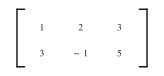
13. (a) All committees: C(10,4)=210. Committees with no woman, four men: C(6,4)=15.
(b) r=\sqrt{1+1}=\sqrt{2}, \tan\theta=-1 with the point (-1,1) in the second quadrant, so \theta=\dfrac{3\pi}{4}:
Check: (-1+i)^{2}=-2i, so (-1+i)^{8}=(-2i)^{4}=16. ✓
14. (a) By the sine law, a=k\sin A, b=k\sin B, c=k\sin C. Then
Using \sin A-\sin B=2\cos\frac{A+B}{2}\sin\frac{A-B}{2} and \sin A+\sin B=2\sin\frac{A+B}{2}\cos\frac{A-B}{2}, the product is \sin(A+B)\sin(A-B). Since A+B=180^{\circ}-C, \sin(A+B)=\sin C:
∎ (b) \vec{a}\cdot\vec{b}=2(1)+3(-2)+(-1)(2)=-6 and |\vec{b}|=\sqrt{1+4+4}=3:
The negative sign means the projection points opposite to \vec{b}.
15. (a) Focus (a,0)=(3,0) gives a=3, and the directrix x=-3 agrees. The parabola opens to the right:
(b) For the line y=mx+c to touch x^{2}+y^{2}=a^{2}, c^{2}=a^{2}(1+m^{2}). Here m=2, a^{2}=5:
16. \bar{x}=9, \bar{y}=13.
| x | y | dx | dy | dx\,dy | dx^{2} | dy^{2} |
|---|---|---|---|---|---|---|
| 5 | 8 | -4 | -5 | 20 | 16 | 25 |
| 7 | 11 | -2 | -2 | 4 | 4 | 4 |
| 9 | 12 | 0 | -1 | 0 | 0 | 1 |
| 11 | 16 | 2 | 3 | 6 | 4 | 9 |
| 13 | 18 | 4 | 5 | 20 | 16 | 25 |
| Total | 0 | 0 | 50 | 40 | 64 |
(a)
a very strong positive correlation. (b) To estimate y from x, use the regression of y on x: b_{yx}=\dfrac{50}{40}=1.25.
The estimated Physics mark is about 20.5.
17. (a) Take logarithms: \ln y=\sin x\cdot\ln x. Differentiate:
(b) The form is \dfrac00. Apply L'Hospital's rule three times:
18. (a) By the cover-up rule,
(b) e^{y}\,dy=x\,dx, so
19. Slack form: 6x+4y+s_1=24, x+2y+s_2=6, Z-5x-4y=0.
| Basis | x | y | s_1 | s_2 | RHS |
|---|---|---|---|---|---|
| s_1 | 6 | 4 | 1 | 0 | 24 |
| s_2 | 1 | 2 | 0 | 1 | 6 |
| Z | -5 | -4 | 0 | 0 | 0 |
x enters (-5). Ratios \dfrac{24}{6}=4, \dfrac61=6; s_1 leaves, pivot 6.
| Basis | x | y | s_1 | s_2 | RHS |
|---|---|---|---|---|---|
| x | 1 | \frac23 | \frac16 | 0 | 4 |
| s_2 | 0 | \frac43 | -\frac16 | 1 | 2 |
| Z | 0 | -\frac23 | \frac56 | 0 | 20 |
y enters (-\frac23). Ratios \dfrac{4}{2/3}=6, \dfrac{2}{4/3}=1.5; s_2 leaves, pivot \frac43.
| Basis | x | y | s_1 | s_2 | RHS |
|---|---|---|---|---|---|
| x | 1 | 0 | \frac14 | -\frac12 | 3 |
| y | 0 | 1 | -\frac18 | \frac34 | \frac32 |
| Z | 0 | 0 | \frac34 | \frac12 | 21 |
Check: 6(3)+4(1.5)=24 ✓; 3+2(1.5)=6 ✓; 5(3)+4(1.5)=21 ✓. Or (a) a=\dfrac{v-u}{t}=\dfrac{25-10}{5}=3\ \text{m s}^{-2} and F=ma=1000\times3=3000\ \text{N}. (b) The resultant is 12+18=30 N, parallel to the forces, acting at a point C on AB with 12\cdot AC=18\cdot CB. With AC=x, CB=1-x: 12x=18(1-x), so 30x=18 and x=0.6 m. The resultant is 30 N at 0.6 m from A (nearer the larger force).
Group C — full solutions
20. (a) \sqrt{0.98}=(1-0.02)^{1/2}:
To three decimal places, \sqrt{0.98}\approx0.990. (The exact value is 0.989949\ldots.) (b) Let P(n) be the statement. P(1): LHS =\dfrac{1}{1\cdot2}=\dfrac12, RHS =\dfrac12. True. Assume P(k) and add the next term \dfrac{1}{(k+1)(k+2)}:
which is P(k+1). By induction the result holds for all n. ∎ (c) Row operations on the equations (the augmented rows): R_2\to R_2-2R_1 and R_3\to R_3-R_1:
Then R_3\to3R_3+R_2: 3y-6z-3y-z=-12-9, so -7z=-21 and z=3. Back-substitute: -3y-3=-9 gives y=2; x=6-2-3=1.
Check: 2(1)-2+3=3 ✓; 1+4-3=2 ✓.
21. (a) By the sine law a=2R\sin A and so on:
Now \sin2A+\sin2B=2\sin(A+B)\cos(A-B)=2\sin C\cos(A-B), and \sin2C=2\sin C\cos C=-2\sin C\cos(A+B). Adding,
∎ (b) Divide by 144: \dfrac{x^{2}}{9}-\dfrac{y^{2}}{16}=1, so a=3, b=4, c=\sqrt{9+16}=5. Foci (\pm5,0); eccentricity e=\dfrac{c}{a}=\dfrac53; latus rectum \dfrac{2b^{2}}{a}=\dfrac{32}{3}. (c) \vec{PQ}=-\vec{i}+2\vec{j} and \vec{PR}=-\vec{i}+3\vec{k}:
22. (a) Let the foot be x m from the wall and the top y m above the ground: x^{2}+y^{2}=25. Differentiate with respect to t:
When x=3, y=\sqrt{25-9}=4, and \dfrac{dx}{dt}=1.5:
The top slides down at 1.125\ \text{m s}^{-1}. (b) Put t=\tan\dfrac x2: 2+\cos x=\dfrac{2(1+t^{2})+(1-t^{2})}{1+t^{2}}=\dfrac{3+t^{2}}{1+t^{2}} and dx=\dfrac{2\,dt}{1+t^{2}}:
(c) Linear with P=\cot x: I.F. =e^{\int\cot x\,dx}=\sin x.
13.3 Model Question Set 2
NEB-style model paper — Grade 12 — Mathematics · Time: 3 hrs. · Full marks: 75 Candidates are required to give their answers in their own words as far as practicable. The figures in the margin indicate full marks. Attempt all the questions.
Group A — Multiple choice \qquad 11\times1=11 Rewrite the correct option of each question in your answer sheet.
- If C(n,2)=45, then n equals [1]a9b10c11d12
- The value of 1^{3}+2^{3}+3^{3}+\cdots+10^{3} is [1]a385b2025c3025d3080
- In a triangle ABC, a=6, b=8, c=10. The value of \cos\dfrac{C}{2} is [1]a\dfrac12b\dfrac{1}{\sqrt{2}}c\dfrac{\sqrt{3}}{2}d0
- The focus of the parabola y^{2}=16x is [1]a(2,0)b(4,0)c(8,0)d(0,4)
- The vectors 2\vec{i}+3\vec{j}+\vec{k} and \vec{i}-\vec{j}+\lambda\vec{k} are perpendicular when \lambda is [1]a-1b0c1d2
- A fair die is thrown twice. The probability that the sum is 8, given that the first throw is 3, is [1]a\dfrac{1}{36}b\dfrac{5}{36}c\dfrac16d\dfrac13
- \dfrac{d}{dx}\tanh(3x) equals [1]a\text{sech}^{2}(3x)b3\,\text{sech}^{2}(3x)c3\cosh^{2}(3x)d-3\,\text{sech}^{2}(3x)
- The slope of the normal to the curve y=x^{2}-3x+2 at (3,2) is [1]a3b-3c\dfrac13d-\dfrac13
- \displaystyle\int\dfrac{dx}{x^{2}-9} equals [1]a\dfrac16\ln\left|\dfrac{x-3}{x+3}\right|+Cb\dfrac16\ln\left|\dfrac{x+3}{x-3}\right|+Cc\dfrac13\tan^{-1}\dfrac{x}{3}+Cd\ln|x^{2}-9|+C
- The order and degree of \left(\dfrac{d^{2}y}{dx^{2}}\right)^{3}+\left(\dfrac{dy}{dx}\right)^{4}=x are [1]a2 and 3b3 and 2c2 and 4d3 and 4
-
Eliminating x from x+2y=7 and 3x-y=7 gives [1](a) 7y=14(b) 5y=14(c) 7y=28(d) 5y=0
Or — A particle is projected with speed 30\ \text{m s}^{-1} at 45^{\circ} to the horizontal (g=10\ \text{m s}^{-2}). Its horizontal range is (a) 45 m (b) 90 m (c) 180 m (d) 900 m
Group B — Short answer questions \qquad 8\times5=40
- (a) Write the expansion of \log_e(1+x) and the values of x for which it holds. [1](b) Express C(n,r) in terms of P(n,r). [1](c) Write the polar form of a complex number x+iy. [1](d) Write the sum of the cubes of the first n natural numbers. [1](e) Write Cramer's rule for x in p_1x+q_1y=r_1, p_2x+q_2y=r_2. [1] [5]
- (a) In how many ways can 6 persons sit round a table if two particular persons must not sit together? [2](b) Use De Moivre's theorem to evaluate (1+i)^{10}. [3] [5]
- (a) In any triangle ABC, prove that a^{2}+b^{2}+c^{2}=2(bc\cos A+ca\cos B+ab\cos C). [3](b) If \vec{a}=2\vec{i}+\vec{j}+\vec{k} and \vec{b}=\vec{i}+2\vec{j}+\vec{k}, find |\vec{a}\times\vec{b}| and the sine of the angle between them. [2] [5]
- (a) Find the equation of the ellipse with foci (\pm4,0) and eccentricity \dfrac45. [3](b) Find the equations of the tangent and the normal to the circle x^{2}+y^{2}=13 at (2,3). [2] [5]
- The regression lines of a bivariate distribution are 3x+2y=26 and 6x+y=31.(a) Find \bar{x} and \bar{y}. [2](b) Find the regression coefficients and the correlation coefficient. [3] [5]
- (a) Find \dfrac{d}{dx}\tanh^{-1}(2x). [2](b) The radius of a circle increases at 0.2\ \text{cm s}^{-1}. Find the rate of increase of its area when the radius is 5 cm. [3] [5]
- (a) Integrate \displaystyle\int\frac{dx}{x^{2}+6x+13}. [2](b) Solve the exact equation (3x^{2}+2y)\,dx+(2x+4y^{3})\,dy=0. [3] [5]
- Using the simplex method, maximise Z=4x+3y subject to 2x+y\leq10, x+2y\leq8, x,y\geq0. [5] Or —(a) A weight of 60 N hangs from two strings, each making 45^{\circ} with the horizontal. Find the tension in each string. [3](b) A stone falls freely from rest from a height of 80 m (g=10\ \text{m s}^{-2}). Find the time taken and the speed on reaching the ground. [2]
Group C — Long answer questions \qquad 3\times8=24
- (a) Show that the coefficient of x^{r} in the expansion of (1-x)^{-3} is \dfrac{(r+1)(r+2)}{2}. [3](b) Prove by mathematical induction that 7^{n}-1 is divisible by 6 for every natural number n. [3](c) Solve 2x+3y=7, 3x-y=5 by Cramer's rule. [2] [8]
- (a) In any triangle ABC, prove that b^{2}\sin2C+c^{2}\sin2B=2bc\sin A. [3](b) Find the equation of the hyperbola with foci (\pm5,0) and eccentricity \dfrac54. [3](c) A force \vec{F}=3\vec{i}+2\vec{j}-\vec{k} newton moves a particle from (1,1,1) to (2,3,0). Find the work done. [2] [8]
- (a) Find the equations of the tangent and the normal to the curve y=x^{3}-2x+1 at the point where x=1. [3](b) Integrate \displaystyle\int\frac{dx}{x(x^{2}+1)}. [3](c) Solve x\dfrac{dy}{dx}+2y=x^{2}. [2] [8]
13.3.1 Solutions to Model Set 2
Group A — answer key with reasons
1. (b) 10 — \dfrac{n(n-1)}{2}=45, n^{2}-n-90=0, n=10.
2. (c) 3025 — \Big[\dfrac{10\times11}{2}\Big]^{2}=55^{2}. (a) is \sum n^{2}.
3. (b) \dfrac{1}{\sqrt{2}} — s=12, \cos^{2}\dfrac C2=\dfrac{s(s-c)}{ab}=\dfrac{12\times2}{48}=\dfrac12. (The triangle is right-angled at C, so \dfrac C2=45^{\circ}.)
4. (b) (4,0) — 4a=16, a=4; focus (a,0).
5. (c) 1 — 2(1)+3(-1)+\lambda=0.
6. (c) \dfrac16 — given the first throw is 3, the second must be 5; \dfrac{P(A\cap B)}{P(A)}=\dfrac{1/36}{1/6}=\dfrac16. (a) forgets to divide by P(A).
7. (b) — \dfrac{d}{dx}\tanh u=\text{sech}^{2}u\cdot u', with u'=3.
8. (d) -\dfrac13 — y'=2x-3=3 at x=3; normal slope is -\dfrac13. (a) is the tangent slope.
9. (a) — \int\dfrac{dx}{x^{2}-a^{2}}=\dfrac{1}{2a}\ln\Big|\dfrac{x-a}{x+a}\Big| with a=3. (b) inverts the quotient.
10. (a) 2 and 3 — the highest derivative is of order 2 and it is raised to the power 3; the \dfrac{dy}{dx} term does not matter.
11. (a) 7y=14 — 3(x+2y)=21 gives 3x+6y=21; subtract 3x-y=7: 7y=14. Or: (b) 90 m — R=\dfrac{u^{2}\sin2\theta}{g}=\dfrac{900\times1}{10}.
Group B — full solutions
12. (a) \log_e(1+x)=x-\dfrac{x^{2}}{2}+\dfrac{x^{3}}{3}-\cdots, valid for -1<x\leq1. (b) C(n,r)=\dfrac{P(n,r)}{r!}. (c) x+iy=r(\cos\theta+i\sin\theta), r=\sqrt{x^{2}+y^{2}}, \theta=\tan^{-1}\dfrac{y}{x} (quadrant by the signs of x,y). (d) \Big[\dfrac{n(n+1)}{2}\Big]^{2}. (e) x=\dfrac{D_x}{D}=\dfrac{r_1q_2-r_2q_1}{p_1q_2-p_2q_1}, provided D=p_1q_2-p_2q_1\neq0.
13. (a) Total arrangements round a table: (6-1)!=120. Arrangements with the two particular persons together: treat them as one unit, (5-1)!\times2!=48.
(b) 1+i=\sqrt{2}\big(\cos\frac{\pi}{4}+i\sin\frac{\pi}{4}\big):
Check: (1+i)^{2}=2i, so (1+i)^{10}=(2i)^{5}=32i^{5}=32i. ✓
14. (a) The cosine law gives 2bc\cos A=b^{2}+c^{2}-a^{2}, 2ca\cos B=c^{2}+a^{2}-b^{2}, 2ab\cos C=a^{2}+b^{2}-c^{2}. Adding,
∎ (b)
Since |\vec{a}|=|\vec{b}|=\sqrt{6}: \sin\theta=\dfrac{\sqrt{11}}{6}=0.553.
15. (a) The foci (\pm c,0) give c=4, and e=\dfrac ca=\dfrac45 gives a=5. Then b^{2}=a^{2}-c^{2}=25-16=9:
(b) The tangent at (x_1,y_1) is xx_1+yy_1=a^{2}: 2x+3y=13. The normal passes through the centre and (2,3): y=\dfrac32x, that is 3x-2y=0.
16. (a) Both lines pass through (\bar{x},\bar{y}). From 6x+y=31, y=31-6x; substitute in 3x+2y=26:
(b) Try 3x+2y=26 as the line of y on x: y=-\dfrac32x+13, so b_{yx}=-\dfrac32. Then 6x+y=31 as the line of x on y: x=-\dfrac16y+\dfrac{31}{6}, so b_{xy}=-\dfrac16.
The assignment is consistent. Both coefficients are negative, so r is negative:
(The other assignment gives b_{yx}=-6 and b_{xy}=-\tfrac23, product 4>1, which is impossible.)
17. (a) \dfrac{d}{dx}\tanh^{-1}u=\dfrac{u'}{1-u^{2}} with u=2x, for |2x|<1:
(b) A=\pi r^{2}, so \dfrac{dA}{dt}=2\pi r\dfrac{dr}{dt}=2\pi(5)(0.2)=2\pi\approx6.28\ \text{cm}^{2}\text{s}^{-1}.
18. (a) Complete the square: x^{2}+6x+13=(x+3)^{2}+4.
(b) M=3x^{2}+2y, N=2x+4y^{3}: \dfrac{\partial M}{\partial y}=2=\dfrac{\partial N}{\partial x}, so the equation is exact. \int M\,dx=x^{3}+2xy; the terms of N free of x are 4y^{3}, giving y^{4}:
19. Slack form: 2x+y+s_1=10, x+2y+s_2=8, Z-4x-3y=0.
| Basis | x | y | s_1 | s_2 | RHS |
|---|---|---|---|---|---|
| s_1 | 2 | 1 | 1 | 0 | 10 |
| s_2 | 1 | 2 | 0 | 1 | 8 |
| Z | -4 | -3 | 0 | 0 | 0 |
x enters (-4); ratios \dfrac{10}{2}=5, \dfrac81=8; s_1 leaves, pivot 2.
| Basis | x | y | s_1 | s_2 | RHS |
|---|---|---|---|---|---|
| x | 1 | \frac12 | \frac12 | 0 | 5 |
| s_2 | 0 | \frac32 | -\frac12 | 1 | 3 |
| Z | 0 | -1 | 2 | 0 | 20 |
y enters (-1); ratios \dfrac{5}{1/2}=10, \dfrac{3}{3/2}=2; s_2 leaves, pivot \frac32.
| Basis | x | y | s_1 | s_2 | RHS |
|---|---|---|---|---|---|
| x | 1 | 0 | \frac23 | -\frac13 | 4 |
| y | 0 | 1 | -\frac13 | \frac23 | 2 |
| Z | 0 | 0 | \frac53 | \frac23 | 22 |
Check: 2(4)+2=10 ✓; 4+2(2)=8 ✓; 4(4)+3(2)=22 ✓. Or (a) Each string makes 45^{\circ} with the horizontal, so the tensions are equal, T. Vertical equilibrium: 2T\sin45^{\circ}=60, so T=\dfrac{60}{\sqrt{2}}=30\sqrt{2}=42.4 N. (Horizontal components cancel.) (b) From s=\tfrac12gt^{2}: 80=5t^{2}, t=4 s. Speed v=gt=10\times4=40\ \text{m s}^{-1}.
Group C — full solutions
20. (a) By the binomial theorem for any index, the coefficient of x^{r} in (1+y)^{n} is \dfrac{n(n-1)\cdots(n-r+1)}{r!}. With y=-x and n=-3:
(The product (-3)(-4)\cdots(-r-2) has r factors, so it equals (-1)^{r}\,3\cdot4\cdots(r+2), and (-1)^{r}(-1)^{r}=1.) ∎ (b) P(n): 7^{n}-1 is divisible by 6. P(1): 7-1=6. True. Assume 7^{k}-1=6m, so 7^{k}=6m+1. Then
which is divisible by 6: P(k+1) holds. By induction, true for all n. ∎ (c) With p_1=2,q_1=3,r_1=7 and p_2=3,q_2=-1,r_2=5: D=p_1q_2-p_2q_1=2(-1)-3(3)=-11, D_x=r_1q_2-r_2q_1=7(-1)-3(5)=-22, D_y=p_1r_2-p_2r_1=2(5)-7(3)=-11:
Check: 2(2)+3(1)=7 ✓; 3(2)-1=5 ✓.
21. (a) Using \sin2C=2\sin C\cos C and \sin2B=2\sin B\cos B:
By the sine law b\sin C=c\sin B=h (the altitude from A):
since b\cos C+c\cos B=a (projection law). And ah=2\Delta=bc\sin A:
∎ (b) c=5 and e=\dfrac ca=\dfrac54 give a=4. Then b^{2}=c^{2}-a^{2}=25-16=9:
(c) Displacement \vec{d}=(2-1)\vec{i}+(3-1)\vec{j}+(0-1)\vec{k}=\vec{i}+2\vec{j}-\vec{k}:
22. (a) At x=1: y=1-2+1=0, so the point is (1,0). \dfrac{dy}{dx}=3x^{2}-2=1 at x=1. Tangent: y-0=1(x-1), that is x-y-1=0. Normal (slope -1): y=-(x-1), that is x+y-1=0. (b) Partial fractions: \dfrac{1}{x(x^{2}+1)}=\dfrac{1}{x}-\dfrac{x}{x^{2}+1}. So
(c) Divide by x: \dfrac{dy}{dx}+\dfrac{2}{x}y=x. I.F. =e^{2\ln x}=x^{2}:
13.4 Predicted Questions
The list is ranked. Tier A holds the topics that came up in four or five of the five papers read: practise these first and to full marks. Tier B topics came up in two or three papers. Tier C are questions not yet asked as a full question in the new course, or asked only once or only in the old-course papers; they are last in the queue, not off the list. Each entry gives the unit, the reason for its rank and a short model answer; for the method in full, see the solved examples in Chapter 12 and the two model papers above. "Seen" counts out of the five papers read (2079, 2080, 2081, 2082, CDC model 2080).
13.4.1 Tier A — asked in four or five of the papers read
- (Unit 15, simplex LPP) Using the simplex method, maximise Z=6x+5y subject to x+y\leq5, 3x+2y\leq12, x,y\geq0. [5] Why: a full simplex question in 5 of 5 papers; worth 5 marks every time. Answer: slack form; x enters (-6), ratios 5 and 4, so s_2 leaves; then y enters, s_1 leaves. Final table: y=3, x=2, Z=27. Check by corner points: (0,0)\to0, (4,0)\to24, (2,3)\to27, (0,5)\to25.
- (Unit 4, induction) Prove by induction that 1+3+5+\cdots+(2n-1)=n^{2}. [3] Why: an identity proof in Group B or C in 5 of 5 papers. Answer: n=1: 1=1^{2}. Assume for k; add (2k+1): k^{2}+2k+1=(k+1)^{2}, which is the statement for k+1. ∎
- (Unit 4, induction inequality) Prove by induction that 2^{n}>n^{2} for all n\geq5. [3] Why: inequalities were set in 2080 (n!\geq2^{n}) and 2081 (n!<2^{n}); test small n first. Answer: n=5: 32>25. Assume 2^{k}>k^{2} with k\geq5. Then 2^{k+1}>2k^{2}=k^{2}+k^{2}\geq k^{2}+2k+1=(k+1)^{2}, because k^{2}\geq2k+1 for k\geq3. ∎ (The base case is 5, not 1: 2^{3}<3^{2} and 2^{4}=4^{2}.)
- (Unit 10, regression) The table gives x: 10,12,14,16,18; y: 15,17,22,24,27. Find r, the regression line of y on x, and estimate y at x=20. [5] Why: correlation and regression from a table in 5 of 5 papers. Answer: \bar{x}=14, \bar{y}=21; \sum dx\,dy=62, \sum dx^{2}=40, \sum dy^{2}=98. r=\dfrac{62}{\sqrt{40\times98}}=0.990; b_{yx}=\dfrac{62}{40}=1.55; y-21=1.55(x-14); at x=20, y=21+1.55\times6=30.3.
- (Unit 5, system of equations) Solve 3x+y-z=4, x-2y+2z=6, 2x+3y+z=10 by Cramer's rule. [5] Why: a three-equation system in 5 of 5 papers. Answer: D=-28, D_x=-56, D_y=-28, D_z=-84; so x=2, y=1, z=3. Check: 6+1-3=4 ✓; 2-2+6=6 ✓; 4+3+3=10 ✓.
- (Unit 3, De Moivre roots) Find the fourth roots of -16. [5] Why: De Moivre roots in 4 of 5 papers (2080, 2081, 2082, CDC). Answer: -16=16(\cos\pi+i\sin\pi), so the roots are 2\Big[\cos\dfrac{\pi+2k\pi}{4}+i\sin\dfrac{\pi+2k\pi}{4}\Big], k=0,1,2,3: \sqrt{2}(1+i), \sqrt{2}(-1+i), \sqrt{2}(-1-i), \sqrt{2}(1-i).
- (Unit 11, conditional probability) If P(A)=0.5, P(B)=0.4 and P(A\cup B)=0.7, find P(A/B). [1] Why: an MCQ on P(B/A) or P(A/B) in 4 of 5 papers (2080, 2081, 2082, CDC). Answer: P(A\cap B)=0.5+0.4-0.7=0.2; P(A/B)=\dfrac{0.2}{0.4}=0.5.
- (Unit 13, partial fractions) Integrate \displaystyle\int\frac{x+1}{x(x-2)(x+3)}\,dx. [5] Why: partial fractions were set in 3 of 4 verified years (2079, 2081, 2082). Answer: \dfrac{x+1}{x(x-2)(x+3)}=-\dfrac{1}{6x}+\dfrac{3}{10(x-2)}-\dfrac{2}{15(x+3)}; integral =-\dfrac16\ln|x|+\dfrac{3}{10}\ln|x-2|-\dfrac{2}{15}\ln|x+3|+C.
- (Unit 12, inverse-hyperbolic derivative) Find \dfrac{d}{dx}\tanh^{-1}(\sin x) and \dfrac{d}{dx}\text{sech}^{-1}(x^{2}). [2+2] Why: an inverse-hyperbolic derivative in 4 of 5 papers (2080, 2081, 2082, CDC). Answer: \dfrac{\cos x}{1-\sin^{2}x}=\sec x; and -\dfrac{2x}{x^{2}\sqrt{1-x^{4}}}=-\dfrac{2}{x\sqrt{1-x^{4}}} for 0<x<1.
- (Unit 12, L'Hospital) Evaluate \displaystyle\lim_{x\to0}\frac{x\cos x-\sin x}{x^{3}}. [3] Why: a limit by L'Hospital in 2080 and 2081 (and an MCQ in 2081, CDC). Answer: form \dfrac00: \dfrac{-x\sin x}{3x^{2}}=-\dfrac{\sin x}{3x}\to-\dfrac13.
- (Unit 12, rate of change) Air is pumped into a spherical balloon at 100\ \text{cm}^{3}\text{s}^{-1}. How fast is the radius increasing when it is 5 cm? [3] Why: a rate question in 2081, 2082 and the CDC model. Answer: \dfrac{dV}{dt}=4\pi r^{2}\dfrac{dr}{dt}, so \dfrac{dr}{dt}=\dfrac{100}{4\pi(25)}=\dfrac{1}{\pi}=0.318\ \text{cm s}^{-1}.
- (Unit 14, linear ODE) Solve \dfrac{dy}{dx}+y\tan x=\sec x. [3] Why: an integrating-factor question in 2079, 2081 and 2082. Answer: I.F. =e^{\int\tan x\,dx}=\sec x; y\sec x=\int\sec^{2}x\,dx=\tan x+C; y=\sin x+C\cos x.
- (Unit 8, ellipse) For the ellipse 4x^{2}+9y^{2}=36 find the eccentricity, the foci, the latus rectum and the directrices. [5] Why: an eccentricity/foci question in 4 of 5 papers. Answer: \dfrac{x^{2}}{9}+\dfrac{y^{2}}{4}=1; a=3, b=2, c=\sqrt{5}; e=\dfrac{\sqrt{5}}{3}; foci (\pm\sqrt{5},0); latus rectum \dfrac{2b^{2}}{a}=\dfrac83; directrices x=\pm\dfrac{a}{e}=\pm\dfrac{9}{\sqrt{5}}.
- (Unit 9, area by cross product) Find the area of the triangle with vertices A(1,2,3), B(2,4,5), C(0,1,2). [3] Why: an area by the vector product in 2081 and in the CDC model. Answer: \vec{AB}=(1,2,2), \vec{AC}=(-1,-1,-1); \vec{AB}\times\vec{AC}=(0,-1,1); area =\dfrac12\sqrt{0+1+1}=\dfrac{\sqrt{2}}{2}\approx0.707.
- (Unit 9, dot product and angle) Find the angle between \vec{a}=\vec{i}+2\vec{j}+3\vec{k} and \vec{b}=3\vec{i}+2\vec{j}+\vec{k}. [2] Why: a dot-product item in 4 of 5 papers (2080, 2081, 2082 and MCQs). Answer: \vec{a}\cdot\vec{b}=3+4+3=10, |\vec{a}|=|\vec{b}|=\sqrt{14}; \cos\theta=\dfrac{10}{14}=\dfrac57; \theta=44.4^{\circ}.
- (Unit 6, half-angle proof) If a, b, c are in A.P., prove that \cot\dfrac A2, \cot\dfrac B2, \cot\dfrac C2 are in A.P. [3] Why: half-angle proofs in 2081 (twice), 2082 and the CDC model. Answer: \cot\dfrac A2=\dfrac{s(s-a)}{\Delta} and similarly for B, C. If a,b,c are in A.P., so are s-a, s-b, s-c; multiplying each by the constant \dfrac{s}{\Delta} keeps them in A.P. ∎
13.4.2 Tier B — asked in two or three of the papers read
- (Unit 2, middle terms) Find the middle term(s) of (x+2y)^{7}. [2] Why: a middle-term question in 2079 and 2082; n odd gives two terms. Answer: T_{4}=C(7,3)x^{4}(2y)^{3}=280x^{4}y^{3} and T_{5}=C(7,4)x^{3}(2y)^{4}=560x^{3}y^{4}.
- (Unit 1, committee) A committee of 5 is chosen from 7 men and 4 women. In how many ways can it contain exactly 2 women? At least 2 women? [3] Why: committee items in 2082 and the CDC model; last counted in 2082. Answer: exactly 2: C(4,2)C(7,3)=6\times35=210. At least 2: C(11,5)-C(7,5)-C(4,1)C(7,4)=462-21-140=301.
- (Unit 2, approximation) Expand (1+x)^{-1/2} to three terms and estimate (1.04)^{-1/2}. [3] Why: "approximation using binomial expansion" is a named syllabus bullet that has not yet been set as a full question; an easy three marks. Answer: 1-\dfrac x2+\dfrac{3x^{2}}{8}; with x=0.04: 1-0.02+0.0006=0.9806 (exact 0.98058).
- (Unit 9, vector proof) Prove the cosine law a^{2}=b^{2}+c^{2}-2bc\cos A by the vector method. [3] Why: vector proofs of a triangle law in 2079 (sine law) and 2082. Answer: with \vec{BC}=\vec{AC}-\vec{AB}, |\vec{BC}|^{2}=(\vec{AC}-\vec{AB})\cdot(\vec{AC}-\vec{AB})=b^{2}+c^{2}-2\vec{AB}\cdot\vec{AC}=b^{2}+c^{2}-2bc\cos A. ∎
- (Unit 16, Lami) A lamp of weight 50 N hangs from two strings inclined at 30^{\circ} and 45^{\circ} to the horizontal. Find the tensions. [5] Why: an equilibrium-of-strings question in 2081 and the CDC-style mechanics. Answer: the angles between the tensions and the weight are 120^{\circ} and 135^{\circ}, and between the tensions 105^{\circ}. Lami: \dfrac{T_1}{\sin135^{\circ}}=\dfrac{T_2}{\sin120^{\circ}}=\dfrac{50}{\sin105^{\circ}}, so T_{1}=36.6 N (string at 30^{\circ}) and T_{2}=44.8 N (string at 45^{\circ}).
- (Unit 16, like parallel forces) The resultant 20 N of two like parallel forces P and Q acts at C on AB with AC=4 cm and CB=6 cm. Find P and Q. [3] Why: like parallel forces in 2080 and the CDC model. Answer: P\cdot AC=Q\cdot CB, so 4P=6Q; P+Q=20; P=12 N at A, Q=8 N at B.
- (Unit 16, projectile) A projectile is fired at 100\ \text{m s}^{-1} at 30^{\circ} (g=10). Find the time of flight, greatest height and range. [5] Why: projectile numericals in 2079 and as the Group A "Or" item in 2081 and 2082. Answer: T=\dfrac{2u\sin\theta}{g}=10 s; H=\dfrac{u^{2}\sin^{2}\theta}{2g}=125 m; R=\dfrac{u^{2}\sin2\theta}{g}=866 m.
- (Unit 15, Gauss–Seidel) Solve 5x+y+z=7, x+5y+z=7, x+y+5z=7 by Gauss–Seidel from (0,0,0), three iterations. [5] Why: in the CDC model (Q19a); the method is on the syllabus beside the simplex. Answer: the matrix is diagonally dominant. Iteration 1: (1.4,\ 1.12,\ 0.896); 2: (0.9968,\ 1.0214,\ 0.9964); 3: (0.9964,\ 1.0014,\ 1.0004), approaching (1,1,1).
- (Unit 13, \int dx/(a+b\cos x)) Evaluate \displaystyle\int\frac{dx}{5+4\cos x}. [3] Why: this integral family was set in 2081 and 2082. Answer: a=5>b=4: \dfrac{2}{\sqrt{25-16}}\tan^{-1}\Big(\sqrt{\dfrac{5-4}{5+4}}\tan\dfrac x2\Big)=\dfrac23\tan^{-1}\Big(\dfrac13\tan\dfrac x2\Big)+C.
- (Unit 14, homogeneous ODE) Solve (x^{2}-y^{2})\,dx+2xy\,dy=0. [3] Why: "is it homogeneous?" MCQs in 2081 and 2082 and a solve-it item in the CDC model. Answer: y=vx: 1-v^{2}+2v\big(v+x\frac{dv}{dx}\big)=0, so \dfrac{2v\,dv}{1+v^{2}}=-\dfrac{dx}{x}; \ln(1+v^{2})=-\ln x+c; x(1+v^{2})=C, that is x^{2}+y^{2}=Cx.
- (Unit 14, exact ODE) Solve (2x+y)\,dx+(x+2y)\,dy=0. [3] Why: an exact equation was the subject of 2081 Q22c. Answer: \dfrac{\partial M}{\partial y}=1=\dfrac{\partial N}{\partial x}, exact; x^{2}+xy+y^{2}=C.
- (Unit 7, solve a triangle) Solve the triangle with b=8, c=5, A=60^{\circ}. [5] Why: solving a triangle in 2081 Q21a (and as a Group A theme in the CDC model). Answer: a^{2}=64+25-2(8)(5)\cos60^{\circ}=49, a=7; \cos B=\dfrac{a^{2}+c^{2}-b^{2}}{2ac}=\dfrac17, B=81.79^{\circ}; C=38.21^{\circ}.
- (Unit 8, tangency) Find the condition for the line lx+my+n=0 to touch the circle x^{2}+y^{2}=a^{2}. [3] Why: tangency conditions in 2081 Q15b, 2082 Q4 and Q21c. Answer: the distance from the centre to the line equals the radius: \dfrac{|n|}{\sqrt{l^{2}+m^{2}}}=a, so n^{2}=a^{2}(l^{2}+m^{2}).
- (Unit 8, ellipse from data) Find the equation of the ellipse with vertices (\pm5,0) passing through \big(3,\tfrac{12}{5}\big), and its eccentricity. [3] Why: an equation-from-data question in 2081 (hyperbola) and the CDC model (ellipse). Answer: a=5; \dfrac{9}{25}+\dfrac{144/25}{b^{2}}=1 gives b^{2}=9; \dfrac{x^{2}}{25}+\dfrac{y^{2}}{9}=1; e=\dfrac{4}{5}.
- (Unit 10, rank correlation) Ranks of five students in two tests are (1,3),(2,1),(3,2),(4,5),(5,4). Find Spearman's coefficient. [3] Why: rank correlation is on the syllabus and never yet set; a cheap three marks. Answer: d=-2,1,1,-1,1; \sum d^{2}=8; r_{s}=1-\dfrac{6\times8}{5\times24}=0.6.
- (Unit 11, draws) Two cards are drawn without replacement from 52. Find P(both hearts), and P(a leap year has 53 Sundays). [2+1] Why: conditional-probability MCQs every year; the leap-year idea in the CDC model. Answer: \dfrac{13}{52}\times\dfrac{12}{51}=\dfrac{1}{17}; a leap year has 2 extra days, and 2 of the 7 pairs contain Sunday, so \dfrac27.
13.4.3 Tier C — not yet asked as a full question, or asked only once
- (Unit 3, Euler) State Euler's formula and deduce e^{i\pi}+1=0 and \cos\theta=\dfrac{e^{i\theta}+e^{-i\theta}}{2}. [3] Why: on the syllabus; no question on it in the five papers — a gap that cannot last for ever. Answer: e^{i\theta}=\cos\theta+i\sin\theta; at \theta=\pi, e^{i\pi}=-1. Adding e^{i\theta} and e^{-i\theta}=\cos\theta-i\sin\theta gives 2\cos\theta.
- (Unit 3, cube roots of unity) If \omega is a complex cube root of unity, show that (1+\omega-\omega^{2})^{3}=-8. [3] Why: cube roots of unity appear as an MCQ (2079) but not as a proof. Answer: 1+\omega=-\omega^{2}, so 1+\omega-\omega^{2}=-2\omega^{2}; (-2\omega^{2})^{3}=-8\omega^{6}=-8.
- (Unit 1, circular) In how many ways can 5 men and 5 women sit round a table so that they sit alternately? [2] Why: circular permutations are on the syllabus and were not set in the five papers. Answer: fix the men round the table in (5-1)!=24 ways; the women go into the 5 gaps in 5!=120 ways: 24\times120=2880.
- (Unit 8, tangent length) Find the length of the tangent from (5,4) to the circle x^{2}+y^{2}=16. [2] Why: a tangent-length MCQ in the CDC model (Q4). Answer: \sqrt{x_1^{2}+y_1^{2}-a^{2}}=\sqrt{25+16-16}=5.
- (Unit 8, parabola) Find the equation of the parabola with vertex at the origin, axis along the y-axis, passing through (4,-2). [2] Why: a parabola item in 2081 (the reflector); this is its companion. Answer: x^{2}=4ay with 16=4a(-2), a=-2: x^{2}=-8y.
- (Unit 8, normal) Find the equation of the normal to y^{2}=4ax at the point (at^{2},2at). [3] Why: a normal condition was the 2082 Group C part. Answer: slope of the tangent =\dfrac{2a}{y}=\dfrac1t; the normal has slope -t: y-2at=-t(x-at^{2}), that is y+tx=2at+at^{3}.
- (Unit 17, group) Show that the set \{0,1,2,3,4\} under addition modulo 5 is an abelian group. [5] Why: group theory in 2079 and 2080 only (the old course); a reserve topic. Answer: closed (the remainder on division by 5 is in the set); associative; identity 0; inverses 0\to0, 1\to4, 2\to3, 3\to2, 4\to1; commutative since a+b=b+a.
- (Unit 17, Rolle) Verify Rolle's theorem for f(x)=\sin x on [0,\pi]. [3] Why: Rolle/MVT in 2080 only; absent since. Answer: continuous and differentiable; f(0)=f(\pi)=0; f'(x)=\cos x=0 at c=\dfrac{\pi}{2}\in(0,\pi).
- (Unit 17, Mean Value Theorem) Find c of the Mean Value Theorem for f(x)=x^{3} on [0,2]. [3] Why: as above. Answer: 3c^{2}=\dfrac{8-0}{2}=4, c=\dfrac{2}{\sqrt{3}}=1.155\in(0,2).
- (Unit 17, Simpson) Estimate \displaystyle\int_{0}^{2}x^{2}\,dx by Simpson's rule with 4 strips. [3] Why: numerical integration is in the retained list, unasked. Answer: h=0.5; S=\dfrac{0.5}{3}\big[0+4+4(0.25+2.25)+2(1)\big]=\dfrac{16}{6}=2.667, which equals the exact \dfrac83 (Simpson is exact for quadratics).
- (Unit 12, percentage error) The radius of a sphere is measured as 7 cm with an error of 0.02 cm. Find the percentage error in its volume by differentials. [3] Why: differentials appear only as a one-mark recall part (2081 Q17c); a full question is overdue. Answer: \dfrac{dV}{V}=3\dfrac{dr}{r}=3\times\dfrac{0.02}{7}=0.00857, that is 0.857\%.
- (Unit 12, differentials) Use differentials to find an approximate value of \sqrt{26}. [2] Why: as above. Answer: y=\sqrt{x}, x=25, dx=1: dy=\dfrac{1}{2\sqrt{25}}\times1=0.1, so \sqrt{26}\approx5.1 (exact 5.0990).
Chapter summary
- The paper is fixed: 11\times1+8\times5+3\times8=75, with one "Or" at Q11 and one at Q19, placed by area in a fixed order (algebra, trigonometry, conics, vectors, probability, calculus, optional unit) in the 2081, 2082 and CDC model papers.
- Nine units were set as Group B or C questions in every paper read: binomial theorem, induction, linear systems, vectors, correlation–regression, derivatives, anti-derivatives, differential equations, and the simplex method. Start your revision there.
- Probability is an MCQ-only unit (P(B/A)), so one mark per year is at stake — learn the formula and do not spend more time.
- Old-course topics (group theory, Rolle/MVT, inverse circular functions, three-dimensional planes, input–output) appeared in 2079 and 2080 and not in 2081, 2082 or the CDC model; they follow the NEB notice that the Mathematics curriculum was revised in 2080.
- Four printed items were not solvable or not as stated (induction n!<2^{n}, the triangle 3+\sqrt{3}, 2, \sqrt{3}, the tangent at (2,5), the "dependent" events that were independent). Test the data before you trust them.
- Do the two model papers under exam conditions: 15 minutes for Group A, 85 for Group B, 65 for Group C, 15 to check. Mark yourself with the solutions, part by part.