Chapter 1 · Evolution and Diversity · 3 questions in the paper · 37 min read
Evolutionary Biology
What the syllabus asks for 4
- Origin of life: the Oparin–Haldane theory and the Miller–Urey experiment
- Evidences of evolution: morphological, anatomical, palaeontological, embryological and biochemical
- Lamarckism, Darwinism and Neo-Darwinism
- Human evolution from Ramapithecus to modern man
Evolutionary Biology carries 3 of the 40 Zoology questions. The paper draws them from four places: the origin of life (Oparin–Haldane and Miller–Urey), the evidences of evolution (homologous, analogous and vestigial organs, connecting links, fossils, embryos and molecules), the theories (Lamarck, Darwin and the modern synthesis) and the line of human ancestry from Ramapithecus to modern man. Almost every question is a name, a date, an example or an exception — this chapter puts them in tables.
- The reducing primitive atmosphere — CH₄, NH₃, H₂ and water vapour, no free O₂ — and the order monomers → polymers → coacervates/microspheres → protocell.
- Miller–Urey (1953): electric spark through CH₄, NH₃, H₂ (2 : 2 : 1) and steam for one week gave amino acids (glycine, alanine), not life.
- Homologous organs = same origin, different function = divergent evolution; analogous = different origin, same function = convergent evolution; vestigial organs and atavism.
- Connecting links (Peripatus, Neopilina, Balanoglossus, lungfish, Archaeopteryx, platypus) and the horse series Eohippus → Equus.
- Haeckel's biogenetic law, Nuttall's precipitin test, the universal genetic code and cytochrome c.
- Lamarck (use and disuse, inheritance of acquired characters; Weismann's reply), Darwin (overproduction, struggle, variation, natural selection), de Vries (mutation, Oenothera) and the modern synthesis with Hardy–Weinberg and industrial melanism.
- The hominid sequence with places, discoverers, cranial capacities and "firsts" — Ramapithecus at Tinau Khola, Butwal; H. habilis the first tool-maker; H. erectus the first user of fire; Neanderthals the first to bury their dead; Cro-Magnon the cave painters.
1.1 Origin of life: the Oparin–Haldane theory and the Miller–Urey experiment
The Earth is about 4.6 billion years old. The oldest undisputed fossils — stromatolites, layered mats built by cyanobacteria — are about 3.5 billion years old, so life arose within the first billion years.
Theories before chemical evolution
| Theory | Claim | Who / evidence | Verdict |
|---|---|---|---|
| Special creation | all species created at once, unchanged since | religious texts | untestable; contradicted by fossils |
| Spontaneous generation (abiogenesis) | life arises repeatedly from non-living matter (maggots from meat, mice from grain) | Aristotle, van Helmont | disproved |
| Disproof 1 | meat in sealed or gauze-covered jars got no maggots | Francesco Redi (1668) | maggots come from fly eggs |
| Disproof 2 | boiled broth in sealed flasks stayed sterile | Lazzaro Spallanzani (1767) | microbes come from the air |
| Disproof 3 | broth in a swan-necked flask stayed sterile; broke the neck → microbes grew | Louis Pasteur (1860s) | biogenesis: omne vivum ex vivo |
| Cosmozoic / panspermia | life came from space as spores | Richter (1865), Arrhenius (1908) | only moves the problem elsewhere |
| Chemical evolution | life arose from non-living chemicals once, under conditions that no longer exist | Oparin (1924), Haldane (1929) | accepted model |
The Oparin–Haldane theory
A. I. Oparin (Russian biochemist, 1924) and J. B. S. Haldane (British geneticist, 1929) proposed independently that life arose by slow chemical evolution. The theory is also called the naturalistic or physico-chemical theory.
Conditions on the primitive Earth
- Atmosphere reducing: methane (CH₄), ammonia (NH₃), hydrogen (H₂) and water vapour, with some CO₂, N₂ and HCN — no free oxygen.
- No ozone layer, so strong ultraviolet radiation reached the surface.
- Energy from UV light, lightning (electric discharge), volcanic heat, radioactivity and cosmic rays.
- A cooling crust, condensing rain and warm shallow seas.
The steps
- Atoms → simple inorganic molecules (H₂O, CH₄, NH₃, CO₂, HCN).
- Simple organic monomers: amino acids, simple sugars, nitrogen bases, fatty acids, glycerol. They accumulated in the sea — Haldane's "hot dilute soup" (prebiotic soup).
- Polymers: proteins, polysaccharides, fats and nucleic acids, condensing on warm clay or in drying pools.
- Protobionts — membrane-bounded aggregates that keep an internal chemistry: Oparin's coacervates and Fox's microspheres (table below).
- First cell (protocell / eobiont): a self-replicating nucleic acid enclosed in a membrane. RNA probably came first (RNA world: RNA both stores information and catalyses, as ribozymes do).
- The first organisms were prokaryotic, anaerobic heterotrophs living on the soup. As the soup ran out, chemoautotrophs and then photoautotrophs (cyanobacteria) evolved.
- Photosynthesis released O₂; the atmosphere became oxidising, the ozone layer formed, and chemical evolution stopped for ever. O₂ allowed aerobic respiration and, later, eukaryotes.
| Protobiont | Proposed by | How formed | Features |
|---|---|---|---|
| Coacervate | Oparin | colloidal droplets of proteins, polysaccharides etc. separating out of water | absorb materials, grow, divide; no lipid membrane |
| Microsphere (proteinoid microsphere) | Sidney Fox | heating dry amino acids gives proteinoids; in water they form spheres | double-layered boundary, osmotic swelling, budding |
Free O₂ in today's air oxidises organic molecules as fast as they form, and any that survive are eaten by existing microbes. "Chemical evolution is going on in the oceans now" is a standard wrong option.
The Miller–Urey experiment (1953)
Stanley L. Miller, a student of Harold C. Urey at the University of Chicago, tested steps 1–2 in a closed glass apparatus.
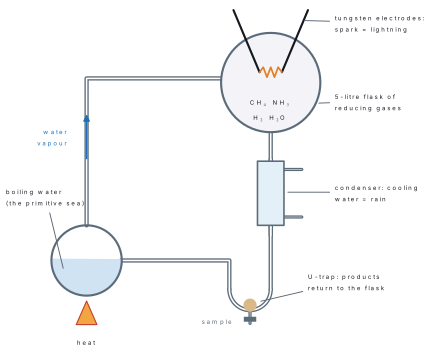
| Item | Detail |
|---|---|
| Gases in the spark flask | CH₄, NH₃, H₂ — Miller's paper gives 20 cm, 20 cm and 10 cm of mercury, i.e. CH₄ : NH₃ : H₂ = 2 : 2 : 1 — + water vapour; no O₂ (some coaching books print 2 : 1 : 2; follow the original) |
| Energy source | electric spark between tungsten electrodes (= lightning); the water was boiled to circulate steam (many textbooks quote "about 800 °C" for the hot zone) |
| Cooling | condenser (= rain) |
| Duration | one week, run continuously |
| Analysis | paper chromatography of the solution that collected in the trap and boiling flask |
| Products | amino acids — glycine and alanine most abundant, also aspartic acid; urea, HCN, aldehydes, simple acids. Later work gave sugars and nitrogen bases |
| Conclusion | organic monomers can form abiotically from the reducing gases → supports Oparin–Haldane |
He made monomers (amino acids), not polypeptides, nucleic acids or cells. No sulphur gas was used, so cysteine and methionine are not among the original products. Options such as "living cells", "enzymes" or "DNA appeared in the trap" are wrong.
1.2 Evidences of evolution: morphological, anatomical, palaeontological, embryological and biochemical
Morphological and anatomical evidence
| Feature | Homologous organs | Analogous organs |
|---|---|---|
| Origin and basic plan | same | different |
| Function | different | same |
| Shows | common ancestry — divergent evolution (adaptive radiation) | adaptation to the same need — convergent evolution |
| Animal examples | forelimbs of man, whale (flipper), bat (wing), horse, cheetah; hearts and brains of vertebrates; mouthparts of cockroach, honeybee, mosquito and butterfly | wings of insect and of bird or bat; eye of octopus and of mammal; flippers of penguin and dolphin; gills of fish and of prawn |
| Plant examples | thorn of Bougainvillea and tendril of Cucurbita (both stem) | sweet potato (root) and potato (stem tuber) |
Vestigial organs are reduced, functionless remnants of organs that were useful in an ancestor. In man: vermiform appendix (a large caecum in herbivores), coccyx (fused tail vertebrae), nictitating membrane (plica semilunaris), auricular (ear) muscles, wisdom teeth (third molars), body hair and the skin muscle (panniculus). Others: the pelvic girdle and hind-limb remnants of python and whale, the wings of the kiwi and ostrich, the splint bones of the horse.
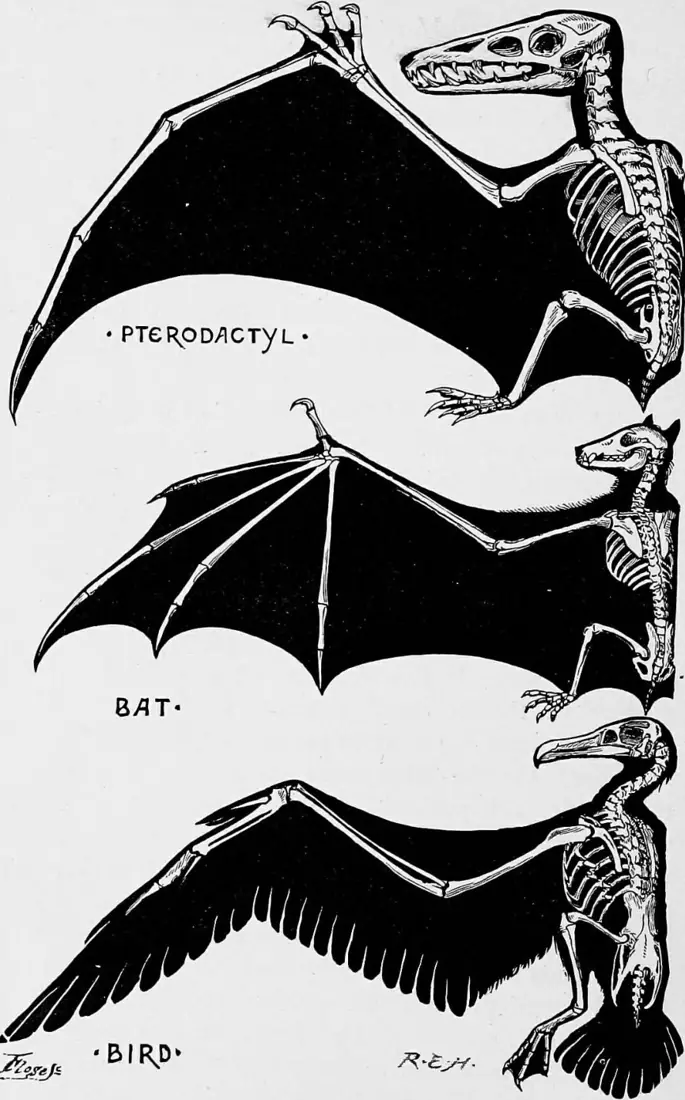
Atavism is the sudden reappearance of an ancestral character: a short tail in a newborn, dense body hair, extra nipples, long canines.
Connecting links are living or fossil organisms with characters of two groups — evidence that one group arose from the other.
| Connecting link | Between | Characters of the first group | Characters of the second group |
|---|---|---|---|
| Euglena | plants and animals | chloroplasts, photosynthesis | no cell wall (pellicle), flagellum; heterotrophic in the dark |
| Proterospongia | Protozoa and Porifera | colonial flagellates | collar cells like choanocytes |
| Peripatus | Annelida and Arthropoda | segmentation, nephridia, unjointed legs, thin cuticle | tracheae, claws, open circulation (haemocoel) |
| Neopilina | Annelida and Mollusca | serially repeated gills and nephridia | shell, foot, radula |
| Balanoglossus | non-chordates and chordates | tornaria larva like an echinoderm larva | pharyngeal gill slits, dorsal nerve cord |
| Lungfishes (Protopterus, Lepidosiren, Neoceratodus) | fishes and amphibians | fins, gills, scales | lungs, three-chambered heart |
| Seymouria (fossil) | amphibians and reptiles | amphibian skull | reptilian skeleton |
| Archaeopteryx (fossil) | reptiles and birds | teeth, long bony tail, clawed fingers, weak sternum | feathers, wings, beak, wishbone (furcula) |
| Duck-billed platypus (Ornithorhynchus), spiny anteater (Tachyglossus) | reptiles and mammals | lay eggs, cloaca | hair, mammary glands |
A living fossil is a living species almost unchanged from long-extinct relatives: Limulus (king crab), Latimeria (coelacanth), Sphenodon (tuatara), Peripatus, Ginkgo. Peripatus is both; Limulus is only a living fossil — it is the favourite distractor for "connecting link between Annelida and Arthropoda".
Palaeontological evidence (fossils)
A fossil is any preserved remain or trace of a past organism (petrified bone, mould, cast, amber insect, frozen mammoth, footprint, coprolite). Fossils show that life changed in order — simple forms in old rocks, complex forms in young rocks — and they supply the missing links. Rocks are dated by radioactive decay: ¹⁴C (half-life 5730 years, for remains under about 50,000 years), potassium–argon and uranium–lead for older rocks.
| Era | Period / epoch | Began (Mya) | Hallmark |
|---|---|---|---|
| Palaeozoic | Cambrian | 541 | "explosion" of invertebrates, trilobites |
| Ordovician | 485 | first vertebrates — jawless fish | |
| Silurian | 443 | first land plants, first jawed fish | |
| Devonian | 419 | Age of Fishes; first amphibians at the end | |
| Carboniferous | 359 | Age of Amphibians; coal forests; first reptiles | |
| Permian | 299 | reptiles spread; the largest mass extinction ends it | |
| Mesozoic (Age of Reptiles) | Triassic | 252 | first dinosaurs, first mammals |
| Jurassic | 201 | dinosaurs dominant; first birds (Archaeopteryx) | |
| Cretaceous | 145 | flowering plants spread; dinosaurs extinct at 66 Mya | |
| Cenozoic (Age of Mammals) | Palaeocene–Eocene | 66 | mammals radiate; Eohippus |
| Oligocene–Miocene | 34 | apes; Dryopithecus, Ramapithecus | |
| Pliocene | 5.3 | Australopithecus | |
| Pleistocene (Quaternary) | 2.6 | ice ages; Homo; Age of Man | |
| Holocene | 0.012 | modern man, agriculture |
Evolution of the horse — the best fossil series, worked out in North America — shows increasing size, longer face and legs, loss of toes and high-crowned grinding teeth as the forest browser became a grassland grazer.
| Genus | Epoch | Toes (fore / hind) | Notes |
|---|---|---|---|
| Eohippus (Hyracotherium) | Eocene | 4 / 3 | fox-sized (about 30 cm), browser, "dawn horse" |
| Mesohippus | Oligocene | 3 / 3 | larger, middle toe larger |
| Merychippus | Miocene | 3 / 3, only the middle toe on the ground | first grazer, high-crowned teeth |
| Pliohippus | Pliocene | 1 / 1 | first one-toed horse; side toes as splints |
| Equus | Pleistocene–Recent | 1 / 1 (hoof) | modern horse, about 1.5 m |
Archaeopteryx (Jurassic, about 150 Mya) was found in the Solnhofen limestone of Bavaria, Germany (1861). It had feathers and wings like a bird but teeth, a long tail of free vertebrae and three clawed fingers like a reptile.
Embryological evidence
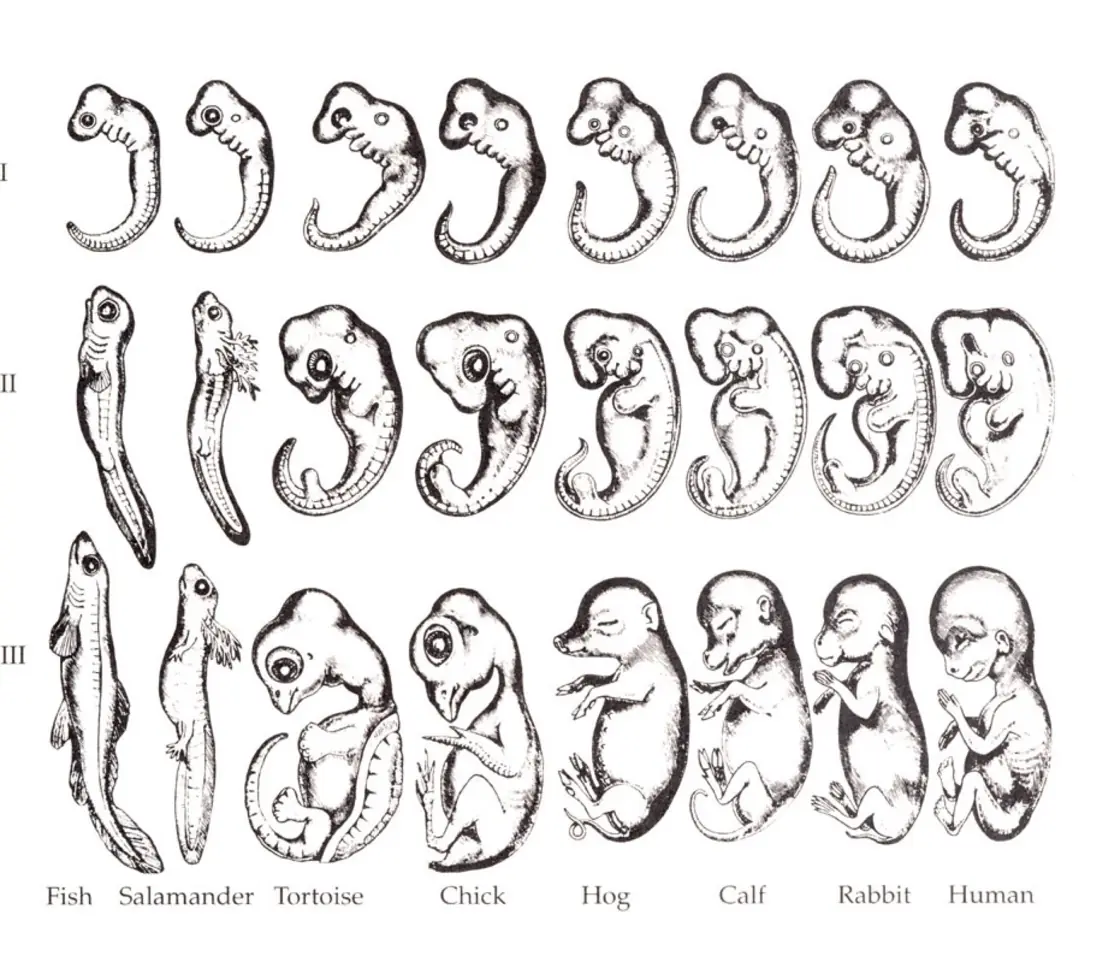
Early embryos of all vertebrates look alike: all have pharyngeal gill slits (pouches), a notochord, a post-anal tail and a two-chambered heart. The human embryo shows gill pouches and a fish-like two-chambered heart in its first weeks; the frog's tadpole is a "fish" with gills, a tail and a lateral line.
- Biogenetic law / recapitulation theory — Ernst Haeckel (1866): "ontogeny recapitulates phylogeny" — an individual's development repeats the evolutionary history of its race.
- Von Baer's law (1828) — embryos of higher animals resemble the embryos, not the adults, of lower animals. This is the form accepted today.
- Larvae show relationships: the trochophore larva links annelids with molluscs; the tornaria of Balanoglossus resembles the bipinnaria of starfish, linking echinoderms with chordates; the tadpole larva of an ascidian has a notochord, proving it a chordate.
It develops gill pouches, never functional gills, and it passes through stages like the embryo of a fish, not the adult fish. Haeckel's literal "adult stages" wording is the trap.
Biochemical evidence
- All organisms use DNA/RNA, the same genetic code, ATP, similar enzymes and the same 20 amino acids.
- Cytochrome c (a respiratory protein of 104 amino acids): human and chimpanzee are identical; human and rhesus monkey differ at 1 position; the number of differences rises with evolutionary distance.
- Serum precipitin test — G. H. F. Nuttall (1904): rabbit anti-human serum precipitates human serum most strongly, then chimpanzee and gorilla, then orang-utan, then monkeys — the same order as the anatomical tree.
- Hormones work across species (pig and cattle insulin treated diabetics for decades); DNA–DNA hybridisation puts human and chimpanzee DNA about 98–99 % alike.
1.3 Lamarckism, Darwinism and Neo-Darwinism
Lamarckism — inheritance of acquired characters
Jean-Baptiste de Lamarck (French, 1744–1829) set out the first full theory of evolution in Philosophie Zoologique (1809). He also popularised the word biology.
- Internal vital force — organisms tend to increase in size.
- Effect of environment and new needs — a changed environment creates new needs and new habits.
- Use and disuse of organs — an organ used more grows stronger; one not used weakens and disappears.
- Inheritance of acquired characters — changes acquired in a lifetime pass to the offspring.
| Lamarck's example | His explanation |
|---|---|
| Long neck and forelimbs of the giraffe | ancestors stretched to browse high leaves; each generation inherited the stretch |
| Limbless snakes | ancestors stopped using legs while creeping through narrow places |
| Webbed feet of ducks | skin between the toes stretched by swimming |
| Flightless birds, blind cave animals | wings and eyes lost by disuse |
Refutation. August Weismann cut off the tails of mice for 22 generations; every newborn had a normal tail. His germplasm theory (1892): only changes in the germ cells (germplasm) are inherited; changes in body cells (somatoplasm) are not. Pierced ears and noses, bound feet and the strong arms of a blacksmith are never inherited.
Darwinism — natural selection
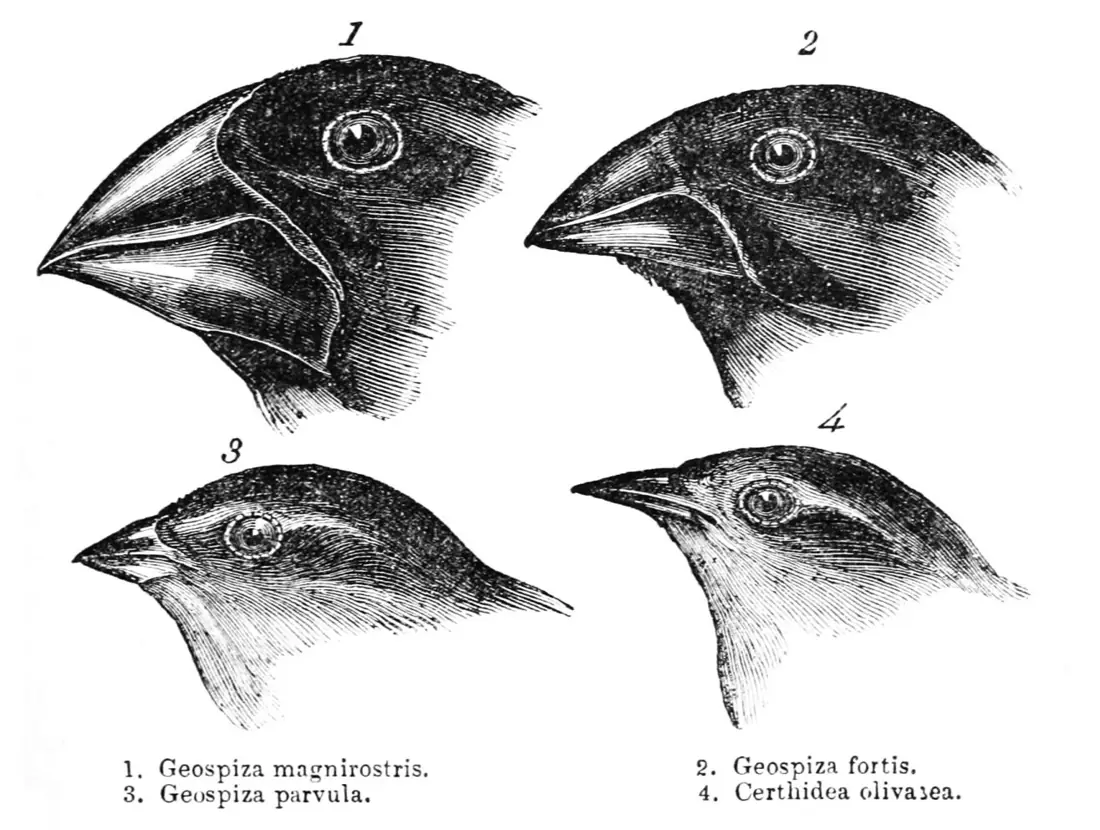
Charles Darwin (English, 1809–1882) sailed round the world on HMS Beagle (1831–1836); the finches and tortoises of the Galápagos Islands impressed him most. He drew on Lyell's Principles of Geology (slow change over long time) and Malthus's Essay on the Principle of Population (1798: populations grow geometrically, food arithmetically). Alfred Russel Wallace, working in the Malay Archipelago, reached the same idea; their joint papers were read at the Linnean Society in 1858*, and On the Origin of Species by Means of Natural Selection appeared on *24 November 1859.
| Postulate | Content |
|---|---|
| 1. Overproduction (prodigality) | every species produces far more young than can survive — even the slow-breeding elephant would leave about 19 million descendants from one pair in 750 years |
| 2. Limited food and space | so numbers stay roughly constant |
| 3. Struggle for existence | intraspecific (most intense — same needs), interspecific, and environmental |
| 4. Variation | no two individuals are alike; some variations are heritable |
| 5. Natural selection — "survival of the fittest" (phrase of Herbert Spencer) | individuals with favourable variations survive and reproduce more |
| 6. Inheritance of useful variations | they accumulate generation after generation |
| 7. Origin of new species | accumulated differences make a new species |
Weaknesses of Darwinism. It could not explain how variations arise or are inherited (Mendel's work of 1866 was unknown; Darwin's own pangenesis theory of "gemmules" was wrong); it did not separate heritable from non-heritable variation; it explains the survival of the fittest, not the arrival of the fittest; and it could not explain vestigial organs or over-specialised structures such as the giant antlers of the Irish elk.
Mutation theory. Hugo de Vries (Dutch botanist, 1901) found new, true-breeding forms appearing suddenly in the evening primrose Oenothera lamarckiana and proposed that species arise by large sudden jumps (saltation). He coined the term mutation.
Neo-Darwinism — the modern synthetic theory
Neo-Darwinism joins natural selection to Mendelian and population genetics. Its builders: R. A. Fisher, J. B. S. Haldane and Sewall Wright (population genetics), T. Dobzhansky (Genetics and the Origin of Species, 1937), Julian Huxley (Evolution: the Modern Synthesis, 1942), Ernst Mayr, G. G. Simpson and G. L. Stebbins.
| Factor | Role |
|---|---|
| Gene mutation | the ultimate source of new alleles |
| Chromosomal mutation | deletions, duplications, inversions, translocations; polyploidy |
| Genetic recombination | crossing over, independent assortment and fertilisation reshuffle alleles — the main source of variation in each generation |
| Natural selection | differential reproduction: genotypes leaving more fertile offspring increase |
| Reproductive isolation | stops gene flow between diverging populations, so they become new species |
| Accessory: gene flow, genetic drift (Sewall Wright effect; founder effect, bottleneck), hybridisation | change allele frequencies, most strongly in small populations |
In neo-Darwinism the population — not the individual — evolves, and evolution is a change in allele frequencies.
Hardy–Weinberg principle (1908). In a large, randomly mating population with no mutation, migration, selection or drift, allele and genotype frequencies stay constant. For alleles A (frequency p) and a (frequency q):
where p^2 = AA, 2pq = Aa (carriers) and q^2 = aa. Any departure shows that evolution is happening.
Problem. In a population 16 % of people show a recessive trait. What fraction are heterozygous carriers?
Solution. q^2 = 0.16, so q = 0.4 and p = 0.6. Carriers = 2pq = 2 \times 0.6 \times 0.4 = 0.48, i.e. 48 %. Shortcut: always take the square root of the recessive phenotype frequency first.
Types of natural selection
| Type | Favours | Example |
|---|---|---|
| Stabilising | the average; removes both extremes | human birth weight (about 3–3.5 kg survives best) |
| Directional | one extreme; the mean shifts | industrial melanism, DDT-resistant mosquitoes, antibiotic-resistant bacteria |
| Disruptive | both extremes; the mean is removed | two beak sizes in some finch populations; can split a population in two |
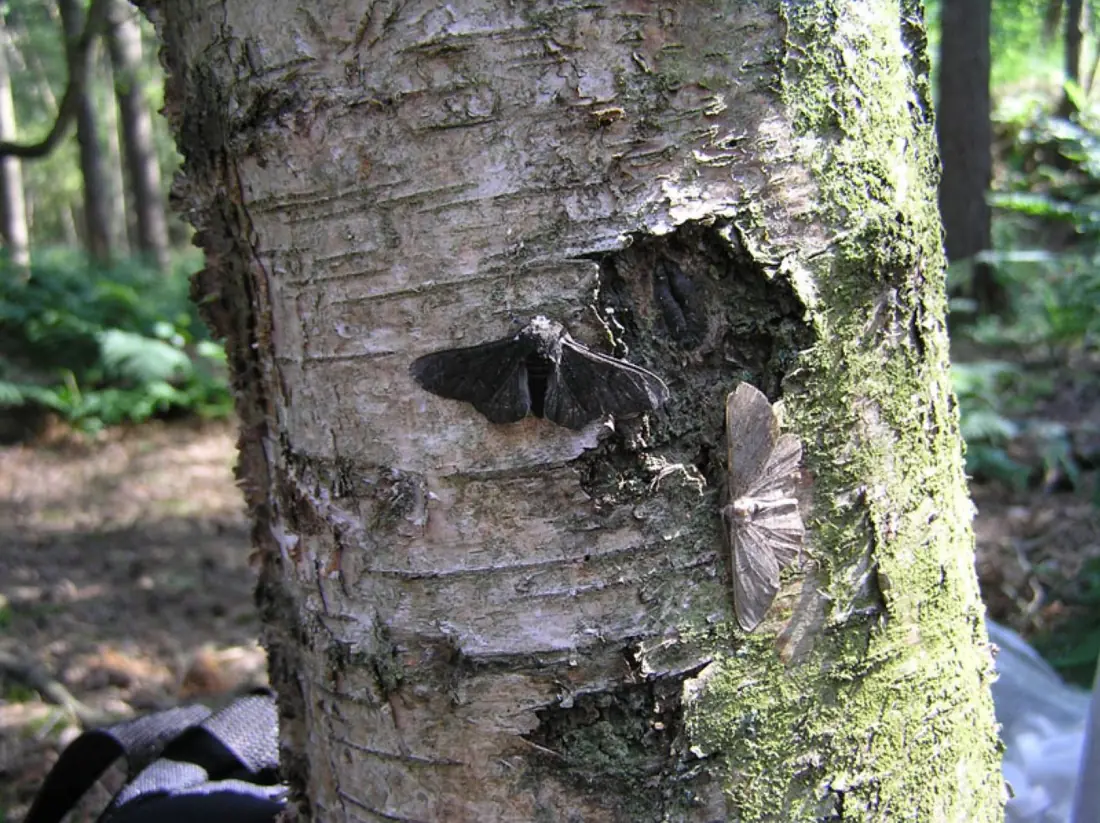
Industrial melanism — the peppered moth Biston betularia in England. Before the Industrial Revolution the light form, camouflaged on lichen-covered bark, was common; after soot blackened the trees, birds ate the conspicuous light moths and the dark (melanic) form rose to about 98 % near Manchester. H. B. D. Kettlewell confirmed this by release–recapture in the 1950s, and after the Clean Air Acts the light form returned. Selection did not create the dark allele; it already existed and was selected.
Isolation and speciation. Pre-zygotic barriers (geographical, habitat, seasonal, behavioural, mechanical, gametic) stop mating; post-zygotic barriers act after it — hybrid inviability, hybrid sterility (the mule, horse × donkey) and hybrid breakdown. Allopatric speciation follows geographical separation; sympatric speciation (common in plants by polyploidy) happens in one place. Adaptive radiation — one ancestor giving many forms for many niches — is shown by Darwin's finches and the Australian marsupials.
| Lamarckism | Darwinism | Neo-Darwinism | |
|---|---|---|---|
| Source of variation | needs and use/disuse | not explained | mutation and recombination |
| Inheritance | acquired characters inherited | not explained (pangenesis) | Mendelian genes; acquired characters not inherited |
| Mechanism | individuals change in response to need | natural selection of individuals | selection of genotypes; drift, gene flow, isolation |
| Unit that evolves | individual | individual | population (gene pool) |
| Giraffe's neck | stretching, inherited | long-necked variants survived droughts better | alleles for long necks increased in frequency |
1.4 Human evolution from Ramapithecus to modern man
Classification of man: Animalia → Chordata → Vertebrata → Mammalia → order Primates → family Hominidae → Homo → Homo sapiens. Man and the modern apes share a common ancestor; man did not descend from the chimpanzee.
Trends in human evolution: habitual bipedal walking with an S-shaped spine, broad pelvis and arched foot; forward shift of the foramen magnum; rising cranial capacity; reduction of brow ridges, jaws and canines; appearance of the chin and a vertical forehead; a fully opposable thumb and precision grip; loss of body hair; speech, tools, fire, culture.
| Stage | Time | Fossil site and discoverer | Cranial capacity | Diagnostic points |
|---|---|---|---|---|
| Dryopithecus ("oak ape") | Miocene, about 25–10 Mya | Africa, Europe, Asia | small, ape-sized | common ancestor of apes and man; knuckle-walker |
| Ramapithecus ("Rama's ape") | Miocene, about 14–9 Mya | Siwalik Hills, India — G. E. Lewis (1932); in Nepal at Tinau Khola near Butwal (Palpa), 1980, a jaw fragment and teeth dated to about 9–11 Mya | not known (jaws and teeth only) | small canines, thick-enamelled molars; long called the first hominid; now referred to Sivapithecus, on the orang-utan line |
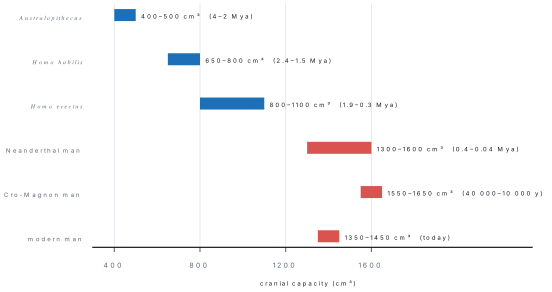
| Australopithecus ("southern ape", ape-man) | Pliocene, about 4–2 Mya | Taung child, South Africa — Raymond Dart (1924); "Lucy" (A. afarensis), Hadar, Ethiopia — D. Johanson (1974) | 400–500 cm³ | first clearly bipedal hominid; ape-sized brain; used stones but made no tools; ate fruit |
| Homo habilis ("handy man") | 2.4–1.5 Mya | Olduvai Gorge, Tanzania — Louis and Mary Leakey (1960) | 650–800 cm³ | first maker of stone tools (Oldowan pebble choppers); first species of Homo |
| Homo erectus ("upright man") | 1.9 Mya – about 0.3 Mya | Java man (Pithecanthropus erectus) — Eugène Dubois (1891); Peking man (Sinanthropus pekinensis), Zhoukoudian, China (1920s) | 800–1100 cm³ (Java ≈ 900) | first to use fire; hand axes; hunted, ate meat; first to leave Africa; heavy brow ridge, no chin |
| Homo neanderthalensis (Neanderthal man) | 0.4 Mya – 40 000 years ago | Neander valley, near Düsseldorf, Germany (1856); Europe, Near East, Central Asia | 1300–1600 cm³ (≈ 1450) | first to bury the dead; wore hides; Mousterian flake tools; heavy brow ridge, weak chin; extinct side branch |
| Cro-Magnon man (Homo sapiens fossilis) | 40 000–10 000 years ago | Cro-Magnon rock shelter, France (1868) | ≈ 1600–1650 cm³ | tall, vertical forehead, prominent chin; cave paintings (Altamira, Lascaux); bone and blade tools; the most recent ancestor |
| Homo sapiens sapiens (modern man) | from about 0.3 Mya in Africa | worldwide | 1350–1450 cm³ | high rounded skull, chin, small teeth; language, agriculture from about 10 000 years ago |
"Really Angry Hens Eat Nuts Calmly, Sapiently" — Ramapithecus → Australopithecus → H. habilis → H. erectus → Neanderthal → Cro-Magnon → H. sapiens sapiens. Pair each with its "first": bipedal — tools — fire — burial — paintings — agriculture.
(1) Fire belongs to H. erectus, tools to H. habilis — not the reverse. (2) The Neanderthal brain (≈ 1450 cm³) was not smaller than ours; size alone is not intelligence. (3) Ramapithecus is no longer regarded as our ancestor, but the paper still calls it the "first hominid" of the textbook line — answer in that language when the stem uses it.
Problem. Arrange Australopithecus africanus, Homo habilis, Homo erectus, and Homo neanderthalensis in ascending order of average cranial capacity and identify which stage first used fire.
Solution. Cranial capacities rise steadily: Australopithecus (\approx 450\text{–}500\text{ cm}^3) < Homo habilis (\approx 650\text{–}800\text{ cm}^3, first tool-maker) < Homo erectus (\approx 900\text{ cm}^3, first regular user of fire) < Homo neanderthalensis (\approx 1{,}400\text{–}1{,}450\text{ cm}^3).
Problem. Classify (a) the forelimb of a bat and the flipper of a whale, and (b) the wing of a bat and the wing of a butterfly, stating the type of evolution each pair demonstrates.
Solution. (a) Bat forelimb and whale flipper share the pentadactyl bone plan (humerus, radius, ulna, carpals, metacarpals, phalanges) adapted to flight vs swimming: homologous organs showing divergent evolution. (b) Bat wing (skin fold over tetrapod bones) and butterfly wing (chitinous cuticular outgrowth) share function without common structural origin: analogous organs showing convergent evolution.
Formula and fact sheet
Origin of life
| Fact | Value |
|---|---|
| Age of the Earth | ≈ 4.6 billion years |
| Oldest fossils | stromatolites (cyanobacteria), ≈ 3.5 billion years |
| Oparin / Haldane | 1924 (Russian) / 1929 (British); "hot dilute soup" = Haldane; coacervates = Oparin |
| Microspheres | Sidney Fox (proteinoids from heated amino acids) |
| Primitive atmosphere | CH₄, NH₃, H₂, H₂O (+ CO₂, N₂, HCN); reducing; no O₂, no ozone |
| First organisms | prokaryotic, anaerobic heterotrophs |
| Miller–Urey | 1953; CH₄ : NH₃ : H₂ = 2 : 2 : 1 (20, 20, 10 cm Hg) + steam; spark; 1 week; glycine, alanine, aspartic acid |
| Disproved spontaneous generation | Redi (1668), Spallanzani, Pasteur (swan-neck flask) |
Evidences
| Term | Key example |
|---|---|
| Homologous (divergent) | forelimbs of man, whale, bat, horse; Bougainvillea thorn and Cucurbita tendril |
| Analogous (convergent) | wings of insect and bird; eyes of octopus and man; sweet potato and potato |
| Vestigial in man | appendix, coccyx, nictitating membrane, ear muscles, wisdom teeth, body hair |
| Atavism | tail, dense hair, extra nipples, long canines in a baby |
| Connecting links | Peripatus (Annelida–Arthropoda), Neopilina (Annelida–Mollusca), Balanoglossus (non-chordate–chordate), lungfish (fish–amphibian), Archaeopteryx (reptile–bird), platypus and Tachyglossus (reptile–mammal), Euglena (plant–animal) |
| Living fossils | Limulus, Latimeria, Sphenodon, Peripatus, Ginkgo |
| Horse series | Eohippus (Eocene, 4/3 toes) → Mesohippus (3) → Merychippus (3, grazer) → Pliohippus (1, first one-toed) → Equus; North America |
| ¹⁴C half-life | 5730 years |
| Biogenetic law | Haeckel (1866), "ontogeny recapitulates phylogeny" |
| Precipitin test | Nuttall (1904) |
Theories
| Name | Fact |
|---|---|
| Lamarck | Philosophie Zoologique (1809); use and disuse; inheritance of acquired characters; giraffe |
| Weismann | tails of mice cut for 22 generations; germplasm theory (1892) |
| Darwin | HMS Beagle 1831–36; Galápagos finches; Origin of Species 24 Nov 1859; pangenesis |
| Wallace | Malay Archipelago; joint paper 1858 |
| Malthus / Lyell | population essay (1798) / Principles of Geology |
| Herbert Spencer | "survival of the fittest" |
| Hugo de Vries | mutation theory (1901), Oenothera lamarckiana, saltation |
| Modern synthesis | Fisher, Haldane, Wright, Dobzhansky (1937), Huxley (1942), Mayr, Simpson, Stebbins |
| Hardy–Weinberg | p + q = 1; p^2 + 2pq + q^2 = 1; large population, random mating, no mutation, migration, selection or drift |
| Industrial melanism | Biston betularia; directional selection; Kettlewell |
| Mule | hybrid sterility (post-zygotic isolation) |
Human evolution
| Hominid | Remember |
|---|---|
| Ramapithecus | Siwaliks (Lewis, 1932); Nepal: Tinau Khola, Butwal (1980) |
| Australopithecus | Dart (1924, Taung); "Lucy" (1974); bipedal; 400–500 cm³ |
| H. habilis | Leakeys, Olduvai (1960); first tools; 650–800 cm³ |
| H. erectus | Java man (Dubois, 1891), Peking man; first fire; 800–1100 cm³ |
| Neanderthal | Germany (1856); burial; 1300–1600 cm³ |
| Cro-Magnon | France (1868); cave art; ≈ 1650 cm³ |
| Modern man | 1350–1450 cm³; agriculture ≈ 10 000 years ago |
Chapter summary
- Life arose by chemical evolution (Oparin 1924, Haldane 1929) in a reducing atmosphere of CH₄, NH₃, H₂ and water vapour with no free O₂, energised by UV and lightning: monomers → polymers → coacervates/microspheres → protocell → anaerobic heterotroph.
- Miller–Urey (1953) sparked CH₄, NH₃, H₂ (2 : 2 : 1) and steam for a week and obtained amino acids (glycine, alanine) — monomers, not life.
- Homologous organs (same origin, different use) show divergent evolution; analogous organs (different origin, same use) show convergent evolution; vestigial organs and atavism point to ancestors.
- Connecting links — Peripatus, Neopilina, Balanoglossus, lungfish, Archaeopteryx, platypus — and the horse series (Eohippus → Equus, toes 4 → 1) are the classic fossil and living evidence.
- Haeckel's biogenetic law (embryos), Nuttall's precipitin test, cytochrome c and the universal genetic code (biochemistry) complete the evidence.
- Lamarck (1809): use and disuse + inheritance of acquired characters — refuted by Weismann (22 generations of tailed mice; germplasm theory).
- Darwin (1859): overproduction, struggle, variation, natural selection ("survival of the fittest", Spencer); weakness — no theory of variation or heredity. De Vries: mutation, Oenothera.
- Neo-Darwinism: mutation + recombination + selection + isolation (+ drift, gene flow); the population evolves; Hardy–Weinberg p^2 + 2pq + q^2 = 1; Biston betularia is directional selection.
- Hominids: Ramapithecus (Tinau Khola, Butwal) → Australopithecus (bipedal, 400–500 cm³) → H. habilis (tools) → H. erectus (fire) → Neanderthal (burial) → Cro-Magnon (cave art) → H. sapiens sapiens (1350–1450 cm³).
Practice questions
Set A — Recall (25 questions)
- The phrase "hot dilute soup" for the primitive sea in which life began was used byaA. I. OparinbJ. B. S. HaldanecStanley MillerdSidney Fox
- Which gas was absent from the primitive atmosphere according to the Oparin–Haldane theory?amethanebammoniachydrogendfree oxygen
- Colloidal droplets of proteins and polysaccharides that Oparin regarded as forerunners of cells are calledacoacervatesbmicrospherescliposomesdribozymes
- In the Miller–Urey apparatus the electric spark between the electrodes stood foraultraviolet lightbvolcanic heatcraindlightning
- The two amino acids found in greatest amount in Miller's original experiment wereacysteine and methioninebtryptophan and tyrosinecglycine and alaninedlysine and histidine
- The swan-necked flask experiment that finally disproved spontaneous generation was performed byaFrancesco RedibLazzaro SpallanzanicJ. B. S. HaldanedLouis Pasteur
- The first living organisms on Earth were most probablyaaerobic autotrophsbanaerobic heterotrophscaerobic heterotrophsdphotosynthetic eukaryotes
- Which pair consists of analogous organs?aflipper of whale and wing of batbwing of butterfly and wing of sparrowcthorn of Bougainvillea and tendril of Cucurbitadforelimb of horse and arm of man
- Which of the following is a vestigial organ in man?aepiglottisbpatellacvermiform appendixduvula
- The connecting link between Annelida and Arthropoda isaNeopilinabLimuluscBalanoglossusdPeripatus
- Archaeopteryx is regarded as a connecting link betweenareptiles and birdsbamphibians and reptilescreptiles and mammalsdfishes and amphibians
- The first one-toed horse in the evolutionary series of the horse wasaEohippusbMesohippuscPliohippusdMerychippus
- "Ontogeny recapitulates phylogeny" was stated byaKarl von BaerbAugust WeismanncHugo de VriesdErnst Haeckel
- The serum precipitin test used to show relationships between animals was introduced byaNuttallbKettlewellcDobzhanskydLyell
- Lamarck published his theory of evolution inaOrigin of SpeciesbPrinciples of GeologycPhilosophie ZoologiquedDas Keimplasma
- The phrase "survival of the fittest" was coined byaCharles DarwinbHerbert SpencercThomas MalthusdAlfred Russel Wallace
- Hugo de Vries based his mutation theory on observations ofaPisum sativumbDrosophila melanogastercOenothera lamarckianadBiston betularia
- Weismann cut off the tails of mice for 22 generations to disproveainheritance of acquired charactersbnatural selectioncmutation theorydthe biogenetic law
- In Nepal a fossil jaw of Ramapithecus was found ataKali Gandaki, MustangbKarnali, ChisapanicTinau Khola near ButwaldArun valley, Sankhuwasabha
- The first hominid to make stone tools wasaHomo habilisbAustralopithecuscHomo erectusdRamapithecus
- Fire was first used byaAustralopithecusbHomo habiliscCro-Magnon mandHomo erectus
- The first hominids known to bury their dead wereaJava menbNeanderthal mencPeking mendAustralopithecines
- The cave paintings of Altamira and Lascaux were made byaNeanderthal manbHomo erectuscCro-Magnon mandHomo habilis
- The cranial capacity of modern man is abouta1350–1450 cm³b650–800 cm³c900–1100 cm³d1800–2000 cm³
- "Lucy", a 3.2-million-year-old skeleton from Ethiopia, belongs toaHomo habilisbAustralopithecus afarensiscHomo erectusdRamapithecus
Answers and explanations — Set A
1. (b) — Haldane (1929) called the primitive ocean a "hot dilute soup" of organic molecules; Oparin's word was coacervate.
2. (d) — the primitive atmosphere was reducing: CH₄, NH₃, H₂ and water vapour. Free O₂ came later, from photosynthesis.
3. (a) — coacervates are Oparin's; microspheres (option b) are Sidney Fox's proteinoid spheres.
4. (d) — the spark supplied the energy of lightning; the boiling water stood for the sea and the condenser for rain. (The gases were CH₄ : NH₃ : H₂ = 2 : 2 : 1 by pressure.)
5. (c) — glycine and alanine were the most abundant. No sulphur gas was used, so cysteine and methionine (a) could not form.
6. (d) — Pasteur's swan-necked flask let air in but trapped dust and microbes in the bend; the broth stayed sterile.
7. (b) — with no O₂ and a "soup" of organic food, the first cells were anaerobic heterotrophs; autotrophs came later.
8. (b) — a butterfly wing is a fold of cuticle, a sparrow wing a feathered forelimb: same function, different origin. The others are homologous.
9. (c) — the vermiform appendix is the vestige of a large herbivore caecum. Epiglottis, patella and uvula all work.
10. (d) — Peripatus has nephridia and unjointed legs (annelid) with tracheae and a haemocoel (arthropod). Limulus is a living fossil, not this link.
11. (a) — feathers and wings of a bird with teeth, a long bony tail and clawed fingers of a reptile.
12. (c) — Pliohippus (Pliocene) was the first one-toed horse; Merychippus still had three toes.
13. (d) — Haeckel's biogenetic law (1866). Von Baer said embryos resemble ancestral embryos, not adults.
14. (a) — G. H. F. Nuttall (1904) showed anti-human serum reacts most strongly with ape sera.
15. (c) — Philosophie Zoologique, 1809. Das Keimplasma is Weismann's.
16. (b) — Herbert Spencer coined it; Darwin adopted it in later editions of the Origin.
17. (c) — the evening primrose Oenothera lamarckiana; its sudden new forms suggested evolution by jumps.
18. (a) — the mice kept being born with normal tails: a mutilation acquired in life is not inherited.
19. (c) — Tinau Khola near Butwal (Palpa) — jaw and teeth found in 1980 and dated to roughly 9–11 million years.
20. (a) — H. habilis, "handy man", made the Oldowan pebble tools. Australopithecus used stones but did not shape them.
21. (d) — H. erectus (Peking man's hearths) first used fire.
22. (b) — Neanderthals buried their dead with flowers and tools — the first evidence of ritual.
23. (c) — Cro-Magnon man, Homo sapiens fossilis, painted the caves.
24. (a) — 1350–1450 cm³; 650–800 is H. habilis, 900–1100 is H. erectus.
25. (b) — Lucy (Hadar, Ethiopia, 1974) was a bipedal Australopithecus afarensis with an ape-sized brain.
Set B — Understanding (15 questions)
- Chemical evolution of life cannot occur on Earth today mainly becauseathe Earth's temperature is too lowbfree O₂ and microbes destroy organic molecules as fast as they formclightning no longer occursdthe oceans are too salty
- The Miller–Urey experiment demonstrated thataliving cells can arise from inorganic matterbproteins form spontaneously in watercamino acids can form from simple gases under primitive-Earth conditionsdoxygen is essential for the synthesis of amino acids
- The thorn of Bougainvillea and the tendril of Cucurbita are homologous because both areamodified leavesbmodified stemscused for climbingdmodified roots
- The eye of an octopus and the eye of a mammal are an example ofaconvergent evolutionbdivergent evolutionchomologydatavism
- Pharyngeal gill pouches in the human embryo are best interpreted as evidence thatathe human embryo passes through an adult fish stagebthe human embryo breathes through gillscman evolved from modern fishesdman and fishes share a common ancestor
- Which explanation of the long neck of the giraffe is Darwinian?alonger-necked variants already existed and left more offspringbgiraffes stretched their necks and passed the stretch onca single mutation suddenly produced a long neckdan internal vital force lengthened the neck
- The chief weakness of Darwin's theory was that itaignored the struggle for existencebcould not explain the origin and inheritance of variationscrejected natural selectiondassumed the Earth was young
- Neo-Darwinism differs from Darwinism chiefly inarejecting natural selectionbaccepting the inheritance of acquired characterscexplaining variation by mutation and recombination in populationsdproposing that species are fixed
- During industrialisation in England the dark form of Biston betularia increased becauseasoot darkened the moths' wings directlybthe dark moths were less visible to birds on blackened barkclight moths mutated into dark onesddark moths needed less food
- Which of the following does NOT disturb Hardy–Weinberg equilibrium?agene flowbgenetic driftcrandom matingdnatural selection
- The mule is sterile. This is an example ofapost-zygotic isolationbgeographical isolationcbehavioural isolationdmechanical isolation
- Ramapithecus is no longer placed on the direct human line becauseaits fossils proved to be fakesbit lived after Homo erectuscit was merged with Sivapithecus of the orang-utan linedit had a larger brain than man
- Which trend is NOT part of human evolution?aincrease in cranial capacitybreduction of brow ridgescdevelopment of a chindenlargement of the canine teeth
- Arrange in the order of evolution: 1 Homo erectus, 2 Australopithecus, 3 Homo sapiens, 4 Homo habilis.a2, 4, 1, 3b4, 2, 1, 3c2, 1, 4, 3d1, 4, 2, 3
- The trochophore larva shared by annelids and molluscs is an evidence of evolution fromapalaeontologybembryologycbiochemistrydbiogeography
Answers and explanations — Set B
1. (b) — O₂ oxidises organic molecules and microbes eat them; lightning (c) still occurs, so that is not the reason.
2. (c) — Miller made monomers (amino acids) from CH₄, NH₃, H₂ and steam under primitive-Earth conditions. No cells or proteins appeared, and O₂ was deliberately absent.
3. (b) — both are modified axillary branches of the stem, though one defends and the other climbs.
4. (a) — they arose independently in molluscs and vertebrates (the octopus retina has no blind spot): analogous organs, convergent evolution.
5. (d) — embryos resemble ancestral embryos; the pouches never become working gills (option a is Haeckel's overstatement).
6. (a) — Darwin: the variation exists first and selection keeps it. (b) is Lamarck, (c) de Vries.
7. (b) — Darwin knew nothing of genes; his pangenesis guess was wrong.
8. (c) — the modern synthesis adds genetics: mutation and recombination supply the variation, and evolution is a change of allele frequencies in a population.
9. (b) — birds ate the conspicuous light moths; the dark allele already existed and was selected (directional selection). Soot does not change genes (a).
10. (c) — random mating is one of the conditions of equilibrium; gene flow, drift and selection all change allele frequencies.
11. (a) — the hybrid zygote forms and grows but is sterile: a post-zygotic barrier.
12. (c) — the Pakistani Sivapithecus face (1980s) matched the orang-utan; Ramapithecus was merged with it.
13. (d) — canines became smaller in the human line; the other three are true trends.
14. (a) — Australopithecus (ape-man) → H. habilis (tools) → H. erectus (fire) → H. sapiens.
15. (b) — similar larvae in different phyla are embryological evidence of common ancestry.
Set C — Application (10 questions)
- In a population in Hardy–Weinberg equilibrium, 9 % of individuals show a recessive phenotype. The percentage of heterozygous carriers isa21 %b49 %c42 %d30 %
- In a village of 1000 people in equilibrium, 160 show an autosomal recessive trait. How many are expected to be heterozygous?a480b360c240d640
- A fossil bone contains one-eighth of the ¹⁴C found in living bone. Taking the half-life of ¹⁴C as 5730 years, its age is abouta11 460 yearsb45 840 yearsc22 920 yearsd17 190 years
- A fossil skull with a cranial capacity of about 700 cm³ is found in East Africa beside crude pebble choppers. It most probably belongs toaHomo erectusbHomo habiliscAustralopithecusdNeanderthal man
- A newly discovered animal has a segmented body, nephridia and unjointed legs, but also breathes by tracheae and has a haemocoel. It would be regarded as a link betweenaAnnelida and MolluscabMollusca and ArthropodacAnnelida and ArthropodadArthropoda and Echinodermata
- A bacterium becomes resistant after an antibiotic is used widely. In neo-Darwinian terms the best explanation is thataresistant mutants already present survived and multipliedbbacteria became resistant because they needed tocthe antibiotic caused every bacterium to changedresistance acquired by use was inherited
- In a hospital record, babies of very low and very high birth weight had the highest death rates. This showsadirectional selectionbdisruptive selectioncgenetic driftdstabilising selection
- Comparing one protein, species P differs from man at 1 amino acid, Q at 12 and R at 44. The correct conclusion is thataP is most distantly related to manbR is most distantly related to mancQ is most closely related to mandall three are equally related to man
- Whales have small pelvic bones buried in the body wall. This is best explained byause and disuse in the lifetime of each whalebrecent independent origin of the pelviscdescent from four-legged land ancestorsdconvergent evolution with fishes
- Blind fish living in dark caves are explained by a student as "they stopped using their eyes, so their young were born blind". The student is applyingaDarwinismbmutation theorycthe biogenetic lawdLamarckism
Answers and explanations — Set C
1. (c) — q^2 = 0.09, q = 0.3, p = 0.7; 2pq = 2 \times 0.7 \times 0.3 = 0.42 = 42 %. Option (b) is p^2.
2. (a) — q^2 = 0.16, q = 0.4, p = 0.6; 2pq = 0.48; 0.48 × 1000 = 480. (b) 360 is p^2 × 1000.
3. (d) — 1/8 = (1/2)³, three half-lives: 3 × 5730 = 17 190 years. (a) is two half-lives.
4. (b) — 650–800 cm³ with Oldowan pebble tools is H. habilis; Australopithecus had 400–500 cm³ and made no tools.
5. (c) — exactly the mix seen in Peripatus, the Annelida–Arthropoda link.
6. (a) — mutations for resistance arise at random, before exposure (Lederberg's replica plating); the antibiotic only selects them. (b) and (d) are Lamarckian.
7. (d) — the intermediate weight is favoured and both extremes removed: stabilising selection.
8. (b) — the more amino-acid differences, the longer ago the lines separated; R (44) is most distant, P (1) closest.
9. (c) — vestigial pelvic bones are the remains of hind limbs of land-living ancestors; use and disuse in one lifetime (a) is not inherited.
10. (d) — "lost by disuse and inherited" is Lamarck's use-and-disuse with inheritance of acquired characters.