Chapter 4 · Study of Selected Animals · 6 questions in the paper · 41 min read
Plasmodium, Earthworm and Frog
What the syllabus asks for 3
- Plasmodium: habitat, structure, life cycle and types of malaria
- Earthworm (Pheretima): morphology, body systems, physiology and economic importance
- Frog (Rana): morphology, body systems and physiology
Study of Selected Animals carries 6 of the 40 Zoology questions — more than any other single chapter outside Human Biology. Three type animals are named: the malarial parasite Plasmodium (habitat, structure, life cycle and the types of malaria), the earthworm Pheretima posthuma (morphology, body systems, physiology and economic importance) and the frog Rana tigrina (morphology, body systems and physiology). Expect about two questions on each, almost all of them numbers and names: which segment, which stage, which host, which species, which chamber.
- Plasmodium: female Anopheles is the definitive host (sexual phase), man the intermediate host (asexual schizogony); sporozoite infects man, gametocytes infect the mosquito.
- The stages in order — liver schizogony → erythrocytic (Golgi) cycle → gametocytes → gametes in the mosquito stomach → zygote (the only diploid stage) → ookinete → oocyst on the stomach wall → sporozoites → salivary glands.
- The four classic species with their fever intervals: P. vivax benign tertian (48 h, relapses from hypnozoites), P. falciparum malignant tertian (cerebral malaria), P. malariae quartan (72 h), P. ovale ovale tertian.
- Earthworm segment numbers: clitellum 14–16, female pore 14, male pores 18, genital papillae 17 and 19, spermathecal pores 5/6–8/9, testes 10–11, ovaries 13, gizzard 8–9, stomach 9–14, caeca 26, hearts 7, 9, 12, 13.
- Earthworm physiology: haemoglobin dissolved in plasma, closed circulation, cutaneous respiration, three kinds of nephridia, protandrous hermaphrodite with cross-fertilisation in the cocoon.
- Frog: three ways of breathing, buccal force pump, three-chambered heart with sinus venosus (pacemaker) and spiral valve, nucleated RBCs, mesonephric kidneys, urinogenital duct in the male, 10 pairs of cranial nerves, external fertilisation and thyroxine-controlled metamorphosis.
4.1 Plasmodium: habitat, structure, life cycle and types of malaria
Systematic position and habitat
| Rank | Taxon |
|---|---|
| Kingdom | Protista |
| Phylum | Protozoa (Apicomplexa) |
| Class | Sporozoa — no locomotory organelles, all parasitic, spore-forming |
| Genus | Plasmodium |
Plasmodium is an intracellular, digenetic (two-host) parasite.
| Host | Status | Where the parasite lives | Phase |
|---|---|---|---|
| Man | intermediate (secondary) host | liver cells (hepatocytes) and red blood cells | asexual — schizogony; gametocytes formed |
| Female Anopheles mosquito | definitive (primary) host and vector | stomach (midgut) wall, haemocoel and salivary glands | sexual — gamogony, fertilisation, sporogony |
Only the female Anopheles transmits malaria: the male feeds on plant juices, while the female needs a blood meal to mature her eggs.
Structure of the stages
| Stage | Structure | Where |
|---|---|---|
| Sporozoite | slender, sickle- (spindle-) shaped, about 10–15 μm; one central nucleus; pellicle with microtubules; apical complex (polar ring, rhoptries, micronemes) for entering cells; glides, no cilia or flagella | salivary glands of mosquito → injected into man; the infective stage for man |
| Cryptozoite / schizont | large multinucleate body formed in a liver cell | liver |
| Merozoite | small, oval, uninucleate; invades a fresh RBC | liver and blood |
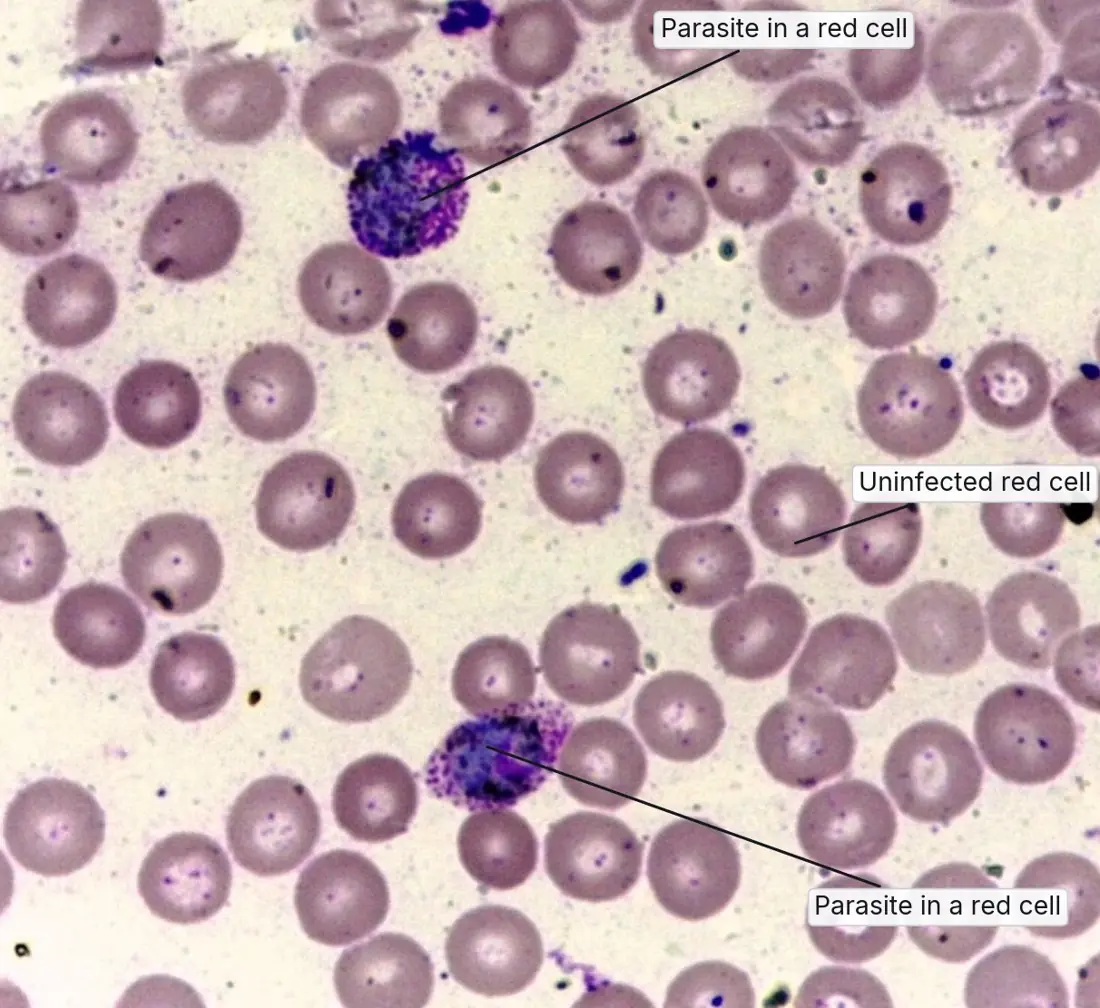
| Trophozoite | feeding stage in the RBC; first a signet-ring (ring stage, a large vacuole with the nucleus at one side), then amoeboid; digests haemoglobin, leaving the brown pigment haemozoin | RBC |
| Erythrocytic schizont | multinucleate stage that divides into merozoites | RBC |
| Gametocytes | microgametocyte (male, smaller) and macrogametocyte (female, larger); round in P. vivax, crescent-shaped in P. falciparum | RBC; the infective stage for the mosquito |
| Microgametes / macrogamete | 4–8 slender flagellated microgametes from one microgametocyte (exflagellation); one macrogamete from each macrogametocyte | mosquito stomach |
| Zygote → ookinete | diploid zygote becomes a motile, worm-like ookinete | mosquito stomach |
| Oocyst | rounded cyst on the outer surface of the stomach wall | mosquito stomach wall |
The life cycle
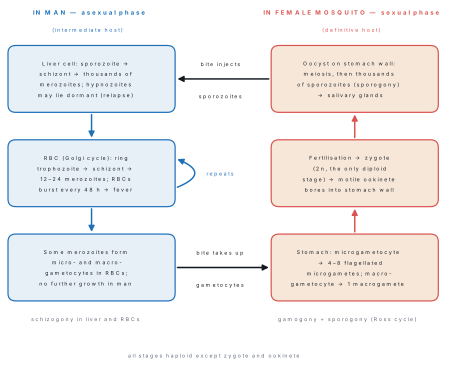
A. In man — asexual phase (schizogony)
- Infection. A female Anopheles injects sporozoites with her saliva. Within about half an hour they leave the blood and enter liver cells.
- Pre-erythrocytic schizogony (liver). Each sporozoite grows into a schizont that divides into thousands of merozoites (cryptomerozoites); the liver cell bursts and they enter the blood. In P. vivax and P. ovale some sporozoites become dormant hypnozoites, which wake weeks or months later and cause relapses. (Older books describe a secondary liver cycle, the exo-erythrocytic schizogony; relapses are now explained by the hypnozoites.)
- Erythrocytic schizogony — the Golgi cycle. A merozoite enters an RBC → ring trophozoite → amoeboid trophozoite, eating haemoglobin → schizont → 12–24 merozoites (P. vivax). The RBCs burst together, releasing merozoites, cell debris and haemozoin into the plasma; this causes the paroxysm of fever. The merozoites attack fresh RBCs and the cycle repeats every 48 h in P. vivax.
- Gametogony. After several cycles some merozoites develop into gametocytes inside RBCs. They do not divide further in man; they wait to be sucked up by a mosquito.
The time from the bite to the first parasites in the blood is the prepatent period; to the first fever, the incubation period — usually about two weeks (12–17 days) for P. vivax.
B. In the female Anopheles — sexual phase
- Gamogony (in the stomach, within minutes of the blood meal): the microgametocyte throws out 4–8 flagellated microgametes (exflagellation); the macrogametocyte matures into one macrogamete. All other blood stages are digested.
- Fertilisation (anisogamy) gives a zygote (synkaryon) — the only diploid stage — which becomes the motile, vermiform ookinete.
- The ookinete bores through the stomach wall and rounds up beneath its outer lining as an oocyst.
- Sporogony: the first division in the oocyst is meiosis, so all later stages are haploid; repeated divisions give thousands of sporozoites. The oocyst bursts, sporozoites drift through the haemocoel and collect in the salivary glands, ready for the next bite. Sporogony takes about 10–14 days and stops in cold weather — one reason malaria is a disease of the warm Terai and not of the high hills.
The definitive host is the one in which sexual reproduction (fertilisation) happens — the mosquito. Man, in whom only asexual multiplication occurs, is the intermediate host, however much he suffers. And the mosquito does not catch the infection from sporozoites: it needs gametocytes in the blood it sucks.
The malarial fever
The paroxysm has three stages: a cold stage (shivering, 15–60 min), a hot stage (fever up to 40–41 °C, 2–6 h) and a sweating stage (2–4 h), after which the patient feels well until the next batch of RBCs bursts. Repeated destruction of RBCs causes anaemia and an enlarged spleen (splenomegaly). The fever is caused by haemozoin and other toxins released when the RBCs rupture.
Types of malaria
| Species | Malaria | Erythrocytic cycle (fever) | Distinctive points |
|---|---|---|---|
| P. vivax | benign tertian | 48 h — fever every third day | commonest in Nepal and South Asia; infected RBCs enlarged with Schüffner's dots; hypnozoites → relapse |
| P. falciparum | malignant tertian (subtertian, pernicious) | 36–48 h, irregular | most dangerous; invades RBCs of all ages, so parasite counts soar; crescent-shaped gametocytes; sticky infected RBCs block brain capillaries → cerebral malaria; blackwater fever (haemoglobin in urine); no hypnozoites |
| P. malariae | quartan | 72 h — fever every fourth day | mild but long-lasting; band-shaped trophozoites |
| P. ovale | ovale (mild) tertian | 48 h | rare, mainly tropical Africa; oval infected RBCs; hypnozoites → relapse |
| P. knowlesi | quotidian | 24 h | monkey malaria of South-East Asia that can infect man |
Discovery. Charles Laveran (1880) saw the parasite in human blood; Camillo Golgi described the cycle in RBCs; Ronald Ross (1897) found the oocysts in the stomach wall of Anopheles and proved transmission by the mosquito (Nobel Prize 1902); Grassi (1898) completed the human cycle in Anopheles; Shortt and Garnham (1948) found the liver stage.
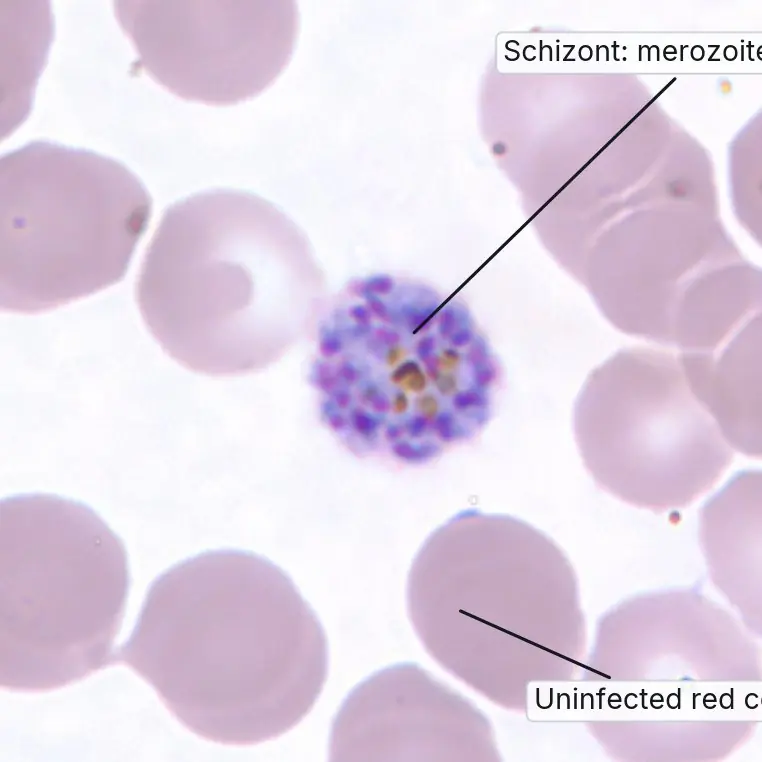
Diagnosis, treatment and control. Thick and thin blood smears stained by Giemsa or Leishman, or rapid antigen tests. Drugs: quinine (from Cinchona bark), chloroquine, primaquine (kills hypnozoites and gametocytes — the "radical cure" of vivax), and artemisinin-based combination therapy (ACT) for falciparum (artemisinin from Artemisia annua). Control: insecticide-treated bed nets, indoor residual spraying, draining stagnant water, the larvivorous fish Gambusia, and the new vaccines (RTS,S and R21). In Nepal most remaining cases are P. vivax in the Terai or imported, and the country is close to eliminating the disease.
Sickle-cell trait. Heterozygotes (HbA HbS) resist falciparum malaria: an infected RBC sickles and is removed by the spleen before the parasite completes its cycle — the classic example of balanced polymorphism.
| Feature | Anopheles (malaria) | Culex (filaria, Japanese encephalitis) |
|---|---|---|
| Resting posture | body at an angle (about 45°) to the surface | body parallel to the surface, "hunch-backed" |
| Palps of the female | as long as the proboscis | much shorter than the proboscis |
| Eggs | laid singly, each with lateral floats | laid in rafts |
| Larva | lies parallel to the water surface; no siphon | hangs at an angle; breathes by a siphon |
| Wings | spotted | unspotted |
Problem. A single infected RBC releases 16 merozoites at the end of each 48-hour cycle, and every merozoite infects a new RBC. Ignoring losses, how many RBCs are infected after three complete cycles?
Solution. The number multiplies by 16 each cycle: 16^3 = 4096 infected RBCs in 6 days. After six cycles (12 days) it would be 16^6 \approx 1.7 \times 10^7 — which is why symptoms appear about two weeks after a bite.
4.2 Earthworm (Pheretima): morphology, body systems, physiology and economic importance
Position, habit and habitat
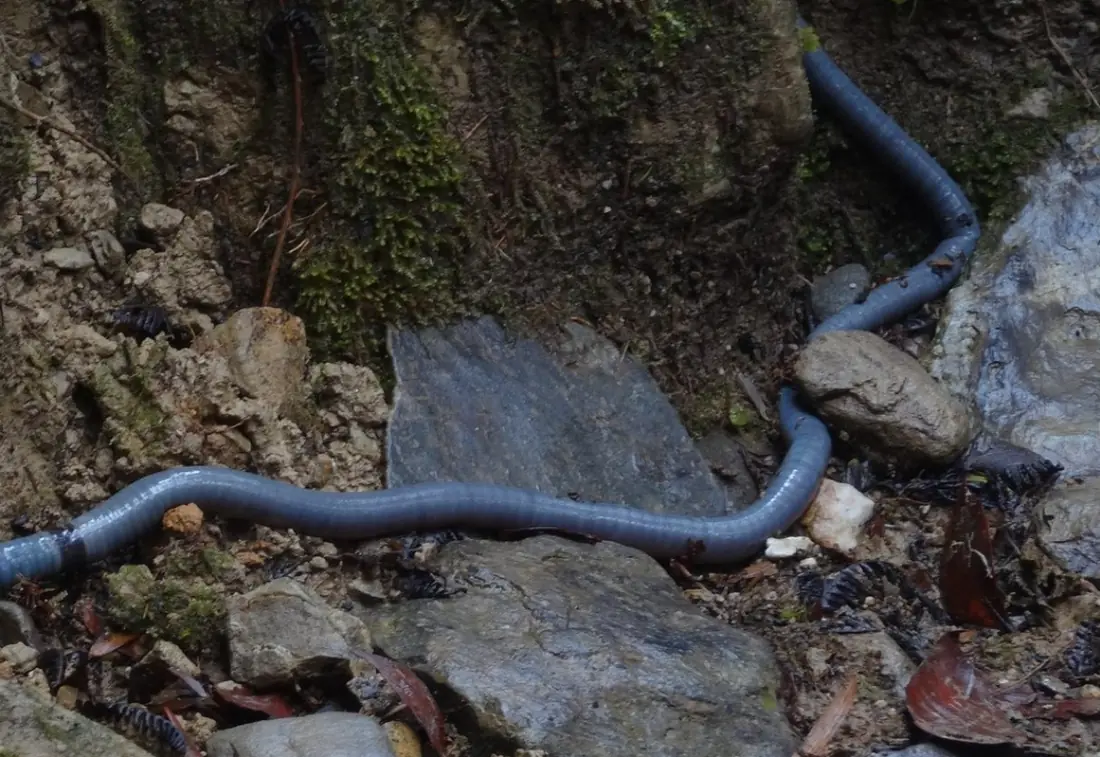
Pheretima posthuma (phylum Annelida, class Oligochaeta) is the common earthworm of Nepal's plains and valleys. It lives in burrows in moist soil rich in humus, is nocturnal, fossorial and feeds on decaying leaves and organic matter swallowed with soil. It comes out after heavy rain because water floods the burrows and it cannot breathe through a drowned skin.
Morphology
- Body long, cylindrical, about 150 mm long and 3–5 mm thick, divided into about 100–120 segments (metameres); dark brown dorsally from the pigment porphyrin; a dark mid-dorsal line marks the dorsal blood vessel.
- The prostomium — a fleshy lobe overhanging the mouth — is not a segment; it probes the soil. The first segment, bearing the mouth, is the peristomium.
- Segments 14, 15 and 16 form the glandular clitellum (girdle). The body is thus pre-clitellar (1–13), clitellar (14–16) and post-clitellar (17 onwards).
- Setae: S-shaped chitinous bristles in a ring round the middle of every segment (perichaetine), absent from the first segment, the last segment and the clitellum; they grip the soil in locomotion.
| Aperture | Number | Position |
|---|---|---|
| Mouth | 1 | peristomium (segment 1) |
| Anus | 1 | last segment |
| Spermathecal pores | 4 pairs | ventro-lateral, in the grooves 5/6, 6/7, 7/8, 8/9 |
| Female genital pore | 1 | mid-ventral, segment 14 |
| Male genital pores | 1 pair | ventro-lateral, segment 18 |
| Genital papillae | 2 pairs | segments 17 and 19 |
| Dorsal pores | 1 per groove | mid-dorsal, from groove 12/13 backwards; release coelomic fluid to keep the skin moist |
| Nephridiopores | very many | all over the body except the first two segments |
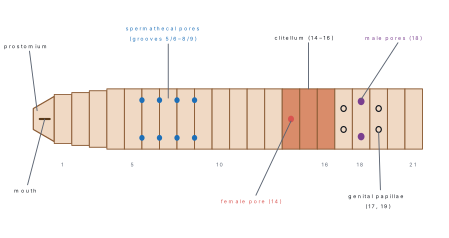
Body wall, coelom and locomotion
Body wall (outside in): cuticle → epidermis (columnar cells with gland cells) → circular muscles → longitudinal muscles → parietal peritoneum. The coelom is a true schizocoel, divided by intersegmental septa and filled with milky, alkaline coelomic fluid with coelomocytes. The fluid is the hydrostatic skeleton: circular muscles contract to make the front segments long and thin and push them forward; setae anchor them; longitudinal muscles then shorten the body and pull the rear up. Chloragogen cells on the gut and blood vessels store glycogen and fat and remove nitrogenous waste (compared with the vertebrate liver).
Digestive system
| Region | Segments | Notes |
|---|---|---|
| Mouth, buccal cavity | 1–3 | eversible |
| Pharynx | 4 | muscular, sucking; pharyngeal (salivary) glands secrete mucus and a protease |
| Oesophagus | 5–7 | narrow tube |
| Gizzard | 8–9 | thick, muscular, cuticle-lined; grinds soil and leaves |
| Stomach | 9–14 | glandular; calciferous glands secrete CaCO₃ that neutralises the humic acid of the humus |
| Intestine | 15 to the last | digestion and absorption; a pair of short conical intestinal caeca at segment 26; the typhlosole, a mid-dorsal fold, runs from segment 26 to all but the last 23–25 segments and increases the absorptive surface |
| Anus | last | worm castings leave here |
Digestion is extracellular; the gut makes protease, amylase and lipase, and cellulose is broken down largely with the help of gut microbes.
Blood vascular system
- Closed system; the blood is red because haemoglobin is dissolved in the plasma; the corpuscles are colourless, nucleated amoeboid cells.
- Dorsal vessel: above the gut, contractile, with valves; blood flows forwards — the chief collecting vessel.
- Ventral vessel: below the gut; blood flows backwards — the chief distributing vessel.
- Four pairs of hearts: lateral hearts in segments 7 and 9 and latero-oesophageal hearts in segments 12 and 13, with valves, pumping from the dorsal to the ventral vessel.
- Blood glands in segments 4, 5 and 6 make blood corpuscles and haemoglobin.
Respiration
There are no respiratory organs. Respiration is cutaneous: O₂ dissolves in the moist film of mucus and coelomic fluid on the skin and diffuses into a dense capillary network beneath the cuticle. A dry skin means death by suffocation.
Excretion
The excretory organs are coiled tubules, the nephridia — three kinds in Pheretima.
| Nephridia | Position | Opening | Nephrostome |
|---|---|---|---|
| Septal | both faces of each septum from segment 15 to the last | into the intestine (enteronephric) | present |
| Integumentary | inner surface of the body wall from segment 3 to the last; very many on the clitellum | outside by nephridiopores (exonephric) | absent |
| Pharyngeal | three paired tufts in segments 4, 5 and 6 | into the buccal cavity and pharynx (enteronephric) | absent |
The worm excretes ammonia in wet soil and more urea when dry (ammonotelic → ureotelic). Enteronephric nephridia send the urine into the gut, where water is reabsorbed — a water-saving adaptation.
Nervous system and sense organs
A pair of cerebral (supra-pharyngeal) ganglia — the "brain" — lies above the pharynx in segment 3; circum-pharyngeal connectives join them to the sub-pharyngeal ganglia in segment 4, forming a nerve ring; from these the ventral nerve cord — double but fused, solid, with a ganglion in every segment — runs to the hind end. There are no eyes: photoreceptor cells (mostly on the prostomium and dorsal surface) sense light, and epidermal receptors sense touch and chemicals; chemoreceptors in the buccal cavity taste food.
Reproduction and development
The earthworm is hermaphrodite (monoecious) but protandrous — the testes mature before the ovaries — so cross-fertilisation is the rule.
| Male organs | Segments | Female organs | Segments |
|---|---|---|---|
| 2 pairs of testes in testis sacs | 10 and 11 | 1 pair of ovaries (on septum 12/13) | 13 |
| 2 pairs of seminal vesicles | 11 and 12 | ovarian funnels and oviducts | 13–14 |
| vasa deferentia | 10 to 18 | single female genital pore | 14 |
| 1 pair of large prostate glands | about 16/17 to 20/21 | 4 pairs of spermathecae | 6, 7, 8, 9 |
| male genital pores | 18 | ||
| 2 pairs of accessory glands (open on the genital papillae) | 17 and 19 |
Copulation (on damp nights): two worms join ventral surfaces head-to-tail and exchange sperm, which are stored in each other's spermathecae. Later the clitellum secretes a cocoon; as the worm wriggles backwards out of it, the cocoon collects ova at segment 14 and sperm from the spermathecae at segments 6–9. Fertilisation therefore takes place in the cocoon, outside the body (external). The cocoon is left in the soil; after about three weeks it releases 2–20 young worms (on average about four). Development is direct — no larva. Earthworms also regenerate lost parts.
(1) Hermaphrodite does not mean self-fertilising — Pheretima is protandrous and cross-fertilising. (2) Sperm pass from worm to worm, but fertilisation is external, inside the cocoon. And remember the single female pore (14) lies in front of the paired male pores (18).
Economic importance
- Farmer's friend: burrows aerate and drain the soil and let roots penetrate; worms bring subsoil up and bury organic matter (Darwin, The Formation of Vegetable Mould through the Action of Worms, 1881).
- Castings are rich in nitrogen, phosphorus, potassium, calcium and humus.
- Vermicomposting (vermiculture) turns farm and kitchen waste into manure; Eisenia fetida (red wiggler) and Perionyx excavatus are the usual species.
- Worms are fish bait, a protein-rich feed for poultry and fish, and are used in traditional medicine.
- Harmful: casts spoil lawns and seedbeds; earthworms are intermediate hosts of the poultry gapeworm Syngamus and the lungworm of pigs; they host the gregarine Monocystis in their seminal vesicles.
"3-4 brain, 4 pharynx, 5-7 gullet, 8-9 gizzard, 9-14 stomach"; then the reproductive run "6-9 spermathecae, 10-11 testes, 13 ovaries, 14 female, 17 and 19 papillae, 18 male"; hearts 7, 9, 12, 13; caeca and typhlosole from 26.
4.3 Frog (Rana): morphology, body systems and physiology
Position, habit and habitat
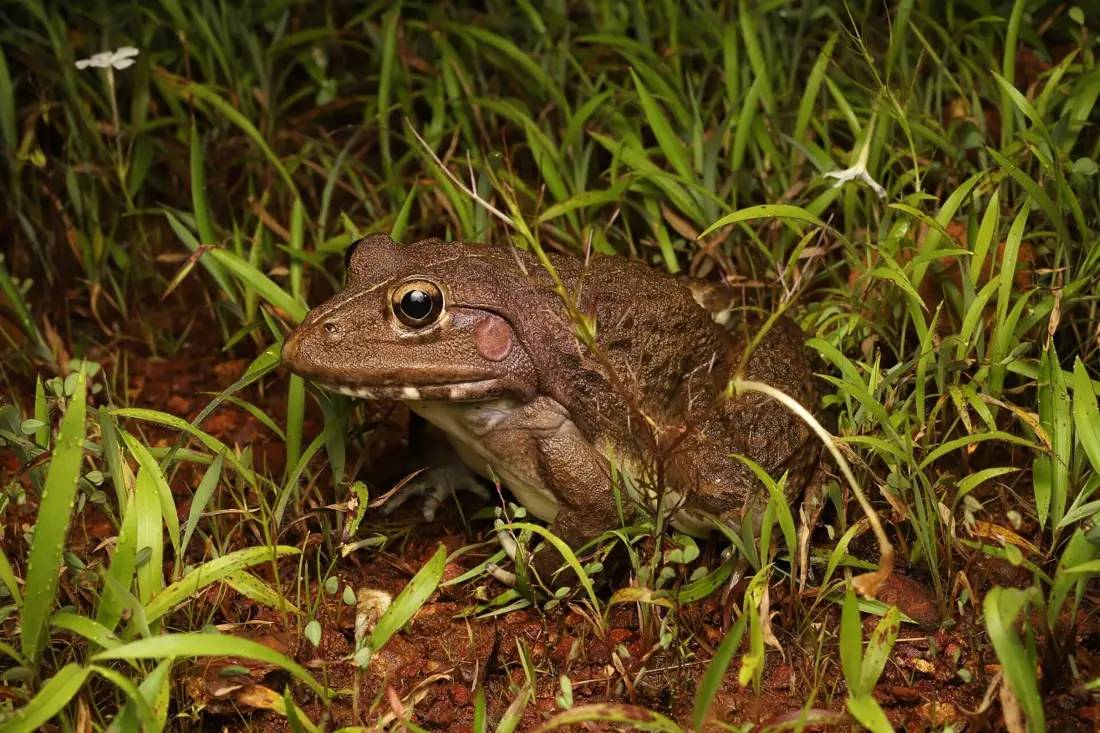
Rana tigrina (now Hoplobatrachus tigerinus, the Indian bullfrog; Chordata → Vertebrata → Amphibia → order Anura) lives in and near ponds, ditches and paddy fields of the Terai and valleys. It is amphibious, carnivorous (insects, worms, snails) and poikilothermic (cold-blooded): it escapes winter cold by hibernation (winter sleep) and summer heat and drought by aestivation (summer sleep), buried in mud and breathing through its skin. It changes skin colour with its surroundings by means of chromatophores (camouflage).
Morphology
- Body of head and trunk; no neck and no tail in the adult.
- Skin smooth, moist, slimy, scaleless, loosely attached, rich in mucous glands and capillaries. The frog never drinks water — it absorbs water through the skin.
- Head: wide mouth, a pair of external nares, bulging eyes with a fixed upper lid, a movable lower lid and a transparent nictitating membrane that protects the eye under water; behind each eye a circular tympanum (ear drum) — there is no external ear.
- Forelimbs short, with 4 digits; hindlimbs long and muscular, with 5 webbed toes for leaping and swimming.
- A single cloacal aperture at the hind end passes faeces, urine and gametes.
- Sexual dimorphism: the male has a pair of vocal sacs (croaking) and a nuptial (copulatory) pad on the first digit of each forelimb; the female has neither.
Skeleton (the facts that are asked)
| Part | Feature |
|---|---|
| Skull | dicondylic (two occipital condyles); teeth on the upper jaw (maxillary) and palate (vomerine); lower jaw toothless |
| Vertebral column | only 9 vertebrae + a rod-like urostyle; the first (atlas) has no transverse processes |
| Ribs | absent |
| Limb bones | radio-ulna and tibio-fibula fused; long ankle (tarsal) bones for leaping |
| Calcified cartilage | suprascapula |
Digestive system
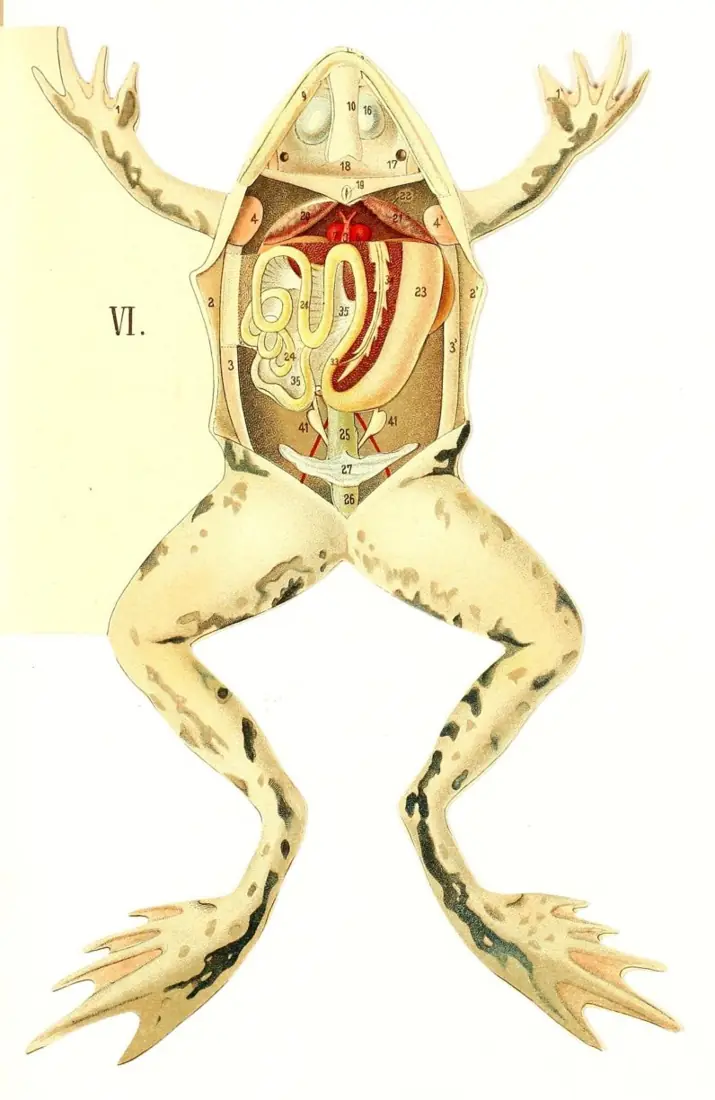
Mouth → buccal cavity with maxillary and vomerine teeth (they grip prey, they do not chew; teeth homodont, acrodont and replaced throughout life) and a sticky bilobed tongue attached in front and free behind, flicked out to catch insects → pharynx → short oesophagus → stomach (cardiac and pyloric parts; HCl and pepsin) → duodenum → coiled ileum with villi (digestion completed, absorption) → rectum → cloaca. The liver (three lobes) secretes bile, stored in the gall bladder; the pancreas lies between stomach and duodenum; the bile duct and pancreatic duct join to form the common bile duct, opening into the duodenum. The adult's gut is short (carnivore); the herbivorous tadpole's is long and coiled.
Respiration
The frog breathes in three ways:
| Mode | Organ | When |
|---|---|---|
| Cutaneous | moist, thin, vascular skin | always — in water, on land and the only route during hibernation and aestivation; gets rid of most of the CO₂ |
| Buccopharyngeal | moist lining of the buccal cavity | at rest on land, mouth shut (the throat flutters) |
| Pulmonary | a pair of thin, elastic, sac-like lungs with internal septa forming alveoli | when active on land |
Pathway of air: external nares → nasal chambers → internal nares → buccal cavity → glottis → laryngo-tracheal chamber → lungs. With no diaphragm and no ribs, the frog fills its lungs by a buccal force pump (positive pressure): with the glottis shut it lowers the buccal floor and draws air in through the nostrils; it then closes the nostrils, opens the glottis and raises the buccal floor, forcing the air into the lungs. Expiration is by elastic recoil and pressure of the body wall. The tadpole breathes by gills.
Blood vascular system
- Closed, with a three-chambered heart — two atria (auricles) and one ventricle — in a pericardium, plus two accessory chambers.
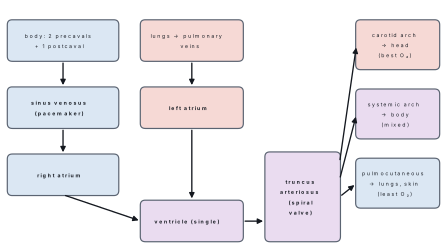
- Sinus venosus (dorsal, thin-walled) receives deoxygenated blood from two precavals and one postcaval and opens into the right atrium; it is the pacemaker — the heartbeat starts here.
- Pulmonary veins bring oxygenated blood from the lungs into the left atrium.
- Both atria empty into the single ventricle, whose spongy wall (trabeculae) limits mixing.
- Truncus (conus) arteriosus leaves the ventricle on the ventral side; its spiral valve directs the most deoxygenated blood into the pulmocutaneous arch (lungs and skin), mixed blood into the systemic arch (body) and the best-oxygenated blood into the carotid arch (head).
- Circulation is double but incomplete (some mixing). Hepatic portal and renal portal systems are present; the lymphatic system has lymph hearts.
- Blood: plasma with nucleated, oval, biconvex RBCs, WBCs and spindle-shaped thrombocytes.
Excretion and osmoregulation
A pair of dark-red mesonephric kidneys lies against the dorsal body wall, each with a yellow adrenal gland on its ventral face. Ureters open into the cloaca; in the male the ureter also carries sperm and is called the urinogenital duct, while in the female the ureter and oviduct open separately into the cloaca. The thin-walled, bilobed urinary bladder opens ventrally into the cloaca, not into the ureters, and lets water be reabsorbed on land. The adult is ureotelic (urea); the aquatic tadpole is ammonotelic (ammonia).
Nervous system, sense organs and endocrine glands
CNS: brain in the cranium and spinal cord in the neural canal, wrapped in meninges. PNS: 10 pairs of cranial nerves and 10 pairs of spinal nerves; an autonomic system as well.
| Brain region | Parts | Job |
|---|---|---|
| Forebrain | a pair of olfactory lobes, a pair of cerebral hemispheres, the diencephalon with the pineal body above and the optic chiasma, infundibulum and pituitary below | smell, voluntary activity, hormone control |
| Midbrain | a pair of large optic lobes | vision |
| Hindbrain | a small cerebellum and the medulla oblongata | balance; breathing, heartbeat and other reflex centres |
Sense organs: eyes (with nictitating membrane), ears (tympanum, a middle ear with one ossicle, the columella, and an internal ear for hearing and balance), nasal epithelium (smell), taste buds and skin papillae (touch). The tadpole has a lateral line system, lost at metamorphosis.
Endocrine glands: pituitary, thyroid, parathyroid, thymus, pineal, pancreatic islets, adrenals and gonads. Thyroxine from the thyroid controls metamorphosis.
Reproduction and development
The frog is dioecious; fertilisation is external; development is indirect through a tadpole larva.
| Male | Female |
|---|---|
| a pair of yellowish oval testes, attached to the kidneys and body wall by the mesorchium | a pair of lobed ovaries near the kidneys, attached by the mesovarium, not connected to the kidneys |
| 10–12 vasa efferentia carry sperm into the kidney → Bidder's canal → urinogenital duct (ureter) → a dilated seminal vesicle → cloaca | ova are shed into the coelom and enter the funnel-shaped ostium of the long coiled oviduct; its hind end, the ovisac, opens into the cloaca |
| finger-like fat bodies store food for the breeding season | lays 2500–3000 eggs at a time in jelly-coated masses |
Breeding follows the first monsoon rains. In amplexus the male clasps the female with the nuptial pads; she sheds eggs into the water and he sheds sperm over them at once. Amplexus is not copulation — fertilisation is external. The egg hatches into a tadpole: aquatic, herbivorous, with horny jaws, a long coiled gut, a tail with fins, external then internal gills, a two-chambered heart, a lateral line, no limbs, and ammonotelic.
Metamorphosis, controlled by thyroxine (which needs iodine), turns the tadpole into a frog. Progressive changes: hindlimbs appear first, then forelimbs; lungs develop; heart becomes three-chambered; eyelids and tympanum form; the gut shortens; excretion becomes ureotelic. Retrogressive changes: the tail is resorbed (by lysosomal enzymes), gills, horny jaws and lateral line disappear. Tadpoles given thyroxine metamorphose early into tiny frogs; tadpoles deprived of thyroid hormone or iodine stay as giant tadpoles.
- The heartbeat starts in the sinus venosus, not in the SA node (the frog has none).
- The frog's RBCs are nucleated and oval, unlike the mammal's.
- The male's ureter carries urine and sperm; the female's oviduct is separate from the ureter.
- The urinary bladder opens into the cloaca, not into the ureters.
- Only the upper jaw carries teeth; the lower jaw is toothless.
Most frog questions are answered by placing the fact in one of three columns: tadpole (gills, two-chambered heart, ammonia, herbivore, lateral line) → metamorphosis (thyroxine) → adult (lungs and skin, three-chambered heart, urea, carnivore).
Problem. A patient presents with classic paroxysms of chill, high fever, and sweating recurring every 48 hours, and peripheral blood smear shows enlarged, stippled RBCs with Schüffner's dots. Identify the Plasmodium species and explain why the fever recurs every 48 hours.
Solution. A 48-hour benign tertian cycle with enlarged host RBCs bearing Schüffner's dots identifies Plasmodium vivax. Fever spikes when erythrocytic schizonts rupture synchronously every 48 hours, releasing merozoites and the pyrogenic toxin haemozoin into the plasma.
Problem. Give the exact segment numbers in Pheretima posthuma for (a) the gizzard, (b) the clitellum, (c) the single female genital pore, (d) the paired male genital pores, and (e) the four pairs of spermathecal apertures.
Solution. (a) Gizzard: 8 (or 8–9); (b) clitellum: 14, 15, and 16; (c) female pore: mid-ventral on 14; (d) male pores: ventro-lateral on 18; (e) spermathecal pores: intersegmental grooves 5/6, 6/7, 7/8, and 8/9.
Formula and fact sheet
Plasmodium
| Item | Fact |
|---|---|
| Class | Sporozoa (Apicomplexa) |
| Definitive / intermediate host | female Anopheles / man |
| Infective stage to man / to mosquito | sporozoite / gametocytes |
| Human sites | liver cells, RBCs |
| Mosquito sites | stomach wall (oocyst), salivary glands (sporozoites) |
| Golgi cycle | erythrocytic schizogony |
| Ross cycle | sporogony in the mosquito |
| Only diploid stage | zygote (and ookinete) |
| Malarial pigment / toxin | haemozoin |
| Relapse | hypnozoites of P. vivax and P. ovale |
| Microgametes per microgametocyte | 4–8 (exflagellation) |
| P. vivax / P. falciparum / P. malariae / P. ovale | benign tertian 48 h / malignant tertian 36–48 h / quartan 72 h / ovale tertian 48 h |
| Cerebral malaria, blackwater fever, crescent gametocytes | P. falciparum |
| Schüffner's dots, enlarged RBCs | P. vivax |
| Laveran / Ross / Golgi / Grassi | parasite in blood 1880 / oocyst in Anopheles 1897 / RBC cycle / cycle in Anopheles |
| Drugs | quinine, chloroquine, primaquine (hypnozoites), artemisinin (ACT) |
| Larvivorous fish | Gambusia |
Earthworm (Pheretima posthuma)
| Item | Segment(s) / fact |
|---|---|
| Length, segments | about 150 mm; 100–120 segments |
| Prostomium / peristomium | not a segment / segment 1 (mouth) |
| Clitellum | 14–16 |
| Setae absent from | segment 1, last segment, clitellum |
| Spermathecal pores / spermathecae | grooves 5/6–8/9 / segments 6–9 |
| Female pore / ovaries | 14 / 13 |
| Male pores / testes / seminal vesicles | 18 / 10–11 / 11–12 |
| Genital papillae | 17 and 19 |
| Dorsal pores begin | groove 12/13 |
| Pharynx / oesophagus / gizzard / stomach | 4 / 5–7 / 8–9 / 9–14 |
| Intestine / caeca / typhlosole begins | 15 onwards / 26 / 26 |
| Hearts | 4 pairs: 7, 9 (lateral), 12, 13 (latero-oesophageal) |
| Blood glands | 4, 5, 6 |
| Pharyngeal / septal / integumentary nephridia | 4–6 / 15 onwards / 3 onwards |
| Brain (cerebral ganglia) / sub-pharyngeal ganglia | 3 / 4 |
| Respiratory pigment | haemoglobin dissolved in plasma |
| Respiration | cutaneous |
| Excretion | ammonotelic and ureotelic |
| Calciferous glands | neutralise humic acid |
| Sex | protandrous hermaphrodite, cross-fertilisation, external fertilisation in the cocoon, direct development |
Frog (Rana tigrina)
| Item | Fact |
|---|---|
| Digits | forelimb 4, hindlimb 5 (webbed) |
| Male-only features | vocal sacs, nuptial pad on first digit of forelimb |
| Teeth | maxillary + vomerine; lower jaw toothless |
| Vertebrae | 9 + urostyle; no ribs |
| Breathing | skin, buccopharynx, lungs; buccal force pump |
| Heart | 2 atria + 1 ventricle; sinus venosus (pacemaker); truncus arteriosus with spiral valve |
| Arches | carotid, systemic, pulmocutaneous |
| Portal systems | hepatic portal, renal portal |
| RBCs | nucleated, oval, biconvex |
| Kidneys | mesonephric; adult ureotelic, tadpole ammonotelic |
| Male duct | ureter = urinogenital duct; Bidder's canal; 10–12 vasa efferentia |
| Nerves | 10 pairs cranial, 10 pairs spinal |
| Ear ossicle | columella |
| Eggs | 2500–3000 at a time |
| Metamorphosis | thyroxine; hindlimbs before forelimbs; tail resorbed |
Chapter summary
- Plasmodium (Sporozoa) is a digenetic intracellular parasite: asexual schizogony in man (intermediate host) — liver cells, then the 48-hour Golgi cycle in RBCs — and sexual phase in the female Anopheles (definitive host) — gametes, zygote, ookinete, oocyst, sporozoites in the salivary glands.
- The sporozoite infects man and the gametocyte infects the mosquito; the zygote is the only diploid stage; the fever follows the synchronous bursting of RBCs and the release of haemozoin.
- P. vivax (benign tertian, relapses from hypnozoites, commonest in Nepal), P. falciparum (malignant tertian, cerebral malaria), P. malariae (quartan, 72 h) and P. ovale (ovale tertian).
- Pheretima posthuma: about 100–120 segments; prostomium; clitellum 14–16; perichaetine setae; female pore 14, male pores 18, papillae 17 and 19, spermathecal pores 5/6–8/9.
- Earthworm gut: pharynx 4, gizzard 8–9, stomach 9–14 with calciferous glands, caeca and typhlosole from 26; closed circulation with Hb in plasma and four pairs of hearts (7, 9, 12, 13); cutaneous respiration; septal, integumentary and pharyngeal nephridia.
- The earthworm is a protandrous hermaphrodite: testes 10–11, ovaries 13, spermathecae 6–9; cross-fertilisation, fertilisation in the cocoon, direct development; it is the farmer's friend and the basis of vermicomposting.
- The frog (Rana tigrina) breathes by skin, buccopharynx and lungs (buccal force pump); its three-chambered heart with sinus venosus and spiral valve gives a double but incomplete circulation; RBCs are nucleated.
- The frog is ureotelic with mesonephric kidneys; the male's ureter is a urinogenital duct; it has 10 pairs of cranial nerves, 9 vertebrae and a urostyle; fertilisation is external after amplexus, and thyroxine drives metamorphosis of the tadpole.
Practice questions
Set A — Recall (30 questions)
- The definitive host of Plasmodium isamanbthe male Anophelescthe female Anophelesdthe female Culex
- The stage of Plasmodium that infects man is theasporozoitebmerozoitecgametocytedookinete
- The erythrocytic schizogony of Plasmodium in man is also called theaRoss cyclebKrebs cyclecCori cycledGolgi cycle
- The toxic pigment released when infected red blood cells burst isahaemocyaninbhaemozoincbilirubindmelanin
- Benign tertian malaria is caused byaP. falciparumbP. malariaecP. vivaxdP. knowlesi
- Malarial fever recurring every 72 hours is caused byaP. malariaebP. vivaxcP. ovaledP. falciparum
- Cerebral malaria and blackwater fever are complications of infection withaP. vivaxbP. ovalecP. malariaedP. falciparum
- The oocysts of Plasmodium are formed on theasalivary glands of the mosquitobstomach wall of the mosquitocliver cells of mandred blood cells of man
- The malarial parasite was first seen in human blood in 1880 byaRonald RossbCamillo GolgicCharles LaverandBattista Grassi
- In the life cycle of Plasmodium the diploid stage is theazygotebsporozoitecmerozoitedgametocyte
- In Pheretima posthuma the clitellum occupies segmentsa10–12b12–14c15–17d14–16
- The female genital pore of Pheretima lies on segmenta13b14c18d16
- The male genital pores of Pheretima lie on segmenta18b14c17d19
- The spermathecal pores of Pheretima area2 pairs, on segments 10 and 11b1 pair, on segment 18c4 pairs, in grooves 5/6 to 8/9d2 pairs, on segments 17 and 19
- The gizzard of the earthworm lies in segmentsa4b5–7c9–14d8–9
- The calciferous glands of the earthworm neutraliseahydrochloric acidbhumic acidcuric aciddlactic acid
- The typhlosole of the earthworm intestineaincreases the absorptive surfacebgrinds foodcsecretes calcium carbonatedstores sperm
- The respiratory pigment of the earthworm isahaemocyanin in the plasmabhaemoglobin in red cellschaemoglobin dissolved in the plasmadmyoglobin in the muscles
- The pharyngeal nephridia of the earthworm lie in segmentsa15 to the lastb3 to the lastc1 to 3d4, 5 and 6
- The testes of Pheretima area1 pair, in segment 13b2 pairs, in segments 10 and 11c2 pairs, in segments 11 and 12d4 pairs, in segments 6–9
- The heartbeat of the frog is initiated in theasinus venosusbright atriumcventricledtruncus arteriosus
- The spiral valve of the frog is found in theasinus venosusbventriclectruncus arteriosusdleft atrium
- The number of cranial nerves in the frog isa12 pairsb8 pairsc11 pairsd10 pairs
- The chief nitrogenous waste of the adult frog isaammoniabureacuric aciddcreatinine
- In the male frog the ureter is also called theaurinogenital ductbBidder's canalcvas efferensdoviduct
- The nuptial (copulatory) pad of the frog is found on theahindlimb of the femalebfirst toe of the male's hindlimbcfirst digit of the male's forelimbdthroat of the male
- The vertebral column of the frog consists ofa7 vertebrae and a sacrumb12 vertebrae and a coccyxc10 vertebrae and no urostyled9 vertebrae and a urostyle
- Metamorphosis of the frog tadpole is controlled byainsulinbthyroxinecadrenalinedprolactin
- In the frog, teeth are present onathe upper jaw and vomers onlybboth jawscthe lower jaw onlydthe tongue
- The midbrain of the frog bears a pair ofaolfactory lobesbcerebellar lobescoptic lobesdcerebral hemispheres
Answers and explanations — Set A
1. (c) — fertilisation (the sexual phase) occurs in the female Anopheles, so she is the definitive host; man is intermediate.
2. (a) — sporozoites from the mosquito's salivary glands are injected with saliva. Gametocytes infect the mosquito, not man.
3. (d) — Golgi described the cycle in RBCs; the Ross cycle is the sporogony in the mosquito.
4. (b) — haemozoin, the residue of digested haemoglobin; haemocyanin is the copper pigment of molluscs.
5. (c) — P. vivax, 48-hour cycle, rarely fatal; P. falciparum causes the malignant form.
6. (a) — the 72-hour erythrocytic cycle of P. malariae gives quartan fever (every fourth day).
7. (d) — sticky falciparum-infected RBCs block brain capillaries, and massive haemolysis darkens the urine.
8. (b) — the ookinete crosses the stomach wall and encysts on its outer surface; sporozoites later move to the salivary glands.
9. (c) — Laveran (1880); Ross (1897) found the oocysts in the mosquito.
10. (a) — the zygote (with the ookinete it becomes) is diploid; meiosis in the oocyst makes every later stage haploid.
11. (d) — segments 14, 15 and 16 form the glandular clitellum, which has no setae.
12. (b) — a single mid-ventral female pore on segment 14, in front of the male pores.
13. (a) — one pair of male pores on segment 18, with genital papillae on 17 and 19.
14. (c) — four pairs, ventro-lateral, in the grooves between segments 5/6, 6/7, 7/8 and 8/9.
15. (d) — the muscular grinding gizzard is in segments 8–9; the stomach follows in 9–14.
16. (b) — the CaCO₃ they secrete neutralises the humic acid of decaying leaves in the soil.
17. (a) — the typhlosole is a mid-dorsal infolding of the intestine that adds absorptive surface.
18. (c) — earthworm haemoglobin is dissolved in the plasma; its corpuscles are colourless.
19. (d) — three paired tufts in segments 4, 5 and 6, opening into the buccal cavity and pharynx.
20. (b) — two pairs of testes in segments 10 and 11; the seminal vesicles are in 11 and 12.
21. (a) — the sinus venosus acts as the pacemaker in the frog; mammals have an SA node instead.
22. (c) — the spiral valve of the truncus arteriosus sorts blood into the three arches.
23. (d) — the frog has 10 pairs of cranial nerves; man has 12.
24. (b) — the adult frog is ureotelic; its aquatic tadpole is ammonotelic.
25. (a) — in the male the ureter carries both urine and sperm; Bidder's canal lies inside the kidney.
26. (c) — the male grips the female in amplexus with nuptial pads on the first digit of each forelimb.
27. (d) — only nine vertebrae and a rod-like urostyle; the frog has no ribs.
28. (b) — thyroxine (thyroid hormone) triggers metamorphosis.
29. (a) — maxillary teeth on the upper jaw and vomerine teeth on the palate; the lower jaw is toothless.
30. (c) — the optic lobes are the midbrain's visual centres; olfactory lobes belong to the forebrain.
Set B — Understanding (21 questions)
- Only the female Anopheles transmits malaria becauseamales lack salivary glandsbonly females feed on bloodcmales are immune to Plasmodiumdmales live only in water
- A patient treated for vivax malaria has a fresh attack eight months later without a new bite. The attack comes fromagametocytes in the bloodbsporozoites in the spleencmerozoites in bone marrowddormant hypnozoites in liver cells
- The 48-hour periodicity of fever in vivax malaria reflects the duration ofaerythrocytic schizogonybsporogony in the mosquitocthe life of an RBCdthe journey of sporozoites to the liver
- Gametocytes of Plasmodium do not develop further in the human body becauseathey are diploidbthey lack nucleicthey need the conditions of the mosquito's stomachdhuman antibodies kill them at once
- Which stage of Plasmodium is NEVER seen in a human blood smear?aring-shaped trophozoiteboocystcgametocytedschizont
- In vivax malaria primaquine is given after chloroquine in order toakill sporozoites in the mosquitobreduce the fever quicklycprevent mosquito bitesddestroy hypnozoites and gametocytes
- People with sickle-cell trait resist falciparum malaria becauseathey have no red cellsbtheir RBCs lack haemoglobincinfected RBCs sickle and are removed earlydthey have antibodies against Anopheles
- The earthworm is hermaphrodite, yet cross-fertilisation occurs becauseaits testes mature before its ovariesbit has no ovariescits sperm cannot swimdmale and female pores lie on one segment
- In the earthworm, fertilisation takes place in theaspermathecaebcocoonccoelomdseminal vesicles
- Earthworms come out of the soil after heavy rain mainlyato feedbto matecto lay cocoonsdto avoid suffocating in flooded burrows
- Blood in the dorsal vessel of the earthworm flowsabackwards, as the distributing vesselbforwards, as the distributing vesselcforwards, as the collecting vesseldbackwards, as the collecting vessel
- The septal nephridia of Pheretima open into the intestine. This is an adaptation foraconserving waterbfaster locomotioncdigesting cellulosedstoring sperm
- The earthworm is called the "farmer's friend" because itaeats insect pestsbaerates the soil and enriches it with its castingscpollinates cropsdfixes atmospheric nitrogen
- Locomotion in the earthworm depends onaparapodia and ciliaba bony endoskeletoncjointed legsdsetae, two muscle layers and the coelomic fluid
- The frog does not need to drink water because itamakes water from fatbnever loses watercabsorbs water through its skindgets all its water from food
- During hibernation the frog respiresathrough its skinbthrough its lungscthrough gillsdthrough the buccopharyngeal lining only
- Air is forced into the lungs of a frog byamovements of the diaphragmbraising the floor of the buccal cavitycmovements of the ribsdcontraction of the lungs
- Although the frog has a single ventricle, mixing of blood is reduced byathe sinus venosusbthe renal portal systemcthe lymph heartsdthe spiral valve and folds of the ventricle wall
- Bidder's canal is found in theaovary of the femalebliverckidney of the maledbrain
- A tadpole excretes ammonia but an adult frog excretes urea. The change is linked toathe change from aquatic to land lifebloss of the tailcthe growth of teethdthe appearance of vocal sacs
- The nictitating membrane of the frogahelps in hearingbprotects the eye under watercsecretes tearsdproduces sound
Answers and explanations — Set B
1. (b) — the female needs a blood meal to mature her eggs; the male feeds on nectar and plant juices.
2. (d) — hypnozoites of P. vivax lie dormant in hepatocytes and later restart the cycle (relapse).
3. (a) — merozoites are released in a synchronised batch at the end of each 48-hour erythrocytic cycle.
4. (c) — gametes form only after the drop in temperature and the chemical cues of the mosquito's stomach.
5. (b) — the oocyst forms only on the mosquito's stomach wall; rings, schizonts and gametocytes are all seen in human blood.
6. (d) — primaquine kills the liver hypnozoites (preventing relapse) and the gametocytes (stopping transmission).
7. (c) — the parasite lowers the oxygen in its RBC, which then sickles and is removed by the spleen before the cycle finishes.
8. (a) — protandry: sperm ripen first, so a worm cannot fertilise its own eggs.
9. (b) — the cocoon picks up ova at segment 14 and sperm at segments 6–9; fertilisation is external, inside it.
10. (d) — water fills the burrows and its cutaneous respiration fails; the worm surfaces to breathe.
11. (c) — the dorsal vessel collects blood from the segments and pumps it forwards to the hearts.
12. (a) — urine entering the gut gives the intestine a chance to reabsorb its water.
13. (b) — burrows aerate and drain the soil; castings are rich in N, P, K and humus. Earthworms do not fix nitrogen (d).
14. (d) — circular and longitudinal muscles act on the incompressible coelomic fluid (hydrostatic skeleton) while setae anchor the body.
15. (c) — the permeable skin takes in water directly.
16. (a) — buried in mud and inactive, the frog relies on cutaneous respiration alone.
17. (b) — the buccal force pump: nostrils closed, glottis open, buccal floor raised. The frog has no diaphragm and no ribs.
18. (d) — the spiral valve and ventricular trabeculae keep the streams partly separate; the circulation is still incomplete.
19. (c) — vasa efferentia enter the kidney and join Bidder's canal on the way to the urinogenital duct.
20. (a) — ammonia needs much water to flush away; urea is less toxic and suits life on land.
21. (b) — the transparent third eyelid covers the eye when the frog is under water.
Set C — Application (12 questions)
- A patient has fever every 48 hours; the smear shows enlarged RBCs with Schüffner's dots, and the disease relapses months later. The parasite isaP. falciparumbP. vivaxcP. malariaedP. knowlesi
- A vivax malaria patient's fever begins on Monday at 10 a.m. The next paroxysm is expected onaTuesday at 10 a.m.bThursday at 10 a.m.cFriday at 10 a.m.dWednesday at 10 a.m.
- A smear shows only ring forms and crescent-shaped gametocytes, and the patient becomes unconscious. The parasite isaP. falciparumbP. vivaxcP. ovaledP. malariae
- Each infected RBC releases 16 merozoites every 48 hours and each merozoite infects a new RBC. Starting from one infected RBC, how many RBCs are infected after three complete cycles?a48b256c4096d65 536
- An earthworm has 120 segments. Setae are absent from the first segment, the clitellum and the last segment. How many segments bear setae?a116b115c117d113
- An earthworm is cut transversely between segments 9 and 10. The front piece contains theatestes and ovariesbclitellum and female porecintestinal caecadgizzard and spermathecae
- An earthworm placed on dry filter paper soon dies becauseagas exchange through its dry skin stopsbits gills collapsecits lungs are damageddits tracheae close
- Earthworms in acidic, humus-rich soil rely most on which structure to keep their gut contents from becoming too acidic?atyphlosolebgizzardccalciferous glandsdchloragogen cells
- A frog's heart beats 40 times a minute, pumping 0.25 mL each beat, and its blood volume is 6 mL. How long does the whole blood volume take to pass once through the heart?a24 sb36 sc60 sd15 s
- Tadpoles reared in iodine-free water fail to metamorphose because theyacannot absorb oxygen through their gillsbcannot digest plantsccannot develop lungs without airdcannot make enough thyroxine
- In the frog, which vessel receives the least oxygenated blood leaving the heart?apulmocutaneous archbcarotid archcsystemic archdpulmonary vein
- In a dissected frog the duct leaving each kidney carries both urine and sperm. The frog isaa femaleba tadpoleca maleda hermaphrodite
Answers and explanations — Set C
1. (b) — a 48-hour cycle, Schüffner's dots in enlarged RBCs and relapses from hypnozoites mark P. vivax.
2. (d) — 48 hours after Monday 10 a.m. is Wednesday 10 a.m. (fever "every third day", counting Monday as day 1). Thursday (b) would be quartan.
3. (a) — crescent gametocytes, only ring stages in peripheral blood (schizonts hide in deep capillaries) and cerebral malaria: P. falciparum.
4. (c) — the count multiplies by 16 each cycle: 16³ = 4096. (b) is 16² (two cycles).
5. (b) — 120 − 1 (first) − 3 (clitellum 14–16) − 1 (last) = 115.
6. (d) — segments 1–9 hold the gizzard (8–9) and spermathecae (6–9); testes (10–11), ovaries (13), clitellum (14–16) and caeca (26) are behind the cut.
7. (a) — earthworm respiration is cutaneous and needs a moist skin; it has no gills, lungs or tracheae.
8. (c) — calciferous glands in the stomach wall secrete CaCO₃ that neutralises humic acid.
9. (b) — output = 0.25 mL × 40 min⁻¹ = 10 mL min⁻¹; time = 6 mL ÷ 10 mL min⁻¹ = 0.6 min = 36 s.
10. (d) — thyroxine contains iodine; without it the thyroid cannot trigger metamorphosis and the larvae grow into giant tadpoles.
11. (a) — the spiral valve sends the most deoxygenated blood to the lungs and skin through the pulmocutaneous arch; the pulmonary vein brings blood to the heart.
12. (c) — only the male's ureter is a urinogenital duct; in the female the oviduct is separate.