Chapter 10 · Human Biology and Physiology · 2 questions in the paper · 22 min read
Endocrine System
What the syllabus asks for 2
- Endocrine glands and their hormones
- Hormonal disorders
The endocrine system is rated at 2 questions in this book's estimate of the 40-question Zoology paper. This is a matching-and-direction chapter: gland → hormone → target → effect, then hyper- and hyposecretion. The highest yield chains are hypothalamus → pituitary → target gland, insulin versus glucagon, PTH versus calcitonin, and the contrast between an underactive and overactive thyroid or adrenal cortex.
- Endocrine glands are ductless and release hormones into blood; only cells with suitable receptors respond.
- The hypothalamus controls the anterior pituitary through releasing/inhibiting hormones in portal blood; the posterior pituitary stores ADH and oxytocin made in the hypothalamus.
- Anterior pituitary hormones: GH, TSH, ACTH, FSH, LH and prolactin.
- Thyroid hormones raise metabolic rate and need iodine; calcitonin lowers Ca²⁺, whereas parathormone raises Ca²⁺.
- Adrenal cortex: aldosterone for Na⁺/water and blood pressure, cortisol for glucose and stress; adrenal medulla: adrenaline/noradrenaline for emergency action.
- Insulin lowers blood glucose; glucagon raises it.
- Disorder anchors: gigantism/acromegaly (GH excess), cretinism/myxoedema and Graves' disease (thyroid), tetany (low PTH/calcium), Addison's/Cushing's/Conn's (adrenal cortex), diabetes mellitus (insulin lack/resistance), diabetes insipidus (ADH failure).
10.1 Endocrine glands and their hormones
An endocrine gland releases its secretion directly into extracellular fluid and blood rather than through a duct. The secretion is a hormone, a chemical messenger effective at very low concentration. Although blood carries a hormone throughout the body, only target cells bearing its receptor can respond. Endocrine control is usually slower than nervous control but broader and longer lasting, coordinating growth, metabolism, reproduction, fluid balance and stress responses.
Chemical classes and modes of action
| Class | Examples | Typical receptor/mechanism |
|---|---|---|
| Peptides and proteins | insulin, glucagon, GH, TSH, ADH, oxytocin | water-soluble; bind cell-surface receptors and use second messengers or enzyme cascades |
| Steroids | cortisol, aldosterone, testosterone, oestrogen, progesterone | made from cholesterol; lipid-soluble; mainly bind intracellular receptors that alter gene transcription |
| Amino-acid derivatives | T₃/T₄, adrenaline, noradrenaline, melatonin | catecholamines usually act at surface receptors; thyroid hormones act mainly on nuclear receptors |
Water-soluble hormones travel largely free in plasma and often have short half-lives. Many steroid and thyroid hormones travel bound to carrier proteins, which prolongs their action. Hormone secretion is regulated chiefly by negative feedback: a rising product inhibits the glands or releasing centres that stimulated its production. Positive feedback is uncommon in healthy endocrinology; oxytocin during labour is the standard example.
Hypothalamus and pituitary: the command axis
The pea-sized pituitary gland (hypophysis) lies in the sella turcica of the sphenoid bone and is joined to the hypothalamus by the infundibulum. Its two lobes differ in origin and should never be confused.
The anterior pituitary (adenohypophysis) is glandular tissue. Hypothalamic releasing and inhibiting hormones reach it through the hypothalamo-hypophyseal portal system. It synthesises and releases:
| Hormone | Principal target/action |
|---|---|
| Growth hormone (GH/somatotropin) | growth of bone and soft tissues; protein synthesis, fat mobilisation, antagonises insulin |
| Thyroid-stimulating hormone (TSH) | thyroid growth and T₃/T₄ secretion |
| Adrenocorticotropic hormone (ACTH) | adrenal cortex, especially cortisol secretion |
| Follicle-stimulating hormone (FSH) | ovarian follicle development; spermatogenesis through Sertoli cells |
| Luteinising hormone (LH/ICSH) | ovulation and corpus luteum; testosterone secretion by Leydig cells |
| Prolactin | development of mammary tissue and milk production |
The posterior pituitary (neurohypophysis) is nervous tissue. It does not manufacture its two hormones. Antidiuretic hormone (ADH/vasopressin) and oxytocin are synthesised in hypothalamic neuron cell bodies, transported down axons and released from posterior-lobe terminals. ADH increases water reabsorption in connecting tubules/collecting ducts; oxytocin contracts the uterus in labour and causes milk ejection.
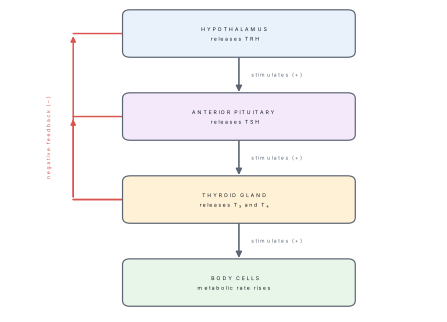
The phrase “master gland” for the pituitary is convenient but incomplete: the hypothalamus itself receives neural and blood-borne information and directs both pituitary lobes.
Thyroid and parathyroid glands
The thyroid, situated below the larynx around the upper trachea, is traditionally described as the largest purely endocrine gland. Follicular cells use iodide to produce thyroxine (T₄) and triiodothyronine (T₃). These increase basal metabolic rate, oxygen consumption and heat production and are indispensable for fetal and childhood brain and skeletal development. T₃ is the more potent hormone; much T₄ is converted to T₃ in target tissues.
Parafollicular C cells secrete calcitonin, which tends to lower blood Ca²⁺ by reducing osteoclast activity and promoting calcium deposition in bone. Four parathyroid glands on the posterior thyroid secrete parathormone (PTH), the dominant minute-to-minute raiser of blood Ca²⁺. PTH releases Ca²⁺ from bone, increases renal Ca²⁺ reabsorption and activates vitamin D, which increases intestinal absorption. Thus the school-level pair is:
PTH ↑ blood Ca²⁺; calcitonin ↓ blood Ca²⁺.
Adrenal glands: two glands in one
Each adrenal gland caps a kidney and contains an outer cortex and inner medulla of different embryological origin.
| Region/zone | Hormone | Main action |
|---|---|---|
| Cortex — zona glomerulosa | Aldosterone (mineralocorticoid) | renal Na⁺ and water retention, K⁺/H⁺ excretion; maintains blood volume and pressure |
| Cortex — zona fasciculata | Cortisol (glucocorticoid) | gluconeogenesis, mobilisation of protein/fat, stress adaptation; anti-inflammatory/immunosuppressive at high levels |
| Cortex — zona reticularis | adrenal androgens | contribute to pubic/axillary hair and libido, especially in females |
| Medulla | Adrenaline and noradrenaline | rapid emergency response: cardiac output and blood pressure rise, bronchioles/pupils dilate, glycogenolysis increases |
The adrenal cortex is essential for life because salt, water and glucose control fail without it. The medulla is a modified sympathetic ganglion; its hormones reinforce sympathetic nerves but are not absolutely essential.
Endocrine pancreas and blood-glucose control
The islets of Langerhans are ductless endocrine clusters scattered through the exocrine pancreas. Their β cells secrete insulin, α cells secrete glucagon, and δ cells secrete somatostatin.
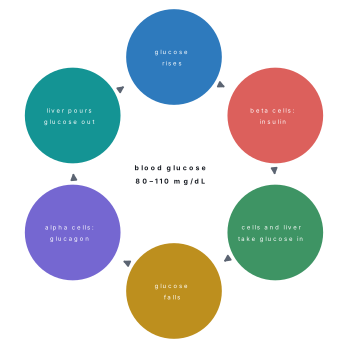
Insulin is released when blood glucose rises. It increases glucose uptake by muscle and adipose tissue, stimulates glycogen, fat and protein synthesis and suppresses hepatic glucose output. Glucagon is released when glucose falls and acts mainly on the liver to stimulate glycogenolysis and gluconeogenesis. Adrenaline, cortisol and GH also tend to raise glucose; insulin is the only major hormone whose dominant systemic action lowers it.
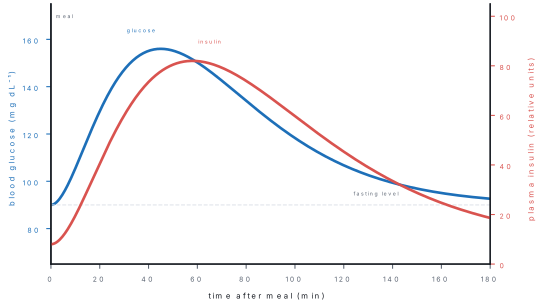
A fasting glucose of 90 mg dL⁻¹ means 90 mg in 100 mL, or 0.9 g L⁻¹. In about 5 L of blood, this is only
Yet a meal may supply many tens of grams. The point of insulin is therefore easy to see: absorbed glucose must rapidly enter tissues and storage forms, while hepatic glucose output is switched down.
Gonads, pineal, thymus and diffuse endocrine tissues
- Testes: Leydig cells secrete testosterone, required for spermatogenesis and male secondary sexual characters. Sertoli cells secrete inhibin, which suppresses FSH.
- Ovaries: developing follicles secrete oestrogens; the corpus luteum secretes mainly progesterone, which prepares/maintains the endometrium.
- Pineal gland: secretes melatonin mainly at night, helping organise circadian rhythms.
- Thymus: thymosins support T-lymphocyte maturation; the gland is most prominent in childhood.
- Kidney: erythropoietin stimulates red-cell production and calcitriol is the active form of vitamin D. The heart releases ANP, adipose tissue releases leptin, the placenta releases hCG, and the gut releases gastrin, secretin, cholecystokinin and motilin.
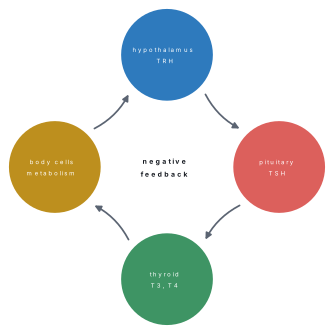
Two ownership traps the paper sets every few years: ADH and oxytocin are made in the hypothalamus and merely released by the posterior pituitary — an option saying the posterior lobe synthesises them is wrong. And calcitonin (thyroid) lowers blood calcium while PTH (parathyroid) raises it — swapped in half of all wrong options.
10.2 Hormonal disorders
An endocrine disorder may result from hormone deficiency, excess, or target-cell resistance. In an axis, the relationship between a pituitary tropic hormone and target-gland hormone locates the fault. For example, low T₄ with high TSH points to primary thyroid failure: the pituitary is correctly “shouting louder”. Low T₄ with low or inappropriately normal TSH points to a pituitary/hypothalamic fault.
Pituitary and posterior-lobe disorders
| Disorder | Hormonal fault | Diagnostic pattern |
|---|---|---|
| Pituitary dwarfism | GH deficiency in childhood | short, normally proportioned growth; intelligence usually normal |
| Gigantism | GH excess before epiphyseal plates close | generalised excessive linear growth |
| Acromegaly | GH excess after epiphyseal closure | enlarged jaw, hands, feet and soft tissues; little increase in height |
| Diabetes insipidus | too little ADH or renal response to ADH | very large volumes of dilute urine, intense thirst, blood glucose normal |
| Hypopituitarism | loss of several anterior pituitary hormones | combined thyroid, adrenal and gonadal underactivity |
Thyroid and parathyroid disorders
Hypothyroidism means insufficient thyroid hormone action. In infancy and early childhood, untreated deficiency causes cretinism: severely impaired growth and brain development. In adults, myxoedema presents with fatigue, cold intolerance, weight gain, dry skin, puffy face, constipation and slow pulse. Iodine deficiency reduces T₄ synthesis; persistent TSH stimulation then enlarges the gland as simple/endemic goitre.
Hyperthyroidism increases metabolic rate. Graves' disease, an autoimmune stimulation of the TSH receptor, causes weight loss despite appetite, heat intolerance, tremor, rapid pulse, anxiety and often exophthalmos (protruding eyes). The presence of a goitre alone does not distinguish under- from overactivity.
Low PTH or severe hypocalcaemia increases neuromuscular excitability and can cause tetany—painful sustained muscle spasms, including laryngeal spasm. Excess PTH produces hypercalcaemia, bone resorption and pain, kidney stones, excess urination and abdominal/neuropsychiatric symptoms. The traditional memory is “stones, bones, groans and moans”.
Adrenal disorders
| Disorder | Fault | Key features |
|---|---|---|
| Addison's disease | adrenal cortex insufficiency (low cortisol and aldosterone) | weakness, weight loss, low blood pressure, low Na⁺, high K⁺, increased skin pigmentation in primary disease |
| Cushing's syndrome | cortisol excess | moon face, central obesity, thin limbs/skin, hypertension, hyperglycaemia, muscle wasting |
| Conn's syndrome | aldosterone excess | Na⁺/water retention, hypertension, K⁺ loss and muscle weakness |
| Phaeochromocytoma | adrenal-medulla tumour secreting catecholamines | episodic severe hypertension, palpitations, headache and sweating |
An adrenal crisis in untreated cortical insufficiency is dangerous because aldosterone deficiency collapses extracellular-fluid volume while cortisol deficiency impairs the response to stress.
Diabetes mellitus and hypoglycaemia
Diabetes mellitus is chronic hyperglycaemia from deficient insulin secretion, deficient insulin action, or both. It must not be confused with diabetes insipidus.
| Feature | Type 1 diabetes | Type 2 diabetes |
|---|---|---|
| Main mechanism | autoimmune destruction of β cells | insulin resistance with progressive β-cell dysfunction |
| Usual onset | childhood/young adult, often abrupt | adult, gradual; increasingly seen in younger people with obesity |
| Endogenous insulin | very low or absent | present early but insufficient for demand |
| Ketosis tendency | high without insulin | less likely except under severe stress/illness |
| Essential treatment principle | insulin replacement | lifestyle measures and glucose-lowering medicines; insulin may later be needed |
When blood glucose exceeds the renal threshold, glucose appears in urine and osmotically increases urine volume. The classical symptoms are polyuria, polydipsia and polyphagia, with weight loss in marked insulin deficiency. Long-term hyperglycaemia injures retinal, renal, nerve and cardiovascular tissues. Modern laboratory diagnosis uses standardised fasting plasma glucose, oral glucose tolerance or HbA1c criteria; a single casual number out of context is not a complete diagnosis.
Conversely, too much insulin or too little food after insulin can produce hypoglycaemia: sweating, tremor, palpitations, hunger, confusion and, if severe, seizures or coma. The brain's heavy dependence on a continuous glucose supply makes this an emergency.
Both can produce excess urine and thirst. In mellitus, urine is glucose-rich because blood glucose is high. In insipidus, urine is very dilute and glucose is normal because ADH signalling fails. The shared word “diabetes” refers to passing large volumes, not to the same hormone.
Problem. A fasting plasma glucose reads 7.0 mmol/L. Convert to mg/dL and classify. A second patient reads 99 mg/dL; convert to mmol/L. Solution. mg/dL = mmol/L × 18: 7.0 × 18 = 126 mg/dL — the diabetic fasting threshold, so the first patient is diabetic. 99 ÷ 18 = 5.5 mmol/L — comfortably normal (the ×18 factor is glucose's molecular weight, 180 g/mol, divided by 10).
Grow: GH. Heat: thyroid. Stress: cortisol and adrenaline. Salt: aldosterone. Sugar: insulin and glucagon. Water: ADH. Calcium: PTH up, calcitonin down. Clock: melatonin. Soldiers: thymosin. Nine hooks hang the whole table.
Sort the three 'diabetes' names once and for all: mellitus type 1 = no insulin, type 2 = insulin ignored, insipidus = no ADH (urine dilute and sweet-free). And sort the growth trio by age: child lack = dwarf, child excess = giant, adult excess = acromegaly.
Problem. Patient X has low serum free \text{T}_4, elevated serum \text{TSH}, and a diffuse goitre; Patient Y has low free \text{T}_4 and low \text{TSH} without goitre. Localise the lesion in each patient.
Solution. In Patient X (primary thyroid failure / endemic iodine-deficiency goitre), low \text{T}_4 removes negative feedback on the anterior pituitary, driving high \text{TSH} which hypertrophies the gland into a goitre. In Patient Y (secondary / pituitary hypothyroidism), the anterior pituitary itself fails to secrete \text{TSH}.
Formula and fact sheet
- Anterior pituitary: GH, TSH, ACTH, FSH, LH, prolactin.
- Posterior pituitary stores hypothalamic ADH and oxytocin.
- Thyroid: T₃/T₄ ↑ BMR; C-cell calcitonin ↓ blood Ca²⁺.
- Parathyroid: PTH ↑ blood Ca²⁺ from bone, kidney and activated vitamin D/gut.
- Adrenal cortex: aldosterone = salt/water; cortisol = glucose/stress.
- Adrenal medulla: adrenaline/noradrenaline = emergency sympathetic hormone.
- Pancreatic β cells → insulin ↓ glucose; α cells → glucagon ↑ glucose.
- Leydig cells → testosterone; corpus luteum → progesterone; pineal → melatonin.
- Low target hormone + high pituitary tropic hormone = primary target-gland failure.
- GH excess: childhood = gigantism; adult = acromegaly.
- Low thyroid hormone: child = cretinism; adult = myxoedema. Excess = Graves' pattern.
- Addison's = low cortical hormones; Cushing's = cortisol excess; Conn's = aldosterone excess.
Rapid-revision tables and high-yield facts
| Quantity | Value |
|---|---|
| Blood glucose normal / diabetic fasting | 80–110 mg/dL / ≥ 126 mg/dL (≥ 7.0 mmol/L) |
| mg/dL → mmol/L | divide by 18 (glucose 180 g/mol) |
| HbA1c window / diagnostic | ~3 months (RBC lifespan) / ≥ 6.5 % |
| Anterior pituitary | GH, TSH, ACTH, FSH, LH, prolactin |
| Posterior pituitary | ADH, oxytocin (made in hypothalamus) |
| Ca²⁺ control | PTH raises, calcitonin lowers |
| Adrenal | cortex: aldosterone, cortisol; medulla: adrenaline |
| Islets | β insulin (lowers glucose), α glucagon (raises) |
Chapter summary
- Hormones are blood-borne messengers whose effects depend on receptors, chemical class, transport and feedback regulation.
- The hypothalamus controls the anterior pituitary through portal blood and supplies the posterior pituitary with ADH and oxytocin.
- Pituitary tropic hormones organise thyroid, adrenal-cortical and gonadal activity; GH and prolactin act more directly on non-endocrine tissues.
- Thyroid hormones set metabolic rate and are essential to development; PTH and calcitonin act in opposite directions on blood calcium.
- The adrenal cortex preserves salt, water and glucose during stress, whereas the medulla supplies a rapid catecholamine emergency response.
- Insulin and glucagon form an antagonistic pair around blood glucose.
- Endocrine diagnosis rests on direction and feedback: identify what is high, what is low and whether the controller is responding appropriately.
- The major named disorders follow mechanically from hormone function, so symptoms can be derived rather than memorised in isolation.
Practice questions
Set A — Recall (25 questions)
- Endocrine glands release their secretions directly into theaintestinal lumenbductscblooddskin surface
- The gland traditionally called the master gland is theapituitary glandbthyroid glandcadrenal glanddpineal gland
- ADH and oxytocin are synthesised in theaanterior pituitarybhypothalamuscposterior pituitarydpineal gland
- Growth hormone is secreted by theathyroidbadrenal cortexcpancreatic isletsdanterior pituitary
- Milk production by mammary glands is stimulated mainly byaoxytocinbADHcoestrogendprolactin
- The hormone that increases water reabsorption in collecting ducts isaADHbaldosteroneccalcitonindglucagon
- Uterine contraction during labour and milk ejection are promoted byaoxytocinbprolactincprogesteronedLH
- Iodine is essential for synthesis ofainsulinbthyroxinecadrenalinedcortisol
- Blood calcium is lowered byaparathormonebcalcitonincADHdaldosterone
- Parathormone is secreted by theathyroid folliclesbadrenal medullacparathyroid glandsdpancreatic acini
- Aldosterone is produced mainly by theaadrenal medullabzona reticularisczona glomerulosadanterior pituitary
- The principal glucocorticoid of humans isaaldosteronebadrenalinectestosteronedcortisol
- Adrenaline is secreted by theaadrenal cortexbadrenal medullacthyroid glanddpituitary gland
- Insulin is secreted by which islet cells?aα cellsbδ cellscβ cellsdacinar cells
- Glucagon increases blood glucose mainly by acting on theakidneybskincthyroiddliver
- Testosterone is produced in the testis byaLeydig cellsbSertoli cellscspermatogoniadseminiferous fluid
- Progesterone is secreted in large amount by theaGraafian follicle before ovulationbcorpus luteumcpituitary glanddplacenta only
- Melatonin is secreted by theathymusbthyroidcadrenal cortexdpineal gland
- Maturation of T lymphocytes is promoted by hormones of theathymusbpineal glandcparathyroiddadrenal medulla
- Erythropoietin, which stimulates red-cell production, comes mainly from theakidneybspleencthyroiddpituitary
- The largest purely endocrine gland in the human body is traditionally theapituitarybadrenalcthyroiddthymus
- Steroid hormones are chemically derived fromaglucosebamino acidscnucleotidesdcholesterol
- A water-soluble peptide hormone usually binds first to a receptor on theanuclear membranebribosomeccell surfacedchromosome
- Secretin, a gastrointestinal hormone, chiefly stimulates pancreatic secretion rich inahydrochloric acidbbicarbonatecbile saltsdinsulin
- FSH in females primarily promotesaovarian follicle developmentbmilk ejectioncuterine contractiondthyroid secretion
Answers and explanations — Set A
1. (c) — Endocrine glands are ductless and deliver hormones to blood.
2. (a) — The pituitary controls several other endocrine glands, although the hypothalamus controls it.
3. (b) — Hypothalamic neurons make ADH and oxytocin; the posterior pituitary stores/releases them.
4. (d) — Somatotroph cells of the anterior pituitary secrete growth hormone.
5. (d) — Prolactin stimulates milk production; oxytocin causes milk ejection.
6. (a) — ADH inserts water channels and increases collecting-duct water reabsorption.
7. (a) — Oxytocin contracts uterine and mammary myoepithelial smooth muscle.
8. (b) — Thyroxine/T₄ contains four iodine atoms and requires dietary iodide.
9. (b) — Calcitonin from thyroid C cells lowers blood calcium.
10. (c) — The four parathyroid glands secrete PTH.
11. (c) — Aldosterone is the mineralocorticoid of the zona glomerulosa.
12. (d) — Cortisol is the main human glucocorticoid.
13. (b) — Chromaffin cells of the adrenal medulla secrete adrenaline and noradrenaline.
14. (c) — Pancreatic β cells secrete insulin.
15. (d) — Glucagon stimulates hepatic glycogenolysis and gluconeogenesis.
16. (a) — Interstitial Leydig cells produce testosterone under LH stimulation.
17. (b) — After ovulation, the corpus luteum is the main progesterone source.
18. (d) — The pineal gland secretes melatonin with a night-time peak.
19. (a) — Thymic hormones support T-cell development.
20. (a) — The kidney senses oxygen delivery and releases erythropoietin.
21. (c) — The thyroid is the largest gland devoted solely to endocrine secretion.
22. (d) — All steroid hormones are synthesised from cholesterol.
23. (c) — Peptide hormones generally cannot cross the lipid membrane and use surface receptors.
24. (b) — Secretin stimulates watery bicarbonate-rich pancreatic secretion to neutralise acid chyme.
25. (a) — FSH supports growth and maturation of ovarian follicles.
Set B — Understanding (15 questions)
- A hormone carried to nearly every tissue affects only some cells because only those cells possessaspecific receptors for itba nucleuscdirect nerve supplydendocrine ducts
- In the thyroid axis, a sustained rise in T₄ normally causesareduced TRH and TSH secretionbincreased TRH and TSH secretioncdestruction of pituitary cellsdconversion of TSH to T₃
- The posterior pituitary differs from the anterior pituitary because it mainlyamakes six tropic hormonesbis controlled by portal bloodcdevelops from mouth roofdstores hypothalamic hormones
- Steroid hormones can influence gene transcription directly because they areastored in synaptic vesiclesbrapidly destroyed by enzymesccarried only by nervesdlipid-soluble and enter target cells
- During fasting, maintenance of blood glucose depends especially onaincreased insulin and glycogenesisbcalcitonin release from thyroidcglucagon-stimulated hepatic glucose outputdADH-stimulated glucose reabsorption
- Aldosterone raises arterial pressure mainly by increasing renal retention ofasodium and waterbpotassium and hydrogen ionscglucose and amino acidsdcalcium and phosphate
- Which statement correctly contrasts PTH and calcitonin?aBoth raise blood calciumbPTH raises and calcitonin lowers blood calciumcBoth lower blood calciumdPTH lowers and calcitonin raises blood calcium
- GH excess produces gigantism in a child but acromegaly in an adult because adults haveano pituitary receptorsbstopped secreting TSHcclosed epiphyseal growth platesdno long bones remaining
- Iodine deficiency can enlarge the thyroid because low T₄ removes feedback inhibition ofainsulinbcalcitonincTSHdprolactin
- Adrenal medullary hormones reinforce sympathetic nerves but their effects last longer because theyaare stored permanently in bonebtravel only inside axonscblock all receptorsdcirculate throughout the blood
- On a hot day with little water intake, increased ADH produces urine that isalarge in volume and dilutebsmall in volume and concentratedcrich in glucosedalkaline and protein-rich
- Cortisol helps maintain glucose during prolonged stress chiefly by promotingaglycogen storage onlybinsulin secretioncurinary glucose lossdgluconeogenesis in the liver
- Insulin is given by injection rather than as an ordinary swallowed protein because it would beaconverted to glucagon in bloodbdigested by gastrointestinal proteasescstored in thyroid colloiddunable to enter any cell
- Calling the pituitary the master gland is incomplete because its anterior lobe is directed byathe spinal cordbadrenal medullachypothalamic releasing hormonesdpancreatic enzymes
- Accidental removal of parathyroid tissue may cause tetany because low blood calcium increasesaneuromuscular excitabilitybinsulin resistancecred-cell productiondthyroid hormone storage
Answers and explanations — Set B
1. (a) — Hormonal specificity is determined by receptor distribution.
2. (a) — T₃/T₄ exert negative feedback on hypothalamic TRH and pituitary TSH.
3. (d) — The posterior lobe is a release site for hormones synthesised in hypothalamic neurons.
4. (d) — Lipid-soluble steroids cross membranes and bind intracellular receptors.
5. (c) — Glucagon mobilises hepatic glycogen and supports gluconeogenesis during fasting.
6. (a) — Sodium retention osmotically retains water, expanding extracellular-fluid volume.
7. (b) — PTH and calcitonin have opposite school-level effects on plasma calcium.
8. (c) — After growth-plate fusion, long bones cannot lengthen, so mainly acral/soft tissues enlarge.
9. (c) — Low T₄ leaves TSH high, chronically stimulating thyroid growth.
10. (d) — Blood-borne catecholamines reach widespread targets and are cleared more slowly than synaptic signals.
11. (b) — ADH-mediated water reabsorption lowers urine volume and raises concentration.
12. (d) — Cortisol mobilises substrates and stimulates hepatic glucose production.
13. (b) — Insulin is a protein and would be hydrolysed in the gastrointestinal tract.
14. (c) — Hypothalamic factors delivered by portal blood regulate anterior-pituitary secretion.
15. (a) — Hypocalcaemia makes excitable membranes unstable, causing spasms.
Set C — Application (10 questions)
- Laboratory tests show low free T₄ together with markedly high TSH. The primary fault is most likely in theahypothalamusbanterior pituitarycadrenal cortexdthyroid gland
- At a blood glucose concentration of 126 mg dL⁻¹, the mass of glucose in 5.0 L of blood is abouta0.63 gb1.26 gc6.3 gd63 g
- An adult develops an enlarging jaw, hands and feet without increased height. The likely disorder isagigantismbcretinismcmyxoedemadacromegaly
- A patient passes 15 L/day of very dilute urine but has normal blood glucose. The deficient signal is most likelyaADH actionbinsulin actioncglucagon actiondaldosterone action
- Low blood pressure, low Na⁺, high K⁺, weakness and skin pigmentation suggestaCushing's syndromebAddison's diseasecGraves' diseasedConn's syndrome
- Moon face, central obesity, hypertension and hyperglycaemia are most consistent with excessacalcitoninbcortisolcinsulindmelatonin
- A diabetic student who injected insulin but missed lunch becomes sweaty, tremulous and confused fromahyperglycaemiabhypercalcaemiachypothyroidismdhypoglycaemia
- Recurrent kidney stones, bone pain and high blood calcium most strongly suggest excessaparathormonebcalcitonincoxytocindthymosin
- Persistent hypertension with sodium retention and low blood potassium suggests excessaADHbglucagoncaldosteronedprolactin
- A newborn with untreated severe thyroid-hormone deficiency is at greatest risk ofaimpaired brain and skeletal developmentbexcessive linear growthcdiabetes insipidusdadrenal crisis
Answers and explanations — Set C
1. (d) — High TSH shows the pituitary responding appropriately to a failing thyroid: primary hypothyroidism.
2. (c) — 126 mg dL⁻¹ = 1.26 g L⁻¹; in 5.0 L the mass is 1.26\times5.0=6.3 g.
3. (d) — Adult GH excess after epiphyseal closure causes acromegaly.
4. (a) — Failure of ADH secretion or renal response produces diabetes insipidus.
5. (b) — Combined cortisol/aldosterone deficiency causes Addison's disease; pigmentation reflects high ACTH in primary disease.
6. (b) — Chronic cortisol excess causes Cushing's syndrome.
7. (d) — Insulin without sufficient carbohydrate lowers glucose below the brain's safe supply.
8. (a) — Excess PTH raises calcium, resorbs bone and promotes urinary stone formation.
9. (c) — Aldosterone excess expands Na⁺/water volume while wasting K⁺.
10. (a) — Thyroid hormone is critical for early brain maturation and skeletal growth; untreated deficiency causes cretinism.