Chapter 11 · Human Biology and Physiology · 2 questions in the paper · 22 min read
Reproductive System
What the syllabus asks for 3
- Male and female reproductive organs
- Gametogenesis
- The ovarian and menstrual cycles
The reproductive system is rated at 2 questions in this book's estimate of the 40-question Zoology paper. The questions are usually anatomical or sequence-based: where sperms form and mature, which cells make testosterone or nourish gametes, why one primary oocyte gives one ovum while one primary spermatocyte gives four sperms, and how FSH, LH, oestrogen and progesterone order the menstrual cycle.
- Male route: seminiferous tubule → rete testis → epididymis → vas deferens → ejaculatory duct → urethra. Sertoli cells nourish developing sperms; Leydig cells make testosterone.
- The scrotum holds the testes about 2–2.5 °C below core temperature, as required for normal spermatogenesis.
- Female route: ovary → fimbriae/infundibulum → ampulla → isthmus → uterus → cervix → vagina. Fertilisation is normally in the ampulla.
- One primary spermatocyte forms four sperms; one primary oocyte forms one ovum plus polar bodies because cytokinesis is unequal.
- The cell ovulated is a secondary oocyte arrested in metaphase II; it completes meiosis only after sperm entry.
- Cycle logic: FSH grows a follicle → oestrogen rebuilds endometrium → high oestrogen triggers the LH surge → ovulation → corpus luteum secretes progesterone.
- hCG from the early embryo/placenta rescues the corpus luteum in pregnancy and is detected by pregnancy tests.
11.1 Male and female reproductive organs
Human reproduction is sexual, with internal fertilisation and development of the embryo inside the uterus (viviparity). The gonads have two inseparable roles: they produce haploid gametes and secrete sex hormones.
Male reproductive system
The testes are paired oval gonads suspended in the scrotum. Dartos and cremaster muscles alter scrotal position and surface area, keeping the testes cooler than the abdomen. Each testis contains many coiled seminiferous tubules, where sperm are produced. Within their walls:
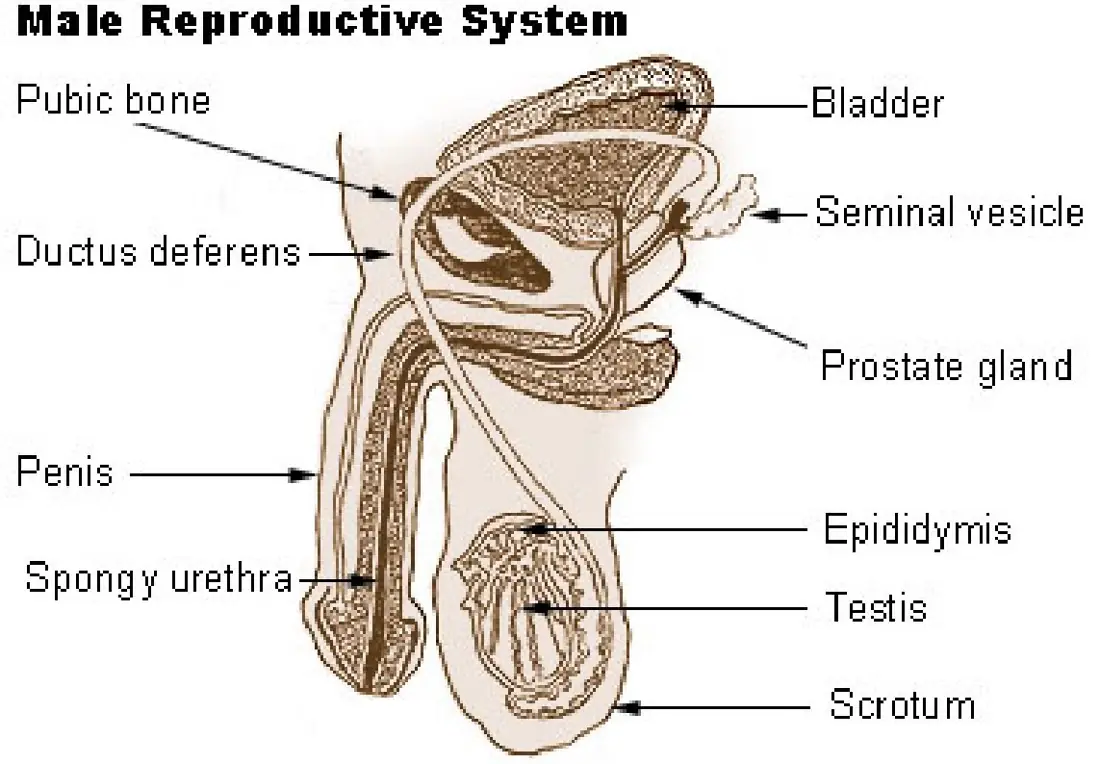
- spermatogenic cells undergo mitosis/meiosis to form sperm;
- Sertoli cells support, nourish and protect developing germ cells, form the blood–testis barrier, and secrete inhibin and androgen-binding protein;
- between tubules, Leydig (interstitial) cells secrete testosterone when stimulated by LH.
Sperm leave through the rete testis and vasa efferentia to the epididymis, a long, tightly coiled duct where they mature, gain motility and are stored. During ejaculation, each vas deferens propels sperm to an ejaculatory duct and then the urethra. Thus a vasectomy, which cuts/seals the vas deferens, prevents sperm reaching semen but does not normally remove the testes' testosterone secretion into blood.
Accessory glands produce most of the volume of semen:
| Gland | Contribution/function |
|---|---|
| Seminal vesicles | fructose-rich fluid providing an energy substrate; prostaglandins and clotting factors |
| Prostate gland | thin secretion with enzymes/citrate/zinc; helps semen liquefaction and sperm function |
| Bulbourethral (Cowper's) glands | clear mucus lubrication and neutralisation of residual urinary acidity |
The penis delivers semen into the vagina. Its urethra is a common passage for urine and semen, though sphincter coordination prevents normal simultaneous flow during ejaculation.
Structure of a sperm
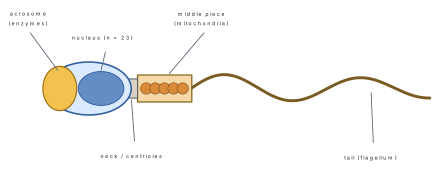
A sperm is a stripped-down delivery vehicle for a haploid nucleus. Its acrosome is a lysosome-like cap containing enzymes for penetrating the oocyte investments. Behind it, the head is mostly compact nucleus. The middle piece contains helically arranged mitochondria supplying ATP to the flagellar axoneme of the tail. Almost all cytoplasm is discarded during maturation—one reason the ovum supplies nearly all cytoplasm and mitochondria to the zygote.
Female reproductive system
The ovaries lie in the pelvic cavity. Each contains follicles at different stages. A mature follicle ruptures at ovulation and then transforms into an endocrine corpus luteum; most follicles instead undergo atresia.
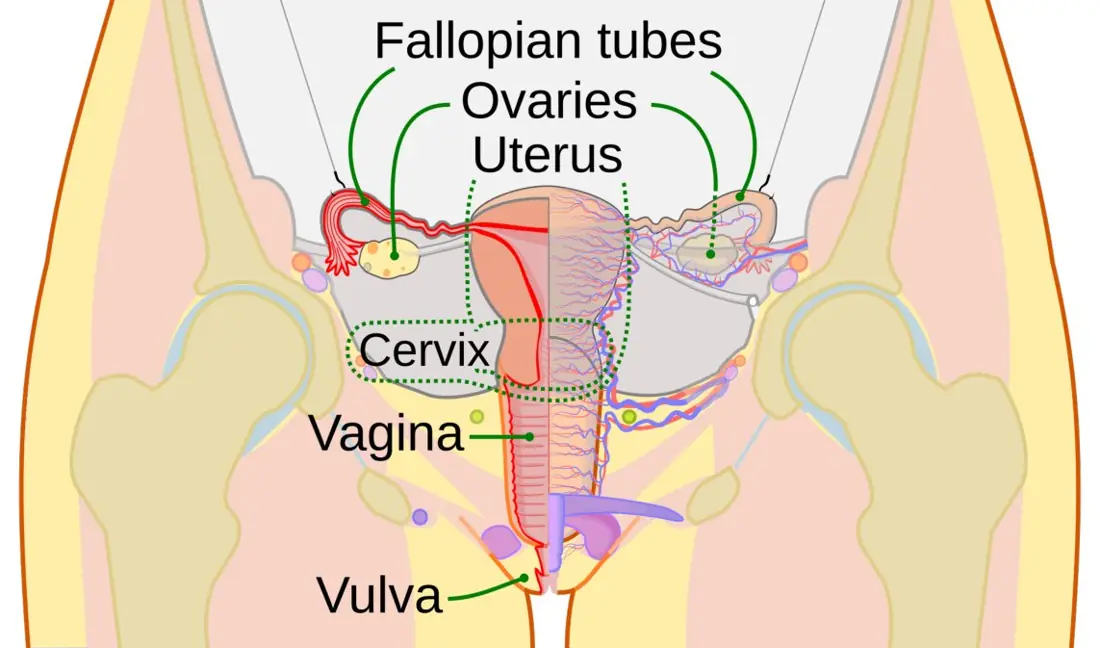
Each uterine (fallopian) tube has:
- Infundibulum with fimbriae that sweep over the ovary and capture the released secondary oocyte.
- Ampulla, the wider middle region and normal site of fertilisation.
- Isthmus, the narrower portion joining the uterus.
Cilia and smooth-muscle contractions move the oocyte/early embryo toward the uterus. A blocked tube can therefore cause infertility even when ovulation is normal, or permit a dangerous tubal (ectopic) implantation.
The uterus has a fundus, body and cervix. Its wall comprises the outer perimetrium, thick smooth-muscle myometrium and inner endometrium. The endometrial functional layer proliferates, becomes secretory, supports implantation or is shed in menstruation. The cervix opens into the vagina, which receives the penis/semen, forms part of the birth canal and conducts menstrual flow. External genitalia are collectively the vulva.
At puberty, gonadotropins activate gonadal hormone production. Testosterone promotes male secondary sexual characters—growth of reproductive organs, facial/body hair, voice deepening and increased muscle mass. Oestrogens promote female reproductive-tract development, breast development and characteristic fat distribution; progesterone principally prepares the uterus and mammary glands for pregnancy/lactation.
Two site-questions the paper repeats: fertilisation happens in the oviduct (ampulla), not the uterus, and implantation happens in the endometrium of the uterus, not the oviduct — an ectopic pregnancy is precisely implantation in the wrong place. And sperm mature in the epididymis, not in the tubules where they are made.
11.2 Gametogenesis
Gametogenesis is gamete formation. It combines proliferation by mitosis, reduction by meiosis and differentiation. Meiosis halves chromosome number from 46 to 23 and creates genetic variation through crossing over and independent assortment.
Spermatogenesis
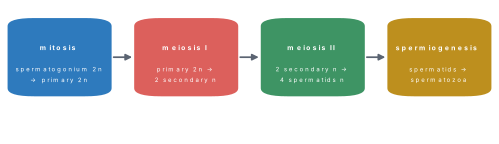
Spermatogenesis begins at puberty and normally continues throughout adult life in the seminiferous tubules. Spermatogonia (2n) divide mitotically; some become primary spermatocytes (2n). Meiosis I forms two secondary spermatocytes (n, duplicated chromosomes), and meiosis II forms four spermatids (n). During spermiogenesis (not another division), each spermatid loses cytoplasm, forms an acrosome and flagellum and becomes a spermatozoon. The complete production process takes roughly two to three months, followed by epididymal maturation.
LH stimulates Leydig cells to secrete testosterone. FSH and high local testosterone act through Sertoli cells to sustain spermatogenesis. Inhibin from Sertoli cells selectively suppresses FSH secretion.
Oogenesis
Oogenesis begins before birth. Fetal oogonia produce primary oocytes that enter meiosis I and arrest in prophase I within primordial follicles. A female is therefore born with a finite oocyte pool—commonly estimated at roughly 1–2 million at birth, falling by atresia to a few hundred thousand by puberty. Only around 400–500 are normally ovulated in a lifetime.
After puberty, a cohort of follicles develops in each cycle. Usually one dominant follicle completes meiosis I just before ovulation, producing:
- a large secondary oocyte, retaining nearly all cytoplasm; and
- a small first polar body.
The secondary oocyte begins meiosis II but arrests at metaphase II and is the cell ovulated. Only if a sperm penetrates it does it complete meiosis II, forming the mature ovum and second polar body. The first polar body may also divide, so one primary oocyte can yield one ovum and up to three polar bodies.
| Feature | Spermatogenesis | Oogenesis |
|---|---|---|
| Site | seminiferous tubules | ovarian follicles |
| Starts | puberty | fetal life |
| Pattern | continuous, enormous numbers | cyclic, usually one dominant oocyte per cycle |
| Cytokinesis | essentially equal | highly unequal |
| Meiotic products | 4 spermatids → 4 sperm | 1 ovum + polar bodies |
| Meiotic arrests | none prolonged | prophase I for years; metaphase II until fertilisation |
| Ends | declines with age, no abrupt universal endpoint | menopause when follicle pool/function is exhausted |
Fertilisation, implantation and gestation
Sperm deposited in the vagina must traverse the cervix and uterus into a uterine tube and undergo capacitation, a final functional maturation in the female tract. At the oocyte, sperm pass through the corona radiata; the acrosome reaction helps penetration of the zona pellucida. Fusion of one sperm triggers cortical-granule release and zona changes that block polyspermy. The secondary oocyte completes meiosis II; male and female pronuclei combine to restore diploidy in the zygote.
Cleavage produces a morula and then a fluid-filled blastocyst. Around 6–7 days after fertilisation, the blastocyst begins implantation in the secretory endometrium. Trophoblast and maternal tissues form the placenta, across which gases, nutrients and wastes exchange by diffusion and transport. Maternal and fetal blood normally remain separate. The placenta also secretes hCG initially and later large amounts of oestrogen and progesterone.
A typical pregnancy lasts about 40 weeks (280 days) from the first day of the last menstrual period, equivalent to about 38 weeks from fertilisation. At parturition, uterine contractions are strengthened by oxytocin in a positive-feedback loop. After birth, prolactin supports milk production and oxytocin causes milk ejection; early colostrum is especially rich in protective antibodies.
How many functional gametes are produced from 50 primary spermatocytes and from 50 primary oocytes?
- Each primary spermatocyte completes both meiotic divisions equally, giving 4 spermatids → 4 sperms. Total = 50 × 4 = 200 sperms.
- In oogenesis the divisions are unequal: each primary oocyte gives only 1 functional ovum (the rest of the material goes to polar bodies). Total = 50 × 1 = 50 ova (plus polar bodies, which degenerate).
Now the variations become one-step: 25 secondary spermatocytes → 25 × 2 = 50 sperms; and "how many polar bodies from 10 primary oocytes" — up to 3 per oocyte (one from meiosis I, which may itself divide, and one from meiosis II), so a maximum of 30.
Fertilisation occurs in the ampulla of the fallopian (uterine) tube, not in the uterus. Sperms are produced in the seminiferous tubules but mature and are stored in the epididymis. Sertoli cells nourish the developing sperms and secrete inhibin; Leydig (interstitial) cells secrete testosterone — MCQs routinely exchange these two.
11.3 The ovarian and menstrual cycles
The ovarian cycle (follicle growth, ovulation and corpus luteum) and uterine/ menstrual cycle (endometrial change) are two views of one hormonal sequence. Day 1 is defined as the first day of menstrual bleeding. A 28-day cycle is a teaching average; healthy adult cycles commonly vary, and much of the variation lies in the pre-ovulatory follicular phase.
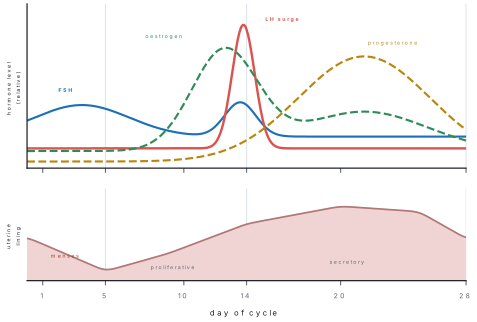
Phases of an idealised 28-day cycle
| Phase | Typical days | Ovary/hormones | Uterine event |
|---|---|---|---|
| Menstrual | 1–5 | corpus luteum has regressed; oestrogen/progesterone low | functional endometrium sheds |
| Follicular/proliferative | about 6–13 | FSH recruits follicles; dominant follicle secretes rising oestrogen | endometrium regrows and thickens |
| Ovulatory | about 14 | sustained high oestrogen switches to positive feedback; LH surge (with smaller FSH rise) | follicle ruptures; secondary oocyte released |
| Luteal/secretory | about 15–28 | corpus luteum secretes progesterone plus oestrogen | glands secrete, vessels coil; lining prepared for implantation |
If pregnancy does not occur, the corpus luteum regresses to a corpus albicans. Progesterone/oestrogen withdrawal causes endometrial breakdown and releases the hypothalamus/pituitary from negative feedback, allowing FSH to rise for a new cycle. If implantation occurs, trophoblast hCG maintains the corpus luteum until the placenta can produce enough steroid hormones.
The released oocyte is fertilisable for roughly a day, while sperm may survive in the female tract for up to about five days. The biologically fertile window therefore spans several days ending soon after ovulation. Cycle-day estimates are averages, not precise individual predictions.
The luteal phase is often about 14 days and is usually less variable than the follicular phase. For a regular 32-day cycle, ovulation is estimated at
not automatically day 14. With sperm survival up to five days and oocyte survival about one day, the approximate fertile interval would be days 13–19. This calculation teaches the physiology; it is not a guarantee for an individual cycle.
Menarche is the first menstruation, marking pubertal activation of the hypothalamo-pituitary-ovarian axis. Menopause is permanent cessation of menstruation after ovarian follicular activity is lost, commonly around the late forties to early fifties. As ovarian oestrogen and inhibin fall, loss of negative feedback allows FSH (and LH) to become persistently high.
The luteal (post-ovulatory) phase is nearly constant at about 14 days; it is the follicular phase that varies. So ovulation day ≈ cycle length − 14.
- 28-day cycle → ovulation about day 14.
- 35-day cycle → ovulation about day 21.
- 24-day cycle → ovulation about day 10.
Notice the trap in the second case: answering "day 14" for every cycle length ignores that the extra days lengthen the follicular phase, not the luteal phase.
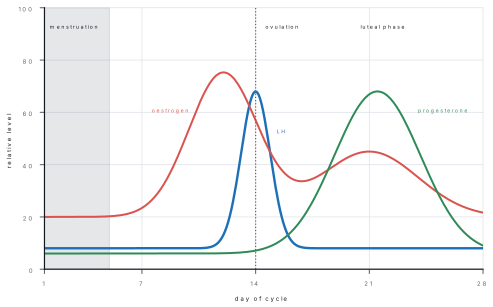
Problem. One woman's cycles run 32 days, another's 26. On which day does each ovulate? Solution. The luteal phase is the fixed half at ~14 days, so ovulation falls 14 days before the next period: 32 − 14 = day 18, and 26 − 14 = day 12. Counting 14 from the start is the classic error — only a 28-day cycle ovulates on day 14.
FSH grows the follicle; oestrogen builds the lining; LH bursts the follicle on day 14; progesterone holds the lining; the fall of both menstruates it. Five verbs, one cycle.
Cycle questions collapse to one identity: ovulation = cycle length − 14. And gametogenesis questions collapse to two numbers: 4 sperm per spermatogonium, 1 ovum (+3 polar bodies) per oogonium.
Formula and fact sheet
- Sperm pathway: seminiferous tubule → rete testis → epididymis → vas deferens → ejaculatory duct → urethra.
- Sertoli = support/nurse/inhibin; Leydig = testosterone; LH acts on Leydig cells.
- Scrotal testes are about 2–2.5 °C cooler than the body core.
- Sperm head = acrosome + haploid nucleus; midpiece = mitochondria; tail = motility.
- Fertilisation: ampulla. Implantation: endometrium. Muscular uterine coat: myometrium.
- One primary spermatocyte → 4 sperm. One primary oocyte → 1 ovum + up to 3 polar bodies.
- Ovulated cell = secondary oocyte arrested in metaphase II.
- FSH grows follicles; oestrogen proliferates endometrium; LH surge ovulates; progesterone makes endometrium secretory.
- hCG maintains the corpus luteum in early pregnancy.
- Gestation ≈ 280 days from last menstrual period.
- Prolactin = milk production; oxytocin = milk ejection and uterine contraction.
Rapid-revision tables and high-yield facts
| Quantity | Value |
|---|---|
| Scrotal temperature | ~2–3 °C below core |
| Spermatogenesis time / output | ~64 days / 4 sperm per spermatogonium |
| Ejaculate | 3–5 mL, 200–300 million sperm, pH ~7.2–7.8 |
| Oogenesis output | 1 ovum + 3 polar bodies per oogonium |
| Ovulations per lifetime | ~400–450 |
| Ovulation day | cycle length − 14 (day 14 if 28-day) |
| Fertilisation site / implantation site | oviduct ampulla / uterine endometrium |
| Egg viable / sperm viable | ~12–24 h / ~3–5 days |
| Pregnancy hormone (test) | hCG from the embryo |
| Menopause | ~45–50 years |
Chapter summary
- The testes produce sperm in seminiferous tubules under FSH, testosterone and Sertoli-cell support; Leydig cells supply testosterone.
- Sperm mature and are stored in the epididymis, then travel through the vas deferens and urethra in semen produced mainly by accessory glands.
- The ovaries produce oocytes and steroid hormones; uterine tubes capture the oocyte and normally host fertilisation in the ampulla.
- Spermatogenesis is continuous and quantitatively equal, whereas oogenesis begins before birth, is interrupted twice and conserves cytoplasm in one ovum.
- Fertilisation restores diploidy, blocks polyspermy and initiates cleavage; the blastocyst implants in a progesterone-prepared endometrium.
- The menstrual cycle is driven by changing feedback among GnRH, FSH/LH, oestrogen and progesterone.
- Ovulation follows the LH surge, and the corpus luteum either regresses— causing menstruation—or is rescued by hCG in pregnancy.
Practice questions
Set A — Recall (25 questions)
- The primary male reproductive organs are theatestesbseminal vesiclescprostate glandsdepididymides
- Spermatozoa are produced in theavas deferensbseminiferous tubulescepididymisdurethra
- Developing germ cells are nourished and supported byaLeydig cellsbspermatogoniacSertoli cellsdacrosomal cells
- Testosterone is secreted by theaSertoli cellsbepididymiscprostate glanddLeydig cells
- Spermatozoa mature and are stored mainly in theaseminiferous tubulebepididymiscseminal vesicledurethra
- Most fructose in human semen is supplied by theaprostate glandbtestescbulbourethral glandsdseminal vesicles
- Enzymes that help a sperm penetrate oocyte coverings are stored in theamidpiecebacrosomectaildcentriole
- Mitochondria supplying ATP for sperm movement are concentrated in theaheadbacrosomecneck onlydmiddle piece
- The female gonads are theauterine tubesbuterus and cervixcovariesdmammary glands
- Fertilisation in humans normally occurs in theaovarybuteruscvaginadampulla of uterine tube
- The blastocyst normally implants in theamyometriumbperimetriumcendometriumdcervix
- The thick muscular layer of the uterus is theamyometriumbendometriumcperimetriumdmesometrium
- Spermatogenesis normally begins atabirthbpubertycfertilisationdold age
- One primary spermatocyte ultimately producesafour spermatozoabtwo spermatozoacone spermatozoondeight spermatozoa
- Oogenesis begins duringafetal lifebpubertycpregnancydmenopause
- The cell released at ovulation is aaprimary oocytebmature ovumcsecondary oocytedpolar body
- Complete oogenesis from one primary oocyte givesaone ovum and polar bodiesbfour equal ovactwo ova onlydeight ova
- Day 1 of the menstrual cycle is the first day ofaovulationbmenstrual bleedingcfertilisationdimplantation
- Ovulation is triggered most directly by a surge ofaprogesteronebLHcprolactindinhibin
- The corpus luteum secretes large amounts ofatestosteronebFSHcprogesteronedhCG
- The proliferative rebuilding of endometrium is stimulated mainly byaoestrogenbprogesteronecprolactindoxytocin
- The hormone detected by most early pregnancy tests isaLHbFSHcprolactindhCG
- Permanent cessation of menstrual cycles is calledamenarchebpubertycmenopausedimplantation
- A normal human sperm contains how many chromosomes?a46b23c22d44
- Exchange between maternal and fetal circulations occurs across theaamnion onlybcervixccorpus luteumdplacenta
Answers and explanations — Set A
1. (a) — Testes are the male gonads producing sperm and testosterone.
2. (b) — Spermatogenesis occurs in seminiferous tubules.
3. (c) — Sertoli cells are the nurse/support cells of the tubule.
4. (d) — Interstitial Leydig cells secrete testosterone under LH.
5. (b) — The epididymis is the main site of sperm maturation and storage.
6. (d) — Seminal-vesicle fluid is rich in fructose.
7. (b) — The acrosome contains enzymes used in the acrosome reaction.
8. (d) — Middle-piece mitochondria power the flagellum.
9. (c) — Ovaries produce oocytes and female sex steroids.
10. (d) — The ampulla of the uterine tube is the normal fertilisation site.
11. (c) — Implantation occurs in the secretory endometrium.
12. (a) — Myometrium is the smooth-muscle coat of the uterus.
13. (b) — Continuous spermatogenesis starts with pubertal gonadotropin activation.
14. (a) — Two meiotic divisions and spermiogenesis yield four sperm.
15. (a) — Primary oocytes form and arrest before birth.
16. (c) — A secondary oocyte arrested in metaphase II is ovulated.
17. (a) — Unequal cytokinesis gives one large ovum and small polar bodies.
18. (b) — Menstrual-cycle dating begins with the first day of bleeding.
19. (b) — The mid-cycle LH surge ruptures the dominant follicle.
20. (c) — Corpus-luteum progesterone dominates the luteal phase.
21. (a) — Follicular oestrogen rebuilds the endometrium after menstruation.
22. (d) — hCG from trophoblast tissue enters maternal blood and urine.
23. (c) — Menopause is permanent loss of ovarian cyclic activity.
24. (b) — Meiosis makes sperm haploid with 23 chromosomes.
25. (d) — Placental villi provide the exchange surface without normally mixing blood.
Set B — Understanding (15 questions)
- The testes are held in the scrotum because spermatogenesis requires a temperatureaequal to core temperaturebbelow core body temperaturecabove fever temperaturedindependent of blood flow
- Unequal division in oogenesis is advantageous because it preserves in one cell most of theacytoplasm and stored resourcesbpaternal chromosomescsperm mitochondriadfollicular fluid
- Millions of sperm are ejaculated although only one fertilises becauseaevery sperm must enter the ovumbmeiosis occurs in the uteruscmost are lost or fail during transportdthe ovum contains millions of nuclei
- Calling the ovulated cell a mature ovum is inaccurate because it has not yet completedamitosis in the folliclebits first meiotic divisioncmeiosis IIdimplantation
- Early in the follicular phase, FSH primarily causesamenstruationbcorpus-luteum formationcmilk secretiondfollicle growth and oestrogen production
- A sustained high oestrogen level just before ovulation triggers the LH surge byapositive feedback on the pituitary/hypothalamusbdestroying GnRH receptorscconverting FSH into progesteronedblocking all gonadotropins
- Regression of the corpus luteum initiates menstruation mainly through withdrawal ofahCGbtestosteronecprolactindprogesterone and oestrogen
- hCG is useful in pregnancy testing because it is produced by early trophoblast and appears in maternalablood and urinebsemen onlyccerebrospinal fluid onlydmenstrual fluid only
- Seminal fructose and mildly alkaline fluid respectively help sperm by providingachromosomes and enzymesbenergy substrate and protection from aciditycoxygen and mitochondriadhormones and antibodies
- After vasectomy, masculine characters usually remain normal because the testes stillarelease sperm into bloodbsecrete testosterone into bloodcstore semen in the bladderdproduce oestrogen only
- Bilateral blockage of uterine tubes can cause infertility despite normal ovulation becauseaeggs become diploidbthe uterus stops contractingcsperm and oocyte cannot meet normallydFSH cannot enter blood
- Which pairing correctly distinguishes milk production from milk ejection?aoxytocin produces; prolactin ejectsbADH produces; oxytocin ejectscprolactin produces; insulin ejectsdprolactin produces; oxytocin ejects
- Maternal and fetal materials exchange in the placenta without wholesale mixing because transfer occurs acrossaplacental barrier surfaces by diffusion/transportbopen holes between arteriescthe fetal digestive tractdthe maternal spinal cord
- FSH is typically high after menopause because falling ovarian hormones reduceahypothalamic blood flowbsperm productioncnegative feedback on the pituitarydthe number of chromosomes
- During the secretory phase, progesterone makes the endometriumashed immediatelybglandular, vascular and receptive to implantationcconvert into myometriumdinsensitive to all hormones
Answers and explanations — Set B
1. (b) — Scrotal positioning/thermoregulation keeps testes cooler than the abdomen.
2. (a) — The ovum retains cytoplasm, organelles and reserves needed before implantation.
3. (c) — Attrition in the female tract is enormous; numbers compensate for loss and transport barriers.
4. (c) — The ovulated secondary oocyte is arrested in metaphase II.
5. (d) — FSH recruits/grows follicles and stimulates granulosa-cell oestrogen synthesis.
6. (a) — Sustained high oestrogen switches from negative to positive feedback at mid-cycle.
7. (d) — Loss of luteal steroids destabilises and sheds the functional endometrium.
8. (a) — Implanting trophoblast secretes hCG that reaches blood and is excreted in urine.
9. (b) — Fructose fuels sperm; seminal fluid buffers the acidic vaginal environment.
10. (b) — Vasectomy blocks the duct path, not endocrine release from Leydig cells.
11. (c) — Tubal transport is necessary for fertilisation and embryo passage to the uterus.
12. (d) — Prolactin supports synthesis; oxytocin contracts myoepithelial cells for ejection.
13. (a) — Exchange occurs across fetal capillary/trophoblast surfaces bathed by maternal blood.
14. (c) — Low oestrogen/inhibin after menopause removes feedback restraint on FSH.
15. (b) — Progesterone converts the proliferated lining into a secretory, implantation-ready tissue.
Set C — Application (10 questions)
- A semen sample has volume 3.0 mL and concentration 80 million sperm/mL. The total sperm number isa80 millionb240 millionc27 milliond800 million
- How many spermatozoa can form from 25 primary spermatocytes, assuming all divisions succeed?a25b50c75d100
- Ten primary oocytes complete oogenesis after fertilisation. The maximum yield isa40 ova and no polar bodiesb20 ova and 20 polar bodiesc10 ova and 30 polar bodiesd10 ova and 10 polar bodies
- In a regular 35-day cycle with an approximately 14-day luteal phase, ovulation is expected near daya14b21c28d35
- If the first day of the last menstrual period is 1 January 2026, the 280-day estimated due date isa28 September 2026b1 October 2026c15 October 2026d8 October 2026
- A man has no sperm in semen after an operation, but testosterone and libido remain normal. The operation most likely blocked theavas deferensbseminiferous tubule blood supplycpituitary portal vesselsdLeydig-cell ducts
- An embryo implants and begins growing inside a uterine tube. This is anaectopic pregnancybnormal implantationccorpus albicansdmenarche event
- Blood sampled immediately before ovulation should show the patternalow oestrogen, low LH, high progesteronebhigh oestrogen, rapidly rising LH, low progesteronechigh progesterone and low FSH/LHdhigh hCG before implantation
- Surgical loss of the corpus luteum very early in pregnancy, before placental steroid production is adequate, threatens pregnancy chiefly through loss ofasperm capacitationbfetal testosteronecprolactin onlydprogesterone support of endometrium
- If about 400 follicles ovulate from a pubertal pool of 400,000, the percentage ovulated isa1.0%b0.01%c0.1%d10%
Answers and explanations — Set C
1. (b) — Total sperm = 3.0\times80=240 million.
2. (d) — Each primary spermatocyte yields four sperm: 25\times4=100.
3. (c) — Each primary oocyte yields one ovum and up to three polar bodies.
4. (b) — Ovulation is approximately 35-14=21 days after cycle day 1.
5. (d) — 1 January plus 280 days in non-leap year 2026 is 8 October.
6. (a) — A vasectomy interrupts sperm transport while testicular endocrine function continues.
7. (a) — Implantation outside the uterine cavity, most often tubal, is ectopic pregnancy.
8. (b) — The LH surge follows sustained high follicular oestrogen while progesterone has not yet risen substantially.
9. (d) — Early pregnancy depends on luteal progesterone before the luteoplacental shift.
10. (c) — (400/400000)\times100=0.1\%; most follicles undergo atresia.