Chapter 12 · Applied Zoology · 4 questions in the paper · 25 min read
Microbial Diseases and Immunology
What the syllabus asks for 3
- Typhoid, tuberculosis, HIV/AIDS, cholera, influenza, hepatitis and candidiasis
- Innate and acquired immunity; antigens and antibodies
- Vaccines: live attenuated, inactivated and toxoid
Microbial diseases and immunology are rated at 4 questions—the largest single block in Applied Zoology. The paper repeatedly tests a four-part chain: agent → transmission → cardinal feature → prevention. It then asks for the logic of immunity: innate versus adaptive, B cells versus T cells, antibody classes, and why a booster or a secondary exposure produces a much stronger response than the first encounter.
- Typhoid: Salmonella Typhi, faecal–oral, chronic gall-bladder carriage. TB: Mycobacterium tuberculosis, airborne, acid-fast mycolic-acid wall, BCG is live attenuated M. bovis.
- Cholera: Vibrio cholerae, toxin-driven “rice-water” diarrhoea; immediate risk is dehydration and the key treatment principle is rehydration.
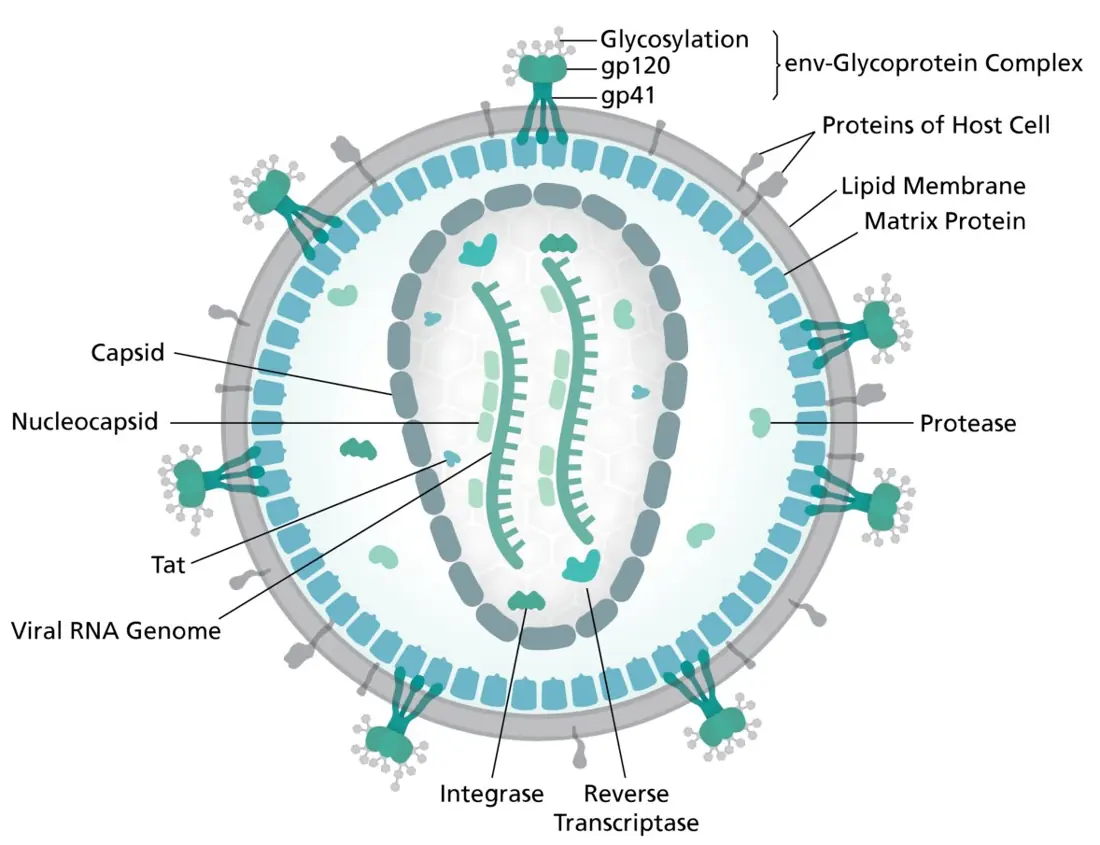
- HIV is an RNA retrovirus that destroys CD4 helper T cells; AIDS is the late immunodeficiency stage, classically CD4 below 200 cells mm⁻³ or an AIDS-defining illness.
- Influenza changes by antigenic drift (small mutations) and shift (major reassortment). Hepatitis A/E are mainly faecal–oral; B/C are mainly blood-borne and may become chronic.
- Candidiasis is an opportunistic fungal infection by Candida albicans, often part of normal microbiota until host control or microbial balance fails.
- IgM is first in a primary response; IgG dominates secondary responses and crosses the placenta; IgA protects secretions; IgE is linked to allergy.
- Vaccination produces artificial active immunity. Live attenuated vaccines replicate weakly; inactivated vaccines cannot replicate; toxoids are inactivated toxins.
12.1 Typhoid, tuberculosis, HIV/AIDS, cholera, influenza, hepatitis and candidiasis
A pathogen is a microorganism or virus capable of causing disease in a susceptible host. Infection means entry and multiplication; disease means that infection or its toxins/immune consequences damage function enough to cause signs and symptoms. Infection can therefore be asymptomatic, latent or carried transmissibly without present illness.
| Agent group | Organisation | Chapter examples | Main attack principle |
|---|---|---|---|
| Bacteria | prokaryotic cells, 70S ribosomes, cell wall | typhoid, TB, cholera | antibiotics can exploit bacterial structures/processes |
| Viruses | acellular nucleic acid + protein coat, sometimes envelope | HIV, influenza, viral hepatitis | vaccination and specific antivirals; antibiotics do not act on viruses |
| Fungi | eukaryotic cells, often chitinous wall | candidiasis | antifungal drugs target fungal membranes/walls/metabolism |
Transmission may be airborne/droplet, faecal–oral, blood/sexual, direct contact, vector-borne, vertical (mother to child), or from the environment. Prevention follows the route: interrupt that chain while treating the patient.
Seven named diseases at examination depth
| Disease | Agent and transmission | Features/mechanism to recognise | Prevention or control |
|---|---|---|---|
| Typhoid (enteric fever) | Salmonella enterica serovar Typhi; Gram-negative bacillus; contaminated food/water and human carriers | sustained/stepwise fever, headache, abdominal pain, constipation or diarrhoea, rose spots, possible intestinal bleeding/perforation; bacteria may persist in gall bladder | safe water, sanitation, food hygiene, typhoid conjugate vaccine (TCV); appropriate antibiotics because resistance occurs |
| Tuberculosis | Mycobacterium tuberculosis; airborne droplet nuclei from pulmonary/laryngeal TB | cough longer than 2 weeks, fever/night sweats, weight loss, haemoptysis; granuloma/caseous necrosis; latent infection may reactivate | BCG in infants, ventilation/masks, rapid diagnosis and complete combination therapy/DOTS strategy |
| HIV/AIDS | HIV-1/HIV-2, enveloped RNA retroviruses; sexual fluids, blood/sharing injecting equipment, mother to child | gp120 binds CD4/co-receptor; reverse transcriptase makes DNA and integrase inserts a provirus; progressive helper-T loss → opportunistic infections/cancers | safer sex, sterile equipment, screened blood, PrEP/PEP where indicated, maternal/infant prophylaxis, antiretroviral therapy (ART) |
| Cholera | Vibrio cholerae O1/O139; comma-shaped Gram-negative bacterium; faecal–oral/water | cholera toxin locks intestinal signalling on, causing massive Cl⁻ and water secretion; painless rice-water stools, vomiting, shock from dehydration | safe water/sanitation, oral cholera vaccine; immediate oral/IV rehydration saves life, antibiotics only adjuncts in selected severe cases |
| Influenza | influenza A/B viruses; segmented RNA genome, haemagglutinin (H) and neuraminidase (N); droplets/aerosols/contact | abrupt fever, myalgia, headache, cough/sore throat; drift causes seasonal change, shift may create pandemics | annual strain-matched vaccination, ventilation, respiratory hygiene; antivirals are most useful early/for high-risk patients |
| Viral hepatitis | HAV–HEV (details below) | liver inflammation: fatigue, nausea, right-upper-abdominal discomfort, dark urine and jaundice; outcome depends on virus | route-specific: WASH for A/E; HBV vaccination and blood/sexual precautions for B/C |
| Candidiasis | mainly Candida albicans, a dimorphic yeast; usually endogenous/opportunistic | oral white plaques (thrush), vulvovaginal itching/discharge, skin-fold infection; invasive blood infection in severely ill/immunocompromised hosts | control diabetes/immunosuppression, judicious antibiotics/steroids, catheter care; antifungal treatment |
Three disease mechanisms students confuse
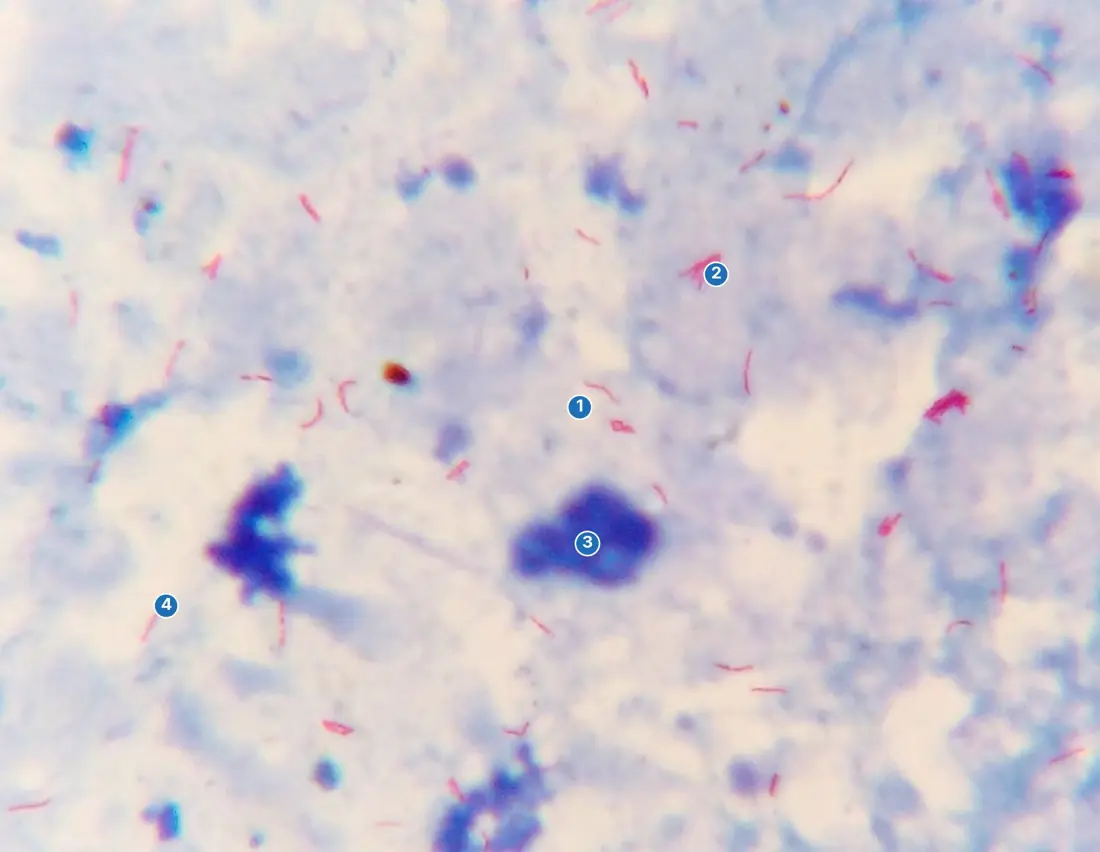
Tuberculosis and acid-fastness. The mycobacterial wall is rich in waxy mycolic acids. In the Ziehl–Neelsen stain, hot carbol fuchsin enters this wall and resists acid–alcohol decolourisation, so bacilli remain red on a blue counterstain—hence acid-fast bacilli (AFB). The wall also contributes to slow growth and survival inside macrophages. BCG is live attenuated Mycobacterium bovis, especially useful against severe childhood forms such as miliary TB and TB meningitis; protection against adult pulmonary TB varies.
Typhoid carriage. Salmonella Typhi is adapted to humans. After recovery, some people continue to harbour bacteria in the gall bladder and shed them in faeces. Such a chronic carrier can contaminate food while feeling well— explaining why sanitation and food-handler hygiene matter after symptoms end.
Cholera is mainly a secretory, toxin-mediated loss of fluid. The bacteria usually do not need to invade the blood to kill. Their toxin raises cyclic AMP in enterocytes and opens chloride channels; Na⁺ and water follow into the gut. ORS works because intestinal Na⁺–glucose co-transport remains functional: absorbed solute drags water back across the mucosa.
HIV and the progression to AIDS
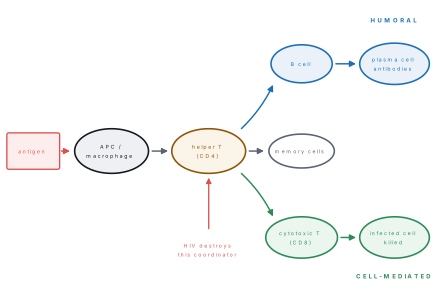
HIV carries RNA plus reverse transcriptase, integrase and protease. It infects CD4-bearing helper T cells and some other immune cells. Because helper T cells coordinate both antibody production and cytotoxic responses, their loss progressively disables both arms of adaptive immunity. Acute infection may resemble a flu-like illness. A long clinical-latency phase follows while viral replication and immune damage continue. AIDS is the advanced stage, not a separate virus.
HIV is not transmitted by casual touch, sharing food, coughing, toilets or mosquito bites. ART does not normally eradicate integrated latent provirus, but sustained suppression restores immune function, prevents AIDS, and a person with a sustained undetectable viral load does not sexually transmit HIV (“undetectable = untransmittable” for sexual transmission).
Influenza: drift versus shift
- Antigenic drift: gradual point mutations in haemagglutinin/neuraminidase during replication; population immunity becomes less well matched; seasonal epidemics and annual vaccine updates follow.
- Antigenic shift: abrupt reassortment of genome segments when two influenza A viruses infect one cell; a substantially new H/N combination may meet little population immunity and cause a pandemic.
Hepatitis: one word, several viruses
| Virus | Genome/route | Chronic infection? | Distinctive point |
|---|---|---|---|
| HAV | RNA; faecal–oral | no | acute, vaccine-preventable |
| HBV | partly double-stranded DNA; blood, sex, perinatal | yes | chronic hepatitis → cirrhosis/hepatocellular carcinoma; recombinant HBsAg vaccine |
| HCV | RNA; mainly blood | commonly | no licensed vaccine; modern direct-acting antivirals can cure most infections |
| HDV | defective RNA agent | only with HBV | requires hepatitis B surface antigen to assemble |
| HEV | RNA; mainly waterborne faecal–oral (some genotypes zoonotic/food-borne) | usually no in immunocompetent people | can be especially severe in pregnancy |
Jaundice reflects bilirubin accumulation and is a sign, not by itself a complete diagnosis: the viral type and route determine prognosis and control.
Candidiasis as an opportunistic infection
Candida albicans commonly lives harmlessly on mucosae. Disease emerges when barriers break, competing bacteria are suppressed by broad-spectrum antibiotics, glucose is poorly controlled, steroids/chemotherapy suppress immunity, neutrophils fall, or HIV lowers CD4 numbers. Oral candidiasis in an adult without a local explanation is therefore an important clue to immune suppression. Candida is a fungus; antibacterial antibiotics do not treat it.
Three route-traps the paper sets: hepatitis A and E travel by food and water, B and C by blood — swapping them is the classic error; HIV is not spread by mosquitoes, shared meals, handshake or toilet seats; and cholera kills by dehydration, not by tissue invasion — the bacterium stays in the gut lumen while its toxin does the damage.
12.2 Innate and acquired immunity; antigens and antibodies
Immunity is the capacity to resist infection and limit damage. It has innate mechanisms present before exposure and adaptive mechanisms that learn from exposure.
Innate immunity: immediate, broad and non-specific
- Physical/chemical barriers: intact skin, mucus and cilia, tears and lysozyme, acidic stomach/vagina, antimicrobial peptides, normal microbiota.
- Phagocytes: neutrophils and macrophages engulf microbes and debris.
- Inflammation: histamine and other mediators increase blood flow and vascular permeability, producing redness, heat, swelling and pain while delivering cells and plasma proteins.
- Complement and interferons: complement opsonises microbes, recruits cells and can lyse membranes; interferons warn neighbouring cells against viruses.
- Natural killer cells: kill stressed/virus-infected cells without prior antigen-specific sensitisation.
Innate immunity responds within minutes to hours but has no conventional immunological memory.
Acquired/adaptive immunity: specific and remembered
Adaptive immunity is mediated by lymphocytes. B cells mature mainly in bone marrow; T cells mature in the thymus. Antigen-presenting cells such as dendritic cells and macrophages display peptide fragments to T cells.
- Humoral immunity: activated B cells proliferate into plasma cells that secrete antibodies and memory B cells. It is especially effective against extracellular microbes and toxins.
- Cell-mediated immunity: helper T cells (CD4) coordinate/cytokine-help; cytotoxic T cells (CD8) kill infected or abnormal body cells. It is vital against intracellular pathogens and in transplant rejection.
Antigens and antibodies
An antigen is a molecule or molecular pattern specifically recognised by an antibody, B-cell receptor or T-cell receptor. The precise region bound is an epitope/antigenic determinant. A large molecule may carry many epitopes. T cells usually recognise short peptide epitopes presented by MHC molecules, whereas antibodies can bind shapes on intact molecules.
An antibody (immunoglobulin) is a Y-shaped glycoprotein made of two heavy and two light chains. The variable tips of the two arms (Fab regions) bind antigen; the stem (Fc) interacts with phagocytes/complement. Antibodies protect by:
- neutralising toxins and blocking viral attachment;
- opsonising particles for phagocytosis;
- agglutinating/precipitating antigens into easier-to-clear complexes;
- activating complement; and
- directing antibody-dependent cellular cytotoxicity.
| Class | School-level identity |
|---|---|
| IgG | most abundant in blood/tissue fluids; main secondary-response antibody; only class that crosses human placenta in quantity |
| IgM | large pentamer; first prominent antibody in a primary response; strong agglutination/complement activation |
| IgA | dimeric in secretions—tears, saliva, mucus, colostrum/breast milk; mucosal protection |
| IgE | binds mast cells/basophils; allergy and defence against some parasites |
| IgD | mainly a receptor on naïve B cells; low serum concentration |
Primary and secondary responses; active and passive immunity
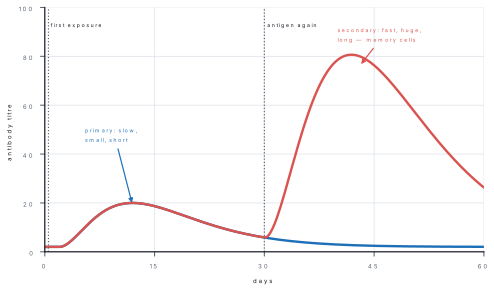
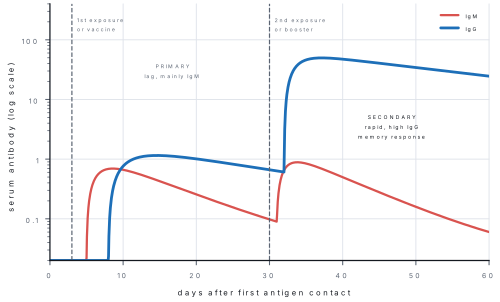
On first exposure, rare matching lymphocytes must expand, so there is a lag of several days; IgM appears first and total antibody is relatively modest. On re-exposure, memory cells respond within 1–3 days, antibody rises much higher and lasts longer, IgG predominates, and affinity is improved.
| Type | How obtained | Onset/duration/memory |
|---|---|---|
| Natural active | recovery from infection | delayed; often long; memory yes |
| Artificial active | vaccination | delayed; long; memory yes |
| Natural passive | IgG across placenta; IgA in colostrum/milk | immediate; temporary; no recipient memory |
| Artificial passive | antiserum, immunoglobulin, antivenom | immediate; short; no memory |
A graph shows antibody concentration against time: after the first injection of antigen the curve climbs slowly to a modest peak over ~2 weeks, then falls; after a second injection months later it rises within days to a much higher, longer peak. Analyse it the CEE way:
- The slow, low curve is the primary response — naive B-cells are being selected and cloned; IgM appears first.
- The fast, high curve is the secondary response — memory B-cells formed earlier now respond, switching mainly to IgG; this is why booster doses work and why most childhood diseases strike only once.
- Any option saying the second peak is high "because more antigen was injected" misses the point: memory, not dose, is the difference.
Vaccines give antigen (live-attenuated, killed, or toxoid) and produce slow-onset, long-lasting active immunity; antisera/immunoglobulin give ready-made antibody (e.g. anti-tetanus serum, anti-snake venom) and produce immediate but short-lived passive immunity. The same confusion hides in "mother to baby": IgG crosses the placenta, while breast milk (colostrum) supplies IgA — both passive, neither a vaccine.
12.3 Vaccines: live attenuated, inactivated and toxoid
A vaccine presents antigen in a controlled way so the adaptive system makes memory without the danger of natural disease. The three syllabus types are the foundation; modern subunit/conjugate/recombinant/vector/mRNA products use the same immunological logic.
| Type | Construction and behaviour | Examples | Strengths/cautions |
|---|---|---|---|
| Live attenuated | weakened live organism replicates to a limited extent | BCG, oral polio vaccine, measles–rubella | strong, broad and often long-lived humoral + cellular response; usually avoided in pregnancy/severe immunodeficiency |
| Inactivated/killed | whole organism destroyed by heat/chemicals/radiation; cannot replicate | inactivated polio (IPV), hepatitis A, rabies cell-culture vaccine | safer where replication is unacceptable; often needs adjuvant and booster doses |
| Toxoid | bacterial exotoxin chemically inactivated while retaining epitopes | tetanus toxoid, diphtheria toxoid | protects against toxin-mediated damage; boosters needed |
| Subunit/recombinant/conjugate | selected antigen, sometimes attached to a carrier protein | hepatitis B HBsAg, HPV, Hib, typhoid conjugate vaccine | focused safety; conjugation converts weak polysaccharide responses into T-dependent memory in infants |
Adjuvants enhance antigen presentation and inflammation so less antigen/more durable memory can result. A booster is not a new primary lesson; it recalls and expands memory clones, increasing antibody level and affinity.
Herd immunity
When enough hosts are immune, an infectious person is likely to meet immune rather than susceptible contacts, so chains of transmission die out. This indirectly protects infants, people being treated for cancer and others who cannot be vaccinated or respond poorly.
For a homogeneously mixing population, the immune fraction at which each case replaces itself on average is
If measles in a fully susceptible population has R_0=15,
If vaccine effectiveness were 95%, the perfectly uniform coverage required in this simplified model would be 0.933/0.95\approx98.2\%. Real populations mix unevenly, so pockets of low coverage can sustain outbreaks below a reassuring national average.
An inactivated vaccine contains no replication-competent organism. Sore arm, fever or malaise can still occur because innate immune activation itself produces inflammatory symptoms. Conversely, live vaccines are usually safe in healthy people but require caution when immune control of even a weakened organism is unreliable.
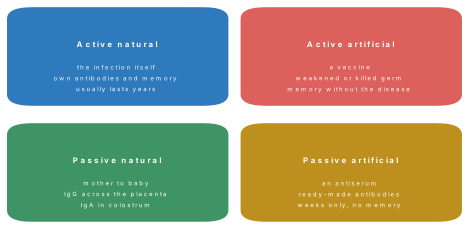
Active = taught (memory stays); passive = borrowed (fades in weeks). Natural = life provides; artificial = medicine provides. Four boxes, two questions each: who taught, and who made the antibody.
Problem. A disease with R₀ = 3 (each case infects three people in a susceptible population) meets a vaccine. What vaccination coverage breaks transmission? What about measles, with R₀ = 15? Solution. Threshold = 1 − 1/R₀: for R₀ = 3, 1 − 1/3 = 66.7 %; for measles, 1 − 1/15 = 93.3 %. The more infectious the germ, the higher the wall of immunity it must meet — which is why measles returns first wherever coverage slips.
Sort the vaccine shelf by what is in the vial: a live but crippled germ (attenuated), a dead germ (inactivated), a detoxified toxin (toxoid), or a single piece (subunit). BCG and MMR are live; Salk polio and rabies are killed; tetanus and diphtheria are toxoids; hepatitis B is a subunit.
Formula and fact sheet
- Typhoid—Salmonella Typhi; TB—Mycobacterium tuberculosis; cholera—Vibrio cholerae; candidiasis—Candida albicans.
- HIV—RNA retrovirus, gp120/CD4, reverse transcriptase, provirus, ART; AIDS is advanced immunodeficiency.
- Influenza drift = mutations; shift = reassortment of segmented genome.
- Hepatitis A/E = faecal–oral/acute; B/C = blood-borne/possibly chronic; D requires B. HBV is a DNA virus.
- Acid-fast stain: red mycobacteria on blue background; cause = mycolic acids.
- Innate = immediate/non-specific/no memory. Adaptive = specific, clonal, memory.
- B cells/plasma cells make antibodies; CD4 cells help; CD8 cells kill infected cells.
- IgM first/largest; IgG secondary/placental; IgA secretions; IgE allergy; IgD B-cell receptor.
- Active immunity makes memory (slow); passive gives ready antibodies (fast, short).
- Live attenuated: BCG/OPV/MR. Inactivated: IPV/HAV/rabies. Toxoid: tetanus/diphtheria.
- Herd threshold (idealised): p_c=1-1/R_0.
Rapid-revision tables and high-yield facts
| Quantity | Value |
|---|---|
| Typhoid test / TB vaccine / cholera treatment | Widal / BCG / ORS |
| TB therapy | DOTS, 4 drugs, ~6 months |
| HIV target / AIDS threshold / test | CD4 helper T cells / < 200/µL / ELISA → Western blot |
| Hepatitis vaccines | A and B (none for C) |
| Antibody classes | IgM first, IgG placenta + memory, IgA colostrum + secretions, IgE allergy |
| Herd immunity threshold | 1 − 1/R₀ (measles ≈ 93–95 %) |
| Vaccine types | live attenuated, inactivated, toxoid, subunit, mRNA |
| Innate vs acquired | non-specific, no memory / specific, memory (except passive) |
Chapter summary
- The named diseases separate cleanly by agent class, route and mechanism: water-borne typhoid/cholera, airborne TB/influenza, blood/sexual HIV and HBV/HCV, and opportunistic candidiasis.
- TB's mycolic-acid wall explains acid-fast staining and macrophage survival; cholera toxin explains massive fluid loss without requiring bacteraemia.
- HIV disables adaptive immunity at its CD4 coordinator and converts normal microbiota or ordinarily controlled organisms into opportunistic threats.
- Influenza's segmented genome permits reassortment shifts as well as drift.
- Hepatitis viruses A–E share a target organ but differ in genome, route, chronicity and vaccine strategy.
- Innate defences act immediately and broadly; adaptive defences recognise epitopes specifically and remember them.
- Antibody classes have distinct timing, location and effector roles, with IgM first and IgG dominant later.
- Vaccines generate artificial active memory; their construction determines replication, strength, booster needs and cautions.
Practice questions
Set A — Recall (25 questions)
- Typhoid fever is caused byaVibrio choleraebMycobacterium tuberculosiscCandida albicansdSalmonella Typhi
- The causative organism of tuberculosis isaMycobacterium tuberculosisbSalmonella TyphicHIVdVibrio cholerae
- Cholera is caused by the comma-shaped bacteriumaMycobacterium bovisbSalmonella TyphicCandida albicansdVibrio cholerae
- HIV primarily infects and destroysared blood cellsbplateletscepithelial cells onlydCD4 helper T cells
- Influenza is caused by aabacteriumbfunguscRNA virusdprotozoan
- Hepatitis B is transmitted most characteristically throughamosquito bitesbcontaminated drinking watercblood, sex and birthdrespiratory droplets
- Candidiasis is an infection caused mainly by aayeast fungusbDNA viruscGram-negative bacteriumdtapeworm
- Profuse painless “rice-water” stools are characteristic ofatuberculosisbinfluenzaccholeradhepatitis B
- Mycobacteria are acid-fast chiefly because their walls contain abundantacellulosebchitincpeptidoglycan onlydmycolic acids
- BCG vaccine contains live attenuatedaMycobacterium bovisbMycobacterium tuberculosiscSalmonella Typhidpoliovirus
- Immunity present from birth and non-specific is calledaadaptive immunitybpassive immunitycinnate immunitydartificial immunity
- A molecule specifically recognised by an antibody or lymphocyte receptor is anaenzymebhormonecantigendadjuvant
- Antibodies are secreted in large quantity byaplasma cellsbred blood cellscplateletsdmast cells
- The immunoglobulin class that crosses the human placenta isaIgMbIgAcIgEdIgG
- The first prominent antibody class in a primary response isaIgGbIgMcIgAdIgD
- The main antibody class in colostrum and mucosal secretions isaIgEbIgAcIgMdIgG
- Allergy is associated especially withaIgDbIgMcIgAdIgE
- Humoral immunity is based chiefly onacytotoxic T cellsbB cells and antibodiescneutrophils onlydstomach acid
- Infected body cells are killed directly mainly byaplasma cellsbcytotoxic T cellscmemory B cellsdantibodies alone
- A faster and stronger response on second exposure is due mainly toamemory lymphocytesbskin thickeningcstomach aciddplatelet increase
- Which is a live attenuated vaccine?atetanus toxoidbhepatitis B subunitcBCGdinactivated polio vaccine
- Which contains a non-replicating whole pathogen?aBCGbinactivated polio vaccinecoral polio vaccinedmeasles–rubella vaccine
- Tetanus vaccine used for active immunisation is aalive bacteriumbready-made antibodyctoxoiddviral vector
- Ready-made antiserum provides which type of immunity?aartificial passivebnatural activecartificial activedinnate cellular
- Ordinary antibacterial antibiotics are ineffective against viruses mainly because viruses lackaproteinsbbacterial walls and ribosomescnucleic acidsdhost cells
Answers and explanations — Set A
1. (d) — Typhoid is caused by Salmonella enterica serovar Typhi.
2. (a) — Mycobacterium tuberculosis is the principal cause of human TB.
3. (d) — Vibrio cholerae is a curved/comma-shaped Gram-negative rod.
4. (d) — HIV targets CD4 helper T cells and related immune cells.
5. (c) — Influenza viruses are segmented RNA viruses.
6. (c) — HBV spreads through blood, sexual fluids and from mother to child.
7. (a) — Candida albicans is a yeast-like fungus.
8. (c) — Cholera toxin causes profuse watery rice-water diarrhoea.
9. (d) — Waxy mycolic acids retain carbol fuchsin after acid–alcohol treatment.
10. (a) — BCG is an attenuated strain of M. bovis.
11. (c) — Innate defences are inherited, immediate and broad.
12. (c) — An antigen is the specifically recognised target; its bound region is an epitope.
13. (a) — Terminally differentiated B-lineage plasma cells secrete antibody.
14. (d) — IgG is transported across the placenta to the fetus.
15. (b) — IgM is the early dominant class in a primary response.
16. (b) — Secretory IgA protects mucosal surfaces and is abundant in colostrum.
17. (d) — IgE arms mast cells and basophils in allergic responses.
18. (b) — Humoral immunity means B-cell/antibody-mediated defence in body fluids.
19. (b) — CD8 cytotoxic T cells kill virus-infected and abnormal cells.
20. (a) — Memory B and T cells persist after first exposure.
21. (c) — BCG contains living but attenuated mycobacteria.
22. (b) — IPV is an inactivated/killed poliovirus vaccine.
23. (c) — Tetanus active vaccine is chemically inactivated toxin.
24. (a) — Transferred ready-made antibody is artificial passive immunity.
25. (b) — Viruses have no bacterial peptidoglycan wall or 70S ribosome for antibiotics to attack.
Set B — Understanding (15 questions)
- Selective toxicity of many antibiotics depends on bacteria possessing structures that areaidentical to human nucleibdifferent from human-cell targetscmade only of lipidsdoutside every cell
- Seasonal influenza epidemics recur largely because viral surface antigens undergoaconjugationbbinary fissioncantigenic driftdendospore formation
- A pandemic influenza strain is most likely after antigenic shift because reassortment createsaidentical surface antigensbbacterial endotoxincno viral envelopeda substantially new H/N combination
- HIV impairs both humoral and cell-mediated immunity because it destroys theared-cell precursorbplasma membrane of all cellscthymus at birthdhelper T-cell coordinator
- Candida often causes disease after broad-spectrum antibiotics or immunosuppression because it is normallyaan obligate airborne virusbunable to live on mucosaeccontrolled microbiota that becomes opportunisticdcarried only by mosquitoes
- Which route pairing is correct?aHAV blood; HBV waterbHEV sexual; HCV foodcHBV droplets; HAV needlesdHAV/HEV faecal–oral; HBV/HCV chiefly blood
- A recovered typhoid patient may remain infectious because bacteria can persist and be shed from theagall bladder in faecesblungs in dropletscskin in sweat onlydred cells by mosquitoes
- Cholera can kill rapidly without high fever mainly because its toxin causesamassive intestinal fluid secretionbdestruction of all villicparalysis of respiratory musclesdcomplete liver failure
- Latent tuberculosis differs from active tuberculosis because viable bacilli areapermanently transformed into virusesbpresent only outside the bodyccontained without current disease/transmissiondunable ever to reactivate
- Oral rehydration solution works in cholera because glucose promotes intestinal absorption ofaantibodies through villibbile into bloodcsodium, with water following osmoticallydbacteria into lymph
- A secondary antibody response is larger and quicker chiefly because memory cellsareplace all innate defencesbeliminate the need for T cellscmake only IgEdare already expanded and affinity-selected
- Passive immunisation fades without memory because the recipient receives antibodies but does notapossess any bloodbexpand its own antigen-specific clonescrecognise the injection sitedmake complement
- Live attenuated vaccines often give broad cellular immunity but are used cautiously in severe immunodeficiency because the vaccine organismais a purified toxoidbcan still replicateccontains no antigenddestroys memory cells intentionally
- Neutralising antibody protects most directly byablocking pathogen/toxin binding to its targetbraising stomach aciditycreplacing cytotoxic T cellsddigesting bacterial DNA itself
- Herd immunity protects a non-immune person indirectly byachanging that person's genesbreducing chances of encountering the pathogencgiving ready-made IgMdsterilising the whole environment
Answers and explanations — Set B
1. (b) — Antibiotics exploit prokaryote-specific walls, ribosomes and pathways.
2. (c) — Drift accumulates small H/N changes that partly evade prior immunity.
3. (d) — Shift can introduce novel haemagglutinin/neuraminidase combinations to humans.
4. (d) — CD4 help is needed for optimal B-cell and cytotoxic-T responses.
5. (c) — Disruption of bacterial competition or immune control permits Candida overgrowth/invasion.
6. (d) — A/E are enteric; B/C are predominantly blood-borne, with HBV also sexual/perinatal.
7. (a) — Chronic gall-bladder carriage leads to intermittent faecal shedding.
8. (a) — Toxin-driven chloride/water secretion causes hypovolaemic shock.
9. (c) — Latency is immunological containment, not necessarily sterilisation; reactivation can occur.
10. (c) — SGLT co-transports Na⁺ with glucose and water follows the absorbed solute.
11. (d) — Memory clones are numerous and their receptors have undergone affinity maturation.
12. (b) — Transferred antibody decays and does not create recipient memory cells.
13. (b) — Even attenuated organisms replicate, which may be hazardous without immune control.
14. (a) — Neutralisation prevents attachment/entry or toxin action.
15. (b) — High population immunity interrupts transmission chains.
Set C — Application (10 questions)
- A person has cough for three weeks, night sweats, weight loss and blood-streaked sputum. The first disease to exclude isapulmonary tuberculosisbcandidiasisccholeradhepatitis A
- In profuse rice-water diarrhoea with sunken eyes and weak pulse, the immediate life-saving principle isawithhold all fluidsbgive a live vaccine firstcrapid fluid and electrolyte replacementdstart antifungal therapy
- A newborn is protected against several infections by maternal antibody acquired before birth. The class is mainlyaIgMbIgAcIgGdIgE
- For an idealised infection with R_0=5, the herd-immunity threshold is abouta80%b50%c20%d95%
- One bacterium doubles every 20 minutes under ideal conditions. After 3 hours, descendants number abouta512b64c128d9
- An untreated HIV-positive patient has CD4 count 180 cells mm⁻³ and oral white plaques. The plaques most likely represent opportunisticatyphoid feverbinfluenzachepatitis Ddcandidiasis
- Serology early after a first infection shows high specific IgM but little IgG. This pattern indicates an earlyapassive responseballergic responsecsecondary responsedprimary response
- A vaccine preparation consists of chemically inactivated tetanus toxin. It is classified as aalive attenuated vaccinebtoxoid vaccinecpassive antiserumdconjugate vaccine
- Why is influenza vaccine reformulated frequently while measles vaccine is comparatively stable? Influenza undergoes rapidaconjugationbaccommodationcantigenic driftdlysogeny only
- A needle-stick injury carries greatest concern for transmission ofahepatitis A and cholerabblood-borne HBV, HCV and HIVcinfluenza and TB onlydCandida by mosquito bite
Answers and explanations — Set C
1. (a) — Chronic cough with systemic symptoms and haemoptysis is a classic pulmonary-TB presentation.
2. (c) — Rehydration corrects the hypovolaemia that causes death in cholera.
3. (c) — Maternal IgG crosses the placenta; milk mainly adds secretory IgA.
4. (a) — p_c=1-1/5=0.80, or 80% in the simplified homogeneous model.
5. (a) — Three hours is nine 20-minute generations; 2^9=512.
6. (d) — Oral thrush due to Candida is a common opportunistic infection at low CD4 counts.
7. (d) — IgM dominance with little IgG is characteristic of an early primary response.
8. (b) — Inactivated toxin used as antigen is a toxoid.
9. (c) — H/N point mutations progressively change circulating influenza antigens.
10. (b) — Sharps transmit blood-borne viruses; HAV/cholera are faecal–oral.