Chapter 14 · Applied Zoology · 2 questions in the paper · 26 min read
Biota, Environment and Conservation
What the syllabus asks for 4
- Animal behaviour: reflex actions, taxes and migration
- Air, water and soil pollution; pesticides
- Aquatic, terrestrial and volant adaptations
- Conservation biology: biodiversity, protected areas, hotspots, Ramsar sites, IUCN categories and endangered species of Nepal
This unit is rated at 2 questions in this book's estimate of the 40-question Zoology paper. It joins four compact topic blocks: how animals respond and move, how pollution moves through air/water/soil and food chains, how body design fits water/land/air, and how conservation status is assigned. Nepal-specific examples—Chitwan, Koshi Tappu, rhino/tiger recovery, red panda and Ramsar wetlands—are especially valuable.
- Taxis is directed whole-body movement toward/away from a stimulus; kinesis is an undirected change in speed/turning; a reflex is a rapid response through a reflex arc.
- Migration is regular, usually seasonal two-way movement. Salmon are anadromous (sea → river to breed); eels are catadromous (river → sea).
- Air: SO₂/NOₓ → acid rain; CFC chlorine → stratospheric ozone loss; CO₂/CH₄/N₂O → enhanced greenhouse effect. These are three different mechanisms.
- Water pollution chain: nutrients/organic waste → algal/microbial growth → BOD rises → dissolved oxygen falls → fish die.
- Persistent fat-soluble pesticides bioaccumulate in an individual and biomagnify across trophic levels.
- Flight signature: feathers/wings, pneumatic bones, keeled sternum, huge pectorals, air sacs and weight-saving anatomy.
- IUCN order: EX, EW, CR, EN, VU, NT, LC; CR+EN+VU are “threatened”. Nepal examples: rhino/snow leopard VU; tiger/red panda EN; gharial/pangolin CR.
14.1 Animal behaviour: reflex actions, taxes and migration
Behaviour is an animal's observable response to internal or external stimuli. Its scientific study is ethology. Innate behaviour is inherited and stereotyped; learned behaviour is modified by experience. Most real behaviour combines genetic predisposition with learning.
Reflexes, taxes and kineses
A reflex action is a rapid, involuntary and stereotyped response mediated by a reflex arc:
receptor → sensory neuron → CNS → motor neuron → effector
Withdrawal from a hot object, blinking and the knee jerk are examples. A reflex usually moves only part of the body and is fast because the pathway is short.
A taxis (plural taxes) is directed locomotion of the whole organism relative to a stimulus. Movement toward it is positive and away from it is negative:
| Taxis | Stimulus | Example |
|---|---|---|
| Phototaxis | light | moth toward a lamp; cockroach away from light |
| Chemotaxis | chemical | mosquito toward CO₂/body odours; sperm toward egg signals |
| Geotaxis | gravity | many soil invertebrates move downward |
| Rheotaxis | water current | fish orient/swim against current |
| Thermotaxis | temperature | animals move toward a preferred temperature |
| Thigmotaxis | touch/contact | cockroaches keep contact with walls/crevices |
A kinesis is undirected: stimulus intensity changes speed or turning rate, but the animal does not steer toward a source. Woodlice move and turn more in dry air and less in humid air, so they accumulate in damp places by differential activity rather than navigation.
A fixed action pattern is a more complex innate sequence released by a sign stimulus and usually carried to completion, such as egg-retrieval in geese. Instinct is a broader inherited programme such as web spinning or nest building. Habituation, conditioning, imitation and insight are forms of learning.
Migration
Migration is regular, often seasonal, two-way movement between breeding and non-breeding/feeding areas. It tracks food, water, climate and breeding sites, at the cost of energy and exposure to predators. Birds may migrate latitudinally or altitudinally; bar-headed geese and demoiselle cranes cross or pass through the Himalayan region. Animals navigate using the sun, stars, polarised light, landmarks, odours and sensitivity to Earth's magnetic field, with an internal clock correcting for time.
Fish terminology is a frequent trap:
- Anadromous: adults live mainly at sea and migrate into fresh water to spawn—salmon.
- Catadromous: adults live mainly in fresh water and migrate to the sea to spawn—freshwater eels.
- Potamodromous: migration entirely within fresh water.
- Oceanodromous: migration entirely within the sea.
Classify three observations: (i) a moth flies towards a lamp; (ii) woodlice move faster in dry air and settle when they reach damp air, with no set direction; (iii) a finger is jerked off a hot pan before any pain is felt.
- (i) Positive phototaxis — locomotion directed towards the light stimulus.
- (ii) Kinesis — the rate of movement changes with humidity but direction is random; the animals simply accumulate where movement slows.
- (iii) A reflex — a fixed, involuntary, spinal response; the conscious pain registers slightly later.
The deciding test: is the movement aimed at/away from the stimulus (taxis), merely faster or slower (kinesis), or an automatic neural arc (reflex)?
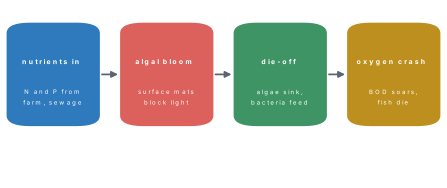
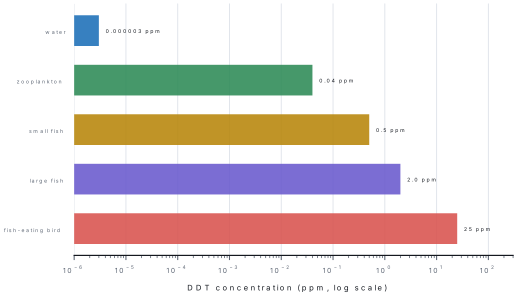
A persistent pollutant such as DDT becomes more concentrated at each higher trophic level (water → plankton → small fish → large fish → bird) because it is fat-soluble and neither excreted nor broken down; the famous end-result is thin-shelled eggs in birds of prey. It is different from eutrophication (nutrient enrichment → algal bloom → oxygen crash) — MCQs like to blur the two.
Problem. In a Chitwan grassland, 40 spotted deer are captured, marked and released. Weeks later 50 are captured, and 10 of them carry marks. Estimate the population. A second survey marks 60, recaptures 80, finds 12 marked — what estimate now? Solution. Lincoln–Petersen: N = (marked first × captured second) ÷ recaptured marked = (40 × 50) ÷ 10 = 200 deer. Second survey: (60 × 80) ÷ 12 = 400. The method assumes marks neither help nor hurt survival and that mixing is complete — break either assumption and the estimate lies, which is why real censuses repeat the capture many times over.
14.2 Air, water and soil pollution; pesticides
Pollution is an undesirable change in the physical, chemical or biological characteristics of air, water or soil that harms organisms, ecosystems or human use. A pollutant may be primary (emitted in harmful form, such as CO or SO₂) or secondary (formed in the environment, such as tropospheric ozone, PAN or acid-rain acids). Sources may be point (a factory pipe) or non-point (fertiliser/pesticide run-off from many fields).
Air pollution
| Pollutant/process | Source and effect |
|---|---|
| Particulate matter (PM₂.₅/PM₁₀) | combustion, dust, brick kilns; penetrates airways/alveoli, aggravates respiratory and cardiovascular disease |
| Carbon monoxide | incomplete combustion; binds haemoglobin much more strongly than O₂, reducing oxygen delivery |
| SO₂ and NOₓ | fossil fuels/vehicles/industry; respiratory irritation and conversion to sulphuric/nitric acids |
| Acid rain | precipitation below the natural pH of about 5.6; acidifies lakes/soils, mobilises toxic aluminium, damages leaves/buildings |
| Ground-level ozone/PAN | secondary products of NOₓ + volatile organics in sunlight (photochemical smog); injure lungs and crops |
| CFCs | old refrigerants/aerosols; UV releases chlorine that catalytically destroys stratospheric ozone |
| Greenhouse gases | CO₂, CH₄, N₂O and fluorinated gases absorb outgoing infrared, enhancing warming |
Do not merge the three atmospheric problems: greenhouse gases warm by trapping outgoing infrared mainly in the troposphere; ozone depletion admits more incoming UV through the stratosphere; acid rain is wet/dry deposition of acids formed from SO₂ and NOₓ.
Water pollution and eutrophication
Sewage, industrial effluents, fertiliser/pesticide run-off, oil, heated water, plastics and pathogens pollute water. Eutrophication follows nutrient enrichment, especially nitrogen and phosphorus:
nutrients → algal/cyanobacterial bloom → light blocked and plants die → decomposition increases BOD → dissolved O₂ crashes → fish/invertebrates die
Clean water has low BOD and high dissolved oxygen. Heavy metals such as lead, cadmium, chromium and mercury do not “rot away”; they persist, bind proteins and may enter food chains. Excess nitrate in drinking water and geogenic arsenic/fluoride are chemical hazards distinct from microbial contamination.
Soil pollution and pesticides
Soil is polluted by excessive fertiliser/pesticide, industrial sludge, mine waste, leaking fuel, plastics and unsegregated municipal waste. Consequences include loss of soil microbiota/earthworms, nutrient imbalance, salinity, groundwater leaching and uptake of toxins by crops.
A pesticide is used against a pest group—such as insecticides, herbicides, fungicides or rodenticides. Its environmental behaviour matters as much as its immediate kill:
- Organochlorines such as DDT are persistent and fat-soluble, making them prone to bioaccumulation/biomagnification.
- Organophosphates/carbamates inhibit acetylcholinesterase; generally less persistent but can be acutely toxic.
- Pyrethroids alter nerve sodium channels and can be highly toxic to fish and aquatic invertebrates.
- Neonicotinoids are systemic neuroactive insecticides of concern for pollinators and aquatic insects.
Bioaccumulation is build-up within one organism over time. Biomagnification is rising concentration at successive trophic levels because predators consume many contaminated prey while retaining most of the persistent chemical.
Integrated pest management combines monitoring/thresholds, crop rotation and resistant varieties, habitat for natural enemies, biocontrol/mechanical methods and targeted chemicals only when needed, reducing resistance and non-target damage.
14.3 Aquatic, terrestrial and volant adaptations
An adaptation is an inherited morphological, physiological or behavioural trait shaped by natural selection that improves survival/reproduction in a particular environment. It differs from acclimatisation, a reversible adjustment within an individual's lifetime.
Aquatic adaptations
Water is dense, buoyant, thermally buffering and oxygen-poor compared with air. Typical fish solutions are:
- fusiform/streamlined body, backward-pointing scales and mucus to reduce drag;
- caudal fin for thrust, dorsal/anal fins against rolling and paired fins for steering/braking;
- large, thin gill lamellae with counter-current blood/water flow;
- a swim bladder for neutral buoyancy in many bony fishes;
- lateral-line detection of vibration/current and often countershading.
Osmoregulation reverses between media. A freshwater bony fish gains water and loses salts, so it excretes abundant dilute urine and actively absorbs ions at the gills. A marine bony fish loses water to the sea, drinks seawater, excretes excess salt at the gills and produces scant urine. Secondary aquatic mammals such as dolphins breathe air with lungs and use flippers/blubber; they are not fish despite a convergent outline.
Terrestrial adaptations
Land removes buoyant support and creates desiccation and temperature stress. Terrestrial animals evolve strong limbs/skeletons, waterproof skin or cuticle, internal lungs/tracheae, water-conserving excretory products and internal fertilisation or shelled eggs. By locomotor habit:
| Habit | Design | Examples |
|---|---|---|
| Cursorial (running) | long limbs, reduced digits, digitigrade/unguligrade stance, elastic tendons | horse, chital, blackbuck |
| Arboreal (trees) | grasping/opposable digits, claws or adhesive pads, prehensile tail in some, binocular vision | langur, red panda, many geckos |
| Fossorial (burrowing) | compact/spindle body, strong forelimbs/claws, reduced eyes/external ears | mole, pangolin |
| Desert/xeric | nocturnality, burrows, concentrated urine/dry faeces, metabolic water, heat tolerance | camel, kangaroo rat |
| Cold/high-altitude | insulation, compact extremities, counter-current limb heat exchange, high oxygen-carrying capacity | yak, snow leopard, marmot |
Bergmann's rule predicts larger body size in colder populations of related endotherms; Allen's rule predicts shorter appendages in cold climates. Both reduce surface-area-to-volume heat loss and are tendencies, not laws.
Volant (flight) adaptations
True powered flight evolved independently in insects, birds and bats (and in extinct pterosaurs). In birds, the examination list is:
- streamlined body and feathers forming smooth aerofoils;
- forelimbs transformed into wings with fused/reduced hand bones;
- pneumatic bones that are hollow but internally strutted;
- a deep keeled sternum (carina) anchoring huge pectoral flight muscles;
- air sacs connected to lungs, supporting highly efficient, largely one-way airflow and cooling;
- four-chambered heart/double circulation and high metabolic rate;
- weight economy: beak instead of teeth/jaw heaviness, no urinary bladder, semi-solid uric-acid excretion and compact reproductive organs outside the breeding season.
Bats instead fly on a skin patagium stretched over greatly elongated finger bones. Gliders such as flying squirrels descend on membranes but do not sustain powered flapping flight.
14.4 Conservation biology: biodiversity, protected areas, hotspots, Ramsar sites, IUCN categories and endangered species of Nepal
Biodiversity is variety at genetic, species and ecosystem levels. Species diversity has both richness (how many species) and evenness (how equally abundant they are). A major threat mnemonic is HIPPO: Habitat loss, Invasive species, Pollution, Population/consumption pressure and Overexploitation—now all amplified by climate change.
A sample contains four species with counts 50, 25, 15 and 10, so N=100. Simpson's dominance is
Simpson's diversity is 1-D=0.662, and the reciprocal 1/D=2.96 is the effective number of equally common species. It is below the richness of 4 because one species dominates.
In-situ and ex-situ conservation; protected areas
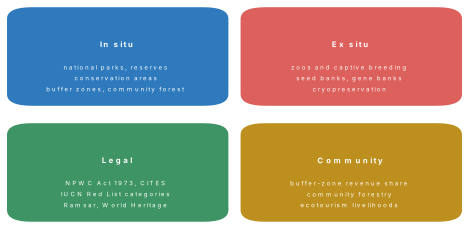
In-situ conservation protects a species in its natural ecosystem—national parks, wildlife reserves, conservation areas, buffer zones/community forests— so ecological interactions and natural selection continue. Ex-situ conservation protects components outside the habitat—zoos, botanical gardens, seed/gene banks, cryopreservation and captive breeding. Ex-situ methods are insurance and a source for reintroduction; they do not by themselves replace a functioning wild ecosystem.
Nepal's network under the National Parks and Wildlife Conservation Act is described in current departmental summaries as 13 national parks, one wildlife reserve, one hunting reserve and seven conservation areas, in addition to buffer zones. Management categories differ:

| Category | Nepal example | Defining management |
|---|---|---|
| National park | Chitwan (first, 1973); Sagarmatha; Bardiya | strict ecosystem protection; resource extraction/hunting prohibited |
| Wildlife reserve | Koshi Tappu (only one) | protection of particular species/habitats, especially arna and wetland birds |
| Hunting reserve | Dhorpatan (only one) | tightly licensed, quota-based trophy hunting |
| Conservation area | Annapurna (largest); Kanchenjunga; Manaslu | multiple use with resident communities participating in management |
| Buffer zone | around Chitwan/Bardiya and other parks | regulated use and revenue-sharing to build local support/reduce conflict |
Biodiversity hotspots and Ramsar sites
A Conservation International biodiversity hotspot must contain at least 1,500 endemic vascular plant species and have lost at least 70% of its original habitat. Nepal's mountain and foothill ecosystems form part of the Himalaya hotspot, one reason the country holds exceptional species richness over a steep elevation gradient.
Ramsar sites are wetlands of international importance designated under the Ramsar Convention (Iran, 1971). Nepal has ten: Koshi Tappu, Beeshazari and associated lakes, Ghodaghodi Lake area, Jagadishpur Reservoir, Gokyo and associated lakes, Gosaikunda and associated lakes, Phoksundo Lake, Rara Lake, Mai Pokhari and the Lake Cluster of Pokhara Valley. Ramsar designation is a commitment to “wise use”, not automatically the same legal category as a national park.
IUCN categories and threatened animals of Nepal
The IUCN Red List orders evaluated species as:
EX Extinct → EW Extinct in the Wild → CR Critically Endangered → EN Endangered → VU Vulnerable → NT Near Threatened → LC Least Concern
DD (Data Deficient) and NE (Not Evaluated) sit outside that risk ranking. A species is threatened only if it is CR, EN or VU. Status is quantitative and can change after reassessment; “endangered” in ordinary speech is not the same as the formal EN category.
| Nepal animal | Scientific name | Global IUCN status used here |
|---|---|---|
| Gharial | Gavialis gangeticus | Critically Endangered |
| Chinese pangolin | Manis pentadactyla | Critically Endangered |
| White-rumped vulture | Gyps bengalensis | Critically Endangered |
| Bengal florican | Houbaropsis bengalensis | Critically Endangered |
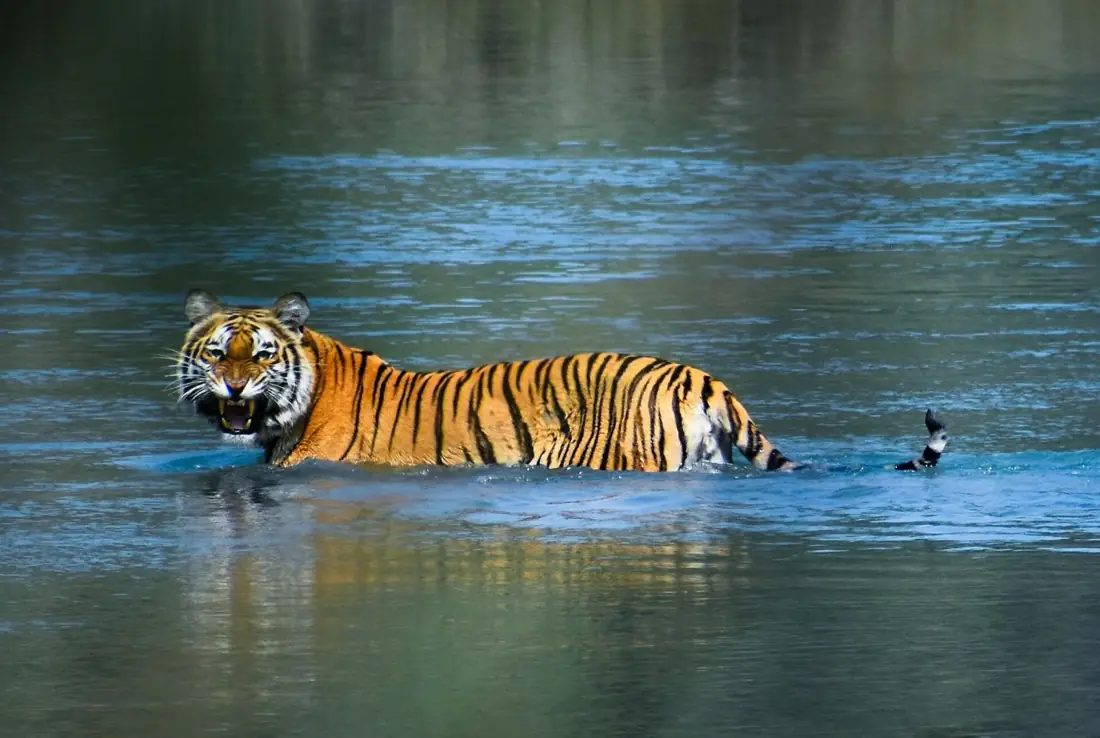
| Bengal tiger | Panthera tigris | Endangered |
| Red panda | Ailurus fulgens | Endangered |
| Asian elephant | Elephas maximus | Endangered |
| Wild water buffalo (arna) | Bubalus arnee | Endangered |
| Himalayan musk deer | Moschus leucogaster | Endangered |
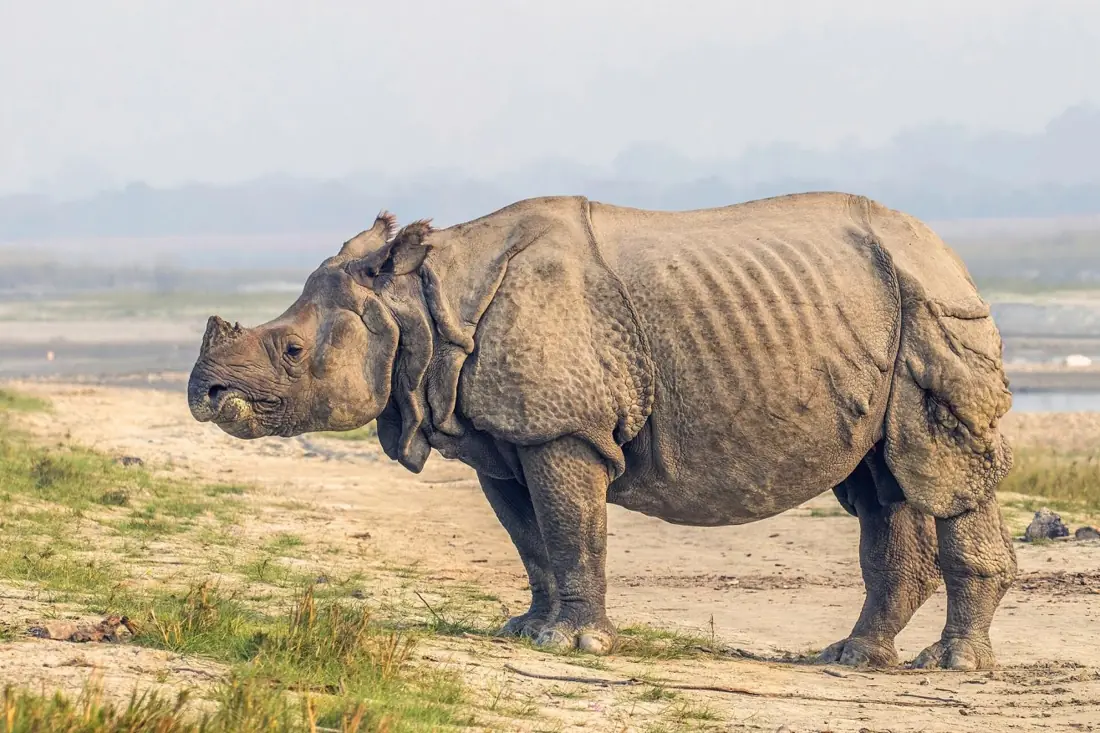
| Greater one-horned rhinoceros | Rhinoceros unicornis | Vulnerable |
| Snow leopard | Panthera uncia | Vulnerable |
| Swamp deer | Rucervus duvaucelii | Vulnerable |
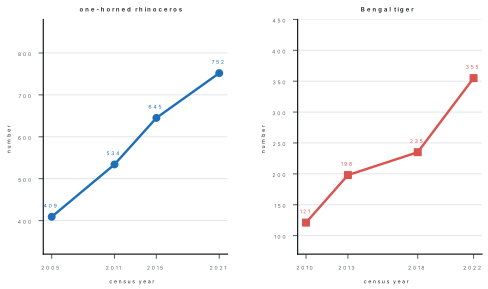
Anti-poaching protection, habitat management, biological corridors, buffer-zone benefit sharing and translocation have produced documented recoveries of two flagship mammals. Their increase also creates new management duties: prey and habitat carrying capacity, genetic mixing and prevention/compensation of human–wildlife conflict.
The collapse of South Asian Gyps vultures shows the opposite lesson: veterinary diclofenac left in cattle carcasses caused renal failure in feeding vultures. Banning veterinary diclofenac, promoting safer meloxicam, captive breeding and drug-free vulture feeding sites converted an invisible chemical threat into a manageable conservation problem.
Four pairs the paper swaps: taxis is directed, kinesis is not (a moth steering to light vs a woodlouse merely slowing in damp); bioaccumulation is build-up within one body, biomagnification is the climb up the food chain; a national park excludes human use strictly, a conservation area is managed with the communities inside it; CR (critically endangered) is one step from the wild's edge, EN (endangered) one step behind CR — 'endangered' in headlines often means the whole CR+EN+VU 'threatened' club.
Formula and fact sheet
- Reflex = receptor → sensory neuron → CNS → motor neuron → effector.
- Taxis = directed whole-organism orientation; kinesis = undirected rate change.
- Anadromous = sea to river; catadromous = river to sea.
- SO₂/NOₓ → acid rain; CFC-Cl → stratospheric ozone depletion; greenhouse gases → infrared trapping.
- Eutrophication: nutrient ↑ → bloom ↑ → decomposition/BOD ↑ → dissolved O₂ ↓.
- Bioaccumulation is within an organism; biomagnification is across trophic levels.
- Freshwater fish: water in, dilute urine out, salts absorbed. Marine bony fish: drinks, salt excreted at gills, scant urine.
- Cursorial = running; arboreal = trees; fossorial = burrowing; volant = flying.
- Bird flight: feathers, pneumatic bones, keeled sternum, pectorals, air sacs.
- Simpson diversity =1-D, where D=\sum n_i(n_i-1)/[N(N-1)]; 1/D = effective species number.
- Ramsar = wetlands of international importance; Nepal has 10 listed sites.
- IUCN: EX, EW, CR, EN, VU, NT, LC; threatened = CR+EN+VU.
Rapid-revision tables and high-yield facts
| Quantity | Value |
|---|---|
| Reflex arc | receptor → sensory → interneuron → motor → effector |
| Taxis vs kinesis | directed vs undirected activity change |
| Migration cues | sun, stars, magnetic field, smell, landmarks |
| Acid rain | pH < 5.6 (H₂SO₄, HNO₃) |
| Montreal Protocol | 1987, CFC phase-out |
| DDT magnification | 0.000003 ppm water → 25 ppm fish-eating birds (≈8 million ×) |
| Lincoln–Petersen | N = M·C ÷ R |
| IUCN threatened club | CR + EN + VU |
| Nepal protected areas | 12 NP + 1 WR + 6 CA + 1 HR ≈ 23 % of land |
| Ramsar | 10 sites; Koshi Tappu first, 1987 |
| Census | rhino 752 (2021), tiger 355 (2022) |
| Nepal symbols | monal = national bird; spiny babbler endemic |
Chapter summary
- Reflexes, taxes and kineses differ by pathway, body involvement and whether movement is directed.
- Migration trades travel costs for seasonal access to food and breeding habitat and relies on multiple navigational cues.
- Air pollution separates into particles/toxic gases, smog, acid deposition, ozone depletion and greenhouse warming.
- Water and soil pollutants may be biodegradable, nutrient-like or persistent; persistence plus fat solubility creates biomagnification.
- Aquatic and terrestrial animals solve opposite mechanical/osmotic problems, while flight imposes the strictest combined demands for lift, power and low mass.
- Biodiversity includes genes, species and ecosystems, and evenness matters as well as species count.
- In-situ protected areas preserve whole systems; ex-situ collections are a complementary safety net.
- Hotspots and Ramsar sites prioritise exceptional endemic-rich and wetland ecosystems under threat.
- IUCN categories make extinction risk comparable, and Nepal's rhino, tiger and vulture programmes show that specific threat removal can work.
Practice questions
Set A — Recall (25 questions)
- The correct sequence of a simple reflex arc isaeffector → CNS → receptorbreceptor → sensory neuron → CNS → motor neuron → effectorcmotor neuron → receptor → effectordCNS → receptor → sensory neuron
- Positive phototaxis means movementaaway from lightbfaster in darkness onlycin circlesdtoward light
- Directed movement in response to a chemical stimulus isaphototaxisbgeotaxiscchemotaxisdkinesis
- A kinesis is an undirected change inamovement or turning ratebchromosome numbercbody temperature onlydhabitat size
- Salmon migrating from sea to river for breeding are described asacatadromousboceanodromouscanadromousdsedentary
- Which pair consists mainly of primary air pollutants?aozone and PANbsulphuric acid and ozonecnitrate and phosphatedcarbon monoxide and sulphur dioxide
- Acid rain is formed principally from atmosphericamethane and oxygenbCFCs and dustcSO₂ and NOₓdcarbon monoxide only
- Stratospheric ozone is destroyed catalytically by chlorine released fromacarbon dioxidebmethanecfertilisersdchlorofluorocarbons
- Which is an important greenhouse gas released from livestock and wetlands?amethaneboxygencnitrogendargon
- Eutrophication is nutrient enrichment of water especially byasand and gravelbnitrogen and phosphoruscoxygen and calciumdsilica only
- Biomagnification is the increase of a persistent pollutant's concentrationainside one cell onlybacross successive trophic levelscduring photosynthesisdin rainfall acidity
- DDT belongs to the persistent pesticide group calledacarbamatesbpyrethroidscorganophosphatesdorganochlorines
- The swim bladder of many bony fishes mainly controlsahearingbcolour changecbuoyancydsalt excretion
- The lateral line of a fish detects principallyaultraviolet lightbvibration and water movementcdissolved oxygendmagnetic north only
- Cursorial adaptation is specialised foraburrowingbrunningcclimbingdgliding
- Fossorial animals are adapted foraburrowingbsustained flightcopen-sea swimmingdtree life
- Hollow, air-filled bones of birds are calledapneumatic bonesbcartilage bonescsesamoid bonesdflat bones
- The keeled sternum of a flying bird provides attachment for powerfulajaw musclesbtail muscles onlycleg musclesdpectoral flight muscles
- Allen's rule states that cold-climate endotherms tend to havealonger ears and limbsbno insulationchigher surface areadshorter appendages
- Biodiversity is measured at genetic, species andaatomic levelsbecosystem levelsccellular levels onlydorgan levels
- Which is an example of in-situ conservation?aseed bankbcryopreserved embryocnational parkdaquarium population
- Which is an example of ex-situ conservation?aseed/gene bankbwildlife corridorcbuffer zonednational park
- In IUCN usage, the threatened categories areaLC, NT and VUbDD, NE and LCcCR, EN and VUdEX, EW and LC
- The Ramsar Convention concerns conservation and wise use ofadesertsbglaciers onlyccoral reefs onlydwetlands
- The greater one-horned rhinoceros is listed globally by IUCN asaVulnerablebEndangeredcCritically EndangereddLeast Concern
Answers and explanations — Set A
1. (b) — The arc runs receptor → afferent → CNS → efferent → effector.
2. (d) — Positive taxis is oriented toward the stimulus.
3. (c) — Chemotaxis is direction relative to a chemical gradient.
4. (a) — Kinesis changes activity/turning without steering to a source.
5. (c) — Anadromous fishes ascend rivers from the sea to spawn.
6. (d) — CO and SO₂ are emitted directly; ozone/PAN/acids are secondary products.
7. (c) — SO₂ and NOₓ oxidise to sulphuric and nitric acids.
8. (d) — UV photolysis of CFCs releases ozone-destroying chlorine atoms.
9. (a) — Methane is emitted by ruminants, wetlands, rice fields and waste.
10. (b) — Nitrogen and phosphorus commonly limit and then fertilise aquatic production.
11. (b) — Concentration rises from prey to predator across a food chain.
12. (d) — DDT is a persistent organochlorine insecticide.
13. (c) — Gas volume in the swim bladder adjusts overall density.
14. (b) — Neuromasts detect pressure waves, currents and nearby movement.
15. (b) — Cursorial animals are running specialists.
16. (a) — Fossorial means adapted for digging/burrowing.
17. (a) — Pneumatic bones reduce mass while retaining strutted strength.
18. (d) — The carina anchors the large downstroke/upstroke flight muscles.
19. (d) — Short appendages reduce exposed surface and heat loss.
20. (b) — The three standard levels are genetic, species and ecosystem diversity.
21. (c) — A national park protects organisms within their ecosystem.
22. (a) — Gene/seed banks conserve material outside the natural habitat.
23. (c) — Critically Endangered, Endangered and Vulnerable are the threatened classes.
24. (d) — Ramsar sites are wetlands of international importance.
25. (a) — Recovery has placed the greater one-horned rhino in VU, not EN.
Set B — Understanding (15 questions)
- A taxis differs from a kinesis because a taxis involvesaoriented movement relative to a stimulusbonly a change in speedcno locomotiondlearned behaviour only
- A spinal withdrawal reflex can precede conscious pain because the motor command is generatedain the receptor itselfbafter cortical decisioncby hormones in blooddthrough a short spinal circuit
- Migration persists despite energetic cost because seasonal movement gives access toabetter food and breeding conditionsbpermanent freedom from predatorscwarmer body temperature in all speciesdidentical habitats
- Ground-level ozone is called a secondary pollutant because it isamined from soilbemitted only by plantscformed by sunlight acting on NOₓ/VOCsdharmless in smog
- Which statement correctly separates greenhouse warming from ozone depletion?aboth are caused only by CFCsbgreenhouse gases admit UV; ozone traps heatcneither involves radiationdgreenhouse gases trap infrared; ozone loss admits UV
- A sewage input with high BOD leads to fish death mainly because decompositionaconverts water to acid instantlybincreases water claritycconsumes dissolved oxygendblocks all sunlight forever
- DDT reaches highest concentrations in top predators because it is persistent, fat-soluble andaproduced by predatorsbretained from many prey over timecsoluble and rapidly excreteddbroken down by sunlight in fat
- A freshwater bony fish maintains osmotic balance by producing copious dilute urine andadrinking seawaterblosing salts at gillscstopping ion transportdactively absorbing salts at gills
- Bird air sacs support flight chiefly by enabling highly efficient ventilation andastoring solid urinebdigesting food in lungscmeeting sustained oxygen demand/coolingdreplacing the heart
- A kangaroo rat can survive without drinking because it combines metabolic water with extremelyaconcentrated urine and little evaporative lossbdilute urinecsweatingdsalt-water drinking
- Two communities have four species each, but one is dominated by a single species. It has lower diversity because itsarichness is zerobevenness is lowercarea is necessarily smallerdgenetic diversity cannot exist
- Habitat fragmentation can threaten a population even when some habitat remains because fragments increase isolation andaremove all predatorsbedge effects/inbreeding and blocked movementcguarantee genetic mixingdeliminate climate effects
- Ex-situ conservation alone is insufficient for most species because captivity does not preserve the fullascientific namebnumber of chromosomescecosystem interactions and natural selectiondneed for food
- Buffer-zone revenue sharing can improve park conservation by giving local residentsapermission to poachbtangible benefits and a stake in protectioncimmunity from wildlife conflictdownership of all park animals
- A biodiversity hotspot is designated for exceptional endemism combined withasevere loss of original habitatbabsence of humanscvolcanic temperaturedonly animal diversity
Answers and explanations — Set B
1. (a) — Directional orientation is the defining distinction.
2. (d) — Spinal integration launches withdrawal before cortical pain perception completes.
3. (a) — Seasonal resource tracking outweighs travel costs in reproductive success.
4. (c) — Tropospheric ozone is a photochemical product, not mainly a direct emission.
5. (d) — The two processes involve different atmospheric layers and wavelengths.
6. (c) — Microbial oxidation lowers dissolved oxygen below aquatic animals' needs.
7. (b) — Each predator integrates the retained burden of many prey.
8. (d) — Freshwater fish replace urinary/diffusive salt losses by gill uptake.
9. (c) — Air-sac ventilation sustains gas exchange and heat loss during flight.
10. (a) — Long loops of Henle and behaviour minimise water loss; oxidation supplies metabolic water.
11. (b) — Equal richness can conceal very unequal abundances.
12. (b) — Small isolated fragments suffer edge exposure, drift/inbreeding and loss of dispersal.
13. (c) — A zoo/gene bank cannot by itself maintain pollinators, prey, migration and selection.
14. (b) — Benefits align local livelihoods with wildlife protection.
15. (a) — Hotspot priority is irreplaceability plus extreme habitat loss.
Set C — Application (10 questions)
- Woodlice move rapidly and turn often in dry chambers but slow down in damp chambers without heading directly toward moisture. This isapositive phototaxisbkinesisca fixed reflex arcdmigration
- DDT is 0.000003 ppm in water and 25 ppm in a fish-eating bird. The overall concentration factor is abouta8.3\times10^6b8.3\times10^3c25d833
- Communities X counts 25,25,25,25, while Y counts 97,1,1,1. Which conclusion is correct?aY is more diverse because it has a dominant speciesbX and Y have identical Simpson diversitycY has greater richnessdX has higher diversity; 1-D is about 0.76 versus 0.06
- Nepal has land area 147,181 km². Increasing protected coverage from 23.39% to 30% requires abouta1,472 km²b44,154 km²c9,729 km²d34,426 km²
- After fertiliser run-off, a pond blooms, then fish die at dawn. The most direct cause isaexcess dissolved oxygenbreduced BODcpesticide biomagnification in one nightdoxygen depletion by respiration/decomposition
- Vultures feeding on carcasses of diclofenac-treated cattle died mainly from drug-inducedafeather lossbbone fluorosisckidney failuredoxygen toxicity
- Which site is one of Nepal's Ramsar wetlands?aDhorpatan Hunting ReservebShivapuri forest onlycKoshi TappudAnnapurna base camp
- The global IUCN status of the red panda isaEndangeredbLeast ConcerncExtinct in the WilddData Deficient
- Nepal's rhino census rose from 409 in 2005 to 752 in 2021. The percentage increase was abouta46%b84%c184%d34%
- An area where residents remain inside and share sustainable resource management is most consistent with a Nepaliastrict national park corebconservation areacgene bankdhunting reserve only
Answers and explanations — Set C
1. (b) — Activity changes with humidity but movement is not oriented toward a source.
2. (a) — 25/(3\times10^{-6})\approx8.3\times10^6.
3. (d) — Richness is 4 in both, but evenness makes Simpson diversity far higher in X.
4. (c) — The increase is (0.30-0.2339)\times147181\approx9,729 km².
5. (d) — Night respiration and decomposition after a bloom deplete oxygen, often lowest near dawn.
6. (c) — Diclofenac causes visceral gout/renal failure in susceptible Gyps vultures.
7. (c) — Koshi Tappu is both a wildlife reserve and Nepal's first Ramsar site.
8. (a) — Ailurus fulgens is classified Endangered.
9. (b) — (752-409)/409\times100\approx83.9\%.
10. (b) — Conservation areas use a multiple-use, community-participatory model.