Chapter 1 · Basic Components of Life · 2 questions in the paper · 37 min read
Biomolecules: Carbohydrates, Lipids, Proteins, Enzymes and Minerals
What the syllabus asks for 3
- Structure, types and biological role of carbohydrates and lipids
- Minerals and their biological roles
- Structure, types and biological role of proteins and enzymes
Basic Components of Life is the first unit of the Botany section and carries 2 of the 40 Botany questions. Both are almost always straight recall or one-step reasoning: which bond joins the glucose units of cellulose, which sugar is non-reducing, which mineral sits in chlorophyll or in nitrogenase, what a competitive inhibitor does to K_m, which class an enzyme belongs to. The chapter is short to read and quick to score — every fact below has been asked in some form by entrance setters, so learn the tables.
- Carbohydrate classes — mono-, di- and polysaccharides; aldose or ketose; reducing or non-reducing (sucrose is the non-reducing one).
- Glycosidic bonds — α-1,4 (starch, glycogen), α-1,6 (their branch points), β-1,4 (cellulose, chitin); inulin is a fructose polymer.
- Lipids — triglyceride = glycerol + 3 fatty acids (ester bonds, 3 H₂O lost); saturated vs unsaturated; phospholipids, steroids, waxes.
- Mineral roles and deficiency signs — Mg in chlorophyll, Mo in nitrogenase, Mn and Cl in water splitting, Ca in the middle lamella; mobile elements show symptoms in old leaves first.
- Protein structure — peptide bond, four levels and the bonds that hold each, fibrous vs globular, simple vs conjugated.
- Enzymes — cofactors, lock-and-key vs induced fit, K_m, the effect of temperature, pH and inhibitors, and the six IUB classes with one example each.
1.1 Carbohydrates and lipids: structure, types and biological role
Carbohydrates
Carbohydrates are polyhydroxy aldehydes or ketones, or substances that give these on hydrolysis. Most fit the formula Cₙ(H₂O)ₙ — "hydrates of carbon" — but the formula is only a guide: deoxyribose (C₅H₁₀O₄) is a carbohydrate that does not fit it, and acetic acid (C₂H₄O₂) fits it but is not a carbohydrate. A sugar with a free aldehyde group (–CHO) is an aldose; one with a ketone group (>C=O) is a ketose.
| Class | Number of carbons | Aldose example | Ketose example | Where it matters |
|---|---|---|---|---|
| Triose | 3 | glyceraldehyde (PGAL) | dihydroxyacetone (DHAP) | first sugars of the Calvin cycle and glycolysis |
| Tetrose | 4 | erythrose | erythrulose | erythrose-4-phosphate in the Calvin cycle |
| Pentose | 5 | ribose, deoxyribose, xylose | ribulose | RNA, DNA; RuBP is the CO₂ acceptor |
| Hexose | 6 | glucose, galactose, mannose | fructose | respiratory fuel; fruit sugar |
| Heptose | 7 | glucoheptose | sedoheptulose | Calvin cycle |
Glucose (dextrose, grape sugar) is an aldohexose; fructose (laevulose, fruit sugar) is a ketohexose and the sweetest natural sugar. In water, hexoses close into rings. In α-glucose the –OH on carbon 1 lies below the plane of the ring; in β-glucose it lies above. That single difference decides whether the polymer is a digestible fuel (starch, α) or an indigestible fibre (cellulose, β).
Two sugars join by a glycosidic bond, formed by condensation (loss of one H₂O) and broken by hydrolysis. Oligosaccharides have 2–10 sugar units.
| Disaccharide | Units | Bond | Reducing? | Source / role |
|---|---|---|---|---|
| Sucrose | glucose + fructose | α-1 → β-2 | No | cane, beet; the transport sugar of the phloem |
| Maltose | glucose + glucose | α-1,4 | Yes | germinating barley (malt); starch digestion |
| Lactose | galactose + glucose | β-1,4 | Yes | milk sugar |
| Cellobiose | glucose + glucose | β-1,4 | Yes | breakdown product of cellulose |
| Trehalose | glucose + glucose | α-1,1 | No | fungi; the blood sugar of insects |
Sucrose is non-reducing because the bond joins the reducing carbons of both units (C-1 of glucose and C-2 of fructose), so no free carbonyl group is left. Its hydrolysis by invertase (sucrase) gives an equal mixture of glucose and fructose called invert sugar — the optical rotation changes from dextro to laevo, hence the name. Raffinose (galactose + glucose + fructose) is a common non-reducing trisaccharide of seeds.
Polysaccharides (glycans) are long chains of hundreds to thousands of units. They are insoluble, non-sweet and non-reducing, which is exactly why they make good stores.
| Polysaccharide | Monomer | Bonds | Shape | Iodine colour | Role and occurrence |
|---|---|---|---|---|---|
| Amylose (≈20–25 % of starch) | α-glucose | α-1,4 | unbranched helix | blue-black | plant food store |
| Amylopectin (≈75–80 % of starch) | α-glucose | α-1,4 + α-1,6 branches every ~24–30 units | branched | red-violet | plant food store |
| Glycogen | α-glucose | α-1,4 + α-1,6 branches every ~8–12 units | highly branched | red-brown | store of animals and fungi ("animal starch") |
| Cellulose | β-glucose | β-1,4 | straight chains in microfibrils | none | plant cell wall; the most abundant organic compound on Earth |
| Chitin | N-acetylglucosamine | β-1,4 | straight | none | fungal cell wall, insect exoskeleton |
| Inulin | fructose | β-2,1 | short chains | none | stored in the tuberous roots of Dahlia and dandelion |
| Pectin | galacturonic acid | α-1,4 | — | none | middle lamella (as calcium pectate) |
| Peptidoglycan (murein) | NAG + NAM with short peptides | β-1,4 + peptide cross-links | net-like sac | none | bacterial cell wall |
| Agar, carrageenan | galactose (partly sulphated) | — | — | none | red algae (Gelidium, Gracilaria) |
- Sucrose is non-reducing; maltose and lactose are reducing. "All disaccharides reduce Benedict's solution" is false.
- Inulin is a fructose polymer, not glucose — and glycogen, not starch, is the store of fungi.
- Cellulose and starch are both glucose. They differ only in α versus β linkage, and humans lack the enzyme (cellulase) that splits the β-1,4 bond between glucose units; cattle digest grass only with the help of cellulase-making microbes in the rumen.
| Test | Reagent | Positive result | Detects |
|---|---|---|---|
| Molisch's | α-naphthol + conc. H₂SO₄ | violet ring at the junction | any carbohydrate |
| Benedict's / Fehling's | alkaline Cu²⁺ (Benedict's: CuSO₄, sodium citrate, Na₂CO₃) | brick-red Cu₂O on boiling | reducing sugars |
| Barfoed's | copper acetate in acetic acid | red precipitate within ~2 min | monosaccharides (disaccharides react slowly) |
| Seliwanoff's | resorcinol + HCl | quick cherry-red | ketoses (fructose) |
| Iodine | I₂ in KI | blue-black | starch (amylose) |
Biological roles. Carbohydrates are the main respiratory fuel (glucose gives about 17 kJ g⁻¹); storage (starch, glycogen, inulin); structure (cellulose, hemicellulose, pectin, chitin, peptidoglycan); the sugar part of nucleotides (ribose, deoxyribose) and of ATP, NAD, FAD and coenzyme A; and recognition markers on cell surfaces (glycoproteins and glycolipids, including the ABO blood-group antigens). Agar from red algae solidifies microbiological culture media.
Lipids
Lipids are esters of fatty acids with alcohols (or substances related to them) that are insoluble in water and soluble in organic solvents such as ether, chloroform and benzene. Unlike carbohydrates and proteins, they are not polymers — a triglyceride is a small molecule (relative molecular mass usually below 1000) built from four parts, not a chain of repeating units.
| Type | What it is | Examples |
|---|---|---|
| Simple lipids — fats and oils | ester of glycerol + 3 fatty acids (triglyceride) | ghee, butter, mustard oil |
| Simple lipids — waxes | ester of a long-chain fatty acid + a long-chain monohydric alcohol | cuticle wax, beeswax, lanolin |
| Compound lipids — phospholipids | glycerol + 2 fatty acids + phosphate + a base | lecithin (choline), cephalin (ethanolamine) |
| Compound lipids — others | lipid + sugar or protein | glycolipids (cerebrosides), lipoproteins |
| Derived lipids — steroids | four fused rings (three 6-carbon + one 5-carbon) | cholesterol (animals), ergosterol (fungi), sitosterol (plants), sex hormones, brassinosteroids |
| Derived lipids — terpenes | built from isoprene (C₅H₈) units | carotenoids, rubber, essential oils (menthol), phytol tail of chlorophyll, gibberellins |
A triglyceride forms when each of the three –OH groups of glycerol makes an ester bond with the –COOH of a fatty acid; three molecules of water are released. A fatty acid is a hydrocarbon chain (usually 14–20 carbons, almost always an even number) ending in –COOH.
| Feature | Saturated fatty acid | Unsaturated fatty acid |
|---|---|---|
| C=C double bonds | none | one (mono-) or more (poly-unsaturated) |
| Chain shape | straight, packs tightly | kinked at each cis double bond |
| State of its fat at room temperature | solid (fat) | liquid (oil) |
| Examples | palmitic (C16:0), stearic (C18:0) | oleic (C18:1), linoleic (C18:2), linolenic (C18:3), arachidonic (C20:4) |
| Typical source | ghee, butter, coconut and palm oil | mustard, sunflower, soybean, fish oil |
Essential fatty acids — linoleic and linolenic acid (arachidonic acid is made from linoleic) — cannot be made by animals and must come from plant food. Hydrogenating an oil with a nickel catalyst saturates its double bonds and turns it into a solid cooking fat (vanaspati ghee).
A phospholipid is amphipathic: its phosphate head is hydrophilic and its two fatty-acid tails are hydrophobic, so in water phospholipids line up tail-to-tail into the bilayer of every cell membrane. Cutin (in the cuticle) and suberin (in cork and the Casparian strip) are lipid polymers that waterproof plant surfaces.
Lipids give about 39 kJ g⁻¹ (9.3 kcal g⁻¹) on oxidation against about 17 kJ g⁻¹ (4.1 kcal g⁻¹) for carbohydrate and protein — more than twice as much — because their carbon is far less oxidised, and they are stored without water. Mustard, groundnut, sesame and sunflower seeds therefore store oil. Lipids stain red with Sudan III, black with osmic acid, and leave a translucent grease spot on paper.
Biological roles of lipids: long-term energy store; structural basis of membranes (phospholipids; sterols such as cholesterol in animals and phytosterols in plants — bacteria have no sterols, Mycoplasma being the exception); waterproofing (wax, cutin, suberin); insulation and cushioning in animals; hormones (steroids, and in plants gibberellins, abscisic acid and brassinosteroids); pigments (carotenoids) and vitamins A, D, E and K, which are fat-soluble.
1.2 Minerals and their biological roles
Burn a plant and the ash holds about 60 elements, but only some are essential. Arnon and Stout (1939) gave the criteria: without the element the plant cannot complete its life cycle; no other element can replace it; and it is directly involved in the plant's metabolism. Seventeen elements meet them — C, H and O from air and water, and 14 mineral elements from the soil. They are grouped by the amount needed (macronutrients occur in excess of 10 mmol per kg of dry matter, micronutrients below it), not by importance.
| Element (absorbed as) | Main roles | Deficiency sign or disease |
|---|---|---|
| N (NO₃⁻, NH₄⁺) | amino acids, proteins, nucleic acids, chlorophyll, ATP, hormones | yellowing of old leaves first; stunting |
| P (H₂PO₄⁻, HPO₄²⁻) | ATP, nucleic acids, phospholipids, NADP | dark green or purple leaves (anthocyanin); poor roots; late maturity |
| K (K⁺) | opening and closing of stomata (guard-cell turgor); activator of over 40 enzymes; osmotic and ionic balance | scorched leaf margins and tips of old leaves; weak stems (lodging) |
| Ca (Ca²⁺) | calcium pectate of the middle lamella; spindle formation; membrane function; second messenger | death of meristems and young leaf tips; blossom-end rot of tomato |
| Mg (Mg²⁺) | centre of the chlorophyll molecule; activates RuBisCO, PEP carboxylase and the kinases; holds ribosome subunits together | interveinal chlorosis of old leaves |
| S (SO₄²⁻) | cysteine and methionine; coenzyme A, thiamine, biotin, ferredoxin | chlorosis of young leaves |
| Fe (Fe³⁺, Fe²⁺) | cytochromes, ferredoxin, catalase, peroxidase; needed to make chlorophyll though not part of it | interveinal chlorosis of young leaves |
| Mn (Mn²⁺) | splitting of water in photosystem II; activates Krebs-cycle enzymes | grey speck of oats, marsh spot of pea |
| Zn (Zn²⁺) | auxin (IAA) synthesis via tryptophan; carbonic anhydrase, alcohol dehydrogenase | little leaf, rosetting; khaira disease of rice |
| Cu (Cu²⁺) | plastocyanin; cytochrome oxidase | die-back (exanthema) of citrus; reclamation disease |
| B (BO₃³⁻, B₄O₇²⁻) | pollen germination and pollen-tube growth; Ca uptake; sugar translocation | heart rot of beet, browning of cauliflower, internal cork of apple |
| Mo (MoO₄²⁻) | nitrogenase and nitrate reductase; needed in the smallest amount of all | whiptail of cauliflower |
| Cl (Cl⁻) | with Mn, water splitting in PS II; anion balance; stomatal movement | wilting, bronzing of leaves |
| Ni (Ni²⁺) | urease; hydrogenase | necrotic leaf tips (urea builds up) |
Mobile elements (N, P, K, Mg) are moved out of old leaves to the growing parts, so the old leaves show the symptom first. Immobile elements (Ca, S, Fe, B) stay where they were deposited, so the young leaves and buds show it first. For the macronutrients say "C. HOPKiNS CaFe, Mighty good" — C, H, O, P, K, N, S, Ca, (Fe), Mg — and remember that Fe, though it sits in the mnemonic, is a micronutrient.
Chlorophyll is a porphyrin ring with magnesium at its centre and four nitrogen atoms holding it; iron sits at the centre of haem (cytochromes, haemoglobin, catalase). Iron deficiency causes chlorosis because iron is needed for chlorophyll synthesis, not because it is part of the molecule.
Mineral roles in animals and humans are asked occasionally: Fe in haemoglobin and myoglobin (lack causes anaemia); Ca and P in bones and teeth, Ca²⁺ in blood clotting and muscle contraction; Na⁺ and K⁺ in nerve impulses and osmotic balance; I in thyroxine (lack causes goitre); Co in vitamin B₁₂; Zn in carbonic anhydrase and insulin storage; F in tooth enamel.
1.3 Proteins and enzymes: structure, types and biological role
Amino acids and the peptide bond
A protein is a polymer of amino acids. Each amino acid has a central α-carbon carrying an amino group (–NH₂), a carboxyl group (–COOH), a hydrogen atom and a variable side chain (R). Twenty kinds are coded by the genetic code. Glycine (R = H) is the simplest and the only one that is not optically active; proline is strictly an imino acid; cysteine and methionine contain sulphur; phenylalanine, tyrosine and tryptophan are aromatic. Plants make all twenty; humans cannot make nine essential amino acids and must eat them.
Amino acids are amphoteric. At a particular pH, the isoelectric point, the molecule carries both charges at once (–NH₃⁺ and –COO⁻) and is called a zwitterion.
The peptide bond (–CO–NH–) forms by condensation between the –COOH of one amino acid and the –NH₂ of the next. A chain of n amino acids has n − 1 peptide bonds and releases n − 1 water molecules when it forms. The chain has a free amino end (N-terminus) and a free carboxyl end (C-terminus); the sequence is always written from N to C.
PVT TIM HaLL — Phenylalanine, Valine, Threonine, Tryptophan, Isoleucine, Methionine, Histidine, Arginine, Leucine, Lysine. Arginine is only semi-essential (needed from food in childhood), which leaves nine for adults.
The four levels of protein structure
| Level | What it is | Bonds that hold it | Example |
|---|---|---|---|
| Primary | the sequence of amino acids, fixed by the gene | peptide (covalent) | insulin: 51 amino acids in chains A (21) and B (30), sequenced by Sanger |
| Secondary | regular local folding: α-helix (right-handed, 3.6 residues per turn) or β-pleated sheet | hydrogen bonds between C=O and N–H of the backbone | α-keratin of hair and wool (helix); silk fibroin (sheet) |
| Tertiary | the whole chain folded into a compact 3-D shape | H-bonds, ionic bonds, disulphide bridges (–S–S–), hydrophobic interactions | myoglobin; every enzyme |
| Quaternary | two or more folded polypeptides together | the same weak bonds as tertiary | haemoglobin — 2α + 2β chains, four haem groups |
Pauling and Corey described the α-helix and β-sheet (1951). Only proteins with more than one polypeptide chain have a quaternary level. Heat, extreme pH, heavy-metal ions (Hg²⁺, Pb²⁺, Ag⁺), urea and strong alcohol break the weak bonds of the secondary, tertiary and quaternary levels — the protein denatures and loses its function, but its peptide bonds (primary structure) survive. Boiling an egg and curdling milk with lemon juice are denaturation.
Types of proteins
| Basis | Type | Features | Examples |
|---|---|---|---|
| Shape | Fibrous | long parallel chains; insoluble; structural | keratin, collagen, fibroin, myosin, elastin |
| Shape | Globular | chains folded into a ball; soluble; functional | enzymes, antibodies, haemoglobin, insulin, albumin |
| Composition | Simple | amino acids only | albumins, globulins, histones, glutelins (glutenin of wheat), prolamines (zein of maize) |
| Composition | Conjugated | protein + a non-protein prosthetic group | nucleoproteins, glycoproteins, lipoproteins, chromoproteins (haemoglobin, cytochromes, phytochrome), phosphoproteins (casein of milk), metalloproteins |
| Composition | Derived | made by partial hydrolysis or denaturation | proteoses, peptones, peptides |
| Role | Examples |
|---|---|
| Catalysis | all enzymes — amylase, RuBisCO (the most abundant protein on Earth) |
| Structure | collagen (the most abundant protein in mammals), keratin, extensin of plant cell walls |
| Transport | haemoglobin, carrier proteins and channels in membranes |
| Defence | antibodies (immunoglobulins), fibrinogen in clotting |
| Hormones and signalling | insulin, glucagon; receptor proteins |
| Movement | actin and myosin, tubulin, flagellin |
| Storage | casein, ovalbumin, seed proteins (glutenin, zein) |
Tests: biuret (CuSO₄ + NaOH) gives violet with two or more peptide bonds; xanthoproteic (conc. HNO₃) gives yellow with aromatic amino acids; Millon's gives red with tyrosine; ninhydrin gives purple with free amino acids.
Enzymes: nature and history
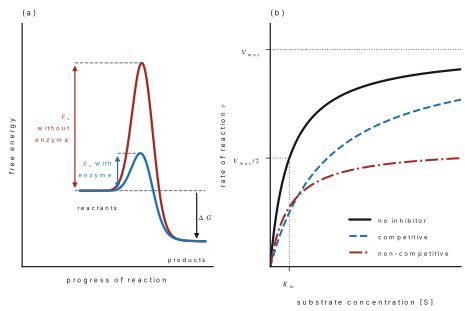
An enzyme is a biological catalyst — usually a globular protein — that speeds up a specific reaction by lowering its activation energy, without being used up and without changing the equilibrium or the energy released (\Delta G).
| Year | Person | Contribution |
|---|---|---|
| 1833 | Payen and Persoz | diastase (amylase) from malt — the first enzyme discovered |
| 1877 | Wilhelm Kühne | coined the word "enzyme" ("in yeast"); some books give 1878 |
| 1894 | Emil Fischer | lock-and-key model |
| 1897 | Eduard Buchner | a cell-free yeast extract (zymase) ferments sugar |
| 1913 | Michaelis and Menten | the kinetic equation and K_m |
| 1926 | James Sumner | crystallised urease from jack bean — enzymes are proteins |
| 1958 | Daniel Koshland | induced-fit model |
| 1982–83 | Cech and Altman | ribozymes — catalytic RNA (Nobel 1989) |
Ribozymes break the rule that all enzymes are proteins: RNase P and the peptidyl transferase of the ribosome (23S rRNA in bacteria) are RNA.
Cofactors. Many enzymes need a non-protein part. The protein part alone is the apoenzyme (inactive); apoenzyme + cofactor = holoenzyme (active).
| Cofactor | Nature | Examples |
|---|---|---|
| Prosthetic group | organic, tightly (often covalently) bound | haem in catalase and peroxidase; FAD in succinate dehydrogenase; biotin in carboxylases |
| Coenzyme | organic, loosely bound, leaves after the reaction; most are made from B vitamins | NAD⁺/NADP⁺ (niacin, B₃), FAD/FMN (riboflavin, B₂), coenzyme A (pantothenic acid, B₅), TPP (thiamine, B₁) |
| Metal-ion activator | inorganic ion | Zn²⁺ in carbonic anhydrase and carboxypeptidase; Mg²⁺ in kinases; Mo in nitrogenase; Fe and Cu in cytochrome oxidase |
How enzymes work
The substrate binds to a small pocket, the active site, forming an enzyme–substrate (ES) complex; the reaction occurs and the products leave: E + S ⇌ ES → E + P. In Fischer's lock-and-key model the active site is rigid and fits the substrate exactly. In Koshland's induced-fit model — the accepted one — the active site changes shape as the substrate binds, closing round it.
The rate rises with substrate concentration [S] and levels off when every active site is busy, at the maximum rate V_{max}. Michaelis and Menten wrote
The Michaelis constant K_m is the substrate concentration at which the rate is half of V_{max}. A low K_m means high affinity — the enzyme reaches half speed at a low substrate concentration. Useful values: at [S] = K_m, v = V_{max}/2; at [S] = 4K_m, v = 0.8\,V_{max}; at [S] = 9K_m, v = 0.9\,V_{max}.
Factors affecting enzyme activity
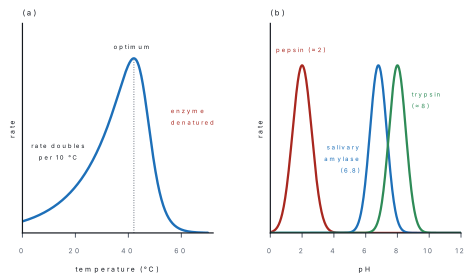
- Temperature. The rate roughly doubles for every 10 °C rise (temperature coefficient Q_{10} \approx 2) up to the optimum — about 37 °C for human enzymes and 25–40 °C for most plant enzymes. Above it the enzyme denatures and the rate falls steeply, usually irreversibly. Low temperature only inactivates an enzyme, reversibly — which is why seeds and food keep in the cold. Enzymes of hot-spring bacteria survive far higher temperatures (Taq polymerase of Thermus aquaticus works at about 72 °C).
- pH. Each enzyme has an optimum pH: pepsin about 2, salivary amylase 6.8, trypsin about 8; most cell enzymes work near 7. pH changes alter the charges on the active site.
- Substrate concentration — a rising curve that levels off at V_{max} (Figure 1b).
- Enzyme concentration — rate is directly proportional to [E] while substrate is in excess.
- Inhibitors and activators — below.
Enzyme inhibition
| Type | Where the inhibitor binds | Effect on K_m and V_{max} | Reversed by more substrate? | Example |
|---|---|---|---|---|
| Competitive | active site — it resembles the substrate | K_m rises, V_{max} unchanged | Yes | malonate blocks succinate dehydrogenase; sulpha drugs mimic PABA in bacteria; ethanol competes with methanol for alcohol dehydrogenase |
| Non-competitive | another site on the enzyme | V_{max} falls, K_m unchanged | No | cyanide on cytochrome oxidase; Hg²⁺, Ag⁺, Pb²⁺ on –SH groups |
| Irreversible | binds the active site covalently | enzyme destroyed for good | No | nerve gas (DFP) on acetylcholinesterase; penicillin on the transpeptidase of bacterial walls |
| Feedback (allosteric) | a regulatory (allosteric) site; the inhibitor is the end product of the pathway | slows the first enzyme of the pathway | — | isoleucine inhibits threonine deaminase; ATP inhibits phosphofructokinase |
Isoenzymes (isozymes) are different molecular forms of one enzyme that catalyse the same reaction — lactate dehydrogenase has five.
Classification of enzymes
The International Union of Biochemistry (1961) sorts enzymes into six classes by the reaction they catalyse; each enzyme has an EC number whose first digit is its class. (A seventh class, translocases, was added in 2018.)
| EC | Class | Reaction | Examples |
|---|---|---|---|
| 1 | Oxidoreductases | transfer of H or electrons (oxidation–reduction) | dehydrogenases, oxidases, catalase, peroxidase |
| 2 | Transferases | transfer of a group (not H) from one molecule to another | transaminases (–NH₂), kinases (phosphate), e.g. hexokinase |
| 3 | Hydrolases | breaking a bond with water | amylase, lipase, pepsin, trypsin, sucrase, urease |
| 4 | Lyases | removing a group without water, leaving a double bond (or adding to one) | aldolase, fumarase, carbonic anhydrase, decarboxylases |
| 5 | Isomerases | rearranging atoms within one molecule | phosphohexose isomerase, triose phosphate isomerase, mutases |
| 6 | Ligases (synthetases) | joining two molecules using energy from ATP | DNA ligase, aminoacyl-tRNA synthetase, pyruvate carboxylase |
"Oh The Hungry Lion Is Lazy" — Oxidoreductase, Transferase, Hydrolase, Lyase, Isomerase, Ligase (EC 1 to 6).
Read the reaction, not the name. Water added across a bond that breaks → hydrolase. A group moved between two substrates → transferase. ATP spent to join two molecules → ligase. One molecule in, one rearranged molecule out → isomerase. A molecule split without water, or a C–C bond broken to release CO₂ → lyase. H atoms or electrons moved → oxidoreductase.
Uses of enzymes: amylase in brewing and baking; pectinase to clear fruit juice; proteases and lipases in detergents; rennet (chymosin) to curdle milk for cheese; papain from papaya and bromelain from pineapple to tenderise meat; invertase for confectionery syrup; streptokinase from Streptococcus to dissolve blood clots.
Problem. A functional plant enzyme consists of two polypeptide chains containing 120 and 80 amino acid residues respectively. What is the total number of peptide bonds in the enzyme, and what is the molecular mass of a linear malto-oligosaccharide made of 10 glucose units (\text{C}_6\text{H}_{12}\text{O}_6 = 180)?
Solution. In a linear protein of n total residues across c polypeptide chains, the number of peptide bonds is n - c: here (120 + 80) - 2 = \mathbf{198} peptide bonds. For 10 glucose units linked by \alpha(1\rightarrow4) glycosidic bonds, 10 - 1 = 9 water molecules (9 \times 18 = 162) are lost, so M = 10 \times 180 - 162 = \mathbf{1638\text{ Da}}.
Problem. An enzyme has V_{\max} = 60\text{ }\mu\text{mol min}^{-1} and K_m = 2.0\text{ mM}. What initial reaction velocity v_0 is obtained at [S] = 6.0\text{ mM}, and how does K_m change if a competitive inhibitor is added?
Solution. By v_0 = \frac{V_{\max}[S]}{K_m + [S]}, at [S] = 6.0\text{ mM} we have [S] = 3K_m, so v_0 = \frac{3}{4}V_{\max} = \mathbf{45\text{ }\mu\text{mol min}^{-1}}. A competitive inhibitor raises the apparent K_m while leaving V_{\max} unchanged.
Problem. A tomato seedling grown in nutrient-deficient sand shows chlorosis first on its oldest lower leaves, whereas a second seedling shows death of the terminal bud and hooked young leaves while old leaves stay green. Which two elements are deficient?
Solution. Old-leaf chlorosis indicates a mobile element (N, P, K, or Mg) translocated to young sinks. Terminal-bud death with hooked young leaves is the signature of an immobile structural element, specifically calcium (\text{Ca}^{2+}) (or boron).
Formula and fact sheet
| Item | Fact |
|---|---|
| Aldohexose / ketohexose | glucose / fructose |
| Ketopentose of the Calvin cycle | ribulose (RuBP = CO₂ acceptor) |
| Non-reducing sugars | sucrose, trehalose, raffinose, all polysaccharides |
| Reducing disaccharides | maltose (α-1,4), lactose (β-1,4), cellobiose (β-1,4) |
| Bonds | starch and glycogen α-1,4 with α-1,6 branches; cellulose and chitin β-1,4 |
| Branching | amylose none; amylopectin every 24–30 units; glycogen every 8–12 |
| Iodine | amylose blue-black; amylopectin red-violet; glycogen red-brown |
| Odd monomers | inulin → fructose; chitin → N-acetylglucosamine; pectin → galacturonic acid; agar → galactose |
| Store of fungi | glycogen (plus oil); wall of chitin |
| Triglyceride | glycerol + 3 fatty acids, 3 ester bonds, 3 H₂O released |
| Energy per gram | lipid ≈ 39 kJ (9.3 kcal); carbohydrate and protein ≈ 17 kJ (4.1 kcal) |
| Essential fatty acids | linoleic, linolenic (arachidonic) |
| Sterol by kingdom | cholesterol (animals), ergosterol (fungi), sitosterol/stigmasterol (plants), none in bacteria |
| Essential elements | 17 = C, H, O + 14 minerals; criteria by Arnon and Stout (1939) |
| Macronutrients | N, P, K, Ca, Mg, S (with C, H, O) |
| Micronutrients | Fe, Mn, Zn, Cu, B, Mo, Cl, Ni |
| Mineral ↔ molecule | Mg chlorophyll; Fe cytochromes, ferredoxin; Cu plastocyanin; Mo nitrogenase, nitrate reductase; Ni urease; Zn auxin synthesis, carbonic anhydrase; Mn and Cl water splitting; Ca middle lamella |
| Mineral diseases | khaira of rice (Zn), whiptail of cauliflower (Mo), heart rot of beet (B), grey speck of oats (Mn), die-back of citrus (Cu), blossom-end rot of tomato (Ca) |
| Mobile → old leaves | N, P, K, Mg; immobile → young leaves: Ca, S, Fe, B |
| Peptide bonds | n amino acids → n − 1 bonds, n − 1 H₂O |
| Number of possible peptides | 20ⁿ for a chain of n residues |
| Protein levels | 1° peptide; 2° H-bonds; 3° H, ionic, S–S, hydrophobic; 4° several chains |
| Haemoglobin | 2α + 2β chains, 4 haem, quaternary; a chromoprotein |
| Insulin | 51 amino acids, chains A 21 + B 30, joined by disulphide bridges |
| Most abundant protein | RuBisCO (biosphere); collagen (mammals) |
| Michaelis–Menten | v = V_{max}[S]/(K_m + [S]); K_m = [S] at V_{max}/2; low K_m = high affinity |
| Competitive / non-competitive | K_m up, V_{max} same / V_{max} down, K_m same |
| Q_{10} | ≈ 2; rate × 2^{\Delta T/10} below the optimum |
| Optimum pH | pepsin ≈ 2, salivary amylase 6.8, trypsin ≈ 8 |
| History | Payen and Persoz diastase 1833; Kühne "enzyme" 1877; Fischer lock-and-key 1894; Buchner zymase 1897; Sumner urease 1926; Koshland induced fit 1958 |
| Holoenzyme | apoenzyme (protein) + cofactor (prosthetic group, coenzyme or metal ion) |
| EC classes | 1 oxidoreductase, 2 transferase, 3 hydrolase, 4 lyase, 5 isomerase, 6 ligase |
Chapter summary
- Carbohydrates are polyhydroxy aldehydes or ketones; glucose is an aldohexose, fructose a ketohexose, ribulose a ketopentose.
- Sucrose (glucose + fructose, α-1 → β-2) is non-reducing; maltose, lactose and cellobiose are reducing.
- Starch (amylose + amylopectin) and glycogen are α-glucose stores with α-1,4 chains and α-1,6 branches; cellulose is β-1,4 glucose; chitin is β-1,4 N-acetylglucosamine; inulin is a fructose polymer.
- A triglyceride is glycerol esterified with three fatty acids (three water molecules lost); lipids give about 39 kJ g⁻¹, more than twice carbohydrate.
- Phospholipids are amphipathic and form membrane bilayers; steroids have four fused rings; waxes are esters of long-chain alcohols.
- Seventeen elements are essential; Mg is in chlorophyll, Mo in nitrogenase, Mn and Cl split water, Ca forms calcium pectate, Zn is needed for auxin; mobile N, P, K, Mg show deficiency in old leaves first.
- Proteins are chains of amino acids joined by peptide bonds (n − 1 for n residues); secondary structure is held by H-bonds, tertiary adds ionic, disulphide and hydrophobic bonds, quaternary needs two or more chains.
- Enzymes lower activation energy; holoenzyme = apoenzyme + cofactor; the induced-fit model (Koshland) replaced lock-and-key (Fischer).
- K_m is the substrate concentration at half V_{max}; competitive inhibitors raise K_m, non-competitive inhibitors lower V_{max}; feedback inhibition acts on the first enzyme of a pathway.
- The six enzyme classes: oxidoreductases, transferases, hydrolases, lyases, isomerases, ligases.
Practice questions
Set A — Recall (20 questions)
- Which of the following disaccharides is non-reducing?asucrosebmaltoseclactosedcellobiose
- Cellulose is a polymer ofaα-glucose joined by α-1,4 bondsbfructose joined by β-2,1 bondscβ-glucose joined by β-1,4 bondsdN-acetylglucosamine joined by β-1,4 bonds
- The branch points of amylopectin and glycogen are formed byaα-1,4 glycosidic bondsbα-1,6 glycosidic bondscβ-1,4 glycosidic bondsdester bonds
- Inulin, the reserve food of the tuberous roots of Dahlia, is a polymer ofaglucosebgalactosecN-acetylglucosaminedfructose
- The characteristic structural polysaccharide of the fungal cell wall isacellulosebpeptidoglycancchitindpectin
- A triglyceride is formed from one glycerol and three fatty acids byathree ester bonds with the loss of three water moleculesbthree glycosidic bonds with the loss of three water moleculescthree ester bonds with the addition of three water moleculesdtwo peptide bonds with the loss of two water molecules
- Which one of these fatty acids is saturated?aoleic acidblinoleic acidclinolenic aciddpalmitic acid
- Lecithin is an example ofaa waxba phospholipidca steroidda terpene
- The metal at the centre of the chlorophyll molecule isamagnesiumbironcmanganesedcopper
- Which of these is a micronutrient for plants?asulphurbcalciumcmolybdenumdmagnesium
- In the middle lamella, calcium occurs asacalcium carbonatebcalcium oxalateccalcium phosphatedcalcium pectate
- The mineral element required, together with chloride, for the splitting of water in photosystem II isaironbmanganeseccopperdzinc
- The simplest amino acid, and the only one that is optically inactive, isaalaninebprolinecglycinedserine
- The α-helix of a protein is held together mainly byahydrogen bonds between C=O and N–H groups of the backbonebpeptide bonds between side chainscdisulphide bridges between cysteinesdionic bonds between acidic and basic side chains
- Haemoglobin shows quaternary structure because itacontains ironbis made of four polypeptide chainscis a globular proteindcarries oxygen
- The most abundant protein on Earth isacollagenbhaemoglobinckeratindRuBisCO
- The loosely attached, non-protein organic part of an enzyme, which leaves after the reaction, is calledaa coenzymeban apoenzymeca prosthetic groupda holoenzyme
- The induced-fit model of enzyme action was proposed byaEmil FischerbJames SumnercDaniel KoshlanddEduard Buchner
- Enzymes that join two molecules using energy from ATP belong to the classalyasesbisomerasesctransferasesdligases
- Ribozymes areaprotein enzymes found only on ribosomesbRNA molecules with catalytic activitycenzymes that digest RNAdenzymes containing riboflavin
Answers and explanations — Set A
1. (a) — In sucrose the bond joins C-1 of glucose to C-2 of fructose, so neither unit has a free carbonyl group. Maltose, lactose and cellobiose each keep one free reducing end.
2. (c) — Cellulose is β-glucose linked β-1,4, which gives straight chains that bundle into microfibrils. Option (d) is chitin; option (b) is inulin.
3. (b) — Both have α-1,4 chains; branches start where an α-1,6 bond joins a side chain. Amylopectin branches every 24–30 units, glycogen every 8–12.
4. (d) — Inulin is a fructose polymer (fructan), unlike starch and glycogen, which are glucose polymers.
5. (c) — Chitin (β-1,4 N-acetylglucosamine), together with glucans, builds the fungal wall. Peptidoglycan is the bacterial wall polymer; cellulose the plant one.
6. (a) — Each –OH of glycerol forms an ester bond with the –COOH of a fatty acid, releasing one water molecule each — three in all. Glycosidic bonds join sugars, peptide bonds join amino acids.
7. (d) — Palmitic acid (C16:0) has no C=C double bond. Oleic (one), linoleic (two) and linolenic (three) are unsaturated.
8. (b) — Lecithin (phosphatidylcholine) is glycerol + two fatty acids + phosphate + choline, a phospholipid of membranes.
9. (a) — Chlorophyll is a porphyrin with Mg²⁺ at its centre. Iron is at the centre of haem, and is only needed for chlorophyll synthesis.
10. (c) — Molybdenum is needed in the smallest amount of all essential elements. S, Ca and Mg are macronutrients.
11. (d) — Calcium pectate cements neighbouring cells together in the middle lamella. Calcium oxalate occurs as crystals (raphides) in vacuoles, not as the cementing layer.
12. (b) — The oxygen-evolving complex of PS II contains a Mn₄CaO₅ cluster and needs Cl⁻. Copper is in plastocyanin, iron in ferredoxin and cytochromes.
13. (c) — In glycine the side chain is just H, so its α-carbon carries two identical H atoms and is not chiral. Proline is an imino acid.
14. (a) — Secondary structure (α-helix, β-sheet) is held by hydrogen bonds within the backbone. Disulphide and ionic bonds stabilise the tertiary level; peptide bonds make the primary chain.
15. (b) — Quaternary structure means two or more polypeptide chains together; haemoglobin has 2α + 2β. Iron, globular shape and O₂ transport do not define the level.
16. (d) — RuBisCO, the CO₂-fixing enzyme of the Calvin cycle, is present in huge amounts in every green leaf. Collagen is the most abundant protein of mammals only.
17. (a) — A coenzyme (NAD⁺, FAD, CoA) is a loosely bound organic cofactor. A prosthetic group is tightly bound; the apoenzyme is the protein part; holoenzyme is the complete active enzyme.
18. (c) — Koshland proposed induced fit in 1958. Fischer gave lock-and-key (1894), Sumner crystallised urease (1926), Buchner discovered zymase (1897).
19. (d) — Ligases (synthetases, EC 6) join two molecules with ATP, e.g. DNA ligase. Lyases break bonds without water or ATP.
20. (b) — Ribozymes are catalytic RNAs, such as RNase P and the peptidyl transferase rRNA of the ribosome — the exception to "all enzymes are proteins".
Set B — Understanding (12 questions)
- Sucrose gives a brick-red precipitate with Benedict's reagent only after it has been boiled with dilute HCl and neutralised, becauseaHCl converts sucrose into starchbHCl activates a free aldehyde group of sucrosecthe acid hydrolyses it into glucose and fructose, which are reducingdHCl itself reduces Benedict's reagent
- Humans cannot digest cellulose even though it is made only of glucose, becauseahumans lack cellulase, which breaks β-1,4 links between glucose unitsbcellulose is held by α-1,6 branchesccellulose contains L-glucosedcellulose is a protein–sugar complex
- Glycogen releases glucose faster than an unbranched amylose chain of the same mass, mainly becauseait is made of β-glucosebit is unbranched and compactcit dissolves in lipidsdits many branches give many chain ends at which enzymes work at once
- Mustard and groundnut seeds store oil rather than starch. The main advantage of this is that lipidsaare polymers that pack tightlybyield more than twice as much energy per gram and are stored without watercdissolve in water and move easily to the embryodsupply the nitrogen needed by the embryo
- Deficiency of which element shows FIRST as yellowing of the older leaves?anitrogenbcalciumcirondboron
- Interveinal chlorosis appears first in the YOUNG leaves of a plant. The most likely deficient element isamagnesiumbnitrogencirondpotassium
- A pea crop grown in soil very poor in molybdenum fixes little nitrogen, because molybdenum is part ofaleghaemoglobinbnitrogenasecchlorophylldferredoxin
- An enzyme solution boiled for ten minutes and cooled does not recover its activity, because boilingahydrolyses its peptide bondsbevaporates its coenzymecdenatures its substratedbreaks the weak bonds of its tertiary structure, destroying the active site
- Malonate inhibits succinate dehydrogenase, and the inhibition is overcome by adding more succinate. Malonate is thereforeaa non-competitive inhibitor binding an allosteric siteban irreversible inhibitorca competitive inhibitor that resembles the substrateda feedback inhibitor of the Krebs cycle
- In the presence of a competitive inhibitor, the K_m and V_{max} of an enzyme change as follows:aK_m falls, V_{max} fallsbK_m unchanged, V_{max} fallscK_m rises, V_{max} fallsdK_m rises, V_{max} unchanged
- A solution gives a violet colour with biuret reagent. It must contain molecules withaat least two peptide bondsba free –SH groupcan aromatic ringda glycosidic bond
- Which pair is correctly matched?akeratin — globular proteinbhaemoglobin — conjugated proteincinsulin — fibrous proteindcasein — simple protein
Answers and explanations — Set B
1. (c) — Sucrose has no free carbonyl group. Acid hydrolysis breaks the glycosidic bond and gives glucose and fructose, both reducing; neutralising lets the alkaline Benedict's test work.
2. (a) — Our amylases attack only α-1,4 links; the β-1,4 links between the glucose units of cellulose need cellulase, which humans do not make. (Lactase splits the β-1,4 bond of lactose, but that is a galactose–glucose bond.) Cellulose has no branches at all.
3. (d) — Glycogen phosphorylase removes glucose from chain ends, and heavy branching (every 8–12 units) provides many ends at once. Glycogen is α-glucose and highly branched, so (a) and (b) are false.
4. (b) — Lipid gives about 39 kJ g⁻¹ against 17 kJ g⁻¹ for starch and is stored anhydrous, so a small seed carries more energy. Lipids are not polymers and are insoluble in water.
5. (a) — Nitrogen is mobile: it is withdrawn from old leaves to feed the growing tips, so old leaves yellow first. Ca, Fe and B are immobile, so their symptoms appear in young leaves.
6. (c) — Iron is immobile and is needed for chlorophyll synthesis, so the newest leaves turn yellow between green veins. Magnesium also gives interveinal chlorosis, but in old leaves, because Mg is mobile.
7. (b) — Nitrogenase (the MoFe protein) of root-nodule bacteria reduces N₂ to NH₃; without Mo it cannot work. Leghaemoglobin and ferredoxin contain iron.
8. (d) — Heat breaks the hydrogen, ionic and hydrophobic interactions of the tertiary structure; the active site loses its shape. The peptide bonds (primary structure) survive boiling.
9. (c) — Malonate resembles succinate and occupies the active site; raising [succinate] out-competes it — the classic competitive inhibition. Non-competitive inhibition cannot be overcome by substrate.
10. (d) — With enough substrate the inhibitor is displaced, so V_{max} is still reached, but more substrate is needed for half speed: K_m rises. Option (b) describes non-competitive inhibition.
11. (a) — The biuret reaction needs two or more peptide bonds (tripeptides and larger). Option (c) is the xanthoproteic test; free amino acids and dipeptides give a negative biuret test.
12. (b) — Haemoglobin is a chromoprotein (protein + haem), a conjugated protein. Keratin is fibrous, insulin globular, and casein is a phosphoprotein, also conjugated.
Set C — Application (8 questions)
- A linear polypeptide contains 120 amino acids. How many peptide bonds does it have, and how many water molecules were released when it formed?a120 and 120b119 and 119c119 and 120d120 and 119
- Glycine (Mᵣ 75) and alanine (Mᵣ 89) form the tripeptide Gly–Ala–Gly. Its relative molecular mass isa239b221c257d203
- How many different tripeptides can be built from the 20 standard amino acids if any amino acid may occupy any position and may repeat?a8000b60c1140d6840
- An enzyme has K_m = 2 mM. At what substrate concentration will the rate reach 80 % of V_{max}?a2 mMb4 mMc8 mMd16 mM
- An enzyme reaction runs at 12 units at 20 °C. If Q_{10} = 2 and the enzyme does not denature, its rate at 40 °C is abouta24 unitsb36 unitsc12 unitsd48 units
- An amylose chain of 500 glucose units is completely hydrolysed to glucose. How many water molecules are used?a499b500c1000d250
- Tomato plants show blackened, rotting ends of the fruit and dying shoot tips, while the older leaves stay green. The farmer should supplyanitrogenbmagnesiumccalciumdpotassium
- A sugar solution gives a violet ring in Molisch's test, a brick-red precipitate with Benedict's reagent, no colour with iodine, and a cherry-red colour within a minute in Seliwanoff's test. The sugar is most likelyaglucosebfructosecsucrosedstarch
Answers and explanations — Set C
1. (b) — A chain of n residues has n − 1 links, and each link releases one water molecule: 120 − 1 = 119 bonds and 119 H₂O.
2. (d) — Two peptide bonds release two water molecules: 75 + 89 + 75 − 2 × 18 = 239 − 36 = 203. Option (a) forgets the water; (b) removes only one molecule.
3. (a) — Each of the three positions can be any of 20 amino acids: 20 × 20 × 20 = 20³ = 8000. Options (c) and (d) wrongly forbid repeats.
4. (c) — 0.8 = [S]/(2 + [S]) gives 1.6 + 0.8[S] = [S], so [S] = 8 mM, i.e. 4K_m. At [S] = K_m = 2 mM the rate is only 50 %.
5. (d) — A 20 °C rise is two steps of 10 °C, so the rate is multiplied by 2² = 4: 12 × 4 = 48 units. Option (a) doubles only once.
6. (a) — 500 units are joined by 499 α-1,4 bonds; hydrolysing each bond uses one water molecule, so 499.
7. (c) — Calcium is immobile; its deficiency kills meristems and causes blossom-end rot of tomato while old leaves stay normal. N, Mg and K are mobile and would show in old leaves first.
8. (b) — Benedict-positive means reducing (rules out sucrose); iodine-negative rules out starch; a fast cherry-red Seliwanoff's reaction marks a ketose. Glucose, an aldose, reacts only slowly and faintly.