Chapter 14 · Developmental and Applied Botany · 2 questions in the paper · 23 min read
Developmental Botany
What the syllabus asks for 4
- Asexual reproduction
- Sporogenesis and gametogenesis in angiosperms
- Pollination and fertilization
- Monocot and dicot embryos; types and functions of endosperm
Developmental Botany carries 2 of the 40 Botany questions and is the story of how a flower makes a seed: the asexual shortcuts plants take, the manufacture of the two gametophytes by sporogenesis and gametogenesis, pollination and double fertilization, and what the products become — dicot and monocot embryos and the endosperm. The questions are unfailingly about ploidy (which cells are n, 2n, 3n), about names (tapetum, scutellum, geitonogamy, chalazogamy) and about the arithmetic of meiosis — how many mother cells a given number of seeds requires.
- Asexual reproduction — rhizome (ginger), tuber (potato eyes), bulb (onion), corm (Colocasia), runner, sucker, offset, leaf buds (Bryophyllum); cutting, layering, grafting; apomixis and nucellar polyembryony (citrus).
- Male side — anther wall (epidermis, endothecium, middle layers, tapetum = nutritive); PMC 2n → meiosis → tetrad of 4 microspores (n); exine of sporopollenin over intine; vegetative (tube) cell + generative cell → 2 male gametes; shed at 2- or 3-celled stage.
- Female side — ovule (funicle, integuments, micropyle, chalaza, nucellus); commonest anatropous; MMC 2n → meiosis → 4 megaspores, one functional → 3 mitoses → Polygonum-type, 7-celled, 8-nucleate embryo sac (egg + 2 synergids with filiform apparatus; central cell with 2 polar nuclei; 3 antipodals).
- Pollination — autogamy, geitonogamy (agent needed but genetically self), xenogamy; anemophily, hydrophily, entomophily, ornithophily, chiropterophily; contrivances: dicliny, dichogamy (protandry Salvia, protogyny Plantago), herkogamy, heterostyly, self-incompatibility; cleistogamy.
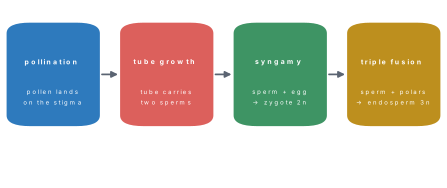
- Double fertilization (Nawaschin, 1898) — syngamy (n + n = 2n zygote) + triple fusion (n + n + n = 3n endosperm nucleus); entry by porogamy, chalazogamy (Casuarina), mesogamy (Cucurbita).
- Embryos — dicot (Capsella): basal cell → suspensor, apical → globular → heart → two cotyledons, plumule terminal; monocot: one cotyledon = scutellum, plumule in coleoptile, radicle in coleorhiza, epiblast.
- Endosperm (3n) — nuclear (coconut water), cellular (Datura), helobial; albuminous vs exalbuminous seeds; aleurone layer; perisperm (2n) from nucellus (black pepper).
14.1 Asexual reproduction
In vegetative propagation an ordinary organ — root, stem, leaf or bud — grows into a whole plant identical to the parent:
| Organ | Structure | Example |
|---|---|---|
| Underground stem | rhizome | ginger, turmeric |
| tuber | potato (the "eyes" are buds) | |
| bulb | onion, garlic | |
| corm | Colocasia, Crocus | |
| Sub-aerial stem | runner | Cynodon (dubo grass) |
| sucker | mint, chrysanthemum | |
| offset | water hyacinth Eichhornia | |
| Leaf | adventitious marginal buds | Bryophyllum pinnatum |
| Root | adventitious buds | sweet potato, Dahlia |
Growers copy the trick artificially: cutting (sugarcane, rose), layering (jasmine, litchi), grafting and budding (mango, citrus, apple in Mustang and Jumla) and micropropagation by tissue culture (Unit 15). Apomixis is asexual reproduction wearing the disguise of seed: an embryo forms without fertilization, so the seedling clones its mother. In nucellar polyembryony (citrus, mango) extra embryos sprout from the nucellus beside the sexual embryo. Breeders covet apomixis because it could fix hybrid vigour permanently — the hybrid would breed true from its own seed.
The trade-off is standard exam fare: asexual offspring are quick and exactly like the prized parent (and the only route for seedless kinds such as banana), but with no variation one new disease can take the whole plantation; sexual reproduction is slower and needs pollinators, but variation is the raw material of breeding and evolution.
Problem. A species' endosperm holds 24 chromosomes. State the chromosome numbers of (a) the embryo, (b) an antipodal cell, (c) the megaspore mother cell. Separately: how many meiotic divisions were needed to make 100 seeds' worth of female and male gametophytes? Solution. Endosperm is 3n = 24, so n = 8: (a) embryo 2n = 16; (b) antipodals are haploid, 8; (c) the megaspore mother cell is 2n = 16. For 100 seeds: each embryo sac costs one megaspore meiosis (three products wasted) → 100; each anther meiosis yields four pollen grains → 100 ÷ 4 = 25; total 125 meiotic divisions — the classic asymmetry the paper tests.
14.2 Sporogenesis and gametogenesis in angiosperms
The plant in the field is the diploid sporophyte; the pollen grain and the embryo sac are the reduced haploid gametophytes, kept inside it. Angiosperms are heterosporous: the anther (microsporangium) makes microspores, the ovule (megasporangium) makes megaspores.
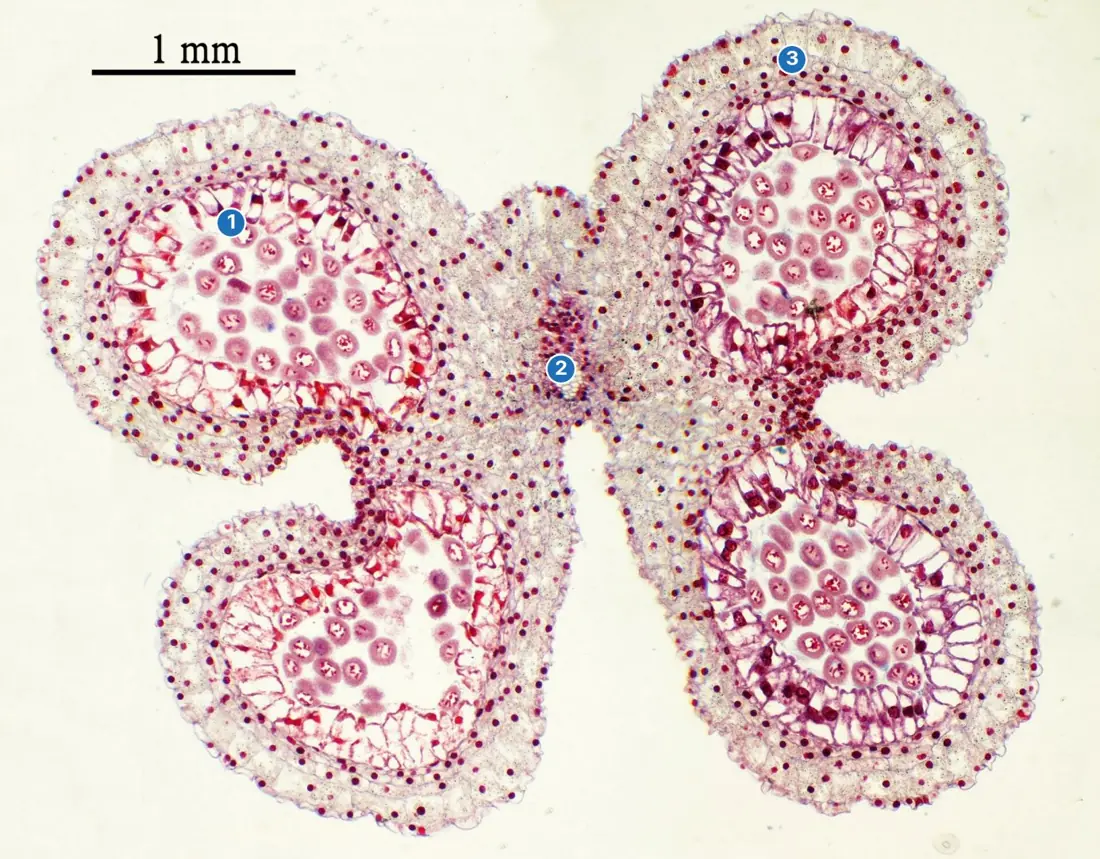
The male side — anther to pollen
An anther typically has two lobes, each with two pollen sacs. Its wall has four layers: epidermis, endothecium (whose fibrous thickenings spring the sac open at dehiscence), middle layers, and innermost the tapetum — dense, often multinucleate cells that nourish the developing spores and supply sporopollenin and wall proteins. If the tapetum fails, the pollen is sterile; protection is the outer layers' business, not the tapetum's.
Inside, each pollen (microspore) mother cell (2n) undergoes meiosis — microsporogenesis — to give a tetrad of four haploid microspores. Each matures into a pollen grain walled by the sculptured outer exine of near-indestructible sporopollenin (pollen survives in sediments for millennia, the basis of palynology) over a pectin– cellulose intine. Microgametogenesis: the microspore nucleus divides unequally into a large vegetative (tube) cell and a small generative cell; the generative cell later divides into the two male gametes. In about 60% of families pollen is shed at the 2-celled stage. The mature male gametophyte is thus only three cells.
The female side — ovule to embryo sac
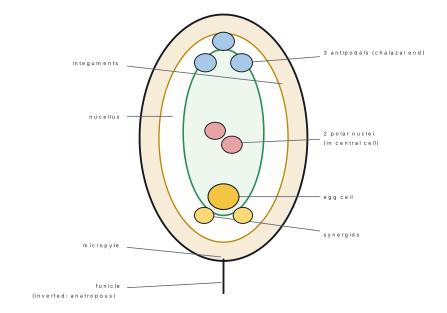
The ovule hangs in the ovary on its stalk, the funicle; its body of parenchyma, the nucellus, is wrapped in one or two integuments leaving a pore, the micropyle, at the tip; the base opposite the micropyle is the chalaza. In the commonest form, the anatropous ovule, the body is inverted so the micropyle faces the funicle (others: orthotropous in Polygonum, campylotropous in pea family).
An archesporial cell in the nucellus becomes the megaspore mother cell (2n), whose meiosis — megasporogenesis — gives a linear tetrad of four megaspores. Typically three (the micropylar ones) degenerate and one functional (chalazal) megaspore remains. Its nucleus divides by three successive mitoses — megagametogenesis — to eight nuclei, which wall off into the Polygonum-type embryo sac: 7 cells, 8 nuclei:
- At the micropylar end, the egg apparatus: the egg cell flanked by two synergids bearing the filiform apparatus that guides the pollen tube.
- In the middle, the large central cell with two polar nuclei (which may fuse into a diploid secondary nucleus before fertilization).
- At the chalazal end, three antipodal cells.
Everything belonging to the sporophyte — nucellus, integuments, both mother cells, later the seed coat and fruit wall — is 2n. Everything inside the pollen grain and embryo sac is n (the central cell carries two n nuclei, becoming 2n only if they fuse as the secondary nucleus). The zygote and embryo are 2n again; the endosperm is 3n. A perisperm (next section) is 2n — it is nucellus, not endosperm.
14.3 Pollination and fertilization
Pollination is the transfer of pollen from anther to stigma — the obligatory first step, since the non-motile male gametes can travel only inside a pollen tube. Within one flower it is autogamy (self-pollination); between flowers of the same plant geitonogamy (an agent is needed, but genetically it is still selfing); to another plant of the species, xenogamy (cross-pollination), the only kind bringing new genes. Selfing is guaranteed by homogamy (sexes mature together), bud pollination (pea, wheat) and cleistogamy — flowers that never open (Commelina, Viola, Oxalis), which set seed even without a single pollinator.
Cross-pollination needs an agent, and flowers advertise accordingly:
| Agent | Name | Syndrome | Examples |
|---|---|---|---|
| Wind | anemophily | dull, nectarless; torrents of light dry pollen; feathery stigma | maize, grasses, Pinus |
| Water | hydrophily | unwettable, often thread-like pollen | Vallisneria, Hydrilla, Zostera |
| Insects | entomophily | coloured, scented, nectar; sticky spiny pollen | mustard, Salvia, fig and its wasp |
| Birds | ornithophily | big red tubes, watery nectar, no scent | Bombax (simal), Butea |
| Bats | chiropterophily | large, dull, musky, opening at night | Kigelia, Adansonia |
Plants also evolve contrivances against selfing: dicliny (unisexual flowers — monoecious maize, dioecious papaya), dichogamy (protandry, anthers first: sunflower, Salvia; protogyny, stigma first: Plantago, Michelia), herkogamy (physical barriers, Calotropis), heterostyly (pin and thrum styles, Primula) and self-incompatibility, a genetic block on own-pollen tubes (tobacco, crucifers). Continuous selfing gives purity but inbreeding depression; crossing gives variation and hybrid vigour at the price of wasted pollen and dependence on agents.
Fertilization. On a receptive stigma the pollen hydrates and the intine grows out as the pollen tube, tube nucleus at the tip, the two male gametes behind, digesting through the style towards synergid signals. It enters the ovule usually by the micropyle (porogamy), sometimes through the chalaza (chalazogamy, Casuarina) or through integument/funicle (mesogamy, Cucurbita), discharges into one synergid, and the angiosperm signature follows (discovered by Nawaschin, 1898, in Lilium and Fritillaria):
Syngamy — one male gamete (n) + egg (n) → zygote (2n) → embryo. Triple fusion — the second male gamete (n) + two polar nuclei (n + n) → primary endosperm nucleus (3n) → endosperm.
The economy is the point: the nutritive endosperm is manufactured only when an embryo has actually been formed — no fertilisation, no wasted food (contrast the gymnosperms' endosperm-equivalent, the female gametophyte, made in advance regardless).
Problem. A fruit contains 100 seeds. Assuming every pollen grain and ovule was used, find (a) the minimum number of pollen grains needed, (b) the number of meiotic divisions in the anthers, (c) the number of meiotic divisions in the ovules, and (d) the total.
Solution. Each seed needs one embryo sac (one egg) and one pollen tube carrying two male gametes.
(a) One pollen grain per ovule: 100 pollen grains.
(b) Each pollen mother cell's meiosis gives four microspores, so 100 / 4 = 25 meiotic divisions in the anthers.
(c) Each megaspore mother cell's meiosis gives only one functional megaspore (three degenerate), so 100 ovules cost 100 meiotic divisions.
(d) Total 25 + 100 = 125 meiotic divisions — the female side is four times as expensive per seed as the male.
14.4 Monocot and dicot embryos; types and functions of endosperm
The zygote divides transversely into a basal cell (towards the micropyle) and an apical cell. In the model dicot Capsella bursa-pastoris the basal cell builds a filamentous suspensor that thrusts the embryo into the nutritive endosperm (and often absorbs food itself), while the apical cell builds the embryo proper: globular stage → heart-shaped stage as the two cotyledons bulge out → mature embryo with two lateral cotyledons, a terminal plumule between them, hypocotyl and radicle.
The monocot embryo bears a single terminal-looking cotyledon, the shield-shaped scutellum, pressed against the endosperm to absorb its contents; the plumule sits laterally inside its hollow sheath, the coleoptile (the spear that pierces the soil at germination), and the radicle is capped by the coleorhiza; a small flap opposite the scutellum, the epiblast, is often read as the vestige of the second cotyledon.
| Feature | Dicot embryo | Monocot embryo |
|---|---|---|
| Cotyledons | two, lateral | one — the scutellum |
| Plumule | terminal, exposed | lateral, inside coleoptile |
| Radicle | exposed | inside coleorhiza |
| Epiblast | absent | present (grasses) |
The primary endosperm nucleus (3n) meanwhile divides to feed the embryo, in one of three patterns:
- Nuclear endosperm — free nuclear divisions first (a multinucleate soup), walls formed later from the outside in, or never: the commonest type (cereals, Capsella). Coconut "water" is free-nuclear endosperm; the white kernel is its later cellular part.
- Cellular endosperm — a wall after every division from the start (Datura, Petunia).
- Helobial endosperm — intermediate: the first division walls off two unequal chambers, the larger then going free-nuclear (order Helobiales).
Seeds that keep the endosperm at maturity are endospermic (albuminous) — cereals (whose outermost endosperm layer is the protein-rich aleurone met in Unit 13), castor, coconut. In non-endospermic (exalbuminous) seeds — pea, bean, gram — the endosperm is consumed during development and the cotyledons become the store. Where the nucellus itself persists and stores food, it is a perisperm (black pepper, beet, cardamom) — diploid maternal tissue, not endosperm at all. The endosperm's functions: nourish the embryo in the seed and (in albuminous seeds) through germination, regulate embryo growth hormonally, and stand as the triploid arena in which so much of our food — wheat flour, rice, maize — actually resides.
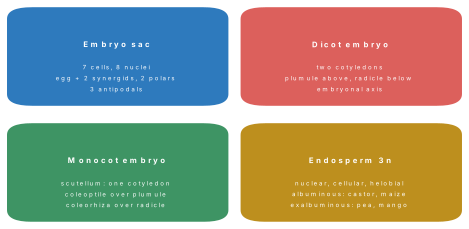
Four pairs the paper swaps: geitonogamy looks like cross-pollination but is genetically self (same plant's genotype); the coconut's liquid is nuclear endosperm, not cell sap; coleoptile sheathes the plumule, coleorhiza the radicle — both monocot-only; and endosperm is 3n while the embryo beside it is 2n, because triple fusion and syngamy used different partners in the same sac.
Problem. A tetraploid female plant (4n = 48) is pollinated by a diploid male plant (2n = 24). Find the chromosome number of the zygote and the primary endosperm nucleus (PEN).
Solution. The tetraploid female produces a diploid egg (2n = 24) and two diploid polar nuclei (2n + 2n = 4n = 48). The diploid male produces haploid male gametes (n = 12). Thus the zygote has 2n + n = 24 + 12 = \mathbf{36} chromosomes (3n), while the PEN has 4n + n = 48 + 12 = \mathbf{60} chromosomes (5n).
Formula and fact sheet
- Asexual gallery: rhizome ginger; tuber potato; bulb onion; corm Colocasia; runner Cynodon; sucker mint; offset Eichhornia; leaf buds Bryophyllum; apomixis = seed without fertilization (citrus nucellar embryos).
- Male: tapetum feeds, endothecium opens; 1 PMC (2n) → meiosis → 4 microspores; exine sporopollenin; tube cell + generative cell → 2 gametes.
- Female: 1 MMC (2n) → meiosis → 4 megaspores, 1 functional → 3 mitoses → 7 cells / 8 nuclei (Polygonum type); anatropous ovule commonest.
- Pollination words: autogamy/geitonogamy/xenogamy; agents anemo-, hydro-, entomo-, ornitho-, chiropterophily; protandry sunflower, protogyny Plantago; cleistogamy Viola.
- Double fertilization (Nawaschin 1898): syngamy n+n=2n embryo; triple fusion n+n+n=3n endosperm; entry porogamy (usual), chalazogamy Casuarina, mesogamy Cucurbita.
- Embryos: dicot — suspensor + 2 cotyledons + terminal plumule (Capsella); monocot — scutellum, coleoptile, coleorhiza, epiblast.
- Endosperm 3n: nuclear (coconut water), cellular (Datura), helobial; albuminous (cereals, castor) vs exalbuminous (pea, bean); perisperm 2n = nucellus (black pepper).
- Arithmetic: 1 seed = 1 ovule + 1 pollen grain; pollen meioses = seeds/4; ovule meioses = seeds; ploidy: sporophyte parts 2n, gametophyte parts n, embryo 2n, endosperm 3n.
Rapid-revision tables and high-yield facts
| Item | Value |
|---|---|
| Pollen wall | exine sporopollenin; intine cellulose |
| Microspore mother cell → pollen | meiosis, 4 per meiosis |
| Megaspores | 4 made, 1 functional |
| Embryo sac | 7 cells, 8 nuclei |
| Egg apparatus | egg + 2 synergids (filiform apparatus) |
| Double fertilisation | syngamy 2n + triple fusion 3n (Nawaschin) |
| Endosperm types | nuclear, cellular, helobial |
| Albuminous / exalbuminous | castor, maize, wheat / pea, bean, mango |
| Monocot sheaths | coleoptile (plumule), coleorhiza (radicle) |
| Meioses per 100 seeds | 100 mega + 25 micro = 125 |
| Apomixis | seed without fertilisation: clones |
| Perisperm | persistent nucellus (beet, pepper) |
Chapter summary
- Plants clone themselves by rhizomes, tubers, bulbs, runners, leaf buds and even apomictic seed — fast and faithful, but variation-free; growers exploit the same tricks by cutting, layering and grafting.
- The anther's tapetum feeds microspores produced four-at-a-time by PMC meiosis; each becomes a sporopollenin-armoured pollen grain carrying a tube cell and a generative cell (source of the two gametes).
- The ovule's single functional megaspore builds, by three mitoses, the 7-celled, 8-nucleate Polygonum embryo sac — egg apparatus, central cell with two polar nuclei, three antipodals.
- Pollination spans autogamy to xenogamy on wind, water, insects, birds and bats, with cleistogamy guaranteeing selfing and dicliny, dichogamy, herkogamy, heterostyly and self-incompatibility enforcing crossing.
- Double fertilization — syngamy making the 2n zygote, triple fusion the 3n endosperm — is unique to angiosperms and economical: food tissue is made only when an embryo exists.
- The dicot embryo (suspensor, two cotyledons, terminal plumule) contrasts with the monocot's scutellum, coleoptile and coleorhiza.
- Endosperm develops by nuclear, cellular or helobial patterns and may persist (albuminous seeds, with aleurone in cereals) or be absorbed into the cotyledons (exalbuminous); perisperm is persistent 2n nucellus, not endosperm.
Practice questions
Set A — Recall (20 questions)
- The "eyes" of a potato tuber, from which new plants grow, arearoot hairsbaxillary budsclenticelsdseeds
- Vegetative propagation by adventitious buds on leaf margins occurs inapotatobgingerconiondBryophyllum
- Apomixis is the formation of a seedaby two parentsbonly in watercwithout fertilizationdwithout a seed coat
- The innermost, nutritive layer of the anther wall is theaendotheciumbepidermisctapetumdmiddle layer
- The exine of a pollen grain is made of the highly resistant substanceasporopolleninbcutincsuberindlignin
- One pollen mother cell, after meiosis, producesatwo microsporesbfour microsporescone microsporedeight microspores
- The two male gametes of the pollen grain are produced by division of theatube cellbmicrospore wallctube nucleusdgenerative cell
- The commonest type of ovule in angiosperms isaorthotropousbcampylotropouscanatropousdcircinotropous
- The female gametophyte develops from the functional megaspore byameiosisbthree successive mitotic divisionscfusion of four sporesdamitosis
- A typical (Polygonum-type) mature embryo sac isa7-celled and 8-nucleateb8-celled and 7-nucleatec4-celled and 4-nucleated1-celled and 8-nucleate
- The filiform apparatus, which guides the pollen tube, is found in theaantipodal cellsbegg cellccentral celldsynergid cells
- Transfer of pollen between two flowers of the same plant is calledaxenogamybgeitonogamycautogamydcleistogamy
- A classic wind-pollinated (anemophilous) plant isamustardbSalviacmaizedfig
- Protandry, in which anthers mature before the stigma, is found inaPlantagobMicheliacsunflowerdpea
- Double fertilization in angiosperms was discovered byaNawaschinbStrasburgercMaheshwaridLeeuwenhoek
- Triple fusion results in the formation of theazygote (2n)bprimary endosperm nucleus (3n)cseed coat (2n)dsuspensor (2n)
- Entry of the pollen tube into the ovule through the chalaza (chalazogamy) occurs inalilybpeacCucurbitadCasuarina
- The single cotyledon of a monocot (grass) embryo is called theascutellumbcoleoptileccoleorhizadepiblast
- The liquid "water" inside a green coconut is actuallyastored rainwaterblatexcfree-nuclear (nuclear-type) endospermdnucellus sap
- Perisperm, the food store of black-pepper seed, is derived from theanucellusbendospermccotyledondintegument
Answers and explanations — Set A
1. (b) — Each eye is a bud in the axil of a scale leaf on the stem tuber.
2. (d) — Plantlets sprout from notches on the Bryophyllum leaf margin and drop off ready-rooted.
3. (c) — An apomictic embryo (e.g. from the nucellus) clones the mother although it arrives inside a seed.
4. (c) — The tapetum feeds the spores and donates sporopollenin; protection belongs to the outer wall layers.
5. (a) — Sporopollenin resists decay for millennia, preserving pollen in sediments.
6. (b) — Meiosis of one diploid PMC yields a tetrad of four haploid microspores.
7. (d) — The generative cell divides mitotically into the two male gametes; the tube cell makes the tube.
8. (c) — Inverted ovules (micropyle facing the funicle) occur in most angiosperms.
9. (b) — One nucleus → 2 → 4 → 8 nuclei, which then organise into seven cells.
10. (a) — Egg + 2 synergids + central cell (2 nuclei) + 3 antipodals: 7 cells, 8 nuclei.
11. (d) — Finger-like wall ingrowths at the synergid tips secrete the tube's guidance chemicals.
12. (b) — It requires a pollinating agent but is genetically self-pollination — a favourite distinction.
13. (c) — Maize pours light dry pollen from versatile anthers onto feathery silks.
14. (c) — Sunflower florets shed pollen before their stigmas become receptive; Plantago is the protogynous opposite.
15. (a) — S. G. Nawaschin, 1898, working on Lilium and Fritillaria.
16. (b) — Gamete (n) + two polar nuclei (n + n) make the triploid endosperm mother nucleus.
17. (d) — Chalazogamy in Casuarina; mesogamy is Cucurbita's route, porogamy almost everybody else's.
18. (a) — The shield-like scutellum absorbs endosperm for the embryo; coleoptile and coleorhiza are sheaths.
19. (c) — The syncytial liquid endosperm before walls form the solid white kernel.
20. (a) — Persistent nucellus (2n maternal tissue), distinct from the 3n endosperm.
Set B — Understanding (12 questions)
- Geitonogamy is genetically equivalent to self-pollination because both flowers belong to theasame speciesbsame genuscsame individual plant (genet)dsame family
- Cleistogamous flowers are advantageous mainly because theyaguarantee seed set even without pollinatorsbproduce more variationcattract insectsdneed less water
- Failure or premature degeneration of the tapetum results inamale sterility of the plantbbigger pollen grainscdouble fertilizationdseedlessness of fruit
- Self-incompatibility promotes cross-pollination byakilling the plant's own flowersbproducing no pollencopening flowers at nightdpreventing the plant's own pollen from fertilising its ovules
- The great economy of double fertilization is that the endosperm is formedabefore the embryobwithout any fusionconly when an embryo has been produced, avoiding wasted food tissuedfrom the seed coat
- The endosperm is triploid because it arises from the fusion ofathree polar nucleibegg and two gametescone male gamete with the two polar nucleidthree antipodal cells
- The suspensor of the dicot embryo functions mainly toaform the seed coatbpush the embryo into the nutritive endosperm and help absorb foodcbecome the radicledstore starch
- Exalbuminous seeds such as pea store their food in the cotyledons because the endospermawas never formedbis poisonouscbecomes the seed coatdis completely consumed during embryo development
- Apomixis is valuable in plant breeding because it canaincrease mutation ratebcreate new speciescremove the need for seedsdfix hybrid vigour so a hybrid breeds true from seed
- Wind-pollinated flowers produce enormous quantities of light, dry pollen becauseadelivery to a stigma is a matter of chance and most pollen is wastedbtheir flowers are largecinsects eat the restdpollen must sink in water
- Before fertilization the central cell is best described as containingaone diploid eggbtwo haploid polar nuclei (2 × n)cone triploid nucleusdthree antipodal nuclei
- The coleoptile protects the monocot seedling byastoring foodbsheathing the delicate plumule as it pushes through the soilcabsorbing waterdcarrying out photosynthesis
Answers and explanations — Set B
1. (c) — Pollinator or not, the genes come from one genotype; only xenogamy imports new ones.
2. (a) — Closed flowers self-pollinate in the bud: assured seed at the cost of variation.
3. (a) — Starved microspores abort — one basis of cytoplasmic and genic male sterility used in hybrid seed production.
4. (d) — A molecular identity check stops self tubes in the style, forcing outcrossing.
5. (c) — Triple fusion happens in the same event as syngamy, so provisioning tracks success exactly.
6. (c) — Three haploid genomes meet: two maternal (polar) and one paternal (gamete).
7. (b) — It is a living umbilical ram and, in many plants, an absorbing haustorium as well.
8. (d) — The embryo eats the endosperm as it grows and banks the reserves in its own cotyledons.
9. (d) — Clonal seed would let farmers replant hybrid seed without it segregating.
10. (a) — Anemophily is artillery, not marksmanship: numbers substitute for aim.
11. (b) — Two separate n nuclei (sometimes pre-fused into a 2n secondary nucleus) — not yet the 3n product.
12. (b) — The tough hollow cone takes the abrasion while the plumule rides inside.
Set C — Application (8 questions)
- The minimum number of pollen grains needed to produce 100 seeds (all grains used successfully) isa25b50c200d100
- The number of pollen mother cells that must undergo meiosis to produce 400 pollen grains isa100b400c200d1600
- A plant has 2n = 24 chromosomes. The chromosome number in its endosperm cells isa12b36c24d48
- Cells of the aleurone layer of a cereal grain areatriploid (3n)bhaploid (n)cdiploid (2n)dwithout nuclei
- In double fertilization, the total number of nuclei that actually take part in the two fusions isatwobthreecfivedeight
- To obtain 40 seeds, the minimum number of meiotic divisions required in the anthers isa40b10c20d160
- The egg apparatus of the embryo sac consists ofaegg and polar nucleibthree antipodalsccentral cell and eggdone egg cell and two synergids
- A leaf cell of a plant contains 18 chromosomes. An antipodal cell of its embryo sac containsa18b27c9d36
Answers and explanations — Set C
1. (d) — One pollen tube per ovule delivers the two gametes a single seed needs.
2. (a) — Each PMC meiosis makes four grains: 400 / 4 = 100.
3. (b) — Endosperm is 3n: 3 \times 12 = 36 chromosomes.
4. (a) — The aleurone is the outermost endosperm layer, hence triploid like the rest of it.
5. (c) — Egg + two polar nuclei from the sac, plus the two male gametes: five nuclei in two fusions.
6. (b) — 40 pollen grains suffice, at four grains per PMC meiosis: 40 / 4 = 10.
7. (d) — The micropylar trio: egg flanked by two synergids with their filiform apparatus.
8. (c) — Antipodals are gametophyte cells, haploid: 18 / 2 = 9 chromosomes.