Chapter 4 · Biodiversity · 2 questions in the paper · 29 min read
Bryophytes, Pteridophytes and Gymnosperms
What the syllabus asks for 3
- Liverworts, hornworts and mosses; structure and reproduction of Marchantia
- Pteridophytes; structure and reproduction of Dryopteris
- Gymnosperms; structure and reproduction of Pinus
This chapter of the Biodiversity unit carries about 2 of the 40 Botany questions. The paper tests the land plants without flowers as one story — from the bryophytes, where the haploid gametophyte is the plant you see, through the ferns, where both generations live on their own, to the gymnosperms, where the gametophytes shrink inside the sporophyte and the seed appears. Expect a comparison question (which group has vascular tissue, seeds, motile sperm, heterospory), a type-organism question on Marchantia, Dryopteris or Pinus, and often a ploidy question (n or 2n of a named structure).
- Which generation dominates — gametophyte in bryophytes; sporophyte in pteridophytes and gymnosperms; both independent only in pteridophytes.
- Three bryophyte classes — liverworts (Marchantia: thalloid, unicellular rhizoids, scales, elaters), hornworts (Anthoceros: horn-like capsule, one chloroplast per cell), mosses (Funaria: leafy, multicellular rhizoids, protonema, peristome).
- Marchantia — dioecious; gemma cups; barrel-shaped air pores; antheridiophore and archegoniophore; capsule with spores (n) and elaters (2n).
- Pteridophytes — first vascular plants; no seeds; homosporous (Dryopteris) or heterosporous (Selaginella).
- Dryopteris — rhizome with ramenta, circinate vernation, sori with reniform indusium, annulus and stomium, heart-shaped prothallus, multiflagellate sperm.
- Gymnosperms — naked ovules, no fruit, wind pollination, haploid endosperm, no double fertilisation, no vessels (except Gnetales).
- Pinus — long and dwarf shoots, needles in fascicles, monoecious cones, winged pollen, 2 ovules per ovuliferous scale, polyembryony, seed with 2n coat, n endosperm and 2n embryo.
4.1 Bryophytes: liverworts, hornworts and mosses; Marchantia
General characters
Bryophytes are small, non-vascular land plants of moist, shady places — the amphibians of the plant kingdom, because they live on land but need water for fertilisation. Their study is bryology.
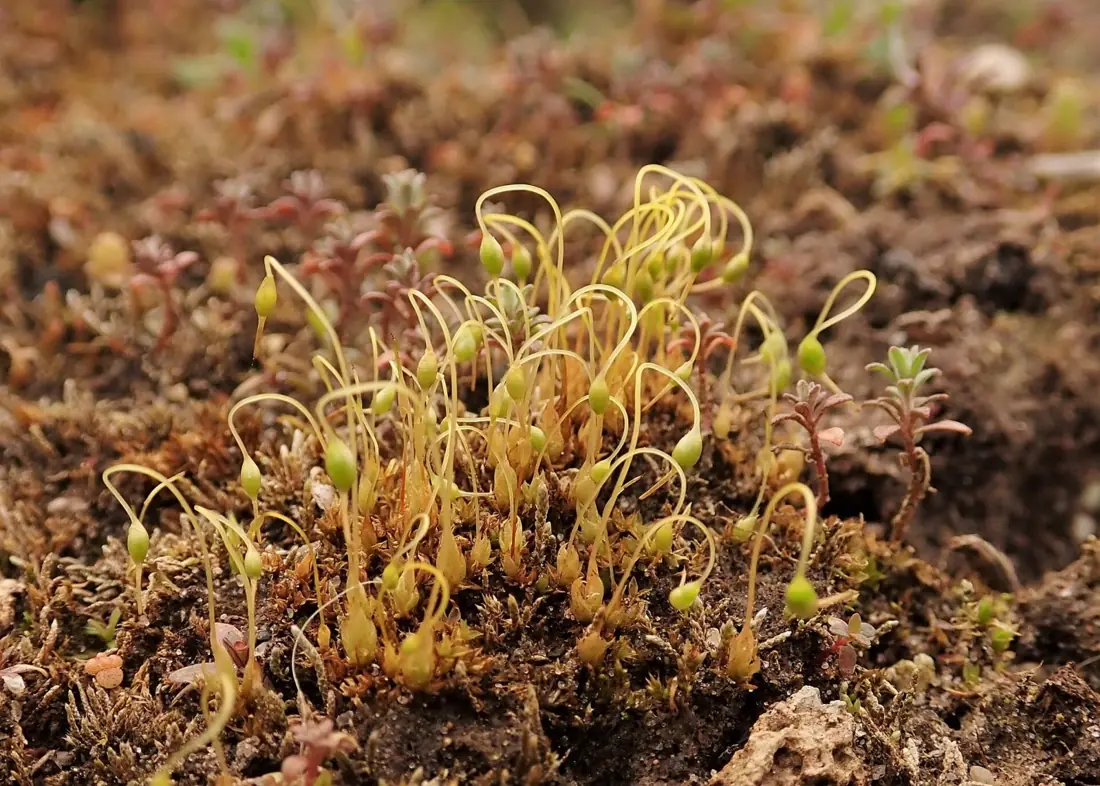
- The plant body is the gametophyte (n) — thalloid or leafy, attached by rhizoids; there are no true roots, stems, leaves, xylem or phloem.
- Sex organs are multicellular and jacketed: the antheridium makes biflagellate antherozoids; the flask-shaped archegonium (neck with neck canal cells, swollen venter with a venter canal cell and one egg) holds the egg.
- Antherozoids swim in a film of water to the archegonium.
- The zygote grows into a multicellular embryo — bryophytes are the first embryophytes — and then into the sporophyte (2n): foot, seta and capsule. It stays attached to and dependent on the gametophyte.
- Spore mother cells in the capsule undergo meiosis; the haploid spores grow into a new gametophyte, directly (liverworts) or through a filamentous protonema (mosses).
| Feature | Liverworts (Hepaticopsida) | Hornworts (Anthocerotopsida) | Mosses (Bryopsida) |
|---|---|---|---|
| Gametophyte | thalloid and dorsiventral (Marchantia, Riccia) or leafy (Porella) | thalloid, lobed | leafy, erect, radial ("stem" with spirally arranged "leaves") |
| Rhizoids | unicellular, smooth and tuberculate | unicellular, smooth | multicellular, branched, with oblique septa |
| Scales | present on the ventral surface | absent | absent |
| Chloroplasts | many per cell, no pyrenoid | usually one large chloroplast with a pyrenoid per cell | many per cell |
| Protonema | absent | absent | well developed |
| Sporophyte | simple: foot, short seta, capsule (Riccia: capsule only) | long, horn-like capsule growing from a basal (intercalary) meristem; has stomata and chlorophyll | foot, long seta, complex capsule with operculum and peristome teeth |
| Columella / elaters | no columella; elaters present | columella present; pseudo-elaters | columella present; no elaters |
| Examples | Marchantia, Riccia, Pellia, Porella | Anthoceros, Notothylas | Funaria, Polytrichum, Sphagnum (peat moss) |
Sphagnum forms peat, which is dried and burnt as fuel and used as packing material because it holds many times its weight of water; mosses and lichens together colonise bare rock in succession.
Marchantia — structure
Marchantia (M. polymorpha) is a liverwort of wet soil, rocks near streams and old walls, common in Nepal's hills in the monsoon.
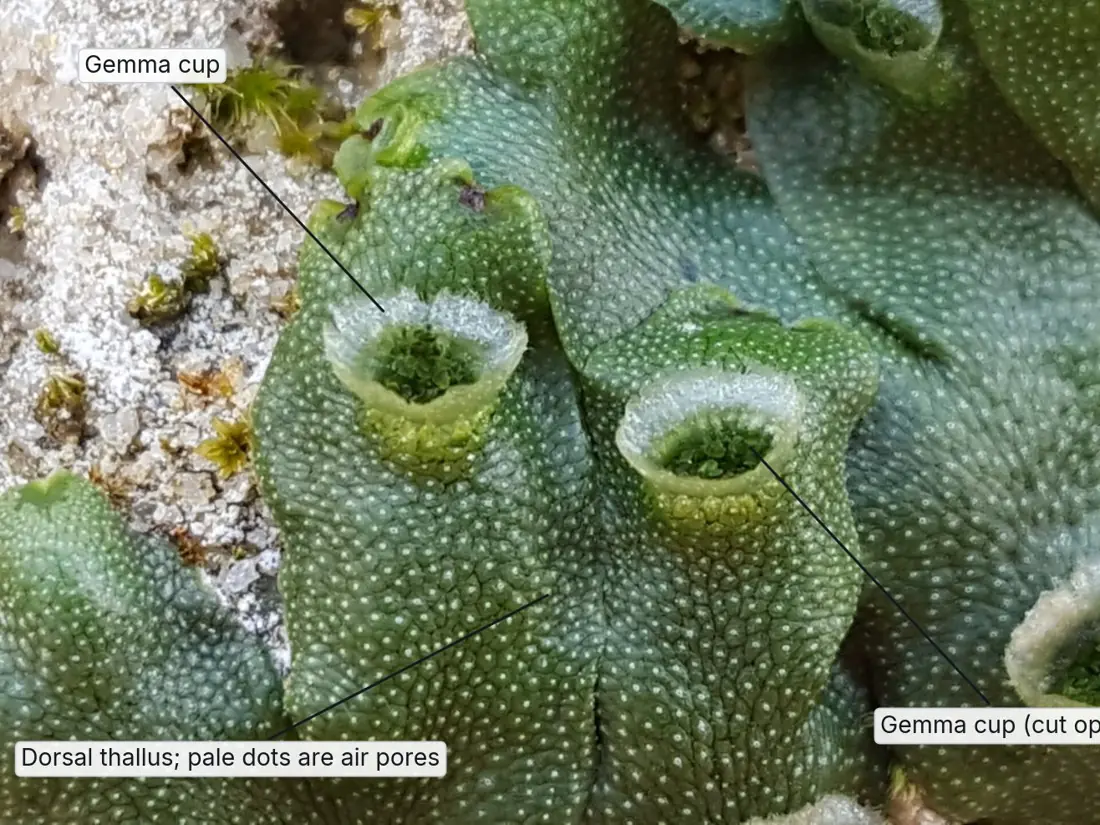
- Thallus: flat, green, dorsiventral, dichotomously branched, with a midrib and a notch (growing point) at each tip.
- Dorsal surface: divided into polygonal areolae, each with a central barrel-shaped air pore (a ring of 4–5 tiers of cells) that cannot close — it is not a stoma. Along the midrib sit cup-like gemma cups.
- Ventral surface: scales of two kinds (appendiculate and ligulate) and rhizoids of two kinds — smooth-walled and tuberculate (with peg-like inward thickenings).
- Internal structure (vertical section): upper epidermis with air pores; air chambers containing branched photosynthetic filaments; a colourless storage zone of parenchyma (starch, oil bodies, mucilage cells); lower epidermis bearing rhizoids and scales.
Marchantia — reproduction
Vegetative. (1) Gemmae: green, multicellular, biconvex discs with two notches, on a one-celled stalk inside the gemma cup; rain splashes them out and each grows into a new thallus identical to the parent. (2) Fragmentation: the older parts of the thallus die and the branches become separate plants. (3) Adventitious branches from the ventral surface.
Sexual. Marchantia polymorpha is dioecious (male and female thalli are separate; sex is fixed by sex chromosomes in the spores). - Male thallus: stalked antheridiophores whose top is a lobed (usually 8-lobed) disc; antheridia sit in flask-shaped cavities on its upper surface. Each antheridium has a one-layered jacket and produces many biflagellate antherozoids. - Female thallus: stalked archegoniophores whose top bears 8–9 finger-like rays. The archegonia hang neck downwards in rows on the underside, between the rays, protected by a fringed perichaetium. - Fertilisation: rain splashes the antherozoids to the female receptacle; they swim down the neck to the egg. The zygote (2n) is the first cell of the sporophyte.
Sporophyte. The embryo grows into a foot (anchored in the receptacle, absorbing food), a short seta and a capsule, enclosed by the calyptra (from the venter) and a pseudoperianth. In the capsule, the sporogenous tissue forms spore mother cells, which divide by meiosis into tetrads of haploid spores, and elater mother cells, which do not divide by meiosis but elongate into elaters — long cells with spiral thickenings, hygroscopic, which twist as they dry and scatter the spores. The capsule splits from the apex into 4–6 teeth. A spore germinates into a short germ tube and then a new thallus — half the spores give male thalli, half female.
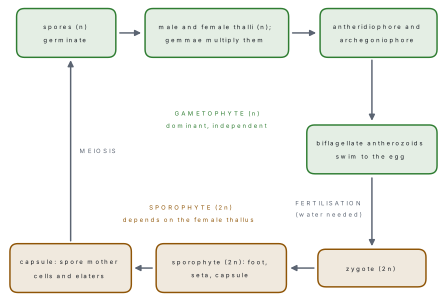
In the Marchantia capsule, spores are haploid (made by meiosis) but elaters are diploid (sporophyte cells that never undergo meiosis). Moss capsules have no elaters — they scatter spores with peristome teeth.
4.2 Pteridophytes; Dryopteris
General characters
Pteridophytes are the vascular cryptogams — the first land plants with xylem and phloem, but still without seeds or flowers.
- The plant you see is the sporophyte (2n), divided into true roots, stem (often an underground rhizome) and leaves — small microphylls (Selaginella, Equisetum) or large megaphylls (ferns).
- Xylem has tracheids (vessels only in a few, e.g. Selaginella); phloem has sieve cells and no companion cells.
- Sporangia are borne on leaves called sporophylls, which in some form compact cones (strobili: Selaginella, Equisetum).
- Most are homosporous — one kind of spore (Dryopteris, Pteris, Lycopodium, Equisetum). A few are heterosporous, with small microspores and large megaspores (Selaginella, Salvinia, Marsilea, Azolla). Heterospory, with the female gametophyte developing inside the megaspore, is the precursor of the seed habit.
- The spore grows into a small, green, free-living, thalloid gametophyte, the prothallus, which bears antheridia and archegonia. Water is needed for fertilisation. The zygote grows into an embryo and then the new sporophyte.
| Class | Example | Note |
|---|---|---|
| Psilopsida | Psilotum (whisk fern) | no true roots; a "living fossil" |
| Lycopsida | Selaginella (spike moss), Lycopodium (club moss) | microphylls; Selaginella is heterosporous and has a ligule |
| Sphenopsida | Equisetum (horsetail) | jointed, ribbed stem with silica; whorled scale leaves |
| Pteropsida | Dryopteris, Pteris, Adiantum (maidenhair fern), Marsilea, Azolla | large compound fronds in most; sori on the underside or inside sporocarps |
In Nepal the young fronds of Diplazium esculentum (niuro) are a popular vegetable, tree ferns (Cyathea) grow in moist hill forests, and Azolla (with Anabaena) is used as a biofertiliser in rice fields.
Dryopteris — structure
Dryopteris (wood fern, male shield fern; D. filix-mas) grows in moist, shady forests.
- Stem: a short, stout, underground rhizome, covered with persistent leaf bases and brown, chaffy, multicellular scales called ramenta; adventitious roots arise from it. Its vascular cylinder is a dictyostele (a ring of separate strands, the meristeles, each with xylem surrounded by phloem).
- Leaves (fronds): large, petiolate, pinnately compound (bipinnate), in a crown at the rhizome tip, with ramenta on the petiole. Young leaves are coiled like a watch spring — circinate vernation — and uncoil as they grow.
Dryopteris — reproduction
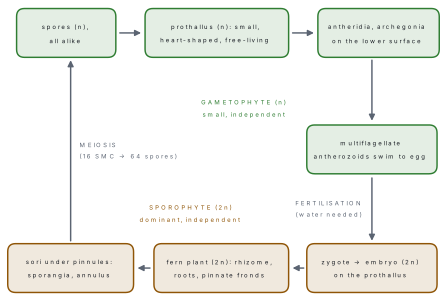
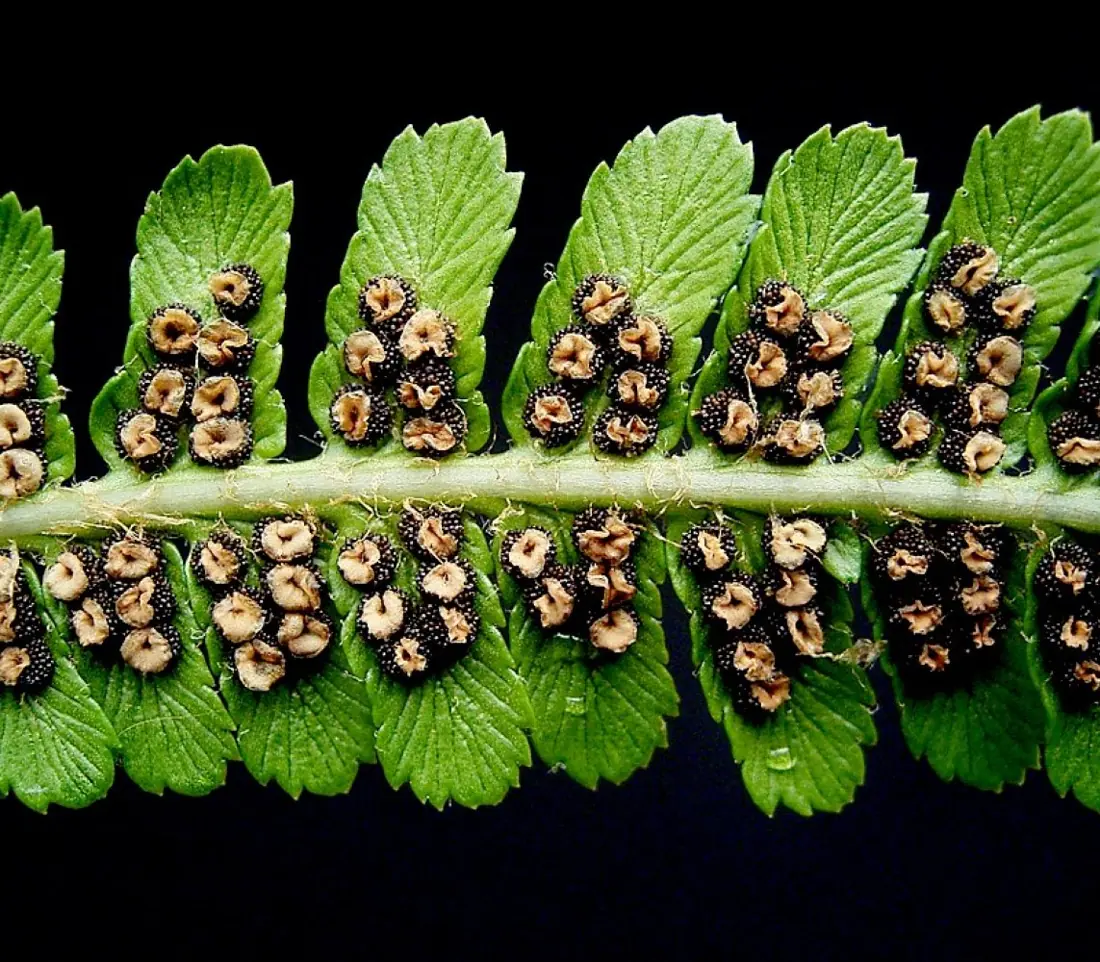
Sporophyte → spores. On the underside of fertile pinnules, along the veins, are rounded sori (singular sorus). Each sorus is a cluster of stalked sporangia on a cushion (the placenta), covered by a kidney-shaped (reniform) indusium. Each sporangium (a leptosporangium, developing from one surface cell) has a stalk and a biconvex capsule with a one-cell-thick wall. Running two-thirds round its edge is the annulus — a row of cells with thick inner and radial walls; the rest is the thin-walled stomium. Usually 16 spore mother cells undergo meiosis to give 64 haploid spores, all alike (homosporous).
Dehiscence. As the annulus dries, its cells lose water and pull the annulus straight; the wall tears at the stomium, then the annulus springs back and flings the spores out like a catapult.
Gametophyte (prothallus). A spore germinates into a small (a few mm), green, heart-shaped, dorsiventral prothallus, one cell thick except for a central cushion. It is free-living and photosynthetic, attached by rhizoids. On its ventral surface it bears antheridia (among the rhizoids, towards the base) and archegonia (on the cushion near the apical notch). It is monoecious but the antheridia mature first (protandry), which favours cross-fertilisation.
Fertilisation. Multiflagellate, spirally coiled antherozoids swim in dew or rain water, attracted chemically (by malic acid) to the archegonium neck, and one fuses with the egg. The zygote (2n) divides into an embryo with a foot, primary root, stem apex and first leaf; the young sporophyte at first depends on the prothallus, then becomes independent, and the prothallus dies.
Unusual cycles. Dryopteris also shows apogamy (a sporophyte grows from a prothallus cell without fertilisation) and apospory (a prothallus grows from a sporophyte cell without meiosis).
4.3 Gymnosperms; Pinus
General characters
Gymnosperms (Greek gymnos, naked; sperma, seed) are seed plants whose ovules are not enclosed in an ovary; they lie exposed on megasporophylls (cone scales), so the seeds are naked and no fruit is formed.
- Woody trees and shrubs (many evergreen conifers), with a tap root; Cycas has coralloid roots containing N₂-fixing cyanobacteria; Pinus roots carry mycorrhizal fungi.
- Xylem has tracheids but no vessels (vessels occur only in the Gnetales — Gnetum, Ephedra); phloem has albuminous cells instead of companion cells. The wood is "soft wood".
- Heterosporous: microsporophylls in male cones make microspores (pollen grains); megasporophylls bear ovules, usually in female cones.
- Pollination is by wind; pollen lands directly on the ovule's micropyle (caught in a pollination drop). A pollen tube carries the male gametes (siphonogamy), so water is no longer needed — though Cycas and Ginkgo still have motile, multiflagellate sperms.
- The female gametophyte (the endosperm) is haploid and forms before fertilisation; it bears archegonia. There is no double fertilisation.
- Polyembryony is common.
| Gymnosperm | Fact worth knowing |
|---|---|
| Cycas | dioecious; palm-like; coralloid roots; largest ovules and sperms among plants; no female cone (loose megasporophylls); sago from the pith |
| Pinus | monoecious; needles on dwarf shoots; resin, turpentine |
| Cedrus deodara (deodar) | durable timber |
| Abies, Picea | firs, spruces of high Himalaya |
| Taxus wallichiana (Himalayan yew, lauth salla) | taxol (paclitaxel) — anticancer drug |
| Ginkgo biloba | maidenhair tree; a "living fossil"; motile sperms |
| Ephedra | ephedrine for asthma and colds; vessels in xylem |
| Sequoia | redwoods — the tallest trees |
Pinus — structure
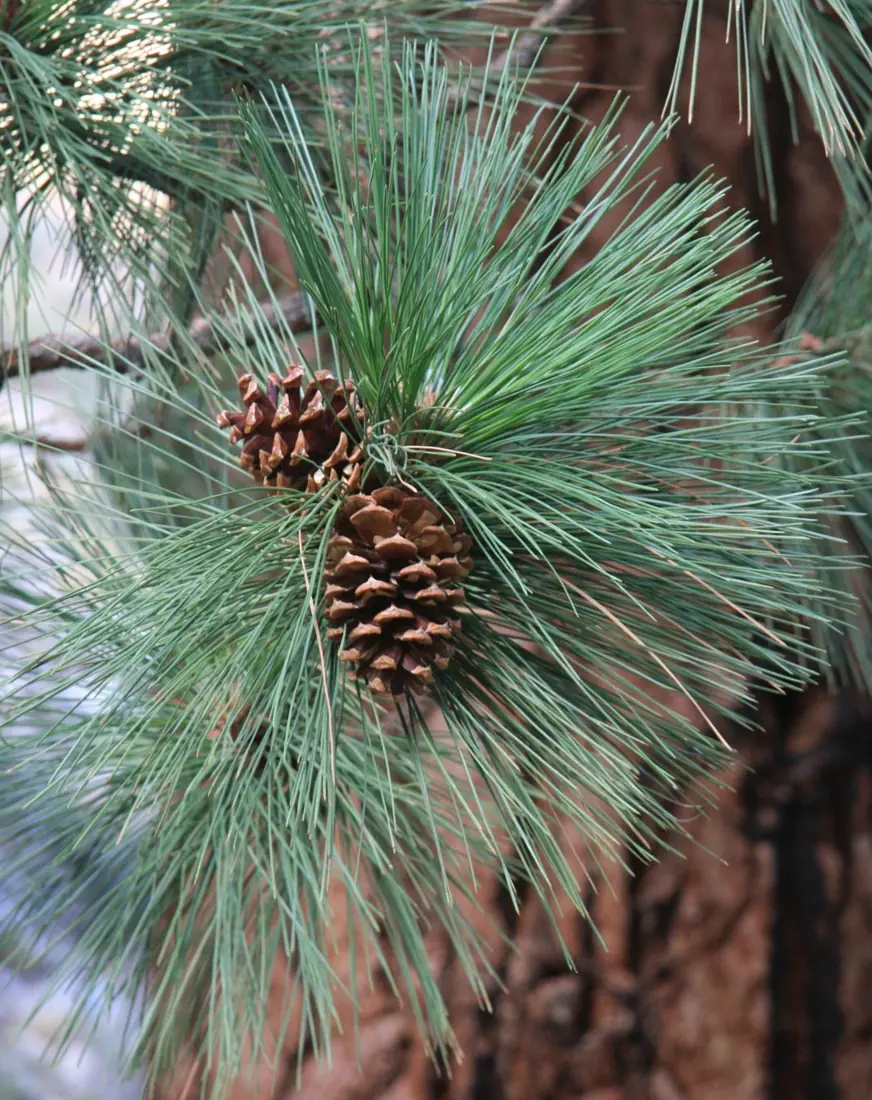
Pinus is a tall, evergreen, monoecious tree with a conical (excurrent) crown. Nepal has Pinus roxburghii (chir pine, khote salla; 3 needles per spur) in the lower hills and P. wallichiana (blue pine, gobre salla; 5 needles) higher up.
- Root: tap root without root hairs; the young roots carry ectomycorrhizae (fungi that absorb water and minerals for the tree).
- Stem: two kinds of branches — long shoots of unlimited growth, bearing only brown scale leaves, and dwarf shoots (spurs) of limited growth, each carrying a cluster (fascicle) of needles wrapped at the base by scale leaves. The dwarf shoot falls with its needles.
- Needle anatomy (xerophytic): thick cuticle, sunken stomata, sclerenchymatous hypodermis, mesophyll with peg-like infoldings, resin ducts, a clear endodermis, transfusion tissue and one or two vascular bundles.
- Number of needles per spur: 1 (P. monophylla), 2 (P. merkusii, P. sylvestris), 3 (P. roxburghii, P. gerardiana), 5 (P. wallichiana).
Pinus — reproduction
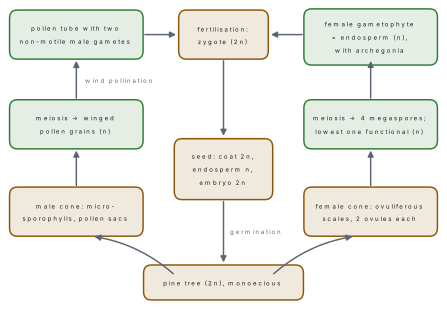
Male cone. Small cones in clusters at the base of the current year's long shoot. A central axis bears spirally arranged microsporophylls, each with two microsporangia (pollen sacs) on its lower surface. Microspore mother cells undergo meiosis to give microspores — the winged pollen grains (two air sacs). The pollen grain is shed at the four-celled stage: two (degenerating) prothallial cells, a generative cell and a tube cell.
Female cone. Larger cones, one to a few near the tip of a long shoot. The axis bears spirally arranged bract scales; in the axil of each is a woody ovuliferous scale carrying two ovules on its upper surface, micropyles facing the axis. Each ovule has one integument and a nucellus. The megaspore mother cell divides by meiosis into a linear tetrad; the lowest (chalazal) megaspore is functional and the other three degenerate. It grows into the female gametophyte (endosperm, n), which bears 2–5 archegonia at its micropylar end.
Pollination and fertilisation. Wind carries the pollen to the micropyle, where it is drawn in by a pollination drop. The generative cell divides into a stalk cell and a body cell; the body cell divides into two non-motile male gametes. The pollen tube grows slowly through the nucellus — fertilisation takes place about a year after pollination. One male gamete fuses with the egg; the other degenerates — there is no double fertilisation and no triple fusion.
Embryo and seed. The zygote forms a proembryo; several archegonia may be fertilised (simple polyembryony) and one proembryo may split into four (cleavage polyembryony), but usually only one embryo survives. The embryo has a radicle, a hypocotyl and many cotyledons (polycotyledonous). The mature seed is winged (the wing comes from the ovuliferous scale) and germinates epigeally.
- Seed coat — from the integument of the parent sporophyte: 2n
- Endosperm — the female gametophyte: n
- Embryo — the new sporophyte: 2n
Compare angiosperms, where the endosperm is triploid (3n) and forms only after double fertilisation.
The three groups compared
| Feature | Bryophytes | Pteridophytes | Gymnosperms |
|---|---|---|---|
| Dominant generation | gametophyte (n) | sporophyte (2n) | sporophyte (2n) |
| Is the other generation independent? | sporophyte dependent | gametophyte (prothallus) independent | gametophytes reduced, inside the sporophyte |
| Vascular tissue | absent | present (tracheids) | present (tracheids; vessels only in Gnetales) |
| True roots | absent (rhizoids) | present | present (tap root) |
| Spores | homosporous | mostly homosporous; some heterosporous | heterosporous |
| Male gamete | biflagellate, swims | multiflagellate in ferns (biflagellate in club mosses), swims | carried by a pollen tube (motile only in Cycas, Ginkgo) |
| Water for fertilisation | needed | needed | not needed |
| Archegonia | present | present | present (reduced) |
| Seeds | absent | absent | present, naked |
| Examples | Marchantia, Anthoceros, Funaria | Dryopteris, Selaginella, Equisetum | Cycas, Pinus, Ginkgo |
Ask "which generation is this structure part of?" Gametophyte → n (thallus of Marchantia, moss leaf, prothallus, pollen grain, Pinus endosperm, spores). Sporophyte → 2n (capsule wall, elaters, seta, fern frond, sporangium wall, pine needle, seed coat, embryo). Spores are the first cells of the gametophyte; the zygote is the first cell of the sporophyte.
Problem. In Dryopteris, a young coiled leaf (circinate vernation) has 2n = 82 chromosomes. Give the chromosome number in (a) a prothallus cell, (b) a neck-canal cell, (c) a spore mother cell, and (d) an indusium cell.
Solution. The leafy fern is the diploid sporophyte (2n = 82), so the spore mother cell and indusium cell are diploid (82). The prothallus is the haploid gametophyte (n = 41), and the archegonial neck-canal cell arises on it by mitosis, so both have 41 chromosomes.
Problem. A root-tip cell of Pinus roxburghii contains 2n = 24 chromosomes. How many chromosomes are present in (a) a cell of the female prothallus (endosperm), (b) a cell of the seed wing, and (c) a cotyledon cell of the embryo?
Solution. Gymnosperm endosperm is pre-fertilisation female gametophyte tissue, so it is haploid (n = \mathbf{12}). The seed wing develops from the ovuliferous scale of the parent sporophyte (2n = \mathbf{24}), and the cotyledon belongs to the new sporophyte embryo (2n = \mathbf{24}).
Problem. Capsule A lacks a columella and disperses spores using diploid-origin nurse cells that become hygroscopic elaters with spiral thickenings; Capsule B has a central sterile columella, a peristome of 32 teeth, and no elaters. Identify A and B.
Solution. Hygroscopic elaters without a columella characterise the liverwort Marchantia (A); a central columella and a two-ringed 32-tooth peristome characterise the moss Funaria (B).
Formula and fact sheet
| Item | Fact |
|---|---|
| Amphibians of the plant kingdom | bryophytes — land plants needing water for fertilisation |
| Bryophyte rhizoids | unicellular in liverworts and hornworts; multicellular, branched, oblique septa in mosses |
| Hornworts | one large chloroplast with pyrenoid per cell; horn-like capsule with basal meristem; columella; stomata on capsule |
| Moss capsule | operculum, peristome teeth, columella, apophysis with stomata; protonema stage |
| Marchantia thallus | dorsiventral, dichotomous; barrel-shaped air pores (non-closing); air chambers with photosynthetic filaments; scales; smooth + tuberculate rhizoids |
| Marchantia reproduction | gemmae in gemma cups; dioecious; antheridiophore (8-lobed disc), archegoniophore (8–9 rays, archegonia hanging below) |
| Marchantia sporophyte | foot, seta, capsule; spores (n) + elaters (2n, spiral bands); capsule splits by 4–6 teeth |
| Pteridophytes | first vascular plants; no seeds; prothallus free-living; water needed |
| Heterosporous pteridophytes | Selaginella, Salvinia, Marsilea, Azolla |
| Dryopteris sporophyte | rhizome with ramenta; adventitious roots; bipinnate fronds; circinate vernation; dictyostele |
| Dryopteris sorus | underside of pinnule; reniform indusium; leptosporangia with annulus and stomium; 16 SMC → 64 spores |
| Prothallus | heart-shaped, n, free-living; antheridia among rhizoids, archegonia near notch (ventral); protandrous |
| Fern sperm | multiflagellate (biflagellate in Lycopodium, Selaginella); attracted by malic acid |
| Gymnosperm features | naked ovules, no fruit, wind pollination, haploid endosperm before fertilisation, no double fertilisation, no vessels, albuminous cells |
| Pinus shoots | long shoots (scale leaves) and dwarf shoots (needles in fascicles) |
| Needles per spur | P. roxburghii 3, P. wallichiana 5, P. merkusii 2, P. monophylla 1 |
| Pinus cones | monoecious; male cone — microsporophylls with 2 pollen sacs; female cone — bract scale + ovuliferous scale with 2 ovules |
| Pollen grain | winged; shed 4-celled (2 prothallial, generative, tube) |
| Megaspore | linear tetrad; chalazal one functional |
| Pinus seed | coat 2n, endosperm n, embryo 2n; many cotyledons; winged; epigeal germination |
| Gymnosperm drugs | taxol (Taxus), ephedrine (Ephedra); turpentine and resin (Pinus) |
Chapter summary
- Bryophytes are non-vascular embryophytes with a dominant haploid gametophyte and a dependent diploid sporophyte; water is needed for their biflagellate sperm.
- Liverworts (thalloid, unicellular rhizoids, scales, elaters), hornworts (horn-like capsule, one chloroplast per cell) and mosses (leafy, multicellular rhizoids, protonema, peristome) are the three classes.
- Marchantia is a dioecious, dichotomous thallus with barrel-shaped air pores and gemma cups; it bears stalked antheridiophores and archegoniophores; its capsule holds haploid spores and diploid elaters.
- Pteridophytes are the first vascular plants; their dominant sporophyte has roots, stems and leaves; most are homosporous, but Selaginella, Marsilea, Salvinia and Azolla are heterosporous.
- Dryopteris has a rhizome with ramenta, circinate fronds, and sori with a reniform indusium; its sporangium opens by the annulus; the spore grows into a free-living, heart-shaped, protandrous prothallus; sperm are multiflagellate.
- Gymnosperms bear naked ovules, are wind-pollinated, have a haploid endosperm formed before fertilisation and no double fertilisation, and lack vessels and fruits.
- Pinus is monoecious with long and dwarf shoots, needles in fascicles, winged pollen, and two ovules on each ovuliferous scale; fertilisation follows pollination by about a year; polyembryony is common.
- A Pinus seed holds three generations: seed coat 2n, endosperm n, embryo 2n.
Practice questions
Set A — Recall (20 questions)
- Bryophytes are called the amphibians of the plant kingdom because theyalive only in waterbhave both vascular and non-vascular tissuecproduce both seeds and sporesdlive on land but need water for fertilisation
- The dominant, independent generation in bryophytes is theasporophytebgametophytecembryodcapsule
- The rhizoids of mosses areaunicellular and smoothbunicellular and tuberculatecmulticellular and branched, with oblique septadabsent
- Elaters in the capsule of Marchantia help inadispersal of sporesbphotosynthesiscabsorption of waterdfertilisation
- The gemma cups of Marchantia are found on theaventral surface of the thallusbdorsal surface, along the midribcarchegoniophoredcapsule wall
- The flask-shaped female sex organ of bryophytes and pteridophytes is theaarchegoniumbantheridiumcoogoniumdcarpogonium
- The air pores on the dorsal surface of the Marchantia thallus areastomata whose guard cells close at nightblenticelschydathodesdbarrel-shaped pores that cannot close
- Pteridophytes are the first plants in evolution to haveaseedsbflowerscxylem and phloemdarchegonia
- In Dryopteris the young leaves are coiled like a watch spring. This is calledacircinate vernationbreticulate venationcphyllotaxydheterophylly
- Each sorus of Dryopteris is covered by a kidney-shapedaannulusbstomiumcramentumdindusium
- The gametophyte of Dryopteris isaa leafy shootba small heart-shaped prothallusca filamentous protonemaddependent on the sporophyte
- The male gametes (antherozoids) of ferns areanon-motilebbiflagellatecmultiflagellatedamoeboid
- Which of these pteridophytes is heterosporous?aDryopterisbEquisetumcLycopodiumdSelaginella
- Gymnosperm seeds are called naked becauseathe ovules are not enclosed in an ovarybthey have no seed coatcthey have no endospermdthey have no embryo
- The needles of Pinus are borne onalong shoots onlybthe rootscdwarf shoots (spurs)dthe male cones
- Each ovuliferous scale of Pinus bearsaone ovulebtwo ovulescfour ovulesdmany ovules
- The endosperm of Pinus isahaploid, formed before fertilisationbtriploid, formed after double fertilisationcdiploid, formed from the nucellusdabsent
- Pollination in Pinus is brought about byainsectsbwatercbirdsdwind
- The roots of Pinus are associated withaRhizobium in root nodulesbcyanobacteria in coralloid rootscectomycorrhizal fungidFrankia in root nodules
- The anticancer drug taxol is obtained fromaPinus roxburghiibTaxus wallichianacCycas revolutadEphedra gerardiana
Answers and explanations — Set A
1. (d) — They live on land but their sperm must swim to the egg in water, as an amphibian must return to water to breed. They have no vascular tissue and no seeds.
2. (b) — The green thallus or leafy shoot is the haploid gametophyte; the sporophyte grows on it and depends on it.
3. (c) — Moss rhizoids are multicellular with oblique cross walls. Liverworts have unicellular smooth and tuberculate rhizoids.
4. (a) — Elaters have hygroscopic spiral thickenings; they twist as they dry and throw out the spores.
5. (b) — Gemma cups sit on the upper (dorsal) surface along the midrib; scales and rhizoids are ventral.
6. (a) — The archegonium (neck + venter with egg) is the female organ of bryophytes, pteridophytes and gymnosperms. Oogonia belong to algae and fungi; the carpogonium to red algae.
7. (d) — The air pore is a ring of cells forming a barrel; it has no guard cells and cannot close, unlike a stoma.
8. (c) — Pteridophytes are the first vascular plants. Seeds came with gymnosperms; archegonia already exist in bryophytes.
9. (a) — Circinate vernation protects the tender tip of the fern leaf. Reticulate venation is a vein pattern, not a bud arrangement.
10. (d) — The reniform indusium is a flap of leaf tissue over the sorus. The annulus and stomium are parts of each sporangium; ramenta are scales on the rhizome.
11. (b) — The fern gametophyte is a small, green, heart-shaped prothallus that lives on its own. A protonema belongs to mosses.
12. (c) — Fern sperm are spirally coiled and multiflagellate; bryophyte sperm are biflagellate.
13. (d) — Selaginella forms microspores and megaspores. Dryopteris, Equisetum and Lycopodium are homosporous.
14. (a) — "Gymnosperm" means naked seed: the ovule sits exposed on a scale, with no ovary around it. The seed does have a coat, endosperm and embryo.
15. (c) — Needles are borne in fascicles on dwarf shoots; long shoots carry only scale leaves.
16. (b) — Two ovules lie on the upper surface of each ovuliferous scale, with micropyles towards the cone axis.
17. (a) — The endosperm of gymnosperms is the female gametophyte itself, haploid and formed before fertilisation. Triploid endosperm after double fertilisation is the angiosperm pattern.
18. (d) — Pinus is wind-pollinated; its pollen has two air sacs (wings) that keep it afloat.
19. (c) — Pine roots carry ectomycorrhizae, which help absorb water and phosphate. Coralloid roots with cyanobacteria belong to Cycas.
20. (b) — Taxol (paclitaxel) comes from yew (Taxus); Nepal's Himalayan yew is Taxus wallichiana. Ephedra gives ephedrine.
Set B — Understanding (12 questions)
- Bryophytes need water for sexual reproduction becauseatheir antherozoids must swim to the archegoniumbtheir spores germinate only under waterctheir pollen tubes grow only in waterdtheir eggs are released into water
- The sporophyte of Marchantia is said to be dependent because itahas no cells of its ownbis haploidcstays attached to the gametophyte by its foot and draws food from itdlives as a parasite on another plant
- In Marchantia the elaters are diploid but the spores are haploid, becauseaelaters form by fertilisationbspores form by mitosiscelaters come from the gametophytedonly spore mother cells undergo meiosis
- In Marchantia, a gemma gives rise toaa sporophyteba new thallus identical to the parentca protonema that bears budsdmale gametes
- Hornworts such as Anthoceros differ from liverworts and mosses in havingamulticellular rhizoidsba leafy gametophyteca long horn-like capsule that grows from a basal meristemdno sporophyte at all
- In ferns both generations are independent at maturity. This means thatathe prothallus and the fern plant each make their own foodbthe sporophyte is a parasite on the prothalluscthe gametophyte is a parasite on the sporophytedneither generation has chlorophyll
- The annulus of a Dryopteris sporangium helps toaattach the sporangium to the leafbburst the sporangium and throw out the sporescprotect the young sorusdform the indusium
- Heterospory in Selaginella is regarded as a step towards the seed habit becauseaall its spores are alikebits spores form without meiosiscits gametophyte is large and free-livingdthe female gametophyte develops inside the megaspore wall
- In a Pinus seed, the seed coat, endosperm and embryo are respectivelya2n, n, 2nb2n, 3n, 2ncn, n, 2nd2n, 2n, n
- Pinus needles survive cold, dry winters mainly because they haveabroad, thin bladesbstomata raised above the surfacecno cuticleda thick cuticle, sunken stomata and a sclerenchymatous hypodermis
- Polyembryony is common in Pinus becauseamany ovules fuse togetherbeach pollen grain carries several eggscseveral archegonia may be fertilised and a proembryo may splitdthe endosperm forms embryos
- Unlike Pinus, Cycas hasawinged pollenbmotile, multiflagellate male gametescneedles on dwarf shootsda female cone of ovuliferous scales
Answers and explanations — Set B
1. (a) — The biflagellate sperm can reach the egg only by swimming in a film of water. Bryophytes have no pollen tubes.
2. (c) — The foot is buried in the female receptacle and absorbs food and water from it. The sporophyte is diploid and has its own cells.
3. (d) — Spore mother cells undergo meiosis (→ n spores); elater cells simply elongate and stay 2n. Both arise in the sporophyte.
4. (b) — A gemma is a vegetative bud made by mitosis, so it grows into a thallus genetically identical to its parent. Protonema is a moss stage.
5. (c) — The hornwort capsule keeps growing from a basal meristem and has stomata and a columella; its cells usually have one chloroplast with a pyrenoid. Hornwort rhizoids are unicellular.
6. (a) — The green prothallus photosynthesises and lives free; the fern plant has roots and leaves — neither depends on the other once the young sporophyte is established.
7. (b) — Drying annulus cells straighten the annulus, tear the stomium and then snap back, catapulting the spores. The indusium, not the annulus, protects the sorus.
8. (d) — In Selaginella the female gametophyte grows inside the megaspore (endosporic), and megaspores may stay in the sporangium — a stage on the way to an ovule. Homospory, option (a), is the opposite.
9. (a) — Coat from the parent's integument (2n), endosperm = female gametophyte (n), embryo = new sporophyte (2n). Option (b) is the angiosperm pattern.
10. (d) — These xerophytic features cut water loss when the soil water is frozen. Broad leaves and raised stomata would lose more water.
11. (c) — Several archegonia can each be fertilised (simple polyembryony) and the proembryo can split into four (cleavage polyembryony). An ovule contains no pollen-borne eggs.
12. (b) — Cycas (with Ginkgo) keeps large, motile, multiflagellate sperms delivered by the pollen tube. Cycas pollen has no wings, it has no dwarf-shoot needles, and its female plant bears loose megasporophylls, not a cone.
Set C — Application (8 questions)
- A Marchantia capsule contains 64 spore mother cells. How many haploid spores can it produce?a64b128c256d32
- The leaf cells of a moss have 10 chromosomes. The chromosome numbers in its capsule wall and in its spores area20 and 10b10 and 20c20 and 20d10 and 5
- A Pinus species has 2n = 24. The chromosome numbers in its endosperm, embryo and pollen grain area36, 24, 12b24, 24, 12c12, 12, 12d12, 24, 12
- A plant from a damp forest at Godavari has a rhizome covered with brown scales, pinnate fronds whose young tips are coiled, and kidney-shaped covers under the leaflets. It isaMarchantiabDryopteriscSelaginelladEquisetum
- A pine in Manang carries its needles in clusters of five on dwarf shoots. It is most likelyaPinus roxburghiibPinus wallichianacPinus merkusiidPinus gerardiana
- A flat green thallus has rhizoids and scales below and cups of gemmae above, and umbrella-like stalked receptacles grow from its tips. It isaFunariabAnthoceroscRicciadMarchantia
- The leaf cells of a fern have 2n = 80 chromosomes. A cell of its prothallus hasa40b80c120d160
- A seed plant has many cotyledons, a haploid endosperm formed before fertilisation, and no fruit. It isamaizebpeacPinusdCycas
Answers and explanations — Set C
1. (c) — Each spore mother cell gives a tetrad of four spores by meiosis: 64 × 4 = 256.
2. (a) — Moss leaves are gametophyte (n = 10); the capsule wall is sporophyte (2n = 20); spores are made by meiosis (n = 10).
3. (d) — Endosperm = female gametophyte (n = 12), embryo = sporophyte (2n = 24), pollen = male gametophyte (n = 12). Option (a) wrongly uses the triploid endosperm of angiosperms.
4. (b) — Ramenta on a rhizome, circinate vernation and sori with reniform indusia identify Dryopteris.
5. (b) — The blue pine (P. wallichiana) of the higher hills has five needles per spur; chir pine (P. roxburghii) has three, P. merkusii two.
6. (d) — Gemma cups and stalked antheridiophores and archegoniophores are diagnostic of Marchantia. Riccia has no gemma cups or stalked receptacles; Funaria is a leafy moss.
7. (a) — The prothallus grows from a spore made by meiosis, so it is haploid: n = 40.
8. (c) — Many cotyledons, haploid endosperm and naked seeds mark Pinus. Cycas is also a gymnosperm but has two cotyledons; maize and pea have triploid endosperm and fruits.